Disclosure: As an Amazon Associate, UMT Smart Tool earns from qualifying purchases. This guide is built from product listings and maker specifications, not from our own hands-on testing. Prices are approximate and can change, so check the current price before you buy. Last updated: November 10, 2026.
“Affordable” means something different in air purifiers than in most appliances, because the purchase price is only part of the cost. A cheap unit with an undersized fan will not clean a large room no matter how long it runs, and a bargain machine with expensive, short-lived filters can cost more over three years than a mid-priced one. This guide is organized by room and job: a proven all-rounder for bedrooms, a slim tower for tight budgets, a desktop unit for small spaces, a quiet model for light sleepers, a certified allergy workhorse for medium rooms, and a high-output pick for larger spaces that still stays in the value tier.
In this guide
Quick Picks
The short version: six affordable purifiers we would look at first, one per use case.
| Pick | Type | Best for |
|---|---|---|
| LEVOIT Core 300 | Compact cylinder, True HEPA | Best overall for bedrooms and home offices |
| GermGuardian AC4825E | 22-inch tower with UV-C | Best budget tower for small rooms |
| LEVOIT Core Mini | Desktop mini purifier | Desks, dorms and very small spaces |
| Blueair Blue Pure 411 | HEPASilent small-room purifier | Quiet bedroom and nursery use |
| Honeywell HPA200 | True HEPA console | Allergies in medium rooms up to about 310 sq ft |
| Medify MA-40 | High-output tower, H13 HEPA | Larger rooms and open spaces on a budget |
Our Picks
1. LEVOIT Core 300 — Best Overall
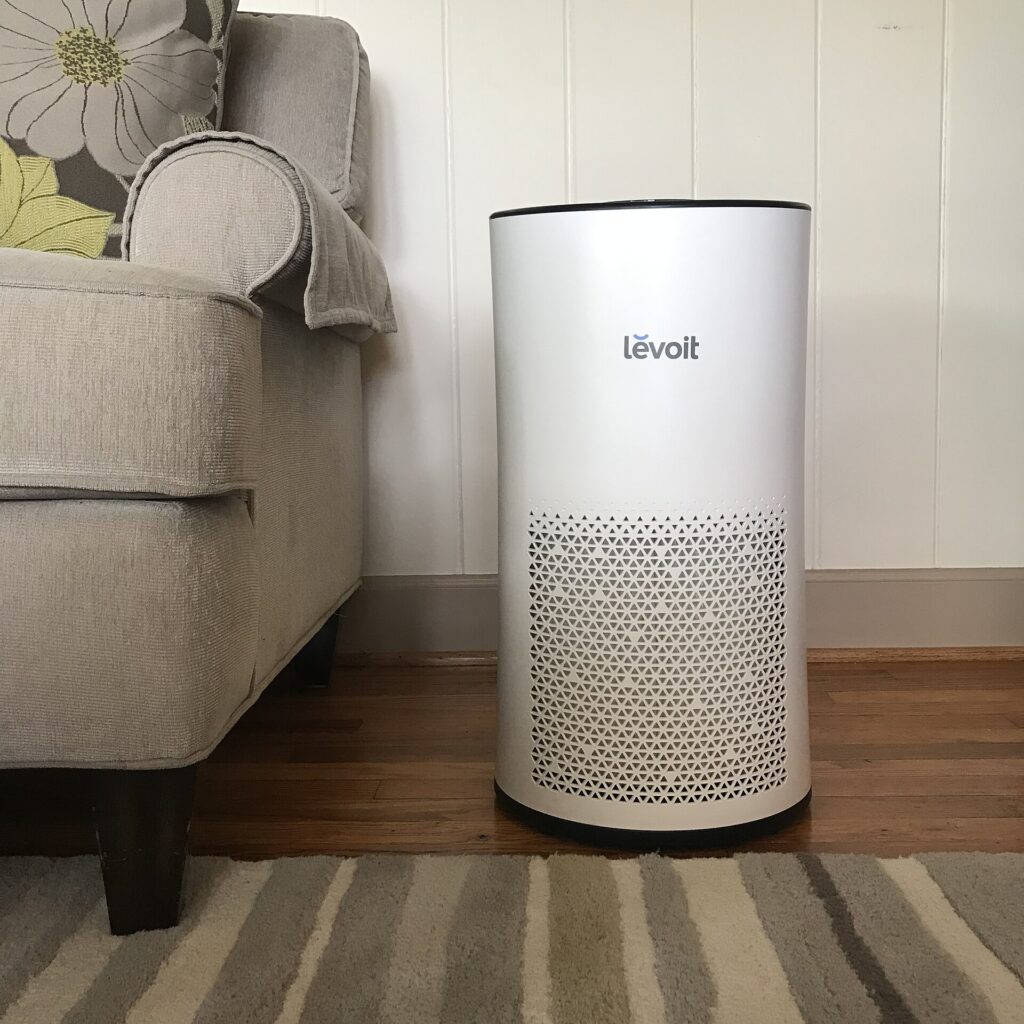
The Core 300 is the affordable purifier we recommend first because its performance is independently verified rather than just claimed. It carries the AHAM Verifide seal with a CADR of 141 CFM, which works out to an AHAM-suggested room size of about 219 square feet at the recommended air-change rate — a typical bedroom or home office. Its 3-in-1 filter combines a pre-filter, an H13 True HEPA layer and an activated carbon layer, so it handles dust, pollen and pet dander while taking the edge off everyday odors. Levoit rates coverage up to 1,073 square feet at one air change per hour, and the unit is Energy Star certified.
The trade-offs are modest. There is no air-quality sensor and no auto mode, so you pick a fan speed and leave it; the sleep mode, rated as low as 24 dB, is the setting most people will live on overnight. Replacement Core 300-RF filters are widely stocked and rated for roughly six to eight months, which keeps running costs predictable. Choose the white version linked here — the black finish is a separate listing. For a first purifier in a bedroom-sized room, this is the safest affordable bet.
2. GermGuardian AC4825E — Best Budget Tower
The AC4825E has been a budget staple for years because its tall, slim tower shape — about 22 inches high with a footprint under 11 inches wide — fits corners and narrow gaps that round purifiers cannot. It is a 4-in-1 design: a HEPA filter that Guardian Technologies rates to capture 99.97% of airborne particles, a charcoal pre-filter for odors, and an optional UV-C light intended to reduce germs carried through the unit. Guardian rates it for small rooms of around 150 square feet at the recommended air-change rate, and backs it with a three-year limited warranty, which is generous at this tier.
The compromises are running costs and noise. The UV-C bulb is a consumable on top of the FLT4825 filter, which the maker says to replace every six to eight months, so budget for both. Higher fan speeds are audible, and the UV-C feature can be switched off if you prefer filtration only. The unit is CARB compliant and ETL listed. If you want a recognized brand, a tower format and a low entry price for a bedroom, dorm or small office — and you accept the extra bulb — the AC4825E remains hard to beat.
3. LEVOIT Core Mini — Best for Desks and Small Spaces
The Core Mini shrinks the purifier down to desk size: roughly 6.5 by 6.5 by 10.4 inches, about 2.2 pounds, and just 7 watts of power draw. Levoit says it can clean up to 255 square feet once per hour, and it carries AHAM verification for small spaces, which makes it a sensible personal-zone purifier for a desk, nightstand, dorm room or nursery corner rather than a whole-room solution. Its 3-in-1 filter pairs a pre-filter and HEPA layer with activated carbon, and a built-in fragrance sponge lets you add a drop of essential oil — a small touch that matters in a stuffy office.
Keep expectations matched to size. Airflow is limited by the small fan, so in a full-size bedroom it will only ever be a supplement to a larger unit, and the display light can be switched off for sleeping. Noise starts at a maker-rated 25 dB on the lowest setting, quiet enough for a bedside table. The white version is linked here; the black finish is sold under a different listing. For one person, one small space and the lowest running costs on this list, the Core Mini is the right tool.
4. Blueair Blue Pure 411 — Best Quiet Pick for Bedrooms
The Blue Pure 411 takes a different filtration route. Blueair’s HEPASilent technology combines electrostatic and mechanical filtration, which lets it move air with less fan effort than a typical HEPA box — the reason it has a long-standing reputation as one of the quietest small purifiers you can buy. Blueair says it cleans a 161-square-foot room in about 12.5 minutes, the pace AHAM recommends for bedrooms, or up to 772 square feet in an hour at one air change. Two washable fabric pre-filters are included, so the outer layer that catches dust and pet hair can be vacuumed or washed instead of replaced, and controls are a single button.
The simplicity cuts both ways: there is no auto mode, no sensor and no speed readout, just tap-to-cycle fan speeds. The main filter is rated by Blueair for up to about nine months, longer than most rivals here, which softens its running costs. Note that this is the original 411, not the sensor-equipped 411 Auto or the newer Max models. Choose it if you are a light sleeper, want a purifier that looks like a fabric-covered stool rather than an appliance, and value quiet over features.
5. Honeywell HPA200 — Best for Allergies in Medium Rooms
The HPA200 is the step up for allergy sufferers with a bigger room. Its certified True HEPA filter is rated to capture up to 99.97% of microscopic airborne allergens — pollen, dust, pet dander, dust mite debris and smoke — and its AHAM-verified CADR of 200 covers rooms up to about 310 square feet at the recommended air-change rate, or up to 1,500 square feet at one air change per hour. An activated carbon pre-filter helps with household odors, and a Turbo Clean setting gives a fast blast when pollen counts spike or a room has been closed up. Kaz, the maker, backs the HPA line with a five-year limited warranty.
This is a deliberately simple machine: manual controls, no app, no Wi-Fi and no auto mode or air-quality sensor, so you set the speed yourself. It uses Honeywell’s widely available R HEPA filters and A pre-filters, which are stocked almost everywhere — a real advantage over brands whose filters disappear. On turbo it is not quiet, so most owners run it lower overnight. If proven, certified filtration for a medium bedroom or living room matters more than smart features, the HPA200 is the affordable workhorse.
6. Medify MA-40 — Best for Larger Rooms on a Budget
Most affordable purifiers fade out above 300 square feet; the MA-40 is the exception. Medify rates it to clean up to 840 square feet every 30 minutes, or 1,793 square feet in an hour, which makes it a realistic single unit for open-plan living areas, large primary bedrooms and basements. The standard version linked here uses a three-stage filter — pre-filter, True HEPA H13 and activated carbon — aimed at smoke, wildfire drift, pollen, pet odors and dust. Touch controls, a timer, a child lock and multiple fan speeds round out a feature set that most budget rivals skip.
The trade-offs are size and filter cost. This is a full-height tower that needs floor space, and its large filters are pricier than the small cartridges above; Medify rates them at roughly 2,500 hours of use, so heavy 24/7 running means planning replacements a few times a year. It has no air-quality sensor or auto mode. Be careful to choose the standard H13 version here rather than the separate UV model if you prefer filtration only. For big-room coverage without stepping up to premium brands, the MA-40 delivers the most airflow per dollar on this list.
Best Picks by Category
- Best overall: LEVOIT Core 300 — AHAM-verified performance, True HEPA and low running costs for bedroom-sized rooms.
- Best budget tower: GermGuardian AC4825E — slim 22-inch format, HEPA plus optional UV-C, and a three-year warranty.
- Best for desks: LEVOIT Core Mini — 2.2-pound personal purifier with an aroma pad, made for small spaces.
- Best quiet bedroom pick: Blueair Blue Pure 411 — HEPASilent filtration and washable pre-filters for light sleepers.
- Best for allergies: Honeywell HPA200 — certified True HEPA, CADR 200 and easy-to-find replacement filters.
- Best for larger rooms: Medify MA-40 — high airflow rated to 840 square feet every 30 minutes, still in the value tier.
The pattern across all six: at this end of the market you are trading smart features, not filtration. Every pick here traps particles with a proper HEPA-grade filter; what the low prices remove is sensors, apps and auto modes.
How to Choose
True HEPA vs. HEPA-type filters
True HEPA is a defined standard: the filter captures at least 99.97% of particles at 0.3 microns, the size that penetrates filters most easily. “HEPA-type” and “HEPA-like” are marketing terms with no standard behind them, and they usually capture far less of the fine particles that trigger allergies. H13 and H14 are European grades roughly equivalent to True HEPA. Every pick in this guide uses a True HEPA or H13 filter. If a budget listing cannot state the standard plainly, treat that as your answer.
CADR and room-size matching
CADR (Clean Air Delivery Rate) is the number that decides whether a purifier actually works in your room. The AHAM rule of thumb: choose a smoke CADR at least two-thirds of the room’s square footage, which delivers about 4.8 air changes per hour. Ignore headline coverage figures — those usually assume just one air change per hour. A unit “rated for 1,000 square feet” may only be properly sized for a 200-square-foot bedroom. Independent AHAM Verifide listings are more trustworthy than maker-only claims.
Activated carbon for odors and VOCs
HEPA filters do nothing for gases, cooking smells, pet odors or VOCs from paint and cleaning products. That is the activated carbon layer’s job. Thin carbon pre-filters, like the ones on most budget models, take the edge off mild odors but saturate quickly; heavier carbon beds last longer but cost more. If odor is your main problem, weigh the carbon stage and its replacement cost as heavily as the HEPA spec — and ventilate as well, because no affordable purifier substitutes for fresh air.
Filter replacement cost and intervals
Do the three-year math before you buy. Add up how often the maker says to replace each filter — typically every six to nine months for HEPA cartridges, sooner for carbon pre-filters — and what each replacement costs. A very cheap purifier with short-lived, proprietary filters can overtake a mid-priced model within two years. Also check that replacements are genuinely stocked by the brand; a purifier whose filter has been discontinued is a disposable appliance, whatever its warranty says.
Noise levels for bedrooms
A purifier only cleans while it runs, and most people run it overnight — so the low-speed noise figure matters more than the turbo figure. Around 25–30 dB on the lowest setting is close to a whisper and fine for most sleepers; higher speeds on budget units are best treated as daytime boost modes. If you are a light sleeper, prioritize designs known for quiet low speeds, place the unit a few feet from the bed rather than on the nightstand, and check whether display lights can be dimmed or switched off.
Energy use and ozone safety
Running costs include electricity. Small units draw as little as 7 watts; large towers can draw several times that on turbo. Energy Star certified models have been tested for efficiency, which adds up over 24/7 use. On safety, look for CARB compliance: California requires air cleaners to meet strict ozone limits. Mechanical filtration — HEPA and carbon — produces no ozone. Be cautious with add-on technologies such as UV lamps and ionizers; if a model offers them, check they can be switched off, and skip anything that markets ozone generation as a feature.
Which affordable air purifier should you buy?
Buy the LEVOIT Core 300 if you want one safe, all-round affordable air purifier for a bedroom or home office, and pick one of the others only when a specific need applies. The right choice depends on room size, noise tolerance and how much you mind replacing filters.
- Bedroom or home office, first purifier: LEVOIT Core 300. Verified performance and easy-to-find filters make it the low-risk starting point.
- Tight corner or smallest entry cost: GermGuardian AC4825E. The slim tower shape fits where round units do not, but plan for the extra UV-C bulb.
- Desk, dorm or nursery corner: LEVOIT Core Mini. It is a personal-zone unit, so treat it as a supplement in a full bedroom.
- Light sleeper: Blueair Blue Pure 411. Quiet running and washable pre-filters matter more here than extra features.
- Allergies in a medium room: Honeywell HPA200. Certified filtration and widely stocked filters suit people who want a simple workhorse.
- Open-plan space, basement or large bedroom: Medify MA-40. It is the only pick here sized for big rooms.
If two picks seem equal, let the room decide. An undersized purifier running on its highest speed is louder and less effective than a correctly sized one running low. When you are between sizes, step up to the larger unit, then use the lower fan speeds for everyday running. Also think about where the unit will sit, because a tower needs floor clearance while a small cylinder can live on a shelf or side table.
What to check before you buy an affordable air purifier, and who should skip it
Before ordering, confirm that the purifier is sized for your room, that replacement filters are available, and that the listing names the exact version you want. Small listing details cause most disappointment with budget purifiers.
- Measure the room and compare it with the coverage and CADR stated on the listing, not just the headline number.
- Confirm the color or version in the listing, since some finishes and UV or non-UV variants are separate products.
- Check that the replacement filter is in stock and note how often the maker says to change it.
- Look at the stated low-speed noise figure and whether the display light can be switched off.
- Read the warranty and return terms on the listing, and keep the box until you are happy with the unit.
- Make sure there is a free wall outlet and clear space around the intake and outlet.
Be honest about the trade-offs. These purifiers skip air-quality sensors, apps and auto modes, so you set the speed yourself and need to remember filter changes. If you want a machine that adjusts itself to the air, a budget unit will feel basic. Skip this category too if your main problem is a strong source such as heavy smoke or gas fumes, because no small purifier replaces ventilation or fixing the source. If simple, proven filtration is enough, compare the picks above, check the current listing for size and what is included, then choose the one that fits how you will use it.
Frequently Asked Questions
How much should I expect to spend on a good affordable air purifier?
For a bedroom-sized room, the budget-friendly tier buys legitimate True HEPA filtration with verified CADR — the picks here sit in that tier. Spending less usually means unverified “HEPA-type” filters or coverage too small for the room. Spending more mostly adds sensors, auto mode, app control and quieter high speeds rather than fundamentally better filtration.
What size air purifier do I need for my room?
Measure the room, then match CADR to it: aim for a smoke CADR of at least two-thirds of the square footage for about 4.8 air changes per hour. A 150-square-foot bedroom wants a CADR around 100 or higher; a 300-square-foot living room wants 200 or more. When in doubt, size up — a larger unit on a lower speed is quieter than a small unit straining on turbo.
Can an affordable air purifier help with allergies and pet dander?
Yes, if it has a True HEPA filter and is correctly sized. HEPA filtration captures pollen, dust mite debris and pet dander, which are the main airborne allergy triggers at home. Run it continuously in the bedroom, keep the door closed, and stay on top of filter changes — a clogged filter quietly turns an effective purifier into a fan.
Do I need UV-C or an ionizer?
For most homes, no. HEPA plus carbon covers particles and everyday odors, which is what most buyers actually need. UV-C inside a sealed unit, as on the GermGuardian pick, is a secondary feature — fine to have, not a reason to buy. Ionizers can generate ozone, so if a model includes one, make sure it can be turned off, and prefer CARB-compliant units.
How often do I need to replace the filter?
It varies by model: most HEPA cartridges here are rated for six to nine months of typical use, the Blue Pure 411’s filter for up to about nine months, and the Medify MA-40’s for roughly 2,500 hours. Carbon pre-filters usually need attention sooner. Follow the maker’s interval rather than the indicator alone if your home has pets, smokers or nearby construction dust.
Where should I place an affordable air purifier?
Put it in the room where you spend the most time — usually the bedroom — on the floor or a low stand with clearance around the intake and outlet. Keep it a few inches from walls and curtains, away from corners that choke airflow, and run it with the door closed. One correctly sized unit in the right room beats two undersized units scattered around the home.
Is it okay to run an air purifier all day and night?
Yes, continuous running is how most purifiers are meant to be used, because they only clean the air that passes through them. Use a low speed for overnight and background running and a higher speed when the room needs a quick clean. Remember that running time shortens filter life, so keep to the maker's replacement schedule.
Do air purifiers help with cooking smells?
They can reduce mild cooking odors if they have an activated carbon layer, but HEPA alone does not remove gases or smells. Thin carbon layers on budget models saturate quickly, so expect partial relief rather than a clean slate. Opening a window or using a range hood still does most of the work.
Can I wash and reuse a HEPA filter?
Generally no, since True HEPA filters are designed to be replaced and water can damage them. Some pre-filters are washable, as on the Blueair pick, so check your manual for which parts can be cleaned. Vacuuming a washable pre-filter regularly keeps airflow strong.
Is a bigger air purifier always better?
Not always, but a unit rated above your room size is usually the better choice than one rated below it. A larger purifier can run on a lower, quieter speed and still clean the room well. The downsides are more floor space, a higher filter cost and more power draw on the top settings.
Should I put an air purifier on the floor or on a table?
Either works as long as air can flow freely in and out of the unit, so follow the placement notes in the manual. Floor placement suits towers, while compact units like the Core Mini suit desks and nightstands. Keep the unit clear of curtains, walls and bedding.
Does an air purifier need a sensor or auto mode?
No, you can get good filtration without them if you are happy to choose a fan speed yourself. Sensors and auto modes add convenience, mainly by ramping up when the air gets dirty and quieting down afterward. At the affordable tier most buyers trade that convenience for lower running costs and simpler operation.
Bottom Line
For most people, the LEVOIT Core 300 is the affordable purifier to buy first: verified True HEPA performance, sensible filter costs and a quiet sleep mode. Tight budgets and tight corners point to the GermGuardian AC4825E; desks and dorms to the Core Mini; light sleepers to the Blueair Blue Pure 411; allergy sufferers with medium rooms to the Honeywell HPA200; and larger, open spaces to the Medify MA-40. Whichever you choose, match the CADR to your room and check the current price and filter cost before you order.