Disclosure: As an Amazon Associate, UMT Smart Tool earns from qualifying purchases. This guide is built from product listings and maker specifications, not from our own hands-on testing. Prices are approximate and can change, so check the current price before you buy. Last updated: November 10, 2026.
Smoke is really two pollutants wearing one name. The visible part is fine particles — PM2.5 from cigarettes, cooking and wildfires — and any purifier with a true HEPA filter and a strong smoke CADR can pull those out of the air. The smell is gas: volatile organic compounds that pass straight through HEPA media and can only be trapped by activated carbon, ideally pounds of it rather than a thin carbon sheet. So every pick below is judged first on its gas-phase media and its published smoke CADR, with one honest limit stated up front: a purifier reduces smoke particles and a share of smoke gases, but no home unit removes every toxin, and none removes carbon monoxide.
In this guide
Quick Picks
The short version: six purifiers we would look at first for smoke, one per situation.
| Pick | Type | Best for |
|---|---|---|
| Airpura T700 | Tobacco-smoke tower with tar barrier | Daily cigarette and cigar smoke in the room where it happens |
| IQAir GC MultiGas XE | Gas-phase cartridge tower | Heavy smoke, VOCs and chemical sensitivity |
| Coway Airmega 400 | Dual-filter large-room tower | Open-plan living rooms and large spaces |
| Medify Air MA-112 | High-CADR tower | Wildfire smoke events and fast particle clearing |
| Rabbit Air MinusA2 (Toxin Absorber) | Slim wall-mountable purifier | One smoking room, a den or a home office |
| Winix 5300-2 | Mid-size tower | A first purifier for smoke on a budget |
Our Picks
1. Airpura T700 — Best Overall for Smoke
The T700 is the only machine on this list designed from the start for tobacco smoke. A TarBarrier pre-filter catches the sticky tars in cigarette and cigar smoke before they can foul the main filters. Behind it sits a 3-inch-deep, 26-pound bed of 100% coconut-shell activated carbon — the heaviest gas-phase stage in this guide — and Airpura rates the unit for rooms up to 2,500 square feet at two air changes per hour, with a variable-speed fan moving up to 635 CFM through a 360-degree intake in an all-metal cabinet.
The honest trade-off is the particle stage: Airpura’s HEPA Barrier is rated at 95% of particles at 1 micron, not the true-HEPA 99.97% at 0.3 microns of the Coway and Medify below, so for fine PM2.5 during wildfire events those are the stronger particle tools. The carbon filter is rated at roughly 24 months before replacement, and there are no sensors or app — just a speed dial. Choose the T700 when the enemy is daily tobacco smoke, its tar and its smell, and you want the deepest carbon bed working on it in the room where it happens.

2. IQAir GC MultiGas XE — Best for Heavy Smoke and VOCs
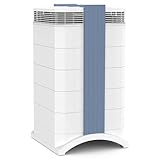
The GC MultiGas XE is the specialist: a Swiss-made tower built gas-first. Four cartridges hold 12 pounds of granular activated carbon and impregnated alumina — the chemisorption half of the blend covers gases that plain carbon adsorbs poorly — wrapped in particulate filter sleeves, with a HyperHEPA pre-filter stage ahead of them. IQAir rates it for rooms up to 1,125 square feet, the six-speed fan moves up to 275 CFM, and the XE generation adds Wi-Fi with app monitoring and a smart sensor. For tobacco smoke in a home where someone is chemically sensitive, this is the deepest gas filtration in a consumer cabinet.
It is also firmly premium-tier, and IQAir publishes airflow rather than an AHAM smoke CADR, so third-party CADR comparisons are not possible. The cartridge set is rated by IQAir at roughly two and a half years of typical use and is costly when it comes due, and the unit and its filters ship in separate boxes. This is not the pick for an occasional smoky evening; it is for persistent smoke and gas problems where lighter machines would saturate and give up.
3. Coway Airmega 400 — Best for Large Rooms
Big open-plan spaces need verified airflow more than exotic media, and the Airmega 400 (model AP-2015F) delivers it with published numbers: Coway lists a smoke CADR of 328 CFM, dust at 328 and pollen at 400, and rates the unit for 1,560 square feet at two air changes per hour. Air is drawn through both sides of the cabinet, each side carrying a washable pre-filter and a Max2 filter combining activated carbon with Coway’s Green True HEPA media. An air-quality sensor drives the auto mode, and the published noise range runs from 22 dB on the lowest speed to about 52 dB on turbo.
The Max2 sets are rated for roughly a year and there are two of them, so annual filter cost is a genuine line item, and the carbon here is a combined filter layer rather than a deep granular bed — for gas-heavy smoke, the Airpura and IQAir above it carry more media. This is the non-Wi-Fi version (the 400S is the connected sibling), which keeps the controls simple. Choose it when the main problem is smoke particles spread across a large living area.
4. Medify Air MA-112 — Best for Wildfire Smoke Events
Wildfire smoke is a particle emergency first: outdoor PM2.5 leaks indoors for days, and the fix is raw clean-air volume in the room where you sleep and sit. The MA-112 is built for exactly that. Medify rates it at a CADR of 950 cubic meters per hour — about 559 CFM, among the highest figures on any home purifier — and its current listing claims coverage of up to 5,948 square feet in an hour at full speed, which in practice means very fast air changes in a normal bedroom or living room. Filtration is a pre-filter, an activated carbon stage and a true HEPA H13 filter set, with four fan speeds and a filter life rated at about 3,000 hours.
Be clear-eyed about the balance: that huge CADR is a particle weapon, while the carbon stage is a conventional filter layer, not the multi-pound beds in our first two picks, so gas and odor removal is the supporting act. At maximum speed it is loud — up to roughly 70 dB by the maker’s figures — so the working pattern is turbo during a smoke event, then a lower speed to hold the room. Medify’s lifetime warranty applies when filters are changed on schedule with genuine Medify filters. For wildfire country, this is the throughput pick.
5. Rabbit Air MinusA2 (SPA-780A, Toxin Absorber) — Best for One Smoking Room
The MinusA2 takes a different approach: its six-stage system includes a swappable customized filter, and the version to buy for smoke is the Toxin Absorber, a granular-carbon filter aimed at VOCs and airborne chemicals, alongside a BioGS HEPA filter and a final activated-carbon stage. Rabbit Air publishes a smoke CADR of 180 CFM (dust 193, pollen 200) and rates the SPA-780A for an 815-square-foot room at two air changes per hour. The slim cabinet can stand on the floor or hang on a wall, noise runs from about 25.6 to 51.3 dBA, and the negative-ion stage can be switched off.
The honest limits: a smoke CADR of 180 is sized for one room, not a whole floor, so this is a den, bedroom or home-office answer, and the replacement filter kits are premium-priced. The slim design and wall mounting earn it the place where a bulky tower would not fit. Choose it when the smoke source lives in a single room — a cigar den, a smoking room, a small lounge — and you want the gas-focused filter recipe without giving up floor space.
6. Winix 5300-2 — Best Budget Pick
Not every smoky room justifies a carbon-heavy specialist. The 5300-2 is the sensible first step: AHAM-verified CADR figures of 232 CFM for smoke, 243 for dust and 246 for pollen, a rated room size of 360 square feet, true HEPA filtration, and Winix’s PlasmaWave stage, which can be turned off. The box includes one HEPA filter and four activated-carbon pre-filters — a year’s supply, since the carbon sheets are swapped roughly every three months. It is Energy Star and CARB certified, and the whole package sits in the budget-friendly tier.
Set expectations to match the price, because this is where the trade-off in this guide is sharpest: the carbon here is a set of thin sheets, not pounds of granular media, so it will take the edge off cooking and occasional tobacco odors but saturate far sooner than the Airpura T700 or GC MultiGas under daily smoke. There is no app and no air-quality display. As a first purifier for a bedroom or study that gets occasional smoke drift, it covers the particle side properly and the odor side lightly.
Best Picks by Category
- Heavy activated carbon: Airpura T700 — a 26-pound coconut-shell carbon bed behind a TarBarrier pre-filter made for tobacco tar.
- Gas and VOC filtration: IQAir GC MultiGas XE — 12 pounds of granular carbon and chemisorbent cartridges for the broadest gas coverage.
- Large rooms: Coway Airmega 400 — 328 smoke CADR from dual Max2 filter sets, rated to 1,560 square feet at two air changes an hour.
- Wildfire smoke events: Medify Air MA-112 — the highest clean-air volume here, built to scrub particle-heavy air fast.
- One smoking room: Rabbit Air MinusA2 with Toxin Absorber filter — a gas-focused recipe in a slim, wall-mountable cabinet.
- Budget: Winix 5300-2 — verified smoke CADR and a year of carbon sheets in the box, at an entry-level tier.
Notice the pattern: the more of your problem is smell and gas, the higher up this list you should shop; the more it is visible haze and PM2.5, the more raw CADR matters.
How to Choose
Decide whether your problem is particles or gas
Haze you can see, and the PM2.5 reading on a monitor, is the particle side — a true HEPA filter handles it. The lingering smell of cigarettes, the VOCs in cooking and wood smoke, are gases that HEPA cannot touch; only activated carbon adsorbs them. Most real smoke is both, which is why every pick here pairs HEPA with a real carbon stage — but the balance between the two should follow your situation: wildfire smoke is particle-dominant, cigarette smoke in a small room is gas-dominant.
Size by smoke CADR, not headline coverage
Headline coverage figures are usually calculated at one or two air changes per hour, which is too gentle for smoke. AHAM’s rule of thumb is that smoke CADR should be at least two-thirds of the room’s square footage for about 4.8 air changes an hour — so a 300-square-foot room wants a smoke CADR near 200. During wildfire events, public-health guidance is to aim for four to five air changes per hour in the room you occupy most. If a maker publishes no CADR, as with Airpura and IQAir, treat its coverage claim as a rough guide and size up rather than down.
Weigh the carbon — literally
Carbon capacity is a weight game. Thin carbon-coated sheets, like the Winix pre-filters here, hold grams of media and are fine for light, occasional odor. Granular beds measured in pounds — 26 in the Airpura T700, 12 in the GC MultiGas XE — keep adsorbing for months or years under the same load. Impregnated media matters too: potassium-iodide or permanganate-treated media target specific gases, such as formaldehyde in tobacco smoke, that plain carbon handles weakly.
Check what “HEPA” actually means on the listing
For smoke particles you want a true HEPA filter — 99.97% at 0.3 microns — or a named grade such as H13. “HEPA-type” and “HEPA-style” filters are not tested to that standard and let more of the finest smoke particles through. Sealed filter housings matter as well: air that leaks around the filter is air that was never cleaned, whatever the filter itself is rated.
Budget for filters under a smoke load
Maker filter-life figures assume average homes. In a smoking household, carbon saturates faster — the practical test is your nose: when smoke odor starts passing through a unit that used to catch it, the carbon is spent, whatever the timer says. Before buying, price the replacement set and its realistic interval: annual Max2 sets on the Coway, multi-year but expensive cartridges on the IQAir and Airpura, roughly quarterly carbon sheets on the Winix.
Placement and running habits
A purifier cleans the room it is in, not the house. Put it in the room where the smoke is, or where you sleep, with clearance around the intake, and run it on its highest tolerable speed during and after smoking or a smoke event — then drop to a quieter speed to maintain the room. During wildfire smoke, keep windows and exterior doors shut, and prioritize one “clean room” — usually the bedroom — over spreading a small unit thinly across the whole home.
Which air purifier for smoke should you buy?
The best air purifier for smoke depends on what kind of smoke you have and how big the space is. Tobacco and chemical odors call for deep carbon, while wildfire smoke calls for high airflow.
- Daily cigarette or cigar smoke: the Airpura T700 is built for tobacco, with a tar pre-filter and the deepest carbon bed in this guide.
- Heavy smoke, chemicals or sensitivity to fumes: the IQAir GC MultiGas XE is the gas-first specialist.
- A large open living area: the Coway Airmega 400 pairs published airflow figures with a sensor-driven auto mode.
- Wildfire smoke events: the Medify Air MA-112 is the throughput pick for clearing fine particles fast.
- One smoking room, den or office: the Rabbit Air MinusA2 (Toxin Absorber) is slim and can hang on a wall.
- A first purifier on a tighter budget: the Winix 5300-2 handles particles well and odors lightly.
If you are unsure, decide whether smell or haze bothers you most. Smell points to more carbon, and haze or outdoor smoke points to higher airflow. Match the smoke CADR to your room size rather than buying the biggest unit by default.
What to check before you buy a smoke air purifier, and who should skip it
Before you buy a purifier for smoke, check that its airflow suits your room and that you can live with the filter upkeep. The cheapest unit is not cheap if its filters need frequent changes.
- Compare the smoke CADR on the listing with your room size, and pick a unit rated above the space you need.
- Look at the carbon: a thin sheet, a combined filter layer or a deep granular bed behave very differently with smoke.
- Check the replacement filter price and how often the maker says to change it.
- Confirm the noise range, especially if the unit will run in a bedroom.
- Check what is included in the box, including pre-filters or spare carbon sheets.
- Read the warranty terms, because some require genuine filters changed on schedule.
- Decide whether you want an ion or plasma stage, and whether it can be switched off.
Be honest about the limits. A purifier reduces smoke particles and some gases, but it does not remove carbon monoxide or the smoke that has soaked into furniture and walls. Powerful units are louder at top speed, and deep carbon models cost more to maintain.
You may skip a purifier if the real fix is to stop smoking indoors, to repair a source such as a faulty stove vent, or to leave a hazardous area. If a purifier is the right tool, compare the picks above, check the current listing for room size and what is included, then choose the one that fits how you will use it.
Frequently Asked Questions
Can an air purifier remove the smell of cigarette smoke completely?
It can reduce it substantially while the unit runs, especially with a heavy carbon bed, but “completely” is too strong a promise. Smoke compounds settle into upholstery, curtains and carpet and keep off-gassing, and saturated carbon stops adsorbing. Expect a big improvement in the air itself and faster clearing after someone smokes, paired with washing soft furnishings for the full effect.
Do these purifiers remove carbon monoxide from smoke?
No. None of the purifiers in this guide — and no ordinary HEPA or carbon home purifier — removes carbon monoxide. Keep working smoke and carbon-monoxide alarms in the home, and treat a purifier as a comfort and particle-reduction device, not a safety device.
How long does it take a purifier to clear a smoky room?
It depends on the smoke CADR against the room volume. A purifier delivering 200 CFM of smoke CADR in a 300-square-foot room with eight-foot ceilings exchanges the room’s air roughly five times an hour, so visible haze typically thins within tens of minutes once the source stops. Ongoing smoking is a continuous source — the unit will hold levels down rather than clear the room while a cigarette is lit.
How often should I replace the carbon filter in a smoking home?
More often than the box suggests. Sheet-style carbon filters may last only a few months under daily tobacco smoke, which is why the Winix ships four a year. Deep granular beds last far longer — the Airpura carbon bed is rated around 24 months and the IQAir cartridges around two and a half years — but heavy daily smoke shortens any rating. Replace on odor breakthrough, not just on the indicator light.
Are ionizers and PlasmaWave safe around smoke?
The models here are CARB certified, which limits ozone emissions, and the ionizing stages on the Winix and Rabbit Air can be switched off entirely. Avoid standalone ozone generators sold as smoke removers: ozone is itself a lung irritant and is not a substitute for filtration. If you are sensitive, run the ion stage off — the HEPA and carbon stages do the core work anyway.
What should I run during a wildfire smoke event?
Close the house up, pick one room — ideally the bedroom — and run the highest-CADR purifier you have on its top speed, then a maintenance speed once the air is clear. That is the use case the Medify MA-112 is picked for. Check your indoor PM2.5 if you have a monitor, and remember the purifier handles particles and some gases; it does not make opening the windows safe while outdoor air is hazardous.
What is the best air purifier for cigarette smoke?
One with a deep activated carbon stage and a strong smoke CADR for your room. In this guide the Airpura T700 is the tobacco-focused pick. Smaller rooms may be fine with the Rabbit Air MinusA2.
Does a HEPA filter remove smoke smell?
No, a HEPA filter traps particles but not gases, and smoke odor is mostly gas. Activated carbon is what adsorbs odor molecules. A purifier with both handles smoke best.
What is smoke CADR and why does it matter?
Smoke CADR is a standard measure of how quickly a purifier clears smoke-sized particles from a room. A higher number means faster cleaning for a given size of room. Compare it with your room area on the maker's listing.
Where should I put an air purifier for smoke?
Put it in the room where the smoke is, or where you spend the most time, with space around the intake. Keep it away from tight corners and curtains that block airflow. Close doors and windows during smoke events.
Should I run a smoke air purifier all day?
Often yes in a smoky home, on a low or auto setting, and higher when smoke is present. Running it continuously keeps levels down. Check the manual for guidance on continuous use.
Can a purifier help with third-hand smoke on furniture?
It helps the air, but it does not clean surfaces. Residue on walls, carpets and upholstery keeps releasing odor, so washing and cleaning those items is still needed.
Bottom Line
For most homes fighting smoke, start with the Airpura T700: its 26-pound carbon bed and tar-trapping pre-filter are what actually work on daily tobacco smoke and odor. Step up to the IQAir GC MultiGas XE for the broadest gas and VOC coverage, choose the Coway Airmega 400 for a large living space, and the Medify Air MA-112 when wildfire particles are the emergency. The Rabbit Air MinusA2 with its Toxin Absorber filter owns the single smoking room, and the Winix 5300-2 is the honest budget starting point. Whichever you choose, size it by smoke CADR, check the current price and the replacement-filter cost before you order.