Disclosure: As an Amazon Associate, UMT Smart Tool earns from qualifying purchases. This guide is built from product listings and maker specifications, not from our own hands-on testing. Prices are approximate and can change, so check the current price before you buy. Last updated: November 10, 2026.
A bedroom air purifier has a harder job than a living-room model. It has to clean the air for seven or eight hours straight without keeping you awake, which makes three things matter more than raw power: how loud it is on the speed you will actually sleep on, whether its display lights can be dimmed or switched off, and whether its CADR still delivers enough air changes at that quiet setting. This guide is organized around those trade-offs, from compact nightstand units to one full-size tower for large primary bedrooms.
In this guide
Quick Picks
The short version: six bedroom purifiers we would look at first, one per use case.
| Pick | Type | Best for |
|---|---|---|
| Coway Airmega 50 | Compact sensor purifier | Light sleepers in small bedrooms |
| Levoit Core 200S-P | Smart Wi-Fi purifier | App control and scheduled overnight runs |
| Blueair Blue Pure 511 | Compact HEPASilent purifier | Small bedrooms and nurseries |
| Honeywell HPA125B AQSense | Compact auto-mode purifier | Hands-off auto mode on a budget |
| Medify MA-25 | Dual-filter HEPA purifier | Medium bedrooms with heavy dust |
| Hathaspace HSP002 | Full-size tower purifier | Large and primary bedrooms |
Our Picks
1. Coway Airmega 50 — Best Overall
The Airmega 50 is the rare purifier designed for the bedroom first. Coway rates its Sleep Mode from 18.4 decibels — quieter than a whisper — and that mode also dims the indicator lights. Its color-coded air-quality ring doubles as a night light on other settings and can be switched off entirely. An onboard PM2.5 sensor drives an auto mode, the footprint is just 6.7 by 6.7 inches, and at about 3.5 pounds it sits happily on a nightstand. Filtration is Coway’s three-stage HyperCaptive system — a washable pre-filter, activated carbon and a fine-particle filter Coway lab-rates at 99.999% capture of particles down to 0.01 microns; note the US listing sells it as a particulate filter rather than using a True HEPA label.
The trade-off is output. The CADR of 120.1 m³/h (about 71 CFM) means the headline 500 sq ft coverage works out to roughly one air change per hour; at the four-changes-per-hour pace usually suggested for bedrooms, it suits rooms up to about 144 sq ft. There is no app control, though the timer (1, 2, 4 or 8 hours), filter-change indicator, 14-watt Energy Star draw and three-year warranty soften that. For a small bedroom where silence is the priority, it is the most complete package here.
2. Levoit Core 200S-P — Best Smart Pick
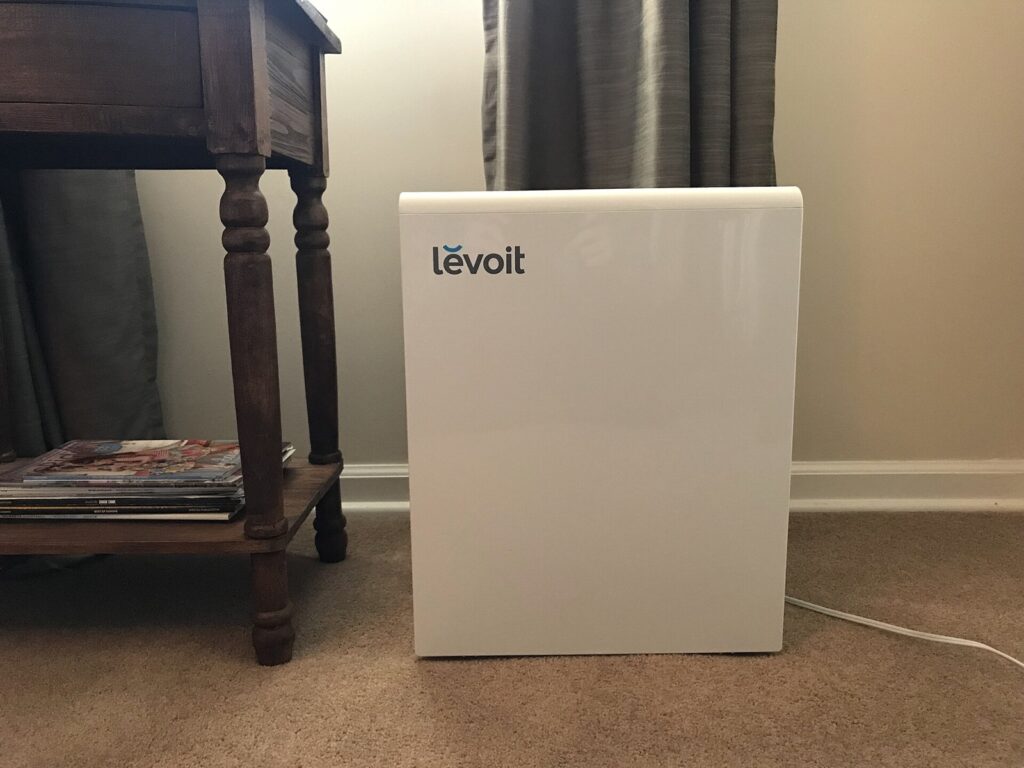
If you want the purifier run from your phone instead of a button, the Core 200S-P is the bedroom-sized option. It connects to the VeSync app and works with Alexa and Google Assistant, so you can schedule it to run hard before bedtime and drop to Sleep Mode — rated at 27 decibels — when you turn in. A Display Off function kills the panel lights, a display lock prevents stray taps from changing settings, and a two-level night light is built in. It is AHAM Verifide with CADR ratings of 90 CFM (smoke), 101 (dust) and 119 (pollen), mapping to about 140 sq ft at 4.8 air changes per hour. The 3-in-1 filter (pre-filter, HEPA, activated carbon) is rated for six to eight months.
The compromise is awareness: unlike the Coway above, the Core 200S-P has no air-quality sensor, so there is no auto mode — it simply runs the speed you set, which is exactly why the scheduling matters. It is also strictly a small-room machine. Pick it if app control and a set-and-forget nightly routine matter more than automatic response to dust or pollen spikes.
3. Blueair Blue Pure 511 — Best for Small Bedrooms and Nurseries
Blueair’s smallest purifier takes the opposite approach to the Levoit: no app, no sensor, no display at all — just one button and three fan speeds. Its HEPASilent system pairs an electrostatic charge with mechanical filtration, and Blueair publishes CADR figures of 122 CFM (smoke), 123 (dust) and 123 (pollen), with a recommended room size of 189 sq ft at 4.8 air changes per hour. The maker-rated sound range is 24 to 49 decibels, so the lowest speed is genuinely night-friendly, and the only light is a small LED. A washable fabric pre-filter catches the coarse dust first and keeps the main filter working longer.
Because there is no auto mode, the 511 cannot react when a dog shakes off dust at 2 a.m.; it holds whatever speed you chose. Its carbon filtration is a sheet rather than a deep pellet bed, so odor control is light duty. Still, it fits corners and nursery floors where bigger units crowd the room. Choose it for simple, quiet, set-it-on-low cleaning in a smaller bedroom.
4. Honeywell HPA125B AQSense — Best Auto Mode for the Price
Honeywell’s 2025 AQSense model brings sensor-driven auto mode to the budget-friendly tier. Its built-in air-quality sensor adjusts the fan on its own, with a color-coded indicator so you can see conditions at a glance. The dedicated Sleep Mode keeps operation ultra-quiet and dims the lights, and Honeywell lists a noise level of about 21 decibels. It is AHAM certified for up to 4.8 air changes per hour in rooms up to 110 sq ft, is Energy Star certified, and its 360-degree 3-in-1 filter (pre-filter, HEPA and activated carbon) is rated to capture 99.97% of particles down to 0.3 microns.
At 7 by 7 by 11 inches it is the smallest machine here, and that shows in coverage: 110 sq ft at the full 4.8-changes pace means kids’ rooms and compact guest bedrooms rather than a primary suite. There is no app or voice control. But if you want a purifier that responds on its own — and goes dark and quiet at night — this is the lowest-cost route to that behavior here.
5. Medify MA-25 — Best for Medium Bedrooms
The MA-25 pulls air through two H13 True HEPA filter sets, one on each side, which gives this compact tower more filter area than single-intake rivals. Medify’s published figures list dust and pollen CADR of 123 CFM, an AHAM Verifide room rating of 172 sq ft, and noise starting at 19.8 dBA on the lowest of three speeds — a strong quiet-speed spec for a machine this size. It is Energy Star certified, has a timer and filter indicator, and Medify backs it with a US-registered lifetime warranty when you register the product, which is unusually generous at this tier.
The running cost is the catch: Medify rates the filters at about 2,500 hours, roughly three to four months, and there are two to replace each time, so budget for filters more often than with any other pick here. There is also no sensor or auto mode. For a medium bedroom with heavy dust or a pet sleeping in the room — and an owner willing to keep up with filters — the airflow-per-decibel trade is still attractive.
6. Hathaspace HSP002 — Best for Large and Primary Bedrooms
Every other pick here tops out below 200 sq ft at the recommended air-change rate, so a large primary bedroom needs a different class of machine. The HSP002 is a full-size tower with a five-stage system — washable pre-filter, activated carbon and zeolite layers, an H13 True HEPA filter and an optional ionizer stage — plus a laser sensor with a real-time PM2.5 readout and an auto mode that reacts while you sleep. The manual lists a CADR of 450 m³/h (about 265 CFM). Be clear-eyed about the headline: the advertised 1,500 sq ft coverage assumes roughly one air change per hour; at the AHAM pace, that CADR supports a room of around 400 sq ft, still enough for most primary bedrooms. Sleep mode drops the fan and dims the touchscreen panel.
The costs of that capacity are size and presence: at 27.2 inches tall and about 26.5 pounds it claims real floor space, the touchscreen is bright unless sleep mode is engaged, and there is no app control. Face the panel away from the bed and let sleep mode handle the light. For a big bedroom that smaller units cannot keep up with, it is the only pick here with headroom to spare.
Best Picks by Category
- Best overall: Coway Airmega 50 — 18.4 dB sleep mode, lights that turn off, sensor-driven auto in a nightstand footprint.
- Best smart pick: Levoit Core 200S-P — VeSync scheduling and voice control with AHAM-verified CADR.
- Best for small bedrooms and nurseries: Blueair Blue Pure 511 — one-button simplicity and 24 dB on low.
- Best auto mode for the price: Honeywell HPA125B AQSense — a real air-quality sensor and dimming sleep mode in the smallest body here.
- Best for medium bedrooms: Medify MA-25 — dual H13 filters and a 19.8 dBA starting noise figure.
- Best for large bedrooms: Hathaspace HSP002 — roughly 265 CFM of CADR for rooms the compact picks cannot serve.
Buying by room size and sleep habits beats buying the biggest number on the box: a purifier that matches the room can idle quietly all night, while an undersized one has to run loud to keep up — and usually ends up switched off.
How to Choose
Noise at the speed you will actually sleep on
Every purifier here publishes a decibel figure for its lowest or sleep setting, and that is the only number that matters at 2 a.m. Figures under about 30 dB sit at or below whisper level; the Coway and Medify start under 20 dB by their makers’ ratings. Remember that CADR falls with fan speed, so overnight cleaning is the low-speed cleaning, not the turbo number on the box. Light sleepers should prioritize the sleep-mode rating over headline coverage and consider a slightly oversized model they can run one notch lower.
CADR and air changes per hour
CADR (Clean Air Delivery Rate) tells you how much filtered air a purifier delivers, and AHAM’s rule of thumb is that the smoke CADR should be at least two-thirds of the room’s square footage. A 150 sq ft bedroom therefore wants a smoke CADR of 100 or more. Treat headline coverage claims with care: most are calculated at about one air change per hour, which is fine for maintenance but slow for allergy-heavy rooms, where four to five changes per hour is the usual target. Match the AHAM room-size rating to your bedroom first, then compare noise.
Lights, displays and night modes
A bright air-quality ring or touchscreen can be more disruptive than fan noise. Look for a sleep mode that dims or extinguishes the display, a display-off button, or — simplest of all — a design with no screen, like the Blue Pure 511. Night lights are a plus in nurseries and a minus for light-sensitive adults, so check whether the glow can be turned off independently.
Filter type and replacement cost
True HEPA filters are the benchmark for fine particles; HEPASilent and other electrostatic hybrids can match the capture with less noise, while proprietary systems like Coway’s HyperCaptive publish their own lab ratings instead. What differs most in daily life is upkeep: intervals here run from about 2,500 hours on the Medify (two filters to buy) to six-to-eight-month cartridges on the Levoit. Multiply filter price by change frequency before deciding a purifier is cheap.
Sensors, auto mode and smart control
A particle sensor lets a purifier respond on its own — ramping up when a door opens or pollen blows in, then settling back down. That is the Coway, Honeywell and Hathaspace pattern here, and it is the easiest way to get strong cleaning without noise you notice. Smart models without sensors, like the Levoit, substitute scheduling: run high before bed, drop to sleep mode at lights-out. Fully manual machines cost less, but they clean at one rate all night. Decide which style matches how much you want to think about the machine.
Footprint, placement and running costs
Bedrooms have limited floor space, so measure where the unit will live and leave clearance around its intakes — a purifier pushed against a wall or behind curtains cannot move its rated air. Place it near the bed, where you breathe, rather than in a far corner, and keep the door closed at night so the machine treats a smaller, sealed volume. Power draw is a minor worry: compact picks sip around 14 watts and several here are Energy Star certified.
Which bedroom air purifier should you buy?
The right bedroom air purifier is the one that matches your room size and your tolerance for noise, light and upkeep, not the one with the biggest coverage claim. Use the list below to map your situation to the picks in this guide.
- Light sleeper in a small room: go for the Coway Airmega 50. Its sleep mode and lights-off behavior are the reason it leads the list, and the sensor handles speed changes for you.
- You want app control and schedules: choose the Levoit Core 200S-P. It suits people who like to set a routine once and forget it, and who accept that it has no sensor.
- Nursery or a small, simple setup: pick the Blueair Blue Pure 511. One button, no glowing screen, and an easy fit in a corner.
- You want auto mode without paying for extras: the Honeywell HPA125B AQSense gives you a sensor and a dimming sleep mode in the smallest body here, best for kids’ rooms and compact guest rooms.
- Medium bedroom, dust or a pet on the bed: the Medify MA-25 moves more air per unit of noise, as long as you are happy to buy filters more often.
- Large primary bedroom: the Hathaspace HSP002 is the only pick built for rooms that compact units cannot cover.
If you sit between two sizes, choose the larger one and run it on a lower speed. It tends to be quieter at the same cleaning rate, and it leaves headroom if you later move the purifier to a bigger room.
If your decision comes down to smart features versus sensors, ask yourself whether you want the purifier to react or to follow a plan. A sensor reacts to what is in the air; a schedule follows the clock. Neither is wrong, but they suit different habits.
What to check before you buy a bedroom air purifier, and who should skip it
Before you buy a bedroom air purifier, confirm the room size rating, the sleep-mode noise figure and the replacement filter details on the current listing. Those three checks prevent most disappointments.
- Measure your bedroom floor area and compare it with the maker’s room size rating, not the larger headline coverage.
- Look for the sleep-mode or lowest-speed noise figure, since that is the speed you will use all night.
- Check whether the display and night light can be switched off separately.
- Find the replacement filter on the listing and see how often it is expected to be changed, and whether you need one filter or two.
- Confirm what is in the box, including any starter filter, and what the warranty covers.
- Measure the nightstand or floor space, and leave room for air to reach the intakes.
- Check the return terms in case the fan sound bothers you at night.
Now the honest objections. A purifier does not replace cleaning bedding, and it will not remove allergens already settled on fabric. Compact models cover small rooms only, so a big bedroom may be underserved. Some models that look cheap up front ask for frequent filter changes, which adds up over a year. And any fan makes some sound, so a very sensitive sleeper may still prefer to run it before bed and switch it off.
Who should skip it? If your bedroom is already well ventilated, you have no dust, pet or pollen concerns, and you sleep best in complete silence, a purifier may add little. If a doctor has advised something specific for a health condition, follow that advice first.
When you are ready, compare the picks above, check the current listing for size and what is included, then choose the one that fits how you will use it.
Frequently Asked Questions
Should I run my bedroom air purifier all night?
Yes — a purifier only cleans the air while it runs, and the hours you spend breathing in one room make the bedroom the highest-value place to run one continuously. Use a higher speed for an hour before bed if the room feels stuffy, then drop to sleep mode. A compact unit’s power draw is closer to a light bulb than an appliance, so overnight running is cheap; filter life, measured in hours, is the real cost of 24/7 use.
What size air purifier do I need for a bedroom?
Start from the AHAM rule: the smoke CADR should be at least two-thirds of the room’s square footage. A 120 sq ft bedroom needs a smoke CADR around 80, which most compact picks cover; a 250 sq ft primary bedroom needs about 167, which is why the Hathaspace-class machines exist. If you want four-plus air changes per hour for allergies, use the maker’s AHAM room-size rating rather than the larger headline coverage figure, which usually assumes one change per hour.
Is it better to oversize the purifier and run it on low?
Usually, yes. A larger model loafing on its lowest speed often moves as much air — more quietly — than a small model straining on medium. The trade-offs are purchase price, floor space and sometimes a bigger replacement filter. If your bedroom is near the top of a small purifier’s rating, stepping up one class and living on the quiet setting is the most reliable route to clean air you can actually sleep through.
Can an air purifier help with dust mites and snoring?
A purifier reduces airborne particles — dust, pollen, pet dander — which is the part of the problem it can honestly address. Dust mites live in bedding and mattresses rather than the air, so hot-washing bedding and mite-proof covers do more for that specific issue. We make no medical claims: significant snoring or allergy symptoms are a conversation for a doctor, with a purifier as household support rather than a treatment.
Where should I place an air purifier in the bedroom?
As close to the bed as the layout allows, with the intakes and outlet unobstructed — not inside a closet, behind curtains or flat against a wall. On or beside a nightstand works for compact models; floor towers should sit on a hard, level surface with a few inches of clearance on the intake side. Keep the door closed while it runs so the purifier is treating the bedroom’s air volume rather than the whole floor of the house.
How often will I replace the filter if it runs every night?
Filter ratings are given in months or hours, and nightly running consumes them at the stated pace: an eight-hour night is a third of a day, every day. In this guide, intervals range from roughly 2,500 hours on the Medify MA-25 to six-to-eight-month cartridges on the Levoit Core 200S-P. A washable pre-filter, vacuumed monthly, protects the main filter and keeps airflow — and quiet — where it should be. Follow the machine’s filter indicator rather than guessing.
Is a quiet air purifier really silent enough to sleep with?
It is quiet enough for many people, but no fan is truly silent. Check the sleep-mode decibel figure on the listing and try it on the lowest speed for a few nights. Return terms matter here, so confirm them before you buy.
Should I turn off the purifier display at night?
Yes, if the light bothers you. Most sleepers do better in a dark room, so look for a sleep mode that dims the display or a button that switches it off. Some units let you keep a soft night light separate from the panel.
Can I put an air purifier on the bed or a bedside table?
A compact model can sit on a sturdy bedside table if the maker's manual allows it, but keep the intakes clear. Never place any purifier on a soft surface like a mattress, since that blocks airflow and may be unsafe. Larger towers belong on the floor.
How close should an air purifier be to the bed?
Closer is generally better for the air you breathe, within the clearance the manual asks for. A spot a short distance from the bed with open space around the unit works well. Avoid pointing the airflow straight at your face if it feels drafty.
Do air purifiers dry out the air in a bedroom?
Standard filter-based purifiers do not add or remove moisture, so they should not dry the room. If the room feels dry, the cause is more likely heating or weather. A separate humidifier is a different product and not part of what these purifiers do.
Is it worth buying a purifier with a sensor for a bedroom?
It is worth it if you want the machine to adjust itself without your input. A sensor ramps the fan up when the air gets worse and settles it back down. If you prefer a fixed quiet speed or a schedule, a model without a sensor can be perfectly adequate.
Bottom Line
For most bedrooms, start with the Coway Airmega 50: it is the quietest here on paper, its lights go fully dark, and its sensor handles the thinking. Choose the Levoit Core 200S-P to schedule everything from an app, the Blue Pure 511 for a nursery or a truly simple small-room unit, and the Honeywell HPA125B for auto mode at the friendliest price. Step up to the Medify MA-25 for a medium room with heavy dust, and to the Hathaspace HSP002 when the bedroom is large enough that compact models fall behind. Size by CADR rather than headline coverage, and check the current price and filter cost before you buy.