Disclosure: As an Amazon Associate, UMT Smart Tool earns from qualifying purchases. This guide is built from product listings and maker specifications, not from our own hands-on testing. Prices are approximate and can change, so check the current price before you buy. Last updated: November 10, 2026.
The best alarm clocks for kids rarely look like alarm clocks at all. A three-year-old cannot read numbers, so a good kids alarm clock speaks in light instead: a sleeping face and a warm glow mean stay in bed, a green light means it is finally OK to get up. Older children need something different — a clock that teaches them to tell time, then grows into a real alarm with snooze for school mornings. This guide is organized by age and job, from simple ok-to-wake trainers for toddlers to teaching clocks for kids up to ten. If your child is older and ready for a voice assistant and a screen instead, our guide to the best smart alarm clocks covers that next step up.
In this guide
Quick Picks
The short version: six kids alarm clocks we would look at first, one per age and use case.
| Pick | Type | Best for |
|---|---|---|
| LittleHippo Mella (Blush Pink) | Ok-to-wake sleep trainer | Best overall for toddlers and preschoolers |
| Mirari OK to Wake! Alarm Clock & Night-Light | Ok-to-wake clock | Youngest toddlers, simplest light cue |
| Hatch Rest+ (2nd Gen) | App-controlled sound machine clock | Parents who want phone control and portability |
| Teach Me Time! Talking Alarm Clock | Teaching clock | Learning to tell time, ages 5 to 10 |
| My Tot Clock (MTC02) | All-in-one routine clock | Bedtime stories, lullabies and full routines |
| I·CODE Kids Alarm Clock (A500, Blue) | Budget sleep trainer | A first ok-to-wake clock on a budget |
Our Picks
1. LittleHippo Mella (Blush Pink) — Best Overall
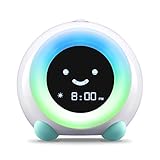
The Mella is the most complete ok-to-wake clock here because its cue is a face, not just a color. At sleep time the face closes its eyes; up to 30 minutes before the wake time you set (adjustable in 5 to 30 minute steps, and it can be switched off) it glows yellow, teaching patience; at wake time it smiles and glows green for a full hour. Around that core it packs three sleep sounds, three alarm sounds, five night light colors, a nap timer and a silent countdown timer for older children, all set with buttons on the clock itself — no app, no Wi-Fi, and a child lock keeps small fingers from reprogramming it. The light ring has three brightness levels and the display five, and the face can be dimmed all the way to black so the clock never lights up the room.
The trade-offs are power and flexibility. The Mella must stay plugged in — the box includes an AC adapter and a 4 ft USB cable — and the pre-installed CR2032 coin battery only preserves the time and settings during an outage or a move; it does not run the clock. There is also no separate weekend wake time, so Friday-night changes are manual. It is made of child-safe ABS and silicone and carries FCC, CE, RoHS and CPSIA approvals, and at 4.25 inches wide it suits most nightstands. One safety note that applies to the whole category: because of that coin cell, keep the clock on a shelf a toddler cannot reach rather than in the bed. For most families with a two- to six-year-old, this is the kids alarm clock to beat.
2. Mirari OK to Wake! Alarm Clock & Night-Light — Best for Toddlers
The OK to Wake! is the original “green means go” clock, and it is still the simplest concept for a child as young as two. At bedtime it glows a soft yellow as a night light; at the time parents set, the whole clock glows green, and the rule is easy enough for a toddler to repeat back to you. Two interchangeable faceplates (a pink flower and a green bug) and simple animations give it personality, big toe buttons let the child switch the night light on and off, and there is a nap timer plus an optional alarm as your child grows. PlayMonster builds it with hidden parent controls at the back.
Simplicity is also the limit. There is no sound machine, no sleep sounds and no app — if white noise is part of your bedtime routine, you will need a separate device. Power is flexible but slightly unfinished: it runs on USB with 4 AA batteries as backup, yet neither the batteries nor a wall adapter are included, so budget for both. The back controls are covered but not truly lockable, so a determined toddler may still explore them. As a first sleep trainer a two-year-old genuinely understands, though, it remains the benchmark.

3. Hatch Rest+ (2nd Gen) — Best App-Controlled Sound Machine
The Rest+ is the pick for parents who want to run the routine from their phone. It combines a sound machine, a night light, a time-to-rise program and a clock display in one Wi-Fi device, all scheduled in the Hatch app: wind-down colors and sounds at bedtime, a gentle light cue in the morning, and adjustments from the hallway instead of a dark bedroom. The 2nd Gen model (HBR4600) adds a charging base and a built-in battery, so it travels from nursery to big-kid room and keeps playing through a power cut. A library of bedtime stories and music makes it as much a bedtime routine hub as an alarm clock for kids.
The costs are money and complexity. This is a premium-tier device, the expanded story and music content sits behind the optional Hatch+ subscription, and everything depends on the app and Wi-Fi — there are no real controls on the unit for the child. One clarification: Hatch’s 2024 recall covered power adapters (model CYAP05 050100U) sold with the 1st Generation Rest only; this 2nd Gen Rest+ was not part of it. Choose it if you value remote control and portability over a simple, screen-free trainer.

4. Teach Me Time! Talking Alarm Clock — Best for Learning to Tell Time
Once your child is past the light-cue stage, the Teach Me Time! (Onaroo by PlayMonster, model 8081) takes over as a teaching tool. It shows analog and digital time side by side and turns practice into a game: an interactive talking game with five skill levels displays a time on the clock face and lets the child answer, then speaks the correct time. Younger children still get a color-changing ok-to-wake nightlight, and older ones graduate to a fully functional alarm clock with snooze — exactly the progression a five- to ten-year-old needs. Three interchangeable bezels (blue, pink and yellow) are included, and it runs on a safety-certified external AC adapter with optional AAA battery backup.
Expect a learning curve for parents too: the teaching game and nightlight timer need the manual to set up, and there is no sound machine for bedtime. The voice prompts are charming to most children and slightly robotic to some adults. None of that changes its unique strength — it is the only pick here that actively teaches telling time rather than just displaying it, so it stays useful for years after a basic ok-to-wake clock is outgrown.

5. My Tot Clock (MTC02) — Best for Bedtime Stories and Routines
My Tot Clock builds the whole day into one clock. Five colors carry the routine: blue for bedtime, yellow for wake time, cyan for naps, green for fun time and red for a “thinking time” timeout timer. It plays bedtime stories, lullabies, wake-up music and white noise, shows analog and digital displays side by side, and includes a separate weekend wake time — the feature parents of early risers ask for most. The faceplate swaps to match a child’s interests (a Stars & Moon plate is included; more designs are sold separately), parental controls hide beneath it, power is AC with 3 AA batteries as backup, and White Dove Innovations backs it with a 1-year warranty.
The richness has a price: it sits in the upper price tier for a toddler clock, extra faceplates and story cartridges are add-on purchases, and the under-faceplate controls take a read of the manual to master. The display can also be harder to read at an angle than a plain digital clock. But if your bedtime involves stories and music as well as a wake cue — and you want one device to handle naps, timeouts and weekend lie-ins too — no other children’s alarm clock here covers as much of the routine in a single box.

6. I·CODE Kids Alarm Clock (A500, Blue) — Best Budget
The I·CODE A500 covers the core sleep-training job for a budget-tier price. A sleepy emoji face with a red light means stay in bed; a smile with a green light means morning. You get two alarms, a nap timer, snooze and a 12/24-hour display, plus a night light with an auto-off timer so it does not glow all night. The maker aims it at children from 2 to 9 years old, and it charges over USB, so there are no disposable batteries to buy or replace — a real running-cost advantage over battery-only toddler clocks.
Temper expectations accordingly. I·CODE is a newer, smaller brand (this model first listed in December 2024), its sound and light options are basic next to the Mella or My Tot Clock, and long-term durability is less proven. Blue is the headline variant, so check the listing for other colors. As a low-risk way to test whether a light-based wake cue works for your child before spending more, it is a sensible first pick.

Best Picks by Category
- Best overall sleep trainer: LittleHippo Mella — a readable face-plus-color cue, sleep sounds and a dim-to-black display.
- Best for the youngest toddlers: Mirari OK to Wake! — one simple rule, “green means go,” that a two-year-old can learn.
- Best app-controlled: Hatch Rest+ (2nd Gen) — full routines from your phone, with a battery and charging base for portability.
- Best for learning to tell time: Teach Me Time! — analog and digital displays with a talking practice game in five levels.
- Best all-in-one routine clock: My Tot Clock — five routine colors, stories, lullabies and a separate weekend wake time.
- Best budget: I·CODE A500 — the essential red/green wake cue and a rechargeable battery at a starter price.
Notice the pattern: the younger the child, the simpler the cue on an alarm clock for kids should be. Faces and colors do the teaching at two and three; numbers, stories and games earn their place later.
How to Choose the Best Alarm Clock for Your Kid
Match the clock to your child’s age
From about 2 to 4, children think in pictures, not numbers, so choose an alarm clock for kids whose whole message is a color or a face: green means go. From 5 to 7, add learning — an analog face and a time-telling game turn the clock into practice. From 7 to 10, graduate to a real alarm with snooze and a display your child can set themselves, like the Teach Me Time! does after its trainer stage. Buying for the stage your child is in now, with one stage of headroom, beats buying features they will not touch for years.
Wake cue: light, sound, or both
A light cue wakes a child gently and, more importantly, works silently before wake time: the absence of green is itself the instruction to stay in bed. A sound alarm is clearer for older kids who must actually get up for school, but a loud buzzer can startle a small child out of sleep in tears. The strongest setups combine both — a light that changes first, with gentle sound as backup — and let you run the light on its own for nap training and quiet time.
Light color and brightness
Warm colors (amber, orange, soft red) are the right palette at night; bright white and blue-rich light are the most alerting and belong to morning. Whatever the clock, insist on dimming: a night light should be just bright enough to comfort, and the time display itself should dim low or switch off entirely, as the Mella’s face does, so the clock never becomes the brightest object in a dark room. If a clock’s glow has fixed colors, as some budget models do, check that the sleep color is a warm one before buying.
Sounds, stories and subscriptions
Built-in sleep sounds help children who settle better with white noise, and stories or lullabies can anchor a bedtime routine. Read the fine print, though: on app-based devices the headline library may need an ongoing subscription, while button-based clocks like the Mella and My Tot Clock include their sounds outright. If a calmer wind-down matters more than extras, our roundup of the best affordable alarm clocks shows what simpler clocks include for less. No feature replaces a consistent routine — it just makes the routine easier to keep.
Power: plug-in, batteries and outages
Plug-in clocks are the most reliable but tie you to an outlet near the bed, with a cord to route out of reach. Battery backup matters more than it sounds: it preserves the time and wake setting through an outage, so the green light still appears at 6:30 after a 3 a.m. blackout. Rechargeable models remove battery costs but add a charging habit. No spare outlet near the nightstand is a genuine reason to choose one of those instead.
Safety checks for children’s clocks
Look for CPSIA compliance and child-safe materials (the Mella’s ABS and silicone shell is a good example), rounded shapes with no sharp edges, and battery compartments that need a screwdriver — essential for any clock with a coin or button cell, which is a serious swallowing hazard. Check current recall status before buying any children’s product; to take one prominent example, Hatch’s 2024 recall covered only the CYAP05 050100U adapter sold with the 1st Generation Rest, not the 2nd Gen models sold now. Finally, place the clock on a stable surface out of the bed itself, and keep cords where a toddler cannot pull the unit down.
Which kids alarm clock should you buy?
The best alarm clock for kids depends mostly on your child’s age and how much of the bedtime routine you want it to handle. Match your situation to the picks above.
- Toddler or preschooler, one clock to start with: the LittleHippo Mella uses a face and color cue plus built-in sounds.
- The youngest toddlers: choose the Mirari OK to Wake! for its simple green-means-go rule.
- You want to control things from your phone: go for the Hatch Rest+ (2nd Gen), and check which content needs a subscription.
- A child learning to tell time: the Teach Me Time! Talking Alarm Clock has analog and digital displays and a practice game.
- Stories, lullabies and a full routine: the My Tot Clock covers bedtime, naps and a weekend wake time.
- Testing the idea on a budget: the I-CODE Kids Alarm Clock covers the basic wake cue and charges over USB.
If you are unsure, start with the simplest clock that matches your child’s age. You can add features later as the routine settles.
What to check before you buy a kids alarm clock, and who should skip it
Before buying a kids alarm clock, check the power setup, the controls and the safety details on the listing. These checks decide whether the clock works in your child’s room.
- Power: confirm whether it needs a wall outlet, batteries or USB, and what comes in the box.
- Controls: check whether settings can be locked so small hands cannot change them.
- Light and display: look for dimming, especially for the display.
- Safety: check for safety approvals and a secured battery compartment.
- Warranty and returns: read the listing terms for coverage.
There are honest limits. A light cue only works if you stay consistent, and some children test it for a week or two. Skip a sleep trainer if your child already reads the time and wants a normal alarm. Skip the app-controlled option if you prefer a screen-free bedroom or do not want to depend on Wi-Fi.
Plan for the first week as well. Set the wake time close to your child’s natural waking time, explain the colors during the day, and change only one thing at a time. If the clock has a lock for the settings, use it once the routine is set. A clock works best as one part of a steady bedtime, not as a fix on its own.
Compare the picks above, check the current listing for size and what is included, then choose the clock that fits how your child will use it.
Frequently Asked Questions
What age should a child start using an ok-to-wake clock?
Most children can learn the light cue of an ok-to-wake kids alarm clock from about age 2, once they are in a toddler bed or starting to climb out of the crib early. Start with a wake time close to when they naturally wake, then move it later in 10- to 15-minute steps. Consistency matters more than the specific clock: the rule only works if “green means go” is true every single morning.
Is a light-based wake cue better than a sound alarm for kids?
For toddlers and preschoolers, yes. Light teaches a boundary all night long — no green light means stay in bed — while a sound alarm only speaks at one moment and can frighten a small child. Sound becomes the better tool around school age, when the goal changes from staying in bed to actually getting up on time.
Will a night light disturb my child’s sleep?
A dim, warm-colored night light is unlikely to be a problem and comforts many children; a bright or blue-white glow is the kind to avoid near sleep. Choose a kids alarm clock with real dimming controls, keep the light as low as your child accepts, and prefer models whose display can go fully dark so stray light does not build up across the night.
Do kids’ alarm clocks need a clock display at all?
No — for the youngest children a display they cannot read is decoration, and a dim or hidden display is often better. Displays earn their keep from about age 5, when numbers start to mean something and an analog face becomes a teaching aid. Several clocks here span both stages by pairing a light cue with a display that can be dimmed now and read later.
What safety features should I check before buying?
Check for CPSIA or equivalent safety approvals, a screw-secured battery compartment (especially if the clock contains a coin cell), no small detachable parts for under-3s, and a current recall search on the exact model — adapters included, since accessory recalls like Hatch’s 1st Generation adapter recall are easy to miss. Place the clock out of reach on a stable nightstand, not in the bed.
When should my child switch to a regular alarm clock?
When they can read the time reliably and the morning goal becomes getting up rather than staying put — typically somewhere between 7 and 9. Teaching clocks with a real alarm and snooze, such as the Teach Me Time!, bridge the gap. After that, a standard bedside clock is fine, and a smart display becomes an option for older kids.
How do you introduce an ok-to-wake clock to a toddler?
Explain the rule in simple words during the day, such as "green means you can get up." Practice at a wake time close to when your child naturally wakes, and praise them for staying in bed. Move the time later gradually.
What if my child gets up before the light changes?
Calmly return them to bed without much conversation and remind them of the rule. Consistency over several mornings usually matters more than any feature. Avoid rewarding early rising with play or attention.
Where should you put a kids alarm clock?
Place it on a stable shelf or nightstand where your child can see it but cannot pull it down. Keep cords out of reach and keep the clock out of the bed. Make sure the light is not too bright at eye level.
Do kids alarm clocks work for naps?
Many include a nap timer or a light cue that can be used during the day. Check the listing for a nap feature on the specific model. It can help build a quiet-time routine.
Is a night light with a color cue safe for sleep?
A dim, warm light is generally gentle and many children find it comforting. Use dimming controls and avoid bright or cool-white light near bedtime. If your child sleeps poorly, try a lower setting or switch it off.
What if my child is afraid of the dark and the clock?
Choose a clock with a soft glow and let your child help set it so it feels familiar. Place it where it does not cast odd shadows. If fear continues, talk with your pediatrician.
Bottom Line
For most families, the LittleHippo Mella is the best alarm clock for kids right now: its face-plus-color cue is the easiest for a young child to read, and its sounds, dimming and child lock are all handled on the clock itself. For a child closer to two, the Mirari OK to Wake! keeps things simple; for phone-first parents, the Hatch Rest+ (2nd Gen) adds app control and portability; school-age children get the most from the Teach Me Time! or the story-filled My Tot Clock; and the I·CODE A500 proves the concept on a budget. When your child outgrows light cues, our general guide to the best alarm clocks covers the next stage. Check the size, power arrangement and current price before you order — and give the new rule a week of consistent mornings before judging it.