A Swiss Army knife packs a blade, scissors, screwdriver and more into a pocket-sized tool. Victorinox makes dozens of models, and the cheaper ones cover the basics without extra bulk. This list focuses on classic budget-friendly models that have been around for years, so they are easy to find and easy to compare. Each model name tells you roughly what tools to expect, which helps when comparing.
The six budget Swiss Army knives below span different styles and budgets. We have not used these products ourselves, and the descriptions come from general product knowledge rather than hands-on testing. Details can change between versions, so confirm sizes, materials and what is included on the current listing before you buy. Tool counts differ across models, so check the current listing for exactly what is on each one.
As an Amazon Associate we earn from qualifying purchases. Links below are affiliate links, and they do not change the product information we give.
What to Look For
| Feature | Why it matters |
|---|---|
| Tool count | More tools add weight; pick what you will actually use |
| Size | Small keychain models carry easily; larger ones are more capable |
| Blade lock | Most small models do not lock, so use with care |
| Scales | Plastic or nylon scales are durable and affordable |
| Extras | Scissors, tweezers and toothpicks come on some models |
| Case material | Alox metal scales feel sturdier; plastic scales are lighter and warmer in the hand |
In this guide
Specs at a Glance
| Model | Type | Key feature | Notes |
|---|---|---|---|
| Victorinox Classic SD | Small multi-tool | Small blade, scissors, file | Keychain size |
| Victorinox Spartan | Medium multi-tool | Blade, can opener, screwdriver | Pocket size |
| Victorinox Tinker | Medium multi-tool | Blade, Phillips screwdriver | Pocket size |
| Victorinox Climber | Medium multi-tool | Blade, scissors, corkscrew | Pocket size |
| Victorinox Huntsman | Large multi-tool | Many tools, saw | Larger |
| Victorinox Pioneer X | Medium multi-tool | Metal scales, blade and tools | Pocket size |
The 6 Best Cheap Swiss Army Knives
Top pickBest for keychain carry
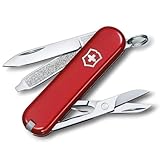
1. Victorinox Classic SD
A tiny keychain-size Victorinox with a small blade, scissors, a nail file and a screwdriver. It is among the most popular models in the line.
Suits: keychain carry. Strengths: a small, light size. Weaknesses: small tools that are best for light jobs. Skip it if you want a larger blade.
Best for basic camp tasks
2. Victorinox Spartan
A slim model with a main blade, a small blade, a can opener and a screwdriver. It covers camp and household basics in a pocket-friendly format. It is a sensible pick if you mostly open cans, tighten screws and cut string.
Suits: basic camp tasks. Strengths: a balanced tool set. Weaknesses: no scissors. Skip it if you need scissors.

Best for home repairs
3. Victorinox Tinker
A medium Victorinox with a blade, can opener and Phillips screwdriver. It is a handy home-and-travel tool.
Suits: home repairs. Strengths: a Phillips driver. Weaknesses: fewer extras. Skip it if you want scissors.

Best for picnics and travel
4. Victorinox Climber
A mid-size model that adds scissors and a corkscrew to the usual blade and tools. It is a good all-rounder for picnics and travel.
Suits: picnics and travel. Strengths: more tools in one body. Weaknesses: a bulkier pocket feel. Skip it if you want a slim tool.

Best for camping and gadget fans
5. Victorinox Huntsman
A feature-rich model with a saw, scissors and more. It is larger than the small models but remains a strong value for the tool count.
Suits: camping and gadget fans. Strengths: lots of tools. Weaknesses: a thick body. Skip it if you want a slim knife.

Best for daily carry
6. Victorinox Pioneer X
A model with metal Alox scales and a good mix of everyday tools. It has a more rugged feel than the plastic-handled models.
Suits: daily carry. Strengths: a durable feel. Weaknesses: slightly heavier. Skip it if you want plastic scales.

Care and Setup
- Rinse with warm water if it gets sticky.
- Lightly oil the hinges once in a while.
- Avoid prying with the blade.
- Keep the knife dry to prevent rust.
- Open each tool occasionally so the springs stay free.
Mistakes to Avoid
- Using small blades as screwdrivers.
- Forgetting that many models do not lock.
- Carrying in places where knives are not allowed.
- Buying for tool count rather than use.
- Tossing the knife in a bag with loose keys that scratch the scales.
Picking the Tool Set by What You Actually Do
The number of tools on a Swiss Army knife is a poor way to choose one. A better method is to list the small jobs you do most often and look for a model that covers them. If you mostly cut string, open packages and tighten the odd screw, a small model with a blade and a screwdriver is enough. If you picnic, travel or camp, scissors, a can opener and a corkscrew become useful. If you work on projects around the house, look for a saw, a Phillips screwdriver or a larger blade.
Scissors deserve a note. Small scissors are handy for trimming threads, opening plastic packaging and cutting tape, and many people use them more than the blade. Check how the scissors feel and how they spring open, since small ones can be fiddly. A can opener is still helpful for camping and travel. Tweezers and a toothpick, found in some models, are small tools that are surprisingly useful.
Think about where each tool sits in the knife. Tools on both sides of the body can be awkward to reach, and some are harder to pull out with your thumbnail. Look for a nail nick that you can grip comfortably. If you have large hands, a very small knife can be fiddly, and if you have small hands, a thick model with many layers may feel clumsy. Match the size to how you will use it.
Size, Weight and Carry Style
Swiss Army knives range from tiny keychain models to chunky, multi-layer designs. Smaller ones slip into a pocket or onto a keyring and are easy to forget, which is the point. Larger ones have more tools and a better grip, but they take up space and add weight. Think about how you will carry it: in a pocket, on a keyring, in a bag or in a kit. A model that bulges in your pocket may end up left at home.
Check the length and the number of layers on the listing. Layers are the stacked sections of tools, and more layers make the knife thicker. A slim knife works well for pocket carry, while thicker ones suit a pack or a tool kit. If you plan to carry it on a keyring, consider the impact on the other items. Keys can scratch the scales, and a heavy knife can wear a hole in a pocket.
Consider also how many people will use it. A knife shared among family members at a campsite might be better with larger tools and a firm grip. A personal knife used for small jobs can be tiny. Many people own two: a tiny one for daily carry and a larger one for trips.
Scales, Locks and Everyday Handling
The handle material, often called scales, affects feel and durability. Plastic scales are light, inexpensive and come in many colors. They can crack or fade over time, but they are comfortable and easy to replace in some cases. Metal scales, such as the Alox type mentioned for one model, feel more solid and resist wear, though they can feel colder and may show scratches. Think about your hands and whether you prefer a warm or a rugged feel.
Many small Swiss Army knives do not have a locking blade. This means the blade can fold back onto your fingers if you press on the spine or apply sideways force. Some larger models include a lock for the main blade. Check the listing for lock details if safety is a concern, and handle the knife with care whether it locks or not. Always cut away from your body, and avoid using the blade for prying.
Check how easy the tools are to open. A stiff nail nick can hurt a thumbnail, and a loose tool can fold unexpectedly. Springs should feel firm, and tools should snap into place with a clear click. Test each tool on arrival, and check that none feel loose or gritty. If something is wrong, contact the seller promptly.
Sharpening, Oiling and Routine Upkeep
Swiss Army blades are usually easy to maintain. A small whetstone, a ceramic rod or a compact sharpener will do for a touch-up. Hold a steady angle and work from the base to the tip using light, even strokes. Scissors can be sharpened with a few passes of a small stone along the beveled edge, taking care not to change the shape. A strop or a piece of cardboard gives a finishing polish.
Keep the hinges clean. Pocket lint and grit build up around the joints and slow the tools. Rinse the knife in warm water, open and close each tool to flush out debris, and dry it. Add a tiny drop of light oil to each hinge, work the tool back and forth, and wipe off any excess. Use food-safe oil on blades that touch food. Never put the knife in a dishwasher, which can wash out lubricants and dull the edge.
Open each tool now and then, even if you do not use it, so the springs stay free. Store the knife in a dry place and avoid leaving it in a damp pocket or a closed bag for long periods. If the blade develops rust spots, rub them gently with a fine abrasive pad and a little oil.
Carrying Rules, Gifts and When to Replace
Carry laws for knives differ by place and setting, and the rules for blades with locks, length and public buildings vary. Schools, offices, courthouses and public transport often have their own policies. If you travel, check rules for the places you pass through, and pack the knife in checked luggage where required. When in doubt, leave it at home.
If you are buying one as a gift, think about the person’s needs. A small keychain model suits someone who wants a few tools without bulk. A mid-size model with scissors and a can opener suits someone who travels or camps. Some listings allow personalization such as engraving, which depends on the seller, so check details and return policies for custom items.
These knives last many years, but signs it is time to replace include a cracked or loose scale, a spring that no longer holds a tool open, a blade that has been chipped beyond repair, or a tool that has bent or broken. Some parts can be replaced, such as tweezers or toothpicks, depending on the model. Read recent buyer feedback and check that the seller is clearly identified. A genuine model should be consistent with the markings described on the listing, and unclear or inconsistent details are a reason to ask the seller before buying.
Swiss Army Knife FAQ
Are cheap Swiss Army knives real Victorinox?
The models listed here are Victorinox. Check who is selling it on the current listing before you buy.
What does SD stand for?
It is part of the Classic SD model name, a small knife with a blade, scissors and a few simple tools.
Can I take a Swiss Army knife on a plane?
Generally not in carry-on bags. Check airline and airport rules. If you travel often, a small tool kit in checked luggage is simpler.
Which model is best for beginners?
The Classic SD is a good, small starting point. It carries easily on a keyring and covers the most common small jobs.
Do Swiss Army knives have locking blades?
Many small models do not lock, while some larger ones do. Check the listing for lock details, and handle any unlocked blade with care.
How do I sharpen the small blade?
Use a small whetstone, ceramic rod or compact sharpener at a steady angle with light strokes. Test the edge on paper before cutting food.
Can I put it in the dishwasher?
It is best not to. Washing can remove lubricant from the hinges and dull the edge, so rinse by hand and dry it.
What can I do if the tools feel stiff?
Rinse out grit with warm water, work the tools open and closed, and add a drop of light oil to each hinge. Wipe off any extra oil.
How should I carry it every day?
A pocket works for most models, and tiny ones suit a keyring. Keep it away from loose keys that can scratch the scales, and follow local rules on where knives are allowed.
Are the scissors good enough for real use?
Small scissors suit light jobs such as trimming thread, tape and packaging. They are not made for heavy cutting.
Can I engrave or personalize one?
Some sellers offer it, but options depend on the listing. Check the details and return policy, since custom items may not be returnable.
How do I know the knife is genuine?
Check that the seller is clearly named, that markings match the listing description, and that the product details are consistent. Ask the seller if anything looks unclear.
Using Each Tool Properly Without Damaging It
Most broken Swiss Army knives are not defective. They were asked to do a job the tool was never meant for. Learning what each implement is actually good at will keep a budget knife working for years, and it makes the difference between a handy gadget and a frustrating one.
The small screwdriver is for small screws, such as those on eyeglasses, electronics covers and light switch plates. It is not a pry bar, and twisting it hard against a stubborn screw is the usual way the tip chips. The larger screwdriver, where a model has one, often doubles as a bottle opener or a wire stripper, so read the markings on the tool before trying a new use. The can opener works with a small rocking motion along the rim and needs a firm grip on the can. Cut slowly, and keep your free hand away from the lid, since the edge it leaves is sharp.
- Scissors: good for thread, tape, packaging and paper. Heavy fabric or thick plastic strapping will strain the small pivot.
- Tweezers and toothpick: these slide out of a slot in the scale and are easy to lose, so push them back in firmly after use.
- Nail file: the file side is for nails, and many models include a flat screwdriver tip on its end for light work.
- Corkscrew: turn it straight down into the center of the cork, and lift using the lever or the knife body instead of wrestling it sideways.
- Saw, where fitted: pull strokes with light pressure, and let the teeth cut rather than forcing them through green wood.
Keep the blade, not the other tools, for cutting. A blade is thin, and the smaller implements share the same spring and the same limited pivot. If a task needs real force, borrow a proper tool and keep the pocket knife for light work.
Steel, Rivets and Construction at the Budget End
A cheap Swiss Army knife is not the same as a cheap knife of unknown origin. The better-known models use stainless steel blades, which resist rust better than plain carbon steel but are not rustproof. Leave one wet in a pocket or a damp drawer and spots can still form, so dry it after contact with water and food. Blades in this class are usually tuned for easy sharpening and edge retention that is adequate rather than exceptional, which suits light daily use.
The body is built around a set of metal liners, with tools pivoting on pins and held under tension by springs. This is what gives the knife its solid feel and its snap when a tool opens. Differences between the small keychain models and the larger ones come down mostly to size and the number of layers in that stack. More layers mean a thicker knife, a heavier pocket and more springs to wear, though still an overall simple mechanism.
One thing to check on any listing is the actual list of tools. Marketing names and photographs can make two models look alike, and a small difference such as a missing file or a different screwdriver may matter to you. Count the implements in the description against your needs rather than buying by name alone.
Where a Little More Money Goes
If you are choosing between the cheapest option and a model one step up, it helps to see what extra spending usually buys. Often it is not a better blade. It is a handier tool mix, a sturdier handle material or a feature that you will use every day.
| Upgrade | What you gain | Who benefits |
|---|---|---|
| Larger handle | More grip and leverage for the same tools | People with bigger hands or heavier tasks |
| Metal scales | A more solid feel and less flex | Anyone who dislikes light plastic |
| Extra tools | Saw, awl or larger screwdriver | Campers, DIY users, tinkerers |
| Locking blade | Safer for harder cutting | Anyone who cuts more than they pick at things |
Pay for the feature that fixes a real annoyance you already have. If you only open mail, trim threads and tighten glasses, the smallest model leaves nothing missing. If you find yourself wishing for a firmer grip or a saw, step up. Buying a bigger knife that stays at home because it is too bulky is wasted money.
Starting a Young or First-Time User Safely
A pocket knife is a good first tool for many teenagers and adults who have never owned one, but a few ground rules keep it safe. Begin with a small, non-locking model so the blade is short and the pivot is easy to control. Teach the habit of cutting away from the body and away from a free hand, opening the knife only when it is needed and closing it straight after.
- Sit down for early practice, working over a table rather than walking around with the blade open.
- Open tools using the nail nick or the small groove, with a thumb away from the closing path.
- Close the blade by pushing on the back of the spine, never the cutting edge.
- Hand the knife to someone else closed, and let them open it themselves.
Check your local rules and any school or workplace policies before carrying one for a young person. Many places restrict blades on school grounds, and an adult should make that call.
Building a Small Everyday Carry Around the Knife
A multi-tool knife works best as one part of a small kit, not as a replacement for everything. A flashlight covers the dark jobs the knife cannot, and a small roll of tape or a few zip ties handle quick repairs. If you carry it on a keychain, remember that a heavy bunch of keys wears on a small knife’s ring and can scratch the scales, so a separate loop or pouch keeps it tidier.
Pocket storage matters too. Carry it in a pocket by itself, not loose with coins, which scratch scales and can knock the tools open. A small belt pouch or a dedicated pocket spot keeps the blade clean and ready, and it prevents the knife from being forgotten and sent through a laundry cycle.
Frequently Asked Questions
What is the difference between a plastic-handled and an Alox Swiss Army knife?
Plastic or nylon scales are light and a bit warmer in the hand, while Alox scales are an aluminum alloy that feels firmer and slimmer. Tool selection can be identical across both. Pick the plastic for lighter carry and the metal for a more solid feel.
Will a Swiss Army knife rust?
The blades are made from stainless steel, which resists rust but is not rustproof. Leaving the knife wet or in a damp pocket can still cause spots. Dry it after use, wipe off food residue, and add a drop of oil to the pivots now and then.
Is a Swiss Army knife good for cutting food?
Small blades handle fruit, cheese and bread on a picnic, if you clean them first and again afterward. For heavy prep work a kitchen knife is safer and easier. Avoid using the file, saw or screwdriver on food, since they may carry grime.
Is a Swiss Army knife a good first knife for a teenager?
A small, non-locking model is often a sensible starting point because the blade is short and the knife is simple to control. Pair it with safety rules about cutting away from the body, and check local and school rules before allowing it to be carried.
The Short Version
For a keychain tool, the Classic SD. For basics, the Spartan. For a home tool, the Tinker. For scissors and a corkscrew, the Climber. For a saw, the Huntsman. For a rugged feel, the Pioneer X.
Related Guides
- 6 Best Victorinox Swiss Army Knives by Size and Use (2026)
- 6 Best Swiss Army Knives for EDC: Slim to Full-Size (2026)
- 6 Best Swiss Army Style Knives: Multi-Tool Alternatives (2026)
- 6 Best Pocket Knives with Scissors: Swiss Army and Multi-Tool (2026)
- 6 Best Cheap EDC Knives: Budget Folders That Perform (2026)