A pocket knife with scissors packs a blade and a pair of small cutting shears into one compact tool. It is a handy pairing for trimming thread, cutting tape, opening packaging, snipping fishing line and handling small first-aid or craft tasks.
The six tools below include classic Swiss Army knives and small multi-tools that all combine a knife blade with scissors. We have not used these products ourselves, so confirm the tool list, size and scissor design on the current listing before buying.
As an Amazon Associate we earn from qualifying purchases. Links below are affiliate links, and they do not change the product information we give.
What to Look For
| Feature | Why it matters |
|---|---|
| Scissor action | Spring-loaded scissors reopen on their own and cut more smoothly |
| Blade | A sharp main blade handles everyday cutting tasks |
| Size | Slim bodies slip easily into pockets and bags |
| Extra tools | Tweezers, files and openers add useful versatility |
In this guide
Specs at a Glance
| Tool | Type | Size class | Notes |
|---|---|---|---|
| Victorinox Classic SD | Swiss Army knife | Small, keychain-friendly | Blade, scissors, file and more |
| Victorinox Rambler | Swiss Army knife | Small | Adds tweezers and a toothpick |
| Victorinox Climber | Swiss Army knife | Medium | More tools, a bit thicker |
| Leatherman Micra | Keychain multi-tool | Very small | Spring-action scissors |
| Leatherman Style PS | Keychain multi-tool | Small | Tweezers and a blade |
| Gerber Dime | Keychain multi-tool | Small | Pliers with scissors |
The 6 Best Pocket Knives with Scissors
Top pickBest for keychain carry
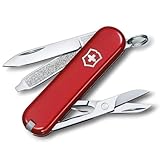
1. Victorinox Swiss Army Classic SD
The best-known small Swiss Army knife, combining a small blade, scissors, nail file, screwdriver and tweezers. It is light enough for a keychain and has long been a favorite for tidy, everyday cutting jobs.
Suits: keychain carry. Strengths: a compact, trusted design. Weaknesses: a short blade. Skip it if you want a locking blade.
Best for office and travel
2. Victorinox Swiss Army Rambler
A slim pocket knife that keeps the blade and scissors while adding a few more small tools such as tweezers and a toothpick. It carries easily and suits office, travel and household use.
Suits: office and travel. Strengths: useful small extras. Weaknesses: a light-duty build. Skip it if you want heavy tools.

Best for general-purpose carry
3. Victorinox Swiss Army Climber
A medium-size Swiss Army knife with a larger blade, scissors and a good selection of other tools. It is a better fit for those who want a fuller toolset and do not mind a slightly thicker body.
Suits: general-purpose carry. Strengths: a fuller toolset. Weaknesses: more bulk. Skip it if you want a slim profile.

Best for keychain and travel
4. Leatherman Micra
A very small keychain multi-tool known for strong spring-action scissors, plus a small blade, tweezers, screwdrivers and a file. It is a good choice for anyone who values cutting power in a tiny package.
Suits: keychain and travel. Strengths: capable scissors. Weaknesses: no pliers. Skip it if you want a larger blade.

Best for everyday small tasks
5. Leatherman Style PS
A slim keychain tool that combines small scissors, tweezers, a knife blade and a few other helpers. It is designed to ride on a keyring and handle small daily jobs with a clean, simple layout.
Suits: everyday small tasks. Strengths: a neat, slim layout. Weaknesses: a small tool set. Skip it if you want pliers.
View Leatherman Style PS on Amazon
Best for light repairs
6. Gerber Dime
A small pliers-based multi-tool with scissors and a short knife blade. It adds light pliers and wire cutting to the usual scissors-and-blade combination, which suits home and garage tasks.
Suits: light repairs. Strengths: pliers in a small body. Weaknesses: a modest blade. Skip it if you want a premium finish.

Care and Setup
- Open each tool and wipe it clean after use.
- Add a drop of oil to the scissors pivot now and then.
- Keep tweezers and files dry to avoid rust.
- Sharpen the blade with a small stone.
- Store the tool in a pouch if you carry it loose in a bag.
Mistakes to Avoid
- Cutting thick materials with tiny scissors.
- Using the knife blade as a screwdriver.
- Forgetting that airlines restrict knives in carry-on bags.
- Ignoring a loose pivot.
How Small Scissors Work and What They Cut
The scissors in a pocket knife or multi-tool are a miniature version of the full-size kind. Two short blades pivot on a single pin, and a leaf spring often pushes them back open after each cut. That spring action is why the scissors feel smooth and quick in use, and it is a feature worth checking on any listing. Without it, you must reopen the blades by hand after every snip.
Their size sets their limits. The blades are short, and the handles are small, so leverage is low. They handle thread, thin paper, tape, fishing line, bandage material, tags and light fabric easily. Thick card, heavy fabric, leather and wire are beyond them, and forcing those materials can spring the pivot or bend the blades. If you need to cut thicker materials, carry a larger pair of scissors or a different tool.
Look at the blade edge and finish. Sharp, well-aligned blades cut cleanly from heel to tip, while blades that are misaligned or loose will chew thread and fabric. Check for a small gap between the blades, which should be tight but not stiff. If you intend to cut for a long time, such as in craft work or first aid, a keychain tool may feel cramped. In that case, a medium-size tool with larger scissors is more comfortable. Consider the handle shape too, since a handle that digs into your fingers will tire your hand quickly.
Swiss Army Knives Versus Keychain Multi-Tools
The tools in this guide fall into two families. Swiss Army style knives use a stack of folding implements on a pair of spring-loaded slip joints, and the picks here range from small keychain sizes to medium ones with more tools. They tend to be slim, simple and familiar. The blade is usually a basic slicing shape, and the tools are lined up on both sides of the handle.
Keychain multi-tools are built on a different layout, often using a frame that folds around the implements. They can include small pliers, a knife blade and scissors in a very compact package. Some are designed more for light tasks and others for fixing small things, and the pliers-based types give you grip and wire cutting at the cost of size and a short blade.
Think about what you will do. If you mainly open packages, trim threads and use tweezers or a file, a Swiss-style knife is simple and light. If you want pliers for small repairs, choose a multi-tool, but accept the compromises in blade size and handle comfort. Also consider how you will carry it. A keychain tool is always with you but can add weight to a ring. A pocket-size tool is easier to use but may be left at home. Check the listing for the full tool list, because variations within a model family can include or omit scissors.
Locking Blades and Safe Handling of Small Tools
Many of the knives in this category have blades that do not lock, which means the blade can fold on your fingers if you press hard on the spine. That is not a flaw for light tasks, but it does affect how you should use the tool. Cut with light pressure, keep your fingers behind the edge and do not try to pry or force the blade. If you need a locking blade for heavier work, check the listing for a lock and plan accordingly.
Small tools are easy to mishandle because they are easy to lose control of. Open the tool you need, keep the others folded, and do not leave open blades in a pocket or bag. Close the tool when you finish. Do not use a knife blade as a screwdriver or pry bar, and do not use the scissors on hard materials. Use proper tools for those jobs.
Also think about children and others. Keep small tools out of the reach of young children, and teach older children how to use them safely if you decide to allow it. Check the rules of schools, workplaces and travel venues before you carry a tool with a blade. Some places restrict blade length or any blade at all. If a tool is for first-aid use, store it in a clean pouch and clean the scissors and tweezers with alcohol before and after use. Safe habits keep a small tool useful for years.
Everyday Uses and Extra Implements Worth Having
The appeal of a small knife with scissors is the range of minor jobs it handles. Trimming loose threads, cutting tape and snipping fishing line are classic examples. It can also open packages, cut cord, trim nails or hangnails, and remove splinters with tweezers. In an office or a travel bag it deals with tags and packaging. In a first-aid kit it can trim bandages and tape.
Extra implements add value if you will use them. Tweezers are useful for splinters and small parts. A nail file or a small screwdriver handles light fixing. A toothpick can be handy, though some people never use it. A bottle opener or a can opener is useful at picnics. A small saw or a larger blade adds function but also bulk. Think about the tools you will really use, and avoid paying for a long list of implements you will not touch.
Check how the tools are arranged. If the implements you need are on the same side, you can open them with one hand. If they are on opposite sides, you may need to rotate the knife. Test how easily each tool opens and whether the nail nick is comfortable. If the tool is stiff or sharp-edged, it will annoy you every time you use it. A simple, well-chosen set of implements is better than a crowded handle with parts you never open.
Travel Rules and Signs It Is Time to Replace the Tool
Knife rules change from place to place, and travel adds another layer. Airlines and airports restrict blades in carry-on luggage in many countries, so small knives and multi-tools with blades may need to be packed in checked baggage or left at home. Some places also restrict scissors above a certain length. Check the rules for each airport and airline before you travel, and look at the policies of any venue that you plan to enter.
Inside your own country, local laws on carrying knives vary. Some places restrict blade length or require a lock to be absent or present. Others have rules about carrying in schools and government buildings. If you are unsure, ask the local authority or choose a tool without a blade, like a pair of folding scissors.
As for replacement, look for signs of wear. Scissors that no longer close properly, blades that are chipped or loose pivots that cannot be tightened are all warning signs. A spring that no longer pushes the scissors open may be broken. Rust on tweezers or files can be cleaned, but deep pitting may mean the tool is past its best. If a part is broken, check whether the maker offers repair or replacement. A small tool is often inexpensive enough to replace, but a well-maintained one can last many years if you keep it clean, dry and lightly oiled.
Pocket Knife with Scissors FAQ
Are the scissors strong enough for fabric?
Small scissors handle thread, paper and light fabric. Heavy materials call for full-size shears.
Does the knife lock?
Many small Swiss Army knives use slip joints without locks. Check the listing for lock details.
Which is better, a knife or a multi-tool?
A knife is simpler, while a multi-tool adds pliers and more functions for repair jobs.
Can I take one on a plane?
Often not in carry-on luggage, so check the airline and airport rules before you travel.
Can small scissors cut fabric?
They can cut thread, light cloth and thin materials. Thick or heavy fabric needs full-size shears, since forcing a small pair can damage the pivot.
Why do some scissors have springs?
A spring opens the blades after each cut so you only need to squeeze. It makes cutting smoother and faster. Check the listing to see whether the tool has this feature.
Can I sharpen the scissors on a small multi-tool?
It is possible with a fine stone or file, but angles are small and it takes care. If the scissors are dull or damaged, replacement may be simpler.
Is a pliers-based multi-tool better than a Swiss-style knife?
It depends on your tasks. Pliers add grip and wire cutting, while a Swiss-style knife is slimmer and simpler. Choose based on the jobs you expect.
How do I clean the scissors in a pocket tool?
Open the scissors fully, wipe the blades with a damp cloth, dry them and add a drop of light oil to the pivot. Wipe off excess oil.
Can I use these tools for first aid?
They can trim bandages and tape and remove splinters, but clean them with alcohol before and after, and do not use them on open wounds without sterilizing. Serious injuries need proper medical care.
How do I stop tweezers and files from rusting?
Keep the tool dry, wipe it after exposure to moisture and store it in a pouch. A light film of oil helps on steel parts, and a clean cloth removes surface spots.
Choosing by Task: Matching the Tool to Your Day
The best pocket knife with scissors is the one that fits the jobs you actually do. A person who mostly opens parcels and trims loose threads has different needs from someone who carries a tool on hikes or keeps one in a sewing kit. Start by writing down the five cutting tasks you expect to repeat most, then see which tool in the list covers them without extras you will never touch.
- Office and desk use: Slicing tape, opening envelopes, trimming a stray label. A small slim knife with spring scissors is enough, and the lighter the better.
- Travel and commuting: Snipping tags, cutting a loose button thread, opening snack packaging. A keychain-sized tool rides along without being noticed, though you should check the rules where you travel.
- Outdoor days: Cutting cordage, trimming moleskin, preparing food. A medium-size knife with a sturdier blade and a few extra tools earns its extra thickness here.
- Craft and sewing: Fine snips matter more than the blade. Look for scissors that close cleanly at the tips.
- First-aid kits: Small scissors and tweezers in one body are convenient, but a dedicated pair of blunt-tip shears is better for cutting dressings near skin.
If two options seem equal, choose the slimmer one. A tool that is annoying to carry ends up in a drawer, and a tool left at home cuts nothing.
Scissor Design Details Worth Checking
Small scissors vary more than their size suggests. The pivot, the blade length and the spring all change how they behave in real use, so read the listing for the following points.
Spring Return
Some designs push the blades open after each cut, which makes repeated snipping quicker and easier on the fingers. Others open and close entirely by hand. For frequent use, a spring is a real convenience. For occasional use, it matters less, but a spring that is stiff can feel awkward when you try to cut slowly and precisely.
Blade Length and Cutting Reach
A longer cutting edge handles tape and paper in fewer strokes. A shorter edge is better at tight work like trimming around a seam. Because the scissors in a pocket tool are small, expect them to suit light materials. Thick cardboard, heavy denim and tough plastic strapping are better handled by the main blade or by full-size shears.
Handle Comfort
Many pocket scissors have a handle that is also the body of the tool, so the feel depends on the shape of the handle scale. Rounded edges are easier on the hand. If you have large hands, check whether the listing shows how the scissors open, since a small finger opening can limit grip.
Edge Alignment
Scissors depend on two edges meeting cleanly. A pivot that loosens over time lets paper fold between the blades instead of being cut. Some tools let you tighten the pivot, while others do not. If the product page mentions adjustment or repair options, note that as a plus for long-term use.
Carrying It: Pockets, Keychains and Bags
How you carry a tool changes which one you should buy. Keychain tools hang with keys and sit in a pocket all day, so they need to be thin and smooth. A flat, rounded body wears less on fabric than a tool with sharp corners. Swiss-style knives with a built-in key ring hole are easy to clip, but heavier models can wear a hole in lightweight pants over months.
Bag carry is more forgiving. A tool that lives in a backpack pocket, a toolkit or a glove box can be larger and richer in features. The trade-off is that you will not have it when you need a quick snip at your desk or in a store. Many people end up with two: a very small one for daily carry and a larger one for trips and projects.
- Check thickness as well as length. A short tool that is thick can feel bulky in a front pocket.
- Consider a small pouch for bag carry so the blades do not snag on cables and cards.
- Keep the tool away from loose coins and keys if you want the finish to stay clean.
Rules about carrying blades vary by country, city, school and workplace. Before you buy, check what applies in the places you will actually take the tool, and leave it at home if you are unsure.
Questions to Ask Before You Order
A short checklist can save a return. Go through these before you choose.
- Does the listing name the exact model and tool list, or only a general category? Models with similar names can include different tools.
- Is the main blade locking or non-locking? A non-locking blade is fine for light tasks but calls for care.
- Are the scissors spring-loaded, and are they designed for left-handed use if that matters to you?
- Can the product be used by a child or a beginner, and if so, are there blunt-tipped alternatives better suited to them?
- Does the seller offer a return window and a clear warranty note from the maker?
- Are you comfortable maintaining the tool with a drop of oil and a quick wipe, as the Care and Setup section describes?
If you can answer yes to most of these, you are probably buying with enough information. If several answers are unclear, wait and compare more listings rather than guessing.
Frequently Asked Questions
What size pocket knife with scissors is best for everyday carry?
For daily carry, a slim tool in the small to medium range usually works best. It fits in a pocket without printing, and the scissors handle thread, tape and packaging. Larger models add more tools but get thick. Pick the smallest body that still holds the tools you will actually use.
Are pocket knife scissors good enough for cutting paper and tape?
Yes, small pocket scissors cut paper, tape, thread and light packaging well. They are less suited to thick cardboard, heavy fabric or plastic strapping. If you cut those often, use the main blade or carry a separate pair of full-size shears for those tougher jobs.
How do I keep pocket scissors cutting cleanly?
Keep the pivot clean and lightly oiled, wipe off lint and adhesive after cutting tape, and avoid forcing thick material. If the blades start to fold paper instead of cutting it, a loose pivot or dirty edge is the usual cause. Clean first before assuming the tool is worn out.
Is a Swiss-style knife or a keychain multi-tool better for scissors?
Swiss-style knives usually offer a broader mix of tools in a slim shape, while keychain multi-tools are often smaller and lighter. Choose the Swiss style if you want more implements and a larger handle. Choose the keychain style if you want the least bulk and mainly need quick snips.
The Short Version
For a classic, the Victorinox Classic SD. For extras, the Rambler. For a fuller set, the Climber. For strong scissors, the Leatherman Micra. For a slim layout, the Leatherman Style PS. For pliers, the Gerber Dime.
A pocket knife with scissors earns its place on a keychain or in a bag because it removes small annoyances: tags, loose threads, tape, packaging and snagged line. Choose the size you will really carry, check the tool list on the current listing, and keep the pivots clean and lightly oiled so the scissors keep working smoothly for years. If you travel often, keep the tool in checked luggage or leave it at home when rules require.