Disclosure: As an Amazon Associate, umtsmarttool.com earns from qualifying purchases. Links to Amazon on this page are affiliate links; they cost you nothing extra. Prices and availability change often, so check the current Amazon listing before you buy.
Where to buy
Our shortlist of the best desk lamps for eye strain starts with our top pick, BenQ e-Reading Desk Lamp, if you want the safest all-round choice. Every linked pick below says check price on Amazon, because prices and availability change often.
- BenQ e-Reading Desk Lamp — Best Overall — check price on Amazon
- Micomlan 24W LED Desk Lamp with Clamp — Best for Balanced Rooms — check price on Amazon
- OttLite Creative Curves LED Desk Lamp — Best Daylight Personal Lamp — check price on Amazon
- Verilux SmartLight Full Spectrum LED Desk Lamp — Best Full-Spectrum Feel — check price on Amazon
- Honeywell H01 Pro Sunturalux LED Desk Lamp — Best Compact Comfort — check price on Amazon
- Lepro LED Desk Lamp 9.5W — Best Diffused Value — check price on Amazon
Read the full guide ↓
Shopping for the best desk lamps for eye strain is really shopping for comfort habits: light that is steady, evenly spread, easy to dim to the level your work actually needs, and positioned so it lights your desk instead of shining toward your face or bouncing off your screen. This guide approaches the topic strictly from comfort and everyday usage — how a lamp’s light feels across a long work session, and how your setup choices support relaxed, comfortable working. It makes no medical promises, and no lamp in this guide should be bought as a treatment for anything. What a good lamp can honestly do is remove the everyday irritations — glare, flicker you can sense, harsh contrast between a bright page and a dark room — that make desk work feel harder than it needs to.
That comfort lens reshapes the usual priorities. Raw brightness drops down the list; steadiness, diffusion, dimming range, and the balance between your desk light and the rest of the room rise to the top. You will see those criteria lead the reviews, alongside practical features like auto-dimming sensors that track a fading afternoon and memory functions that spare you a daily setup ritual. Readers whose main issue is a screen-heavy desk should also see best desk lamps for monitors and best monitor light bars, while readers furnishing a calmer evening desk may enjoy best desk lamps for reading.
A final framing note, because it matters: comfort is personal and cumulative. The lamp is one part of a comfortable desk — chair height, screen position, breaks, and room light all play their parts, and our setup section treats the lamp as part of that whole rather than a cure in a box. Buy the lamp for better light and better habits, set it up with the care described below, and judge it by the honest standard of whether your desk simply feels easier to work at, hour after hour.
In this guide
Quick Picks
| Pick | Badge | Key spec |
|---|---|---|
| BenQ e-Reading Desk Lamp | Best Overall | 2700K–5700K, 1600 lux, auto-dimming |
| Micomlan 24W LED Desk Lamp with Clamp | Best for Balanced Rooms | 24W, CRI above 90, auto-dimming sensor |
| OttLite Creative Curves LED Desk Lamp | Best Daylight Personal Lamp | 4 brightness settings, daylight LEDs, adjustable neck |
| Verilux SmartLight Full Spectrum LED Desk Lamp | Best Full-Spectrum Feel | Full-spectrum LED, gooseneck, USB port |
| Honeywell H01 Pro Sunturalux LED Desk Lamp | Best Compact Comfort | CRI 95+, 3000K–5500K, USB-A plus C |
| Lepro LED Desk Lamp 9.5W | Best Diffused Value | 800 lumens, 72 LEDs, 5 modes x 5 levels |
How These Picks Were Chosen
We selected these six for comfort-relevant design, verified from listings and manufacturer sources we opened during research. The BenQ contributes ultrawide, even coverage and auto-dimming. The Micomlan contributes an angled-away main light plus a soft upward ambient light that balances a dark room. The OttLite and the Verilux contribute daylight-balanced, full-spectrum-style light in personal formats. The Honeywell H01 Pro contributes high-rendering, flicker-conscious design in a foldable body, and the Lepro contributes soft diffusion from a wide array of LEDs behind a frosted shade. Different designs, one shared brief: light that is pleasant to sit under for a long time.
Every specification in this guide comes from an opened source recorded in the article’s sources file, and we make no hands-on testing claims and no health claims. Where a listing describes its light as flicker-free or low-glare, we report that as the maker’s design description and focus our review on the usage side: how you would position the lamp, which settings suit which tasks, and what habits make any good lamp feel better. That restraint is deliberate. Comfort advice ages well; borrowed medical language does not belong in a buying guide.
We also favored lamps that forgive imperfect rooms. Most desks do not live in perfect lighting labs; they live in spare rooms, dorms, and corners where daylight swings and ceiling lights are whatever the landlord installed. Sensors, wide dimming ranges, and ambient-balancing designs help a lamp adapt to those real rooms, and they feature prominently in the picks and in the buying guide that follows.
The 6 Best Desk Lamps for Eye Strain

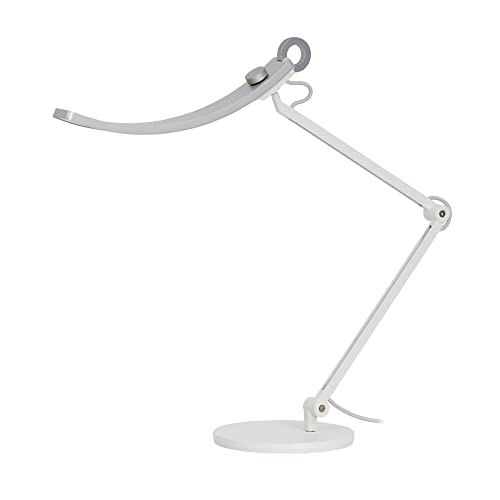
BenQ e-Reading Desk Lamp — Best Overall
Anyone who works for long stretches at a wide desk — writing, reading paperwork, coding, or mixing screen work with paper — and wants one lamp that covers the whole surface evenly instead of a narrow pool of light.
- Light source: LED, 18 watts
- Color temperature: 2700K to 5700K, adjustable
- Max illuminance: 1600 lux at 17.71 inches height
- Coverage: designed for desks wider than 35.4 inches
- Controls: touch with auto-dimming and two smart modes
Strengths
- Ultrawide, even coverage that lights a broad desk without a harsh hot spot in the middle
- Auto-dimming reacts to room light so you are not constantly reaching for the control
- Adjustable color temperature lets you shift from warm evening light to cooler focus light
Trade-offs
- Large footprint and a substantial base that needs clear desk space
- Premium positioning compared with simple clamp lamps
- Arm reach is generous side to side but it is still a base lamp, not a long drafting arm
What sets this lamp apart in daily use is not raw brightness on its own, it is how that brightness is spread. A narrow lamp can be very bright in one circle and dim everywhere else, so your eyes keep adjusting as you look across the desk. The wide head and the optical design here aim for a broad, even field, which is calmer for paperwork spread either side of a keyboard and for a notebook open next to a monitor.
The two smart modes are worth understanding rather than treating as marketing labels. One mode is tuned for screen work, balancing the light on the desk against the brightness of the display so the contrast between the two is less abrupt. The other is tuned for paper, pushing a little more light onto the page. In practice you will probably settle on one mode for your main task and only switch when your evening work looks very different from your daytime work.
Adjustment is where the lamp earns its keep over weeks, not just on day one. The arm moves smoothly enough that small corrections — a little lower for a thick book, a little higher for a larger sheet — do not feel like a fight. The touch control remembers the feel of a quick tap versus a deliberate hold, and the auto-dimming sensor does the boring work of compensating when daylight fades outside the window.
Build quality is the other reason this model keeps appearing in serious desk setups. The materials feel chosen for a lamp that will be repositioned thousands of times, and the matte finishes cut down reflections from the lamp itself. It is not a decorative lamp pretending to be a task lamp, and it is not a workshop light pretending to belong in a study. It sits confidently in between, which is exactly where most home offices live.
The honest limitation is size and commitment: the weighted base and wide head reward a permanent home position. If you move your workspace every day or your desk is very narrow, you will feel that footprint more than the benefit of the coverage.
Best for: wide desks and long sessions needing even coverage / Not suited for: tiny desks with no room for a weighted base

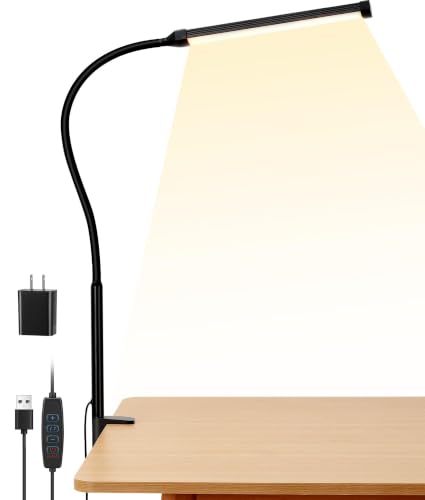
Micomlan 24W LED Desk Lamp with Clamp — Best for Balanced Rooms
Screen workers who want strong desk light without screen wash, and anyone whose room lighting is poor enough that a little upward ambient glow makes the whole corner feel balanced.
- Power: 24 watts
- Color rendering: CRI above 90 in the listing
- Design: angled-away asymmetric main light with upward ambient lights
- Joints: 7 rotatable joints in the listing
- Sensor: built-in light sensor for auto-dimming
Strengths
- Main light angled away from screens plus soft upward ambient light in one unit
- Auto-dimming sensor adapts to the room without manual fuss
- Multiple joints make it easy to fold the light around monitors and shelves
Trade-offs
- Ambient and main lights are controlled separately, which takes a day to learn
- Many joints mean more positions to get wrong on first setup
- Brightest settings are more than a small desk will ever need
The clever idea here is separation: a main light that does the task work and auxiliary lights that point upward to soften the room. A desk lamp alone in a dark room creates a bright island surrounded by darkness, and your eyes work harder every time they move between the two. A gentle upward glow narrows that gap, which is why this design feels restful during long evening sessions.
The angled-away main light follows the same logic as a monitor light bar. By throwing light onto the desk surface at an angle rather than straight down or toward the display, it reduces the mirror-like reflection you get on screens and glossy paper. You still need to position it with care — height and angle both matter — but the starting geometry is on your side.
Seven joints sound excessive until you try to light a desk with a shelf above it, a monitor in the middle, and a notebook on the side. The arm can rise, fold, and lean in ways a two-joint lamp simply cannot. Spend the first session finding two or three poses you love — work pose, reading pose, away pose — and you will stop fiddling and start benefiting.
Color rendering above 90 in the listing means colors under this light should look close to how they look in daylight, which helps with printed proofs, fabric, and artwork as well as ordinary documents. It is not a specialist color-matching booth, but for a home desk it is a meaningful step above basic LEDs that wash colors flat.
The honest limitation is complexity for its own sake if your needs are simple. If you only ever read paper at one brightness, the sensor, the ambient lights, and the many joints are features you will rarely touch — a simpler lamp will serve you just as well.
Best for: screen desks in dark rooms needing ambient balance / Not suited for: buyers who want the simplest possible controls

OttLite Creative Curves LED Desk Lamp — Best Daylight Personal Lamp
Students, readers, and crafters who want daylight-style light in a friendly, compact form — especially in dorms, bedrooms, and small desks where a big architect arm would dominate.
- Dimming: 4 dimmable brightness settings in the listing title
- Light: energy-efficient natural daylight LEDs in the listing title
- Neck: adjustable neck
- Use cases in listing: home office, computer desk, and dorms
- Brand: OttLite daylight lighting specialist
Strengths
- Daylight-balanced light from a brand built around that idea
- Curved, compact form suits dorms and small home offices
- Simple stepped brightness that is easy to share and explain
Trade-offs
- Fewer color-temperature options than multi-mode rivals
- Design-led shape offers less reach than an architect arm
- Daylight character may feel cool for warm evening readers
OttLite built its reputation on a simple claim: light that behaves more like daylight helps you see detail and color more comfortably. The Creative Curves lamp packages that idea in a small, sculptural form that looks at home in a dorm or a bedroom office, where a black metal architect arm can feel like office equipment that wandered into the wrong room.
Four brightness settings keep the lamp approachable. There is a level for bright task work, a couple for ordinary reading and writing, and a low level for winding down. Because the steps are distinct, you quickly learn which number belongs to which activity, and the lamp becomes predictable — a quality underrated in tools you use every day.
For crafts, the daylight character helps with thread, yarn, and paper colors, reducing the surprise when a project leaves the desk and meets real daylight at a window. For screen-adjacent work, position the lamp to the side of the monitor rather than behind it, so the desk is lit without a bright source competing with the display in your peripheral vision.
The curved silhouette also matters practically: there are no sharp arm joints to knock, and the lamp reads as one calm object on a small desk. If your workspace is also your living space, that calm counts. You get specialist light without the visual noise of a workshop fixture.
The honest limitation is reach and tuning: the adjustable neck covers a personal workspace well, but it is not a long arm for large boards, and its daylight focus means fewer warm options for mood lighting in the evening.
Best for: dorms, readers, and crafters wanting daylight balance / Not suited for: large boards needing long reach
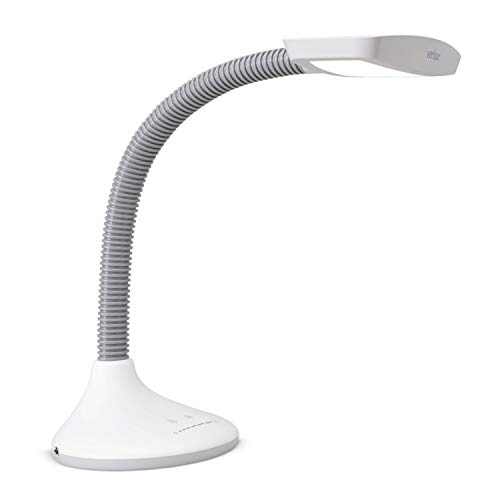
Verilux SmartLight Full Spectrum LED Desk Lamp — Best Full-Spectrum Feel
Readers, artists, and crafters who spend long, settled sessions in one spot and want light that feels natural, plus the small luxury of charging a device from the lamp base.
- Light: full-spectrum LED in the product name
- Neck: flexible gooseneck
- Brightness: adjustable brightness in the product name
- Charging: integrated USB charging port in the product name
- Positioning in listing: for readers, artists, and crafters
Strengths
- Full-spectrum positioning aimed at natural, comfortable light
- Flexible gooseneck suits reading chairs and desks alike
- Built-in USB port keeps a phone or e-reader charging at the light
Trade-offs
- Gooseneck reach is personal-scale, not drafting-table scale
- Full-spectrum benefits are about comfort and color feel, not magic
- Design is functional rather than decorative
Full-spectrum is a phrase that deserves a calm explanation. It describes light designed to spread its energy across the visible spectrum more evenly, the way daylight does, rather than spiking in a few bands. In a desk lamp, the practical effect is light that feels natural to sit under and that renders colors in a balanced way — the reason the listing points it at readers, artists, and crafters.
The gooseneck format fits settled, personal work. Curve it over a novel, an embroidery hoop, or a sketchbook and it stays, session after session, in the same trusted position. Owners of gooseneck lamps often set them once and rarely move them again, which is a different kind of adjustability from an architect arm that gets re-posed hourly — both are valid, for different working styles.
The integrated USB charging port sounds minor and proves daily. A phone, an e-reader, or wireless earbuds can sip power at the exact spot where you sit to read, which removes one cable from the floor and one charger from the wall. Small consolidations like this are how a reading corner becomes a place you actually use every evening.
Use this lamp where you linger. It rewards the long session — the chapter that becomes three, the craft project that eats an afternoon — with light that does not call attention to itself. Pair it with a comfortable chair and a side table, and you have built the oldest and best lighting setup there is: a good light, in the right place, that you forget is even on.
The honest limitation is scale and scope: this is a personal lamp for a chair or a desk corner, not a wide-coverage workstation light, and its appeal is comfort and color feel during long sessions rather than raw output numbers.
Best for: long settled reading and craft sessions / Not suited for: wide workstation coverage

Honeywell H01 Pro Sunturalux LED Desk Lamp — Best Compact Comfort
Color-sensitive workers on compact desks — illustrators checking proofs, crafters matching materials, students under long study light — who want quality of light first and a lamp that folds away second.
- Color rendering: CRI at or above 95 in the listing
- Color temperature: 3000K to 5500K in the listing
- Light source: 48 full-spectrum lamp beads in the listing
- Charging: USB and Type-C dual output ports, 5V/2.1A in the listing
- Adjustment: vertical rotation 0 to 180 degrees, horizontal swivel 0 to 90 degrees in the listing
Strengths
- Full-spectrum, high-rendering light in a space-saving folding design
- Rotary-style smooth control feel described by owners and listings
- Dual charging ports suit phone-plus-earbuds desk life
Trade-offs
- Compact output is tuned for personal zones, not whole benches
- Folding joints favor portability over drafting reach
- Premium features concentrate on light quality, not raw size
The H01 Pro refines the compact formula with a focus on spectrum. Forty-eight full-spectrum beads, in the listing’s description, spread the light across a broad, daylight-like range, and the high rendering figure means the colors you mix, sort, or proof under it stay honest. For illustrators and crafters, that honesty is not a luxury — it is the difference between work that survives daylight and work that surprises you in the morning.
Control feel matters more than spec sheets admit. A smooth rotary-style adjustment invites the tiny corrections that keep light comfortable as a session evolves — a touch brighter for fine lines, a touch warmer as the evening deepens. When control is pleasant, people actually use it, and a lamp that gets adjusted is a lamp that stays comfortable.
The folding geometry — generous vertical rotation and a useful horizontal swivel, per the listing — lets a small lamp behave bigger than it is. You can stand it tall over a keyboard, lean it low over a sketchbook, or fold it flat into a drawer. In small apartments and shared rooms, that disappearing act is a genuine feature, not a gimmick.
Finally, the dual USB and Type-C outputs acknowledge how desks actually look in this decade: a phone, earbuds, maybe a tablet, all wanting power within arm’s reach. Building that into the lamp base keeps the desk surface for work and the floor free of charger bricks. It is a small, civilized detail that you will appreciate nightly.
The honest limitation is, again, scale: this lamp invests in spectrum and rendering rather than in a huge bar or a long arm. On a compact desk that investment pays off every hour; on a sprawling worktable, pair it with room light or choose a wider lamp.
Best for: compact desks and color-sensitive work / Not suited for: sprawling benches needing a long arm

Lepro LED Desk Lamp 9.5W — Best Diffused Value
General desk workers, sewers, puzzle fans, and readers who want one versatile, diffused lamp for a normal desk — bright enough for detail, soft enough for long sessions.
- Power: 9.5 watts
- Output: 800 lumens
- Color rendering: CRI 85 in the listing data
- Color temperatures: 3000K, 3500K, 4000K, 5000K, 6500K
- Light source: 72 LEDs with frosted diffuser, 5 color modes and 5 brightness levels
Strengths
- Diffused, even light that is gentle on glossy paper and screens nearby
- Twenty-five mode and level combinations cover most desk tasks
- Slim, foldable form suits almost any desk style
Trade-offs
- CRI 85 is good, not specialist-grade for color-critical proofing
- Base design takes a small footprint of desk surface
- Touch controls can be sensitive when you move the lamp
Diffusion is this lamp’s quiet superpower. Seventy-two LEDs behind a frosted shade merge into one soft source, so the light on your page has gentle edges and your hands cast soft shadows. For sewing, puzzles, model work, and handwriting, that softness reduces the visual noise that makes detailed work tiring, especially under the hard little spotlights built into cheaper lamps.
The five-by-five grid of color modes and brightness levels sounds like arithmetic and feels like freedom. Cooler and brighter for morning paperwork, neutral for afternoon screen-and-paper mix, warmer and lower for evening reading — the lamp covers the daily arc of a desk without ever feeling like it is shouting. Memory behavior means it also remembers where you left it, which removes a small daily friction you will not miss.
Its slim profile respects the reality that desks accumulate objects. The lamp folds, tucks, and coexists with monitors, speakers, and the inevitable stack of notebooks. In shared and small workspaces, a lamp that does not demand its own territory is a lamp that stays on the desk instead of being exiled to a cupboard.
For drawing and sketching, treat it as a strong general light: position it opposite your drawing hand to keep your own shadow off the page, use a mid-to-cool temperature for pencil contrast, and drop a level when you move to inking or coloring so the page does not glare. It rewards thoughtful placement like any good tool.
The honest limitation is specialization: this is an excellent all-rounder, and all-rounders concede the extremes. Color-critical artists should step up to a 95-plus rendering lamp, and owners of very wide desks should look at a bar or arm design for coverage.
Best for: general desks wanting soft, even light / Not suited for: color-critical proofing needing 95+ rendering
Comparison Table
| Pick | Mount | Key spec | Best use |
|---|---|---|---|
| BenQ e-Reading Desk Lamp | Weighted base | 2700K–5700K, 1600 lux, auto-dimming | Best Overall |
| Micomlan 24W LED Desk Lamp with Clamp | Clamp | 24W, CRI above 90, auto-dimming sensor | Best for Balanced Rooms |
| OttLite Creative Curves LED Desk Lamp | Base | 4 brightness settings, daylight LEDs, adjustable neck | Best Daylight Personal Lamp |
| Verilux SmartLight Full Spectrum LED Desk Lamp | Base | Full-spectrum LED, gooseneck, USB port | Best Full-Spectrum Feel |
| Honeywell H01 Pro Sunturalux LED Desk Lamp | Foldable base | CRI 95+, 3000K–5500K, USB-A plus C | Best Compact Comfort |
| Lepro LED Desk Lamp 9.5W | Base | 800 lumens, 72 LEDs, 5 modes x 5 levels | Best Diffused Value |
How to Choose a Desk Lamp for Comfortable, Easy-on-the-Eyes Light
Start with steadiness and diffusion, the two qualities your eyes notice without your brain naming them. A lamp whose listing describes flicker-free design and a diffused or surface light source will generally feel calmer than a bare, point-source lamp at the same brightness, because the light arrives evenly rather than sparkling from a few intense points. Frosted shades, diffusion panels, and wide LED arrays — all represented in this guide — are the physical forms that steadiness takes. If you are sensitive to harsh light, let these design features outrank headline brightness every time.
Next, balance the contrast in your whole visual field, not just on the page. A bright desk island in a dark room forces your eyes to re-adapt every time you look up, and that constant adjustment is tiring in the ordinary, everyday sense. Two designs help: ambient or upward light from the lamp itself, as in the Micomlan pick, and a modest room light left on while you work. Judge a lamp partly by how gracefully it can be one element in a balanced room rather than the only light in a cave. The wider setup advice in desk lighting and cable management guide will help you plan that room as a whole.
Dimming range is your comfort control, so prefer range and smoothness. The comfortable brightness for noon paperwork is wrong for evening reading, and both are wrong beside a dimmed monitor at midnight. Stepless dimming finds the in-between levels that fixed steps skip, while memory functions return you to yesterday’s comfort without a fresh hunt. When you test a new lamp, resist maximum brightness entirely for the first week — most people discover their comfortable level sits well below the top of the range, and living there makes long sessions feel markedly easier.
Color temperature shapes comfort across the day. Cooler, daylight-range light feels alert and suits detailed morning work; warmer light feels relaxed and suits the evening wind-down, reading, and handwriting. An adjustable lamp lets your desk follow that arc. A fixed-character lamp asks you to choose your arc in advance. Neither is a health feature — it is a mood and habit feature — and the right answer is the one that matches when and how you actually use your desk. Night owls who also struggle with mornings may find best wake up light alarm clocks a natural companion purchase.
Position is a comfort feature you control for free. Light should land on your work, not in your eyes: keep the head above your line of sight, angled down at the desk, and to the side opposite your writing hand. Beside a monitor, the lamp should light the desk surface without washing the screen or shining past it toward your face. Angled-away and asymmetric designs exist precisely to help with this geometry, but any lamp in this guide can be positioned well with two minutes of care, following the setup steps below.
Finally, build the lamp into a comfortable routine rather than expecting it to work alone. Comfortable desk workers share habits: they set light once per session instead of constantly adjusting, they look up and away regularly, they keep the room softly lit, and they notice when a setup change — a new monitor, a moved desk — has quietly broken a good arrangement. Choose the lamp whose controls make those habits easy: reachable, memorable, and pleasant to adjust. That is the honest promise of this category, and it is enough. For color-critical desk work under the same lamp, see best desk lamps for drawing.
Key Takeaways
- Favor steady, diffused light over headline brightness for long, comfortable sessions.
- Balance the room: a soft ambient light alongside the desk lamp beats a bright island in darkness.
- Your comfortable brightness is probably well below maximum — find it and use memory to keep it.
- Position light onto the work and away from your eyes and screen; geometry is comfort.
- Judge the lamp by a week of real work, not by a first dazzling switch-on.
How to Set Up a Desk Lamp for Comfortable Long Sessions
A comfortable setup is built in layers: the room first, the lamp position second, the settings third, and your habits last. Most people do the layers in reverse — they buy settings, fiddle with them hourly, and never fix the room or the geometry underneath. Work through this section in order and you will feel the difference in a single evening, with the lamp you already chose doing exactly what it was designed to do.
Keep a notebook or a phone note for your settings during the first week. Comfortable light is personal, and the fastest way to learn yours is to record what felt good for which task at which time of day. After a week, the note becomes your setup memory — and if your lamp has a memory function, it will simply hold the answer for you.
- Soften the room first: turn on a modest ambient light or open curtains to a gentle level, so the desk lamp will not be the only light in the space.
- Place the lamp to the side opposite your writing hand, with its head above your eye line and angled down onto the work surface.
- If you work at a screen, angle the light onto the desk in front of the keyboard, not onto the display and not past it toward your face.
- Start at a low-to-mid brightness — deliberately below what looks impressive — and raise it slowly until the page is clear and easy, then stop.
- Choose a color temperature for the time of day: cooler for alert morning detail, warmer for the evening wind-down.
- Work for twenty minutes, then look up and around the room: if the room feels like a cave by contrast, raise the ambient light rather than the lamp.
- Note the brightness and temperature that felt easy for this task, and set or save them so tomorrow starts from comfort.
- Repeat the quick contrast check whenever you change tasks, monitors, or rooms — comfort is a setup, not a setting you find once forever.
Problem: the page feels harsh even at moderate brightness. Fix: check for glare first — tilt the head, shift it sideways, or lower it a level; harshness is usually reflection, not power. Problem: the screen looks washed out since the new lamp arrived. Fix: move the lamp so its light lands on the desk rather than the display, and drop the lamp a level; screens need a lit desk around them, not light on them. Problem: evenings feel stark and unrelaxing. Fix: warm the temperature, lower the brightness, and add a soft ambient source; a single cool, bright lamp is a morning tool being asked to do an evening job. Problem: you keep adjusting the lamp all session. Fix: set it once using the steps above, note the setting, and give your eyes a full session to settle before judging — constant adjustment is often the discomfort, not the cure.
Support the lamp with habits that cost nothing. Look away from the desk regularly and let your gaze rest on the far side of the room. Blink, stretch, and stand when a task naturally pauses. Keep the lamp’s shade clean, because dust dims and yellows light gradually. And if discomfort at your desk persists or worries you, the right next step is a conversation with a qualified professional, not a brighter lamp — this guide’s promise is a more comfortable desk, honestly and only that. Readers arranging a calmer bedroom desk may also like best sunrise alarm clocks for heavy sleepers.
Comfort is easiest to judge across a week, not a minute, so give a new lamp a fair trial before you decide it has failed. Use the setup routine on day one, keep your settings note for the first several sessions, and pay attention to the end of long work blocks: do you leave the desk feeling like you worked, or like you fought the light? That end-of-session feeling is the honest metric for this entire category, and no specification sheet can report it for you.
Small environmental changes multiply a good lamp’s effect. A desk that faces a wall gives light a calm backdrop; a desk facing a bright window asks the lamp to compete all afternoon. Curtains, monitor brightness matched to the room, and a page or document stand that brings work up into the light all support the same goal. Treat the lamp as the leader of a small team of comfort choices, and the team will outperform any single purchase.
If you share the desk — a partner on opposite shifts, a child doing homework where you work — leave your settings note on the desk itself. Comfortable light is personal, and a shared note (‘evening reading: warm, low; morning paperwork: cool, mid’) turns arguments about the lamp into a two-line reference card. The best setups are the ones a household can reproduce without the person who designed them standing by.
Common Buying Mistakes
Mistake one is buying maximum brightness for a comfort problem. Harsh, overbright light is one of the most common reasons a desk feels unpleasant, and it is the easiest to create by shopping for the biggest number. Shop for range, steadiness, and diffusion instead — and live below maximum.
Mistake two is working in a bright island surrounded by darkness. The contrast between a lit desk and a black room makes every glance outward an adjustment. A soft ambient light — from the lamp’s own upward glow or a modest room light — is the cheapest comfort upgrade in this entire guide.
Mistake three is aiming the lamp at the screen or past it. Light belongs on the work surface. On the display it washes out contrast; past the display it shines toward your face. Two minutes of angling fixes both, and angled-away designs in this guide exist to make that angling easy.
Mistake four is setting the lamp once, at noon on day one, and never revisiting it. Comfort changes with the task, the season, and the time of day. Use the lamp’s range, keep a note of your favorite settings, and re-run the short setup routine when your desk changes.
Mistake five is expecting a lamp to carry the whole of desk comfort alone. Chair, screen height, breaks, and room light are partners in how a long session feels. The lamp is the partner this guide can help you choose well — honor the others with the same care, and see best ergonomic office chairs in our live guides if your chair is the weak link.
Final Recommendation
For most readers, start with BenQ e-Reading Desk Lamp. It is the pick we would buy first for this exact job, and it is the one least likely to need replacing when your desk or your habits change a little. As a runner-up, choose Micomlan 24W LED Desk Lamp with Clamp, which covers the same ground with a different strength — read its review above and decide which trade-off fits your room, your desk edge, and the way you actually work in the evening as well as the morning.
Whichever you choose, set it up carefully on day one, live with it for a week of real work, and adjust its position before you judge its light. Desk lamps reward placement more than almost any other desk purchase, and an hour of honest positioning is worth more than another hour of comparison shopping.
Frequently Asked Questions
Can a desk lamp really help my desk feel more comfortable for long sessions?
It can remove common everyday irritations — glare, harsh contrast with a dark room, light that feels unsteady, and brightness that is hard to tune — and those removals make long sessions feel easier. This guide makes no medical claims; it is about light quality, positioning, and habits, judged by the simple standard of a desk that feels pleasant to work at.
What does flicker-free actually mean when I am shopping?
It describes a driver and light design intended to keep output steady rather than pulsing. You cannot verify it from a photo, so treat it as one design signal among several — alongside diffusion, dimming range, and sensible positioning — and buy from listings that describe their light design in concrete terms, as the picks in this guide do.
Should I choose warm or cool light for evening work?
Most people find warmer light more relaxing in the evening and cooler light more alert in the morning, which is why adjustable lamps are so popular for desks that serve both. Treat it as a comfort and mood choice: experiment across a week, note what feels easy, and let your own evenings decide.
How bright should my desk lamp be for reading and paperwork?
Bright enough that the page is clear without effort at your normal working distance — and, for most people, well below the lamp’s maximum. Start low, raise slowly, and stop at the first level that feels easy. If you are squinting, add light or move the lamp closer; if the page glares, you have gone too far or the angle is wrong.
Is a monitor light bar better than a desk lamp for screen work?
They solve different halves of the problem. A bar lights the desk in front of a screen without touching the display; a desk lamp also lights paper, books, and the wider desk. Many screen workers end up happiest with a good desk lamp positioned carefully, as described in our setup section — and the two approaches can coexist on larger desks.
Why does my desk feel uncomfortable even with a good lamp?
Comfort is cumulative: room contrast, screen height, chair support, and work habits all contribute alongside light. Re-run the setup steps in this guide, soften the room light, and check your lamp’s angle before blaming its brightness. If discomfort persists or concerns you, speak with a qualified professional rather than shopping for a stronger lamp.
What is the single best first change for a more comfortable desk?
Balance the contrast: add a soft ambient light so your desk lamp is not a bright island in a dark room, then set the lamp itself a little dimmer than instinct suggests. It costs almost nothing, it works with any lamp in this guide, and most people feel the difference the same evening.