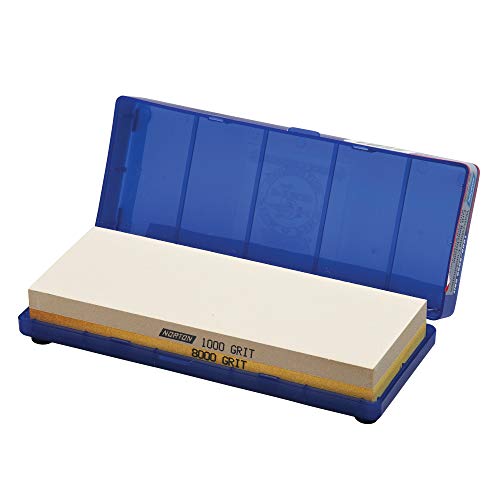
A dull kitchen knife is slower and less safe than a sharp one, because it slips on tomato skin and needs more force to cut. A sharpener restores the edge so your knife glides through food again. The options range from motorized machines to small manual tools that sit on a counter.
The six sharpeners below include electric models and manual pull-through tools. We have not used these products ourselves, so confirm which knife types, angles and blade materials each one supports on the current listing before buying. Many tools are not suited to serrated or very thick blades.
As an Amazon Associate we earn from qualifying purchases. Links below are affiliate links, and they do not change the product information we give.
What to Look For
| Feature | Why it matters |
|---|---|
| Type | Electric units are fast and consistent; manual pull-through tools are small and simple |
| Angle | Match the sharpener to your knife’s edge angle, since Western and Asian styles often differ |
| Stages | More stages let you reset a dull edge, then refine and polish it |
| Knife compatibility | Check whether serrated, ceramic or thick-spined knives are supported |
| Grip and base | A non-slip base keeps the tool steady while you pull the blade through |
In this guide
Specs at a Glance
| Sharpener | Type | Stages | Notes |
|---|---|---|---|
| Chef’sChoice Trizor XV EdgeSelect | Electric | Multi-stage | Reshapes edges to a different angle |
| Work Sharp Culinary E2 | Electric | Guided | Built for kitchen knives |
| Presto EverSharp | Electric | Two-stage | Compact countertop unit |
| Kitchen IQ Edge Grip 2 Stage | Manual | Two-stage | Pull-through design |
| Longzon 4-in-1 | Manual | Multi-stage | Also covers scissors, per the maker |
| Brod and Taylor Professional | Manual | Guided | Hand-pulled with angle guides |
The 6 Best Kitchen Knife Sharpeners
Top pickBest for a full set of straight-edge kitchen knives
1. Chef’sChoice Trizor XV EdgeSelect Electric Knife Sharpener
A long-running electric sharpener from a company known for them. It is designed to reshape edges to a different angle, a feature aimed at people who want to refresh a whole block of knives.
Suits: a full set of straight-edge kitchen knives. Strengths: a respected brand and multi-stage design. Weaknesses: it takes counter space and removes some metal. Skip it if you only own one or two knives.
View Chef’sChoice Trizor XV EdgeSelect Electric Knife Sharpener on Amazon
Best for home cooks who want guided results
2. Work Sharp Culinary E2 Kitchen Knife Sharpener
An electric sharpener built for kitchen blades, with guides that help hold the knife at a set angle. Work Sharp is a respected name in sharpening, which adds confidence for home cooks.
Suits: home cooks who want guided results. Strengths: angle guides and a focus on kitchen knives. Weaknesses: it may not suit every blade shape. Skip it if you prefer a manual tool.
View Work Sharp Culinary E2 Kitchen Knife Sharpener on Amazon
Best for quick, easy touch-ups
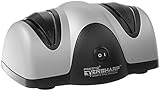
3. Presto EverSharp Electric Knife Sharpener
A compact electric sharpener known for a simple, two-stage design. It is a practical pick for people who want a quick refresh without learning a technique.
Suits: quick, easy touch-ups. Strengths: a simple build and brand familiarity. Weaknesses: less control than guided systems. Skip it if you own fine Japanese knives.
Best for a drawer or small kitchen
4. Kitchen IQ Edge Grip 2 Stage Knife Sharpener
A small manual pull-through sharpener with a gripping base. One stage coarse-sharpens, and the other hones, so you can refresh a dull knife in a few passes.
Suits: a drawer or small kitchen. Strengths: compact size and no power needed. Weaknesses: results depend on your pulling technique. Skip it if you want precise angle control.
View Kitchen IQ Edge Grip 2 Stage Knife Sharpener on Amazon
Best for a mixed set of knives and scissors
5. Longzon 4-in-1 Kitchen Knife Sharpener
A manual sharpener with several slots for different jobs, from coarse repair to fine finishing. The maker also positions it for scissors, which adds some range.
Suits: a mixed set of knives and scissors. Strengths: multiple slots in one tool. Weaknesses: the quality of a multi-slot tool can vary. Skip it if you want a premium finish.
View Longzon 4-in-1 Kitchen Knife Sharpener on Amazon
Best for cooks who want better results by hand
6. Brod and Taylor Professional Knife Sharpener
A manual sharpener that pairs sharpening stones with angle guides. It is designed to give better edges than simple pull-through tools while staying compact.
Suits: cooks who want better results by hand. Strengths: angle guidance and a quality focus. Weaknesses: it takes more practice than a motorized unit. Skip it if you want fast, one-pass sharpening.

Care and Setup
- Wash and dry each knife before sharpening so grit does not spread.
- Follow the maker’s guidance on how many passes to use per stage.
- Wipe metal dust from the sharpener after each session.
- Test sharpness on paper or a soft tomato before returning the knife to the block.
- Keep serrated knives away from tools that do not list them.
Mistakes to Avoid
- Using one sharpener on every knife without checking compatibility.
- Pressing too hard, which removes extra metal.
- Skipping the finishing stage after coarse sharpening.
- Sharpening a damaged blade without repairing chips first.
- Ignoring the stated blade angle.
Matching the Angle to Your Knives
Every knife edge is ground at an angle, and a sharpener that works at a very different angle will reshape the edge instead of simply restoring it. That can be fine, but it should be a choice rather than a surprise.
Western-style kitchen knives, such as those from European makers, commonly have a somewhat wider edge angle, which gives a sturdier edge that tolerates heavy chopping and the occasional bone or hard squash. Many Asian-style knives, including Japanese chef’s knives, are often ground at a narrower angle, which cuts very cleanly but is more delicate and can chip if mistreated. These are tendencies, not rules, so check your knife’s manual or the maker’s website for the stated angle. If you cannot find one, ask yourself what the knife is for: a thin, hard slicer needs a gentler touch than a heavy cleaver.
Check each sharpener for the angle or angles it uses. Some sharpeners have a fixed slot angle, some offer a choice of two settings and some use guides that you set yourself. A fixed-angle tool is simple, but it only works well if your knives are close to that angle. A tool that reshapes your edges to a new angle removes more metal in the process, which is acceptable for sturdy knives but not what you want for thin, fine blades.
- Look up the edge angle for your knives before buying.
- Choose a sharpener that matches the angle, or lets you select it.
- If you own both sturdy and delicate knives, consider using different tools for each.
- Avoid using any aggressive tool on a prized knife until you understand how it works.
When the listing says nothing about angle, treat that as a gap in information, and check the manual or ask the seller.
Telling Honing from Sharpening
Before you reach for a sharpener, find out whether the knife actually needs sharpening. Many knives that feel dull only have a bent edge, and a light honing session can bring them back without removing metal.
Sharpening removes metal to create a new edge. Honing realigns an existing edge that has rolled to one side during use. Think of it as straightening a bent wire versus cutting a new end. A knife that was sharp last week and now struggles is often just in need of honing. A knife that has been neglected for years, or that has chips and flat spots, needs sharpening.
A few simple tests help you decide:
- Paper test: a sharp knife slices cleanly through a sheet of paper held in the air. A dull one snags or tears.
- Tomato test: a sharp blade bites into tomato skin with almost no pressure. A dull one slides or squashes the fruit.
- Light test: look at the edge under a bright light. A reflection along the edge indicates a flat or rounded spot where it is dull.
- Feel test: if you need to press harder than usual to cut, the edge is probably worn.
If honing restores the edge for a short time but it dulls quickly again, it is time to sharpen. If the knife still fails the tests after sharpening, check for chips, a bent tip or a heel that has worn unevenly. Those problems may call for a professional service or a more advanced tool, as a pull-through sharpener cannot repair major damage. Regular honing between sharpenings keeps the edge usable for longer and means you grind metal away less often.
Abrasives and What They Do
The surface that touches your blade decides how fast it cuts, how much metal it removes and what kind of finish the edge gets. Listings use a few common terms.
Carbide is a hard material often used in simple pull-through slots. It removes metal quickly and can restore a very dull edge with a few passes, but it tends to leave a rougher, more scraped edge and takes off more steel than gentler methods. It is better for utility knives than for fine, thin blades. Diamond abrasive is extremely hard and cuts fast on almost any steel, including very hard ones. It is available in various grit sizes, with coarser grits for fast removal and finer grits for refinement. Ceramic is gentler and finer. It removes little metal and produces a smooth finish, which suits touch-ups and finishing stages. Abrasive belts, which are used in some electric models, provide controlled grinding and can be replaced when worn. Stones, such as those in guided kits, offer a range of grits and a lot of control, but they take longer.
Multi-stage sharpeners combine these abrasives so you can start coarse and finish fine. A common arrangement uses a coarse stage to set the edge, followed by a finer stage to refine and polish it. Use the coarse stage sparingly: a knife that is only slightly dull should skip it and go straight to the fine one.
- Choose fine abrasives for regular upkeep and thin blades.
- Reserve coarse abrasives for neglected or damaged edges.
- Check whether worn parts such as belts or wheels are replaceable.
Technique for Pull-Through and Electric Models
A good sharpener can still give poor results if it is used wrongly. A few technique habits are the same across most pull-through and electric models.
First, read the manual. The maker will state how many passes to use in each stage, how much pressure to apply and which knife types the sharpener supports. Place the sharpener on a stable surface, and if it has a non-slip base, make sure it is clean and dry so it does not slip. Hold the knife straight, not tilted, because tilting changes the angle at the edge. For a pull-through, draw the knife from heel to tip in one smooth motion, using light, even pressure and letting the slot guide the blade. For an electric unit, let the motor and guides do the work and keep the knife moving at a steady pace, without pressing down.
Count passes, and stop as soon as the knife is sharp. Over-sharpening wears away the blade for no benefit. After sharpening, run the knife lightly through the finest slot a few times to clean up the edge, then wipe it and test it on paper or a tomato.
- Keep fingers well away from the blade path and the sharpener’s slot.
- Use the same number of strokes on both sides of the edge to keep it even.
- Sharpen the heel to the tip, without lifting at the end.
- Clean the knife with a damp cloth to remove metal dust before using it on food.
- Do not use water on electric models unless the manual says it is safe.
If the results are inconsistent, the cause is often a tilted knife or uneven pressure. Slow down and watch the blade as it passes.
Choosing a Sharpener for Your Kitchen
The best sharpener is the one that fits your knives, your habits and your space. Answering a few practical questions makes the choice much easier.
Start with your knives. If you have a few sturdy, mid-range knives and want a fast, forgiving tool, an electric model or a simple two-stage pull-through is a sensible match. If you own thin, hard or expensive knives, look for a sharpener that is made for that kind of blade, with fine abrasives and guides, or consider a guided manual system. Think about how often you cook. Someone who prepares meals daily will notice dull edges sooner than someone who cooks occasionally, and may want a tool that stays within reach.
Think about the space you have. An electric sharpener sits on a counter or lives in a cupboard, and it needs a nearby outlet. A manual pull-through tucks into a drawer. Consider noise as well, since electric units can be loud for a short time, and some people mind it.
Price tiers describe tradeoffs rather than quality:
- Simple, low-cost tools are quick and easy but offer less control and may remove more metal.
- Mid-range electric and guided tools add stages, guides and better finish.
- Higher-end systems give the best control and can handle many knife types, but take more time to learn.
Also check what happens if something wears out. Some sharpeners have replaceable belts or abrasives, and others must be replaced entirely. Ask about support, replacement parts and warranty terms before you buy. If you share a kitchen with other cooks, a tool that is simple and safe to use may matter more than the finest edge.
Which kitchen knife sharpener should you buy?
The right kitchen knife sharpener depends on how many knives you own, how much practice you want and how much counter space you can spare. Match your situation to the picks already covered above.
- A full block of straight-edge knives: the Chef’sChoice Trizor XV EdgeSelect is the electric option aimed at refreshing a whole set, and it can reshape edges to a different angle.
- Guided electric results: the Work Sharp Culinary E2 is built for kitchen knives and uses guides to hold the blade at a set angle.
- A quick touch-up with no learning curve: the Presto EverSharp is a compact two-stage electric unit.
- A drawer-sized manual tool: the Kitchen IQ Edge Grip 2 Stage needs no power and is simple to store.
- Knives plus scissors: the Longzon 4-in-1 has several slots, and the maker also positions it for scissors.
- Better edges by hand: the Brod and Taylor Professional pairs stones with angle guides, so it rewards patience.
If you are unsure, start from your knives rather than the tool. Sturdy mid-range knives forgive almost any option here, while thin, hard blades call for a guided system and a gentle touch. Compare the two or three picks that fit, then read the current listing for supported blade types.
What to check before you buy a knife sharpener, and who should skip it
Before buying a kitchen knife sharpener, confirm that it supports your blades, then decide whether you will really use it. A short checklist catches most mistakes.
- Does the listing state the edge angle or angles, and do they suit your knives?
- Are serrated, ceramic or thick-spined knives supported, if you own any?
- Is there a non-slip base, and does the tool feel stable on your counter?
- For electric models, is there a free outlet nearby and room to store the unit?
- Are abrasives, belts or wheels replaceable, and what does the warranty cover?
- What is the return policy if the angle or fit is wrong for you?
- Is there a coarse stage you can skip for light touch-ups?
Now the honest trade-offs. Electric sharpeners are fast but remove more metal and take space. Manual pull-through tools are cheap in effort and storage, yet results depend on your technique and they give little angle control. Guided manual systems give the best control but ask for time and practice.
You may want to skip a sharpener entirely if your knives only need honing, if you own a single prized knife that deserves a professional service, or if you rarely cook. Skip a fixed-angle tool if your knives are ground at a very different angle from it.
Compare the picks above, check the current listing for supported blade types and what is included, then choose the one that fits how you will use it.
Knife Sharpener FAQ
How often should I sharpen kitchen knives?
It depends on how much you cook. Honing between sharpening sessions can extend the time between them.
Are electric sharpeners safe for good knives?
Many remove more metal than manual tools, so confirm the tool suits your blade type.
Do manual sharpeners work well?
They are fine for routine upkeep, though technique matters.
Can one sharpener handle serrated knives?
Only if the listing says so.
How do I find my knife's edge angle?
Check the maker's manual or website. Western-style knives are often ground at a wider angle than many Asian-style knives, but this varies, so confirm for your own knives.
How can I tell if my knife needs sharpening or just honing?
If it was sharp recently and has begun to struggle, honing may fix it. If it fails the paper and tomato tests after honing, or has flat spots or chips, it needs sharpening.
Is carbide a bad abrasive?
It is fast and effective on dull edges, but it removes more metal and leaves a rougher edge. Use it sparingly and avoid it on thin or delicate knives.
How many passes should I use?
Follow the manual. Count your passes and stop when the knife is sharp, since extra strokes only remove metal.
Can I sharpen a chipped knife with a pull-through tool?
Minor chips may be worn out over time, but large chips or a broken tip usually need a more capable tool or a professional service.
Do I need to clean the knife after sharpening?
Yes. Wipe or rinse it to remove metal dust before cutting food, and dry it thoroughly.
Is an electric sharpener loud?
It makes noise while the motor runs, usually for a brief time. If noise bothers you, a manual pull-through or guided kit is quieter.
What is the best type of knife sharpener for beginners?
A two-stage pull-through or a guided electric model is usually the easiest start, because the slot or guide holds the angle for you. Manual stones and guided kits take more practice. Check that the listing supports your blade type.
Are electric knife sharpeners worth it?
They are worth it if you have several knives and want fast, repeatable results. They cost counter space and remove more metal than gentle manual methods. For one or two knives, a small manual tool may be enough.
Can a knife sharpener damage a good knife?
Yes, if the tool is too aggressive or the angle is wrong for the blade. Thin, hard knives are the most vulnerable. Use fine abrasives, count your passes and read the maker's guidance first.
How do I know if a sharpener fits my knife brand?
Brand matters less than the edge angle, blade thickness and steel type. Look up your knife's stated angle and compare it with the sharpener's listing. If the listing gives no angle, ask the seller or check the manual.
Should I sharpen a knife before or after washing it?
Wash and dry it first so grit and food residue do not spread across the abrasive. Wipe off metal dust after sharpening and before cutting food. Dry the blade fully to avoid spots.
Do I need to sharpen both sides of the blade?
Most double-bevel kitchen knives need both sides worked evenly, which pull-through slots handle for you. Some single-bevel knives are sharpened differently and need a suitable tool. Check the knife maker's guidance.
The Short Version
For a full-block refresh, the Chef’sChoice Trizor XV. For guided kitchen results, the Work Sharp Culinary E2. For simplicity, the Presto EverSharp. For a small manual tool, the Kitchen IQ. For multiple slots, the Longzon. For better manual edges, the Brod and Taylor.