Where to buy
Check the latest price, availability and delivery on Amazon. Orders are placed on Amazon. We may earn a commission from qualifying purchases.
An honest note before the list: there is no ergonomic office chair from any established maker at this budget — the cheapest credible mesh chairs with real lumbar support sit a clear step above it. The six chairs below are the closest real options, presented without purchase links so this guide stays honest: they are the step-ups worth saving for, in the order we would buy them. Check the current price on Amazon when you are ready.
- Closest real option overall: BestOffice Ergonomic Office Chair, Mid-Back Mesh — the benchmark to save for — covered in the reviews below
- Closest option with certifications: NEO CHAIR High Back Mesh Chair with Flip-Up Armrests — the credentialed step-up — covered in the reviews below
- Closest option with full dimensions: Furmax Office Chair, Mesh Mid-Back — the measured step-up — covered in the reviews below
See 3 more options below
- Closest armless mesh option: Sweetcrispy Low-Back Mesh Office Chair, Armless — the small-desk step-up — covered in the reviews below
- Closest compact upholstered option: Sweetcrispy Small Armless Desk Chair, PU Leather — the furniture-look step-up — covered in the reviews below
- Closest low-profile option: Furmax Mid-Back Task Chair, PU Leather, Armless — the low-profile step-up — covered in the reviews below
Read the full guide ↓
Disclosure: As an Amazon Associate, umtsmarttool.com earns from qualifying purchases. Links to Amazon on this page are affiliate links; they cost you nothing extra. Listing details such as price and availability change often, so check the current Amazon listing before you buy.
The best ergonomic office chair for small spaces under $30 does not exist — and small spaces suffer the $30 listings worst, because a bad chair in a small room is not just uncomfortable, it is inescapable: too wide for the desk, too bulky for the corner, and not even supportive for its size. This guide names the six closest real chairs a modest step above the budget, chosen compact — armless tuck-away designs, a flip-up-armed chair, frames light enough to move daily — with verified capacities stated for each. The best ergonomic office chair for small spaces under $30 search ends at the nearest chairs that respect both your body and your floor plan, and our Best Small Desk Under $30 guide covers the small-desk half of the problem meanwhile.
In this guide
Quick Picks
Short on time, or comparing several options at once? Each row below names a buyer type and the ergonomic office chair that suits it, with the key specification that separates it from the rest of the list.
| Buyer type | Pick | Why it stands out | Link |
|---|---|---|---|
| Closest real option overall | BestOffice Ergonomic Office Chair, Mid-Back Mesh — the benchmark to save for | Mesh mid-back chair with lumbar support, sponge seat, adjustable height; seller-stated capacity 250 lb | See review below |
| Closest option with certifications | NEO CHAIR High Back Mesh Chair with Flip-Up Armrests — the credentialed step-up | High-back mesh chair, adjustable lumbar, flip-up arms, waterfall seat; 250 lb maximum, BIFMA-tested base/casters, SGS-certified lift | See review below |
| Closest option with full dimensions | Furmax Office Chair, Mesh Mid-Back — the measured step-up | Mesh mid-back chair, seat 19.7 x 19.7 in, seat height 16.5-20.5 in, SGS-certified lift, 240 lb capacity | See review below |
| Closest armless mesh option | Sweetcrispy Low-Back Mesh Office Chair, Armless — the small-desk step-up | Armless low-back mesh chair with lumbar support; 250 lb maximum per the listing | See review below |
| Closest compact upholstered option | Sweetcrispy Small Armless Desk Chair, PU Leather — the furniture-look step-up | Compact armless PU-leather chair, U-shaped lumbar support, padded foam seat; 250 lb maximum per the listing | See review below |
| Closest low-profile option | Furmax Mid-Back Task Chair, PU Leather, Armless — the low-profile step-up | Armless mid-back task chair in faux leather, bucket seat; 210 lb maximum per the listing | See review below |
How These Picks Were Chosen
Why this guide has no chairs under $30 to sell you: the tier was searched first, before any step-up was considered. What it contains is stools, armless shells and chairs whose listings publish no weight capacity at all — products that call themselves ergonomic with nothing verifiable behind the word. Rather than link them, this guide documents the six closest real chairs, each verified the same way as our standard guides: published capacity, describable support construction, stated certifications where they exist.
Every chair in this guide is a real, currently listed product whose key specifications were verified against the maker’s listing or documentation: rated weight capacity, back construction (mesh or upholstered), seat-height adjustability, armrest type, and any certifications the maker actually claims (SGS gas-lift testing and BIFMA-tested components appear on several picks — and only where the maker states them). Listings that use the word ‘ergonomic’ with no published capacity and no describable support features were excluded.
We did not sit in these chairs. The comparisons rest on published construction — mesh versus foam-and-vinyl, fixed lumbar curves versus adjustable supports, nylon versus metal bases — and on the fit between those constructions and the working pattern each version of this guide addresses. Comfort language in the reviews is framed as exactly that: what a design tends to feel like and for whom, never as a medical claim. No chair at any price treats or prevents back conditions, and this guide does not pretend otherwise.
The budget was applied as a ceiling, and at this ceiling honesty requires a framing note: ‘ergonomic’ at this level means a shaped mesh back, some form of lumbar support, a height-adjustable seat and a proper five-point base — a real and worthwhile package for a few hours a day. It does not mean the multi-adjustable task chairs of the higher tiers, and the reviews say plainly where each chair’s support story ends.
Small spaces added a footprint audit to the usual verification: each pick’s arm style was checked against the tuck-under test (can the chair disappear under a standard desk?), and weights were recorded because small-room chairs get moved daily. Two full-size chairs with fine specifications were cut for failing the room, not the body.
Best Ergonomic Office Chair For Small Spaces Under $30 — The 6 Closest Real Options
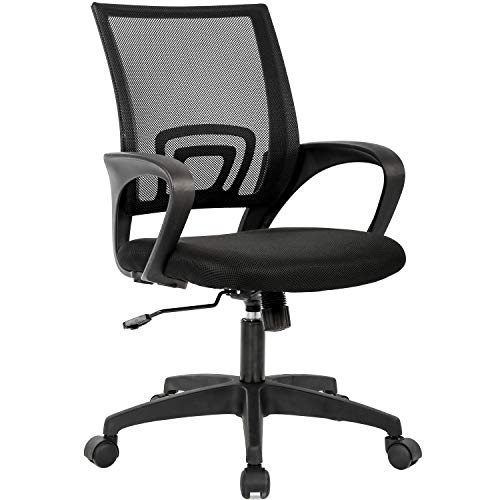
1. BestOffice Ergonomic Office Chair, Mid-Back Mesh — the benchmark to save for — Closest real option overall
If you save for one chair, save for this one. The BestOffice is the budget mesh class’s benchmark: a ventilated mesh back with a lumbar curve, a padded sponge seat, height adjustment and a five-point base, with a seller-stated 250 lb capacity, at the lowest price of any chair in this step-up list — typically a modest step above this guide’s budget. That small gap is the entire lesson of this tier: the distance between a $30 hope and a real ergonomic chair is one small increment, not a leap to the premium tiers.
Its support is a fixed mesh curve rather than a mechanism, so it suits a few hours a day better than eight — but as the first real chair after a dining chair or a stool, it is transformative, and it is the chair this guide’s step-up list is ordered around.
The saving arithmetic deserves one honest paragraph: the distance from this guide’s budget to this chair is the price of a modest takeaway meal, and the chair will be sat in for thousands of hours. Few purchases in a home office repay their increment as completely. If the budget is truly fixed today, the improvisation guidance in this guide — cushions, a rolled towel for lumbar support, a box for your feet — will carry you the few weeks the saving takes.
For small spaces, judge this chair by the tuck-under test first: arms, footprint and weight decide whether the room works; support decides whether the sitting works. A pick must pass both.
Pros
- The class benchmark at the smallest step up
- Real mesh back and lumbar curve
- 250 lb seller-stated capacity
Honest limitation: It is not under $30 — nothing credible is; it is the closest honest step up.
Choose it if you can stretch the budget once and want the proven budget chair.
Skip it if you need a chair today at exactly $30 — that product does not exist as an ergonomic chair; see the alternatives in this guide.
2. NEO CHAIR High Back Mesh Chair with Flip-Up Armrests — the credentialed step-up — Closest option with certifications
The NEO CHAIR step-up adds the two things money above this tier buys first: stated credentials (BIFMA-tested casters and base, an SGS-certified gas lift) and adjustable lumbar support, plus flip-up armrests that tuck the chair under any desk. It typically sells a step above the BestOffice. For a buyer whose current seat is genuinely hurting their workday, this is the step-up whose extra spend is easiest to justify line by line.
Its ceiling is the class-standard 250 lb, and its seat foam is of standard depth. What you are buying over the benchmark is adjustability and documentation — the two things that decide whether a budget chair still serves in year three.
For the remote and home-office buyer, this step-up has a paperwork virtue beyond its certifications: it is the easiest chair in this list to justify to an employer’s home-office stipend or to your own records, because every claim about it is documented by its maker. Undocumented chairs are hard to expense and harder to warranty; this one arrives with its evidence attached.
Small-spaces tiebreaker: item weight. In a small room the chair is furniture in motion — rolled, tucked, carried — and the lightest adequate chair wins ties over the heaviest excellent one.
Pros
- Stated BIFMA and SGS credentials
- Adjustable lumbar and flip-up arms
- High-back support
Honest limitation: Above this budget, at the class-standard 250 lb ceiling.
Choose it if you want the most documented, adjustable chair in the budget class.
Skip it if your weight exceeds 250 lb — your step-up market is the higher tiers’ 300 lb class.
3. Furmax Office Chair, Mesh Mid-Back — the measured step-up — Closest option with full dimensions
Furmax’s step-up is the one you can fit on paper: seat 19.7 by 19.7 inches, seat height 16.5 to 20.5 inches, an SGS-certified gas lift and a stated 240 lb capacity, all published. It typically sells around the top of the under-$50 tier. For a buyer burned before by a chair that arrived the wrong size, that published-dimension honesty is the feature — measure yourself against the listing and the chair that arrives is the chair you chose.
The 240 lb ceiling is the step-up list’s second-lowest, so the capacity check comes first. Dimensions second: its seat is a touch wider and deeper than the benchmark’s, which average and larger builds tend to prefer for sessions of a few hours.
The measured step-up rewards a specific ritual: measure yourself first (the five-minute check in this guide), then read this chair’s published dimensions against your numbers, and order only if they agree. It sounds obvious; almost nobody does it, which is why chairs get returned. This maker’s transparency makes the ritual possible — the only chair in this step-up list whose seat you can truly try on paper.
For compact desks, prefer chairs whose support does not depend on bulk: a shaped mesh low-back supports as honestly in a corner as a high-back does in an office, and it lets the room breathe.
Pros
- Every key dimension published
- SGS-certified gas lift
- Generous seat for average builds
Honest limitation: Above this budget; 240 lb ceiling.
Choose it if you want to fit a chair by numbers before it ships.
Skip it if you need more capacity — the benchmark and NEO step-ups carry 250 lb.
4. Sweetcrispy Low-Back Mesh Office Chair, Armless — the small-desk step-up — Closest armless mesh option
For a small desk — a vanity, a bedroom corner, a low-apron table — the armless Sweetcrispy is the step-up that fits where armed chairs cannot: no armrests to collide with the desk, a breathable low-back mesh with lumbar support, a stated 250 lb maximum, and the lightest build in this list, so it moves between rooms without a thought. It sells in the same modest step-up band as the benchmark.
Armless is a posture choice as much as a size one: it suits varied sitting and shorter sessions, and it gives up elbow support that long typing wants. If your desk is small and your sessions are a few hours, this is your step-up; if your sessions are marathons, save for an armed pick instead.
In a small room this step-up has one more virtue: it makes the desk look intentional. A real chair — even an armless, featherweight one — turns a vanity or a corner table into a workstation in a way a stool never does, and that difference is part of what the step up buys. Your work corner will feel like a place you chose, not a place you ended up.
For small spaces, judge this chair by the tuck-under test first: arms, footprint and weight decide whether the room works; support decides whether the sitting works. A pick must pass both.
Pros
- Fits under any desk, including low aprons
- Featherweight, room-to-room easy
- Mesh breathability with a 250 lb stated maximum
Honest limitation: Above this budget; no armrests for long typing sessions.
Choose it if your desk or room forbids armrests and your sessions are moderate.
Skip it if you type all day — an armed step-up serves you better.
5. Sweetcrispy Small Armless Desk Chair, PU Leather — the furniture-look step-up — Closest compact upholstered option
The upholstered step-up: PU leather over foam, a U-shaped lumbar support in the back’s structure, a compact armless frame, and a stated 250 lb maximum on a metal base. It is the step-up for rooms where a black mesh chair would look like office equipment that wandered in — bedrooms, vanities, living-room desks. It sells in the same band as its mesh sibling.
Upholstery trades breathability for cushion and looks, and PU surfaces age faster than mesh under daily use. Sessions of a few hours in a temperate room are its home ground — within them, it is the most presentable chair in this step-up list.
Budget the step up with its lifespan in mind: PU upholstery at this level is a few-years surface, so this chair suits a room whose look matters now — a first apartment, a bedroom office, a guest-room desk — more than it suits a decade-long installation. Bought with that horizon stated, it is an honest purchase; bought as a forever chair, it would disappoint on a schedule the listing never promised otherwise.
Small-spaces tiebreaker: item weight. In a small room the chair is furniture in motion — rolled, tucked, carried — and the lightest adequate chair wins ties over the heaviest excellent one.
Pros
- Looks like furniture, not office surplus
- Cushioned first sit with structured lumbar support
- Compact armless frame, 250 lb stated maximum
Honest limitation: Above this budget; PU holds heat and ages faster than mesh.
Choose it if the chair must match a bedroom or living room and sessions are moderate.
Skip it if you sit long hours in a warm room — the mesh step-ups breathe.
6. Furmax Mid-Back Task Chair, PU Leather, Armless — the low-profile step-up — Closest low-profile option
The final step-up is the stylist’s: a low-profile bucket-seat task chair that tucks completely under a desk and reads as a designed object in a small room. The listing states a 210 lb maximum — the clearest limit in this list, stated here so the right buyer finds it: a lighter user at a small desk, in sessions rather than marathons, who values the room’s look and the chair’s disappearing act.
Everyone else should read its numbers as directions to the step-ups above it. That is what an honest step-up list is for: not six versions of the same chair, but a ladder whose rungs are labeled with who should stop at each.
The low-profile step-up closes the list with the narrowest brief and the clearest labeling, which is what an honest ladder looks like: six chairs, six different right buyers, and no pretense that the cheapest tier of all — this guide’s budget — contains any of them. Save for the rung that matches your body and your room, and the saving itself will feel shorter for knowing exactly what it buys.
For compact desks, prefer chairs whose support does not depend on bulk: a shaped mesh low-back supports as honestly in a corner as a high-back does in an office, and it lets the room breathe.
Pros
- Tucks entirely under desks; designed-object looks
- Bucket seat suits small rooms
- Light and easily moved
Honest limitation: Above this budget; 210 lb ceiling and shaping-only lumbar.
Choose it if you are a lighter user with a small desk and a room to protect.
Skip it if you need capacity or lumbar support — climb the ladder above.
Comparison Table
| Pick | Back | Seat height | Rated capacity | Armrests |
|---|---|---|---|---|
| BestOffice Ergonomic Office Chair, Mid-Back Mesh — the benchmark to save for | Mesh mid-back | Adjustable | 250 lb (seller-stated) | Fixed |
| NEO CHAIR High Back Mesh Chair with Flip-Up Armrests — the credentialed step-up | Mesh high-back | Adjustable | 250 lb | Flip-up padded |
| Furmax Office Chair, Mesh Mid-Back — the measured step-up | Mesh mid-back | 16.5-20.5 in | 240 lb | Fixed |
| Sweetcrispy Low-Back Mesh Office Chair, Armless — the small-desk step-up | Mesh low-back | Adjustable | 250 lb | Armless |
| Sweetcrispy Small Armless Desk Chair, PU Leather — the furniture-look step-up | PU leather mid-back | Adjustable | 250 lb | Armless |
| Furmax Mid-Back Task Chair, PU Leather, Armless — the low-profile step-up | Faux leather mid-back | Adjustable | 210 lb | Armless |
Capacity figures are the makers’ stated maximums as published on each listing — treat them as limits, not targets, and prefer a chair whose limit sits comfortably above your weight. Seat-height ranges are quoted where the maker publishes them; a chair whose range is not published is marked as adjustable-only, because an invented range would be worse than none.
How to Choose a Ergonomic Office Chair That Fits Your Desk
Fit the chair to your body in this order: seat height first (your feet should rest flat on the floor, or on a footrest, with thighs roughly level), then seat depth (a fist’s width between the seat edge and the back of your knees is the classic check), then the backrest’s lumbar curve against your lower back, then armrest height so your shoulders stay relaxed. A chair that cannot achieve the first two is the wrong chair for you regardless of its features — which is why seat-height range and seat dimensions lead every review in this guide.
Capacity is a fit specification, not a footnote. The maker-stated maximums in this class run from about 210 to 250 lb. Sit comfortably inside the limit — a chair worked at its maximum all day ages fast, and its gas lift and base are the parts that pay. Heavier readers should treat the higher-capacity picks here as their shortlist and the higher tiers as their real market; this guide flags capacity in every review so the sorting is easy.
Mesh versus upholstered is the class’s real fork. Mesh backs breathe — the deciding factor for warm rooms and long sessions — and their support comes from the frame’s curve. Upholstered seats and PU-leather backs feel softer at first touch and suit shorter sessions and cooler rooms, but they hold heat and their foam compresses with age. Most picks here pair a mesh back with a padded seat, which is the budget class’s sensible compromise.
Armrests deserve a decision, not a default. Fixed arms suit a single desk at a known height. Flip-up arms (one pick here) tuck the chair under the desk and suit small rooms. Armless chairs (two picks here) fit under any desk, allow sideways sitting and cross-legged postures, and remove the arm-versus-desk collision problem entirely — at the cost of elbow support during long typing sessions. Choose by your desk and your habits, not by the product photo.
Finally, assembly and aftercare: every chair here assembles with a hex key in roughly 15-30 minutes, and the gas lift is the component that decides the chair’s lifespan. Buy from makers who publish their capacity and any lift certification, keep the receipt, and re-tighten the arm and base bolts after the first month — budget chairs loosen audibly before they loosen dangerously, and a two-minute tightening is the whole maintenance schedule.
Small-space setup: measure the desk apron’s height and the chair’s arm height before ordering — the difference decides whether the chair tucks away or colonizes the room. If the apron is low, the armless picks are not a compromise; they are the correct engineering answer.
And plan the chair’s parked position as deliberately as its working one: under the desk, in the corner, rolled to the closet. A small room forgives a working chair everything except having nowhere to put it at night.
The Tuck-Under Test: Chairs That Disappear
A small room’s chair earns its keep twice: supporting you at the desk and vanishing after. Armless chairs vanish completely — the two Sweetcrispys and the low-profile Furmax slide under any desk, apron permitting — and the NEO’s flip-up arms achieve the same trick while keeping arms for the working hours. The fixed-arm picks park beside the desk; choose them only if your room has a parking place.
Test before you buy with a tape measure, not optimism: apron height, desk depth, the floor area the chair will occupy parked. Our Best Small Desk For Home Office Under $30 guide covers desks designed for the same rooms, and pairing a small desk with a tuck-under chair is how a corner becomes an office that closes at night.
Small Chair, Real Support: What Compact Must Not Surrender
Compact tempts makers to cut support first — a smaller back, a thinner seat, no lumbar shaping. The picks here refuse that trade in different ways: shaped mesh backs with lumbar curves, a U-shaped lumbar structure in an upholstered back, stated capacities identical to full-size chairs (250 lb on four of six). Small is a footprint specification, not a support discount.
What compact does surrender, honestly, is session length and elbow room: low backs support to the mid-back, armless designs give up arm support, and seats run narrower. For the small room’s typical pattern — focused sessions at a corner desk — those are the right surrenders, chosen openly rather than discovered later.
Setting Up Your Chair and Desk as One System
For small spaces, the chair-and-desk system is also a room system — the setup below assumes the chair must share its square footage with a life:
A chair is half a system. Set it in relation to the desk: chair height so your elbows rest at desk height with shoulders down, feet flat (a footrest closes any gap — it is the cheapest ergonomic accessory there is), screen top at or just below eye level at arm’s length. If the chair must sit high for a tall desk, the footrest stops being optional; dangling feet undo the backrest’s work within the hour.
The lumbar curve only helps if it meets your back: sit fully back in the seat — most people perch on the front half and then blame the chair — and check that the backrest’s fullest curve lands in your lower back’s natural hollow. On the fixed-curve chairs here, your seat height is the adjustment that moves that meeting point; spend the first week fine-tuning it in small steps.
Movement is the system’s third member. No chair at any price makes eight still hours healthy; the budget chairs here, with their simpler tilt mechanisms, especially reward a rhythm of standing, walking and posture changes. Set the tilt tension so you can lean back and return without effort, and use the lean — a chair that only ever sits at 90 degrees is furniture used at half its design.
Revisit the fit after a month: foam seats settle, gas lifts reveal their true height retention, and your own sense of the chair sharpens. Small corrections — a cushion’s position, a footrest’s height, the monitor’s distance — compound. The goal is a setup you stop noticing, and noticing nothing is the only honest definition of ergonomic success this guide will offer.
Gas Lifts, Bases and Casters: The Parts That Decide Lifespan
The gas lift is the chair’s engine: a sealed cylinder that carries your weight and sets your height. Makers who state SGS or BIFMA testing for the lift (several picks here do) are publishing the one credential that predicts whether the chair still holds height in year three. A chair that slowly sinks is not ‘settling’ — its lift is failing, and on a documented maker’s chair it is a replaceable part; on an anonymous listing it is the end of the chair.
Bases divide into nylon and metal at this tier. Nylon bases are lighter, kinder to floors and — on the documented picks — tested to the same stated capacities as metal ones. Metal bases feel more substantial and suit the upper end of the capacity range. Either is acceptable from a maker who publishes a capacity; neither is acceptable from one who does not.
Casters are floor-specific: the standard wheels on every pick here are made for carpet and hard floors in the general sense, but on hardwood, dedicated soft-wheel casters (a cheap swap) roll quieter and mark less. If your chair will live on a floor you care about, budget the caster swap with the chair — it is the smallest money in this guide and the most appreciated daily.
Armrest bolts and seat-plate bolts loosen in the first month on almost every budget chair — this is normal, universal, and fixed with the included hex key in two minutes. Put a calendar note at week four. The chairs that get returned as ‘wobbly’ in month two are very often chairs that needed that one tightening and never got it.
A note on buying two: households furnishing two home workstations often ask whether to match chairs or mix. Match, if both sitters fit the same model — identical chairs simplify parts, adjustments and expectations, and a maker who documents one documents both. Mix only when the sitters’ measurements genuinely differ, in which case this guide’s per-chair dimensions exist precisely to let each person fit their own. Either way, buy the documented chairs; a matched pair of mysteries is still a mystery.
Finally, a word about the chair you already own: if it is a documented chair from a known maker and merely old, its lift and casters are replaceable parts, and a $15 lift can return a sound chair to service — the most budget-honest move in this entire guide. Replace the chair when the frame, base or back has failed or when it never fit you; repair it when only the consumables have worn. Knowing the difference is worth more than any single pick listed here.
One last measurement habit worth forming: re-run the five-minute fit check whenever the desk, the room or your own body changes — a new desk height quietly unmakes an old fit, and the chairs here adjust in minutes when someone thinks to ask them to.
While the budget grows, your current seat can be improved for free: raise or lower it with cushions or blocks until your elbows meet the desk with shoulders relaxed, put a rolled towel or small cushion in the small of your back to imitate a lumbar curve, and place a box or stack of books under your feet if they dangle. None of this makes a dining chair ergonomic — but it closes half the comfort gap, and it teaches you exactly which measurements your step-up chair must satisfy when you buy it.
And when you do buy, buy once: the step-up chairs in this guide are the floor of the real market, and a reader who saves the extra few dollars for a documented chair — published capacity, named maker, stated lift — will not be shopping again next year. The $30 listings will still be there, selling stools to the next searcher. Your search ends better: with a chair whose numbers you checked, at a price that was honest about what a chair costs.
Before You Order: The Five-Minute Chair Fit Check
Run these checks against your body and your desk before ordering any chair in this guide. A budget chair that fits is a good chair; a budget chair that does not fit is a return.
- Measure your popliteal height. Sit with feet flat and measure from the floor to the crease behind your knee. The chair’s seat-height range must include a setting at or just below that number — check it against each review’s published range.
- Check the capacity honestly. Your weight against the maker’s stated maximum, with margin preferred. Every review in this guide states the figure; the sorting takes ten seconds and decides the shortlist.
- Measure your desk’s underside. Fixed armrests need clearance to roll the chair in; measure the desk’s apron height. If it is tight, the flip-up and armless picks exist precisely for you.
- Decide mesh or upholstered by your room. Warm room or long sessions: mesh back. Cooler room, shorter sessions, a softer first sit: upholstered. Your climate is a specification.
- Confirm the floor plan. Hard floors argue for soft-wheel casters (a cheap swap) or a chair mat; carpet argues for the standard wheels. Decide now, not after the first scratched board.
- Plan the first-month tightening. Hex key kept, calendar note set. Two minutes at week four is the entire difference between a solid chair and a ‘wobbly’ return.
What ‘Ergonomic’ Can and Cannot Mean at This Budget
Small-space buyers are the most vulnerable to ‘ergonomic’ as decoration, because compact chairs hide weak support behind cute proportions. The honest definition protects you:
At this tier, ergonomic means geometry: a back shaped to support the spine’s natural curve, a seat that adjusts to your leg length, a base that keeps you stable. Those are real benefits, and for the large population whose alternative is a dining chair or a stool, they are transformative for daily comfort. What the word cannot mean at this budget is adjustability depth: seat-depth sliders, multi-axis armrests, dynamic lumbar systems and synchronized tilt mechanisms live in higher tiers, and no review here will pretend a fixed mesh curve is their equal.
Comfort claims deserve the same honesty. These chairs can make long sitting more comfortable; they cannot treat, prevent or cure back pain or any other condition, and any listing that promises medical outcomes from a mesh chair is telling you something about the listing, not the chair. If you have persistent pain, the answer is a clinician and possibly a chair fitted by a professional — not a budget guide, including this one.
The practical buying consequence: at this budget, choose the chair whose fixed geometry matches your body, because fixed geometry is what you are buying. Tall readers need the seat-height range and back height; smaller readers need a chair that goes low enough and a seat that is not too deep. The reviews state dimensions and ranges precisely so that matching is possible — use them, and the budget chair you receive will fit like a considered purchase rather than a lottery ticket.
And keep the time horizon honest: a budget chair used eight hours a day is a consumable with a lifespan of a few years, not a decade. That is not a defect — it is the arithmetic of the tier — and it argues for buying the chair that fits you now, from a maker who publishes real specifications, over saving indefinitely for a flagship while sitting on a dining chair.
Common Buying Mistakes
Buying a full-size chair for a small room because its specifications were better. A chair that cannot tuck away or be moved will be resented daily, and resented furniture gets replaced — the room is a specification.
Skipping the apron measurement. Fixed arms plus a low desk apron equals a chair that lives in the middle of the room. Measure; the armless and flip-up picks exist for measured reasons.
Assuming compact means weak. Four picks here state the same 250 lb as full-size chairs. Check the capacity figure, not the chair’s silhouette.
Forgetting the parked position. If you cannot say where the chair sleeps, you have not finished shopping. The Best Small Desk For Gaming Under $30 guide’s small desks pair with the tuck-under picks here to close the question.
Final Recommendation
For small spaces, the recommendation is the armless Sweetcrispy mesh chair: the lightest, most tuck-away-able real ergonomic chair in the guide, with a breathable lumbar back and a stated 250 lb capacity. Start with the BestOffice Ergonomic Office Chair, Mid-Back Mesh — the benchmark to save for — it is the pick that fits the widest range of buyers fitting a real chair into a small room, bedroom corner or vanity desk at this budget, and the one we would buy first with our own money.
If its particular trade-off does not suit your desk, the runner-up is the NEO CHAIR High Back Mesh Chair with Flip-Up Armrests — the credentialed step-up, which answers the next most common need in this category. Choose the NEO if you want arms that flip away on demand; the PU Sweetcrispy if the room is a bedroom first; the low-profile Furmax if the chair must vanish entirely. Every one of them respects the room — complete the corner with the Best Footrest Under $20 guide.
Frequently Asked Questions
What is the smallest real ergonomic chair here?
The armless Sweetcrispy mesh chair — the lightest pick in the guide at under 12 lb, with a low back and no arms to collide with anything. The PU Sweetcrispy and the low-profile Furmax are close behind. All three tuck completely under a desk, apron permitting.
Will an armless chair still support my back?
Yes — armrests support elbows, not backs. The armless picks here carry shaped mesh or structured lumbar backs and the same stated capacities as the armed chairs. What you give up is elbow rest during long typing, which is a session-length question, not a support question.
How do I know a chair will fit under my desk?
Measure the floor-to-apron height under your desk and compare it with the chair’s arm height (for armed chairs) or seat-back height pushed in (for armless). This guide’s fit check walks through it. When in doubt, armless always fits — that is their design purpose.
Can a compact chair hold a full-size adult?
Check the stated capacity, not the chair’s size: four picks here state 250 lb, the class standard, in compact frames. The exception is the low-profile Furmax at 210 lb — stated plainly so lighter users can choose it and others can skip it.
Which chair for a vanity or bedroom desk?
The upholstered armless Sweetcrispy — it looks like furniture, tucks away, and its structured lumbar back supports real work sessions. The Best Small Desk For Small Spaces Under $30 guide covers the desk-and-chair pairing for bedroom workspaces, and Best Footrest For Small Spaces Under $20 the footrest that completes a vanity-height setup.
Do small chairs last as long as full-size ones?
The same rules apply: documented makers, week-four tightening, a few years of daily use. Compact chairs get moved more, which is harder on casters and bolts — another reason the light, documented picks here beat anonymous shells.
A small room does not need a lesser chair; it needs a considered one. Measure the room, fit the chair, and let the office close at night. Our Best Small Desk Under $50 guide covers the compact desk these chairs were chosen for.