Disclosure: As an Amazon Associate, umtsmarttool.com earns from qualifying purchases. Links to Amazon on this page are affiliate links; they cost you nothing extra. Prices and availability change often, so check the current Amazon listing before you buy.
Where to buy
Short on time? These are the best neck knives picks from this guide, each linked to its Amazon listing where one is verified:
- ESEE Izula II — Check on Amazon
- CRKT Minimalist Bowie — Check on Amazon
- Morakniv Eldris — Check on Amazon
- Ka-Bar BK11 Becker Necker — Check on Amazon
- Cold Steel Mini Tac Bowie — Check on Amazon
- ESEE Izula (see the review below for where it fits)
Read the full guide ↓
If you are shopping for the best neck knives, you are really shopping for a carry system as much as a blade. A neck knife hangs inverted in a sheath on a cord around your neck, which puts a small fixed blade in exactly the same place every time: opening boxes at a loading dock, cutting cord on a boat, trimming line while fishing, or handling the hundred small cutting jobs that appear when your pockets are full, your hands are wet, or you are wearing waders, a harness, or gym clothes with no belt at all. That consistency is the whole appeal, and it is also why the details that look minor on a spec sheet — sheath retention, cord comfort, total carried weight, and how the handle fills a three-finger grip — matter more here than raw blade length.
This guide covers six neck knives that approach the job from different directions. At one end sit skeletonized American-made workhorses in 1095 carbon steel that you can baton, pry with lightly, and resharpen on almost anything. At the other end sit featherweight stainless designs under two ounces that disappear under a shirt and shrug off sweat and rain. Between them are a Swedish pocket-sized blade with a proper four-finger handle, a bottle-opener-equipped Becker design, and the longest blade in the group for people who want a neck knife that can genuinely substitute for a belt knife at camp. If you are also building out a small-blade kit, our guides to best pocket knives under $50 and best keychain multitools cover the folding and multi-tool sides of the same everyday-carry problem.
One honest note before the picks: neck carry is not legal everywhere, and a visible knife on a cord reads differently in an office, on public transport, or in a school zone than it does on a trail. Check your local rules on fixed-blade and concealed carry before you make any neck knife your daily default, and treat the cord as part of the safety system — a breakaway cord or a cord you can cut quickly is the responsible choice for anything worn around the neck all day. With that said, the six knives below are the ones worth your money, starting with the strongest all-rounder in the category.
In this guide
Quick Picks
| Pick | Badge | Key spec |
|---|---|---|
| ESEE Izula II | Best Overall | 2.63 in cutting edge, 1095 carbon steel, 6.75 in overall |
| CRKT Minimalist Bowie | Most Comfortable Carry | 2.125 in clip-point blade, 5Cr15MoV steel, 1.6 oz |
| Morakniv Eldris | Best for Outdoor Use | 2.2 in Sandvik stainless blade, Scandi grind, pocket-size handle |
| Ka-Bar BK11 Becker Necker | Best Hard-Use Value | 3.25 in blade, 1095 Cro-Van steel, integrated bottle opener |
| Cold Steel Mini Tac Bowie | Best Budget | 3.625 in clip-point blade, Griv-Ex handle, Secure-Ex sheath |
| ESEE Izula | Best Ultralight Workhorse | 2.63 in cutting edge, 1095 steel, 2.0 oz, 6.25 in overall |
How These Picks Were Chosen
Every pick here had to pass the same four tests. First, carry weight: a neck knife and its sheath together should stay light enough that you forget them by mid-morning, which in practice means the knife itself should be well under four ounces. Second, sheath retention: because the knife rides tip-up and inverted, the sheath must hold it securely through running, bending, and brush, yet release with a firm, deliberate pull — a sheath that is too loose is a lost knife, and one that is too tight turns every draw into a two-handed wrestling match against your own chest. Third, grip security: most neck knives offer only a three-finger grip, so finger grooves, handle texture, and a lanyard that extends the grip for your pinky all count for more than they would on a belt knife. Fourth, steel honesty: we favored steels matched to the job — tough carbon steel where hard use is likely, stainless where sweat and weather are constant — and we left out decorative blades with no published steel specification at all.
The shortlist was built from manufacturer specifications and long-running retailer listings, cross-checked across multiple sources before any Amazon link was attached. Where an exact model-to-listing match could not be confirmed from a source we opened, the pick is presented without a purchase link rather than with a guessed one, and that is flagged in the article’s source notes. Prices move constantly in this category, so this guide discusses value in tiers rather than printing figures that would be stale within weeks; use the check-price links to see the current listing before you buy.
The 6 Best Neck Knives

ESEE Izula II — Best Overall
- Blade: 1095 high-carbon steel, drop point
- Cutting edge: 2.63 in; overall length: 6.75 in
- Handle: Micarta scales fitted as standard
- Sheath: molded polymer with clip plate
- Origin: made in the USA
Strengths
- Longer handle than the original Izula gives a genuine four-finger grip
- 1095 steel is tough, easy to resharpen in the field, and backed by a strong maker warranty culture
- Micarta scales included, so no separate handle purchase is needed
Trade-offs
- Carbon steel edge and exposed tang will rust if stored wet
- Heavier than the minimalist stainless options in this guide
- Powder coating wears with hard use, which is cosmetic but noticeable
The Izula II is what happens when a proven neck knife gets the one upgrade its owners kept asking for: a longer handle. The blade is the same useful drop point as the original Izula, with a 2.63-inch cutting edge in 1095 carbon steel, but the stretched handle and factory-fitted Micarta scales turn a three-finger compromise into a grip you can actually work with — cutting rope under tension, carving a tent stake, or breaking down boxes for an hour without your hand cramping around a skeletonized tang.
That matters more on a neck knife than on almost any other blade, because grip is the category’s weak point. The Izula II hangs in a molded sheath with a clip plate, so the same knife moves from neck cord to belt to pack strap without new hardware, and the retention strikes the balance this guide keeps coming back to: secure when you run or bend, decisive when you pull. Owners who carry daily tend to end up here after trying lighter knives and missing the control.
The honest limitation is the steel’s upkeep. 1095 is a working carbon steel, not a stainless one, and the uncoated edge will spot with rust if you sweat through a summer day and drop the knife in a drawer still damp. A wipe and a drop of oil solve it, and the steel rewards that small effort by resharpening quickly on almost any stone — pair it with one of the systems in our best sharpening guides for knives guide and maintenance takes minutes. If your carry environment is constantly wet and you will not maintain a blade, choose the stainless Eldris below instead.
Best for: Best for: buyers who want one neck knife that handles real work, not just packages. / Not suited for: anyone who wants a sub-two-ounce knife they will never oil or maintain.

CRKT Minimalist Bowie — Most Comfortable Carry
- Blade: 2.125 in clip point, 5Cr15MoV stainless steel
- Overall length: 5.125 in
- Weight: 1.6 oz
- Handle: resin-infused fiber with deep finger grooves
- Sheath: polypropylene with neck paracord
Strengths
- Lightest and lowest-profile carry in this guide
- Three deep finger grooves lock the hand in despite the tiny handle
- Included lanyard extends the grip for your smallest finger
Trade-offs
- Three-finger grip only, even with the lanyard
- Budget stainless steel needs frequent touch-ups under hard use
- Small blade is out of its depth for wood processing
The Minimalist Bowie, CRKT’s production version of Alan Folts’s custom design, is the neck knife for people who tried neck carry and gave up because the knife printed through their shirt or bounced against their chest all day. At 1.6 ounces and just over five inches long in its slim polypropylene sheath, it genuinely disappears under a T-shirt, which is why it keeps winning the ‘most comfortable carry’ slot in roundup after roundup.
The design trick is the handle. Three deep finger grooves are carved into the resin-infused fiber scales, and they position your hand with a certainty that flat skeleton handles never achieve. The braided fob that ships in the box is not decoration: hook your pinky through it and the effective grip grows by a finger, which transforms the little clip-point blade — 2.125 inches of easy-sharpening 5Cr15MoV — from a letter opener into a controlled utility cutter for cord, packaging, food, and light camp chores.
Its limitation is written into its name. This is a minimalist knife: the steel is a budget stainless that trades edge life for easy sharpening and total rust indifference, and the blade is simply too small for batoning, prying, or any job where leverage matters. Treat it as an always-on-person utility blade that pairs with a larger knife — something from our best fixed blade knives for hiking guide, for example — and it is close to perfect. Ask it to be your only blade on a backcountry trip and you will feel the compromise by the first evening.
Best for: Best for: discreet daily carry under light clothing, warm climates, and first-time neck-knife buyers. / Not suited for: heavy camp work or anyone with very large hands who cannot abide a three-finger grip.
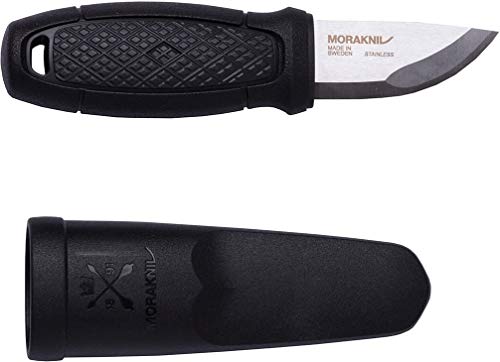
Morakniv Eldris — Best for Outdoor Use
- Blade: Swedish Sandvik stainless steel, Scandi grind
- Blade length: about 2.2 in; overall about 5.6 in
- Handle: textured polymer with a full, palm-filling grip
- Sheath: polymer; neck-kit versions add firesteel and paracord
- Origin: made in Sweden
Strengths
- Handle is shaped like a real knife handle, not a flat tang
- Scandi grind excels at wood carving and feather sticks
- Stainless blade shrugs off rain, sweat, and fish-cleaning duty
Trade-offs
- Short blade limits slicing length on food and rope
- Sheath is bulkier than the slimmest neck sheaths here
- Neck kit costs more than the base knife-and-sheath version
The Eldris is Morakniv’s answer to a fair criticism of neck knives: most of them have handles designed for hanging, not for holding. Mora instead shrank a bushcraft knife. The blade is short — roughly 2.2 inches of Swedish stainless with a true Scandi grind — but the handle is a proper sculpted polymer grip that fills the palm, so carving, whittling, and controlled push cuts feel like using a small fixed blade rather than pinching a pendant.
Outdoors, that combination is better than it sounds on paper. The Scandi grind bites into wood and holds a carving line beautifully, the spine on neck-kit versions is ground to work with the included firesteel, and the stainless steel means the knife can live on your chest through rain, river crossings, and fish cleaning without a thought about rust. It is the neck knife most likely to be borrowed at camp, because it is the one that looks and works like a tool rather than a tactical accessory.
The trade-off is reach. A 2.2-inch blade makes short work of kindling and cord but is tedious for food prep and hopeless for splitting anything thicker than a thumb. The sheath, while secure, is also chunkier than the Minimalist’s, so the Eldris prints a little more under thin shirts. Carry it as an outdoor and camp neck knife — the role it was designed for, alongside the larger blades in our best bushcraft knives guide — and those compromises fade into the background.
Best for: Best for: hikers, anglers, and bushcraft learners who want carving control in a neck-carried package. / Not suited for: discreet office carry or anyone who needs a longer slicing blade.
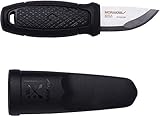

Ka-Bar BK11 Becker Necker — Best Hard-Use Value
- Blade: 1095 Cro-Van carbon steel
- Blade length: about 3.25 in
- Handle: skeletonized tang with bottle opener at the butt
- Sheath: hard plastic, neck and belt carry
- Origin: made in the USA
Strengths
- 1095 Cro-Van is a proven, tough steel that sharpens easily
- Bottle opener in the tang is genuinely useful at camp
- Skeleton handle accepts a paracord wrap for a fuller grip
Trade-offs
- Bare skeleton handle is the least comfortable here for long sessions
- Carbon steel needs drying and occasional oil
- Sheath retention can loosen with years of hard use
Ethan Becker designed the BK11 Necker as the small companion to his big Campanion-series knives, and it carries the same design philosophy: a simple, thick, skeletonized slab of 1095 Cro-Van steel with nothing on it that does not earn its place — including the bottle opener cut into the butt of the tang, which sounds like a gimmick until the third evening at a campsite.
With about 3.25 inches of blade, the BK11 sits at the capable end of the neck-knife class. It is long enough for food prep and camp kitchen work, tough enough for the light batoning and prying that would embarrass thinner blades, and the flat skeleton handle wraps beautifully in paracord, which most owners do within the first week. Wrapped, the grip improves from acceptable to good, and the knife still hangs flat and light in its hard plastic sheath.
Unwrapped, though, the handle is the coldest, hardest grip in this guide, and an hour of carving will tell you about it. The carbon steel also asks for the same basic care as the ESEE picks: dry it, oil it occasionally, and do not store it wet in the sheath. Buyers who want a fit-and-forget stainless knife should look at the Eldris or the Minimalist; buyers who want maximum toughness per dollar in an American-made neck knife have found their pick — it also makes a natural small companion to the full-size Becker in our best survival knives roundup.
Best for: Best for: campers and hard-use buyers who will wrap the handle and maintain carbon steel. / Not suited for: bare-hand comfort seekers or anyone in a constantly wet, salty environment.

Cold Steel Mini Tac Bowie — Best Budget
- Blade: 3.625 in clip point
- Overall length: 6.875 in
- Handle: Griv-Ex with sub-hilt finger groove
- Sheath: Secure-Ex with bead chain included
Strengths
- Longest blade in this guide for the lowest tier of pricing
- Sub-hilt groove gives an unusually secure grip for a neck knife
- Full, textured handle rather than a skeleton tang
Trade-offs
- Supplied bead chain is widely replaced with paracord for comfort
- Steel specification differs between retailer listings — verify on the listing
- Bigger package prints more under clothing than the Minimalist
The Mini Tac Bowie breaks the neck-knife pattern in one specific way: it gives you a real blade. At 3.625 inches, its clip point is half again as long as most blades in this guide, on a knife that still comes in under seven inches overall. If your neck knife has to double as your camp kitchen knife, your fishing knife, and your general utility blade, that extra edge length is the difference between managing and enjoying the work.
Cold Steel built the grip around a sub-hilt finger groove in the Griv-Ex handle, and it works: the knife locks into the hand and stays there when wet, which is more than can be said for most flat-handled neck knives. The Secure-Ex sheath and bead chain complete a package that typically sells at the very bottom of the category’s price range, making this the default recommendation for buyers who want to try neck carry without committing real money.
Two honest caveats keep it from a higher badge. First, the included bead chain is the weak point of the package — most owners swap it for paracord or a breakaway cord within days, and you should budget the five minutes to do the same. Second, retailer listings for this model have described its budget stainless steel inconsistently, so check the current listing’s specification table before you buy and treat any steel claim there as the one that counts. Neither caveat changes the value story, but both are worth knowing before the box arrives.
Best for: Best for: budget buyers who want the most blade length neck carry can offer. / Not suited for: discreet carry under thin clothing, or buyers who will not swap the stock chain.
ESEE Izula — Best Ultralight Workhorse
- Blade: 1095 high-carbon steel, drop point
- Cutting edge: 2.63 in; overall length: 6.25 in
- Weight: 2.0 oz without sheath
- Handle: skeletonized tang; scales and wraps optional
- Sheath: molded polymer
Strengths
- Two ounces of genuinely hard-use-capable knife
- Huge aftermarket for scales, sheaths, and carry hardware
- Same tough 1095 steel and warranty culture as the Izula II
Trade-offs
- Shorter handle than the Izula II means a three-finger grip for most hands
- Scales are an extra purchase if you dislike skeleton handles
- Carbon steel maintenance applies, as with all 1095 picks here
The original Izula — named for a Peruvian bullet ant — is the knife that defined the modern American neck knife, and it remains the lightest way to carry a blade that can genuinely work. Two ounces, 6.25 inches overall, a 2.63-inch cutting edge in powder-coated 1095, and a skeletonized handle with a generous lanyard hole: there is nothing else on it, and that is precisely the point.
Around that simple core has grown the deepest accessory ecosystem in the category. Factory and aftermarket Micarta and G10 scales, custom Kydex in every carry orientation, paracord wraps, belt clips, and firesteel loops all exist for this knife, so an Izula bought as a neck knife this year can become a pocket-carry or pack knife next year without replacing the blade. For hikers counting grams, it is also a rational backup to a primary blade from our best fixed blade knives for hiking guide: two ounces buys you a real cutting tool if your main knife is lost or broken.
Choose it over the Izula II only if weight or price leads your decision, because the II’s longer, scale-fitted handle is the better grip for sustained work, while the original asks most hands to settle for three fingers plus a lanyard. And like its bigger sibling, it is carbon steel: the coating protects the flats, but the edge itself wants a wipe after wet use. Accept that one habit and the Izula remains, years after launch, one of the easiest recommendations in this entire guide.
Best for: Best for: ultralight hikers, minimalists, and anyone who wants a customizable hard-use blade at two ounces. / Not suited for: buyers who want a full grip out of the box with no accessories to add.
Comparison Table
| Pick | Key spec | Badge |
|---|---|---|
| ESEE Izula II | 2.63 in cutting edge, 1095 carbon steel, 6.75 in overall | Best Overall |
| CRKT Minimalist Bowie | 2.125 in clip-point blade, 5Cr15MoV steel, 1.6 oz | Most Comfortable Carry |
| Morakniv Eldris | 2.2 in Sandvik stainless blade, Scandi grind, pocket-size handle | Best for Outdoor Use |
| Ka-Bar BK11 Becker Necker | 3.25 in blade, 1095 Cro-Van steel, integrated bottle opener | Best Hard-Use Value |
| Cold Steel Mini Tac Bowie | 3.625 in clip-point blade, Griv-Ex handle, Secure-Ex sheath | Best Budget |
| ESEE Izula | 2.63 in cutting edge, 1095 steel, 2.0 oz, 6.25 in overall | Best Ultralight Workhorse |
Read the table as a map of philosophies rather than a ranking. The ESEE pair and the Becker bet on tough carbon steel and hard use, and ask for a wipe of oil in return. The CRKT and the Mora bet on stainless convenience — one ultralight and discreet, the other shaped for carving — while the Cold Steel bets on blade length at a budget tier. Weight is the second axis: everything here is carryable, but the difference between the 1.6-ounce Minimalist and the scale-fitted Izula II is obvious on your chest by hour six of a hot day.
Sheath design is the quiet deciding factor. All six sheaths retain the knife inverted, but they differ in how they release, how they mount to a belt when you switch carry methods, and how much they print under clothing. If you expect to move the knife between neck, belt, and pack, the ESEE clip-plate system is the most flexible; if the knife will live on a cord permanently, the slimmer CRKT and Cold Steel sheaths carry flatter.
How to Choose a Neck Knife
Start with the job, not the blade. Neck knives divide into three honest roles: the always-there utility cutter that opens, trims, and slices through a working day; the outdoor backup that carves, makes feather sticks, and cleans fish when the main knife is elsewhere; and the discreet last-resort blade carried where pockets and belts are impractical. The Minimalist Bowie owns the first role, the Eldris the second, and the skeletonized ESEE and Becker designs straddle the second and third. Naming your role first prevents the most common disappointment in this category — buying a two-inch pendant and expecting camp-knife performance.
Weight and sheath retention decide whether you keep carrying it
A neck knife succeeds only if it is still around your neck at 4 p.m. Total carried weight — knife plus sheath plus cord — is the best predictor: once the package climbs much past five ounces, most people start leaving it at home. Retention is the partner specification. Shake-test any new sheath inverted over a bed; the knife should stay put through vigorous shaking yet draw with one firm pull. If it rattles loose, return it. If it needs two hands, it will fail you when one hand is holding the thing you need to cut.
Grip: plan for three fingers
Almost every neck knife is a three-finger knife. Designs cope differently: the Minimalist carves deep finger grooves, the Eldris keeps a full palm-filling handle and shortens the blade instead, and the skeleton knives rely on a lanyard or paracord wrap to give your pinky purchase. If you have large hands, prioritize the Izula II or the Eldris; if your hands are smaller, the grooves of the Minimalist may fit you better than any of them. Whichever you choose, add a lanyard — it is the cheapest grip upgrade in the category, and it also makes the knife easier to draw.
Steel: carbon toughness versus stainless indifference
The 1095-family steels in the ESEE and Becker picks are tougher and easier to resharpen, and they are the right choice if the knife will pry, baton lightly, or be sharpened on improvised abrasives. Their cost is corrosion: the edge is bare steel and will rust if neglected. The stainless picks — the Minimalist and the Eldris — give up some toughness and edge life in exchange for total indifference to sweat, rain, and salt air. Neither family is better in the abstract; match the steel to your climate and your willingness to spend thirty seconds on maintenance. Our best knife sharpeners for pocket knives guide covers the compact stones that suit blades this size.
Legality and carry etiquette
Fixed-blade and concealed-carry rules vary sharply by state, city, and country, and a knife worn under a shirt can count as concealed even when the same knife on a belt would be unremarkable. Check the rules where you live and where you travel, keep the knife fully sheathed in shared spaces, and use a breakaway cord so the carry system itself can never become a hazard if it snags. A neck knife is a tool; carry it like one.
Key Takeaways
- Sheath retention and total carried weight matter more than blade length in a neck knife.
- The Izula II is the best all-rounder; the Minimalist Bowie is the one you will forget you are wearing.
- Carbon steel (ESEE, Becker) rewards hard use and asks for oil; stainless (CRKT, Mora) asks for nothing.
- Plan on a three-finger grip, and add a lanyard to every knife in this category.
- Check local fixed-blade and concealed-carry rules before making neck carry your default.
How to Carry and Use a Neck Knife Safely
Set up the carry system before the knife ever leaves the house. Thread the sheath on paracord or a breakaway ball chain adjusted so the handle sits at sternum level — high enough to reach with either hand, low enough to clear your chin when you look down. Wear it under a shirt for discretion or over a base layer outdoors, and practice the draw slowly: grip the handle fully, pull straight down and away from your body in one motion, and never draw by pinching the sheath and shaking the knife free.
- Adjust the cord so the sheathed knife rests at mid-sternum and cannot swing into your face when you bend.
- Grip the exposed handle with a full three- or four-finger grip before applying any draw force.
- Pull down and slightly outward until the sheath releases; keep the edge oriented away from your body throughout.
- Use the knife with the sheath dangling clear or set aside — never cut toward the hand holding the sheath.
- Wipe the blade dry, especially carbon steel, before re-sheathing; moisture trapped in a sheath is the main cause of rust.
- Re-seat the knife until you feel or hear the sheath engage, then tug-test it once before moving.
Problem: the knife feels like it might fall out when you run. Fix: check whether the cord has stretched or the sheath mouth has worn; replace the cord first, and if retention is still loose, replace the sheath rather than trusting it. Problem: the knife is hard to draw one-handed. Fix: confirm you are pulling in line with the sheath rather than at an angle, and clean grit out of the sheath with water and a brush. Problem: rust spots on a carbon blade. Fix: polish them off with a rust eraser or fine abrasive, oil the blade lightly, and store the knife out of its sheath.
How to Maintain a Neck Knife
Maintenance is light but specific. Rinse and dry the sheath weekly if the knife lives against your skin, because sweat salt accumulates exactly where the blade sits. Touch up edges little and often — a few strokes on a fine stone or ceramic rod after a day of cardboard keeps a small blade cutting without ever needing a full resharpening session. Carbon-steel owners should make the oil wipe automatic: dry blade, drop of mineral or camellia oil, done. Finally, inspect the cord monthly and replace it at the first sign of fraying; the cord is a wear item, and treating it as permanent is how good knives get lost.
Neck Knives in Daily Life: Where Each Pick Earns Its Place
Consider how these knives actually get used across a week, because the best neck knife is the one whose strengths match your most frequent cuts, not your most dramatic imagined ones. The warehouse worker breaking down boxes and cutting stretch wrap all shift long will feel the difference between the Minimalist’s grooved three-finger grip and the Izula II’s full handle by the second hour: small blades are drawn dozens of times a day in that setting, and grip comfort compounds. The same worker, though, will never once wish for the Eldris’s carving grind, while the angler cleaning fish on a rocking boat will want exactly that Mora’s stainless indifference to water and its palm-filling handle when hands are wet and slimy.
Outdoors, the calculus shifts toward the carbon-steel picks. A neck knife on a backpacking trip is usually the backup and the detail knife: it trims cord for guylines, opens meal pouches, makes feather sticks when the main blade is busy, and handles the small whittling that passes an evening. The BK11 and both ESEEs do that work with edges that can be restored on a flat stone or even a smooth river rock, which is a genuine advantage three days from the trailhead. Their shared weakness — rust — is also at its most manageable outdoors, where wiping a blade on a trouser leg before re-sheathing quickly becomes habit.
For runners, cyclists, and anyone who carries while exercising, the ranking inverts again: carried weight and sheath security dominate everything. The Minimalist Bowie at 1.6 ounces is the only pick here that truly vanishes against the chest under a technical shirt, and its sheath retention is tuned for exactly that jostling carry. The Eldris is the second choice for sport carry in wet conditions, accepting a little more bulk for a much better grip. The heavier, scale-fitted Izula II still works on a hike, but on a long run its presence announces itself — a useful reminder that ‘best’ in this category is always best for a named activity.
Pairing a neck knife with the rest of your kit
A neck knife works best as one layer in a small system. Pair it with a folding knife from our best pocket knives under $50 roundup for the cuts where a longer, thinner edge slices better, and with one of the compact options in our best keychain multitools guide for the screwdriver, pliers, and bottle-opener jobs no knife should be asked to do. Keep a small sharpening stone or ceramic rod in the same kit — the systems in our best sharpening guides for knives guide include pocket-size options — and the whole setup covers daily cutting, light outdoor work, and routine repairs without a belt pouch or a heavy pack.
One more scenario deserves a direct answer, because readers ask about it constantly: the neck knife as a fishing and boating blade. On the water, a knife on a cord beats a knife in a pocket for a simple reason — you can reach it with either hand, even with a fish in the other one, and if it goes overboard on its cord it is retrievable rather than gone. Stainless is non-negotiable here, which is why the Eldris and the Minimalist are the two water picks in this guide, and a bright handle or sheath color is worth choosing deliberately: a black knife dropped in a dark hull at dusk is effectively lost even when it is technically still aboard. Rinse the sheath after saltwater use, because salt trapped against any blade — stainless included — will eventually mark it.
Finally, think about replacement and support before you buy. The American makers here stand behind their carbon-steel knives with strong warranty cultures, Mora’s distribution is global and its sheaths and accessories are easy to source, and CRKT’s Minimalist line has been in production long enough that replacement sheaths and alternate blade shapes are simple to find. A neck knife is a small purchase, but it is one you may carry for a decade; buying the design with an ecosystem behind it is the quiet decision that separates a good pick from a drawer orphan.
Common Buying Mistakes
Buying by blade length alone. A 3.6-inch blade that prints through your shirt and bounces on your chest will be left at home, while a 2.1-inch blade you forget you are wearing gets used daily. In this category, the carried knife beats the capable knife.
Trusting a loose sheath. An inverted knife with weak retention is a lost knife at best. Shake-test every new sheath over a soft surface, and replace sheaths whose retention fades.
Wearing a non-breakaway cord for active work. A cord that cannot break or be cut away is a snag hazard around machinery, brush, and livestock. Choose a breakaway chain or a cord you have honestly assessed for the environments you work in.
Storing carbon steel wet in its sheath. The sheath traps moisture against the edge. Dry the blade before re-sheathing and store the knife out of the sheath at home.
Ignoring local law. Neck carry can be treated as concealed carry. Five minutes checking your local rules is cheaper than any consequence of guessing.
Expecting a neck knife to replace a belt knife. These are companion blades. For sustained wood processing or heavy camp work, pair one with a full-size fixed blade instead of forcing a two-inch edge to do a six-inch job.
Final Recommendation
Start with the ESEE Izula II if you want one neck knife that does the most things well: a real grip, a tough and easily sharpened blade, and a sheath system that adapts to belt and pack when neck carry does not suit the day. It asks for basic carbon-steel care and gives back years of hard service.
Choose the CRKT Minimalist Bowie instead if your priority is a knife that disappears — under a shirt, on a run, through a workday — and handles the small cuts of daily life without announcing itself. Between those two poles, the Eldris, the BK11, the Mini Tac Bowie, and the original Izula each own a clear niche, and any of the six will serve you better than a decorative blade with no published steel, no retention worth trusting, and no maker standing behind it.
Frequently Asked Questions
Are neck knives legal to carry?
It depends entirely on where you are. Some jurisdictions treat any fixed blade as restricted, and a knife under clothing may count as concealed even where open belt carry is fine. Check your state, city, and workplace rules before carrying, and re-check them when you travel.
What size blade is best on a neck knife?
For most people, a cutting edge between two and three inches balances usefulness against carry comfort. Shorter blades disappear but limit food prep and wood work; longer blades like the Mini Tac Bowie’s cut better and print more. Match the size to the role you named in the buying guide above.
Is a neck knife safe to run or hike with?
With a secure sheath, a breakaway cord, and the knife riding at sternum height, yes — that is exactly the use case these designs are built for. The risks come from loose sheaths, swinging cords adjusted too long, and non-breakaway cords around machinery.
Carbon steel or stainless for a neck knife?
Choose carbon steel such as 1095 if you value toughness and easy sharpening and will wipe the blade dry after wet use. Choose stainless if the knife will live against sweaty skin, around salt water, or in a kit you do not want to maintain.
How do I stop my neck knife from rusting in its sheath?
Dry the blade before re-sheathing, oil carbon steel lightly, rinse the sheath regularly to remove sweat salt, and store the knife outside the sheath at home. Most neck-knife rust is storage rust, not use rust.
Can a neck knife replace my pocket knife?
For many daily tasks, yes — and our best pocket knives under $50 guide covers the folding alternative if you prefer pocket carry. A neck knife’s advantage is constant position and access with full or wet hands; a folder’s advantage is discretion and, in many places, simpler legality.
What cord should I use for a neck knife?
Paracord is the common default and lets you add grip-extending wraps and fobs, while ball chain with a breakaway connector is the safer choice around machinery or in any setting where a snag is plausible. Replace either at the first sign of wear. Whatever you choose, set the length deliberately: the sheathed knife should rest at mid-sternum, reachable by either hand, high enough that it cannot swing up toward your face when you bend, run, or climb, and consistent enough that your draw never has to search for it.