Where to buy
Check the latest price, availability and delivery on Amazon. Orders are placed on Amazon. We may earn a commission from qualifying purchases. At $30 the powered tier genuinely begins: three verified 5-inch random orbital sanders below are linked, led by the SKIL with its cyclonic dust box. The remaining picks are prose-only step-ups and class picks, with reasons stated in each review.
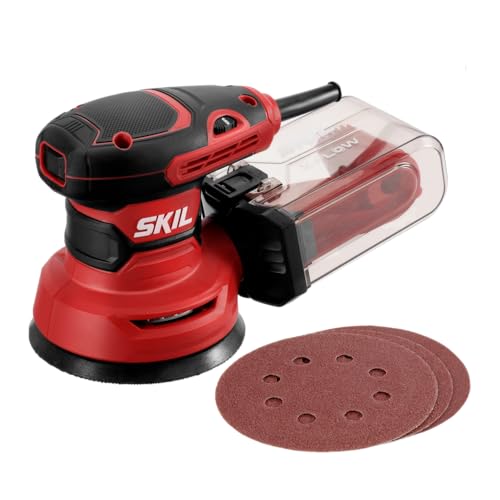
- Best orbital sander under $30: SKIL 5″ Random Orbital Sander (SR211601) — Check on Amazon
- Best accessory bundle: HYCHIKA 300W Random Orbital Sander (OS300W) — Check on Amazon
- Best value alternative: DEKOPRO 2.5A Random Orbital Sander — Check on Amazon
- BLACK+DECKER 5″ Random Orbit Sander (BDERO100) — the brand step-up just above this tier; prose-only below
- Cordless 20V random orbital sanders — the untethered class, above this tier; prose-only below
- Pro-grade 3-amp random orbital sanders — the graduation class; prose-only below
Read the full guide ↓
Disclosure: As an Amazon Associate, umtsmarttool.com earns from qualifying purchases. Links to Amazon on this page are affiliate links; they cost you nothing extra. Listing details such as price and availability change often, so check the current Amazon listing before you buy.
The best orbital sander under $30 is a real powered tool, and that sentence could not be written about the tier below: the entry 5-inch random orbital class lives exactly here. The best orbital sander under $30 for most buyers is the SKIL SR211601 — a 2.8-amp variable-speed machine with a cyclonic dust box that actually works, a counterbalanced design that keeps vibration civilized, and a price that has been sighted right at this tier’s ceiling. Around it, the HYCHIKA competes on its generous accessory bundle and the DEKOPRO on value, and together the three linked picks cover the realistic choices at this budget: all are 5-inch random orbitals — the format that sands fast without the swirl marks a plain orbital leaves — all take standard hook-and-loop discs, and all will strip, smooth and prep furniture, doors and cabinets at a pace hand sanding cannot approach.
This guide verifies each linked pick’s specifications from maker listings, explains what separates them (dust collection, speed control, bundle contents), lays out the disc ladder that governs results at any price, and marks the honest boundaries — the BLACK+DECKER step-up just above the tier, the cordless class above that, and the pro machines beyond. Readers arriving from the hand-sanding tier will find the same ladder discipline applies, at motor speed; the $15 system’s full story is at Best Orbital Sander Under $15. Check prices on Amazon before buying — this tier’s listings move with promotions, and a pick’s position inside the budget is a live fact, not a printed one.
In this guide
Quick Picks
Each row matches a buyer to the pick that fits. The three linked picks are verified as sold within this budget; the prose-only picks carry their reasons in their reviews.
| Buyer | Pick | Why it stands out | Link |
|---|---|---|---|
| Best overall | SKIL 5″ Random Orbital Sander (SR211601) | 2.8A variable speed, X-Flow cyclonic dust box, low vibration | Check on Amazon |
| Best bundle | HYCHIKA 300W Orbital Sander (OS300W) | 6 speeds, 12 discs included, dust bag collection | Check on Amazon |
| Best value | DEKOPRO 2.5A Orbital Sander | 6 speeds, 16 discs, dust box — the full kit at a value price | Check on Amazon |
| Best brand step-up | BLACK+DECKER Random Orbit Sander (BDERO100) | 2.0A single-speed simplicity from the category staple | Prose-only — just above this tier |
| Best untethered | Cordless 20V random orbital class | No cord, platform batteries — at platform prices | Prose-only — above this tier |
| Best graduation | Pro-grade 3-amp random orbital class | Sealed switches, dust ports, all-day refinement | Prose-only — well above this tier |
How These Picks Were Chosen
The budget was applied to complete, ready-to-sand purchases: a 5-inch random orbital sander with dust collection and at least a starter supply of discs, sold as a real Amazon listing positioned within $30 in the United States. Random orbit — pad spinning while it orbits — was required, because the plain orbital (sheet) sanders at this price leave swirl patterns that finish exposes; sheet sanders are a different tool with a different guide. Check the current price on Amazon before you buy, because this tier’s prices move with promotions and a pick verified inside the budget can drift above it between sellers.
We did not use these tools ourselves. We verified each linked pick’s ASIN and key specifications — motor amps, speed range and control, pad size, dust system, weight, included discs — against maker listings and product pages, then ranked by the factors that separate machines in use: dust collection first, because a sander you can see through its own dust cloud cuts straighter and finishes cleaner; speed control second, because variable speed is control on veneer, curves and finish-adjacent work; vibration and weight third, because an afternoon of sanding is an ergonomic event. Prose-only picks are excluded from links for stated reasons: the BDERO100 sits just above this tier’s ceiling, and the cordless and pro classes are included as planning context at class level. No specification in this guide is invented; anything we could not verify from a maker listing was left out. Buyers whose work is beginner-paced or project-shaped will find the same shortlist reframed at Best Orbital Sander For Beginners Under $30 and Best Orbital Sander For Diy Projects Under $30.
The 6 Best Orbital Sanders Under $30
SKIL 5″ Random Orbital Sander (SR211601)
Who it suits: The default buyer at this tier — furniture, doors, cabinets, general home and project work — who wants the most complete machine the budget verifies.
The SR211601 leads because it solves the entry tier’s worst problem — dust — better than its rivals. Its X-Flow cyclonic dust box separates and traps debris instead of merely bagging some of it, keeping the work surface visible and the cut honest, and it empties without the paper-bag consumables the class usually demands. The motor is a healthy 2.8 amps driving a variable-speed dial across roughly 7,000 to 13,000 orbits per minute, so the machine throttles down for veneer and curves and opens up for stripping — the control range that separates a tool from an appliance. A counterbalanced design keeps vibration low, the body is compact at about 3.4 pounds, and the box includes starter discs across grits so the first project begins the day the tool arrives. Check the current price on Amazon; it has been sighted right at this tier’s ceiling, and at that level it is simply the most sander the budget buys.
In the work, its virtues compound: the dust box means the pencil grid and the scratch pattern stay visible — the inspection discipline the hand tier teaches remains possible at motor pace — and the speed dial means one machine covers the ladder from coarse stripping to pre-finish smoothing without swapping tools. Its honest limits are the class limits at this price: the dust box, while the best here, is not a vacuum port’s equal; the cord is the cord; and heavy daily use will find the ceiling of a value-tier motor eventually. For the buyer this guide serves — projects and furniture at home pace — it is the complete answer at $30, and the benchmark the other two linked picks are measured against. Disc strategy for it is covered in the ladder section below; a general orientation to the category lives at How To Choose An Orbital Sander.
- X-Flow cyclonic dust box — the best dust management at this tier.
- 2.8-amp motor, variable speed roughly 7,000–13,000 OPM.
- Counterbalanced, about 3.4 lb — an afternoon’s comfort.
- Starter discs included across grits.
Honest limitation: Dust box beats bags, not vacuums; value-tier motor is built for home pace, not trade abuse — and the pad face is a wear item whose replacement, years in, restores the machine’s manners for a few dollars.
Choose it if you want the default best at this budget. Skip it if a rival’s live price undercuts it decisively on the day — then compare bundles below, because at this tier the bundle is half the product.
HYCHIKA 300W Random Orbital Sander (OS300W)
Who it suits: Buyers who value a complete starter bundle — machine, discs and dust collection — in a single purchase.
The HYCHIKA’s case is completeness. Its 300-watt (2.5-amp class) motor drives six speed settings spanning roughly 6,000 to 13,000 orbits per minute, the pad is the standard 5-inch hook-and-loop, and the box arrives with a dozen sanding discs across grits plus a dust collection bag — a bundle that starts a project the day it lands. The speed range is the widest at the slow end of the three linked picks, which veneer and curved work appreciate. In use it is a straightforward, effective entry random orbital: the dust bag collects less elegantly than the SKIL’s cyclonic box — bags are the class’s baseline — but the machine cuts the same ladder at the same pace, and for buyers whose projects are occasional, the bundle’s convenience is a real virtue.
Two honest notes belong with this pick. Its price history hovers right around this tier’s ceiling — averages slightly above $30 with dips below — so treat its position as promotion-dependent and check the live price: on a dip day it is arguably the tier’s best value; above the ceiling, the SKIL is the safer assignment of the same money. And as a value-brand machine, its long-term parts and support trail the legacy brands — a consideration for heavy users, a footnote for occasional ones. Within those notes, it is a legitimate co-finalist at this tier, and the disc bundle it includes is the most generous of the three.
- Six speeds, roughly 6,000–13,000 OPM — the widest low end here.
- 12 discs included plus dust bag — a complete starter bundle.
- 300W motor in the standard 2.5-amp entry class.
Honest limitation: Price straddles the tier ceiling — promotion-dependent; dust bag is the class baseline, not its best.
Choose it if its live price is at or below the SKIL’s on the day, bundle included. Skip it if it is priced above the ceiling — the SKIL is the better spend there, and the discipline of the ceiling is what keeps a budget tier honest.
DEKOPRO 2.5A Random Orbital Sander
Who it suits: Value-first buyers who want variable speed and a full disc kit at the tier’s friendliest typical price.
DEKOPRO’s entry covers the specification sheet with unusual completeness for its price: a 2.5-amp motor, six variable speeds reaching up to roughly 13,000 orbits per minute per its US listing, a 5-inch hook-and-loop pad, a dust collection box rather than a bag, and sixteen discs in the box — the largest starter supply of the three linked picks. For a buyer equipping from zero, that bundle arithmetic matters: the machine plus a working ladder of discs in one purchase, at a price sighted below the tier’s ceiling. The dust box, while not the SKIL’s cyclonic design, is a genuine box — emptier-friendly and bag-free — and the machine’s pace through the grits is the class standard.
The cautions are research-shaped. Regional listings for this model family show variants — including different voltage configurations for other markets — so verify on the Amazon listing that the unit offered is the US configuration before ordering; the ASIN linked here is the US listing we verified. Value-brand support and longevity trail the legacy names, as with the HYCHIKA. Within those notes, DEKOPRO is the pick for buyers who would rather spend the tier’s remainder on discs and materials than on a badge — a rational allocation at $30, where abrasives quality decides finishes more than motor badges do.
- 2.5A, six speeds to roughly 13,000 OPM per US listing.
- 16 discs included — the largest starter supply here.
- Dust box collection at a value price.
Honest limitation: Verify the US configuration on the listing — regional variants exist; value-brand support trails legacy brands.
Choose it if the bundle arithmetic wins on the day. Skip it if brand support matters to you — that is the SKIL’s or the step-up’s case, and at this tier the difference is a preference, not a performance gap.
BLACK+DECKER 5″ Random Orbit Sander (BDERO100)
Who it suits: Brand-loyal buyers willing to step slightly above $30 for the category’s staple name and dead-simple operation.
The BDERO100 is the entry random orbital a generation of home users started on: a 2.0-amp motor at a single speed of about 12,000 orbits per minute, a 5-inch pad, a dust bag, and nothing to adjust. That simplicity is a genuine design position — one speed, chosen well, covers the majority of home sanding, and the absence of a dial is the absence of a failure point and a learning curve. It is prose-only here for a price reason: its typical US price sits just above this tier’s ceiling, just above this tier’s ceiling, so it fails this guide’s within-budget verification while remaining the obvious step-up for buyers who value the badge, the parts network and the known quantity.
Against the linked three, its case is longevity and support rather than specification — on paper the SKIL out-features it at a lower price, which tells you most of what the entry market has become. Buyers who sand occasionally and keep tools for decades rationally pay the step-up; buyers who sand projects now rationally buy the SKIL or the bundle picks. Either way, the BDERO100’s presence in this guide is the honest map of the tier’s border: the ceiling is real, the staple lives just above it, and the choice between them is about ownership style, not sanding quality.
- 2.0A single-speed (about 12,000 OPM) — simplicity as a feature.
- The category staple: parts, support and a known quantity.
- Typically priced just above this tier — the defined step-up.
Honest limitation: Above this budget, and single-speed in a tier where rivals offer dials for less.
Choose it if brand support and simplicity outrank specification per dollar. Skip it if you are shopping strictly under $30 — the linked three are your list.
Cordless 20V Random Orbital Sanders (Class Pick)
Who it suits: Buyers already invested in a 20V battery platform, for whom the sander is an addition to a system rather than a standalone purchase.
Cordless random orbitals in the major 20V platforms are genuinely good tools — the cord’s absence is worth real money on ladders, in yards and across big sheet goods — but the class cannot be an under-$30 pick honestly: bare tools typically cost multiples of this tier, and a battery-and-charger start costs more again. The class is included because platform owners searching this budget deserve the map: if your batteries already exist, watch for the bare tool on platform promotions; if they do not, the corded linked picks deliver the same sanding for a fraction of the system cost, and the cord — on bench and furniture work, where the piece comes to the tool — is a smaller burden than cordless marketing suggests.
Performance notes at class level: cordless sanders match corded pace on a charge, with runtime measured in tens of minutes of continuous sanding per battery — fine for project bursts, a rotation exercise for stripping days. Dust collection on cordless models is typically a bag or box, as with corded entry machines. The verdict for this tier’s readers is patience: the corded three are the buy today; the cordless joins when a platform and a promotion align. No link, no specific model — platform choice is the buyer’s existing investment, not this guide’s to make.
- Freedom from the cord — real on ladders, yards and sheet goods.
- Bare tools cost multiples of this tier; platform economics rule.
- Runtime suits bursts; stripping days need battery rotation.
Honest limitation: Not purchasable within this budget in any honest configuration.
Choose it if your platform batteries already exist and a promotion lands. Skip it if you are equipping from zero — corded value is overwhelming here.
Pro-Grade 3-Amp Random Orbital Sanders (Class Pick)
Who it suits: Heavy users and aspiring professionals reading this tier as a starting point and wondering what the money above buys.
The pro class — 3-amp-class motors, sealed switches that shrug off dust for years, precision pads, proper vacuum ports, refined vibration control — costs several times this budget and repays it in the currency of daily use: longevity, dust extraction that protects lungs and finishes, and ergonomics that survive eight-hour days. It is included as the map’s far edge. Nothing in it sands a given board better at 220 grit than the SKIL in this guide; the differences declare themselves across years, volumes and dust-managed shops. Home and project users should graduate here only when the entry machine’s limits — duty cycle, dust, refinement — have been personally met, because until then the premium buys capacity the work never invoices.
The graduation path runs through this tier, not around it: the linked picks teach the ladder, the dust discipline and the inspection reads at motor pace, and they remain useful afterward as the shop’s second sander or the site’s loaner. Buy the pro machine on evidence, the way this guide’s step-up logic has argued throughout — and expect, when you do, to find its virtues are durability and air quality rather than a different quality of surface. The surface was always the ladder’s doing.
- Sealed switches, vacuum ports, all-day ergonomics and longevity.
- Costs several times this tier; repays at daily-use volumes.
- No better surface at a given grit — better years, air and endurance.
Honest limitation: Far above this budget, and wasted on occasional use.
Choose it if your entry machine’s limits are personally known. Skip it if you are equipping a home shop — this tier’s picks are the rational buy.
Comparison Table
| Product | Type | Key verified spec | Best use | Link |
|---|---|---|---|---|
| SKIL Random Orbital Sander (SR211601) | Corded random orbital | 2.8A, variable ~7,000–13,000 OPM, X-Flow dust box, ~3.4 lb | Best overall under $30 | Check on Amazon |
| HYCHIKA Orbital Sander (OS300W) | Corded random orbital | 300W, 6 speeds ~6,000–13,000 OPM, 12 discs, dust bag | Complete starter bundle | Check on Amazon |
| DEKOPRO Orbital Sander | Corded random orbital | 2.5A, 6 speeds to ~13,000 OPM, 16 discs, dust box | Value bundle | Check on Amazon |
| BLACK+DECKER Orbit Sander (BDERO100) | Corded random orbital | 2.0A, single speed ~12,000 OPM, dust bag | Brand step-up | Prose-only — above tier |
| Cordless 20V random orbitals | Cordless class | Platform batteries, 5-in pads | Platform owners | Prose-only — above tier |
| Pro-grade 3-amp class | Corded pro class | ~3A class, vacuum ports, sealed switches | Daily professional use | Prose-only — above tier |
How to Choose an Orbital Sander Under $30
- Random orbit, not plain orbit. The combined spin-and-orbit action is what prevents swirl marks; sheet sanders are a different tool for different work.
- Dust collection is the tier’s separator. Cyclonic box over box over bag. You sand what you can see, and you breathe what you do not collect.
- Variable speed is control. Slow for veneer, curves and control; fast for stripping and flats. Single-speed machines choose for you — sometimes well, never always.
- Amps in the 2.5–2.8 range are the entry sweet spot. Enough to hold speed under load on furniture work without trade-tier price.
- Count the bundle honestly. Included discs across grits are real money; a machine $5 cheaper with no discs is not cheaper.
- Check live prices against the ceiling. This tier’s listings move with promotions; a pick’s in-budget status is a day-of-purchase fact.
- Weight and vibration decide afternoons. Around 3.5 lb with counterbalancing is the comfort zone for project-length sessions.
- Plan the disc supply. Standard 5-inch hook-and-loop discs are cheap and universal — one more reason the format owns this tier — and a stocked ladder prevents the mid-project rung-skipping that ruins surfaces to save a disc.
The Disc Ladder: Running a Powered Sander Like a Finisher
The machine changes pace, not principles: the grit ladder that governed the hand tier governs here, and powered mistakes are just hand mistakes at speed. Enter at the finest grit that can do the job — stripping failed finish may earn 80, but most furniture work starts at 120 — and climb 120, 150, 180, 220 with complete pattern erasure at each rung, verified wiped-clean in raking light. The powered-specific disciplines are three. Keep the sander moving: a stationary spinning pad digs a dish in seconds, so start the machine on the surface, keep it traveling in slow overlapping passes, and lift it only after it stops. Let the machine’s weight do the pressing: added downward force slows the pad’s rotation, increases swirl risk and tires the user while cutting less — the exact inversion of intuition, and the entry tier’s most common error. And manage the pad’s edge: tilt is forbidden, because a tilted random orbital writes crescents that only reveal themselves under finish.
Disc economics deserve a paragraph in a budget guide. Discs are the consumable, and quality discs cut longer, shed less grit and leave fewer pigtail swirls — the tiny spiral scratches a trapped grain writes under a spinning pad. Change discs when cutting slows rather than on a schedule, blow or brush dust from the surface between grits (the machine’s own dust is the pigtail’s raw material), and never skip a rung to save a disc: the disc costs cents, the rescue costs the surface. Stocked across the ladder and changed on evidence, discs run a few dollars per project — the powered tier’s running cost, and a fair trade for the hours returned.
Dust: The Real Reason This Tier Exists
Hand sanding’s dust settles; powered sanding’s dust flies, and managing it is half of what the entry powered tier is for. The hierarchy in this guide’s picks — cyclonic box, plain box, bag — is a hierarchy of how much dust leaves the work zone, and its importance is practical before it is medical: a visible surface sands straighter, a clean surface shows its scratch pattern honestly, and a shop (or living room) without a dust film is a place finishing can happen. Wear the mask anyway at coarse stages; the box catches the bulk, not the fraction your lungs would notice. Empty the box or bag before it fills — collection efficiency falls off a cliff as containers pack — and treat the sander’s dust port area as part of the tool’s maintenance, brushing it clear when flow fades.
For project work in living spaces, the powered tier asks for the drop-cloth method the hand guide described, plus one addition: sand and finish in separate sessions with a vacuum pass between, because airborne dust and wet varnish are enemies with good memories. Users who find themselves sanding weekly indoors should read that as the first argument for the pro class’s vacuum ports — dust extraction is the graduation that health, not speed, most often justifies.
Ergonomics Over an Afternoon: Weight, Vibration and the Second Hour
Sanding specifications are quoted at the first minute, but sanding is experienced at the second hour, and the entry tier’s machines separate there. Weight around three and a half pounds is the comfort zone this guide’s linked picks share: light enough to run one-handed on vertical work — door faces on hinges, cabinet sides in place — without the shoulder becoming the schedule. Vibration is the subtler tax. A counterbalanced design like the SKIL’s keeps the buzz in the tool rather than in your hands; value machines without it announce themselves in tingling fingers by the third door. The test is not whether a sander feels fine in the store — they all do — but whether your grip stays relaxed at hour two, because a tightening grip is both a symptom and a cause: it transmits more vibration, steers worse, and presses harder, which slows the pad and writes the swirls you then sand out at the next grit.
Manage the session like the physical work it is. Work at bench height so the machine travels level without wrist torque; route the cord over your shoulder or behind the bench so it never drags the sander’s tail across a finished pass; and take the breaks the hand tier taught — dust emptied, surface inspected, arms shaken out — at each grit change, which conveniently is also when the process wants your attention anyway. Users with any history of hand or wrist complaints should treat variable speed as an ergonomic feature, not a luxury: slower speeds on curved and vertical work reduce the corrective grip forces that accumulate into soreness. The machine is supposed to return hours to your project, not invoice your hands for them.
What the Entry Tier Cannot Do: An Honest Capability Map
Budget guides earn trust at their borders, so here is this tier’s, plainly. It cannot sand profiles, spindles, inside corners or any shaped surface — the pad is flat and the work is not; the hand system’s grips and sponges own that jurisdiction at every budget. It cannot match a vacuum-extracted pro setup on dust: boxes and bags manage the work zone, not the room’s air, over a long stripping day. It cannot run trade duty cycles — the motors are built for project pace with rest between sessions, and continuous daily stripping will find their ceiling in seasons rather than years. It cannot sand between coats on anything but flats, and it cannot wet-sand finishes at polishing grits, because its disc ladder effectively ends where the hand ladder’s fine half begins. And it cannot fix technique: a powered sander in unpracticed hands manufactures rounded edges and dished panels at motor speed, which is why the $15 tier’s curriculum remains the recommended first course even for buyers who start here.
None of those borders diminishes what the tier is: the flat-area engine of a home and project workshop, at a price that leaves budget for the discs, finishes and hand tools that complete the system. Buyers who read the map before purchasing own the machine happily for years; buyers who discover the borders afterward blame a tool for a brochure’s omissions. This guide’s prose-only picks — the step-up, the cordless class, the pro class — exist to mark the roads beyond each border, so the map is complete in both directions.
First Projects With a Powered Sander: A Starter Sequence
New owners should earn the machine’s pace on forgiving work, and the sequence matters. Project one: a flat, solid, low-stakes surface — a garage-sale table top, a door slab, a plywood panel destined for the shop. Run the full ladder with inspection at every rung, deliberately practicing the three disciplines: machine started on the surface, constant slow travel, weight-only pressure. Time the rungs; the pace will surprise you, and the surprise recalibrates every project estimate you make afterward. Project two: a piece with edges that matter — a dresser top with crisp arrises — where the lesson is edge discipline: passes that stop at the edge, never tilt across it, and the fine rungs taken with the speed dialed down. Project three: a curved-adjacent piece — a chair seat, a rounded table — where the machine does the flats and the hand system does everything else, teaching the partnership’s border in the only way it is ever really learned, by working it.
By the third project the ownership questions answer themselves: whether the dust system suits your space, whether the speed dial earns its keep on your furniture’s shapes, whether your volume argues for anything above this tier at all. Most home users find the entry machine simply sufficient, permanently — which is the outcome this guide predicts and the reason it ranks dust, speed control and comfort above the specification-sheet arms race. The sander was never the project. It is the ladder’s engine, and the ladder was always the craft.
Maintenance and Pad Care: Keeping the Entry Machine Honest
Entry sanders ask for little maintenance and repay all of it. The pad is the first wear item: its hook-and-loop face loses grip as it accumulates dust and heat, and a disc that wanders or flies off is the pad announcing replacement — pads are inexpensive, model-specific wear parts, and swapping one restores a machine that felt “tired” for reasons its motor never caused. Keep the dust path clear: brush the box’s cyclone or the bag’s neck at every emptying, because a choked dust path quietly degrades collection long before it stops it, and degraded collection is degraded visibility, which is degraded sanding. Blow dust from the motor vents with the machine unplugged after stripping sessions; the entry tier’s motors breathe the room they work in, and their longevity is largely the story of their vents.
Storage is the other half: coil the cord loosely rather than in the tight wrap that fatigues it at the strain relief, keep the machine out of the dust-settling zone it creates (a closed cabinet or its box, not the open bench under next week’s coarse work), and store discs flat and dry, since a curled disc never sits flat on the pad and a damp one sheds grit into pigtails. None of this is burdensome — five minutes across a project — and it is the difference between an entry machine that serves a decade of projects and one that feels disposable by its third year. At this tier, care is the cheapest specification upgrade available.
Common Buying Mistakes
- Buying a plain sheet sander for furniture finishing and sanding swirl marks into everything.
- Pressing down for speed — slowing the pad, adding swirls, exhausting the user.
- Parking a running sander on the surface and digging dishes that appear under finish.
- Skipping disc grits to save pennies and paying in surface rescue.
- Ignoring the dust system’s type — bag, box and cyclonic are not interchangeable in practice.
- Buying on printed price memory in a tier where promotions move picks across the ceiling weekly — check the live listing the day you buy, every time.
- Choosing single-speed for veneer and curved work the dial exists to protect — one torn veneer face costs more than the dial ever did.
- Sanding in the same session and air as a curing finish.
- Judging the machine by its first minute instead of its second hour — weight and vibration are specifications too, and they are the ones your hands will grade.
Final Recommendation
- Most buyers: SKIL 5″ Random Orbital Sander (SR211601).
- Bundle buyers: HYCHIKA OS300W on a price-dip day; DEKOPRO for the fullest disc kit.
- Brand loyalists: the BDERO100 step-up, just above the tier.
- Platform owners: cordless, when a bare-tool promotion aligns.
The best orbital sander under $30 is the SKIL SR211601: the tier’s best dust system, a proper variable-speed 2.8-amp motor, and comfort that survives an afternoon — verified inside the budget and complete with starter discs. The HYCHIKA and DEKOPRO are legitimate co-finalists whose bundles win on the right day’s pricing, which is why this guide insists you check live prices before ordering: at this tier, the day’s promotion is part of the specification. Whichever you choose, run it like a finisher — ladder honestly, pressure lightly, machine moving, dust managed — and the entry powered tier will produce surfaces that give nothing away to machines at three times the price. The ladder was always the skill; now it has a motor. Keep the hand drawer beside it, maintain the pad and the dust path, and the partnership will cover every sanding job a home and project life generates — flats at motor pace, shapes at hand pace, finishes at the fine grits where the two meet.
Frequently Asked Questions
Is a random orbital sander really better than a sheet sander?
For furniture and finish work, yes: the pad’s combined rotation and orbit breaks up scratch patterns, so it cuts fast without the swirl marks a plain orbital (sheet) sander leaves — marks that stay hidden until finish reveals them. Sheet sanders keep a niche in flat prep and corner access with their square pads, but the 5-inch random orbital is the correct default for the work this guide covers. The distinction matters most at purchase time, because the two are sold side by side at similar prices with similar names, and the wrong one is a decade-long companion to regretted results.
SKIL, HYCHIKA or DEKOPRO — which should I buy?
The SKIL is the default: best dust collection (cyclonic box), strongest motor, lowest vibration. The HYCHIKA wins when its promotion pricing dips it decisively below the SKIL, bundle included. The DEKOPRO wins for value-first buyers — the fullest disc kit and a dust box at the friendliest typical price. All three sand the same ladder at the same pace; the differences are dust, bundles and the day’s prices, so check all three live before deciding. One more consideration separates them over time: the SKIL’s dust box has no consumable bags to reorder, which quietly lowers its cost of ownership across years of projects, while the bundle picks front-load their value into the box of discs they arrive with — both are honest shapes of value, matched to different ownership styles.
What discs do I need?
A ladder of standard 5-inch hook-and-loop discs: 80 for stripping, 120 and 150 for smoothing, 180 and 220 for pre-finish — a few of each per project. Buy quality discs; they cut longer and write fewer pigtail swirls. Change a disc when its cutting slows, brush dust from the surface between grits, and never skip a rung to save a disc. Keep the ladder stocked before the project starts: running out of 150 mid-dresser is how rungs get skipped and surfaces get rescued later at ten times the disc’s price.
Why is the BLACK+DECKER not linked if it is the famous one?
Because its typical US price sits just above this guide’s $30 ceiling, and links in this guide are reserved for picks verified inside the budget. It remains the defined step-up — simple, supported and known — for buyers willing to spend slightly more for the badge. Its specification (2.0-amp, single-speed) also trails the linked SKIL, which is the honest state of the entry market today: the famous name is no longer the specification leader at its own price, and a budget guide’s loyalty belongs to the buyer’s work, not to the brand’s history.
How long will an entry sander last?
Years at home and project pace. The wear items are the pad’s hook-and-loop face (replaceable), the dust container’s seals, and eventually brushes on some motors. Value brands trail legacy brands on parts and support, which occasional users rarely test. Treat the dust system kindly, do not press the motor into stalls, and the tier’s machines routinely outlast the projects that bought them. The practical sign a machine is aging is not noise but behavior: discs wandering on a worn pad, dust collection fading on choked paths, speed sagging under ordinary load — each has a cheap remedy before it has an expensive one, and the maintenance section above is the remedy list.
Can I use it for between-coat and finish work?
Partly: at its slowest speed with fine discs it scuffs flat coats competently, but between-coat work on shaped pieces and all polishing-grade wet sanding remain hand work — the hand system from the $15 tier stays in the drawer beside the machine permanently. Powered and hand are complements at every budget; this tier buys the flat-area half of the partnership. Buyers who finish furniture seriously will use both in a single afternoon and wonder why the tools are ever sold as rivals.
- Best Orbital Sander Under $15
- Best Orbital Sander For Beginners Under $30
- Best Orbital Sander For Home Use Under $30
- Best Orbital Sander For Small Workshops Under $30
- How To Choose An Orbital Sander
- Best Power Tool Set Under $50