Where to Buy the Best Power Tool Set Under $50
- Best overall: BLACK+DECKER 20V MAX drill and home tool kit (BDCD120VA) — linked below
- Best drill-first buy: BLACK+DECKER 20V MAX cordless drill and driver (LDX120C) — linked below
- Save-up step-up: BLACK+DECKER MATRIX combo systems — prose-only, typically above this tier
As an Amazon Associate, umtsmarttool.com earns from qualifying purchases. Prices change constantly at this tier — check the live listing before you buy.
The best power tool set under $50 is the BLACK+DECKER 20V MAX drill and home tool kit — a real drill/driver on a real battery platform, bundled with a 34-piece set of the hand tools and accessories a household actually consumes — and this guide exists to draw the line it sits on honestly. Fifty dollars is the first tier where the word “set” can be true: below it, the honest guides on this site recommend hand-tool foundations and call powered sets what they mostly are at $30 — costumes. At $50, one genuine configuration exists: a credible drill/driver from a major platform, with its battery and charger, plus enough supporting tools to finish the jobs the drill starts. What $50 still does not buy is a multi-tool combo — saws, sanders and lights on one battery remain a $100-and-up proposition, and any listing claiming otherwise is selling the costume again with a bigger box. This guide verifies the two linked BLACK+DECKER configurations against the Amazon Creators API record, prices the step-ups honestly as prose, and teaches the platform arithmetic that decides whether this purchase is a foundation or a dead end.
In this guide
Quick Picks
| Pick | Product | Key Spec | Check Price |
|---|---|---|---|
| Best overall | BLACK+DECKER 20V MAX Drill & Home Tool Kit (BDCD120VA) | 20V drill/driver + 34-piece home tool kit, battery and charger | Check price on Amazon |
| Best drill-first buy | BLACK+DECKER 20V MAX Cordless Drill/Driver (LDX120C) | 3/8-in chuck, 11-position clutch, LED work light, battery and charger | Check price on Amazon |
| Save-up step-up | BLACK+DECKER MATRIX quick-connect combo | One motor head, swappable attachments | Prose-only — check price on Amazon |
| Save-up step-up | BLACK+DECKER 20V MAX 4-tool combo (BD4KITCDCMSL) | Drill, saws and light on one platform | Prose-only — check price on Amazon |
| Essential partner | The hand-tool foundation | Tape, level, stud finder, drivers, pliers | Prose-only |
| The alternative split | Drill/driver + hand tools bought separately | Same money, chosen pieces | Prose-only |
How These Picks Were Chosen
We did not use these tools ourselves. We verified the two linked products against the Amazon Creators API — the BDCD120VA’s API record confirms the 20V MAX drill and 34-piece home tool kit configuration, and the LDX120C’s record confirms the 3/8-inch chuck drill/driver with LED work light, battery and charger — and cross-checked maker specifications for the platform: 20V MAX batteries shared across the BLACK+DECKER cordless family, keyless chucks, multi-position clutches for driving control. The step-ups are documented from maker materials and retailer sightings and are prose-only because their typical pricing sits above the tier. The judgment applied throughout: at $50 the winning purchase is the one whose battery, charger and drill remain useful when the household’s ambitions grow — platform value over piece count, verified configuration over box art. No static prices are printed and no rating counts appear; at this tier both are falsehoods on timers.
The Picks in Detail
BLACK+DECKER BDCD120VA: The Kit That Is Actually a Set
Who it suits: First-apartment and first-house households that need the drill and the supporting cast in one purchase — hanging, assembling, repairing, mounting — without a second shopping trip.
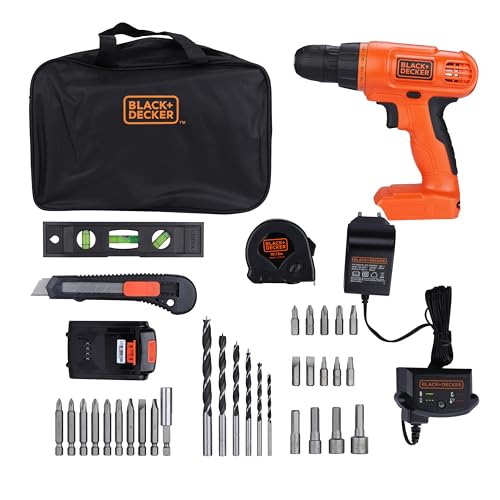
The BDCD120VA’s API-confirmed configuration is the tier’s whole argument: a 20V MAX cordless drill/driver — 3/8-inch keyless chuck, clutch settings for controlled driving — sold with a 34-piece home tool kit, a battery and a charger. The 34 pieces are the unglamorous consumables of household work: driving and drilling bits, hand tools and accessories that turn the drill from a tool into a capability. Hung pictures, assembled furniture, mounted brackets, tightened hardware — the kit’s division of labor covers the household job list end to end, and the drill sits on the 20V MAX platform, so the battery bought here powers the platform’s sanders, saws and lights when the household graduates. Judge it as a system: drill, energy, accessories, one box, verified: check price on Amazon.
Its honest limitation is the drill’s ceiling: this is a household drill — furniture, fixtures, studs with patience — not a renovation tool, and masonry or deck-building ambitions will outgrow it. The kit’s hand pieces are starter grade, replaced one by one over years as the good ones earn their upgrades. Within the household brief, though, nothing else at the tier is as complete.
- API-confirmed: 20V MAX drill/driver plus 34-piece home tool kit.
- Battery and charger included — platform ownership from day one.
- Covers the household job list in a single purchase.
Honest limitation: Household-duty drill ceiling; starter-grade hand pieces.
Choose it if you are equipping a home from near-zero. Skip it if you already own hand tools — the LDX120C puts the whole budget into the drill.
BLACK+DECKER LDX120C: The Drill-First Buy
Who it suits: Buyers who already own basic hand tools and want the strongest simple drill/driver the tier offers, on the platform, with nothing spent twice.
The LDX120C is the BDCD120VA’s drill philosophy undiluted: the API record confirms a 20V MAX cordless drill/driver with 3/8-inch chuck, LED work light, battery and charger included. The 11-position clutch is the specification that matters most in household work — it is what lets the same tool drive a hinge screw without stripping it and bore a pilot hole without wandering — and the LED earns its keep inside cabinets and closets, where household drilling actually happens. On the 20V MAX platform, it is the natural first citizen: every later BLACK+DECKER cordless purchase shares its battery. For the already-tooled household, this is the tier’s cleanest purchase: check price on Amazon.
Its honest limitation is the mirror of its focus: no accessories ride along, so bits and drivers come from your existing kit or a separate purchase, and the single battery means heavy sessions plan around charging. It is also, like its sibling, a household tool — torque and speed sized for the home’s materials, not the job site’s.
- API-confirmed 20V MAX drill/driver, 3/8-in chuck, LED work light.
- 11-position clutch for controlled driving.
- Battery and charger included; platform-compatible.
Honest limitation: No accessory kit included; single battery; household-duty ceiling.
Choose it if your hand tools are already handled. Skip it if you are starting from zero — the BDCD120VA’s kit covers more per dollar.
BLACK+DECKER MATRIX Combo: The Save-Up Step-Up
Who it suits: Planners whose project list already names a second and third powered verb — sanding, sawing, trimming — and who can stretch past the tier deliberately.
The MATRIX system answers the combo problem with a clever mechanism: one powered head whose front end swaps between attachments — drill/driver, sander, saws and more — so the second verb costs an attachment rather than a second tool with a second battery. Documented from maker materials, MATRIX combos typically price above this tier, which is why this pick is prose-only: it is the honest answer to “what if I can stretch?”, not a claim about $50. The system’s trade is real — attachments share one motor’s power and the swapping interrupts flow — but for apartment-scale work its economics are genuinely attractive, and it keeps faith with the platform principle: buy energy and motors once.
Honest limitation: Above the tier at typical pricing; one motor shared across every verb.
Choose it if stretching buys a named second verb. Skip it if the budget is firm — the linked kits are complete at the tier.
BLACK+DECKER BD4KITCDCMSL 4-Tool Combo: The Full Step-Up
Who it suits: Buyers whose honest self-assessment says renovation, not maintenance — and who are really shopping the next tier up with this guide as a reality check.
The four-tool combo — drill/driver, reciprocating saw, circular saw and work light on the 20V MAX platform — is what “power tool set” means in the trade’s full sense, and its typical pricing, well above this tier, is the measure of the $50 guides’ honesty: this capability cannot be truthfully sold at $50, and listings suggesting otherwise are the costume pattern from the $30 tier wearing a bigger box. It is documented here as the graduation target: the purchase the linked kits’ platform leads to, battery-compatible with them, so nothing bought at $50 is wasted when this day comes.
Honest limitation: Priced well above the tier; a target, not a $50 option.
Choose it if the budget honestly stretches to the next tier. Skip it if it does not — platform patience beats debt.
The Hand-Tool Foundation: The Partner Every Set Needs
Who it suits: Every buyer in this guide — the kit owners whose 34 pieces cover the basics, and the drill-first buyers whose existing tools need auditing.
Power drills holes; hands do everything around the hole. The foundation — tape measure, level, stud finder, utility knife, pliers, adjustable wrench, hex keys, a real hammer — remains the household’s most-used tool set, and the $50 tier does not repeal that: it adds the drill to the foundation, it does not replace it. Kit buyers should inventory the 34 pieces against the foundation list and fill gaps first; drill-first buyers should audit honestly, because a drill without a stud finder hangs shelves into drywall anchors and regret. The full foundation doctrine lives in the Best Power Tool Set Under $30 guide’s hand-tool curriculum.
Honest limitation: No holes, no driving — it is the partner, not the power.
Choose it if any foundation verb is missing from your home. Skip it if the audit comes back complete.
The Alternative Split: Drill and Hand Tools Bought Separately
Who it suits: Deliberate buyers who distrust bundles on principle and would rather choose every piece — accepting the homework the bundle does for them.
The split is the kit’s honest rival: the LDX120C as the drill, plus hand tools and bits chosen individually to the same total. Its virtues are choice and grade — every piece selected, nothing padded — and its costs are time, shipping and the risk of forgetting the consumables (bits, anchors, drivers) that the kit remembers automatically. The arithmetic usually lands within a few dollars either way, which is the real lesson: at $50 the bundle is no longer a trap but a convenience with a fair price, and the choice is temperament, not correctness.
Honest limitation: Demands a complete shopping list; forgotten consumables stall first projects.
Choose it if you enjoy specifying every piece. Skip it if you want the home equipped this weekend.
Comparison Table
| Pick | Configuration | Key Verified Spec | Best For | Check Price |
|---|---|---|---|---|
| BLACK+DECKER BDCD120VA | Drill/driver + 34-piece home tool kit | 20V MAX, battery and charger included | Equipping a home from zero | Check price on Amazon |
| BLACK+DECKER LDX120C | Drill/driver alone | 3/8-in chuck, 11-position clutch, LED | Drill-first buyers with hand tools | Check price on Amazon |
| BLACK+DECKER MATRIX combo | Swappable-head system | One motor, multiple attachments | Stretch budgets, small spaces | Prose-only |
| BLACK+DECKER BD4KITCDCMSL | 4-tool combo | Drill, 2 saws, light, 20V MAX | The graduation target | Prose-only |
| Hand-tool foundation | Layout, fastening, cutting basics | Steel quality over piece count | Partner to every set | Prose-only |
| The alternative split | Drill + chosen hand tools | Buyer-specified pieces | Deliberate specifiers | Prose-only |
How to Choose a Power Tool Set Under $50
- Verify the configuration, not the box art. A real set names its battery, charger and drill specifications. Both linked picks are API-verified configurations; any listing that hides its battery is the costume pattern.
- Buy the platform, not the pieces. The 20V MAX battery under either linked pick powers a family of tools; a no-name set’s battery powers a landfill appointment. Platform is the tier’s whole economics.
- Kit or drill-first: decide by your drawers. Empty drawers: the BDCD120VA’s 34 pieces cover the household list. Stocked drawers: the LDX120C concentrates the budget in the drill.
- Respect the household ceiling. These are home tools — furniture, fixtures, hangings, repairs. Renovation ambitions mean saving for the combo tier, not over-driving a household drill into masonry and decks.
- Count the charger. A set without a charger in the box is a rental. Both linked picks include battery and charger — verify any alternative the same way before comparing prices.
- Plan the second battery. Single-battery kits pace long sessions by the charger. The platform makes the second battery a cheap future purchase; orphan brands make it impossible.
- Let promotions close, never open, the decision. Choose the configuration on specs and platform; then let the live price — checked on Amazon at purchase time — pick the day, the week, and sometimes the retailer bundle.
Drill/Driver Literacy: The Specs That Matter at This Tier
The drill is the set’s engine, and its specification sheet rewards translation. The chuck — 3/8 inch on both linked picks — is the jaw that grips bits; 3/8 covers every household bit and most accessories, while 1/2-inch chucks belong to the heavier tier. The clutch is the ring of numbers behind the chuck: it slips the drive at a set torque so screws seat without snapping or sinking through drywall, and learning it — low numbers for flat-pack cams, higher for hinges and framing screws, drill mode for boring — is the single skill that separates household drilling from household damage. Voltage is the platform’s name, not a power score: 20V MAX (18 volts nominal under load, in the industry’s universal arithmetic) places the tool in the full-size household class, above the 12-volt compact class and below nothing that matters for home work. Torque ratings, where listed, matter less than the clutch’s manners for this tier’s jobs. The LED work light sounds like garnish until the first under-sink or in-closet repair, which is to say the first month. And the battery’s amp-hour figure is endurance: the included packs are sized for household sessions, with larger platform packs available when projects grow. Read this way, the linked drills’ sheets describe exactly the household tool they are — no more, and honestly no less.
The Platform Decision: Why the Battery Is the Purchase
Every cordless purchase is two purchases: the tool in hand and membership in a battery family. The family’s value compounds — the second tool arrives cheaper (bare tools cost less than kitted ones), the batteries pool across jobs, the chargers standardize — and its risk concentrates in one question: will this family still be sold, stocked and supported in five years? BLACK+DECKER’s 20V MAX family passes that test on scale alone: it is among the most widely retailed household platforms in the country, its batteries and bare tools sit on shelves everywhere, and the two linked picks are its canonical entry points. The costume sets fail the test in reverse: their batteries are proprietary to a listing, not a platform, and when the listing vanishes the tools are orphans with motors. This is also why the guide’s step-ups stay inside the family — MATRIX and the four-tool combo extend the same membership rather than restarting it. Buy the drill if you must think tactically; buy the platform if you think like an owner. The $50 tier, spent on a real family, is the cheapest tuition in the cordless world.
Household Job Audit: What This Tier Actually Does
Ground the purchase in the job list. Hanging: pictures, mirrors, shelves, curtain rods, TVs — drill, stud finder, level, anchors; both linked picks plus the foundation cover it completely. Assembly: flat-pack furniture, grills, storage systems — the clutch earns its keep on cam locks and confirmat screws, and the kit’s drivers handle the hex keys’ overflow. Repairs: hinges, handles, brackets, towel bars, loose everything — drill and hand tools in weekly rotation. Mounting and installation: blinds, hooks, organizers, baby gates, smoke detectors — small holes, exact placement, layout tools leading. Light construction: closet systems, garage storage, raised beds with patience — the tier’s upper edge, where the drill works slowly and the step-up saws start to be missed. What is absent: demolition, deck framing, masonry beyond a picture hook’s tapcon ambitions, and any job whose failure would be structural. The audit’s verdict is the tier’s identity: a household fully equipped for its real work is not a compromise purchase; it is the correct tool set, honestly sized.
Common Buying Mistakes
- Counting pieces instead of reading configurations. A 34-piece kit with a real drill beats a 200-piece box of costume accessories around a toy.
- Buying a second platform by accident. A bargain drill from another family doubles your chargers and halves your battery pool.
- Skipping the clutch lesson. Full-torque driving strips, snaps and sinks; ten minutes learning the ring saves every later project.
- Drilling without finding studs or wires. The drill makes holes confidently anywhere — including into plumbing and cable. Layout and detection first, always.
- Expecting renovation from a household tool. Over-driving this tier into decks and masonry kills the tool and the warranty’s spirit; save for the combo tier instead.
- Forgetting bits and anchors. Drill-first buyers especially: the drill is inert without the consumables the kit remembers for you.
- Storing batteries dead or baking. Platform wealth is battery health: store charged, indoors, and rotate the packs through the charger.
Final Recommendation
- Equipping a home from zero: the BLACK+DECKER BDCD120VA — drill, battery, charger and the 34-piece supporting cast in one verified box.
- Hand tools already owned: the BLACK+DECKER LDX120C — the tier’s cleanest drill-first purchase.
- A second powered verb already named: save toward the MATRIX system or the four-tool combo, inside the same platform.
- Any buyer: audit the hand foundation alongside — the drill joins it, never replaces it.
The best power tool set under $50 is the BLACK+DECKER BDCD120VA kit for new households and the LDX120C for equipped ones — two API-verified configurations on a platform worth joining, in a tier whose honesty rule is that combos still live higher up the price ladder. Buy the platform, learn the clutch, keep the foundation sharp, and let the live price on Amazon — checked at purchase time — choose the day.
FAQ
Is a real power tool set possible under $50?
Yes — exactly one shape of it: a credible drill/driver kit on a major platform, like the linked BDCD120VA. Multi-tool combos with saws are not real at this price; listings claiming them are the costume pattern.
BDCD120VA or LDX120C — which should I buy?
Starting from zero, the BDCD120VA — its 34 pieces cover the household consumables. Already own hand tools and bits? The LDX120C concentrates the budget in the drill itself.
What does 20V MAX actually mean?
The platform’s name for its full-size household battery family — 20 volts maximum, 18 nominal under load, the industry-standard way of describing this class. Its real meaning is compatibility: every 20V MAX tool shares the batteries.
Can these drills handle masonry or decks?
Not as designed work. Occasional small holes with the right bits, yes; sustained masonry or deck framing will overheat and outwear a household drill. That work is the combo tier’s — or a rental’s.
Why are the combo kits only prose here?
Because their typical pricing sits above $50, and this guide prints only verified in-tier links. They are documented as step-ups so the platform path is visible without pretending they cost what they do not.
What should I buy next on the platform?
A second battery first — it transforms session pacing — then the bare tool your job list names most: a sander for furniture work, a reciprocating saw for the yard and demolition-lite.
Keep Researching
- Best Power Tool Set For Beginners Under $50
- Best Power Tool Set For Diy Projects Under $50
- Best Power Tool Set For Home Use Under $50
- Best Power Tool Set Under $30
- Best Reciprocating Saw Under $50
- Best Orbital Sander Under $30
Bits, Anchors and Consumables: The Kit’s Second Half
A drill is a promise; bits and anchors are the delivery. The consumable curriculum starts with drilling bits: brad-point or twist bits for wood, a small masonry set for the occasional brick or block hole, and a spade bit or two for the cable-and-plumbing passages household projects eventually demand. Driving bits follow: Phillips and slotted in multiples (they are consumables that wear and vanish), square-drive for modern hardware, Torx for appliances and decks-in-miniature, and a magnetic bit holder that turns one-handed driving from circus to craft. Anchors are the wall’s half of every hanging job: plastic expansion anchors for light loads in drywall, self-drilling anchors for medium duty, toggle bolts where the load is real, and studs — found, marked, trusted — wherever the job allows. The BDCD120VA’s 34 pieces seed this curriculum; every household then grows it job by job, buying the specific bit or anchor each project names rather than another hundred-piece box of duplicates. Store the consumables visibly, in the case or a small organizer, because the project’s momentum dies in the search for the one bit that rolled under the bench. Consumables are also the honest test of a household’s maturity: the drill stays the same for a decade while the bit case quietly becomes a biography of everything the home has needed.
Battery Care and Platform Housekeeping
Lithium batteries are the platform’s treasury, and their care is simple, specific and widely neglected. Store them indoors at room temperature, neither in the freezing garage nor the summer car; heat and deep cold both shorten their working lives measurably. Store them partially to mostly charged — lithium chemistry dislikes both the flat drawer and, over months, the pinned-at-full state far less than it dislikes being forgotten dead; a quarterly top-up rhythm for spare packs keeps the treasury sound. Charge on the maker’s charger only, on a clear surface, and retire any pack that swells, cracks or overheats — a battery is stored energy and deserves the respect that phrase implies. Rotate packs through tools rather than marrying one to the drill, so wear distributes and no pack dies of neglect while its sibling dies of use. Keep contacts clean and dry, keep the charger vents clear, and label packs with their purchase season if the family grows — the label turns replacement planning from archaeology into arithmetic. None of this is burdensome; it is the five-minute discipline that makes a $50 platform purchase behave like the decade-long asset it is meant to be.
A First Month With the Kit: Four Weekends
Weekend one is hanging: the gallery wall, the bathroom mirror, the curtain rods — stud finder and level leading, clutch low, anchors where studs refuse. The kit’s pieces all touch work, and the drill’s manners get learned on forgiving jobs. Weekend two is assembly: the flat-pack dresser or the garage shelving unit, where the clutch graduates from novelty to necessity across a hundred cam locks, and the bit case’s organization earns its first revision. Weekend three is the repair round: every loose hinge, wobbly handle and sagging bracket in the home, collected on a list through the week and cleared in an afternoon — the weekend that makes the kit feel less like a purchase and more like staff. Weekend four is the first making: closet organizers cut and mounted, a garden cold frame screwed together, garage storage built to measure — the job list crossing from maintaining the home to improving it, with the step-up conversation (a sander? a saw?) starting from evidence rather than appetite. This is the tier’s promise kept: not a workshop in a box, but a household that stops waiting for help with its own walls.
Driving and Drilling Technique: The Ten-Minute Curriculum
The clutch ring is lesson one: start every new screw type at a low setting and raise it until the screw seats flush without the clutch chattering or the head sinking — that number, remembered per material, is the difference between furniture that assembles and furniture that splits. Lesson two is the pilot hole: any screw near a board’s edge, into hardwood, or larger than a #8 gets a drilled pilot first, sized to the screw’s shank, because wood splits along exactly the lines impatience ignores. Lesson three is pressure and alignment: the drill works straight, supported by the second hand on the body rather than by leaning bodyweight through the bit — leaning bends holes, snaps small bits, and teaches wrists bad news when a bit catches. Lesson four is bit discipline: drill mode for boring, driving mode for screws, speed low for control in metal and plastic, and a stop the moment smoke or squealing announces a dull bit or a wrong speed. Lesson five is the exit: ease off as the bit breaks through, support the workpiece’s back face against tear-out, and clear chips from deep holes by backing the bit out spinning rather than forcing depth in one push. Ten minutes of this curriculum, practiced on scrap, repays itself on the first real project and every project after — the tool is honest, and technique is what makes honesty sufficient.
Safety at Household Scale
Household scale is not safety-free scale. Eye protection for every drilling job, without exception — bits shed metal and walls shed grit at eye height, and the household’s emergency room stories begin exactly this way. Hair, sleeves and jewelry secured before the trigger; the drill’s torque is small until a bit binds, when it becomes a wrist-twisting argument for the clutch’s lower settings. Clamp or brace the workpiece rather than holding it in the drilling hand — the hand’s job is the drill, and a spinning bit near a holding hand is the tier’s classic injury. Unplug the charger-side habits too: batteries off the tool when changing bits, so an accidental trigger bump spins nothing. Dust from drilling — especially in older homes, where paint and plaster carry histories — gets a mask and a vacuum, not a shrug. Ladders and drills combine badly: mount from stable footing, pre-stage bits and screws in a pocket or pouch, and never lean the body’s weight through a drill at height. And children inherit the household’s norms: the kit stored charged but out of reach, its first supervised uses treated as the apprenticeship they are. Safety at this scale is mostly temperament — the refusal to hurry — and the kit rewards it with a decade of uneventful competence.
What $50 Cannot Do, and the Roadmap Past It
Honesty about the ceiling is this guide’s signature, so let it be complete. This tier cannot cut lumber to length (no saw), cannot demolish or prune with power (no reciprocating saw), cannot sand a tabletop (no sander), cannot light a work area beyond the drill’s LED, and cannot run two battery-hungry jobs in parallel on one pack. The roadmap past it is platform-shaped: second battery, then the bare tool the job list demands — the Best Reciprocating Saw Under $50 guide prices the demolition and yard verb, the sander guides price the finishing verb — each purchase cheaper for standing on the battery already owned. The roadmap also runs the other direction, into grade: the kit’s starter hand pieces retire one by one into the toolbox’s second drawer as forged, lifetime versions arrive for birthdays and project justifications. A household that follows this roadmap spends its money once per capability, in the order its own walls demand — which is the entire philosophy the $30 and $50 guides exist to teach, and the reason the platform, not the piece count, was always the purchase.
Reading the Listing Like an Inspector
Before any alternative to the linked picks earns consideration, interrogate its listing with the inspector’s five questions. One: is the battery named — platform, voltage class, amp-hours — or hidden behind the word “lithium” alone? Two: is the charger explicitly in the box, or does the fine print sell it separately? Three: does the drill state a chuck size and a clutch, or does the copy retreat into adjectives? Four: do the kit’s pieces enumerate — named tools and bit types — or does the count dissolve into washers and sandpaper counted as pieces? Five: does the brand sell bare tools and spare batteries through ordinary retail, so the platform survives the listing? The linked BLACK+DECKER configurations answer all five on their API records and maker pages; a listing that fails two or more is the costume pattern regardless of its photography, its piece count or its discount theater. This inspection is the transferable skill of the whole tranche: prices and promotions churn weekly, but a verified configuration, a named battery and a living platform are facts, and facts are what $50 should buy.
The Household Tool Audit, Revisited as a Budget
Translate the job audit into money and the tier’s logic sharpens. The hanging jobs alone — a dozen a year in a settling household — would cost a handyman’s minimum call-out fee several times over annually; the kit pays for itself against that single category by spring. Assembly jobs carry a different currency: furniture assembled with a clutch-controlled drill survives moves and years, while hand-driver assembly loosens within seasons, so the kit’s value compounds in the furniture’s lifespan. Repairs are the audit’s quiet giant: the hinge, bracket and handle jobs are individually trivial and collectively the difference between a home that feels maintained and one that feels tired, and they happen precisely because the tool is present — capability creates its own occasions. Even the resale arithmetic is kind: a named-platform kit with healthy batteries holds value in a way orphan sets never do. None of this requires romanticizing a $50 purchase; it requires only noticing that the household was already spending this money — in fees, in failures, in deferred maintenance — and the kit merely collects the spending into an asset.
Gifting and Household Milestones
This tier is the standard equipment of life’s thresholds — first apartment, first house, wedding registry, the college graduate’s trunk — and the gifting logic deserves the same honesty as the buying logic. Give the platform, not the novelty: the BDCD120VA’s kit is the rare gift that is used the week it arrives and still used a decade later, its battery quietly standardizing every cordless gift that follows it (relatives take note: future birthdays become bare tools). Pair it with the foundation’s gaps if you know them — a good tape and a stud finder ride along beautifully — and with a card that teaches the clutch in two sentences, because the giver who teaches the clutch has given the second tool free. For the recipient who already owns hand tools, the LDX120C is the respectful version: it assumes competence and equips it. What not to give is the costume set, however impressive its box: a gift that orphans teaches the recipient that tools are disappointing, and the giver’s name rides along on the lesson. Milestones deserve foundations; that is the whole of the doctrine.
Troubleshooting the First Year: The Usual Complaints, Answered
“The drill stalls on big screws” — the household ceiling announcing itself honestly: pilot holes, a lower gear of patience, and the clutch set to drill mode for driving’s heavy end solve most cases; the rest are the combo tier’s jobs introducing themselves. “The battery dies mid-job” — single-pack arithmetic: stage the job’s second half, charge during lunch, and put the second battery on the household’s list before the second tool. “Screws keep stripping” — a clutch-and-bit lesson, not a tool failure: match the bit exactly (a #2 Phillips in a #1 head is a strip machine), set the clutch by test on scrap, and replace worn bits before they teach the screws violence. “Holes wander” — start with a punched dimple, begin at low speed until the bit seats, and let the LED show the mark rather than drilling from memory. “The chuck drops bits” — hand-tighten in two stages and check the jaws’ grip on the bit’s flats; a chuck that truly slips on a new tool is a warranty conversation, and the platform’s retail scale makes that conversation easy. Nearly every first-year complaint resolves into technique, staging or consumables — which is the deepest reassurance the tier offers: the tools are sufficient, and what grows is the operator.
Storage, Organization and the One-Charger Household
The kit’s case is its first home, and the discipline is simple: everything returns to its slot, because a kit that must be searched is a kit half lost. As the platform grows, graduate to a shelf or a small cabinet zone — tools at waist height, batteries on the charger shelf with airflow, the bit case beside the drill it serves — and resist the garage’s far corners, where temperature and forgetfulness conspire. The one-charger household develops rituals: the battery goes on charge when the job ends, not when the next job begins; the spare pack, once acquired, lives charged and rotated; and the charger’s light becomes a piece of household information everyone can read. Organization is also the audit’s friend: an annual ten minutes with the kit — bits inventoried, worn pieces replaced, the foundation’s gaps listed — keeps the $50 purchase performing like the system it was bought to be, and generates the household’s most honest shopping list: the one written by the year’s actual work.
The Verdict in One Paragraph, and the Warranty Reality
Everything in this guide compresses to a sentence: at $50, buy a verified drill/driver configuration on a living platform — the BDCD120VA kit if the home starts empty, the LDX120C if it does not — and spend the savings of honesty (the combo you did not pretend to buy) on the foundation, the consumables and, soon, the second battery. The warranty reality supports the compression: major-platform tools carry real warranties serviced through real retail networks, while costume sets carry the listing’s lifespan as their only coverage. Register the purchase, keep the receipt with the manual in the kit case, and treat the platform’s support infrastructure as part of what the $50 bought — because it is, and because it is precisely what the cheaper tier, for all its hand-tool virtues, could not sell you. The drill will hang the pictures this weekend; the platform will still be answering for it in ten years. That is the best power tool set under $50, and it is enough.
A Note on the Numbers This Guide Refuses to Print
Regular readers will notice two absences: no prices beside the picks, and no ratings anywhere. Both are policy, and at this tier both are protection. These kits live in promotion country — their street prices swing with sales events, coupons and platform-wide discounts by margins that would make any printed figure a lie within weeks — so the guide prints the only honest price instruction in commerce: check price on Amazon, at the moment of decision, on the verified listing. Ratings are refused for the mirror reason: counts and averages churn constantly, aggregate the costume sets’ manufactured enthusiasm with real tools’ real records, and tell a buyer nothing the configuration check does not tell better. What the guide prints instead is what stays true: the verified configuration, the platform, the specs that govern the work, and the ceilings stated plainly. A guide that respects its readers prints durable facts and sends them to the live listing for the volatile ones; that division of labor is the whole ethics of the page.
One Last Distinction: Sets, Kits and Combos
The vocabulary itself misleads, so end with definitions. A kit is one tool with its battery, charger and often accessories — the BDCD120VA and LDX120C are kits, and kits are what $50 honestly buys. A combo kit is two or more power tools sharing batteries — the graduation tier, priced accordingly, worth saving for when the job list names its second verb in earnest. A set, in this guide’s usage, is the household’s whole capability: the kit plus the foundation plus the consumables, assembled across purchases and years. Buyers who hold these definitions firmly cannot be costume-sold, because the costume depends on blurring them — on a kit’s box implying a combo’s capability at a combo’s fraction of the price. The definitions are the guide’s final gift: carry them to every listing, every tier, every future platform decision, and the market’s favorite trick stops working on you permanently.