Disclosure: As an Amazon Associate, umtsmarttool.com earns from qualifying purchases. Links to Amazon on this page are affiliate links; they cost you nothing extra. Prices and availability change often, so check the current Amazon listing before you buy.
Where to buy
This best outdoor shower under $75 guide compares the shortlist below on water delivery, warmth, capacity and upkeep, so you can decide in minutes rather than weekends.
- Ivation Portable Outdoor Shower — Best Overall — Check on Amazon
- KEDSUM Portable Camping Shower (GFS-1701) — Best for Families — Check on Amazon
- Advanced Elements 5 Gallon Summer Shower — Best Solar Bag — Check on Amazon
- Coleman 5-Gallon Solar Shower — Best Budget Classic — Check on Amazon
- KIPIDA Solar Shower Bag — Best Value Capacity — Check on Amazon
- Sea to Summit Pocket Shower — Best for Small Spaces — Check on Amazon
Read the full guide ↓
Best outdoor shower under $75
Finding the best outdoor shower under $75 for your household means matching three things — how the water arrives, how it gets warm, and how many people are queuing for it — to the spot where the shower will actually live. An outdoor shower sounds like a luxury until you have lived with one for a single muddy, sandy or chlorinated week. Then it becomes the hardest-working fixture you own: swimmers rinse before they drip through the house, gardeners stop at the door instead of the hallway carpet, dogs get washed without a bathroom battle, and campers come home to a kit that actually gets used. The market, though, splits into two very different families — portable systems you fill, hang or pump, and plumbed fixtures you install once — and the right choice depends entirely on where the shower will live.
This guide compares both families honestly. Portable picks trade pressure for freedom: they go to campsites, beaches and rental properties, and they ask nothing from your plumbing. Plumbed and column picks trade that freedom for permanence: real pressure, warm water on demand, and a station that is simply always there. Read the lens that matches your life, note the water and warmth maths for your household, and the shortlist below will narrow itself quickly.
Honest tier note: under $75 buys the strongest portable formats — battery pumps, dual-battery systems and quality solar bags — but not permanent fixtures. Judge this tier on runtime, capacity and warmth management rather than on plumbing dreams.
In this guide
Quick Picks
| Product | Badge | Key spec |
|---|---|---|
| Ivation Portable Outdoor Shower | Best Overall | Battery pump, 0.66 GPM, USB rechargeable |
| KEDSUM Portable Camping Shower (GFS-1701) | Best for Families | Dual batteries, 1 GPM flow, 5.9 ft hose |
| Advanced Elements 5 Gallon Summer Shower | Best Solar Bag | 5 gal, 4-ply insulated solar bag, temp gauge |
| Coleman 5-Gallon Solar Shower | Best Budget Classic | 5 gal solar bag, gravity fed, on/off valve |
| KIPIDA Solar Shower Bag | Best Value Capacity | 5 gal/20L bag, removable hose, switchable head |
| Sea to Summit Pocket Shower | Best for Small Spaces | 10L dry-bag shower, 4.3 oz, roll-top |
How These Picks Were Chosen
Every pick in this guide earned its place through published specifications and documentation, not marketing copy. We compared capacity, flow rate, power source, materials and mounting style across the current outdoor shower market, then checked each shortlisted model against manufacturer documentation and established outdoor-gear coverage. Where a specification could not be verified for the exact model, it does not appear in this article — you will find no invented numbers here.
We also weighted the unglamorous virtues that decide whether a shower is still in use next season: how it is stored, how it is cleaned, what wears out first, and what the owner has to do before the water runs. A shower that needs an hour of preparation gets used twice; a shower that is ready in minutes becomes part of the household. That readiness test eliminated more candidates than any specification did.
Finally, a note on prices and tiers. Outdoor shower pricing moves constantly, so this guide discusses tiers qualitatively and asks you to check the current listing before buying. Where a budget band is thin — and some are — we say so plainly and fill the slots with the closest honest options rather than pretending a product exists at a price it does not.
If you are still deciding between formats, our companion guide to Outdoor Shower Buying Guide walks through the same decision from another angle.
The 6 Best Options for outdoor shower under $75

Ivation Portable Outdoor Shower — Best Overall
Anyone who wants a real shower stream without plumbing, batteries to manage beyond a USB cable, or a bag hoisted overhead. It suits campers, beach-day families, pet owners and anyone rinsing off beside a pool, a van or a garden tap with a bucket nearby.
- Power: rechargeable 2200mAh lithium battery, USB charging
- Runtime: up to 60 minutes per charge
- Flow rate: 0.66 gallons per minute
- Hose length: 6.5 feet
- Mounting: suction cup holder and S-shaped hanging hook included
Strengths
- Turns any bucket or sink of water into a steady, gentle shower stream
- Battery sits in the pump unit and recharges from a laptop, power bank or car USB port
- Suction cup and S-hook give hands-free options on tile, glass, branches and rails
Trade-offs
- Flow is gentle by design, so thick hair takes patience to rinse
- You supply the water container; nothing to hang means you need a hook point nearby
- Charge time runs several hours, so it rewards planning ahead
The Ivation design is the simplest answer to the oldest outdoor-shower problem: gravity bags work, but the stream is weak and the bag has to hang above your head. Here the pump drops into a bucket, a storage tote or even a sink, and the battery-driven motor pushes water up the hose at a calm, even pace. That evenness is the point. The stream does not surge or fade as a bag empties, and it does not depend on how high you managed to hang anything.
In daily use the details are friendly. The on/off switch is a single touch on the pump unit, the shower head sticks to smooth surfaces with the included suction cup, and the S-hook covers the branch, fence rail and shower-rod situations. Because the flow is modest, a standard bucket stretches a long way: a few gallons covers a full wash with water to spare for sandy feet, a dog, or a stack of muddy boots afterwards.
Temperature is entirely in your hands, which is both the freedom and the homework. Fill the bucket from a warm tap, heat water on a stove, or leave a dark container in the sun, and the Ivation delivers it at whatever warmth you prepared. On cold mornings that preparation matters, because the pump adds no heat of its own. Treat it as a delivery system rather than a water heater and it is a very good one.
The honest limitation is pressure: this is a gentle rinse, not a blast. Anyone expecting home-shower force for washing shampoo out of very thick hair will find the pace slow.
Best for: buyers who want best overall performance in this tier. / Not suited for: anyone whose situation contradicts the trade-offs above.

KEDSUM Portable Camping Shower (GFS-1701) — Best for Families
Families and groups who shower one after another, because the twin-battery system keeps the pump running while a spare charges. Also a strong pick for pet washing and post-beach rinses where a stronger stream helps.
- Batteries: two detachable 2200mAh USB-rechargeable batteries
- Flow rate: 1 gallon per minute (4 L/min)
- Runtime: 45–60 minutes per battery
- Hose length: 5.9 feet
- Weight: about 1.6 lb for the kit
Strengths
- Two detachable batteries roughly double real-world shower time
- Batteries stay out of the water, which is the safer, longer-lived layout
- A gallon-a-minute flow rinses shampoo and sand noticeably faster than gentler pumps
Trade-offs
- Batteries are not waterproof and must hang outside the bucket
- Charge time of a few hours per battery rewards a routine
- Pump needs clean water; gritty sources shorten its life without the filter kept clean
KEDSUM’s GFS-1701 solves the battery shower’s obvious weakness — one battery, one charge, then a wait — by shipping two detachable 2200mAh batteries. One drives the pump while the other charges from any USB source, and swapping takes seconds. Because the batteries clip on outside the water container, they never sit submerged, which is both the safer arrangement and the kinder one for battery lifespan.
Flow is the other headline. At a gallon a minute the stream has genuine rinsing authority: shampoo clears faster, sand lets go of ankles, and a muddy dog takes minutes rather than a quarter of an hour. The pump itself drops into a bucket, a water carrier or a collapsible basin, and the kit includes the hook and suction fittings to hold the head hands-free. Total kit weight stays low enough that it disappears into a car boot corner or a family camping box.
The routine that makes it work is simple discipline: charge both batteries after each trip, keep the pump’s intake filter rinsed, and store the batteries dry. Owners who do that report season after season of service. Households that shower several people in a row — the classic family campsite queue — are exactly who the twin-battery design was made for.
The honest limitation is water logistics: at a gallon a minute a small bucket empties fast, so family use means a bigger container or a refill runner on duty.
Best for: buyers who want best for families performance in this tier. / Not suited for: anyone whose situation contradicts the trade-offs above.

Advanced Elements 5 Gallon Summer Shower — Best Solar Bag
Campers and van travellers who like the solar-bag idea but want faster heating, better heat retention and a way to check the water temperature before stepping under it.
- Capacity: 5 gallons
- Construction: 4-ply build with reflector and insulator panels
- Temperature gauge: built-in indicator shows water warmth
- Filling: extra-large valve with twist-off cap
- Flow control: on/off valve at the shower head
Strengths
- Layered construction heats water faster and holds warmth longer than single-skin bags
- Built-in temperature indicator prevents the cold-shock guessing game
- Large filling valve makes topping up from taps, hoses and streams easy
Trade-offs
- Costs more than basic solar bags while sharing their gravity pressure limits
- Full weight still demands a serious hanging point
- The gauge reads the bag surface zone, so mix the water before trusting it fully
Advanced Elements took the basic solar bag and engineered the two things users complain about: slow heating and no idea how warm the water actually is. The Summer Shower wraps the reservoir in a four-layer system — a reflector panel, an insulator layer and a solar-absorbing surface — that coaxes heat in faster and keeps it there into the evening. The built-in temperature indicator then tells you whether you are about to enjoy a warm rinse or a bracing one.
The practical difference shows up on shoulder-season trips. Where a plain black bag gives up its warmth by the time the sun drops, the insulated build holds a usable temperature noticeably longer, which is exactly when you want to wash — after the day’s hike, ride or drive. The extra-large filling valve is a small mercy that becomes a big one at awkward campsite taps and when adding a kettle of hot water to lift the temperature.
Everything else follows the proven solar-bag pattern: hang it high, use the on/off valve to pause while soaping, and expect gentle gravity pressure. The construction feels a step above bargain bags, with seams and materials chosen for seasons of use rather than a single summer. For buyers who have already decided a solar bag is their format, this is the refined version of it.
The honest limitation is shared with every gravity bag: pressure is modest, and no amount of insulation changes the physics of water flowing downhill from a bag.
Best for: buyers who want best solar bag performance in this tier. / Not suited for: anyone whose situation contradicts the trade-offs above.
Coleman 5-Gallon Solar Shower — Best Budget Classic
Budget-first campers, scout groups, festival crews and households that want a no-battery, no-fuss rinse that warms itself in the sun. It is the classic solar bag done by the brand that popularised it.
- Capacity: 5 gallons (19 litres)
- Material: heavy-duty heat-locking PVC
- Heating: solar, warms in direct sun over a few hours
- Control: on/off valve at the shower head
- Carry: reinforced handle for hanging the full bag
Strengths
- Five gallons covers several quick showers from one fill
- Nothing to charge, pump or assemble beyond filling and hanging
- Dark PVC absorbs sunlight efficiently and the bag packs flat when empty
Trade-offs
- Gravity pressure fades as the bag empties
- A full bag is heavy, so the hanging point must be genuinely sturdy
- Warmth depends entirely on sunshine and patience
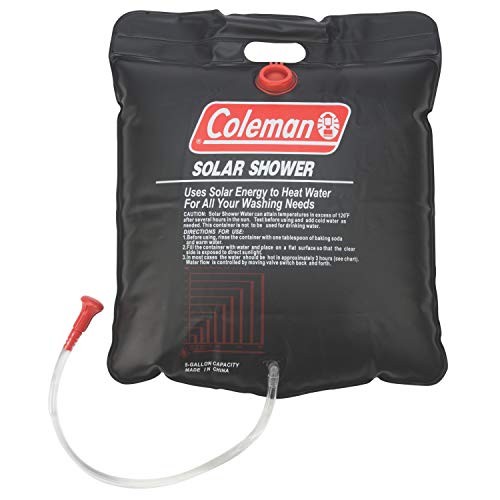
The Coleman solar shower is the reference design for the whole category: a tough black PVC reservoir, a short hose, a simple shower head with an on/off valve, and a handle built to carry the full weight of five gallons of water. There is nothing electronic to fail, nothing to charge before a trip, and almost nothing to learn. Fill it in the morning, lay it in the sun, hang it in the afternoon, and wash.
Heat is the headline feature and it is real within honest limits. On a bright day the water turns properly warm, the kind of warm that makes an evening rinse pleasant rather than bracing. On overcast days it takes the chill off rather than delivering a hot shower, and experienced users top up with a kettle of hot water when they want more. The on/off valve at the head matters more than it sounds: shutting the flow while you soap up is how five gallons becomes three or four comfortable showers instead of one extravagant one.
Durability is the quiet reason this bag keeps selling. The PVC is thick enough to survive being dragged across gravel and stuffed into kit boxes, and the handle is reinforced because a full bag concentrates serious weight on one point. Hang it from something that can truly hold that weight — a stout branch, a roof rack, a beam — rather than a hopeful hook.
The honest limitation is pressure and pace: gravity gives you a gentle rain, and the last gallon arrives as little more than a trickle unless you raise the bag higher.
Best for: buyers who want best budget classic performance in this tier. / Not suited for: anyone whose situation contradicts the trade-offs above.

KIPIDA Solar Shower Bag — Best Value Capacity
Value hunters who want maximum water per dollar: beach families, festival campers, allotment gardeners and anyone stocking an emergency kit with a warm-rinse option.
- Capacity: 5 gallons (20 litres)
- Hose: removable, with on-off switchable shower head
- Material: PVC reservoir with reinforced handle strap
- Heating: solar absorption through the dark bag body
- Extras: mesh storage pocket on the bag face (listing)
Strengths
- Five gallons of capacity in one of the lightest, cheapest formats available
- Removable hose makes filling, cleaning and packing easier than fixed-hose bags
- Switchable head lets you pause flow while soaping to stretch the water
Trade-offs
- Thin-bag feel compared with premium multi-layer rivals
- Gravity pressure only, fading as the level drops
- Seams and valve are the long-term wear points to inspect each season
The KIPIDA bag is the straightforward end of the solar shower market and it knows it: twenty litres of water, a dark PVC body to soak up sunlight, a hose you can detach, and a shower head you can switch off at the head itself. That switch is the feature owners end up praising, because pausing the flow mid-shower is the difference between one long wash and water left over for the next person.
Setup is the usual solar ritual. Fill through the wide cap, lay the bag flat in full sun with the dark side up, then hang it as high as you reasonably can once the water feels warm. Hung from a pergola beam, a tree or a roof bar, it delivers a soft, steady rain that is perfectly adequate for washing off salt, sand, sweat and campsite dust. The mesh pocket on the front keeps soap and a cloth with the shower instead of scattered around camp.
Expectations should match the format. The material is functional rather than luxurious, the pressure is gravity’s, and a full bag is a heavy lift overhead. In exchange you get a shower that folds to almost nothing in a drawer or glovebox, costs very little to replace, and asks nothing of batteries or plumbing. For occasional and seasonal use, that trade is exactly right.
The honest limitation is longevity: at this end of the market the valve and seams work hard, so treat it as a consumable you inspect each spring rather than a decade-long fixture.
Best for: buyers who want best value capacity performance in this tier. / Not suited for: anyone whose situation contradicts the trade-offs above.

Sea to Summit Pocket Shower — Best for Small Spaces
Backpackers, bikepackers and minimalists for whom every ounce is argued over, plus travellers who want a shower that vanishes into a corner of a bag and doubles as waterproof storage.
- Capacity: 10 litres (2.6 gallons)
- Material: 70-denier nylon with waterproof coating
- Weight: 4.3 ounces
- Closure: roll-top, doubles as a dry bag
- Flow: twist on/off shower head at the bag base
Strengths
- Featherweight and packs to roughly the size of a fist
- Doubles as a dry bag, so it earns its place even on dry days
- No batteries, no pump, nothing electronic to fail on the trail
Trade-offs
- Ten litres is one efficient shower, not a family supply
- Gravity flow is gentle and depends on hang height
- Black fabric warms water only modestly compared with big solar bags
The Pocket Shower is the outdoor shower reduced to its essence: a roll-top dry bag made from tough 70-denier nylon, with a small twist-operated shower head set into its base. Filled with ten litres and hung from a branch, it delivers a surprisingly civilised seven or so minutes of flow. Emptied and rolled, it goes back to work as a dry bag for clothes or electronics, which is why weight-obsessed travellers keep it in the kit year after year.
Using it well is a technique. Hang it as high as you can — pressure is purely a function of height — and master the navy-shower rhythm: wet down, twist off, soap up, twist on, rinse. The twist head at the base makes that rhythm easy with one hand. Left in the sun while you walk, the black fabric takes the edge off cold water, though nobody should expect a hot shower from ten litres of thin nylon.
For a solo traveller the capacity maths works beautifully. Ten litres is a genuine full wash with discipline, the whole system weighs less than a chocolate bar, and there is nothing to charge before a trip. It is the shower you carry when carrying a shower at all seems extravagant — and then it surprises you by being enough.
The honest limitation is scale: one person, one efficient wash per fill. Groups and long-haired shampoo routines will drain it before the rinse feels finished.
Best for: buyers who want best for small spaces performance in this tier. / Not suited for: anyone whose situation contradicts the trade-offs above.
Comparison Table
| Product | Badge | Power / format | Key figure |
|---|---|---|---|
| Ivation Portable Outdoor Shower | Best Overall | rechargeable 2200mAh lithium battery, USB charging | 0.66 gallons per minute |
| KEDSUM Portable Camping Shower (GFS-1701) | Best for Families | two detachable 2200mAh USB-rechargeable batteries | 45–60 minutes per battery |
| Advanced Elements 5 Gallon Summer Shower | Best Solar Bag | 5 gallons | built-in indicator shows water warmth |
| Coleman 5-Gallon Solar Shower | Best Budget Classic | 5 gallons (19 litres) | solar, warms in direct sun over a few hours |
| KIPIDA Solar Shower Bag | Best Value Capacity | 5 gallons (20 litres) | PVC reservoir with reinforced handle strap |
| Sea to Summit Pocket Shower | Best for Small Spaces | 10 litres (2.6 gallons) | 4.3 ounces |
For a deeper look at one end of this market, see Best Outdoor Shower For Beginners Under $75.
How to Choose: Best outdoor shower under $75 Criteria That Matter
Capacity and recovery
Capacity is people, not litres. A five-gallon fill is one generous shower or several disciplined ones, and recovery is the hidden half of the spec: a solar tank needs sun hours to reheat, a battery needs charge hours, a plumbed line needs nothing. Households should size for the busiest realistic hour — the post-beach return, the post-swim pile-up — rather than the average day.
Water delivery: gravity, pump or plumbed
Gravity systems hang a reservoir overhead and let physics set the pressure: gentle, silent and free to run, but fading as the level drops. Battery and foot pumps hold a steadier stream and let the water container sit on the ground, at the cost of charging or pumping. Plumbed fixtures deliver household pressure and unlimited water, at the cost of a permanent installation. Decide which trade you are making before you compare anything else, because no accessory fixes a format mismatch.
Warmth: where the heat actually comes from
No portable shower heats water quickly from nothing. Solar bags and columns absorb sun over hours; pump showers deliver water at whatever temperature you filled them with; only plumbed fixtures with a hot line give on-demand warmth. Plan your routine around your heat source — fill in the morning for an afternoon wash, or keep a kettle habit for cold evenings — and the shower will meet you halfway.
Materials and weather exposure
Outdoor fixtures live hard lives. Stainless steel in 304 grade handles most gardens and pools; coastal and salt-heavy sites are harder on everything and reward marine-grade thinking and a rinse-down habit. Plastic reservoirs should be thick, UV-stable and stored out of the sun when empty. Whatever you buy, the drain-down and storage routine in the manual decides whether it survives its third winter.
Controls the whole household can run
The best outdoor shower control is the one a wet, cold, impatient guest understands instantly. Single handles beat mystery dials; a shower head you can pause beats walking back to a valve; a foot faucet beats everything for a quick rinse. If children, grandparents or holiday guests will use the shower unsupervised, simplicity is a safety feature as much as a convenience.
Mounting, footprint and storage
Every shower needs a home twice: where it runs and where it sleeps. Portable kits should pack into the space you actually have; columns need a solid, level base in full sun; wall fixtures need a wall that can take fixings and water lines. Measure both homes before ordering, and be honest about the hanging point for gravity bags — a full five gallons is a serious load for any branch or hook.
Readers comparing budgets often start with Best Outdoor Shower Under $150 before settling on a format.
Setting Up Your Outdoor Shower
Key Takeaways
- Decide the water source and drainage before the first fill or the first drilled hole.
- Warmth is scheduled, not switched on: sun hours, a kettle, or a plumbed hot line.
- Drain and dry after use; ten minutes of routine protects the whole investment.
- Fill the reservoir or bucket with clean water first, and set solar bags in full sun as early in the day as you can — warmth is a morning decision that pays out in the afternoon.
- Choose the station: a hanging point that is genuinely strong, a flat spot for a pump bucket, and drainage that will not turn the washing area into a swamp. A pallet, a gravel patch or a simple deck square keeps feet out of the mud you are washing off.
- Hang gravity bags as high as practical; pressure rises with height. Route pump hoses without kinks, clip batteries and electrics up out of the splash zone, and test the on/off control before anyone undresses.
- Use the navy-shower rhythm — wet down, water off, soap up, rinse — and a five-gallon fill will serve several people instead of one long indulgence.
- After use, drain everything, leave caps open while the kit dries, and store reservoirs out of direct sun. A dry shower is a shower that does not smell by the next trip.
Drain-down discipline is what separates a five-year shower from a one-season regret. Before the first hard frost, portable reservoirs should be emptied, dried and stored indoors; plumbed fixtures need their lines isolated and drained at the lowest point, with the head and hose removed where the design allows. Solar columns hold a large volume in an exposed body, so their drain plugs matter — open them early rather than after a cold snap. In spring, flush every system through before the first shower, check seals and hoses for cracks, and run the water until it is clear and fresh-tasting systems are not involved — this is rinse water, but it should still be clean water. Ten minutes twice a year is the entire maintenance contract for most outdoor showers, and it is the cheapest insurance in this whole guide.
The related guide to Outdoor Shower Pros And Cons covers the neighbouring use case in the same detail.
You may also find Best Outdoor Shower Under $50 useful while you plan the installation.
Common Buying Mistakes
Expecting heat without giving it time or sun
Solar is a schedule, not a switch. A bag filled at four in the afternoon will be a cold shower at five. Fill early, site in full sun, and keep a kettle plan for grey days.
Hanging five gallons from something hopeful
Water is heavy and a full reservoir concentrates that weight on one handle. Branches snap, hooks pull out and bags fall on feet. Test the hanging point with your own weight in mind, not optimism.
Leaving water sitting in the system
Stored wet, reservoirs grow slimy and hoses grow smells. Drain, dry and store open. The two minutes after each trip decide how the next trip starts.
Judging by pressure alone
The strongest stream is not the best shower if it empties the tank in three minutes or frightens the children. Match flow to capacity and to the people under it.
Installing a fixture without a winter plan
Exposed pipework and hard frost are enemies. If your climate freezes, buy and install with drain-down in mind from day one, not as an autumn improvisation.
Once the format is chosen, Portable Camping Shower Vs Outdoor Shower helps you sanity-check the shortlist.
Final Recommendation
Start with the Ivation Portable Outdoor Shower (Best Overall): it is the pick that fits the widest range of households in this tier, and its trade-offs are the easiest to live with. If its format does not match your space or your water supply, the KEDSUM Portable Camping Shower (GFS-1701) (Best for Families) is the runner-up we would buy instead. Round out your planning with Best Outdoor Shower For Small Spaces Under $20 if you have not already, and re-check the water, warmth and queue maths for your own household before ordering — those three numbers decide satisfaction more than any single product does.
Living With an Outdoor Shower: The Details That Decide Satisfaction
Finally, remember that an outdoor shower is one of the few home purchases that gets more valuable as it gets more ordinary. The first week it is a novelty; by the second month it is simply where the day ends. Choose for that second month — for the routine, the queue, the weather and the upkeep you will actually sustain — and the purchase will justify itself quietly, daily, for years.
And a final planning truth: nobody regrets drainage, and everybody regrets skipping it. Whatever else your budget forces you to compromise — capacity, finish, features — protect the gravel bed, the fall of the ground and the path the water takes away. It is the one part of the installation that is miserable to retrofit.
Finally, the category’s oldest truth: water finds the path you give it or chooses its own. Every paragraph in this guide about drainage, bases and falls exists because that sentence is undefeated. Give the water a planned path and the outdoor shower is all pleasure; skip it, and the shower will plan its own route through your garden.
Wind matters more than brochures admit. It cools tanks, chills wet skin and turns a pleasant evening rinse into an endurance event. A station tucked against a wall or hedge, even at the cost of a little sun, often serves more days of the year than the exposed, sunnier alternative.
If your household includes someone who showers at dawn, think about the neighbours and the household asleep indoors. Site the station away from bedroom windows where you can, choose the quieter formats for early use, and keep the gravel bed raked so footsteps do not announce every rinse. Courtesy is a design specification.
Water quality leaves its signature on equipment. Hard water scales heads and valves; gritty well or stream water wears pump filters; chlorinated splash shortens the life of cheap plastics. None of this is a reason to avoid an outdoor shower — it is a reason to keep the filter rinsed, the head descaled once a season, and a spare seal in the drawer. Maintenance is cheap; neglect is what costs.
Gardeners develop their own shower theology: the end-of-day wash that marks the border between the plot and the house. For that ritual, warmth and position matter more than pressure — a solar tank that has soaked up the same sun you worked under, sited by the shed or the back door, with a hook for the hat and a stone for the boots. It is the cheapest luxury in this entire guide, and the one owners describe with the most affection.
Solar siting is a small science of its own. The tank wants the longest sun window, ideally catching morning light to rebuild heat early, and shelter from wind that steals warmth from exposed surfaces. A column moved two metres across a patio can gain an hour of useful sun; measure shadows before you bolt anything down.
Houses on septic systems benefit in a quieter way: every rinse that happens outdoors is a rinse the tank never processes. Sand especially — the enemy of every drainage field — stays in the garden gravel where it belongs. Over a beach house’s lifetime, that is a meaningful kindness to expensive infrastructure.
At the allotment or smallholding, the outdoor shower marks the border between work and home. Sited by the shed with a solar tank above it, it washes off the day’s soil before the drive, keeps the car clean, and turns the last task of the day into the most pleasant one.
Beach houses live by the outdoor shower. Sand is the enemy of every indoor drain, and a rinse station at the door — even a simple hose-fed or pump setup — keeps it outside where it belongs. Prioritise a handheld for feet and gear, a base that drains to gravel, and materials that shrug off salt air. The fanciest fixture in the world is worth less here than the one positioned exactly where sandy people actually arrive.
There is a social dimension worth planning for. Outdoor showers at shared properties, rentals and family compounds serve people who did not choose them and will not read the manual. Robust fittings, obvious controls and a small laminated note about the winter routine protect the installation from its kindest-intentioned users. Design for the guest, and the owner’s life gets easier.
Consider the path from the car to the shower, because that is where outdoor showers earn or lose their keep. Sandy feet cross it, wet dogs shake on it, children sprint it. A station placed on that natural path gets used without a single household rule being written; a station placed for the convenience of the plumbing alone gets admired and bypassed. When in doubt, optimise for the muddy return journey, not the architect’s drawing.
Finally, buy the shower your household will maintain, not the one you admire. Every format in this guide asks for something — sun, charging, draining, wiping, winterising — and the right choice is the one whose small chore fits your temperament. The best outdoor shower is not the most capable one on paper; it is the one still running, clean and ready, on an ordinary Tuesday in the middle of the season.
Do not overlook the humble bucket in your planning. Buckets fill pumps, catch the first cold run-off for the garden, carry warm water from the kitchen on grey days, and store the whole kit afterwards. The best outdoor shower stations are quietly organised around one or two excellent buckets.
Sound and splash are small things that matter at close quarters. A shower beside a bedroom window or a neighbour’s fence benefits from a head with a soft, rain-style pattern rather than a jet, and from a base that drains quietly into gravel rather than drumming on hollow decking. None of this appears on a spec sheet, and all of it appears in how the shower feels at seven in the morning.
Accessibility planning and guest planning converge on the same shortlist: lever or single-handle controls, a handheld that reaches everywhere, a level approach, and water that cannot surprise. The shower that serves the widest range of bodies and moods is rarely the most specialised one; it is the most considerate one.
Water sourcing is the unglamorous foundation of every good setup. Portable systems want a fill point within a hose or bucket-carry of the shower spot; plumbed systems want a sensible pipe run; solar columns want both a hose feed and full sun, which are not always found in the same corner of a garden. Walk the route with a bucket before you buy anything. The shower that fits your water geography is the shower that gets used.
Stables and yards run on the same logic with higher stakes: mud, and everything mud contains, should stop at the yard tap. A handheld on a long hose handles boots, buckets and the occasional pony, and a station that drains to gravel keeps the yard itself from becoming the problem.
For the campervan and caravan world, the outdoor shower solves the small-bathroom problem from outside the vehicle entirely. A pump kit or pressure tank at the door, a mat on the grass and a privacy screen where the site requires one — the van stays dry, the queue stays outside, and the tiny indoor shower becomes storage, as nature intended.
During building work on a house, an outdoor shower quietly saves the remaining bathroom. Dust, plaster and worse stop at the garden station for the whole project. Contractors have known this for years; homeowners usually learn it one renovation too late.
For households with children, the winning features are boring ones: a control that cannot accidentally swing to scalding, a head height that adjusts or a handheld that reaches small shoulders, and a station layout with no full-water lifting for anyone. Supervise first uses, set the temperature before small people step in, and the outdoor shower becomes the part of the day children request rather than endure.
Frequently Asked Questions
What maintenance does an outdoor shower need?
Drain and dry portable systems after trips, rinse pump filters, wipe stainless fixtures occasionally, and drain everything exposed before frost. Twice a year, check hoses, seals and valves. That is the whole contract for most designs.
How long does five gallons of water last?
With a pause-while-you-soap rhythm, five gallons covers several quick showers or one long, relaxed one. Continuous running at typical gravity or pump flow empties it in roughly five to ten minutes, which is why the on/off control is the most important feature on any portable shower.
What is the best outdoor shower for a rental property?
Portable formats win for rentals because they need no permission, no plumbing and no permanent fixings: a pump shower with a bucket, or a solar bag on a strong existing hook. Everything packs away when you leave, taking your investment with you.
How warm does an outdoor shower actually get?
Solar bags and columns in strong sun commonly reach comfortably warm to genuinely hot, which is why mixing and a quick hand-test matter before children step in. On overcast days expect tepid. Pump showers deliver whatever temperature you filled the bucket with, and plumbed fixtures with a hot line behave like the shower indoors.
How do I keep a solar shower from getting too hot?
On very hot days, mix before you shower: top the tank with cool water, or run the mixing control toward cold on plumbed and column models. Always test with a hand and supervise children until the temperature is set — solar water can surprise you at midday.
Can I drink or cook with water from a solar shower bag?
Treat outdoor shower water as wash water only. Reservoirs are designed for bathing, and water that has sat warm in any container should not be used for drinking or cooking. Fill from a clean supply, use it for washing, and store the system dry.