Disclosure: As an Amazon Associate, umtsmarttool.com earns from qualifying purchases. Links to Amazon on this page are affiliate links; they cost you nothing extra. Prices and availability change often, so check the current Amazon listing before you buy.
Where to buy
This outdoor shower buying guide shortlists the picks below by format, warmth and upkeep, so the comparison starts from products that actually fit real properties.
- gotonovo Outdoor Shower Fixture System (SUS304, 8-Inch) — Best Overall — Check on Amazon
- KEDSUM Portable Camping Shower (GFS-1701) — Best Portable — Check on Amazon
- Outsunny 7ft Solar Heated Outdoor Shower (A20-238) — Best Solar Column — Check on Amazon
- Advanced Elements 5 Gallon Summer Shower — Best Solar Bag — Check on Amazon
- Sea to Summit Pocket Shower — Best for Small Spaces — Check on Amazon
- Ivation Portable Outdoor Shower — Best for Beginners — Check on Amazon
Read the full guide ↓
Outdoor shower buying guide
An outdoor shower buying guide has one job: to turn a confusing shelf of bags, pumps, columns and fixtures into a shortlist that fits your property. This guide does it in the order experienced owners wish they had used — format before product, warmth before brand, drainage before everything — and it is honest about the places where the market is thin, because a buying guide that pretends every tier is full is not guiding anyone.
By the end you will know which format your site supports, which specifications are worth paying for, which are decoration, and which of the shortlisted picks matches your household’s queue. The picks table links each recommendation so you can check the current listing once the decision is made.
In this guide
Materials and weather exposure
Outdoor fixtures live hard lives. Stainless steel in 304 grade handles most gardens and pools; coastal and salt-heavy sites are harder on everything and reward marine-grade thinking and a rinse-down habit. Plastic reservoirs should be thick, UV-stable and stored out of the sun when empty. Whatever you buy, the drain-down and storage routine in the manual decides whether it survives its third winter.
Warmth: where the heat actually comes from
No portable shower heats water quickly from nothing. Solar bags and columns absorb sun over hours; pump showers deliver water at whatever temperature you filled them with; only plumbed fixtures with a hot line give on-demand warmth. Plan your routine around your heat source — fill in the morning for an afternoon wash, or keep a kettle habit for cold evenings — and the shower will meet you halfway.
Water delivery: gravity, pump or plumbed
Gravity systems hang a reservoir overhead and let physics set the pressure: gentle, silent and free to run, but fading as the level drops. Battery and foot pumps hold a steadier stream and let the water container sit on the ground, at the cost of charging or pumping. Plumbed fixtures deliver household pressure and unlimited water, at the cost of a permanent installation. Decide which trade you are making before you compare anything else, because no accessory fixes a format mismatch.
Mounting, footprint and storage
Every shower needs a home twice: where it runs and where it sleeps. Portable kits should pack into the space you actually have; columns need a solid, level base in full sun; wall fixtures need a wall that can take fixings and water lines. Measure both homes before ordering, and be honest about the hanging point for gravity bags — a full five gallons is a serious load for any branch or hook.
Controls the whole household can run
The best outdoor shower control is the one a wet, cold, impatient guest understands instantly. Single handles beat mystery dials; a shower head you can pause beats walking back to a valve; a foot faucet beats everything for a quick rinse. If children, grandparents or holiday guests will use the shower unsupervised, simplicity is a safety feature as much as a convenience.
Capacity and recovery
Capacity is people, not litres. A five-gallon fill is one generous shower or several disciplined ones, and recovery is the hidden half of the spec: a solar tank needs sun hours to reheat, a battery needs charge hours, a plumbed line needs nothing. Households should size for the busiest realistic hour — the post-beach return, the post-swim pile-up — rather than the average day.
Budget Tiers, Framed Honestly
The entry tier buys gravity and simplicity: solar bags and basic pumps that work well for occasional use and trials. The middle tier buys recovery and refinement — dual batteries, insulated bags, foot-pump pressure, hose-fed solar columns. The upper tier buys permanence: stainless fixtures and larger columns that become part of the property. Spend where your routine lives; a daily-use household should buy up, a twice-a-summer household should not, and no tier fixes a mismatched format.
The Shortlist
| Product | Badge | Key spec |
|---|---|---|
| gotonovo Outdoor Shower Fixture System (SUS304, 8-Inch) | Best Overall | SUS304, 8 in rain head, 1.24 GPM, single handle |
| KEDSUM Portable Camping Shower (GFS-1701) | Best Portable | Dual batteries, 1 GPM flow, 5.9 ft hose |
| Outsunny 7ft Solar Heated Outdoor Shower (A20-238) | Best Solar Column | 9.2 gal solar column, freestanding, foot faucet |
| Advanced Elements 5 Gallon Summer Shower | Best Solar Bag | 5 gal, 4-ply insulated solar bag, temp gauge |
| Sea to Summit Pocket Shower | Best for Small Spaces | 10L dry-bag shower, 4.3 oz, roll-top |
| Ivation Portable Outdoor Shower | Best for Beginners | Battery pump, 0.66 GPM, USB rechargeable |
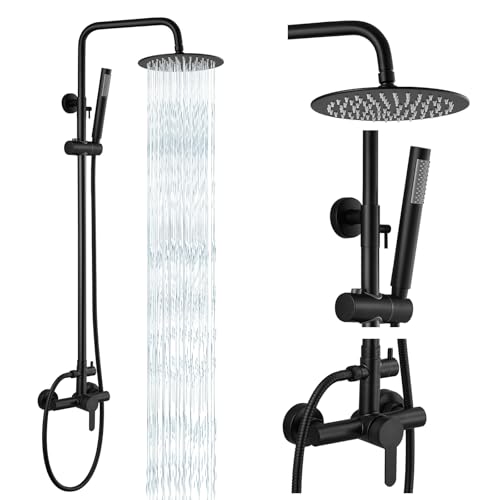
gotonovo Outdoor Shower Fixture System (SUS304, 8-Inch) — Best Overall
Homeowners who want the plumbed outdoor shower experience with straightforward single-handle control — a favourite for pool walls, patio returns and beach-house exteriors.
gotonovo built its reputation in outdoor fixtures by keeping the formula simple: 304 stainless steel everywhere water touches, an 8-inch rain head for the full-body rinse, a handheld spray for everything else, and one handle to run it all. Reviewers of outdoor showers keep landing on this kit because it behaves like a quality indoor shower that happens to live outside — no novelty controls, no fragile finishes, nothing to learn.
The single handle deserves its own mention. Outdoor showers serve guests, children and visiting grandparents, and a control that twists one way for flow and temperature gets understood in seconds. The 1.24 gallon-per-minute flow is deliberate: enough pressure to rinse properly, restrained enough to respect households on wells, septic systems or water restrictions. The handheld on its long hose handles the jobs the rain head cannot — feet, paws, sandy coolers, muddy bikes.
The honest limitation is the same as every plumbed pick: the shower is only as good as the wall, water lines and winterising discipline behind it.

KEDSUM Portable Camping Shower (GFS-1701) — Best Portable
Families and groups who shower one after another, because the twin-battery system keeps the pump running while a spare charges. Also a strong pick for pet washing and post-beach rinses where a stronger stream helps.
KEDSUM’s GFS-1701 solves the battery shower’s obvious weakness — one battery, one charge, then a wait — by shipping two detachable 2200mAh batteries. One drives the pump while the other charges from any USB source, and swapping takes seconds. Because the batteries clip on outside the water container, they never sit submerged, which is both the safer arrangement and the kinder one for battery lifespan.
Flow is the other headline. At a gallon a minute the stream has genuine rinsing authority: shampoo clears faster, sand lets go of ankles, and a muddy dog takes minutes rather than a quarter of an hour. The pump itself drops into a bucket, a water carrier or a collapsible basin, and the kit includes the hook and suction fittings to hold the head hands-free. Total kit weight stays low enough that it disappears into a car boot corner or a family camping box.
The honest limitation is water logistics: at a gallon a minute a small bucket empties fast, so family use means a bigger container or a refill runner on duty.
Outsunny 7ft Solar Heated Outdoor Shower (A20-238) — Best Solar Column
Pool and garden households that want a fixed, always-ready warm rinse without opening a wall or hiring a plumber — the column bolts down, connects to a hose, and heats itself.
The Outsunny column shower is the middle path between a hanging bag and a plumbed fixture. It stands about seven feet tall on its own base, stores just over nine gallons in its black column, and lets the sun do the heating while a garden hose handles the filling. Bolt it down beside the pool, the patio or the garden gate and it simply waits there, warm and ready, all season.
The foot faucet turns out to be the feature households use most. A quick rinse of feet before stepping into the pool keeps the water cleaner, muddy wellingtons stop at the door, and the dog’s paws get a five-second wash instead of a full production. The main head on its swivel mount handles the full-body version: post-swim rinses, gardening wash-downs and cooling off on hot afternoons.
The honest limitation is solar reality: warmth is a fair-weather promise, and the shower is a seasonal fixture in any climate with hard frosts.
Check on Amazon

Advanced Elements 5 Gallon Summer Shower — Best Solar Bag
Campers and van travellers who like the solar-bag idea but want faster heating, better heat retention and a way to check the water temperature before stepping under it.
Advanced Elements took the basic solar bag and engineered the two things users complain about: slow heating and no idea how warm the water actually is. The Summer Shower wraps the reservoir in a four-layer system — a reflector panel, an insulator layer and a solar-absorbing surface — that coaxes heat in faster and keeps it there into the evening. The built-in temperature indicator then tells you whether you are about to enjoy a warm rinse or a bracing one.
The practical difference shows up on shoulder-season trips. Where a plain black bag gives up its warmth by the time the sun drops, the insulated build holds a usable temperature noticeably longer, which is exactly when you want to wash — after the day’s hike, ride or drive. The extra-large filling valve is a small mercy that becomes a big one at awkward campsite taps and when adding a kettle of hot water to lift the temperature.
The honest limitation is shared with every gravity bag: pressure is modest, and no amount of insulation changes the physics of water flowing downhill from a bag.

Sea to Summit Pocket Shower — Best for Small Spaces
Backpackers, bikepackers and minimalists for whom every ounce is argued over, plus travellers who want a shower that vanishes into a corner of a bag and doubles as waterproof storage.
The Pocket Shower is the outdoor shower reduced to its essence: a roll-top dry bag made from tough 70-denier nylon, with a small twist-operated shower head set into its base. Filled with ten litres and hung from a branch, it delivers a surprisingly civilised seven or so minutes of flow. Emptied and rolled, it goes back to work as a dry bag for clothes or electronics, which is why weight-obsessed travellers keep it in the kit year after year.
Using it well is a technique. Hang it as high as you can — pressure is purely a function of height — and master the navy-shower rhythm: wet down, twist off, soap up, twist on, rinse. The twist head at the base makes that rhythm easy with one hand. Left in the sun while you walk, the black fabric takes the edge off cold water, though nobody should expect a hot shower from ten litres of thin nylon.
The honest limitation is scale: one person, one efficient wash per fill. Groups and long-haired shampoo routines will drain it before the rinse feels finished.

Ivation Portable Outdoor Shower — Best for Beginners
Anyone who wants a real shower stream without plumbing, batteries to manage beyond a USB cable, or a bag hoisted overhead. It suits campers, beach-day families, pet owners and anyone rinsing off beside a pool, a van or a garden tap with a bucket nearby.
The Ivation design is the simplest answer to the oldest outdoor-shower problem: gravity bags work, but the stream is weak and the bag has to hang above your head. Here the pump drops into a bucket, a storage tote or even a sink, and the battery-driven motor pushes water up the hose at a calm, even pace. That evenness is the point. The stream does not surge or fade as a bag empties, and it does not depend on how high you managed to hang anything.
In daily use the details are friendly. The on/off switch is a single touch on the pump unit, the shower head sticks to smooth surfaces with the included suction cup, and the S-hook covers the branch, fence rail and shower-rod situations. Because the flow is modest, a standard bucket stretches a long way: a few gallons covers a full wash with water to spare for sandy feet, a dog, or a stack of muddy boots afterwards.
The honest limitation is pressure: this is a gentle rinse, not a blast. Anyone expecting home-shower force for washing shampoo out of very thick hair will find the pace slow.
If you are still deciding between formats, our companion guide to How To Choose An Outdoor Shower walks through the same decision from another angle.
How-to-Choose Checklist
- Site audited for sun, water, privacy and drainage.
- Warmth source chosen: solar, heated fill or plumbed hot line.
- Format matched to site and routine.
- Capacity sized for the busiest hour, recovery included.
- Controls tested mentally against the youngest and oldest users.
- Drain-down and storage routine read and accepted.
Drain-down discipline is what separates a five-year shower from a one-season regret. Before the first hard frost, portable reservoirs should be emptied, dried and stored indoors; plumbed fixtures need their lines isolated and drained at the lowest point, with the head and hose removed where the design allows. Solar columns hold a large volume in an exposed body, so their drain plugs matter — open them early rather than after a cold snap. In spring, flush every system through before the first shower, check seals and hoses for cracks, and run the water until it is clear and fresh-tasting systems are not involved — this is rinse water, but it should still be clean water. Ten minutes twice a year is the entire maintenance contract for most outdoor showers, and it is the cheapest insurance in this whole guide.
Worked Examples: Three Households
The pool family of five
Site: sunny patio, hose nearby, drainage to a garden bed. Warmth: solar, with evening top-ups from the tap for the children. Format: a solar column for the station plus a pump shower as overflow on the busiest days. Capacity thinking: the column serves the afternoon wave; the pump covers guests. The lesson is that busy households often need a station and a satellite, not a single hero product.
The renting couple with a dog
Site: small paved yard, no permission for fixings, one strong fence post. Warmth: heated fills from the kitchen tap. Format: a dual-battery pump shower over a large basin, with a solar bag for summer weekends. Everything packs into one box when they move. The lesson: portability is not a compromise here, it is the entire point.
The beach house with guests
Site: exterior wall on the arrival path, sand everywhere, salt in the air. Warmth: plumbed hot line, because guests will not manage solar schedules. Format: a stainless wall fixture with a handheld, on a gravel pad with a duckboard. The lesson: when users are many and unsupervised, permanence and simplicity beat every portable virtue.
Common Buying Mistakes
Skipping the pause
Showers that cannot pause while you soap waste most of their water before the rinse. Choose a head or valve you can work one-handed, and teach the household the wet-off-soap-rinse rhythm.
Buying capacity by the headline number
A big tank that takes all day to warm or a huge bag nobody can lift when full is worse than a smaller system that matches your routine. Size for the busiest hour and the strength of the person who fills it.
Leaving water sitting in the system
Stored wet, reservoirs grow slimy and hoses grow smells. Drain, dry and store open. The two minutes after each trip decide how the next trip starts.
Expecting heat without giving it time or sun
Solar is a schedule, not a switch. A bag filled at four in the afternoon will be a cold shower at five. Fill early, site in full sun, and keep a kettle plan for grey days.
Forgetting drainage
Every outdoor shower makes a puddle with ambitions. Without gravel, a deck square or a drain, your wash station becomes a mud patch that adds more dirt than it removes.
For a deeper look at one end of this market, see Best Outdoor Shower Under $75.
The related guide to Outdoor Shower Pros And Cons covers the neighbouring use case in the same detail.
You may also find Portable Camping Shower Vs Outdoor Shower useful while you plan the installation.
Once the format is chosen, Best Outdoor Shower Under $20 helps you sanity-check the shortlist.
If you are still deciding between formats, our companion guide to Best Outdoor Shower For Small Spaces Under $20 walks through the same decision from another angle.
Notes From the Field
There is a winter minority report worth hearing: hardy households in mild climates use their outdoor showers all year, draining between uses and revelling in the cold. If that is you, choose formats that drain completely and quickly, and treat every fitting as if frost were personal — because to exposed pipework, it is.
Sound and splash are small things that matter at close quarters. A shower beside a bedroom window or a neighbour’s fence benefits from a head with a soft, rain-style pattern rather than a jet, and from a base that drains quietly into gravel rather than drumming on hollow decking. None of this appears on a spec sheet, and all of it appears in how the shower feels at seven in the morning.
Accessibility planning and guest planning converge on the same shortlist: lever or single-handle controls, a handheld that reaches everywhere, a level approach, and water that cannot surprise. The shower that serves the widest range of bodies and moods is rarely the most specialised one; it is the most considerate one.
For households with children, the winning features are boring ones: a control that cannot accidentally swing to scalding, a head height that adjusts or a handheld that reaches small shoulders, and a station layout with no full-water lifting for anyone. Supervise first uses, set the temperature before small people step in, and the outdoor shower becomes the part of the day children request rather than endure.
Salt air deserves its own maintenance note. Coastal fixtures and fittings should be rinsed with fresh water when you remember, wiped when you notice spotting, and checked each spring for the first freckles of corrosion. Stainless grades differ in salt tolerance, and the coast is where the difference stops being theoretical.
Emergency preparedness lists increasingly include a solar bag, and the reasoning is sound. When power or water pressure fails, a dark bag, a sunny spot and any stored water restore basic hygiene — the thing households miss first and talk about most afterwards. It costs little, stores flat and asks nothing until the day it matters enormously.
A shower’s first job at many properties is not people at all. It is the rinse that keeps the pool filter alive, the wash that keeps sand out of the septic, the hose-down that keeps the hire boat or the borrowed wetsuit in good standing. When you total the value, count these invisible jobs; for many owners they outweigh the showers themselves.
Gardeners develop their own shower theology: the end-of-day wash that marks the border between the plot and the house. For that ritual, warmth and position matter more than pressure — a solar tank that has soaked up the same sun you worked under, sited by the shed or the back door, with a hook for the hat and a stone for the boots. It is the cheapest luxury in this entire guide, and the one owners describe with the most affection.
Mud runs, obstacle races and trail events have made the portable shower standard kit in certain car parks. The etiquette is simple: rinse the worst off at the car, bag the kit, and let the venue’s drains live. A dual-battery pump earns its boot space on exactly these days.
If your property has a pool, rinse discipline protects your water chemistry as much as your carpets. A quick rinse before swimming removes lotions and sweat that the filter would otherwise handle, and a rinse after removes chlorine before it reaches indoor fabrics. Siting the shower on the natural path between pool and house — not around a corner, not up steps — is what turns that discipline from a rule into a habit.
Outdoor workers — landscapers, builders, farm hands — treat the yard shower as welfare equipment, and they are right. A warm wash before the drive home is dignity, car preservation and family diplomacy in a single fixture. Employers fitting one at a depot rarely remove it.
There is a simple test for any outdoor shower decision: picture the third use, not the first. The first use is novelty; the third is routine. Where is the towel? Who filled the water, and when? What is underfoot? If the third use still sounds easy, the format fits your life. If it already sounds like a chore, choose the simpler system — the outdoor shower market rewards honesty about your own habits.
There is a social dimension worth planning for. Outdoor showers at shared properties, rentals and family compounds serve people who did not choose them and will not read the manual. Robust fittings, obvious controls and a small laminated note about the winter routine protect the installation from its kindest-intentioned users. Design for the guest, and the owner’s life gets easier.
Accessibility is rarely discussed in this category and should be. A handheld sprayer on a long hose, a control reachable from a seated position, and a level, non-slip standing area turn an outdoor shower into one that serves ageing parents, recovering athletes and anyone whose balance is having a day. The households that plan for this early rarely regret it.
For properties on wells or rainwater tanks, the outdoor shower’s modesty is a feature. A five-gallon rinse is a rounding error next to a bath, and a foot faucet answers the commonest need — clean feet at the door — with a cupful. In water-careful households the outdoor shower is not an indulgence; it is the rationing device that makes the indulgence of cleanliness affordable.
For the campervan and caravan world, the outdoor shower solves the small-bathroom problem from outside the vehicle entirely. A pump kit or pressure tank at the door, a mat on the grass and a privacy screen where the site requires one — the van stays dry, the queue stays outside, and the tiny indoor shower becomes storage, as nature intended.
Hooks and shelves sound like accessories and behave like infrastructure. A hook for the towel within arm’s reach, a small shelf or caddy for soap that does not live in the mud, and a peg for the clothes you are changing out of — these three cheap additions separate a shower station from a shower product. Plan them with the same care as the water itself.
Houses on septic systems benefit in a quieter way: every rinse that happens outdoors is a rinse the tank never processes. Sand especially — the enemy of every drainage field — stays in the garden gravel where it belongs. Over a beach house’s lifetime, that is a meaningful kindness to expensive infrastructure.
Temperature discipline matters most at the extremes. Solar water at midday in high summer can scald, and the first seconds from any system can run colder or hotter than expected. The household rule is universal and short: hand first, children second, every time. No fixture in this guide removes the need for that rule.
A word about shower heads, because owners swap them more than any other part. Rain-style heads spread water softly over a wide area and suit full-body rinses; focused jets rinse hair and mud faster but empty tanks sooner; handhelds do everything adequately and some things — feet, dogs, gear — better than any fixed head. If your chosen system allows a standard threaded swap, you hold an upgrade path that costs little and changes the shower’s character completely.
Festival and event campers value a different virtue: dignity. A solar bag and a pop-up tent at the pitch restore a private, warm wash in a field of thousands, and the queue maths — one bag, one person, one disciplined navy shower — is exactly what the format was built for.
For households with a hot tub, the pre-soak rinse is the outdoor shower’s most hygienic job. Lotions, sweat and cosmetics stay out of the water, chemicals last longer, and the tub stays clearer. Siting the shower on the path to the tub is what makes the rinse a habit rather than a rule.
Consider the view from the shower, not just of it. The outdoor showers people love face the garden, the sea or the evening sky — not the bins, the boiler flue or the neighbour’s kitchen window. A quarter-turn of the station at planning stage costs nothing and pays out at every single use.
Consider the path from the car to the shower, because that is where outdoor showers earn or lose their keep. Sandy feet cross it, wet dogs shake on it, children sprint it. A station placed on that natural path gets used without a single household rule being written; a station placed for the convenience of the plumbing alone gets admired and bypassed. When in doubt, optimise for the muddy return journey, not the architect’s drawing.
More Buying Notes
Finally, remember that an outdoor shower is one of the few home purchases that gets more valuable as it gets more ordinary. The first week it is a novelty; by the second month it is simply where the day ends. Choose for that second month — for the routine, the queue, the weather and the upkeep you will actually sustain — and the purchase will justify itself quietly, daily, for years.
Solar siting is a small science of its own. The tank wants the longest sun window, ideally catching morning light to rebuild heat early, and shelter from wind that steals warmth from exposed surfaces. A column moved two metres across a patio can gain an hour of useful sun; measure shadows before you bolt anything down.
If the shower will serve a business — a rental, a campsite, a swim school — durability and idiot-proofing outrank every other virtue. Choose the format with the fewest instructions, the strongest fittings and the easiest drain-down, and laminate the winter routine where the person who needs it will actually find it.
Freeze-thaw is not the only weather that ages equipment. Ultraviolet light embrittles cheap plastics, which is why reservoirs stored in shade outlast identical ones stored in full sun, and why stainless and quality nylon dominate the long-lived end of this market. When a product feels flimsy in the hand, the sun has usually been consulted in its design — briefly.
The standing surface is a safety item disguised as a comfort item. Wet grass, smooth decking and mud are all slip hazards, and the fix is humble: a slatted duckboard, a textured mat rated for outdoor use, or a gravel bed that drains instantly. Whatever you choose, it should stay put when wet and hose clean in seconds. Falls beside outdoor showers are the category’s most preventable injury.
Water quality leaves its signature on equipment. Hard water scales heads and valves; gritty well or stream water wears pump filters; chlorinated splash shortens the life of cheap plastics. None of this is a reason to avoid an outdoor shower — it is a reason to keep the filter rinsed, the head descaled once a season, and a spare seal in the drawer. Maintenance is cheap; neglect is what costs.
Do not overlook the humble bucket in your planning. Buckets fill pumps, catch the first cold run-off for the garden, carry warm water from the kitchen on grey days, and store the whole kit afterwards. The best outdoor shower stations are quietly organised around one or two excellent buckets.
During building work on a house, an outdoor shower quietly saves the remaining bathroom. Dust, plaster and worse stop at the garden station for the whole project. Contractors have known this for years; homeowners usually learn it one renovation too late.
Beach houses live by the outdoor shower. Sand is the enemy of every indoor drain, and a rinse station at the door — even a simple hose-fed or pump setup — keeps it outside where it belongs. Prioritise a handheld for feet and gear, a base that drains to gravel, and materials that shrug off salt air. The fanciest fixture in the world is worth less here than the one positioned exactly where sandy people actually arrive.
Finally, the category’s oldest truth: water finds the path you give it or chooses its own. Every paragraph in this guide about drainage, bases and falls exists because that sentence is undefeated. Give the water a planned path and the outdoor shower is all pleasure; skip it, and the shower will plan its own route through your garden.
Think about who else uses the water point. Outdoor showers quietly become the household’s utility tap: watering cans fill there, bikes and boots get hosed there, the dog’s bowl gets rinsed there. A handheld sprayer or a foot faucet earns its keep a hundred times a season in these small jobs, and a station laid out with a little elbow room — a hook for a towel, a flat stone for the soap — serves all of them better.
Children learn water discipline at an outdoor shower faster than anywhere else, because the tank makes water visibly finite. The pause-while-you-soap rhythm, learned at six beside a solar bag, becomes a lifetime habit. Parents consistently rank this among the purchase’s unexpected dividends — a small, daily lesson in enough.
Privacy deserves a paragraph in any outdoor shower plan, because the best system in the world goes unused if nobody feels comfortable under it. The solutions scale with the setting: a pop-up privacy tent for campsites and festivals, a simple screen or trellis panel for the garden, or the natural privacy of a walled courtyard for plumbed installs. Think about sightlines from neighbouring windows and the path from shower to door with a towel in hand. Ten minutes of privacy planning does more for how much a household loves its outdoor shower than any specification on the box.
Surfers and paddleboarders rinse for their equipment’s sake as much as their own. Salt destroys zips, seals and car upholstery, and a pressurised portable at the car park extends the life of everything it touches. This is the use case where pressure genuinely earns its premium.
Seasonality shapes satisfaction more than buyers expect. A solar shower bought in a July heatwave will be judged by August’s cooler evenings; a plumbed fixture installed in spring earns compliments until the first frost tests the drain-down. Buy for the whole season you actually have, including its grey weeks and cold snaps, and the shower will feel well chosen in month six, not just week one.
The environmental ledger is mostly friendly. Solar formats heat without energy; pause-while-you-soap discipline uses a fraction of an indoor shower’s water; rinsing before swimming reduces chemical demand in the pool. The honest debits are plastics at the cheap end and the water itself in drought regions — where a foot faucet and a handheld, used briefly, answer most of the need with very little water at all.
At the allotment or smallholding, the outdoor shower marks the border between work and home. Sited by the shed with a solar tank above it, it washes off the day’s soil before the drive, keeps the car clean, and turns the last task of the day into the most pleasant one.
The resale and rental lens flatters this category. An outdoor shower photographs as a lifestyle, reviews as a luxury and functions as infrastructure — a rare triple. Properties that swim, surf or garden sell the life around those activities, and the shower is the prop that makes the life believable.
Fishing and hunting camps prize silence and simplicity, which is why gravity bags outnumber pumps there. No hum, no charging, a warm wash at dusk from water the sun handled all day — the format’s limitations become its character when the nearest socket is a day’s walk away.
A children’s party by a pool stress-tests any station: volume, patience and drainage all at once. The systems that cope are the boringly robust ones — plumbed or column formats with simple controls and a base that swallows the splash. Plan for the party and the ordinary Tuesday takes care of itself.
Think about lighting, too. The evening shower is the one people love most — after the swim, after the garden, after the drive home — and it often happens at dusk. A station with a solar light, a nearby porch lamp or even a well-placed hook for a lantern gets used twice as much as one that goes dark with the sun. Comfort is a system, and light is part of it.
Think ahead to the second season, because that is when outdoor showers prove themselves. Seals that survived one winter, hoses that stayed flexible, finishes that did not peel — these are the returns on buying one tier up from the cheapest. The market’s middle is popular precisely because it is where second-season satisfaction concentrates.
Cyclists and runners finishing at home develop a threshold ritual of their own. The garden rinse removes the ride before it reaches the hallway, washes the worst off kit and shoes, and — on winter evenings — a bucket of warm water through a pump shower is the difference between dreading and enjoying the return.
If your household includes someone who showers at dawn, think about the neighbours and the household asleep indoors. Site the station away from bedroom windows where you can, choose the quieter formats for early use, and keep the gravel bed raked so footsteps do not announce every rinse. Courtesy is a design specification.
Frequently Asked Questions
How warm does an outdoor shower actually get?
Solar bags and columns in strong sun commonly reach comfortably warm to genuinely hot, which is why mixing and a quick hand-test matter before children step in. On overcast days expect tepid. Pump showers deliver whatever temperature you filled the bucket with, and plumbed fixtures with a hot line behave like the shower indoors.
Can I drink or cook with water from a solar shower bag?
Treat outdoor shower water as wash water only. Reservoirs are designed for bathing, and water that has sat warm in any container should not be used for drinking or cooking. Fill from a clean supply, use it for washing, and store the system dry.
How do I keep a solar shower from getting too hot?
On very hot days, mix before you shower: top the tank with cool water, or run the mixing control toward cold on plumbed and column models. Always test with a hand and supervise children until the temperature is set — solar water can surprise you at midday.
Is a plumbed outdoor shower worth the installation?
If the location is permanent and the household rinses daily in season — pool owners, beach houses, muddy-dog homes — the installation pays back in use within a season or two. For occasional use, a quality portable delivers most of the benefit with none of the commitment.
How much pressure does a gravity shower give?
Gentle is the honest word. Pressure depends on hang height — higher is stronger — and it fades as the bag empties. It is plenty for washing off and rinsing short hair; for long, thick hair or a home-shower feel, a pump or plumbed system is the right format.
Do outdoor showers work in winter?
Portable systems work wherever you can keep water liquid and yourself willing; the shower is rarely the limiting factor. Plumbed fixtures and solar columns in freezing climates need draining and isolation before hard frost, or the first freeze can split pipes and tanks.
What maintenance does an outdoor shower need?
Drain and dry portable systems after trips, rinse pump filters, wipe stainless fixtures occasionally, and drain everything exposed before frost. Twice a year, check hoses, seals and valves. That is the whole contract for most designs.
Final Recommendation
If you read nothing else: the gotonovo Outdoor Shower Fixture System (SUS304, 8-Inch) is the shortlist’s safest first look for most households, and the format decision in the criteria above matters more than the badge order. Work the checklist, then buy the pick whose trade-offs you mind least.
Readers comparing budgets often start with Best Outdoor Shower Under $150 before settling on a format.