A single blade pocket knife does one job well: it opens a box, trims a thread, cuts cord or slices an apple. With no extra tools, it stays slim in a pocket and is quick to open. The main choices are lock type, blade shape and steel, and each affects how the knife feels after a year in your pocket.
The six knives below cover a French classic, an American folding standard, an assisted-opening slim folder and a few modern designs. We have not used these products ourselves, so confirm blade length, steel and local carry rules on the current listing before buying. Always follow the laws where you live.
As an Amazon Associate we earn from qualifying purchases. Links below are affiliate links, and they do not change the product information we give.
What to Look For
| Feature | Why it matters |
|---|---|
| Lock | A lock keeps the blade open under pressure; a slip joint is slimmer but less secure |
| Blade shape | Drop point and clip point blades are all-around; straighter edges help with boxes |
| Steel | Stainless is low maintenance; carbon steel sharpens easily but can rust |
| Pocket size | A slim handle disappears in a pocket; a larger one fits the hand better |
| Opening | Thumb studs, nail nicks and flippers all feel different |
In this guide
Specs at a Glance
| Knife | Lock type | Steel class | Notes |
|---|---|---|---|
| Opinel No. 8 | Rotating collar lock | Stainless or carbon, by version | French folding classic |
| Buck 110 Folding Hunter | Back lock | Stainless | Long-running American folder |
| Kershaw Leek | Frame lock | Stainless | Slim, assisted-opening style |
| Case Mini Copperlock | Back lock | Stainless or carbon, by version | Traditional with a lock |
| CRKT Squid | Frame lock | Stainless | Compact modern folder |
| Benchmade Bugout | Axis lock | Stainless | Lightweight modern folder |
The 6 Best Single Blade Pocket Knives
Top pickBest for food and everyday cuts
1. Opinel No. 8 Folding Knife
A French folding knife with a wooden handle and a rotating collar that locks the blade open. The classic shape and simple build have made it a favorite for picnics and daily chores. Check the listing for the steel version and handle finish before you order.
Suits: food and everyday cuts. Strengths: a slim, simple design with a lock. Weaknesses: the collar can loosen if not tightened. Skip it if you need one-hand opening.
View Opinel No. 8 Folding Knife on Amazon
Best for rugged outdoor chores
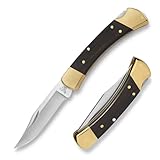
2. Buck 110 Folding Hunter
A long-running American folder with a single large blade, a back lock and brass-trimmed handle. It is heavy for a pocket knife but very sturdy. Expect a robust feel that suits belt-loop sheaths better than deep pockets.
Suits: rugged outdoor chores. Strengths: a solid back lock and a classic look. Weaknesses: it is heavy in a pocket. Skip it if you want a slim carry.
Best for slim, daily carry
3. Kershaw Leek
A slim, sleek folder with an assisted-opening mechanism and a frame lock. It carries easily and suits office or city use. Check local rules on assisted-opening knives before buying.
Suits: slim, daily carry. Strengths: a streamlined shape and quick opening. Weaknesses: a narrow handle for large hands. Skip it if you want a rugged farm knife.

Best for fans of traditional knives
4. Case Mini Copperlock
A traditional single-blade folder with a back lock and a classic handle. It brings the feel of an older pocket knife with added security. The lock makes it more confident for tougher cuts than a plain slip joint.
Suits: fans of traditional knives. Strengths: a lock in a classic style. Weaknesses: handle and steel vary by version. Skip it if you prefer modern materials.

Best for small hands and light duty
5. CRKT Squid
A compact modern folder with a frame lock and a pocket clip. It is small, easy to carry and widely available. The compact size suits keychain-weight carry.
Suits: small hands and light duty. Strengths: a compact and clipped design. Weaknesses: short blade. Skip it if you need extra length.

Best for long daily carry
6. Benchmade Bugout
A lightweight modern folder with a smooth lock and a thin handle. It is the kind of knife you can carry all day without noticing. Check the listing for the exact blade steel and handle material.
Suits: long daily carry. Strengths: low weight and quality fit. Weaknesses: a higher cost of entry. Skip it if you want a budget-friendly pick.

Care and Setup
- Wipe the blade dry after cutting food or working outdoors.
- Put a drop of oil on the pivot now and then.
- Check that screws are snug.
- Keep the blade clear of lint in the pocket.
Mistakes to Avoid
- Using a pocket knife as a pry bar.
- Ignoring local laws on carry and blade length.
- Buying a locking style you cannot easily close.
- Leaving carbon steel damp.
Why Choose a Single-Blade Folder
A single-blade pocket knife does one job well: it cuts. With no extra tools folded into the handle, it is slimmer, lighter and quicker to open than a multi-tool or a multi-blade penknife. For everyday carry, that simplicity matters. The knife sits flat in a pocket, does not print through clothing and is less likely to snag.
The design also keeps the mechanics straightforward. Fewer moving parts mean fewer places for dirt to collect and fewer parts that can fail. When you need a screwdriver or bottle opener, a single-blade knife won’t help, but many carriers pair it with a small separate tool.
The knives in this guide range from classic traditional folders to modern designs. Traditional knives often have wood or bone handles and a simple mechanism. Modern ones use metal or polymer handles and spring-assisted or manual opening. Read the descriptions for the opening method and check that it is legal where you live, because some opening styles are regulated.
Decide what you will cut most often: boxes and packaging, cord, food, tape, fruit, wood shavings or camping tasks. That will point you toward the right blade length and edge shape.
Blade Shape and Edge Geometry
Blade shape affects what the knife does best. A drop-point has a convex spine that slopes to the tip, giving a strong point and a generous curved edge, good for general use. A clip-point has a concave spine near the tip for a finer point, which is useful for detail work but a little weaker at the tip. A spear-point is symmetrical and good for piercing, while a straight or modified shape may offer a different feel.
The cross-section of the blade matters too. A thin blade slices more easily but can be less sturdy. A thicker blade handles harder tasks but may feel clumsy on food. Flat, hollow and convex grinds each behave differently: hollow grinds slice well and sharpen quickly, flat grinds are sturdy and versatile, and convex grinds are strong and durable.
The listing may list blade length and shape. Where the specification is missing, check the product page or the maker’s website. Do not assume that longer is better. A modest blade is often enough and easier to carry, store and carry legally.
- Light daily tasks: a small to medium blade with a thin grind.
- Outdoor use: a sturdier blade with a strong tip.
- Food: a clean, easy-to-sharpen edge and a corrosion-resistant steel.
Lock Types and Safe Operation
A lock keeps the blade from folding on your fingers. Several kinds exist. A lockback has a spring-loaded bar at the spine that you press to release. A liner lock uses a spring piece on the inside of the handle that you push aside. A frame lock is similar but uses part of the handle itself. A collar lock uses a ring around the blade base. Slip-joint knives have no lock, and rely on spring tension.
No lock design is perfect. Lockbacks are often described as strong, but they require two hands to close. Liner and frame locks can be closed one-handed but can wear over time. Wear, dirt and misuse can cause any lock to fail. Check by pressing the spine gently when the blade is open and listening for any play. Don’t test with your fingers near the edge.
Good habits:
- Keep your fingers away from the path of the blade when closing.
- Don’t use the knife to pry, which can break the tip or damage the lock.
- Close it before passing it to someone else.
- Clean the lock area periodically.
Check the listing for lock type, and decide whether you want one-handed closing, a traditional style or the simplicity of a no-lock design.
Carry Comfort and Pocket Fit
A knife you leave at home does nothing. Comfort in carry decides whether it goes with you. Consider weight, thickness, clip style and how it sits in your pocket. Heavier knives can drag a pocket down and feel awkward in a sitting position. Thin, light knives disappear but may feel small in hand.
Pocket clips hold the knife upright and in place, either tip-up or tip-down depending on the design, and some can be moved. A knife without a clip, such as many traditional folders, is carried loose in a pocket or in a small sheath or pouch. Keep it separated from keys and coins to avoid scratches and accidental opening.
Handle shape matters in use. A gentle curve and texture give grip, while sharp corners or rough edges can bite your hand during long cuts. Handle materials differ in feel: polymer is light and low maintenance, metal is sturdy, wood and bone are warm but need care.
Think about your clothing. Dress pants, shorts and work trousers have different pockets. Some knives work better with a lanyard or a belt pouch. Try different carrying positions before deciding.
Always check local regulations on carrying folding knives, including blade length, lock type and places where knives are prohibited.
Edge Maintenance and When to Replace
A pocket knife dulls with use, but simple habits keep it working. Wipe the blade clean after cutting, particularly if it touched food or moisture. Remove lint and dirt from the pivot and lock area with a brush or compressed air. Add a drop of lubricant to the pivot occasionally if the maker advises, and wipe off excess.
To maintain the edge, a small stone, ceramic rod or leather strop can keep it keen between more thorough sharpenings. Keep the angle consistent and use light pressure. Learn the grind of your blade before you start. Hollow grinds, for example, behave differently from flat ones. Avoid aggressive pull-through sharpeners if you value the edge geometry.
Carbon steel blades benefit from a thin film of oil to prevent rust. Stainless blades are more forgiving but not immune. Store the knife dry, away from damp.
Signs that it’s time to repair or replace a pocket knife:
- The blade wobbles side to side or fails to stay locked open.
- The pivot is loose and cannot be adjusted.
- The tip is broken or the edge is chipped beyond what sharpening can fix.
- The handle is cracked or the scales are loose.
Check the warranty and the maker’s service options on the listing. Some makers offer repair or sharpening, which can extend a knife’s life.
Single Blade Pocket Knife FAQ
Is a lock necessary?
Not always, but it adds a layer of safety for heavier cuts.
What blade length is typical?
That varies by design. Check each listing for the exact length.
Is a single blade better than a multi-tool?
For plain cutting, yes. It is lighter and faster to open.
Can I sharpen it at home?
Yes. A small stone or strop keeps the edge keen.
What blade length is best for everyday carry?
A modest length suits most daily tasks and is easier to carry. The right choice depends on your needs and local laws, so check the listing for the exact length.
Is a spring-assisted or automatic knife a good choice?
These can be fast to open, but laws vary and some opening types are restricted. Check the rules where you live before buying.
Do I need a pocket clip?
Not necessarily. A clip helps keep the knife in place, but a traditional knife without one can be carried in a pocket or small pouch.
How often should I oil the pivot?
When it feels gritty or stiff, or after exposure to water or dirt. Follow the maker's advice and wipe off the excess.
Can I take a pocket knife on a plane?
Rules differ by country and airline, but knives are generally not allowed in carry-on bags. Check the authorities' current guidance and pack in checked luggage if allowed.
What steel should I look for?
It depends on your habits. Stainless steel resists rust, while carbon steel is often easy to sharpen but needs more care. Check the product page for the steel type.
Are cheaper pocket knives safe?
Safety depends on build quality and how you use it. Check lock strength, fit and finish, and read the maker's guidance. Use the knife only for cutting tasks.
The Short Version
For a French classic, the Opinel No. 8. For a heavy-duty folder, the Buck 110. For slim carry, the Kershaw Leek. For a traditional lock, the Case Mini Copperlock. For compact carry, the CRKT Squid. For lightweight carry, the Benchmade Bugout.
Related Guides
- 6 Best Men's Pocket Knives for Everyday Carry
- 6 Best Pocket Knives: Folders for Everyday Carry (2026)
- 6 Best Folding Knives for Everyday Carry (2026)
- 6 Best Kizer Knives: Everyday Carry Folders
- 6 Best MagnaCut Knives for Everyday Carry
Opening Mechanisms: Thumb Stud, Nail Nick, Flipper and Slip Joint
How a knife opens shapes how often you reach for it. Single-blade folders use a handful of mechanisms, and each has trade-offs for speed, one-handed use and safety.
- Nail nick: A groove in the blade that you catch with a thumbnail. Simple and traditional, it works with two hands or with practice, one. It keeps the profile slim and clean.
- Thumb stud or hole: A small protrusion or cutout you push with your thumb. Easy to open with one hand, and common on modern knives.
- Flipper tab: A lever on the spine that you press to flick the blade open, usually on a bearing or washer pivot. Fast and smooth, but it demands care so the blade does not swing out unexpectedly.
- Slip joint: A spring holds the blade open and closed without a separate lock. It is the classic design and relies on the spring tension, so a stiff pull and firm closing action are normal.
- Spring-assisted: A spring finishes the opening once you start it. Check local rules for these, since some places regulate them differently from manual openers.
Pick the style that suits how you work. If you use your knife with gloves, a larger thumb stud or flipper is easier to find. If you want the lowest profile and the least snagging in a pocket, a nail nick is a good option.
Handle Materials, Grip and Weight
The handle matters as much as the blade. A knife you cannot hold securely is a hazard, even if the steel is excellent.
- Wood: Warm, comfortable and classic, but it can swell or dry with humidity. Some are treated for durability. They look good as they age.
- Synthetic polymers such as glass-filled nylon: Light, tough and easy to care for. They can feel slick when wet unless textured.
- Aluminum: Slim and strong, with a precise feel. Usually anodized for protection. It can be cold and slippery in wet conditions without grooves.
- Stainless steel: Durable but heavier. Often has a finish that resists wear.
- G10 and carbon fiber: Layered composite materials known for durability and good texture. They usually cost more.
Texture and shape also count. Gentle curves and finger grooves help in the hand, whereas flat, slab-sided handles carry better in a pocket. If the knife is for cutting tough materials, favor a secure grip over thin elegance.
Matching the Knife to Everyday Jobs
Most owners rely on a small set of tasks. Matching those tasks to the knife helps you avoid buying either too much or too little.
- Opening boxes and packages: A sharp, slim blade of modest length is ideal. A pocket clip keeps it ready.
- Kitchen and food prep on the go: A clean, easy-to-wipe blade and a handle that tolerates moisture are useful. Avoid blades that stain easily if you cut acidic foods.
- Cutting cord, rope and tape: A tough edge that tolerates abrasive material. A serrated section is not found on most single-blade knives, so keep a spare sharpener at home.
- Camping and light outdoor use: A sturdier lock and a comfortable grip matter more, and a drop-point shape handles general tasks well.
- Workplace carry: A slim, discreet knife that meets your employer’s rules. Check workplace policies before carrying anything.
If you find yourself needing a screwdriver, a bottle opener or scissors, a multi-tool is the better path. A single blade excels at simplicity, and it should not be asked to do everything.
Laws, Rules and Courtesy
Knife rules vary widely by country, state, city and even building. Blade length limits, restrictions on automatic or spring-assisted openers, and rules about carrying in schools, government buildings, airports and courthouses all differ. A knife that is legal in one place may not be in another.
Before you buy or travel, look up the rules where you live and where you plan to go. Check the policies of your workplace and any venues you visit. Never carry a knife where it is prohibited, and keep it in checked baggage when flying, following the airline and transportation authority guidance. Common sense helps too: open and use a knife discreetly, and put it away when others might be uneasy.
Budget Versus Premium: What Extra Money Buys
An inexpensive folder can cut just as well on day one as a costly one. The differences show up over time and in details. Higher-priced knives usually have more refined fit and finish, tighter tolerances at the pivot, better steel with longer edge life, stronger locks and nicer handle materials. Budget knives often use simpler steel that needs sharpening more often and may have slight blade play or rough edges.
Spend more if you will carry the knife daily, depend on it for work, or value smooth action and long-term durability. Spend less if you are new to knives, tend to lose them, or want a beater for rough jobs. Whatever you pay, choose a knife from a maker with a clear warranty and available replacement parts.
Frequently Asked Questions
Are there laws about pocket knife blade length?
Yes, in many places. Limits and rules on locking or opening mechanisms differ by country, state and city, and certain locations ban carry entirely. Check your local rules and any workplace or venue policy before you buy or carry.
How do I clean a pocket knife?
Open the blade, wipe it with a damp cloth and mild soap, dry it fully, and clear lint from the pivot with a brush or compressed air. Add a drop of oil to the pivot, then wipe off the excess.
What is a good first pocket knife for a teenager?
Look for a simple, small, easy-to-control design with a reliable lock or slip joint, and follow local laws and school rules. A parent or guardian should teach safe use, including how to close the blade without cutting fingers.
Why does my pocket knife blade wobble side to side?
Some play can come from a loose pivot screw. If the design allows adjustment, tighten it slightly until the movement is gone but the blade still opens freely. If the wobble persists, contact the maker about repair or replacement.