Disclosure: As an Amazon Associate, umtsmarttool.com earns from qualifying purchases. Links to Amazon on this page are affiliate links; they cost you nothing extra. Prices and availability change often, so check the current Amazon listing before you buy.
Where to buy
Shopping for the best soft tackle bags? These are the six soft tackle bags reviewed below. Linked picks go to the exact model on Amazon; one Plano model is listed without a direct link because we could not verify a single Amazon ASIN for the exact model from the sources we opened — match it by the model number given in its review (PLABZ370).
- Plano Guide Series 3500 Tackle Bag (PLABG350) — check price on Amazon
- Plano Guide Series 3700 Tackle Bag (PLABG370) — Check on Amazon — check price on Amazon
- KastKing Bait Boss Tackle Bag — check price on Amazon
- Plano Weekend Series 3500 Tackle Case (PLABW350) — check price on Amazon
- Plano Z-Series 3700 Tackle Bag (PLABZ370) — check price on Amazon
- KastKing Bait Boss Fishing Tackle Backpack (34L) — check price on Amazon
Start with our top pick: Plano Guide Series 3500 Tackle Bag (PLABG350) — check on Amazon.
Read the full guide ↓
The best soft tackle bags solve a problem hard boxes created: tackle grew up. Modern bass and multi-species anglers carry standardized utility trays — 3500, 3600 and 3700 sizes — plus pliers, line spools, soft-plastic binders and a rain jacket, and they carry them from truck to boat to bank and back. A soft bag built around those tray sizes, with a structured body, a base that does not soak through, and pockets that assume tools exist, is simply a better tool for that life than a rigid box with a handle. This guide covers soft-sided tackle bags only; if you want the trays and hard boxes themselves, see our guides to the best tackle boxes and the best tackle boxes for bass fishing.
The six bags below form a deliberate ladder. At the top sit Plano’s Guide Series bags in 3500 and 3700 sizes — hard-backed, 1680-denier, with magnetic DropZone lids and trays included — for anglers who want one bag that does everything for years. In the middle are the value and specialty plays: KastKing’s saltwater-resistant Bait Boss, Plano’s compact Weekend Series 3500 for short trips, and Plano’s zipperless Z-Series 3700, built specifically to end saltwater zipper corrosion. At the end is a backpack-format KastKing for anglers who walk banks and need their hands free — a different carry style that still belongs in any honest roundup of soft tackle storage. If you prefer to carry everything on your back, our best fishing backpacks guide goes deeper on that format.
Sizing language needs one translation before you shop: the numbers 3500, 3600 and 3700 are tray sizes, not capacities, and a “3700 bag” is simply a bag whose main compartment fits 3700-size trays. Bigger is not better by default — it is heavier, and it invites you to carry tackle you never throw. We state each bag’s tray format, included trays and verified dimensions where sources published them, and we flag the one model we present without a direct link rather than guessing at listings.
In this guide
Quick Picks
| Pick | Badge | Key spec |
|---|---|---|
| Plano Guide Series 3500 Tackle Bag (PLABG350) | Best Overall | 1680-denier hard-backed bag, includes five 3500 StowAway trays |
| Plano Guide Series 3700 Tackle Bag (PLABG370) | Best for Big Loads | 1680-denier bag, includes five 3700 and one 3600 StowAway trays, 19 x 11.5 x 11.25 in |
| KastKing Bait Boss Tackle Bag | Best Saltwater-Resistant Value | Saltwater-resistant soft bag sized for 3600 trays |
| Plano Weekend Series 3500 Tackle Case (PLABW350) | Best Compact Bag | Compact soft case, includes two 3500 StowAway trays, MOLLE attachments |
| Plano Z-Series 3700 Tackle Bag (PLABZ370) | Best for Saltwater | Zipperless design, 500-denier PVC fabric, waterproof molded base, includes two 3700 trays |
| KastKing Bait Boss Fishing Tackle Backpack (34L) | Best Backpack-Style Soft Bag | 34L backpack, rod holders, four tackle boxes included, rain cover |
How These Picks Were Chosen
We chose these bags around the tray system, because that is how soft tackle bags are actually used. First, tray format and included trays: a bag that arrives with its trays (the Guide Series and Weekend Series do) is a complete system on day one, while a bag sold empty must be priced against the trays you will add. Second, structure: hard-backed or molded-base bags keep their shape on a boat deck and protect trays; unstructured bags pack smaller but slump. Third, the wet problem — every bag here was assessed on what happens when it sits in bilge water, rain or salt spray, from molded waterproof bases to the Z-Series’ zipperless answer.
Specs were verified against manufacturer and established retailer sources: Plano model numbers PLABG350 (Guide 3500), PLABG370 (Guide 3700), PLABW350 (Weekend 3500) and PLABZ370 (Z-Series 3700), plus KastKing’s Bait Boss line. One Plano bag — the Z-Series 3700 (PLABZ370) — is prose-only in this guide because no source we opened tied one exact Amazon ASIN to the exact model — the bag and its specs are thoroughly documented, and its model number is given so you can match it precisely. The KastKing Bait Boss bag link is flagged in its source notes because that product family sells in multiple sizes under related listings; confirm the size on the listing before buying.
The 6 Best Soft Tackle Bags
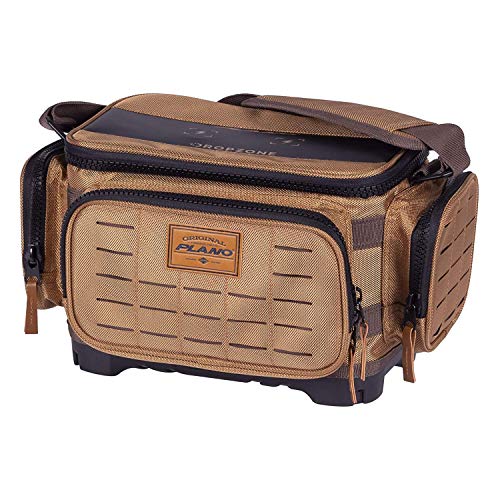
Plano Guide Series 3500 Tackle Bag (PLABG350) — Best Overall
This is the default recommendation for most anglers: a premium mid-size soft bag with its trays included, a magnetic top for tools, and a non-skid base that stays put on a boat deck.
- Model: PLABG350, 3500 size
- Fabric: 1680-denier, hard-backed construction
- Included: five 3500-size StowAway utility trays
- Lid: patented DropZone magnetic top
- Base: non-skid TPR over-molded foot pads; waterproof phone and license holders included
Strengths
- Complete system out of the box — trays included and matched to the bag
- Magnetic DropZone lid holds pliers and baits during rigging
- Hard-backed body keeps its shape and protects tray contents
Trade-offs
- 3500 trays are smaller than 3700 — tournament anglers may outgrow it
- Premium tier pricing above weekend-class bags
- Structured body does not pack flat for storage
The Guide Series is Plano’s flagship soft-bag line, and the 3500 is its sweet spot for most anglers. The hard-backed 1680-denier shell is the headline construction: unlike slouchy bags that collapse around their trays, this one stands open and upright on a deck, in a truck bed or on a dock, so the bag works like a piece of furniture rather than a sack. Oversized molded zippers are easy to run with cold or gloved hands, and the non-skid TPR base pads address the oldest soft-bag complaint — the bag sliding and tipping in chop — by gripping the deck instead.
The DropZone lid is the feature owners actually talk about. Its magnetic top surface holds hooks, baits and tools where you put them during rigging, instead of letting them migrate into the bilge or the grass. Anyone who has watched a freshly tied jig roll off a hard box lid into the lake understands the value instantly. Inside, five included 3500 StowAways organize a complete mid-size arsenal: hardbaits in one, terminal tackle in another, soft plastics, jigs and a spare-parts tray, with the front compartment’s waterproof pouch keeping a phone and license dry.
Choose the 3500 if your fishing is a boat, a kayak or a day of bank hopping with a focused kit. Choose its bigger brother below if you carry a true tournament load. Either way, the Guide Series’ build quality is the kind you buy once — see how it compares with the hard boxes in our best tackle boxes for bass fishing guide if you are deciding between formats.
Honest limitation: the 3500 tray format caps how much bulky tackle you can carry, and anglers with large crankbait or swimbait collections will fill it quickly. It is a mid-size bag and does not pretend otherwise.
Best for: most anglers wanting one premium, complete soft bag for boat, kayak and bank use / Not suited for: tournament anglers with maximum tray loads
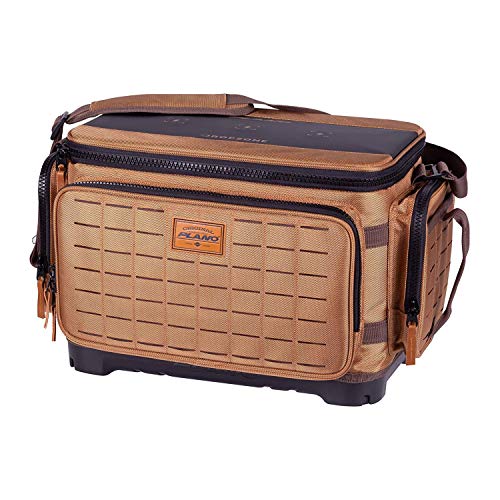
Plano Guide Series 3700 Tackle Bag (PLABG370) — Best for Big Loads
This is the maximum-capacity pick for serious bass and multi-species anglers: the same Guide Series construction scaled to the big 3700 tray format, with six trays included.
- Model: PLABG370, 3700 size
- Dimensions: 19 in L x 11.5 in W x 11.25 in H (retailer specs)
- Included: five 3700-size and one 3600-size StowAway trays
- Fabric: hard-backed 1680-denier
- Features: DropZone magnetic top, laser-cut MOLLE webbing, non-skid TPR base, waterproof phone holder, license holder and carabiner
Strengths
- Six included trays in the two biggest formats — a full tournament system
- Same flagship construction as the 3500, scaled up
- MOLLE webbing and handled side pockets add real carrying options
Trade-offs
- Big and heavy when loaded — a boat bag, not a hiking bag
- Several Guide sizes look alike — confirm model PLABG370 on the listing
- Premium pricing, and overkill for light-tackle anglers
Everything said about the Guide 3500 applies here at full scale. The 3700 format is the tournament standard because 3700 trays swallow full-size crankbaits, big jigs and bulk soft-plastic storage that smaller trays force you to subdivide. Five of them, plus a 3600, arrive in the bag — a detail that matters when comparing prices, because six quality trays bought separately are a significant purchase on their own. The bag’s handled side pockets double as a second carry option, useful when the main shoulder strap is buried under a life jacket and a net.
The DropZone magnetic lid, the non-skid base and the hard-backed shell all matter more at this size, not less: a loaded 3700 bag is heavy enough that a tip-over is a genuine tackle spill, and a bag this size that slumped would be unusable. Plano’s structure keeps it a workstation. The laser-cut MOLLE webbing on the exterior lets you hang tools and accessories where your hands expect them, which is how tournament anglers actually rig — everything reachable without opening the bag.
This bag is sold through many tackle retailers under model number PLABG370, so check the model number on the listing, verify the 3700 size and the included tray count, and you will have the right bag. It is worth the extra minute: at this tier, buying the 3600 or 3500 by mistake is an expensive misunderstanding.
Honest limitation: fully loaded, this bag is a two-hand lift and a permanent boat resident. Bank anglers who walk distance should look at the Weekend 3500 or the backpack pick instead.
Best for: tournament and serious bass anglers running full 3700 tray systems / Not suited for: long bank walks or light-tackle minimalists

KastKing Bait Boss Tackle Bag — Best Saltwater-Resistant Value
This is the value pick for inshore and saltwater anglers: a water- and salt-resistant bag built around 3600 trays, from a brand that prices aggressively against the heritage names.
- Type: soft tackle bag, stores 3600-size tackle boxes (trays sold separately on most listings)
- Resistance: saltwater-resistant, water-resistant material
- Maker: KastKing
- Sizes: sold in multiple size options under the Bait Boss name
- Use: saltwater and freshwater boat and bank fishing
Strengths
- Saltwater-resistant build at a mid-tier price
- 3600 format is the versatile middle size for mixed tackle
- KastKing’s value pricing leaves budget for the trays to fill it
Trade-offs
- Trays are generally not included — budget for them separately
- Size options under one product name require care when ordering
- Fabric and hardware sit a tier below Plano’s Guide Series
Saltwater is where soft bags go to die — zippers corrode, fabrics mildew and hardware rusts — so a bag designed to resist salt at a fair price earns its place in this guide. The Bait Boss is KastKing’s answer: water-resistant, saltwater-resistant materials in a bag organized around the 3600 tray format, which many inshore anglers prefer because 3600 trays balance capacity against the reality of carrying the bag across docks, jetties and boat decks all day.
KastKing’s broader proposition is value engineering: fewer heritage-brand costs, direct pricing, and features that track what anglers actually use. The trade-off is equally honest — the fabrics, zippers and finishing are a tier below the Guide Series, and the bag arrives as a shell, with trays to be added. Priced as a system (bag plus the 3600 trays you need), it still undercuts the flagship bags while covering the same water.
One ordering caution, flagged in our sources: the Bait Boss name covers multiple size options, and listings vary. Confirm the size and whether trays are included on the exact listing before you buy — the linked listing is a starting point, and the size selector is part of the product. Anglers who fish salt exclusively and hate zippers on principle should also read the Z-Series review below before deciding.
Honest limitation: “saltwater resistant” is not “saltwater proof.” Rinse the bag after salt use and dry it open, or hardware and fabric will still age — resistance buys time, not immunity.
Best for: inshore and mixed salt/fresh anglers wanting 3600 capacity at a value price / Not suited for: buyers wanting trays included and flagship finishing

Plano Weekend Series 3500 Tackle Case (PLABW350) — Best Compact Bag
This is the grab-and-go pick: a small soft case for short sessions, pond hopping, kayak decks and keeping a focused kit in the truck, with two trays included.
- Model: PLABW350, 3500 size
- Included: two 3500-size StowAway trays
- Exterior: MOLLE attachment webbing
- Format: soft tackle case with top access
- Maker: Plano Weekend Series
Strengths
- Right-sized for short trips — no hauling a full system for an hour of fishing
- Two included trays make it a working kit immediately
- MOLLE webbing lets it integrate with bigger bags and packs
Trade-offs
- Two-tray capacity fills fast for serious bass tackle
- Not a boat-deck workstation like the Guide Series
- Soft structure offers less protection than hard-backed bags
Most fishing trips are short. The Weekend Series 3500 is built for the hour at the pond after work, the morning kayak lap and the borrowed-boat afternoon, where the full Guide Series would be ballast. Two 3500 trays carry a sane, focused kit — a handful of hardbaits, terminal tackle, a bag or two of soft plastics — and the case format keeps it flat, light and easy to stash behind a truck seat so the kit is always with you. More fishing happens because the bag is small; that is a real feature.
The MOLLE webbing is the detail that elevates it above generic small bags. Tools, a line spool or a small pouch clip onto the exterior, and the case itself can ride on a larger pack or boat bag as a satellite kit. Plano positions the Weekend Series as the lighter tier of its system, and the compatibility with the same StowAway tray sizes means tackle moves between this case and a big bag without re-sorting.
Buy it as a second bag even if you own a flagship: the big bag lives on the boat, this one lives in the vehicle, and between them every kind of trip is covered. Anglers whose only fishing is short and light may find it is the only bag they need.
Honest limitation: capacity is the compromise by design. If your “short trip” still means twelve crankbaits and five bags of plastics, you will outgrow it in a month and should start with the Guide 3500.
Best for: short trips, kayak anglers, truck kits and as a satellite bag / Not suited for: primary storage for a large tackle collection
Plano Z-Series 3700 Tackle Bag (PLABZ370) — Best for Saltwater
This is the saltwater specialist: a zipperless soft bag — no zippers to corrode, ever — with a waterproof base and PVC fabric that sheds spray, built for boats and surf-side work.
- Model: PLABZ370, 3700 size
- Fabric: 500-denier PVC
- Base: waterproof molded base with non-slip inserts
- Closure: zipperless design with heavy-duty strap closure
- Included: two 3700-size StowAway trays; holds up to four 3700 trays (retailer specs)
- Pockets: quick-drain mesh side pockets
Strengths
- No zippers anywhere — the number one saltwater failure point is deleted
- Waterproof base can sit in bilge water without soaking the contents
- PVC fabric sheds spray and rinses clean
Trade-offs
- Strap closures are slower than zippers for constant in-and-out access
- Only two trays included; most anglers will add two more
- Presented without a direct link here — match model PLABZ370 on Amazon
Ask saltwater anglers what kills their tackle bags and the answer is one word: zippers. Salt creeps into zipper teeth, the slider freezes, and one hard pull ends the bag. The Z-Series deletes the failure point entirely — there is not a single zipper on the bag — replacing them with strap closures and openings designed to seal tight without teeth. Combined with 500-denier PVC fabric that sheds water instead of absorbing it and a waterproof molded base that can sit in standing bilge water, it is the most honestly salt-focused design in this guide.
The details support the mission. Quick-drain mesh side pockets give wet gear somewhere to live that is not against your dry tackle. Molded attachment hardware avoids the corrosion-prone metal fittings of freshwater bags. The body has added structure so the bag stands and works like a bag rather than a sack, and the included two 3700 StowAways start a system that holds up to four trays as your program grows.
Freshwater anglers who fish in constant rain will also get the point of this bag, and boat anglers tired of soaked bag bottoms may choose it for the base alone. It is listed prose-only because no opened source tied one exact ASIN to PLABZ370; the model number is widely retailed, so match it exactly and confirm the 3700 size and the two included trays on the listing.
Honest limitation: zipperless means slower. If your style is opening the bag forty times a day for single baits, strap closures will test your patience where the Guide Series’ zippers and magnetic lid would not.
Best for: saltwater boat anglers and anyone whose zippers keep dying / Not suited for: anglers who prioritize fastest possible access above all
Check price on Amazon (listed without a direct link in this guide).
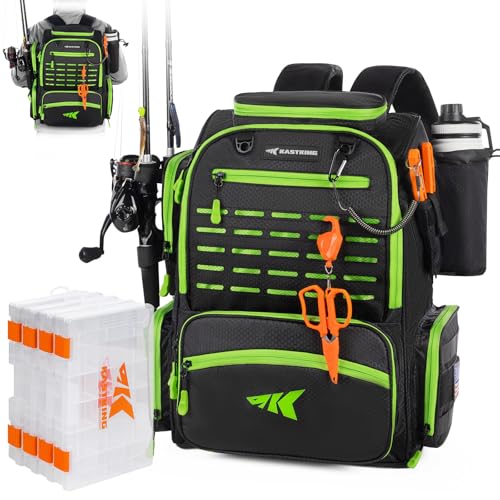
KastKing Bait Boss Fishing Tackle Backpack (34L) — Best Backpack-Style Soft Bag
This is the hands-free pick for bank, creek and surf anglers who walk to their water: a 34-litre tackle backpack with rod holders, four included tackle boxes and a protective rain cover.
- Capacity: 34 litres
- Included: four tackle boxes
- Carry: backpack with rod holders
- Protection: waterproof protective rain cover included
- Use: bank, creek, hiking-in and surf fishing
Strengths
- Hands stay free for rods, nets and wading staffs on the walk in
- Four included boxes make it a complete system immediately
- Rain cover handles the walk out in bad weather
Trade-offs
- Backpack access is slower than a deck bag’s open top
- 34L fills quickly for boat-style tackle loads
- Not a substitute for a boat bag on deck — different carry, different job
Soft tackle storage has two carry philosophies: the bag that sits and the pack that walks. This KastKing is the walking kind, and for bank anglers it changes the day. Rods ride in holders, both hands are free for gates, banks and wading, and 34 litres swallows four tackle boxes plus the layers, food and water that a walked session actually requires. The included rain cover is not a garnish — bank fishing means weather arrives while you are a mile from the car, and a soaked pack is a miserable walk home.
Organization inside follows the tray logic of the rest of this guide: boxes for lures and terminal tackle, with the pack’s compartments separating soft plastics, tools and personal gear. Access is the honest trade-off — a backpack comes off your back and opens on the ground, which is slower than reaching into an open Guide Series on a deck — but on the bank, the bag was coming off anyway, and the ground is your deck.
Choose this format if your fishing starts with a walk, and see our best fishing backpacks guide for more carry-focused options. Boat anglers should stay with the deck bags above; this pack’s strengths are wasted in a cockpit.
Honest limitation: four included boxes and 34 litres sound like a full system, but a serious bass arsenal outgrows it. Treat it as a mobile subset of your tackle, curated for the water you are walking to.
Best for: bank, creek and surf anglers who hike to their spots / Not suited for: boat anglers wanting open-top deck access
Comparison Table
| Pick | Tray format | Included trays | Standout feature |
|---|---|---|---|
| Plano Guide Series 3500 Tackle Bag (PLABG350) | PLABG350, 3500 size | 1680-denier, hard-backed construction | Best Overall |
| Plano Guide Series 3700 Tackle Bag (PLABG370) | PLABG370, 3700 size | 19 in L x 11.5 in W x 11.25 in H (retailer specs) | Best for Big Loads |
| KastKing Bait Boss Tackle Bag | soft tackle bag, stores 3600-size tackle boxes (trays sold separately on most listings) | saltwater-resistant, water-resistant material | Best Saltwater-Resistant Value |
| Plano Weekend Series 3500 Tackle Case (PLABW350) | PLABW350, 3500 size | two 3500-size StowAway trays | Best Compact Bag |
| Plano Z-Series 3700 Tackle Bag (PLABZ370) | PLABZ370, 3700 size | 500-denier PVC | Best for Saltwater |
| KastKing Bait Boss Fishing Tackle Backpack (34L) | 34 litres | four tackle boxes | Best Backpack-Style Soft Bag |
How to Choose the Best Soft Tackle Bags
Start with tray format, because it locks in your whole system. If you already own 3700 trays, buy a 3700 bag; if you are starting fresh, 3600 is the versatile middle and 3700 is the bass-tournament standard, while 3500 suits compact, focused kits. Then count honestly: how many trays does a real trip use? Most anglers fish from two to four and store the rest. A bag sized to your trip, not your collection, stays light enough to carry and organized enough to fish from.
Structure is the second decision. Hard-backed and molded-base bags (the Guide Series, the Z-Series) behave like workstations: they stand open, protect trays and keep their shape for years. Unstructured bags pack smaller and cost less but slump, and slumping bags eat time on the water. If the bag will live on a boat, structure wins; if it will live in a closet and travel in a car trunk, a softer bag is defensible.
Third, match the bag to your water. Freshwater anglers can prioritize access and organization. Saltwater anglers must prioritize corrosion: PVC fabrics, waterproof bases, molded hardware and — the boldest answer — no zippers at all. Finally, price the system, not the shell: a bag with five or six trays included is often cheaper than a bare bag plus the trays you will inevitably buy, and included trays are guaranteed to fit.
Key Takeaways
Tray format first (3500, 3600 or 3700), then structure, then water resistance. Included trays change the real price — count them. Saltwater kills zippers before anything else, which is why the zipperless Z-Series exists. And the best bag is the one sized to your actual trip, not to your entire tackle collection.
How to Organize a Soft Tackle Bag
A soft bag fishes well when every tray has one job and every tool has one home. This layout works for any bag in this guide.
- Assign trays by category, not by trip: hardbaits, jigs and trailers, terminal tackle, soft plastics, and a small “day” tray you rebuild per trip from the others.
- Put the day tray on top and terminal tackle second — those two cover most mid-session needs without opening the whole bag.
- Tools live outside the trays: pliers in their holder or on the MOLLE webbing, line in a side pocket, scissors with the terminal tray.
- Use the waterproof pouch for phone, license and keys — always the same pocket, so it becomes reflex.
- End each trip with a two-minute reset: used baits out of the magnetic lid and pockets, wet items out to dry, trays back in order.
Label tray spines with a marker or tape. On a rocking boat, reading “CRKB” on a spine is faster than opening three trays, and labeled trays make the post-trip reset almost automatic. Your future self, rigging at dawn, will be grateful.
How to Care for a Soft Tackle Bag (and Fix Common Problems)
Soft bags fail from moisture, salt and grit more than from wear. Empty and dry the bag open after wet trips — a bag stored damp will mildew its fabric and rust the hooks in every tray inside it. Rinse salt off exterior fabric and hardware after saltwater use, and work zippers occasionally so grit does not set in the teeth.
- Problem: a zipper is stiff or stuck. → Rinse the teeth with fresh water, work the slider gently back and forth, and lubricate with a zipper-safe lubricant. Never force it; forced sliders tear teeth. If salt corrosion is your recurring story, your next bag should be zipperless.
- Problem: the bag smells and shows mildew spots. → Wash with mild soap and water, rinse, and dry fully in moving air. Store it open or loosely closed in a dry place thereafter.
- Problem: the bag will not stand up anymore. → Check for a cracked internal structure or a warped base; soft bags without hard backing slump with age and cannot be re-structured — cascade it to bank duty and replace the boat bag.
- Problem: trays slide and rattle inside. → The bag is under-filled. Add a tray, a soft-plastics binder or a towel layer; a full bag is a quiet, protective bag.
Treat trays as part of the bag’s care: cracked tray lids let water migrate between compartments, and a five-minute tray audit each season keeps the whole system honest. For the trays themselves, our best tackle boxes guide covers replacements and formats.
Soft Bag vs Hard Box: An Honest Comparison
The soft-versus-hard debate survives because both sides are right about different things. A hard box protects: it shrugs off being sat on, stacked under coolers and dropped on concrete, and its rigid trays present tackle like a toolbox. For a single boat that never changes, or a young angler whose box doubles as a step stool, hard boxes remain entirely sensible — which is why our best tackle boxes guide exists. A soft bag carries: it conforms to the space available, weighs less for the same volume, organizes around the tray system modern tackle uses, and travels between vehicles and boats without drama. For anglers whose fishing happens in more than one place, that portability usually wins.
The deciding question is where your tackle spends its life. Tackle that lives on one boat and fishes from it values protection and presentation. Tackle that lives in a closet, a truck and three different boats values carry and conformity. Most serious anglers end up owning both — a soft bag as the traveling system and hard boxes or spare trays as home storage — and move trays between them. That hybrid is not indecision; it is the mature state of a tackle collection, and it is why tray format consistency matters more than the bag-versus-box argument.
What to Carry Beyond Trays: The Complete Soft Bag Loadout
A soft bag earns its keep from what rides outside the trays. Start with the tools that end sessions when forgotten: pliers with cutters, a second pair of scissors or braid cutters, a hook file, and a small first-aid kit. Add line management — a spool of leader material in the test you actually use, plus the knot tools you prefer — and consumables: sunscreen, insect repellent and a spare pair of sunglasses straps have saved more fishing days than any lure. The waterproof pouch in bags like the Guide Series exists for the phone, license and keys; use it every trip, in the same pocket, until checking it is reflex.
Then the fishing extras that separate a bag from a box of lures: a scale and a measuring board if you record fish, a small towel that lives on a carabiner, a headlamp for dawn and dusk rigging, and a zip bag for used soft plastics so their scent and dye stay out of the trays. In cold or wet seasons, a spare pair of gloves and a hand warmer ride in the bag permanently. None of this is tackle, exactly — it is the difference between a storage product and a fishing system, and soft bags, with their pockets and webbing, are built to carry it in a way hard boxes never were.
Sizing a Soft Bag to Your Fishing: Three Worked Examples
Example one: the weekend bass angler with a small boat. Your real system is four trays — crankbaits, jigs, terminal, plastics — plus tools and a jacket. A Guide Series 3500 covers it if your baits run small-to-medium; step to a 3700-format bag if your crankbait collection is the point of the exercise. Either way, hard backing and a non-skid base earn their money on a deck, and included trays mean you are fishing the weekend the bag arrives.
Example two: the inshore saltwater angler. Your enemies are corrosion and soakings, and your tackle is a mix of jigs, spoons, soft plastics and leader material in 3600 trays. The Z-Series 3700 is the structural answer — PVC, waterproof base, no zippers — while the Bait Boss is the budget answer with resistance rather than immunity. Both beat watching a freshwater bag’s zippers freeze solid by the second season, which is the fate this example exists to avoid.
Example three: the bank and creek walker. Your tackle must share space with water, food and layers, and your hands must stay free. The 34L KastKing backpack is the format; the discipline is curation — two boxes of lures chosen for the water you are walking to, one terminal box, and the restraint to leave the rest at home. Walkers who master that curation catch as many fish as anyone, with a third of the weight, and their bag choice is what makes the discipline possible.
Common Buying Mistakes
Buying capacity for your collection instead of your trip. The biggest bag carries the most weight and the least-used tackle. Size to the trays you actually fish.
Ignoring tray format compatibility. A 3700 bag with a drawer of 3600 trays wastes space and rattles. Commit to a format, or buy the bag that fits the trays you own.
Comparing shell prices only. A bag with six trays included can be the cheaper system. Always price bag-plus-trays before deciding what “expensive” means.
Taking zippers to the salt. Standard zippers in saltwater are on a countdown. Rinse religiously, or buy the zipperless design and delete the problem.
Storing the bag wet and closed. Mildew, rusted hooks and ruined soft plastics all start the same way. Dry it open after every wet trip.
Using a deck bag for hiking (or a backpack on deck). Carry style is a real spec. Match the bag to how the tackle travels, not just how much it holds.
Final Recommendation
For most anglers, the Plano Guide Series 3500 is the soft bag to buy: complete with trays, structured, and built to live on a deck for years — check on Amazon. Saltwater anglers should seriously consider deleting zippers from their life with the Z-Series 3700 (model PLABZ370, listed without a direct link here), and bank walkers should take the KastKing backpack — check on Amazon. Match the tray format to your system and the bag to your water, and your tackle will finally travel as well as it fishes.
One last test before you buy: load the bag mentally with your actual trays and walk it mentally from your door to your water. Every transfer — closet to truck, truck to dock, dock to deck — is where bags earn or lose their keep, and the right bag is the one that makes those transfers forgettable. If a transfer involves repacking, rebalancing or worrying about water, the bag is wrong no matter how good its spec sheet looks. The six bags above each make a different set of transfers disappear; pick the set that matches your fishing and you will stop thinking about tackle storage entirely, which is the highest praise storage can earn. Buy once, buy the right format, rinse it when the water is salty, dry it when the day is wet, and the same bag will still be riding to the lake with you when the trays inside it have turned over twice, season after season, trip after trip, without complaint, in rain, spray, heat and cold, wherever the fish are, from the first spring launch to the last cold trip of the year, every single year.
Frequently Asked Questions
What do the numbers 3500, 3600 and 3700 mean on a tackle bag?
They are tray sizes, not capacities. A 3700 bag fits 3700-size utility trays, the largest common format; 3600 is the mid-size and 3500 the compact. The bag and your trays must share a format, which is why this guide states the format for every pick.
Are tackle trays included with soft tackle bags?
Sometimes — and it changes the value calculation completely. The Guide Series bags and the Weekend 3500 in this guide include trays; the KastKing Bait Boss bag generally does not. Always check the included count on the listing before comparing prices.
Is a soft tackle bag better than a hard tackle box?
For anglers who move between truck, boat and bank with tray systems, usually yes: soft bags carry more, organize around trays and ride better. Hard boxes still win for pure crush protection and for traditional tray-and-lid storage. Our best tackle boxes guide covers the hard side of the decision.
How do I stop my tackle bag zippers from corroding in saltwater?
Rinse them with fresh water after every salt trip, work them so grit does not set, and lubricate occasionally. If corrosion keeps winning, the structural answer is a zipperless bag like the Z-Series — no teeth, nothing to freeze.
How big a tackle bag do I need for bass fishing?
Most bass anglers fish happily from three to five trays: hardbaits, jigs, terminal tackle and soft plastics, plus a day tray. That points to a 3600 or 3700 bag for boat anglers and a 3500 for compact kits. Tournament anglers running six-plus trays should go straight to the Guide 3700 class.
How long should a good soft tackle bag last?
A quality soft bag in regular use should give five years or more: the fabrics and structure in bags like the Guide Series are built to that horizon, and the usual first failures are zippers and strap hardware rather than the body. Saltwater shortens everything unless the bag is designed and rinsed for it. The practical lifespan test is functional, not cosmetic — a faded bag that stands open, seals dry and runs its zippers smoothly is not worn out, while a handsome bag with a frozen zipper is. Budget accordingly: cost per year, not cost per purchase, is the honest way to compare a flagship bag against two cheap ones, and it is why included trays and replaceable components matter — a bag whose trays you can replace individually ages one part at a time instead of all at once.
Can I use a tackle backpack instead of a bag?
Yes, if your fishing involves walking. Backpacks free your hands and carry personal gear as well as tackle, at the cost of slower access than an open deck bag. Match the format to the trip: walkers take packs, boat anglers take bags.