Disclosure: As an Amazon Associate, umtsmarttool.com earns from qualifying purchases. Links to Amazon on this page are affiliate links; they cost you nothing extra. Prices and availability change often, so check the current Amazon listing before you buy.
Where to buy
Shopping for the best tackle boxes for kids? These are the six kids’ tackle boxes reviewed below. All six picks are linked to the exact model on Amazon — match each by the exact product name given in its review.
- Shakespeare Customize-It Kids Tackle Box with 29-Piece Tackle and Stickers — Check on Amazon — check price on Amazon
- Wakeman Outdoors Single Tray Tackle Box with 55-Piece Tackle Kit (Blue) — check price on Amazon
- Plano One Tray Take Me Fishing Tackle Box with Tackle (500000) — check price on Amazon
- Flambeau Outdoors 6382TB 2-Tray Classic Tackle Box — check price on Amazon
- Flambeau Outdoors Wild Bite Bass Tackle Box Kit (25-Piece) — Check on Amazon — check price on Amazon
- Shakespeare Youth Fishing Play Box — check price on Amazon
Start with our top pick: Wakeman Outdoors Single Tray Tackle Box with 55-Piece Tackle Kit (Blue) — check on Amazon.
Read the full guide ↓
The best tackle boxes for kids are not small versions of adult boxes, because a child’s tackle box has a different job. It must be light enough for small arms to carry from car to bank without a negotiation, simple enough for small fingers to open and — critically — close again, and honest enough in its organization that a seven-year-old can find a bobber without emptying the whole box onto the grass. Most of the picks below arrive with starter tackle inside, which matters more than it sounds: a box that comes with hooks, bobbers, sinkers and a practice plug is a fishing kit on day one, while an empty box is a shopping list. If you are building the full first setup, pair this guide with our look at the best tackle boxes for the grown-ups who will inevitably end up carrying a second box of their own.
The six picks split by age and intent. At the top is Shakespeare’s Customize-It, a starter box kids decorate with included stickers — the personalization pick, because children look after boxes that are unmistakably theirs. Then come two complete kits with real carrying capacity: Wakeman’s 55-piece single-tray box for older kids who fish every weekend, and Plano’s Take Me Fishing box, a made-in-USA classic with a starter kit and a cause attached. Below those sit the Flambeau 6382TB, a genuine two-tray cantilever box for the child graduating to real tackle organization; the Flambeau Wild Bite, a fish-shaped 25-piece kit for the youngest anglers; and Shakespeare’s Youth Play Box, a compact character box for the very first seasons.
Safety deserves its sentence up front: several of these kits include real hooks, including treble hooks on small lures. That is normal for kids’ fishing gear and it is managed the way it has always been managed — an adult handles hook-tying and lure changes for young children, practice casting plugs (included with the Customize-It) replace hooked lures for backyard casting practice, and boxes live closed and latched between uses. We note hook content in each review so you can choose with your eyes open.
In this guide
Quick Picks
| Pick | Badge | Key spec |
|---|---|---|
| Shakespeare Customize-It Kids Tackle Box with 29-Piece Tackle and Stickers | Best Overall | 29 pieces of tackle, 2 practice casting plugs, 3 sticker sheets, 13 x 8 x 8 in |
| Wakeman Outdoors Single Tray Tackle Box with 55-Piece Tackle Kit (Blue) | Best for Older Kids | 55-piece kit, 12.75 x 7 x 5.5 in, removable tray, 10 compartments |
| Plano One Tray Take Me Fishing Tackle Box with Tackle (500000) | Best Classic Starter | One tray, 10 fixed compartments, starter kit included, 13.5 x 7 x 6 in, made in the USA |
| Flambeau Outdoors 6382TB 2-Tray Classic Tackle Box | Best Grow-With-Me Box | Cantilever 2-tray design, 15 compartments, 6 removable dividers, Draw Tite latch |
| Flambeau Outdoors Wild Bite Bass Tackle Box Kit (25-Piece) | Best for Youngest Anglers | Bass-shaped box, 25 pieces, 7 compartments, 10.75 x 7 x 1.88 in, 8.6 oz |
| Shakespeare Youth Fishing Play Box | Best Compact Character Box | Compact play box with a 12-piece tackle set (listing data) |
How These Picks Were Chosen
We chose these boxes on the criteria that decide whether a child actually fishes with them a month later: carry weight and handle comfort for small hands, latch simplicity (one latch a child can operate beats three they cannot), tray layouts a child can keep tidy without a system, and — for the kits — whether the included tackle is genuinely usable for panfish and stocked trout rather than decorative. Boxes from the established fishing brands (Plano, Flambeau, Shakespeare, Wakeman) dominate because their plastics, hinges and latches survive childhood, which discount novelty boxes often do not.
Specifications were verified against manufacturer, retailer and specialist roundup sources for the exact models: piece counts, dimensions and weights in the reviews below come from those listings, and where sources disagreed we used the figure from the product’s own listing data. All six picks are linked where an opened source tied the exact Amazon ASIN to the exact model, and all are widely retailed under their exact names. The Shakespeare Youth Play Box link is flagged in our sources as a character-variant listing, so confirm the design and contents on the listing before buying.
The 6 Best Tackle Boxes for Kids

Shakespeare Customize-It Kids Tackle Box with 29-Piece Tackle and Stickers — Best Overall
This is the first-box recommendation for most children: a starter tackle box the child decorates themselves, with real tackle, a fishing journal and practice plugs for safe backyard casting.
- Contents: 29 pieces of assorted tackle
- Includes: 2 practice casting plugs
- Includes: 3 sheets of Customize-It stickers (letters, shapes and fish) plus a fishing journal
- Dimensions: 13 x 8 x 8 in; about 2.46 lb (retailer listing specs)
- Tray: spill-proof tray design
Strengths
- Personalization makes the box unmistakably the child’s own — and cared for
- Practice plugs allow real casting practice with no hooks involved
- Journal and stickers turn the box into a fishing project, not just storage
Trade-offs
- At about 2.46 lb loaded, it is a lot of box for the smallest children
- Similar Shakespeare kits differ — confirm the 29-piece contents on the listing
- Starter tackle is panfish-scale; keen kids will add to it within a season
The Customize-It understands something about children that spec sheets miss: ownership creates care. A child who has spelled their name in stickers across the lid, chosen the fish decals and logged their first catch in the included journal does not leave that box in the rain, lend it carelessly or lose its contents across the bank. Shakespeare builds the whole product around that insight — the box, the 29 pieces of real tackle, the sticker sheets and the journal are one idea, and it is the right idea for a first box.
The practical content holds up the concept. Twenty-nine pieces of assorted tackle cover the bobber-and-worm basics a young angler actually uses, and the two practice casting plugs are the quietly brilliant inclusion: casting is the skill kids most need to rehearse and the one that most endangers siblings, windows and ears when practiced with a hooked lure. With a plug, the backyard becomes a driving range. The spill-proof tray keeps the small chaos of split shot and hooks contained when — not if — the box gets knocked over.
It is sold widely under its full product name, and the specs above (13 x 8 x 8 inches, 29 pieces) will confirm you have the right box on the listing. For a child between about six and ten getting a first real box, this is where we would start.
Honest limitation: the box’s size and weight suit school-age children, not toddlers, and its starter tackle is sized for panfish and stocked trout. A child already fishing for bass with a parent will treat it as a side box within a season.
Best for: first real tackle box for children about 6–10, especially as a gift / Not suited for: toddlers or children already running their own bass tackle

Wakeman Outdoors Single Tray Tackle Box with 55-Piece Tackle Kit (Blue) — Best for Older Kids
This is the step-up kit for the older child who fishes every weekend: the biggest included tackle count in this guide, a removable tray over bulk storage, and room to grow into real lures.
- Contents: 55 pieces of tackle
- Dimensions: 12.75 x 7 x 5.5 in
- Layout: removable single tray over main storage, with lid storage compartment
- Kit includes: standard and snelled hooks, jig heads, sinkers, bobbers, swivels, spoon and crankbait lures, soft plastics, line and tools such as a clipper and hook remover (per retailer kit lists)
- Color: blue (other colorways sold under separate listings)
Strengths
- A genuinely complete starter arsenal — lures, not just bobber rigs
- Removable tray and lid compartment teach real box organization
- Sized for the 9–12 angler who is outgrowing toy-like boxes
Trade-offs
- Real lures mean real treble hooks — adult supervision for younger users
- Close to 13 inches is a big box for a small child to carry far
- Included line and lures are starter quality; keen anglers will upgrade pieces
The Wakeman kit is where kids’ tackle stops being a toy and becomes equipment. Fifty-five pieces is not a marketing sprinkle: the kit lists snelled and standard hooks, jig heads, a spoon, a crankbait, soft plastics, sinkers, bobbers, swivels, fishing line and small tools, packed in a box with a removable tray, a lid storage compartment and bulk space below. A ten-year-old with this box can rig for panfish in the morning and throw a crankbait for bass after lunch, from one box, without borrowing a parent’s tackle. That independence is the product.
The box itself teaches the adult pattern: tray above for the small and frequently used, bulk below for the rest, lid compartment for the things you grab without thinking. Children who learn that layout on this box walk into any adult tray system later without relearning anything, and the box’s size — nearly thirteen inches — is honest about its audience: this is for the older child who fishes often, not a first box for a five-year-old.
Supervision note, plainly: the kit includes lures with treble hooks. For children under about nine, an adult should handle lure changes and hook work; older children can be taught safe handling with the included hook remover doing its job. Bought for the right age, this is the best value-per-piece kit in the guide and the one most likely to still be in use three seasons from now.
Honest limitation: piece counts in starter kits include every split shot and swivel, and the included line and lures are serviceable rather than premium. Judge it as a complete starting system, not as 55 premium items.
Best for: older kids about 9–12 who fish regularly and want real lures included / Not suited for: young children or first-ever boxes

Plano One Tray Take Me Fishing Tackle Box with Tackle (500000) — Best Classic Starter
This is the traditional first box, done properly by the company that invented the molded tackle box: a red one-tray box with a starter kit, a brass bail latch and bulk storage below the tray.
- Model: 500000
- Dimensions: 13.5 x 7 x 6 in (retailer specs)
- Tray: removable tray with 10 fixed compartments
- Latch: brass-bailed latch
- Includes: starter tackle kit (bobber, hooks, sinkers and soft plastics per Plano descriptions)
- Origin: made in the USA; a portion of proceeds supports the Future Fisherman Fund
Strengths
- Simple one-tray layout a young child can keep tidy
- Brass bail latch is easy for small hands and durable for years
- Buying it supports youth fishing through the Future Fisherman Fund
Trade-offs
- Fixed compartments cannot be reconfigured as tackle grows
- Starter kit is basic — bobber-rig essentials, not lures
- One tray fills quickly once a child starts collecting
Plano built the first molded plastic tackle box in 1952, and the Take Me Fishing box is that heritage aimed at a child’s first season. The design is deliberately simple: one removable tray with ten fixed compartments over an open bulk bin, closed by a brass bail latch that small hands can flip and that will outlast the box itself. Fixed compartments sound like a limitation until you watch a six-year-old try to keep a configurable system tidy — for a first box, compartments that cannot be rearranged are compartments that are always where the child left them.
The included starter kit covers the honest basics — the bobber, hooks, sinkers and soft plastics of a first morning on a pond — and Plano donates part of the proceeds to the Future Fisherman Fund, which puts tackle into kids’ hands through community programs. Bassmaster’s beginner-gear coverage of this box makes the same points we would: it is small enough for a kid to carry at about thirteen inches, big enough for a real day at the lake, and simple enough to be a first responsibility a child can fully own.
Choose it for the youngest true beginners in this guide’s range, especially as a first fishing gift that is more about the fishing than the gear. When the child outgrows it — and the sign is tackle living in bags around it — it graduates to the garage as a parts box and the Flambeau below takes over.
Honest limitation: this is a starter box with a starter kit, and its ceiling arrives quickly for keen children. Buy it for the first seasons, not the fifth.
Best for: young beginners about 5–8 and first fishing gifts / Not suited for: older kids with growing lure collections
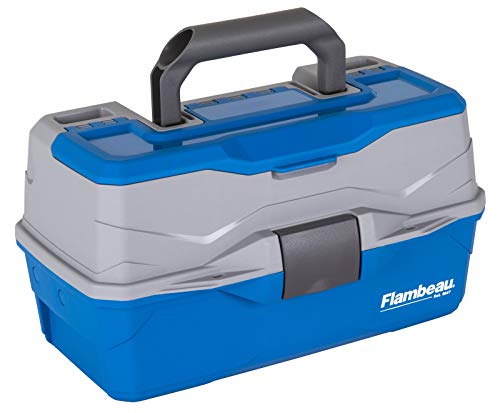
Flambeau Outdoors 6382TB 2-Tray Classic Tackle Box — Best Grow-With-Me Box
This is the graduation box: a real two-tray cantilever tackle box — the classic adult design — sized and priced for the child who has outgrown starter kits and is building a genuine collection.
- Model: 6382TB
- Layout: cantilever 2-tray design with bulk base storage
- Compartments: 15 tray compartments with 6 removable dividers
- Latch: Draw Tite latch
- Construction: weather-resistant resin (Flambeau listing data)
Strengths
- The cantilever trays open like a real tackle box — because it is one
- Removable dividers let the layout grow with the collection
- Flambeau resin build shrugs off years of bank and boat use
Trade-offs
- Sold empty — budget for tackle if the child has none
- Bigger and more complex than a young child needs
- Cantilever trays spill if the box is tipped while open — a habit to learn
At some point a young angler stops needing a kids’ box and starts needing a box. The 6382TB is that box, and its presence in this guide is deliberate: it is a classic adult-pattern cantilever tackle box — the trays swing up and out as the lid opens, presenting fifteen compartments over a bulk base — in a size and at a tier that suits a child of about nine and up who fishes seriously. Flambeau’s resin construction and Draw Tite latch are the same hardware adults rely on, which is why this box, alone in this guide, can plausibly serve from late childhood into the teen years without replacement.
The six removable dividers matter more than they appear to. A starter box’s fixed compartments fit the tackle it came with; this box reconfigures as the collection changes — long cells for the first jerkbaits, small cells for the growing hook and weight stash — and reconfiguring it is itself the lesson in how tackle systems work. The bulk base takes the items trays cannot: line spools, pliers, a stringer, a small first-aid kit and the snack that makes the last hour of fishing possible.
Buy it empty with intent: pair it with a modest hand-picked set of tackle for the waters your child actually fishes, rather than a giant pre-filled kit of lures for fish they will never meet. A child who helps choose the first contents of a real box is a child who is becoming an angler, and this is the box that marks the transition. When their system outgrows even this, the adult formats in our best tackle boxes for bass fishing guide are the next step.
Honest limitation: it arrives empty and its cantilever trays demand a flat surface and a moment of care when open. For a child still in the drop-everything phase, the simpler one-tray boxes above are the safer purchase.
Best for: children about 9+ graduating to real tackle and real organization / Not suited for: first boxes or children who need tackle included

Flambeau Outdoors Wild Bite Bass Tackle Box Kit (25-Piece) — Best for Youngest Anglers
This is the under-seven pick: a light, bass-shaped box a small child can carry in one hand, with a gentle starter kit and a pocket fishing guide tucked inside.
- Contents: 25 pieces of tackle (hooks, weights and bobbers)
- Dimensions: 10.75 x 7 x 1.88 in; weight 8.6 oz (retailer listing specs)
- Compartments: 7
- Includes: spade-and-plier multi-tool and an illustrated pocket guide to bass, panfish and trout
- Origin: made in the USA (listing data)
Strengths
- At 8.6 oz it is genuinely carryable by a five-year-old
- The fish shape makes it the box young kids ask for by name
- Pocket guide turns bank-side questions into a learning game
Trade-offs
- Capacity is tiny by design — it is a first box, not a system
- Buy by exact product name on the listing — similar Flambeau kits differ
- Older children will outgrow it within a season or two
For a child under seven, the tackle box’s first job is to be carried — proudly, independently, the whole way from the car — and at 8.6 ounces in the shape of a bass, the Wild Bite is the only box in this guide a five-year-old can manage without help. That is not a trivial spec. A child carrying their own box is participating; a child watching a parent carry everything is spectating, and the difference shows in how long they want to stay at the water.
Inside, the kit is sensibly gentle: 25 pieces of hooks, weights and bobbers across seven compartments — bobber-rig fishing, which is what under-sevens actually do — plus a small multi-tool for the adult’s pocket and an illustrated pocket guide to common fish that turns “what’s that fish?” into a page the child can check themselves. The bass shape does double duty as identification practice and as the reason this box, of all boxes, gets remembered.
It is a long-running Flambeau product sold widely by name. Buy it for the first seasons, expect it to be outgrown, and keep it afterward — few objects in a family’s fishing history carry more nostalgia per ounce.
Honest limitation: seven small compartments and 25 gentle pieces define a short career. It is a first box for the youngest anglers, and buying it for a nine-year-old would be a mistake the child would identify immediately.
Best for: children under 7 and their very first fishing seasons / Not suited for: older children or growing tackle collections

Shakespeare Youth Fishing Play Box — Best Compact Character Box
This is the small-and-fun pick: a compact character-themed play box with a starter set of tackle, for very young children whose favorite character is the surest route to the water’s edge.
- Type: youth play box with removable tray (series design)
- Contents: 12-piece tackle set (per listing data for this ASIN)
- Maker: Shakespeare youth line
- Role: first box for very young children; also used as a play and craft box
- Designs: character themes vary by listing and season
Strengths
- Character designs make the box an object of desire for the youngest kids
- Compact size suits small hands and short sessions
- Doubles as a play and craft box between fishing trips, so it stays in the child’s life
Trade-offs
- Character variants rotate — confirm the exact design and contents on the listing
- Play-box tier: not built for years of hard tackle use
- Tackle set is minimal; it is an introduction, not a kit
Shakespeare’s play boxes start from a truth about young children: the character on the box is not decoration, it is the invitation. A child who will not carry a plain box will carry their favorite character’s box everywhere — to the pond, yes, and also around the house for a week beforehand, which is how fishing becomes part of their imagination before it becomes part of their weekend. The play box format supports that life: a removable tray, a snap closure small fingers can manage, and a box that moonlights as a craft and treasure box between trips.
The tackle content is an introduction rather than a kit — the listing for this model describes a 12-piece set — and that is the correct scale for a three-to-five-year-old’s first bobber sessions with a parent doing the rigging. Everything about this tier is supervised by design: the adult ties, the adult handles hooks, the child carries, opens, chooses and fishes. Judged as that introduction, the play box does its job at a gentle price and with maximum willingness from its owner.
Ordering care is the one real caution, and our sources flag it: Shakespeare sells these play boxes in many character variants, and designs and contents differ between them. The linked ASIN corresponds to a specific variant’s listing data — open it, confirm the character and the 12-piece contents match what you want, and check whether a sibling’s preferred character is a separate listing. Two minutes of checking prevents the only real disappointment this box can deliver.
Honest limitation: this is a play box first and a tackle box second. Children who fish monthly will be ready for the Plano Take Me Fishing or the Customize-It within a season, and that graduation is the intended path.
Best for: very young children about 3–6 and character-motivated first trips / Not suited for: children ready for real tackle and independent rigging
Comparison Table
| Pick | Tackle included | Layout | Best age |
|---|---|---|---|
| Shakespeare Customize-It Kids Tackle Box with 29-Piece Tackle and Stickers | 29 pieces of assorted tackle | 2 practice casting plugs | Best Overall |
| Wakeman Outdoors Single Tray Tackle Box with 55-Piece Tackle Kit (Blue) | 55 pieces of tackle | 12.75 x 7 x 5.5 in | Best for Older Kids |
| Plano One Tray Take Me Fishing Tackle Box with Tackle (500000) | 500000 | 13.5 x 7 x 6 in (retailer specs) | Best Classic Starter |
| Flambeau Outdoors 6382TB 2-Tray Classic Tackle Box | 6382TB | cantilever 2-tray design with bulk base storage | Best Grow-With-Me Box |
| Flambeau Outdoors Wild Bite Bass Tackle Box Kit (25-Piece) | 25 pieces of tackle (hooks, weights and bobbers) | 10.75 x 7 x 1.88 in; weight 8.6 oz (retailer listing specs) | Best for Youngest Anglers |
| Shakespeare Youth Fishing Play Box | youth play box with removable tray (series design) | 12-piece tackle set (per listing data for this ASIN) | Best Compact Character Box |
How to Choose the Best Tackle Boxes for Kids
Match the box to the child’s stage, not their enthusiasm. The stages run: character play box for the very young (about 3–6), whose fishing is parent-rigged bobber sessions; a one-tray starter kit (about 5–8) for the child learning to carry, open and organize; a personalization or full kit box (about 6–10) for the child fishing most weekends; and a real cantilever box (about 9+) for the young angler building a collection. Buying one stage ahead is the commonest waste in this category — the big box overwhelms the small child, and the money would have bought both correct boxes in sequence.
Weight and latch are the two specs to physically test if you can. A loaded box a child cannot carry becomes the parent’s second box, and the child’s engagement drops accordingly. The latch test is just as decisive: if a child cannot open and securely close the box themselves, every fishing moment routes through an adult, and independence — the thing a kids’ box is for — never arrives. One simple latch beats three clever ones at this age, every time.
Finally, decide about included tackle honestly. Pre-filled kits are the right choice for first boxes because they make the box fishable on day one and their contents are scaled to the panfish and stocked-trout fishing children actually do. Empty boxes make sense only as graduation boxes for children who already own tackle. And whatever you buy, add the unglamorous essentials yourself: a small pair of nail clippers for line, a hook remover, sunscreen and a zip bag for the wet and the lost. For the adult side of the family’s tackle, our best soft tackle bags guide covers the carry systems parents end up using.
Key Takeaways
Stage first: play box, starter kit, full kit, real box — in that order, at the child’s pace. Light enough to carry and a latch they can work are the specs that decide whether the box gets used. Included tackle makes first boxes fishable immediately; empty boxes are for graduations. Adult supervision owns the hooks until the child is old enough to be taught otherwise.
How to Set Up a Child’s First Tackle Box (and a First Trip)
A first box set up well makes the first trip about fishing instead of untangling. Do the setup together, at a table, before the trip — it is part of the gift.
- Sort the included tackle together: bobbers in one compartment, hooks and weights in another, and let the child place each item so they know the map of their own box.
- Tie the first rig at home: a bobber, a small weight and a hook (or a practice plug for casting rehearsal), so the bank is for fishing, not for a tying lesson with an audience.
- Practice casting in the yard with a plug or a bobber only — no hook — until the motion is safe around siblings, pets and windows.
- Pack the adult’s pocket kit separately: clippers, hook remover, pliers (the best fishing pliers and tools guide covers the adult kit), and a rod-and-reel combo matched to the child — see the best fishing rod and reel combos guide for family-friendly pairings: sunscreen and a small first-aid kit live with the adult, not in the child’s box.
- On the water, keep sessions short and successful: a stocked pond or a panfish spot where bites come quickly beats a famous lake where they do not.
End the first trip while it is still fun — the rule that governs all children’s fishing. The box goes home, gets emptied of anything wet, and is ready for next time; building that small ritual is how a tackle box becomes a habit instead of a souvenir.
Hook Safety and Box Care for Kids (Troubleshooting)
Kids’ tackle care is mostly safety care. Hooks are the hazard and they are managed with habits, not fear: boxes stay latched, hooks live in closed compartments or on their rigs, and lure changes for young children are adult jobs. Teach older children the two safe grips — by the shank, never by the bend — and give them the hook remover early; a child who can remove a hook safely with a tool is safer than one who improvises with fingers.
- Problem: tackle is everywhere in the box. → The layout outgrew the child or the box. Re-sort together, remove anything not used, and consider whether it is graduation time to the next stage of box.
- Problem: the latch will not stay closed. → Check for a bent bail or a cracked catch, and for overfilling — a box stuffed past its tray line defeats any latch. Remove tackle before blaming hardware.
- Problem: hooks are rusting. → Wet tackle is being closed in the box. Dry everything before it goes back, and store the box open at home for a day after wet trips.
- Problem: my child has lost interest in the box. → Usually the fishing, not the box: sessions too long, spots too hard, or a box one stage behind their ability. Shorten the trip, find biting fish, and let them graduate a stage early if skill says so.
Store kids’ boxes where the child can reach them, latched, with hooks secured — accessibility is what turns a box into a hobby, and a latched box is a safe box. When the family is ready to fish together with everyone carrying their own system, the parents’ formats live in our best tackle boxes roundup.
What Tackle Does a Child Actually Need? A Minimal, Honest Kit
Starter kits invite a fair question: how much of this will a child actually use? The honest core of children’s fishing is small. A handful of bobbers in two sizes, split shot, small hooks for worms and dough baits, a few jig heads with soft plastics, and one or two small spinners or spoons for the older child cover nearly every fish a child will realistically catch — bluegill, perch, stocked trout, the occasional small bass. Everything beyond that in a kit is variety and spares, which have their own value (a lost bobber should never end a trip), but no child needs forty lure types, and a box organized around the honest core fishes better than a stuffed one.
Adults stocking a graduation box like the Flambeau should buy in the same spirit: duplicates of the few things that work on your water beat singles of everything in the catalog. Two of the local jig, two of the local spinner, hooks and shot in the sizes the panfish take, and a spare spool of light line. The child’s box then mirrors the family’s actual fishing, restocking is a short list, and the young angler learns the deepest tackle lesson early — that fish are caught by a few well-known baits presented well, not by owning the wall of a tackle shop.
Restocking is part of the ritual, too. After each trip, count what is left of the consumables — hooks, shot, bobbers — and replace them before the next trip, with the child doing the counting. A child who maintains their own box inventory is learning the unglamorous half of angling, and it is the half that keeps the glamorous half possible.
Common Buying Mistakes
Buying one stage ahead. The big, complex box overwhelms the young child and sits unused. Stages exist because children develop; buy the box for the angler they are now.
Choosing by character alone. A beloved character on a box with a latch the child cannot work is a toy, not a tackle box. Character is a fine tiebreaker between boxes that pass the carry and latch tests.
Handing a young child hooked lures unsupervised. Treble hooks in kits like the Wakeman are real. Adults own lure changes and hook work until a child is old enough to be taught safe handling — and practice plugs exist for casting practice.
Buying an empty box for a first-timer. An empty first box is a deferred gift. First boxes should arrive fishable, with starter tackle inside.
Ignoring the carry test. If the child cannot carry the loaded box, the parent carries two boxes and the child carries none of the experience. Weight is a headline spec at this age.
Letting wet tackle live in a closed box. Rust and mildew move in within days. Dry the contents, store the box open after wet trips, and make the reset part of the ritual.
Final Recommendation
For most children, start with the Shakespeare Customize-It: a real starter kit in a box the child makes their own (check the 29-piece contents on the listing). The youngest anglers start lighter with the Plano Take Me Fishing — check on Amazon — and older, keener kids graduate to the Wakeman 55-piece kit — check on Amazon — or the empty, real-deal Flambeau cantilever when their own collection begins. Match the stage, keep the hooks supervised, and end every trip while it is still fun.
One final encouragement: the box matters less than the mornings. Every pick in this guide will hold bobbers and hooks adequately; what turns a child into an angler is a parent or grandparent who takes them often, keeps the trips short, celebrates the small fish loudly and lets the child carry their own box the whole way. Buy the right stage, set it up together, and go — the first fish a child catches with their own box is a story your family will tell for decades, and it does not require a single premium feature to happen.
Frequently Asked Questions
What age should a child get their first tackle box?
Most children are ready for a simple play or starter box between about four and six, with an adult doing all rigging and hook handling. Readiness looks like: they can carry the box, work its latch, and sit with a bobber for fifteen minutes. Older starters simply enter the stage ladder higher up.
Are tackle boxes with included tackle worth it for kids?
For first and second boxes, yes — they make the box fishable immediately and their contents are scaled to the panfish fishing children actually do. Once a child owns tackle and opinions, an empty graduation box plus hand-picked additions is the better buy.
How do I keep kids safe around the hooks in these kits?
Adults handle hooks and lure changes for young children, full stop. Boxes stay latched between uses, casting practice uses plugs or bobbers without hooks, and older children are taught to handle hooks by the shank and to use a hook remover. The kits in this guide are standard children’s fishing gear; supervision is the safety system.
What is the difference between a one-tray and a two-tray kids’ box?
A one-tray box has a single removable tray over open bulk storage — simple, light, and right for beginners. A two-tray cantilever box swings two trays up as it opens, presenting more, smaller compartments for a growing collection. Children graduate from the first to the second as their tackle and care habits grow.
How long will a kids’ tackle box last?
Physically, the branded boxes in this guide last for years — often into hand-me-down service. Functionally, each stage lasts one to three seasons before the child outgrows its size or simplicity. Plan on the ladder, keep the retired boxes for siblings and garage duty, and the spending stays modest.
What should I do when my child outgrows their tackle box?
Graduate them one stage, and make an occasion of it — the new box, stocked together at the table, marks their progress as an angler more clearly than almost any other fishing milestone. The retired box does not leave the family: it becomes the sibling’s first box, the car’s spare kit, or the garage’s small-parts box, and children who hand a box down to a younger sibling take visible pride in the transfer. Keep the ladder moving at the pace of the child’s skill and care, not the calendar — a careful eight-year-old may be ready for the cantilever box while a boisterous ten-year-old is still happiest with a one-tray — and the boxes in this guide will cover the whole journey from first bobber to first self-run system.
Can a kids’ tackle box be used for other things?
Happily, yes — and it helps. Play boxes double as craft and treasure boxes, and starter boxes become parts and hobby storage after graduation. A box that stays in a child’s daily life between trips keeps fishing in their imagination, which is worth more than any single feature in this guide.