Where to buy
Check the latest price, availability and delivery on Amazon. Orders are placed on Amazon. We may earn a commission from qualifying purchases.
- Best overall: Amazon Basics Foldable 14 Inch Metal Platform Bed Frame, Twin — Check on Amazon
- Zinus Yelena 14 Inch Metal Platform Bed Frame, Twin — Check on Amazon
- Zinus SmartBase Mattress Foundation, Narrow Twin — Check on Amazon
- EMODA 18 Inch Twin Bed Frame — Check on Amazon
See 2 more Amazon options
- Allewie 18 Inch Twin Metal Bed Frame, White — Check on Amazon
- Novilla 14 Inch Metal Platform Bed Frame, Queen — Check on Amazon
Read the full guide ↓
Disclosure: As an Amazon Associate, umtsmarttool.com earns from qualifying purchases. Links to Amazon on this page are affiliate links; they cost you nothing extra. Listing details such as price and availability change often, so check the current Amazon listing before you buy.
The best storage bed frames for side sleepers under $30 have to pass two different tests, and this guide will not blur them together. The storage test is the one this family of guides always applies: at $30, “storage” means open under-bed clearance, never drawers — no frame with built-in storage exists anywhere near this budget — and the honest measure is the clear inches between the floor and the underside of the deck. The side-sleeper test is about what happens on top of the frame. A side sleeper does not load a bed evenly. You lie on one edge of it, shoulder and hip pressing down along a single line, shifting on that same edge all night. What you need from a frame is not cushioning — a frame has none to give — but evenness: a deck that does not sag between its slats, rails that do not flex away under one-sided weight, joints that stay silent when the load moves. A frame can only avoid making side sleeping worse. The comfort itself lives in the mattress.
There is a second honesty point, and it matters more: under $30 is a twin-size story. We checked the queen market hard, because queen is the size most side sleepers actually sleep on, and no complete queen storage frame could be verified in this budget tier. The cheapest verified queen platform frame sits well above this budget tier, so queen readers get one clearly labelled over-budget pick below and a route onward to Best Storage Bed Frame Under $75, which is the first honest queen budget. Everything else here is a twin frame in this budget tier, judged first on clearance, then on the support it gives a mattress loaded from one side. And to say the quiet part plainly: clearance itself does nothing for side sleeping. Thirteen inches of air under the bed stores your bins; it does not soften your shoulder. It is this family’s axis, not this lens’s — the picks below earn their places on both, separately. If you already own a frame and only need it higher, stackable bed risers exist — but risers are not frames, so they are named here as the alternative, not sold as picks.
In this guide
Quick Picks
Short on time? Each row below names a buyer type and the product that suits it, with a link to the listing.
| Buyer type | Pick | Why it stands out | Link |
|---|---|---|---|
| Best overall | Amazon Basics Foldable 14 Inch Metal Platform Bed Frame, Twin | A one-piece steel deck with no slat gaps for a foam mattress to sag into, about 13 inches of clearance — check price on Amazon | Check on Amazon |
| Best slatted frame | Zinus Yelena 14 Inch Metal Platform Bed Frame, Twin | Maker-specified 12 inches of clearance and published specs — check price on Amazon — but read the slat-spacing note before ordering for foam | Check on Amazon |
| Best for narrow spaces | Zinus SmartBase Mattress Foundation, Narrow Twin | 13 inches of clearance and the strongest maker capacity claim in this guide, in a 30-inch-wide frame — for genuinely narrow mattresses only | Check on Amazon |
| Most storage space | EMODA 18 Inch Twin Bed Frame | 16.5 inches of clearance, and six legs — the center support under your hip line is the side sleeper’s sag defense | Check on Amazon |
| Best tall frame | Allewie 18 Inch Twin Metal Bed Frame, White | The tall option in a white finish, with the thinnest documentation in this guide — check price on Amazon | Check on Amazon |
| Best queen option | Novilla 14 Inch Metal Platform Bed Frame, Queen | The verified queen floor: 12 inches of clearance — check price on Amazon | Check on Amazon |
How These Picks Were Chosen
The first filter was the budget itself, applied per size. Every product below is a real Amazon listing, and size matters to how each listing is positioned, because listings in this category headline the twin size in large type and let you assume the queen is the same. It is not. Where a frame sits above this budget tier in a given size, the review says so plainly, so you can check the current price on Amazon for that size or move up a tier. Anything that called itself a storage bed but turned out to be a set of drawers with no frame, a headboard with shelves, or a frame priced for a different size was left out, however good it might be.
The second filter was storage, measured honestly. We compared maker-published clearance figures — from listings and the manufacturers’ own manuals — rather than marketing height, because a 14-inch frame is not 14 inches of storage: the deck, the side rails and the slats all hang below the top, and the 14-inch frames in this guide actually clear 12 to 13 inches. We also looked at how the legs divide the space, since a frame with center legs offers two shorter storage bays rather than one long one, which decides whether a long tote slides in or does not. What we did not do is invent storage volumes: no listing here publishes a trustworthy cubic figure, so this guide works in clear inches: standard under-bed bins are roughly 6 inches tall, tall bins roughly 14 inches, and those are the heights your clearance has to beat, with an inch to spare for sliding.
The third filter was the side sleeper’s. We looked at how each deck carries a load that arrives along one edge rather than spread across the bed. Slat spacing matters here twice over: many foam mattress makers ask for slats no more than about 3 inches apart, and a foam mattress that dips between wider slats presents a ridged, uneven surface to a sleeper whose hip sits right on one of those dips — one pick below runs a maker-stated 6.4 inches, and its review prints that as its limitation rather than hiding it. Where a listing publishes no slat spacing at all, this guide says so openly instead of filling the silence with a guess. We also weighed center support — the legs and rails under the middle of the bed, where a side sleeper’s hip concentrates weight — and treated noise as a sleep-quality fact, not a nuisance: a joint that creaks under a sleeper who shifts on one edge all night is a joint that wakes them. Load figures are quoted only as what they are, which is maker claims and roundup reporting, never independent tests. And we checked the recall record. The two big platform-bed recalls of recent years — Home Design’s upholstered beds, recalled in January 2024 after reports of breaking, sagging and collapsing, and Lucid’s upholstered platform beds, recalled in September 2024 over legs that could break — involved upholstered models, not the metal frames picked here, and none of these six picks is a recalled model. But those notices are the best inspection checklist ever written for a cheap frame, and the final section of this guide uses them that way.
The 6 Best Storage Bed Frames for Side Sleepers Under $30
One omission is deliberate and worth explaining before the reviews. The cheapest complete frame found anywhere in this research programme — a 10-inch twin platform in this budget tier — is not here, because on this guide’s axis it fails: it clears only about 9 inches underneath, enough for shoe boxes and little else. A storage guide that led with it would be answering a different search. Every pick below clears at least 12 inches or explains exactly why it is here anyway, and the six of them form a ladder: 12 to 13 inches from the 14-inch frames, 16.5 inches from the tall ones, in sizes from narrow twin to the one honest queen.
Amazon Basics Foldable 14 Inch Metal Platform Bed Frame, Twin
Who it suits: Renters, students and foam-mattress owners who want the most storage in this budget tier from a frame that also folds away when the lease ends.
This is the pick that makes the whole category work in this budget tier, and for a side sleeper it holds a specific advantage none of the slatted frames can match: its deck is a one-piece steel platform rather than individual slats, so there is no slat-spacing question at all. A foam mattress lies on a continuous surface and cannot dip between gaps along the line where your hip rests. The frame stands 14 inches tall and leaves about 13 inches of clear space underneath — tied for the best clearance in this guide among the frames that genuinely reach the budget — — check price on Amazon for the current listing in this twin size. This frame can also sit in a higher tier, so check the current price on Amazon before you buy. When it sits in this budget tier, it is the best storage buy in this guide; when it sits higher, the reviews below it become the better route. Setup is the other half of its appeal: the steel frame folds out and locks with no tools at all, and when you move, it folds flat again — the only pick here that stores itself.
Thirteen inches of clearance is the useful kind of storage: standard low bins slide in two deep, shoe organizers disappear entirely, and a suitcase on its side fits without forcing. What you are not getting is strength in depth. Roundup coverage of the twin size reports a capacity of roughly 250 lb — a figure reported by reviewers rather than published as a formal maker rating — and it is the lowest number attached to any pick in this guide. For a back sleeper spreading weight across the deck, that is a footnote. For a side sleeper it deserves a harder look, because your weight arrives concentrated along one edge and through two points, shoulder and hip, rather than distributed. One lighter sleeper, yes; a heavier sleeper whose hip loads the same strip of deck every night is asking more of this frame than its design intends, and should read the stronger claims further down the list before choosing the cheapest one.
- A one-piece steel deck — continuous support, with no slat gaps for foam to sag into.
- About 13 inches of under-bed clearance, the joint-best at this budget.
- Tool-free fold-out setup, and it folds flat for moving or storing.
- In this budget tier for the twin size — check the current price on Amazon.
Honest limitation: Check the current price on Amazon, as this frame can sit well above this budget tier; and its reported twin capacity of roughly 250 lb is the lowest in this guide — a real consideration when your weight lands on one edge.
Choose it if storage in this budget tier is the priority, your mattress is foam, and the current listing fits this tier — check price on Amazon. Skip it if you are a heavier sleeper who wants a stronger capacity claim under the hip line, or you need a queen — a queen version exists, but it does not sit in this budget tier.

Zinus Yelena 14 Inch Metal Platform Bed Frame, Twin
Who it suits: Buyers who want a conventional slatted frame from a major bed-frame brand, sleep on a spring or hybrid mattress, and will check the current price on Amazon for their size.
The Yelena is the traditionalist’s pick: a black steel frame, 74.5 by 38 inches, with steel slats running across it and no box spring needed. Zinus specifies 12 inches of under-bed clearance for it — the figure appears in the maker’s own manual and in the listing’s ground-to-item distance — and that foot of clear space takes standard storage bins, off-season clothes boxes and bedding without any of it touching the deck. Check price on Amazon for the current listing in this twin size. Like the foldable above, its position relative to this budget tier can vary, so confirm the current price on Amazon before ordering rather than assuming this tier is its everyday position.
The trade hiding in the specification is slat spacing, and for this guide’s readers it is the whole review. Zinus’s listing states the slats sit 6.4 inches apart on the twin size. An innerspring or hybrid mattress, with its own internal structure, will not care. A foam mattress might: many foam makers ask for slats roughly 3 inches apart or closer, partly for warranty reasons and partly because foam settles into gaps. For a side sleeper the settling is not abstract — your hip is the heaviest point load on the bed, and if it comes to rest over a gap rather than a slat, the surface under it sits slightly lower than the surface under your ribs, night after night. The honest fixes are a bunkie board or a sheet of pegboard over the slats, either of which takes ten minutes to add — but you should know the spacing before you order, not after the mattress arrives. Judged purely as storage, this is the most conventional route in the guide: a foot of clearance, an open span under a slatted deck, and a brand whose manuals actually publish the numbers this guide is built on.
- Maker-specified 12 inches of under-bed clearance.
- Steel slat support — no box spring needed.
- Check price on Amazon, with full dimensions and specs published by the maker.
Honest limitation: The 6.4-inch slat spacing is wider than many foam mattresses are warranted for, and wider than a foam-sleeping side sleeper wants under the hip without a board over it; it can also sit well above this budget tier — check the current price on Amazon before you buy.
Choose it if you want a slatted frame with published specs, sleep on springs or a hybrid, and can check the current price on Amazon. Skip it if your foam mattress demands close slat spacing and you do not want to add a board, or if you need a frame in this budget tier this week regardless of the current listing.

Zinus SmartBase Mattress Foundation, Narrow Twin (74 × 30 Inch)
Who it suits: RV and camper sleepers, narrow-room and cot setups — anyone whose bed is genuinely 30 inches wide and who still wants real storage under it.
The SmartBase line is the closest thing this category has to a storage specialist: Zinus built the range around under-bed space, and the maker’s manual for this narrow-twin version specifies 13 inches of clearance — the joint-best figure in this guide — under a tool-free folding steel frame. The same manual rates single-size SmartBase frames to a maximum of 750 lb, which we quote as what it is, a maker claim rather than a test. For this guide’s readers it is still the most reassuring number on the page, because a side sleeper loads a frame unevenly by definition, and the strongest stated claim in the guide belongs to the frame built around support rather than around a low tier position. Check price on Amazon for the current listing. So this is a just-over pick: the strongest storage-per-inch option here, positioned just above this budget tier — check the current price on Amazon before you buy.
The limitation is printed in its name and it is absolute: narrow twin means 74 by 30 inches. It fits narrow-twin mattresses — the size used in RVs, campers, some dorms and children’s setups — and nothing else. A standard twin mattress is 38 inches wide and would overhang this frame by four inches on each side, which is not a cosmetic problem but a support one: the unsupported strip is exactly the edge a side sleeper lies on, so the mismatch lands precisely where this guide’s readers can least afford it. And even used correctly, 30 inches is very little bed: you sleep near an edge all night, and the frame’s edge stiffness stops being a detail. Measure your mattress before you check price on Amazon. If it is a true 30 inches, this frame gives you a foot-plus of storage in a footprint most frames ignore, with a folding design that assembles without tools and packs away when the vehicle or the room changes use.
- 13 inches of clearance, specified in the maker’s own manual.
- Maker-claimed 750 lb maximum for single sizes — the strongest claim in this guide, and the one that matters most under one-sided load.
- Tool-free folding assembly — check price on Amazon.
Honest limitation: It fits 30-inch narrow-twin mattresses only — on a 30-inch bed a side sleeper lives near the edge — and it typically sits well above this budget tier — check the current price on Amazon.
Choose it if your mattress is a genuine narrow twin and storage space is scarce. Skip it if your mattress is a standard 38-inch twin — no discount makes the wrong width fit, and the overhang lands on the edge you sleep on.
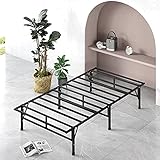
EMODA 18 Inch Twin Bed Frame
Who it suits: Storage maximalists — the reader whose closet overflow is the entire problem and who needs tall things to fit, not just flat ones.
Every frame above tops out at 12 or 13 inches of clearance, which quietly excludes the tallest things people actually store: upright suitcases, tall storage totes, boot boxes. The EMODA is the pick that removes that ceiling. It stands 18 inches tall with 16.5 inches of under-bed clearance in roundup measurements — half a foot more than the 14-inch frames — and that difference is the difference between lying a suitcase flat and standing it up. Check price on Amazon for the current listing, fulfilled by Amazon where shown on the listing, which makes it a stretch pick: positioned above this guide’s budget tier, and included because on the storage axis it is not a marginal improvement but a different category of space.
For a side sleeper, though, the interesting number is not the height — it is the legs. This frame uses six reinforced legs, and the two center legs sit under the middle of the bed, which is where a side sleeper’s hip concentrates the load. A valley in a mattress usually starts as flex in the frame beneath it: the middle of a long, unsupported span gives a little more each night until the sleeper is rolling gently toward the center. Center legs are the direct answer to that failure mode, and this is the only pick in the guide whose leg count makes the point so plainly. Its stated capacity is 800 lb — a maker claim, quoted as one. The trade-offs are real. The six legs divide the under-bed span into bays, so the longest items — a full-length tote, skis, a keyboard case — may not slide straight through the way they would under a four-leg frame. Eighteen inches of frame plus a 10- or 12-inch mattress also puts the sleeping surface around 28 to 30 inches off the floor, which is a genuine climb for children, shorter adults and older guests, and a long drop for a phone at 3 a.m. And the slat spacing is not published in the material we reviewed — this guide will not guess it — so foam-mattress owners should check the listing or plan on a board. None of that dents the central facts: if storage volume is the reason you are reading, this is the most of it near this money, and if mid-bed support is your worry, its center legs are the strongest argument in the guide.
- 16.5 inches of clearance — tall bins and upright suitcases fit, not just flat boxes.
- Six reinforced legs: center support under the hip line, where a side sleeper’s weight concentrates.
- Maker-stated 800 lb capacity — check price on Amazon — the tall format as a stretch pick above this budget tier.
Honest limitation: It sits above this guide’s budget tier, the finished bed is tall enough to be a climb, its center legs split the storage span into bays, and its slat spacing is unpublished.
Choose it if maximum storage is the whole point, mid-bed sag is your fear, and a stretch above this budget tier is available. Skip it if the bed is for a child or an older guest, or if your longest storage item needs one unobstructed span.

Allewie 18 Inch Twin Metal Bed Frame, White
Who it suits: Buyers who want the tall-storage format in a white finish, positioned just above this budget tier — and who will do the checking this pick’s thin documentation requires.
Allewie’s 18-inch twin is the EMODA’s idea in a different finish and in a similar stretch position above this budget tier: a white powder-coated metal platform, no headboard or footboard, built purely to lift a twin mattress and open the space beneath it. Check price on Amazon for the current listing — it sits just above this budget tier, as a route to an 18-inch frame in this guide. In a white or light-colored room it also disappears in a way the black frames in this guide do not, which is a real consideration when the frame is this tall and this visible.
This pick carries the guide’s thinnest documentation, and the review will say so plainly. The listing markets the full 18-inch height as storage space but does not publish a separate clearance figure, and since the deck and rails sit below the top of the frame, the true clear height will be somewhat less than 18 inches — this guide will not lend it the EMODA’s 16.5-inch figure, because they are different frames and the number belongs to the other one. Measure it on arrival, inside the return window, before you buy bins to fit it. Allewie also sells many near-identical frames, so confirm the live listing is the 18-inch white twin before ordering. The documented compromises matter more for this guide’s readers than most: coverage notes that bolts can loosen over time and squeak until re-tightened — and a side sleeper works the loaded edge’s joints all night, so a loosening bolt announces itself to exactly the person lying on it — and that the perimeter lip is limited, so a restless mattress can wander without a gripper pad, which matters when the sleeper’s weight sits near the edge the mattress is wandering toward. A white finish also shows shipping scuffs. None of these is a surprise in this stretch tier, but they are the trade-off of the format, and you should accept it knowingly.
- 18-inch frame height in a white finish the other tall pick does not offer.
- Check price on Amazon — positioned just above this budget tier as an 18-inch twin option.
- Simple platform design, no box spring needed.
Honest limitation: No published clearance figure separate from the frame height, the thinnest documentation in the guide, a tendency to squeak as bolts loosen until they are re-tightened, and a brand whose many similar listings make it easy to order the wrong variant.
Choose it if you want tall storage in white and will verify the listing and measure on arrival. Skip it if you need published specs and a documented clearance figure before you buy — take the EMODA instead.

Novilla 14 Inch Metal Platform Bed Frame, Queen
Who it suits: Queen sleepers — the only pick in this guide that fits your mattress, included so its position above this budget tier is stated honestly instead of implied.
Let us be direct: this frame does not sit in this budget tier, and nothing in this guide’s research suggests any queen frame does. Check price on Amazon for the current queen listing. This Novilla’s queen size sits well above this budget tier, and that position is the verified floor of the queen market, and this frame earns its place by being that floor with real storage attached: Novilla’s own manual specifies 12 inches of under-bed clearance, the frame measures about 80 by 60 inches, and the maker’s manual for this frame line gives a maximum capacity of 1,200 lb — again, a maker claim, not a test result, but the largest stated figure in this guide.
For side sleepers this pick carries an extra argument the twin frames cannot make: width. Most side sleepers who share a bed, and many who sleep alone, do it on a queen, because 60 inches gives a sleeper room to lie on one side of the bed without living on its edge — and a frame that fits the mattress properly supports the whole surface instead of leaving strips of it hanging over the sides. Why print an over-budget pick at full length? Because the alternative is what the rest of the internet does: headline a twin listing against a queen keyword and let you discover the difference at checkout. The same per-size pattern shows everywhere in this category — the twin hero of our sibling platform research sits in a much higher tier in its queen size — and even the tall-storage route is no cheaper in queen: EMODA’s 18-inch queen is named here rather than linked, as its Amazon listing showed no featured offers when we checked. The walk-away rule for this pick is simple. Check the current price on Amazon if you need a queen storage frame now. If the current queen price sits close to the next tier, stop: at that point Best Storage Bed Frame Under $75 is the more honest route, because $75 is where the honest queen market actually begins.
- A true queen size — the only one in this guide, and the size most side sleepers actually sleep on.
- 12 inches of clearance, specified in the maker’s manual.
- Its position as the verified queen floor in this guide — check price on Amazon.
Honest limitation: Well above this budget tier, it sits outside this guide’s budget on purpose — that is what a queen storage frame in this range requires, and any guide implying otherwise is quoting you a twin.
Choose it if you sleep on a queen and need storage now at the verified queen floor — check price on Amazon. Skip it if its current price sits close to the next tier — step up to the $75 tier instead, where queen frames are positioned honestly.

Comparison Table
| Product | Size | Under-bed clearance | Support note for side sleepers | Link |
|---|---|---|---|---|
| Amazon Basics Foldable 14 Inch | Twin | About 13 in | One-piece deck, no slat gaps; lowest capacity figure in the guide | Check on Amazon |
| Zinus Yelena 14 Inch | Twin | 12 in (maker spec) | Slats at 6.4 in — add a board under foam | Check on Amazon |
| Zinus SmartBase | Narrow twin (30 in) | 13 in (maker spec) | Strongest maker capacity claim; a very narrow stage for side sleeping | Check on Amazon |
| EMODA 18 Inch | Twin | 16.5 in | Six legs — center support under the hip line; slat spacing unpublished | Check on Amazon |
| Allewie 18 Inch, White | Twin | Not published (18 in frame) | Re-tighten bolts to keep the loaded edge quiet; mattress can wander without a gripper pad | Check on Amazon |
| Novilla 14 Inch | Queen | 12 in (maker spec) | Full-width support for the size most side sleepers sleep on | Check on Amazon |
How to Choose a Storage Bed Frame Under $30
- Judge clearance for storage and support for sleep — separately. Clearance decides what fits under the bed. Deck type, slat spacing and center support decide how the bed feels. No single number answers both questions, and a tall frame is not automatically a supportive one.
- Measure your bins before the frame. The tallest thing you plan to store, plus an inch for sliding, is the clearance you need. Everything else is decoration.
- Frame height is not clearance. The deck and rails hang below the top of the frame: the 14-inch frames here clear 12 to 13 inches. Shop by the clearance figure, and distrust any listing that only quotes height.
- Check slat spacing against your mattress. Many foam makers ask for slats about 3 inches apart or closer. A frame at 6.4 inches needs a bunkie board under foam, or a different frame — and a side sleeper’s hip is the load that finds the gaps. A one-piece deck has no spacing question at all.
- Think about where your weight actually lands. A side sleeper loads one edge and the middle of the bed, not the corners. Center legs and stiff side rails are your sag defense; a frame that is strong at the corners and soft in the middle is strong in the wrong places.
- Treat capacity numbers as maker claims. They are not independent tests, and one-sided loading argues for respecting the low ones rather than averaging them away. Add up the mattress and the sleepers — the things stored underneath rest on the floor, not on the frame, so storage weight does not count against the rating.
- Match the size honestly. Listings headline the twin size. A narrow twin is 30 inches wide, not 38 — and on a bed that narrow, a side sleeper sleeps near the edge all night. A queen is a different product in a different tier. Measure your mattress, then check price on Amazon for that size.
- Check the current price for your size. In this category the same frame can sit in different tiers by size, so check price on Amazon for your exact size before you buy — that check is worth more than any single feature.
- Inspect it like a recall inspector — then re-tighten. Slats seated, rails straight, center support present, every bolt snug. Go around it again after the first few weeks, when budget metal settles: for a side sleeper, the squeak that starts in month two is a loose joint at the edge you load, asking to be tightened, not a soundtrack you have to accept.
What a Frame Can and Cannot Do for a Side Sleeper
Start with the sentence this guide keeps coming back to, because it is the one the listings will never print: under-bed clearance does nothing for side sleeping. It is storage. It is measured in inches of air, and air neither cushions a shoulder nor supports a hip. A 16.5-inch-clearance frame and a 12-inch-clearance frame with the same deck would feel identical to sleep on. Clearance is this family’s axis — the reason these six frames are in a storage guide at all — and it should be judged on storage terms alone: bins, suitcases, bays, lids. The side-sleeper judgment is a separate judgment, made on different evidence, and any review that lets a big clearance number blur into a comfort claim is selling you the wrong thing.
What a frame genuinely controls is evenness. A mattress can only do its job on a surface that stays flat under load: if the deck sags in the middle, the mattress sags with it, and the side sleeper in that shallow valley spends the night with their spine following its curve. If the deck is widely spaced slats, a foam mattress drapes into each gap, and the hip — the point of greatest load — finds the dips. If the side rail flexes under one-sided weight, the bed’s edge gives way a little every time the sleeper settles. None of these is a comfort feature; they are the absence of sabotage. That is the honest ceiling on what any frame does for a side sleeper, and at $30 the picks reach it unevenly: the foldable’s continuous deck and the EMODA’s center legs reach it by design, the Yelena reaches it with a board added, and the Allewie reaches it on the day its bolts are tight.
Which leaves the mattress holding the actual comfort brief — the pressure at your shoulder, the give at your hip, the surface you feel. If you wake uncomfortable on a flat, silent, well-supported frame, the frame has done its whole job and the problem is upstairs, in the mattress or the pillow. No frame in this guide treats pain, and none claims to. If discomfort is persistent — pain that does not ease, numbness or weakness in an arm or leg — that is a question for a clinician, not for a bed-frame listing, and it deserves an answer before another purchase rather than after one.
Slats, Decks and the Sagging Middle
Slat spacing is the technical core of the side-sleeper question, so it deserves its own plain statement. A slatted deck supports a mattress at intervals. Between the slats, the mattress carries itself — and a foam mattress, having no internal springs or structure, carries itself worst exactly where the load is greatest. Many foam makers ask for slats roughly 3 inches apart or closer. In this guide, exactly one pick publishes its spacing: the Yelena, at 6.4 inches on the twin size — more than double the common ask, printed in its review as its limitation. The EMODA’s spacing is not published in the material we reviewed; the Allewie publishes neither spacing nor clearance; the Novilla’s manual gives clearance and capacity but the spacing figure is not one this guide verified. Those silences are stated, not filled. If your mattress is foam and your frame is one of the silent ones, the listing’s current specification is the place to check before ordering — and a bunkie board over any slatted deck removes the question entirely.
The deck alternative is continuity. The Amazon Basics hero skips the spacing question by being a one-piece steel platform: support everywhere, gaps nowhere. That is the strongest simple argument in this guide for a foam-sleeping side sleeper, and it is why the hero leads despite carrying the guide’s lowest capacity figure — the two facts pull in opposite directions, and the reviews print both rather than letting either one win quietly. Between the two designs sits the middle of the bed itself: the longest unsupported span flexes most at its center, and a side sleeper’s hip sits close to that center. The EMODA’s six legs shorten the span from below; the recall notices below make the same point from the failure side — one recalled platform model had no center support leg at all. When you inspect a frame, the middle is where to press down hard and watch.
What the Recall Notices Teach You to Check
The largest bed-frame recalls of recent years were not about the tall metal frames in this guide. Home Design’s upholstered low-profile and platform beds — about 527,000 of them in the United States — were recalled in January 2024 after 128 reports of the beds breaking, sagging or collapsing during use, with 36 injuries; the notice pointedly observed that one platform model had no center support leg halfway along its side rail. Lucid’s upholstered platform beds followed in September 2024, recalled over legs that could break. Two lessons survive the details. The first is that a higher tier is no protection: the recalled beds sat well above this guide’s budget. The second is that the failures were structural and visible — slats, side rails and legs — which are exactly the parts a side sleeper loads hardest, along one edge and through the middle of the bed. A buyer can inspect for precisely them.
So inspect. When your frame arrives, check that every slat seats fully and cannot rock, that the side rails are straight and their welds or bolt holes are clean, and that a frame in a double size or larger has the center support its design promises. Press down hard at the middle of each side rail — the edge you will actually sleep on — and watch for flex. After the first weeks of use, go around it once more with the wrench: budget metal settles, bolts relax, and the squeak that starts in month two is a loose joint at the loaded edge asking to be tightened, not a soundtrack you have to accept. None of the six picks in this guide is a recalled model — they are simple metal frames, and the recalled lines were upholstered beds from other makers — but the checklist costs you ten minutes and it is written in other people’s injuries. Use it.
Common Buying Mistakes
- Reading the headline twin listing as the queen listing, when the listing is quoting the twin — the single most common disappointment in this category.
- Expecting a frame to fix a mattress problem. A frame can stop sabotaging your mattress; it cannot soften a shoulder or support a hip by itself. If the mattress is wrong, a new frame will faithfully reproduce the wrongness on a level surface.
- Assuming an 18-inch frame gives 18 inches of storage, then buying bins that do not fit the real clearance.
- Putting a foam mattress on wide-spaced slats its maker never warranted — and sleeping a hip over the gaps. Check the spacing, or add the board.
- Ordering a narrow twin for a standard twin mattress, and discovering the four-inch overhang on each side after assembly — an overhang that lands exactly where a side sleeper lies.
- Treating a maker’s capacity claim as a tested limit — and forgetting both that it covers the sleepers, not the storage, and that one-sided loading deserves more headroom, not less.
- Ignoring the first squeak. On a frame a side sleeper loads from one edge, a new noise is a loosening joint at that edge; a wrench now is cheaper than a collapse later.
- Forgetting the total bed height: frame plus mattress, measured against children, guests and ceilings.
Final Recommendation
- Most buyers: Amazon Basics Foldable 14 Inch, Twin — check the current price on Amazon; the continuous deck is the side sleeper’s quiet advantage.
- Slatted support with published specs: Zinus Yelena 14 Inch, Twin — with a bunkie board over the slats if your mattress is foam.
- Narrow rooms and RVs: Zinus SmartBase, Narrow Twin — for genuine 30-inch mattresses only.
- Maximum storage and center support: EMODA 18 Inch, Twin.
- Tall storage in white: Allewie 18 Inch, Twin — verified on arrival.
- Queen beds: Novilla 14 Inch, Queen — check price on Amazon, as the verified queen floor above this budget tier.
Our top two are the Amazon Basics foldable for anyone whose bed is a twin and whose budget is real — its one-piece deck is the cleanest answer to the slat question in this guide — and the Yelena for anyone who wants slats and a spec sheet, because between them they cover the two honest ways to buy storage in this budget tier. If storage volume is the whole problem and you can stretch above this budget tier, skip both and take the EMODA’s extra half-foot of height and its center legs. And if your mattress is a queen, let this guide’s least welcome sentence save you a return: there is no queen storage frame under $30, there is a good one well above this budget tier, and the tier where queen pricing turns honest is Best Storage Bed Frame Under $75. Measure your bins, check price on Amazon for your size, press hard on the middle of the rail when the frame lands — and the dead space under your bed stops being dead, on a surface that stays where you put it.
Frequently Asked Questions
Can you really buy a storage bed frame for under $30?
Yes — in a twin size, in this budget tier, if by storage you mean under-bed clearance. The twin frames in this guide belong in this budget tier — check price on Amazon for the current listing in your size. What $30 does not buy, at any size, is a frame with built-in drawers or a lift-up deck, and it does not buy a queen: the verified queen floor sits well above this budget tier.
Does under-bed clearance make any difference to side sleeping?
No, and this guide would rather say so than imply otherwise. Clearance is storage — inches of air for bins and suitcases. What a frame does for a side sleeper is keep the sleeping surface even, stiff at the edges and quiet under one-sided load. Judge the two things separately, the way the reviews above do, and be suspicious of any listing that merges them into a comfort claim.
What slat spacing does a foam mattress need?
Many foam makers ask for slats roughly 3 inches apart or closer, and it is worth checking your own mattress maker’s figure before ordering. In this guide only the Yelena publishes its spacing — 6.4 inches on the twin — which is why its review recommends a bunkie board under foam. A one-piece deck, like the foldable hero’s, has no spacing to check. Where a listing publishes no spacing, this guide says so rather than guessing.
Will a new frame help my shoulder or hip?
A frame can remove problems it causes — a sagging middle, a flexing edge, a ridged surface over wide slats — and a mattress works better on an even base than on a failing one. Beyond that, comfort at the shoulder and hip is the mattress’s and the pillow’s job, and no frame treats pain. If pain is persistent, or you notice numbness or weakness in an arm or a leg, see a clinician rather than shopping for a fix.
Why is there no queen storage frame under $30?
Because of how the category tiers sizes. Listings headline the twin size, and the same frame in queen sits in a much higher tier — and the cheapest queen platform frame we could verify, the Novilla above, sits well above this budget tier. That is the market, not a gap in this guide’s research.
How much clearance do I need for storage bins?
Standard low under-bed bins are roughly 6 inches tall and fit any frame in this guide with room to spare. Tall bins are roughly 14 inches tall and need the 18-inch frames — a 14-inch frame clearing 12 or 13 inches will not take them. Either way, add an inch to the bin’s height for sliding it in and out without scraping the deck.
Are bed risers a cheaper way to get under-bed storage?
They can be, if you already own a sound frame: a set of stackable risers lifts the whole bed by a few inches without replacing the frame. But risers are not frames, they only fit legs up to a stated width, and they raise the bed without adding any support — for a side sleeper, they also raise the bed on the legs it already has, wobble included. They are covered as their own category in Best Storage Bed Frame Under $30; this guide sticks to complete frames.
Will an 18-inch frame make my bed too high?
Add the frame and mattress heights together and compare the total with your current bed. Eighteen inches of frame under a 12-inch mattress makes a 30-inch sleeping surface — fine for most adults, a climb for children and shorter sleepers, and worth checking against low ceilings and ceiling fans. If your storage is all low bins, a 14-inch frame gives you the storage without the altitude.
- Best Storage Bed Frame Under $75
- Best Storage Bed Frame Under $100
- Best Platform Bed Frame Under $30
- Best Platform Bed Frame For Apartments Under $30
- Best Storage Bed Frame For Small Bedrooms Under $75