Where to buy: All six picks below are sold on Amazon. Check the current price on Amazon for the queen size of each frame — in this product family the size you select matters, because each size sits in its own position in the tier.
Disclosure: umtsmarttool.com is reader-supported. When you buy through links on our site, we may earn an affiliate commission through the Amazon Associates Program. Prices and availability are accurate as of the date and time indicated and are subject to change. We do not accept payment for placement in our guides.
This guide starts with the sentence most “for side sleepers” frame guides skip: a bed frame is not a comfort product. It has no padding, no give, no pressure relief, and nothing in this guide will treat shoulder pain, hip pain or back pain. What a frame does for a side sleeper is narrower: it is the foundation the mattress lies on, and its whole job is to stay flat and rigid. A side sleeper loads a bed unevenly — most of the body’s weight arrives through one shoulder and one hip, in a band much narrower than a back sleeper’s. If the deck flexes, bows or dips under that concentrated load, the mattress follows it down and becomes a hammock: shoulder and hip sink, the spine curves to follow, and the sleeper blames the mattress for the frame’s failure. So this guide judges six queen storage frames as foundations first, storage second — using only what the verified record can support.
The tier itself is the good news from our base under-$75 research. A complete queen storage frame is finally an everyday purchase at this budget: five of the six frames below sit comfortably inside this tier for the queen size, at everyday positions confirmed by more than one independent check — check price on Amazon for the current figure — and the sixth adds a headboard and footboard. One thing $75 still does not buy: drawers — none verifies under $75, and queen frames with built-in storage drawers sit in a higher tier above this budget. At $75, “storage” still means open under-bed clearance, and it is genuinely good clearance: about twelve inches under the 14-inch frames, and the open height of an 18-inch frame where the maker leaves the space unobstructed.
For every pick below, check the current price on Amazon for the queen size. Every clearance and capacity figure is attributed to whoever published it — the maker’s manual, the listing, or a named roundup. Where a listing does not publish a figure, this guide says so instead of borrowing one from a sibling model. That matters twice over for side sleepers, because the figure this audience most needs — the gap between the slats — is one that not a single pick publishes for the queen.
In this guide
Quick Picks: The 6 Best Storage Bed Frames for Side Sleepers Under $75
| Pick | Product (Queen) | Best for | Price |
|---|---|---|---|
| Best overall | Novilla 14-Inch Queen Metal Platform Bed Frame | The default foundation: maker-documented clearance and capacity at an everyday position in this tier | Check price on Amazon |
| Best value | Hafenpo 14-Inch Queen Bed Frame | Positioned at the low end of this tier, with a listing-published clearance figure | Check price on Amazon |
| Best tall storage | EMODA 18-Inch Queen Bed Frame | The tallest open clearance in the guide, on nine legs | Check price on Amazon |
| Best 18-inch alternative | NEW JETO 18-Inch Queen Metal Bed Frame | Tall-frame storage with a listing-published weight limit | Check price on Amazon |
| Best low price, tall frame | HLIPHA 18-Inch Queen Metal Platform Bed Frame | 18-inch height positioned at the low end of this tier | Check price on Amazon |
| Best documented deck | Fluest Queen Bed Frame with Headboard and Footboard | The only pick with a verified slat count — 13 slats on 9 legs | Check price on Amazon |
- Best overall: the Novilla is the only pick whose clearance and capacity both come from the maker’s own manual for the exact queen model — and it sits at an everyday position in the middle of this tier; check price on Amazon.
- Best value: the Hafenpo sits at the low end of this tier and is one of only three picks whose listing publishes its own clearance figure.
- Best tall storage: the EMODA’s 18-inch frame stands on nine reinforced legs, per its listing — with one honest condition: its featured offer has flickered in past crawls, so confirm it is live when you buy.
- Best 18-inch alternative: the NEW JETO matches the EMODA’s height with a cleaner offer history and a weight limit printed in its own listing.
- Best low price, tall frame: the HLIPHA pairs 18-inch height with a position at the low end of this tier; the trade is the thinnest documentation — including no capacity figure at all.
- Best documented deck: the Fluest is the only pick whose support structure is described in countable terms — 13 slats on 9 legs — and the only one that arrives as a complete-looking bed.
How These Picks Were Chosen
We verified all six picks at the queen size, on dated sources, cross-checking Amazon listings, independent checks, roundups, and — for the hero pick — the manufacturer’s own manual. Three base filters applied. First: does the queen size actually sit at or under $75 in this tier, at an everyday position rather than a fleeting one? Second: is the storage real — a published clearance figure, or at minimum a frame height with genuinely open space beneath it? Third: is anything the listing claims about capacity or construction attributed to a source we can name?
On top of those, this variant applies the side-sleeper test, deliberately a test about foundations, not feelings. Does the verified record say anything real about the deck — its type, its leg count, its documented load figure? A side sleeper’s weight concentrates through a shoulder and a hip, so resistance to local flex is the property that matters, and we favoured picks whose structure is described in verifiable terms: countable legs, a roundup-reported slat count, a capacity figure a maker printed for this exact size. Where the record is silent — and it is silent about slat spacing for all six — the review says so and charges the silence against the pick, because a side sleeper’s mattress warranty and even support both care about that gap.
Two things this guide refuses to do. It refuses to treat any frame as a treatment: no frame here relieves pressure, aligns a spine or fixes a sore shoulder, and any listing language implying otherwise is marketing, not a finding. And it refuses to treat listing noise language as fact: metal frames can creak as joints loosen, and a side sleeper, who turns and re-loads the deck several times a night, is the sleeper most likely to hear it. Where a listing claims noise reduction, we report the claim as a claim; no verified source tested any of these frames for noise, so neither do we pretend to.
The drawer question got its own search in the base research, and the result was unambiguous: drawer queens in marketplace crawls show no featured offer and no verifiable position in this tier, and queen frames with built-in storage drawers sit in a higher tier above this budget. Built-in drawers in a queen do not start at $75. All six picks below are open-clearance frames.
We also re-ran the recall check for this tier in November 2026. The standing landscape is unchanged: Home Design’s upholstered low-profile platform beds were recalled on January 18, 2024 (about 527,177 units in the US; the beds could break, sag or collapse in use), and Lucid’s platform beds with upholstered headboards were recalled on September 19, 2024, because their legs could break. None of the six picks is a recalled model; all six are plain metal frames. For a side sleeper the point is not abstract: a deck that sags or a leg that fails dips exactly where the load concentrates.
Two disciplines from the rest of this series apply at full strength. The per-size rule: a frame’s twin price says nothing about its queen price, so no twin figure appears below as evidence for a queen claim. And the attribution rule: a clearance or capacity figure is credited to the source that published it — maker’s manual, listing, or roundup — and figures are never harmonised across picks.
The 6 Best Storage Bed Frames for Side Sleepers Under $75, Reviewed
1. Novilla 14-Inch Queen Metal Platform Bed Frame — Best Overall
Who it suits: The side sleeper who wants the default recommendation — a queen storage frame whose two most important numbers come from the maker’s own documentation rather than roundup copy, at an everyday position in this tier rather than a fleeting one.
The Novilla was the “queen reality check” in our under-$30 guide — a verifiable queen that did not fit that tighter tier. At $75 it stops being the exception and becomes the standard. It sits at an everyday position in the middle of this tier, confirmed across multiple independent checks: no deal day or coupon is part of its case. Check the current price on Amazon.
For a side sleeper, what elevates the Novilla is documentation. The maker’s manual for this exact model (N-F10013-Q-BK) publishes a 12-inch under-bed clearance for the queen and a maximum weight figure of 1,200 pounds. The capacity figure is not a comfort rating and not independently tested — it is a maker’s claim — but it is the maker’s claim about this model, in the maker’s own document: the strongest signal in this guide that the deck was designed with a stated load in mind. Keeping your combined load comfortably inside a figure the maker published for your size is the closest thing to a support guarantee this price band offers. The 12 inches of clearance is the honest working number for a 14-inch frame — total height includes the deck structure, and Novilla is one of the few makers in this class that prints the usable figure.
- Queen positioned at an everyday level in the middle of this tier — check price on Amazon
- 12 inches of under-bed clearance published in the maker’s manual for the queen model
- 1,200 lb maximum weight figure published by the maker for this model (maker’s claim)
- 14-inch height keeps the finished bed lower and easier to get in and out of than the 18-inch picks
- No box spring needed; the mattress sits directly on the steel slat deck
Honest limitation: The manual verifies clearance and capacity, but we could not pin a maker-published slat-spacing figure for the queen, and this guide does not invent one. That gap matters more to a side sleeper than to anyone: your mattress warranty may specify a maximum slat gap, and support evenness under a concentrated shoulder-and-hip load depends on it. Ask Novilla for the figure, in writing, before ordering — the advice applies to every pick here, because none of the six publishes a verified queen slat spacing. The frame is also a plain black metal platform: it stores well and disappears visually, which some buyers want and some do not.
Choose it if: you want the safest pair of hands at this budget — documented clearance, a documented capacity figure, and a queen price that does not depend on catching a sale.
Skip it if: you need maximum storage height (the 18-inch picks below clear several more inches), or you want the bed to arrive with a headboard (only the Fluest includes one).

Check on Amazon · Check on Amazon · Check on Amazon · Check on Amazon · Check on Amazon · Check on Amazon
2. Hafenpo 14-Inch Queen Bed Frame — Best Value
Who it suits: The side sleeper who wants a position at the low end of this tier and is willing to trade the Novilla’s manual-grade documentation for a listing that still publishes its own clearance figure.
The Hafenpo sits at the low end of this guide’s tier, and its positioning is among the best-documented things about it, confirmed by multiple independent checks. No coupons or deal windows are part of its case — it is an everyday pick at the low end of the tier, among the most accessible complete queen storage frames we could verify. Check the current price on Amazon.
The listing itself publishes the figure most budget listings hide: 12.1 inches of ground clearance, fractionally better than the Novilla’s manual figure and enough for standard storage bins with room to slide. The listing’s maximum weight recommendation is 1,100 pounds — a maker’s claim, presented as one. What the verified sources do not give is a precise slat-gap measurement; one price-checked roundup flagged exactly that gap and recommended the frame anyway on price and simplicity, which is also our position — with the side-sleeper charge attached: of all buyers, you are the one who should ask the maker for that figure before you buy, because your mattress sits on this deck under a concentrated load every night.
- Positioned at the low end of this tier, confirmed across multiple independent checks — check price on Amazon
- 12.1 inches of ground clearance published in the listing itself
- 1,100 lb maximum weight recommendation stated by the listing (maker’s claim)
- Assembly hardware and tools included, per the listing
- 79.5 × 59.5 in listed footprint — the standard queen deck size in this class
Honest limitation: Two documentation gaps, and one of them is aimed at this audience. The verified information does not include a precise slat-spacing figure. And the listing’s noise-reduction language should be read as marketing rather than a guarantee — a point the same roundup that verified its price also made. A side sleeper turns and re-settles through the night, loading and unloading the same joints; a frame quiet in a listing photograph can still creak at 3 a.m., and no verified source tested this frame’s noise either way. Hafenpo is also a no-name brand with no published warranty story comparable to the big frame makers; at this end of the tier that is the trade you are making.
Choose it if: position in the tier is the first priority and 12 inches of clearance covers what you store — this pairs low-end positioning with full storage clearance in this guide.
Skip it if: your mattress warranty demands a documented slat gap, or you want a maker’s manual behind the capacity figure rather than a listing line.

Check on Amazon · Check on Amazon · Check on Amazon · Check on Amazon · Check on Amazon
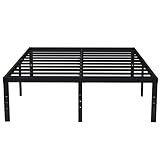
3. EMODA 18-Inch Queen Bed Frame — Best Tall Storage
Who it suits: The storage-first side sleeper who wants the tallest open space in the guide — tall bins, stacked boxes, luggage — and who will take thirty seconds to confirm the listing’s offer is live before ordering.
In queen at this budget, the under-$30 guide’s storage-max stretch pick becomes a straightforward recommendation with one condition attached. Its position in this tier verifies comfortably across multiple checks, and current roundups rank the queen as a purchasable budget pick — check the current price on Amazon. The frame is the tall-storage archetype: an 18-inch platform on nine reinforced legs (per the listing’s own description). The leg count is the side-sleeper-relevant fact: nine legs spread the deck’s support across more points, including the middle of the bed, where a one-sided load does its work — argued qualitatively, because that is what the verified record supports; no source we found tested this deck’s flex. A roundup published November 1, 2026 credits it with up to 1,200 pounds of capacity — a roundup-reported figure, not a maker document, and it is labelled that way here.
The condition is the offer state. Across repeated crawls during 2026, this listing’s price box has at times shown no featured offer, even while roundups continued to price and rank the frame as buyable — the pattern of a listing that sells through rotating third-party offers. Confirm a live featured offer at the queen size before you rely on this pick, and treat the NEW JETO below as the same-height alternative if the EMODA’s offer is dark on the day you shop.
- 18-inch frame — the tallest storage geometry in the guide
- Nine reinforced legs, per the listing’s own description — support points spread across the deck, including the middle
- Queen positioned comfortably inside this tier, and ranked as a live budget pick in recent roundups — check price on Amazon
- Capacity reported at up to 1,200 lb by a November 2026 roundup (roundup-reported, not maker-documented)
- 79.6 × 59.6 in listed footprint
Honest limitation: Two documentation gaps, stated plainly. The listing does not publish a separate under-bed clearance figure for the queen — the frame is 18 inches tall and the space beneath is open, but we do not convert “18-inch frame” into a clearance number the maker never printed. And the featured-offer flicker described above is this listing’s known weakness; the price evidence is strong, the offer stability is not. Add the height itself: an 18-inch frame plus your mattress makes a tall finished bed, and a side sleeper who sits on the edge at night should read the height section below first.
Choose it if: storage volume is the whole point of the purchase and you are comfortable confirming the live offer at checkout.
Skip it if: you want the set-and-forget certainty of a listing with a stable featured offer — take the NEW JETO or a 14-inch pick instead.
Check on Amazon · Check on Amazon · Check on Amazon · Check on Amazon
4. NEW JETO 18-Inch Queen Metal Bed Frame — Best 18-Inch Alternative
Who it suits: The side sleeper who wants the EMODA’s 18-inch storage height with a calmer purchase experience — a weight limit printed in the listing itself, and no offer-state drama in its recent record.
The NEW JETO is the second tall frame in the guide and the one we would send a cautious buyer to first. The 18-inch queen sits comfortably inside this tier at an ordinary, non-flash position — check the current price on Amazon before ordering. The listing’s own specification block does two things budget listings often skip: it states a maximum weight recommendation of 1,100 pounds, and it gives full dimensions — 79.5 by 59.5 by 18 inches. For a side sleeper, the listing-stated limit is the usable fact: a maker’s claim, not a test result, but a number the maker attached to this size, against which your combined load can be weighed before you buy rather than after.
Against the EMODA, the trade is documentation style rather than substance: the NEW JETO’s capacity figure comes from its own listing, the EMODA’s from a roundup; the EMODA counters with a slightly lower position in this tier and a leg count its listing states. Neither publishes a clearance figure or slat spacing for the queen. If both offers are live, the EMODA sits lower in the tier; if you value the listing that states its own limits, the NEW JETO is the tidier document.
- 18-inch queen positioned comfortably inside this tier — check price on Amazon
- 1,100 lb maximum weight recommendation stated in the listing’s own specifications (maker’s claim)
- Full listed dimensions: 79.5 × 59.5 × 18 in
- Ranked as a current queen pick in November 2026 roundups
- Wrought-iron-look finish, per the listing — the least industrial-looking of the tall frames
Honest limitation: The listing does not publish a separate under-bed clearance figure, so the usable storage height is “an 18-inch frame with open space beneath,” not a number we will fabricate. Slat spacing is likewise unpublished in any source we verified — the side-sleeper charge from the rest of this guide applies in full. And this is a young marketplace brand: the documentation is better than most, the track record shorter.
Choose it if: you want tall-frame storage and the most self-documented listing in the tall group.
Skip it if: position in the tier matters more than offer stability (the EMODA sits lower), or you need a published clearance figure before buying (neither tall frame provides one — the 14-inch picks do).

Check on Amazon · Check on Amazon · Check on Amazon · Check on Amazon
5. HLIPHA 18-Inch Queen Metal Platform Bed Frame — Best Low Price, Tall Frame
Who it suits: The side sleeper who wants 18-inch storage height with low-end positioning in this tier and accepts the thinnest documentation package in the guide as the trade.
The HLIPHA’s proposition is simple: it pairs a position at the low end of this tier with the guide’s joint-tallest frame. A roundup singled it out as the lowest-positioned tall-clearance frame in its comparison — check the current price on Amazon. It sits below the other 18-inch picks in the tier — an 18-inch platform, 79.6 inches long per its listing, with open space beneath.
What it gives up is paperwork, and for a side sleeper the missing piece is the one that matters most. We could not pin a maker capacity figure for the queen from a dated source, so none is printed here — the capacity cell in the comparison table below is honestly blank rather than filled with a number borrowed from the brand’s king listing. Every other pick lets you weigh your load against at least a claimed figure; this one does not, and a side sleeper’s concentrated load is exactly the case where that check earns its keep. Its listing has also shown no featured offer in past crawls, the EMODA’s flicker pattern, so confirm the live offer when you shop — or step up within the tier for the NEW JETO’s documents.
- 18-inch queen positioned at the low end of this tier — tall-frame height at a low-end position; check price on Amazon
- Named the lowest-priced tall frame in a September 2026 roundup comparison
- 79.6 in length per its listing; open under-bed space
- Ships from Amazon per its listing crawl
Honest limitation: The thinnest verification file of the six: no dated maker capacity figure could be pinned for the queen, no clearance figure is published, no slat spacing is published, and past crawls have shown the listing without a featured offer. Everything printed above is verified; the point is how much is not available to verify — and for a side sleeper, the unverifiable item is the deck’s documented strength.
Choose it if: the budget is firm, the storage height matters more than the paperwork, and you will confirm the live offer before ordering.
Skip it if: an unpublished capacity figure is a deal-breaker — in this guide that means choosing among the Novilla, Hafenpo and NEW JETO, whose listings or manuals state their limits.

Check on Amazon · Check on Amazon · Check on Amazon · Check on Amazon
6. Fluest Queen Bed Frame with Headboard and Footboard — Best Documented Deck
Who it suits: The side sleeper who wants the one deck in this guide described in countable parts — and a bed that looks finished — and who would rather use the whole budget on that than choose a bare platform positioned lower in the tier.
Every other pick in this guide is a platform: a deck and legs, designed to disappear under a mattress. The Fluest is a bed. It sits at the top of this tier — check the current price on Amazon for the queen size — and what that position buys is a headboard and footboard in a retro rustic-brown finish, an all-metal support system with 13 slats on 9 legs, a stated clearance of 12.2 inches, and a maker-claimed capacity of 800 pounds. The slat count is why this pick leads the side-sleeper conversation despite its position in the tier: it is the only verified structural count in the guide. Hold the honesty line, though — 13 slats is a count, not a spacing. It tells you the deck is built from countable, repeated supports rather than a token pair of bars; it does not tell you the gap between them, and no figure in this guide does. Nor does it beat the platforms at their own game: the 800 lb capacity claim is the lowest in the guide, it sits above the Novilla and Hafenpo in this tier, and its positioning rests on a thinner verification file rather than the multi-check record the two lower-positioned picks have.
The 12.2-inch clearance deserves a word: the Fluest stores as much underneath as the 14-inch platforms despite spending structure on a headboard and footboard, and standard bins fit. Buy it for the deck you can count and the room it makes, with your eyes open about the file behind it.
- Only pick with a verified slat count — 13 slats on 9 legs, per roundup accounts of the listing (a count, not a spacing)
- Only pick with a headboard and footboard included — a complete-looking bed; check price on Amazon
- 12.2 in of under-bed clearance, per the deal report’s listing account
- 800 lb maker-claimed capacity — the guide’s lowest, printed rather than rounded up
- Retro rustic-brown finish; the only pick that contributes to a room’s décor
Honest limitation: Its position in this tier rests on a thinner verification file, where the Novilla and Hafenpo have multiple checks each. Confirm on Amazon that the queen still sits at or under $75 before ordering; if it has moved above this guide’s budget, it is over budget and the platforms win by default. The same brand’s two-drawer queen, named here as context only, shows no featured offer or verifiable position in this tier and is not a pick.
Choose it if: you want the deck described in countable parts and a bed that looks like furniture the day it arrives.
Skip it if: you are maximising documented capacity or storage value in this tier — the Novilla beats it on both, by design.

Check on Amazon · Check on Amazon · Check on Amazon · Check on Amazon
Comparison Table
| Product (Queen) | Price | Frame height | Published clearance | Capacity figure (source) | Headboard |
|---|---|---|---|---|---|
| Novilla 14-Inch Queen | Check price on Amazon | 14 in | 12 in (maker’s manual) | 1,200 lb (maker’s manual) | No |
| Hafenpo 14-Inch Queen | Check price on Amazon | 14 in | 12.1 in (listing) | 1,100 lb (listing) | No |
| EMODA 18-Inch Queen | Check price on Amazon | 18 in | Not published | Up to 1,200 lb (roundup-reported) | No |
| NEW JETO 18-Inch Queen | Check price on Amazon | 18 in | Not published | 1,100 lb (listing) | No |
| HLIPHA 18-Inch Queen | Check price on Amazon | 18 in | Not published | Not pinned for queen | No |
| Fluest Queen with Headboard | Check price on Amazon | Platform + headboard | 12.2 in (deal report) | 800 lb (maker claim via roundup) | Yes |
Read the blank cells as information: “not published” means the maker does not state the figure for the queen, and any guide that fills those cells in has borrowed the number from somewhere it does not belong. The capacity column mixes sources deliberately and labels each one, because a maker’s-manual figure and a roundup-repeated figure are not the same grade of evidence. A slat-spacing column would be six blanks in a row — which is why spacing gets its own section below instead of a column of invented numbers.
How to Choose the Right Storage Bed Frame as a Side Sleeper
Start with the size discipline, because it decides whether the position in the tier is real. Every frame in this category is sold in twin, full, queen and king versions positioned differently, and the listing’s headline figure is usually the twin’s. Select Queen and check the current price on Amazon: every pick in this guide was verified at the queen size, and the moment you change the selector, you are looking at a different size’s position.
Judge the frame as a foundation, and your comfort problem separately. If your shoulder or hip is sore, the frame is not the fix — pressure is a mattress question, answered by the mattress’s comfort layer and, if needed, a topper. What the frame decides is whether the mattress you chose gets to work on a flat surface. Buy the frame for flatness, documentation and fit; buy mattress changes for feel. Confusing the two budgets is how side sleepers spend $75 and wake up with the same shoulder.
Weigh your real load against the documented figure — where one exists. Add the mattress, both sleepers and any toppers, then compare with the maker’s claim for the queen, keeping a generous margin, because your load concentrates on one side. Five of the six picks publish a figure you can do this against. The HLIPHA does not, and for a heavier side sleeper that blank is a reason to choose a documented pick.
Ask the slat question in writing. No pick here publishes a queen slat spacing, and foam and hybrid warranties commonly specify a maximum gap. If your mattress is under warranty — or simply expensive — message the maker through the listing before ordering and keep the reply. A maker who answers with a number has given you the best support document available at this price; one who never answers has told you something too.
Choose your height by your edge, not just your bins. The finished sleeping surface is the frame’s height plus your own mattress’s thickness — we do not know your mattress, so do that sum yourself. The 14-inch frames publish about 12 inches of usable clearance, which swallows standard storage bins. The 18-inch frames add roughly four inches of storage height and the same four inches to the finished bed. A side sleeper sits on the edge of the bed to get up in the night; if the finished surface leaves your feet dangling, you will slide off the edge every morning, and if it is too low you will be pushing up out of a squat. Measure both numbers — tallest bin, current finished height — before choosing.
Confirm the offer, not just the price. Two listings here have shown no featured offer in past crawls while remaining genuinely buyable through other offers. Before ordering, confirm three things on the live listing: the queen size is selected, a featured offer is actually present, and the price is at or under $75.
A Frame Is Not a Comfort Product: The Flat-Foundation Rule
Here is the whole side-sleeper case for a bed frame, in one paragraph. Comfort — the feel of the surface against a shoulder and a hip — is manufactured into the mattress: its foam layers, its coil gauge, its top. A frame contributes none of that, and a frame listing that promises pressure relief is promising something a steel rectangle cannot deliver. What the frame contributes is geometry. A mattress is designed to work lying flat; its layers assume a level, unyielding base. Put it on a deck that flexes and the assumption breaks exactly where the load is greatest. A back sleeper spreads weight across the full width, so a mildly flexible deck may never announce itself. A side sleeper parks most of their weight in a band perhaps a foot wide, night after night, in the same place. A deck with any bow in it bows there first, the mattress dips into the bow, and the sleeper’s spine spends the night curved around a hollow nobody chose. That is the hammock effect, and it is the only comfort-adjacent claim this guide makes about frames: a frame cannot make a mattress feel better than it is, but a bad frame can make a good mattress feel worse than it is.
Judged that way, the verified record supports a modest ranking logic. Decks whose support is described in countable terms — the EMODA’s nine legs from its own listing, the Fluest’s 13 slats on 9 legs from roundup accounts — give a buyer something to reason from: more support points, spread wider, is the direction flatness lives in. Decks with a maker-published load figure for the queen give a second kind of evidence: not a test result, but a maker’s willingness to attach a number to this size. And the HLIPHA’s blank capacity cell is the honest bottom of the scale — not proof the frame is weak, but proof that nobody has documented that it is strong. None of this is a flex test. It is documentation triage, which is what $75 buys.
One boundary deserves its own sentence, because this audience is the one most often sold across it. If you have persistent shoulder, hip or back pain — pain still there at noon, numbness or tingling in an arm or leg, or any weakness — that is a clinician’s question, not a shopping question. No frame, mattress or topper in any of our guides treats it. Replace a sagging frame because it is sagging; see a professional about the pain.
The Slat-Spacing Gap: The Number Nobody at This Price Publishes
Slat spacing is the figure a side sleeper most needs and this price band simply does not print. The gap between slats decides how evenly the underside of a foam or hybrid mattress is held up. Too wide a gap and the mattress works its way into the spaces under load — under a side sleeper’s concentrated shoulder-and-hip band, in exactly the spot where support matters most. Mattress makers know this, which is why foam and hybrid warranties commonly name a maximum slat gap, and why exceeding it can void coverage on a mattress that cost several times what any frame here costs.
Against that need, the verified record is six blanks. None of the six queens in this guide has a maker-published slat-spacing figure in any source we could check — not the Novilla, whose manual documents clearance and capacity but not spacing; not the Hafenpo or NEW JETO, whose listings publish other figures; not the tall pair; not the Fluest. The Fluest’s 13 slats deserve a precise word here, because it is the number most likely to be misread as an answer: a slat count describes quantity, not gaps. Thirteen slats suggests a reasonably populated deck, but the gap depends on slat width as well as count, and this guide will not divide one verified number by an unverified one and present the quotient as a specification. If a competing guide prints a spacing figure for any of these frames, ask where it came from.
The practical route is unglamorous and effective: ask the maker, in writing, through the listing’s question channel, before you order — and if your mattress warranty names a maximum gap, treat a non-answer as a failed check and buy from the documented end of this list, or from a higher tier where makers publish the figure. Capacity numbers get the same treatment, for the opposite reason: published everywhere, standardised nowhere. The six figures here are all makers’ or repeaters’ claims, none independently tested; the spread says more about marketing posture than about steel. Use them as this guide does: evidence that a maker stood behind a number for your size, with your real load kept well inside the claim.
Four Inches of Frame: Height, Edges and the Turning Sleeper
The other decision a side sleeper makes in this guide is height, and it is a decision about edges as much as about storage. The finished height of your bed is the frame’s height plus your mattress’s thickness — your mattress, whose thickness we do not know and will not guess. What the frame contributes is fixed: 14 inches from the two low picks and the Fluest’s platform, 18 inches from the tall three. That four-inch difference arrives unchanged at the edge of the bed: sitting in the dark, feet finding the floor. Too tall a finished bed and your feet dangle — you slide forward off the edge to stand, and the mattress edge takes that sliding load nightly. Too low and every standing-up starts from a deep squat. Neither is a medical claim; both are the plain ergonomics of a bed you get out of in the dark, and the right answer is the finished height closest to the one your current bed already gives you. Measure before you choose, because the storage argument will always vote for 18 inches and it is not the argument that gets up at 3 a.m.
On storage, one caution survives from the base guide: the 18-inch frames’ under-bed gain is real but unquantified, because neither tall pick’s maker publishes a clearance figure for the queen — so if your storage is one specific tall case, measure it against the frame height with a margin for the deck and a finger’s width to spare.
Height’s companion issue is noise, and here the side-sleeper lens changes the weighting rather than the facts. The facts are thin and we keep them thin: all six frames are bolted metal constructions; metal joints can loosen and creak over time; tightening bolts at assembly and re-tightening them after the first weeks is ordinary maintenance, not a defect. No verified source in our research measured any of these frames for noise, and where a listing uses noise-reduction language — the Hafenpo’s does — this guide declines it as fact, because a claim in a listing is not a test. What the lens adds is exposure: a side sleeper turns more than most sleepers, working every joint in the frame several times a night, so a creak a back sleeper never triggers can become a nightly soundtrack. That is a reason to favour careful assembly, re-check fasteners, and — if a partner’s sleep is light — test the bed with a few deliberate turns before the return window closes. It is not a reason to pay more for a listing’s promise of quiet.
Common Buying Mistakes
Buying a frame to fix a mattress problem. Shoulder and hip pressure live in the mattress’s comfort layers. A new frame under a worn-out mattress is a flat, rigid platform under the same sore shoulder — and a $75 receipt. If the mattress itself has dipped, no frame here will undip it.
Reading a slat count as a slat spacing. “13 slats” (the Fluest) is a count, not a gap. The spacing your mattress warranty names is a different figure, and no pick in this guide publishes it. Do not let a tidy-sounding number answer a question it does not address.
Reading frame height as finished bed height. The number in the title is the frame alone. Your mattress adds its own thickness on top, and the sum is what your feet meet at the edge of the bed. Side sleepers choosing the 18-inch frames for storage alone regularly discover the climb afterwards.
Believing a drawer bed exists in this tier. Search results will show you queen frames with drawers inside “$75” articles. Those listings have no verifiable position under $75 — drawer queens sit in a higher tier above this budget. If drawers are non-negotiable, move to a higher budget tier rather than hunting for a listing that is not there.
Trusting a “noise-free” promise. Listing noise language is marketing; no source we verified tested these frames for sound. Assemble carefully, tighten every bolt, re-tighten after the first weeks, and test with a few turns while you can still return the frame.
Skipping the offer check. Budget listings rotate sellers. A frame can be genuinely buyable through one offer while its page shows no featured offer in a crawl. Confirm the live offer and the queen size together, and check the current price on Amazon at checkout — especially for the EMODA and HLIPHA.
Ignoring the recall list because the price is low. The two standing platform-bed recalls in this category — Home Design (January 2024) and Lucid (September 2024) — covered beds sold across ordinary price bands, and the failure mode was collapse in use: the exact failure a concentrated side-sleeper load would find first. Sixty seconds checking a frame is not a recalled model is the cheapest safety step in the purchase.
Final Recommendation
Buy the Novilla 14-Inch Queen unless you have a specific reason not to. It is the only pick whose clearance and capacity are documented in the maker’s own manual for the queen model, it sits at an everyday position in the middle of this tier across multiple checks — no deal day required; check price on Amazon — and its 14-inch height keeps the finished bed at the easier end for edge-sitting. If position in the tier counts most, the Hafenpo is the same storage idea positioned at the low end of the tier, with its clearance figure published in its own listing. If storage volume is the priority, take an 18-inch frame — the NEW JETO for the tidier listing, the EMODA for its nine stated legs and lower position in the tier once its offer is confirmed live, the HLIPHA only if the budget is firmest and the missing capacity figure does not trouble you. And if you want the one deck in this guide you can count — 13 slats on 9 legs — in a bed that looks like furniture, the Fluest uses the whole $75 budget, once you have confirmed its live position in this tier on Amazon.
Whichever you choose, hold onto this variant’s two lessons. The frame’s job is to disappear: flat, rigid, silent enough, and out of the way of the mattress doing the comfort work — judge it on documentation, not on promises. And “storage” at $75 still means open clearance; the drawer bed you may be picturing starts in a higher tier above this budget.
Frequently Asked Questions
Will a new bed frame help my shoulder or hip pain?
Not as a treatment — no frame treats pain, and this guide makes no such claim for any pick. What a frame can do is stop making things worse: if your current deck sags or flexes, your mattress dips with it, and replacing the deck restores the flat surface the mattress was designed for. If pain persists — especially with numbness, tingling or weakness — see a clinician.
Does slat spacing really matter for a side sleeper?
Yes, twice over. Your mattress warranty may name a maximum slat gap, and the evenness of support under a concentrated shoulder-and-hip load depends on the gaps being modest. The problem is verification: none of the six picks publishes a queen slat spacing, so ask the maker in writing before ordering, and treat the Fluest’s 13-slat count as what it is — a count, not a spacing.
Should a side sleeper choose a 14-inch or an 18-inch frame?
Choose by finished height: frame height plus your own mattress’s thickness. The 18-inch frames store more and raise the finished bed by the same four inches, which your feet will notice every time you sit on the edge in the dark. If your current bed’s finished height suits you, match it; the storage difference is real but it is the smaller half of the decision.
Can I get a queen bed frame with drawers for under $75?
No verifiable one exists in this tier. Drawer queens surface in marketplace crawls without featured offers or verifiable positions in this tier, and queen frames with built-in storage drawers sit in a higher tier above this budget. At $75, storage means open under-bed clearance; move to a higher budget tier if built-in drawers are essential.
Are the weight capacity numbers trustworthy?
They are makers’ claims, not independent test results, and this guide labels each one with its source — a maker’s manual, a listing, or a roundup. Use them as a documentation signal and keep your real combined load comfortably inside the claim, remembering that a side sleeper’s load concentrates rather than spreads. One pick (the HLIPHA) has no pinnable queen figure at all, printed as a blank rather than filled in from another size.
Will these frames creak when I turn over?
Honestly: they can. All six are bolted metal frames, joints loosen with use, and a side sleeper works those joints every time they turn. No verified source tested these frames for noise, and listing claims of noise reduction are marketing, not measurements. Tighten every bolt at assembly, re-tighten after the first few weeks, and test the bed with a few deliberate turns while returns are still simple.
Keep Reading
- Best Storage Bed Frame Under $30
- Best Storage Bed Frame Under $100
- Best Storage Bed Frame Under $200
- Best Platform Bed Frame Under $75
- Best Storage Bed Frame Under $75