Disclosure: As an Amazon Associate, umtsmarttool.com earns from qualifying purchases. Links to Amazon on this page are affiliate links; they cost you nothing extra. Prices and availability change often, so check the current Amazon listing before you buy.
Where to buy
Short on time? This best under sink water filter under $700 guide starts with the short list, then explains every choice in full below.
- Waterdrop G3P800 Tankless Reverse Osmosis System — Best Overall. Check on Amazon
- Frizzlife PD1200 Tankless Reverse Osmosis System — Best Flow. Check on Amazon
- Frizzlife PD600 Tankless Reverse Osmosis System — Best Value Tankless. Check on Amazon
- iSpring RCC7AK-UV Under Sink Reverse Osmosis System — Best Well-Water System. Check on Amazon
- iSpring RCC7P-AK Reverse Osmosis System with Pump — Best for Low Pressure. Check on Amazon
- iSpring RCC7AK Under Sink Reverse Osmosis System — Best Traditional System. Check on Amazon
This is the flagship tier: flow, information and finish are what the extra money buys. Read the full guide ↓
Best under sink water filter under $700: what this budget and this buyer actually get
The best under sink water filter under $700 must begin with a confession this cluster owes every flagship shopper: the water does not get purer here. Certified reverse osmosis reached its contaminant ceiling in the $300 and $500 tiers, and no membrane in this list removes a category of contaminant that the PD600 leaves behind. What $700 buys is everything around the purity: production speed that feels like a municipal tap, a 3:1 efficiency that halves the drain’s share, and a smart faucet that reports water quality and filter life at the point of use. This guide ranks those luxuries honestly, as luxuries worth pricing rather than necessities worth fearing to skip.
Waterdrop’s G3P800 leads because its flagship features are the ones owners actually touch: 800 gallons a day of tankless production and a faucet display that ends maintenance guesswork. Frizzlife’s PD1200 counters with the highest flow in the cluster and an eleven-stage train, the spec for households whose draw is genuinely industrial. The PD600 holds third as the tier’s conscience, delivering most of the experience for meaningfully less, and its presence in a $700 list is this guide’s way of saying the quiet part in print.
The three traditional systems close the ranking because flagship money does not repeal household physics. A well still wants UV, a low-pressure home still wants a booster pump, and a standard-parts loyalist still wants the RCC7AK’s aisle-available filters. The correct $700 purchase is the one matched to the house, and for many houses the correct $700 decision is to spend a tier less and bank the difference. This guide will happily sell you down, which is how you can trust its rankings up.
In this guide
Quick Picks
| Pick | Badge | Key spec |
|---|---|---|
| Waterdrop G3P800 Tankless Reverse Osmosis System | Best Overall | Tankless reverse osmosis design, 800 gallons per day capacity |
| Frizzlife PD1200 Tankless Reverse Osmosis System | Best Flow | Tankless reverse osmosis design, 1,200 gallons per day capacity |
| Frizzlife PD600 Tankless Reverse Osmosis System | Best Value Tankless | Tankless reverse osmosis design, 600 gallons per day capacity |
| iSpring RCC7AK-UV Under Sink Reverse Osmosis System | Best Well-Water System | Seven-stage filtration: RO, alkaline remineralisation and ultraviolet disinfection |
| iSpring RCC7P-AK Reverse Osmosis System with Pump | Best for Low Pressure | Six-stage RO with alkaline remineralisation and booster pump |
| iSpring RCC7AK Under Sink Reverse Osmosis System | Best Traditional System | Six-stage reverse osmosis filtration with alkaline remineralisation |
How These Picks Were Chosen
Flagship selection ignored purification claims almost entirely, since every RO here shares the membrane ceiling, and scored instead on production pace, pure-to-drain efficiency, information design, build finish and five-year cartridge economics at flagship prices. Special-case systems, UV, pumped and traditional, were admitted where a defined household constraint makes them the rational flagship purchase despite their older architecture. Any feature that could not be verified against the manufacturer’s listing was described in prose rather than specified.
The 6 Best Options in This Best under sink water filter under $700 Guide
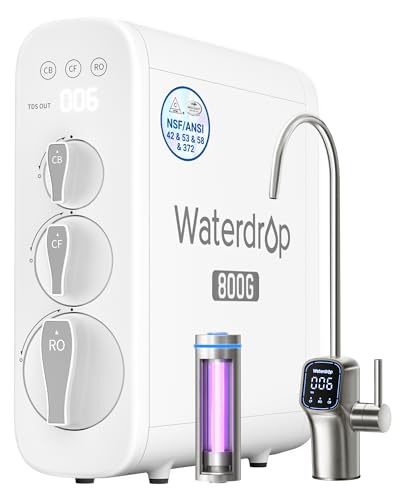
Waterdrop G3P800 Tankless Reverse Osmosis System — Best Overall
Households that want flagship tankless RO: fast flow, low waste, and a faucet that shows water quality at a glance.
- Tankless reverse osmosis design, 800 gallons per day capacity
- 10-stage filtration per the manufacturer listing
- Pure-to-drain ratio of 3:1
- Certified to NSF/ANSI 42, 53, 58 and 372 per the manufacturer listing
- Smart faucet with LED water-quality display; model WD-G3P800-W
Strengths
- 800-GPD output makes tankless flow feel instant even for pots and bottles
- A 3:1 pure-to-drain ratio is among the most water-efficient in this guide
- The smart faucet displays water quality and filter life, ending guesswork
Trade-offs
- Flagship purchase price and composite filter replacements to match
- Needs power, a drain connection and a drilled or spare faucet hole
- No stored reserve: a power cut means no filtered water until it returns
Certification breadth is the other flagship marker, with the listing claiming NSF/ANSI 42, 53, 58 and 372 coverage. The compromises are the flagship compromises: purchase price at the top of this guide, proprietary composite cartridges, and total dependence on household power. For a busy family that will actually use the flow, the G3P800 is the easiest high-end recommendation here. For a couple in a small flat, it is magnificent overkill.
Judged against the whole field in this guide, the Waterdrop G3P800 makes a case built on fit rather than flash. undefined Ownership settles into a rhythm of rare, predictable cartridge events rather than recurring projects. undefined
One honest limitation: Composite all-in-one cartridges simplify changes but lock owners into Waterdrop’s pricing for the life of the system.
Best for: households that want flagship tankless ro: fast flow, low waste, and a faucet that shows water quality at a glance / Not suited for: anyone whose constraints the trade-offs above describe

Frizzlife PD1200 Tankless Reverse Osmosis System — Best Flow
Large or impatient households that want the fastest tankless RO flow in this guide and a faucet that reports water quality.
- Tankless reverse osmosis design, 1,200 gallons per day capacity
- 11-stage filtration per the manufacturer listing
- Pure-to-drain ratio of 3:1
- Certified to NSF/ANSI 42, 58 and 372 standards per the manufacturer listing
- Smart faucet with real-time water quality display class features
Strengths
- The highest rated output here: filling large pots and bottles stops being a wait
- A 3:1 pure-to-drain ratio is efficient even by modern tankless standards
- Eleven stages including RO give the broadest treatment train in the Frizzlife line
Trade-offs
- Flagship pricing and flagship replacement-filter costs to match
- Requires under-sink power and a drain connection like every RO system
- Its extra flow is wasted on small households that never felt the PD600 hesitate
Eleven stages sounds like marketing arithmetic, and stage counts should always be read sceptically, but the underlying train is conventional and sound: sediment and carbon pre-treatment protecting an RO membrane, then post-polishing. The smart faucet’s water-quality readout is the feature owners actually mention, because it turns filter condition from a guess into a glance. Buy it for flow and feedback, not for the stage number.
In the context of this ranking, the Frizzlife PD1200 earns its place on evidence rather than novelty. As a membrane system it addresses the dissolved list that carbon and ultrafiltration leave untouched. Ownership settles into a rhythm of rare, predictable cartridge events rather than recurring projects. undefined
One honest limitation: Households of one or two will rarely draw fast enough to justify the flagship premium over the 600-GPD class.
Best for: large or impatient households that want the fastest tankless ro flow in this guide and a faucet that reports water quality / Not suited for: undefined

Frizzlife PD600 Tankless Reverse Osmosis System — Best Value Tankless
Space-pressed households seeking genuine RO purification with no storage tank in the cabinet.
- Integrated tankless RO appliance rated at 600 gallons per day
- Two gallons purified for every gallon sent to drain
- TAM3 alkaline stage restores minerals and steadies pH after the membrane
- Listing claims certification to NSF/ANSI 58, 53, 42 and 372
- Built-in pump and display-faucet class controls in one body
Strengths
- Deleting the tank returns a cubic foot of cabinet to the household
- Remineralised output answers the flat-taste objection at the factory
- Efficiency doubles the traditional tank systems’ pure-to-drain performance
Trade-offs
- An under-sink outlet is mandatory; the pump and electronics need power
- On-demand production caps the pour at the pump’s pace
- Composite replacements cost more than commodity carbon cartridges
The PD600 represents the moment under-sink RO grew out of its aquarium-plumbing phase. The traditional layout, a rack of canisters plus a bulky pressure tank, is replaced by a single integrated appliance that makes water as you draw it. The cabinet keeps room for cleaning supplies again, and the hygiene question that hangs over stored RO water disappears with the tank. Output is rated at 600 gallons per day, which in practice means a strong, steady stream at the dedicated faucet rather than the fading trickle of a depleting tank.
This guide places the Frizzlife PD600 where it does because its compromises land where most households feel them least. As a membrane system it addresses the dissolved list that carbon and ultrafiltration leave untouched. undefined undefined
One honest limitation: During a power outage the system waits with the rest of the appliances; there is no stored reserve to draw on.
Best for: space-pressed households seeking genuine ro purification with no storage tank in the cabinet / Not suited for: buyers better matched to a different format in this guide

iSpring RCC7AK-UV Under Sink Reverse Osmosis System — Best Well-Water System
Homes on private wells or with any microbiological concern who want UV disinfection layered onto certified RO.
- Seven-stage filtration: RO, alkaline remineralisation and ultraviolet disinfection
- 75 gallons per day RO membrane class
- Certified system in the RCC7AK family with UV final stage
- Pressurised storage tank and dedicated faucet included
- UV stage requires electrical power at the system
Strengths
- UV adds a genuine disinfection step that membranes and carbon alone do not guarantee
- Combines purification, remineralisation and disinfection in one factory package
- Built on the widely supported RCC7 platform and filter sizes
Trade-offs
- The UV lamp is a consumable with its own replacement interval and power draw
- Most chlorinated municipal supplies gain little from UV, making it insurance rather than necessity
- The fullest, heaviest version of an already space-hungry tank layout
The AK-UV is the belt-and-braces specification of the RCC7 family. Reverse osmosis already rejects the overwhelming majority of microorganisms by size, and the alkaline stage handles taste; the ultraviolet lamp then disinfects the stored water as a final barrier. On municipal water that layering is mostly peace of mind. On a private well, where no utility maintains a chlorine residual and a single contamination event can go unnoticed, that peace of mind has a rational basis and this package delivers it without a separate UV purchase.
Judged against the whole field in this guide, the iSpring RCC7AK-UV makes a case built on fit rather than flash. As a membrane system it addresses the dissolved list that carbon and ultrafiltration leave untouched. undefined undefined
One honest limitation: UV disinfects but removes nothing; it complements filtration rather than extending the contaminant list, and it only works while the lamp is within its service life.
Best for: homes on private wells or with any microbiological concern who want uv disinfection layered onto certified ro / Not suited for: buyers whose needs contradict the trade-offs above

iSpring RCC7P-AK Reverse Osmosis System with Pump — Best for Low Pressure
Homes whose water pressure is too low for a standard RO system to produce water efficiently.
- Six-stage RO with alkaline remineralisation and booster pump
- Booster pump raises feed pressure for low-pressure homes
- 75 gallons per day membrane class
- Pressurised storage tank and dedicated faucet included
- Pump requires electrical power
Strengths
- The booster pump restores membrane performance where pressure-starved RCC7 installs struggle
- Better pressure improves both production speed and the pure-to-waste ratio
- Keeps the alkaline stage’s taste correction from the RCC7AK
Trade-offs
- Pump adds noise, power draw and one more component that can wear
- Homes with healthy pressure gain nothing and should buy the unpumped AK
- Still a full-size tank layout with the usual cabinet cost
The rest of the package is the familiar RCC7AK formula, six stages ending in alkaline remineralisation, standard filter sizes, and iSpring’s deep support bench. The buying rule is unusually clean for this category: measure or learn your home’s static pressure first. Below the comfortable range, the pump is not an upgrade but a requirement. Comfortably inside it, the pump is hardware you do not need.
Within this list’s priorities, the iSpring RCC7P-AK is the pick that keeps answering the same question well. undefined undefined undefined
One honest limitation: Diagnosing pressure problems matters: if low pressure comes from a failing pressure regulator or well pump, fixing the house beats compensating at the filter.
Best for: homes whose water pressure is too low for a standard ro system to produce water efficiently / Not suited for: buyers better matched to a different format in this guide

iSpring RCC7AK Under Sink Reverse Osmosis System — Best Traditional System
Taste-sensitive households that want certified tank RO without the flat flavour of un-remineralised output.
- Six stages of RO treatment ending in an alkaline remineralisation cartridge
- Membrane rated at 75 gallons per day
- Whole-system certification to NSF/ANSI 58 and 372
- Pressure tank and dedicated faucet in the box
- Alkaline stage returns calcium and magnesium and rebalances pH
Strengths
- Remineralisation fixes the flat flavour that makes households abandon ordinary RO
- System-level 58 certification verifies the assembled product, not a lone membrane
- The platform’s standard filter sizes keep spares cheap and everywhere
Trade-offs
- The tank claims the same generous cabinet volume as the base RCC7
- Drain losses reflect a traditional design rather than tankless thrift
- One extra cartridge joins the replacement rotation for the alkaline stage
What separates the RCC7AK from its own sibling is a single cartridge and a single certificate, and both matter out of proportion to their size. The cartridge, an alkaline stage after the membrane, restores the mineral character that osmosis removes, converting laboratory-pure water back into something a household recognises as drinking water. The certificate, full-system NSF/ANSI 58, converts a collection of parts into a verified product. Together they explain why this variant, rather than the cheaper original, became the platform’s reference model and the traditional architecture’s strongest answer to the tankless challengers.
Within this list’s priorities, the iSpring RCC7AK is the pick that keeps answering the same question well. undefined undefined undefined
One honest limitation: The alkaline stage restores a taste-level mineral fraction only; it is not a route to high-mineral water.
Best for: taste-sensitive households that want certified tank ro without the flat flavour of un-remineralised output / Not suited for: households whose water, space or routine fights the trade-offs above
Comparison Table
| Pick | Filtration type | Headline specification |
|---|---|---|
| Waterdrop G3P800 Tankless Reverse Osmosis System | tankless RO | 10-stage filtration per the manufacturer listing |
| Frizzlife PD1200 Tankless Reverse Osmosis System | tankless RO | 11-stage filtration per the manufacturer listing |
| Frizzlife PD600 Tankless Reverse Osmosis System | tankless RO | Pure-to-drain ratio of 2:1 |
| iSpring RCC7AK-UV Under Sink Reverse Osmosis System | tank RO alkaline UV | 75 gallons per day RO membrane class |
| iSpring RCC7P-AK Reverse Osmosis System with Pump | tank RO pumped | Booster pump raises feed pressure for low-pressure homes |
| iSpring RCC7AK Under Sink Reverse Osmosis System | tank RO alkaline | 75 gallons per day RO membrane |
See also Best Under Sink Water Filter Under $500, Under Sink Water Filter Review 2026 and Under Sink Water Filter Buying Guide.
How to Choose the Right System for Your Kitchen
Certification: read the standard, then the contaminant list
Certification is the only part of a filter’s marketing that a third party has verified, so it deserves slow reading. NSF/ANSI 42 attests aesthetic reductions, 53 attests health-related reductions, 58 governs reverse osmosis systems, and 372 addresses lead content in the product’s own materials. Just as important, certification belongs to an exact model and an exact claim list. A system certified for chlorine has not been certified for lead by association, and a membrane certified alone does not certify the assembled system around it. The strongest listings in this guide publish performance data sheets; the weakest hide behind the word tested.
Capacity and cartridge life: the running-cost decision
A filter’s purchase price is a down payment; its cartridges are the subscription. Compare systems on rated gallons and rated months together, because whichever limit arrives first ends the cartridge’s certified life. Small 500-gallon class systems suit light use and punish heavy use with frequent changes, while high-capacity canisters and two-year cartridges spread their cost thin for busy families. Also weigh who sells the replacement and whether the format is proprietary: a cheap system with a single-source cartridge can cost more across five years than a dearer system drinking standard filters.
Flow rate and how your household actually draws water
Flow decides whether a filter feels like an upgrade or an obstacle. Dedicated carbon faucets typically deliver around half a gallon per minute, which fills a glass briskly and a stockpot slowly. Direct-connect systems share the main tap’s plumbing, so their cartridges trim the whole cold line’s pace. Tank RO pours at line speed until the reserve runs down; tankless RO pours at its production rate, which is why the jump from 400 to 800 to 1,200 gallons per day is a felt difference rather than a spec-sheet vanity. Match the rating to your busiest hour, not your average one.
Faucet format: direct-connect, dedicated tap or smart faucet
Decide the faucet question before the filtration question, because it eliminates half the catalogue. If the counter cannot be drilled, direct-connect and existing-hole systems are your whole market. If a spare hole exists, dedicated faucets unlock the most economical cartridge usage in the category. If the household runs on data and reminders, a smart faucet’s quality readout is a feature with daily visibility. The filter behind the faucet matters enormously, but the faucet is the part you will touch ten thousand times.
Installation footprint: cabinet space, drain and power
The tape measure is a filtration tool. Record the cabinet’s clear width, depth and height, note what already lives there, and then compare against each system’s published dimensions with honest allowances for tubing bends and cartridge-removal clearance. RO buyers must also confirm a drain point for the saddle and, for tankless and UV models, a powered outlet that is not switched with the disposal in an inconvenient way. Ten minutes of measuring prevents the category’s most common return.
Audit your draw before auditing these systems. Log one ordinary week of filtered-water use, honestly, including the fridge. Households under roughly ten gallons a day are buying flagship flow they will never summon, and the PD600’s tier is their correct home. Households above it, and anyone filling bottles, brewing at scale or running a small food business from the kitchen, will feel the flagship pace daily and should buy it without guilt.
Information as a Feature: What the Smart Faucet Actually Changes
The smart faucet is easy to dismiss as jewellery until you consider what it replaces: a guess. Every other system in this cluster asks its owner to remember an install date, estimate a household’s throughput and intuit when performance has drifted. The flagship display substitutes measurement for memory, reporting water quality and remaining filter life where the water is drawn. Across a five-year ownership, that substitution is the difference between cartridges changed on condition and cartridges changed on folklore, and folklore is how good systems quietly become ordinary ones.
There is a behavioural dividend too. A visible quality number turns filtration into a household fact rather than one owner’s hobby: partners check it, children ask about it, and the system’s maintenance acquires witnesses. Flagship pricing is indefensible on contaminant lists alone. On the evidence of how ownership actually succeeds and fails, the information layer is the most defensible luxury in this entire guide.
See also Under Sink Water Filter Review, How To Install An Under Sink Water Filter and Reverse Osmosis System Vs Under Sink Water Filter.
Key Takeaways
- Match the technology to your water report: carbon for taste, ultrafiltration for a particle barrier, reverse osmosis for dissolved contaminants.
- Certification attaches to an exact model and an exact contaminant list, so read the performance data sheet before paying for a claim.
- Cartridge capacity and interval decide the true cost of ownership far more than the purchase price does.
- Measure the cabinet, the drain and the counter hole situation before ordering any system in this guide.
How Installation and Day-to-Day Maintenance Actually Go
Installation difficulty in this category is decided by the faucet format, not by the filter. Direct-connect cartridges go in with the cold valve closed, the supply line disconnected, the cartridge inserted in the correct flow direction and the line restored, followed by a manufacturer-specified flush. Dedicated-faucet systems add the faucet mount, and reverse osmosis adds a drain saddle and, on tank models, a pressurised tank to position before the lines go on.
- Clear the cabinet completely and lay a towel under the work area; every fitting you will touch is easier to reach than to dry.
- Close the cold-water angle valve and open the tap to relieve pressure before disconnecting anything.
- Fit the system in the order the manual specifies, keeping tubing runs gentle and compression fittings snug rather than forced.
- Restore water slowly, then check every joint with a dry paper towel, once immediately and again after an hour.
- Flush exactly as instructed, fill and drain an RO tank once if fitted, and write the cartridge change date on the housing.
Maintenance after that is a calendar, not a hobby. Carbon cartridges change on their rated interval, RO pre-filters on theirs, and membranes when output or water quality says so. The owners who struggle with under-sink filtration are almost never struggling with the technology; they are struggling with a reminder they never set.
Busy kitchens do not experience average flow, and cartridge life is written in their busiest weeks. Sediment load steals chemical capacity, which is why gritty supplies age cartridges ahead of the calendar. Flow decline and returning taste are the cartridge’s own late warnings, and both deserve obedience. A fridge connection quietly adds a second appliance’s draw to the same cartridge account. Buy the rating your busiest month respects.
Common Buying Mistakes
Drilling first and measuring later
Counter holes are permanent, tanks are bulky and cabinets are smaller than they look in product photography. Measure the cabinet, confirm the faucet hole or spare opening, locate the drain and check for an outlet before the box arrives. Every return story in this category begins with a dimension nobody checked.
Forgetting the flush and the first gallons
Fresh carbon sheds black fines and fresh membranes shed preservative, and both are supposed to leave during commissioning. Owners who skip the flush judge a sound system by its worst glass and occasionally return it for the crime of being installed correctly but commissioned lazily. The manual’s flushing steps are chemistry with a timer; run them in full.
Letting the cartridge calendar drift
Exhausted media does not slam a door; it simply stops reducing while the water keeps flowing and the household keeps trusting. The defence costs nothing: a reminder set on install day, governed by whichever of the month rating or gallon rating arrives first, and a household culture that treats the reminder as an instruction rather than a suggestion.
Filtering the wrong line
Under-sink systems belong on the cold feed, full stop. Hot water attacks carbon media, invalidates the ratings the system was certified under and can dump captured load back into the stream. Crossed lines happen most often in cabinets rearranged by earlier appliance work, so trace both supplies from their valves with a run of the cold tap before any connection is made.
Living With the Decision: What Experience Adds to the Specifications
The membrane is the only component in this category that addresses the water’s dissolved fraction directly. Membrane life is measured in years because the film works slowly and steadily rather than in bursts. Chlorine destroys membrane film, which is why carbon pre-filters stand guard in front of every design in this guide. Production rate, waste ratio and pressure requirements are all the same physics wearing different clothes. Respect the membrane’s requirements and it will quietly out-perform every other technology here on scope.
Coffee and tea are the most sensitive instruments a kitchen owns for judging filtered water. Cafés remineralise deliberately; a home alkaline stage is the same idea at kitchen scale. Carbon-filtered water is the traditional brewing sweet spot: clean of chlorine, still mineral enough to extract well. Kettles filled from a filtered tap scale more slowly when the supply’s chemistry is tamed at the source. The brew test is subjective, repeatable and, for most households, decisive.
A tee fitting and a patient run of quarter-inch tubing turn one purchase into two appliances’ worth of value. Plan the connection at install time, because reopening finished plumbing to add it later is nobody’s favourite Saturday. Long tubing runs cost pressure, so route the line as directly as the cabinet allows. Small cartridges feel the fridge’s appetite first; generous ratings absorb it without changing the household’s rhythm. One tee, honestly planned, doubles the system’s daily usefulness.
A dry paper towel at every joint is the cheapest leak detector in the building trade. Writing the date on the housing converts the next service from archaeology into reading. Owners who commission properly judge their system on its real water, not its first hour. Leak checks belong at one hour and at one morning, because pressure finds slow weeps on its own schedule. Commissioning is thirty minutes that protect a decade of mornings.
Tankless design deletes that compromise by making production fast enough to meet demand directly. After a heavy draw the tank’s pace softens until production refills it, a rhythm owners learn in the first month. Modern high-output membranes have narrowed the tank’s flow advantage to the first glass of the morning. A tank keeps dispensing through a power cut, an independence no pumped tankless design can claim. The tank is a compromise, honestly priced, and for many households still the right one.
Final Recommendation
Buy the flagship for pace and information, or buy a tier down for identical purity; both are rational, and this guide respects either. Start with the Waterdrop G3P800 Tankless Reverse Osmosis System (Best Overall), and keep the Frizzlife PD1200 Tankless Reverse Osmosis System (Best Flow) as the closest alternative if its format suits your kitchen better. See also Best Under Sink Water Filter For Families Under $500 and Is An Under Sink Water Filter Worth It.
Context That Matters More Than Marketing: Further Notes
No utility can certify what your own pipes add to the water after it enters the house. Flushing a stagnant line reduces exposure, but a verified barrier works on the mornings nobody remembers to flush. A certified health-standard claim for the exact model is the only version of lead protection worth paying for. Ion-exchange and adsorption media in the better carbon systems are engineered specifically for this contaminant class. Treat lead as a specification to be checked, not a fear to be marketed to.
The marker-pen habit, writing the install date on the housing, outperforms every reminder technology except the smart faucet. Dedicated faucets stretch ratings by refusing to spend them on utility water. Sediment load steals chemical capacity, which is why gritty supplies age cartridges ahead of the calendar. Flow decline and returning taste are the cartridge’s own late warnings, and both deserve obedience. The cheapest gallon in this category belongs to the system whose capacity your household cannot outrun.
Low pressure does not merely slow an RO system, it makes it wasteful in proportion. Booster pumps exist to lift weak supplies into that range, restoring both pace and ratio. High pressure has its own manners: regulators and hammer arrestors protect fittings and quiet the system. Upper floors, long runs and tired well pumps are the usual suspects when pressure disappoints. Measure first; the correct system for your pressure is cheaper than the wrong system at any discount.
Remineralisation is where reverse osmosis negotiates with human taste. The quantities involved are small beside dietary intake, and the better brands say so. Calcium and magnesium media dissolve in trace amounts as purified water passes over them. Households converting from spring water notice the correction immediately and approve of it. Flavour is not a frivolous specification in a product whose endpoint is a glass.
Chlorine chemistry explains why two homes on the same street can need different filters. Full-size canisters often outperform slim cartridges on stubborn municipal supplies simply because the water spends longer inside the media. Catalytic carbon and generous contact time matter when the disinfectant is chloramine rather than free chlorine, because the reaction is slower. Free chlorine reacts with activated carbon almost on contact, which is why even a modest cartridge transforms a glass of tap water. A filter that wins on chlorine wins the daily referendum every other specification depends on.
Every cartridge system creates a spent cartridge; every RO system creates a reject stream. Water rejected by a membrane returns to the municipal cycle; it is billed, not destroyed. Plastic, transport and refrigeration make bottled water the heavyweight in any footprint contest. A two-year cartridge is an environmental feature as surely as it is a convenience one. Sustainability here is mostly a matter of intervals and honesty.
Rust from mains work, sand from wells and scale from ageing plumbing all arrive at the same first stage. Layered systems exist precisely to keep the coarse work away from the polishing media. Homes with chronic sediment sometimes solve it once, upstream, with a whole-house pre-filter. A first stage that clouds early is doing its job loudly; replace it and protect the rest. Treat sediment as its own problem and the drinking-water stages will live their full rated lives.
Chlorine chemistry explains why two homes on the same street can need different filters. Free chlorine reacts with activated carbon almost on contact, which is why even a modest cartridge transforms a glass of tap water. By the time water reaches a kitchen it has generally done its disinfecting work, so removing the residual costs the household nothing in safety. Full-size canisters often outperform slim cartridges on stubborn municipal supplies simply because the water spends longer inside the media. A filter that wins on chlorine wins the daily referendum every other specification depends on.
Chilled water from a filtered line ends the bottled truce in most kitchens within a week. Flush the main system thoroughly before the fridge line is connected, so the ice maker never meets commissioning water. Long tubing runs cost pressure, so route the line as directly as the cabinet allows. Plan the connection at install time, because reopening finished plumbing to add it later is nobody’s favourite Saturday. It is the rare upgrade that delights children, guests and the person who used to buy the bottles.
Osmosis works because pressure persuades water through a film that dissolved matter cannot follow. What the membrane rejects leaves through the drain line, carrying the contaminants with it in a concentrated stream. Chlorine destroys membrane film, which is why carbon pre-filters stand guard in front of every design in this guide. Production rate, waste ratio and pressure requirements are all the same physics wearing different clothes. The membrane rewards correct pressure and punctual pre-filters with the broadest purification a household can buy.
Busy kitchens do not experience average flow, and cartridge life is written in their busiest weeks. Sediment load steals chemical capacity, which is why gritty supplies age cartridges ahead of the calendar. Flow decline and returning taste are the cartridge’s own late warnings, and both deserve obedience. A fridge connection quietly adds a second appliance’s draw to the same cartridge account. Size for your real draw and the ratings stop being marketing and start being a schedule.
Stripped water is pure, flat and faintly acidic, because the minerals that buffered it are gone. Households converting from spring water notice the correction immediately and approve of it. The quantities involved are small beside dietary intake, and the better brands say so. Calcium and magnesium media dissolve in trace amounts as purified water passes over them. Flavour is not a frivolous specification in a product whose endpoint is a glass.
Long intervals, big canisters and efficient ratios shrink the format’s footprint considerably. A two-year cartridge is an environmental feature as surely as it is a convenience one. Water rejected by a membrane returns to the municipal cycle; it is billed, not destroyed. Plastic, transport and refrigeration make bottled water the heavyweight in any footprint contest. Buy long, maintain on schedule, recycle what the maker accepts.
Mineral balance shapes extraction, which is why brewers argue about water with religious intensity. Cafés remineralise deliberately; a home alkaline stage is the same idea at kitchen scale. Straight RO water brews thin for many palates, which is why remineralisation stages found their market. Kettles filled from a filtered tap scale more slowly when the supply’s chemistry is tamed at the source. Judge the glass you actually drink from, not the one in the advertisement.
The storage tank is traditional RO’s answer to a mismatch between slow production and impatient households. Stored water is also a hygiene conversation, which is why commissioning flushes and periodic sanitising appear in serious manuals. Modern high-output membranes have narrowed the tank’s flow advantage to the first glass of the morning. A tank keeps dispensing through a power cut, an independence no pumped tankless design can claim. Decide the tank question with a tape measure and your household’s busiest hour, not with ideology.
Carbon systems forgive almost any household pressure; membranes keep accounts. Booster pumps exist to lift weak supplies into that range, restoring both pace and ratio. Manufacturers publish a working range because membrane efficiency collapses below it. Upper floors, long runs and tired well pumps are the usual suspects when pressure disappoints. Measure first; the correct system for your pressure is cheaper than the wrong system at any discount.
Visible grit in a glass is the supply asking for a staged answer rather than a single cartridge. Homes with chronic sediment sometimes solve it once, upstream, with a whole-house pre-filter. A first stage that clouds early is doing its job loudly; replace it and protect the rest. Particles lodge in carbon pores and steal capacity that was rated for chemical duty. The staged designs in this guide are sediment strategy wearing a product’s clothes.
Because lead contamination happens inside or just outside the home, point-of-use treatment is a rational, targeted defence. Reverse osmosis rejects lead by size and charge along with the rest of the dissolved fraction, which is why it anchors the cautious end of the market. Flushing a stagnant line reduces exposure, but a verified barrier works on the mornings nobody remembers to flush. Ion-exchange and adsorption media in the better carbon systems are engineered specifically for this contaminant class. The durable fix is a barrier you can verify, installed where the contamination actually happens.
Commissioning is the ritual that separates a good installation from a lucky one. Leak checks belong at one hour and at one morning, because pressure finds slow weeps on its own schedule. Flush durations in manuals are chemistry, not caution theatre; shortening them borrows taste trouble. Owners who commission properly judge their system on its real water, not its first hour. The manual’s last page is the one that decides the first year.
Long intervals, big canisters and efficient ratios shrink the format’s footprint considerably. A two-year cartridge is an environmental feature as surely as it is a convenience one. Water rejected by a membrane returns to the municipal cycle; it is billed, not destroyed. Several manufacturers run cartridge recycling schemes that are worth the small effort they ask. Sustainability here is mostly a matter of intervals and honesty.
Rust from mains work, sand from wells and scale from ageing plumbing all arrive at the same first stage. A first stage that clouds early is doing its job loudly; replace it and protect the rest. Homes with chronic sediment sometimes solve it once, upstream, with a whole-house pre-filter. Layered systems exist precisely to keep the coarse work away from the polishing media. Read your first spent pre-filter; it is a report on your supply.
The storage tank is traditional RO’s answer to a mismatch between slow production and impatient households. Modern high-output membranes have narrowed the tank’s flow advantage to the first glass of the morning. Stored water is also a hygiene conversation, which is why commissioning flushes and periodic sanitising appear in serious manuals. A tank keeps dispensing through a power cut, an independence no pumped tankless design can claim. Neither architecture is the future in the abstract; one of them is the future of your cabinet.
A reverse osmosis membrane is a sieve built at molecular scale, and everything about RO ownership follows from that image. Chlorine destroys membrane film, which is why carbon pre-filters stand guard in front of every design in this guide. Production rate, waste ratio and pressure requirements are all the same physics wearing different clothes. Membrane life is measured in years because the film works slowly and steadily rather than in bursts. Understanding the film turns the rest of the RO specification sheet into plain reading.
Frequently Asked Questions
What does TDS mean, and should I chase a low number?
TDS is best understood as a dashboard light, not a diagnosis. It tells you how much dissolved material is present in total, without naming any of it. That makes it genuinely useful for RO owners monitoring membrane condition and nearly meaningless as a quality score for carbon-filtered water, where retained minerals keep the number up while the water tastes clean. Judge systems by their certified contaminant claims; use TDS only for the narrow jobs it actually performs.
How do I know what is actually in my tap water?
Start with your utility’s annual consumer confidence report, which lists detected contaminants and their levels for municipal supplies. Well owners should commission a laboratory test, because no utility is reporting on their behalf. Match the findings to filter claims: chlorine taste needs only aesthetic treatment, a lead detection calls for certified 53-class reduction or RO, and microbial concerns point toward ultrafiltration or UV-backed systems. Buying filtration before reading your own water’s report is how households end up over- or under-protected.
Do under sink water filters remove fluoride?
Fluoride is the question that separates the two halves of this category. Carbon and ultrafiltration systems, however good, do not meaningfully reduce it; a reverse osmosis membrane does. Households that want fluoride reduction should therefore start from the RO picks in this guide and treat every non-RO claim with suspicion unless a certified performance data sheet names fluoride explicitly.
Will an under sink filter lower my water pressure or flow?
Expect a small, livable change rather than a dramatic one. Carbon stages on a dedicated tap usually run near half a gallon per minute, direct-connect models trim the main faucet’s stream a little, and pressurised tank systems pour at full speed until the tank empties. If your home’s pressure is already marginal, that baseline matters more than the filter: RO systems in particular publish a minimum feed pressure, and homes below it should consider a pumped model.
What is the difference between NSF/ANSI 42 and 53 certification?
Think of 42 as the taste standard and 53 as the health standard. Forty-two certifies reductions you can perceive, like chlorine and odour. Fifty-three certifies reductions of health-related contaminants such as lead, and it is the number that matters when a water report, rather than a flavour complaint, is driving the purchase. Always confirm the contaminant you care about is named for the exact model, because certification attaches to listed claims, not to the brand generally.
Do these filters remove PFAS?
Some do, and the claim must be checked model by model. Certain carbon systems in this guide, including Aquasana’s Claryum line and several Frizzlife and Waterdrop cartridges, publish PFAS-class reduction claims, and reverse osmosis membranes reduce PFAS effectively by size exclusion. Because PFAS covers a family of compounds, look for the specific claim, ideally a certified one referencing PFOA and PFOS, in the performance data for the exact system you are buying rather than accepting a generic forever-chemicals headline.