Disclosure: As an Amazon Associate, umtsmarttool.com earns from qualifying purchases. Links on this page are affiliate links; they cost you nothing extra. Prices and availability change often, so check the current Amazon listing before you buy.
Most winix air purifier problems are not Winix problems — they are the category’s universal failures wearing a Korean badge: the loaded filter announcing itself as weak airflow, the sensor window blinded by dust, the placement starving the intake, the carbon bed exhausted and reporting itself as a smell the machine is blamed for making. This guide works through the Winix-specific versions of each, because Winix’s designs have their own tells — the washable pre-filter’s ritual and its neglect, the PlasmaWave feature’s questions, the filter families’ letters that must match the model, the colour-dot and sensor generations’ different feedback dialects — and because the brand’s machines are durable enough that owners meet the maintenance failures years before they meet a mechanical one. Start where the guide starts every brand: power, placement, pre-filter, cartridge, sensor — in that order, cheapest first, and do not buy a part until a test has indicted it.
A note on the line’s breadth before the symptoms: Winix sells towers and compacts across several generations — the PlasmaWave-era machines built around lettered filter families, the Zero and 5000-series towers, the current 5510 and 9800-class models with modern sensing — and the problems below are organised by symptom rather than by model precisely because the families share their failure logic. Where a fix is generation-specific, the guide says so. Where the symptom is the filter family’s letter — H for the 5500-2’s generation, its siblings elsewhere — the rule is universal: match the letter to the model, fit the genuine article, and let the machine’s performance be the one it was rated for. Readers mid-crisis should also know the guide’s bias, stated once: in this brand, as in the Honeywell and Levoit lines covered in this cluster’s companion guides, the large majority of “broken” machines are maintenance states, and the tests below exist to prove a machine guilty before money is spent acquitting it.
Key Takeaways
- Weak airflow on a Winix is the pre-filter first, the cartridge second, the placement third — and almost never the motor, until the empty-run test says otherwise.
- The washable pre-filter is this brand’s blessing and its commonest neglect: a matted pre-filter impersonates every expensive failure in the catalogue.
- Odour complaints split at the carbon bed: exhausted carbon returns smells; a sweet or electrical smell is a different case, investigated with PlasmaWave off and, if it persists, with the machine off and support called.
- Sensor generations misbehave when their windows film over; the colour-dot models “misbehave” mostly by being misread.
- Filter letters must match the model exactly, and the genuine article is the performance — pattern cartridges are this brand’s false economy.
In this guide
Problem 1: Weak Airflow and a Machine That “Stopped Cleaning”
Work the Winix order. First, the pre-filter — on the PlasmaWave-era towers it is the washable mesh behind the front panel, and a matted one throttles the machine before the cartridge is even consulted; vacuum it, rinse it if the model allows, dry it fully, and retest. Second, the cartridge: remove it, inspect its face, and run the machine empty — full roar restored means the cartridge was the resistance, and the verdict is replacement with the genuine lettered filter, not a smaller room or a new machine. Third, the placement, audited by the rules in where should I place my air purifier — a Winix tower exiled behind furniture cleans its exile superbly. Fourth, the room: has the territory grown — a door now open, a partition removed — beyond the machine’s arithmetic? The energy a throttled machine wastes labouring against its own mat is tallied by the method in how much energy does an air purifier use — one more reason the wash comes first. Only when all four acquit does the fan itself stand accused, and by then its announcement is usually audible: the growl, the rub, the speed that no longer changes the note. That is a support conversation, armed with the empty-run evidence, and on a machine of the brand’s durable class it is the rarest paragraph in this guide.
Problem 2: The Filter Light, the Letters, and the Cartridge Economy
Winix’s filter reminders are timers wearing a sensor’s clothes — they count hours, not dirt — so a light that arrives early in a clean rural room and a light that lags in a dusty one are both behaving as designed; the owner judges by airflow, tone and odour, and resets with the manual’s sequence when the cartridge is genuinely changed. The letters are the real content of this section. Each Winix generation drinks from its own filter family — the 5500-2’s Filter H is the famous example — and the families do not interchange, however close the dimensions look on a listing photograph. A cartridge forced from the wrong family seals badly or not at all, and the machine then cleans with a leak at its heart while its owner blames its age. The genuine-versus-pattern question answers itself in this brand with unusual clarity: the carbon beds in the genuine cartridges carry the mass the models’ odour reputations rest on, and pattern versions economise exactly there. Fit the genuine lettered filter, keep a spare from the second change, and check the listing annually — the consumable discipline that our Winix 5500-2 air purifier review sets out for the benchmark model applies, letter for letter, across the line.
Problem 3: Smells — Exhausted Carbon, New-Filter Smell, and the PlasmaWave Question
Sort the smell before treating it. Returning household odours — cooking, pets, the room’s background — announce an exhausted carbon bed: the HEPA still works, the adsorption is spent, and the cure is the cartridge, with the pre-filter washed so the new bed is not taxed from its first hour. A sweet or cardboard note from a new cartridge is the media’s own arrival smell and clears within days of running. A musty smell points at moisture’s history — a pre-filter reinstalled damp, a machine that lived in a steamy room — and the fix is drying, cleaning and relocating, in that order. An electrical or sharp smell gets the serious protocol: switch PlasmaWave off — ionisation stages can contribute a detectable note, one reason this site treats the feature as optional across every Winix review — and if the smell persists with the feature off and the filters removed, stop the machine and call support rather than running a diagnostic on a smell that might be a fault. Owners who want the full ionisation argument will find it in our ozone-free air purifiers investigation; the problems guide’s version is shorter: the filters do the documented work, and no smell investigation should ever be prolonged to protect a feature the machine does not need.
Problem 4: Sensor Behaviour — Windows, Colours and Numbers
The sensing generations misbehave in the family’s familiar way: the sensor’s window films with dust and the machine’s world dims — auto idles through events it once answered, or the readout sits implausibly serene. The cure is the lens routine from the manual — power off, the specified gentle cleaning, no solvents, no poking — and a retest against a known event. The colour-dot generations present the opposite complaint: owners read the dot’s moods as faults when the dot is merely coarse, reporting a machine that “thinks the air is bad” when it is reporting, in its three-colour dialect, exactly what a number would say more calmly. Neither generation’s behaviour should be judged in a room whose placement starves the intake — the sensor samples the machine’s neighbourhood, and a starved neighbourhood is a fiction the machine cannot be blamed for believing. Judge the sensor only after the placement audit, and replace no part for a reading until the window is clean and the circuit is honest.
The Parts That Fix Most of It

Winix Filter H — the genuine cartridge for the 5500-2 generation
The genuine Filter H — HEPA and carbon bed together — is the replacement the benchmark generation was designed around, and the fix for that family’s airflow and odour verdicts alike. Match the letter to the model before ordering. Check price on Amazon
- Strengths: genuine media and seal; the carbon mass the odour performance rests on
- Trade-offs: generation-specific — other Winix families take their own letters
Best for: 5500-2-generation owners with an indicted cartridge. Not suited for: any other filter family.

Winix 5510 — when the verdict is replacement
If the empty-run test convicts the motor, or the machine’s generation has outlived its consumables, the 5510 is the line’s present tense: the same staged-filtration philosophy with current sensing and support. Check price on Amazon
- Strengths: current production; inherited formula; modern feedback
- Trade-offs: a new filter family to stock; PlasmaWave still asks its question
Best for: owners replacing within the brand. Not suited for: owners whose old machine a cartridge would have cured.
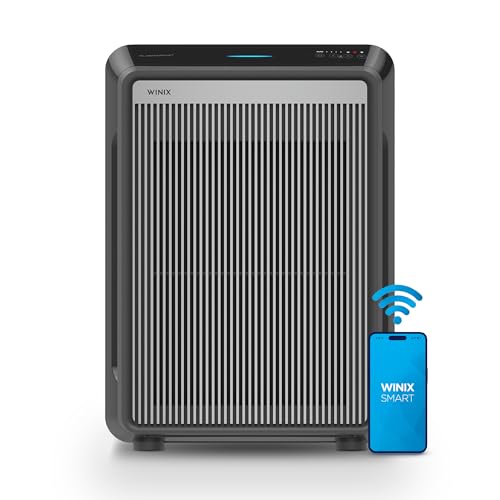
Winix 9800 — the larger-room successor
For households whose territory outgrew the old tower — the open plan, the combined living space — the 9800 class is Winix’s larger answer, and replacing upward into it is the honest fix for a sizing problem no cartridge could cure. Check price on Amazon
- Strengths: large-room delivery in the brand’s own idiom; current support
- Trade-offs: a bigger footprint to place by the rules; its own consumable family
Best for: replacement where the room, not the machine, was the problem. The brand’s wider field is surveyed in best air purifier brands.
Problem 5: Noise — Rattles, Growls and the Pre-Filter’s Revenge
Sort new noises by the test this site’s guides share. A rattle is usually a thing, not a failure: the front panel’s seating, the pre-filter’s frame, a cartridge not fully home, a small object in the intake’s path — reseat everything, run empty, and let the noise’s survival or departure identify its author. A whine that tracks speed on an older machine is the bearing’s announcement, and it is a support or succession conversation, not a cleaning one. A whoosh that grew over months is the pre-filter’s revenge for its skipped rituals — the fan labouring against a mat — and it clears with the wash the machine was owed. And the new machine that is simply louder than the old room expected is the sizing-and-speed reality every guide states: run the working speed the room needs and judge the machine there, at its placement, with the door in its working state. Noise complaints, like airflow complaints, are placement and maintenance until the empty run proves them mechanical — and in this brand, the empty run acquits often enough that the guide insists on it before any other spending.
Problem 6: Controls, Reminders and the Machine That “Ignores” Its Owner
The remaining complaints are clerical. A filter light that will not reset wants the manual’s exact sequence — the press-and-hold, in the right state, for the counted seconds — performed on the genuine cartridge’s installation, not before it. A sleep mode that seems too quiet is doing its specification; judge it by the morning, not by the ear’s suspicion. An auto mode that idles is reading its sensor, whose window is Problem 4’s subject. A machine unresponsive at the panel after a power cut wants a full minute unplugged before it wants a funeral. None of these is a part, a purchase or a warranty claim until the clerical layer has been worked honestly — and the clerical layer, in a brand whose owners keep machines for a decade, is where the guide respectfully suggests most “electronic failures” live. The manual is the first tool; the forum thread about your exact model is the second; the parts catalogue is a distant third, and this guide’s whole architecture exists to keep it there.
The Preventive Calendar: Making This Guide Unnecessary
Every problem above has a date on which it was preventable, and the calendar that prevents them is short enough to print on the machine’s own panel in spirit. Monthly: the pre-filter vacuumed, the intake wiped, the sensor window glanced at. Quarterly: the pre-filter rinsed where the model allows and dried like it matters, the placement audited against the furniture’s drift, the cartridge’s face inspected for its grey gradient. On evidence, roughly annually: the genuine lettered cartridge, the spare replenished, the listing checked. Seasonally: the machine moved or re-aimed as the household’s air problem migrates — pollen’s spring, smoke’s summer, the closed house’s winter — per the placement guide’s seasonal logic. Households that keep this calendar meet this problems guide the way careful drivers meet a repair manual: as literature, not as a lifeline. Households that do not will find, in the sections above, that the guide has kept their place for them — the problems are patient, the tests are cheap, and the machine, in this brand above most, is almost always willing to be acquitted.
Three Winix Cases, Worked in Full
The first case is a 5500-2 in a cat household, reported “dead” by its owner after five years: airflow a whisper, the indicator sullen, a replacement already in an online basket. The order was worked in an afternoon. The pre-filter, never rinsed, came out wearing a felt of cat hair that vacuumed away to reveal the mesh; the cartridge, tested by the empty run, proved innocent — the roar returned with it removed and, decisively, stayed returned with it refitted once the pre-filter was clean. Total expenditure: an hour and no parts. The basket was emptied, and the machine entered its sixth year. The second case is a sensing-generation tower whose auto mode “stopped working” across one winter: the sensor window, filmed by a season of candle and cooking vapour in the room it served, cleaned by the manual’s method and retested against a shaken cushion, to which it responded like a new machine. The third case is the guide’s necessary counterweight — a tower whose growl survived the empty run, whose owner had the succession conversation with the evidence in hand, and replaced it with the 5510 in a single order, without a wasted cartridge bought on hope. Three cases, two acquittals, one conviction — the ratio this brand’s durability predicts, and the reason the tests come before the spending in every section above.
Generation Notes: Where Your Model’s Quirks Live
A symptom-first guide owes its readers a model-second appendix, because each Winix generation keeps its problems in characteristic places. The PlasmaWave-era towers — the 5500-2 and its siblings — concentrate their failures in the pre-filter ritual and the lettered cartridge: machines designed to be maintained by hand, failing exactly where the hand forgets. Their electronics are simple, their feedback coarse, and their mechanical lives long; expect maintenance verdicts and almost never electronic ones. The Zero-series and the connected generations move the frontier: sensor windows, app accounts and firmware join the suspect list, and the clerical layer — resets, re-pairings, the manual’s exact sequences — acquits more machines than any part. The current 5510 and 9800 class inherit both heritages: staged filtration’s maintenance calendar underneath, modern sensing’s windows and accounts on top, and an owner who must therefore work both halves of this guide. None of the generations is badly served by the symptom order — power, placement, pre-filter, cartridge, sensor, clerical — but knowing your generation tells you where along the order your answer most likely waits, and a troubleshooting hour is mostly the art of starting near the answer. Find your generation in the manual’s first pages, and start there.
The Warranty and Support Conversation, Prepared
When the tests do convict — the motor’s growl surviving the empty run, the panel dead after the clerical layer — the support conversation goes better for being evidence-led, and Winix’s owners should prepare it the way this guide has taught them to prepare everything. Record the model and its generation, the symptom’s history, and the tests already performed, in the order performed: pre-filter cleaned on this date, cartridge indicted or acquitted by the empty run on that one, sensor window cleaned, placement audited. A support agent meeting that record skips the script’s first ten minutes and starts where the evidence starts, which is where resolutions live. Photograph the cartridge’s face and the machine’s rating label; both end arguments before they begin. And keep the genuine consumable’s receipts — in a brand where pattern cartridges circulate, proof of the genuine article is the owner’s warranty hygiene, cheap to keep and occasionally decisive. None of this guarantees an outcome; all of it guarantees a conversation between adults, which is the most a guide can deliver. The machines, remember, are on your side in that conversation: a decade-durable brand’s support organisation expects to meet maintained machines, and the record is how yours introduces itself as one.
Problems That Are Not Problems: A Short Amnesty
Close the main text with the acquittals, because a problems guide that never declares innocence teaches paranoia. The new cartridge’s faint sweet smell in its first days: the media settling, not a fault. The auto mode’s long silences in a clean room: the sensor reporting good news in the only way it can, by resting. The turbo’s roar when the indicator burns its worst colour: the machine spending its voice where the air needs it, exactly as designed. The filter light’s arrival while the cartridge still performs: a timer, doing arithmetic, not espionage. The colour dot’s stubborn amber on a cooking evening: a coarse instrument telling a true story coarsely. Each of these has generated returns, reviews and replacement purchases across the category, and each dissolves on contact with the manual’s plain statements — which is why this guide, like its companions for the other brands in this cluster, keeps returning the reader to the same unglamorous sources: the manual, the calendar, the empty-run test. Winix’s machines are unusually honest appliances, built by a company that publishes its figures and letters its filters clearly. Their problems, overwhelmingly, are the problems of honest machines in busy houses: dust, time, and the occasional forgotten rinse. Solve those, and the brand’s famous durability does the rest — which is, after several thousand words of symptoms, the guide’s whole message in one sentence.
The Cost of Getting the Diagnosis Wrong
One economic section, because misdiagnosis is the most expensive problem in this guide and the only one it can fully prevent. Price the errors. A cartridge bought for a pre-filter’s crime: the cartridge’s whole price, spent to store a spare the household did not yet need, while the machine stays throttled and the owner concludes the brand is finished. A machine replaced for a sensor window’s film: a successor’s price, spent to inherit a new filter family and abandon a durable unit whose fault was a cloth’s worth of dust. A pattern cartridge fitted to save money against the genuine: the saving, repaid in carbon performance within the season, with the machine’s odour reputation as the interest. A support call made without the empty-run evidence: an hour of script, a possible misdirected part, a second call. Against those prices, the guide’s method costs an afternoon at most — usually an hour, often twenty minutes with a vacuum — and its tools are the manual, a cloth and a cushion to shake near the intake. Troubleshooting is the highest-paid hour in appliance ownership, and Winix’s owners, whose machines reward it for a decade, are the best paid of all. Work the order. The order is the savings.
A Seasonal Troubleshooting Rhythm
Problems arrive seasonally, and the guide’s last practical section teaches the household to meet them on the calendar rather than in crisis. Spring, pollen’s onset: the pre-filter’s first deep clean of the year, the cartridge’s face inspected before the season spends it, the bedroom machine’s placement re-audited for the closed-window months. Summer, smoke and humidity: the carbon’s odour evidence checked monthly rather than quarterly, the machine’s distance from steam and cooking vapour reconfirmed, the sensor window cleaned before the season’s worst weeks rather than during them. Autumn, the closed house: the full calendar — rinse, inspect, the spare’s shelf checked, the genuine listing verified while no emergency presses. Winter, the heating months: dust’s indoor concentration at its peak, the pre-filter’s rhythm shortened accordingly, and the dry air’s static noted as a sensor’s occasional confuser rather than a fault. None of this is extra work; it is the same work, distributed to the moments when it is cheap. Crisis troubleshooting is maintenance that was postponed to the most expensive possible date, and the seasonal rhythm is how a household of Winix owners — whose machines will serve long enough to see every season many times — keeps the interest from ever accruing.
What This Guide Deliberately Does Not Cover
Honesty about scope closes the practical text. This guide does not open machines: no internal repairs, no motor swaps, no capacitor folklore — those belong to technicians and to the warranty’s terms, and a guide that taught them to a general readership would be spending its readers’ safety on its own completeness. It does not adjudicate the PlasmaWave debate beyond the owner’s switch, because the evidence article elsewhere on this site owns that argument and the problems page owns only the protocol: off during smell investigations, decided consciously otherwise. It does not promise that every symptom resolves at home — the conviction cases exist, and the guide’s service in those cases is to make the conviction early, evidenced and cheap, rather than to deny it. And it does not cover the counterfeit and grey-market units that surface under famous model names, beyond the standing advice that a machine whose genuine cartridge does not fit was never the machine its badge claims. Within its scope — the maintenance states, the clerical layer, the sensor’s window, the cartridge’s letters — the guide is complete, and it leaves its readers where every good troubleshooting document should: with a working machine, a short calendar, and a clear conscience about the money they did not spend.
The Ten-Minute Triage, for the Reader in a Hurry
Everything in this guide compresses into a drill for the household that wants its machine back tonight. Minute one: power and panel — a full minute unplugged, then a clean restart, and note what the machine says on waking. Minutes two to four: the pre-filter out, vacuumed, held to the light; if the light does not pass, the rinse and the dry, and the machine run with the panel open to hear it breathe. Minutes five and six: the empty run — cartridge out, every speed, listening for the roar’s return and for any growl that survives. Minute seven: the cartridge’s face read like a document — grey gradient, odour at the media, the letter checked against the model. Minute eight: the sensor window, cleaned by the book. Minute nine: the placement — a forearm’s clearance, the jet’s road, the door’s state. Minute ten: the verdict, written down — acquitted, indicted part named, or convicted with evidence — and the calendar entry that prevents the sequel. Ten minutes, honestly spent, resolves or correctly escalates the overwhelming majority of what owners call Winix problems. The long sections above exist for the minority, and for the understanding that turns a drill into a habit; the drill exists for tonight.
Closing: The Brand’s Character, Reflected in Its Problems
A brand can be read in its failure modes, and Winix reads well: its problems are the honest ones — dust in the pre-filter, time in the carbon, film on the sensor’s eye, letters confused between generations — and its dishonest problems, the premature electronic deaths and the designed obsolescences, are conspicuously rare in the record this guide draws on. That is not a small thing to be able to say at the end of a problems article, and it is why the guide’s tone has been able to stay practical rather than adversarial: the reader and the manufacturer are, in most of these cases, on the same side of the machine, against the dust. Keep the calendar, fit the genuine letters, clean the window, work the order — and the Winix in the corner will do what Winix machines are documented, across a decade of households, to do: outlast the guide written about its problems, and be replaced, when it is replaced, for reasons of territory and taste rather than of failure. The questions below close the remaining particulars.
Households With Several Winix Machines: Fleet Lessons
Multi-machine households — the natural end-state of a durable brand’s ownership — develop problems of administration rather than of engineering, and the guide’s fleet notes may save them their characteristic errors. Cartridges migrate: a spare bought for one generation is fitted, or nearly fitted, to another, and the fleet rule is therefore storage discipline — each spare shelved with its model’s name on the box, in the room its machine serves. Calendars diverge: the bedroom tower’s pre-filter and the living-room compact’s live different dust lives, and a single household rhythm serves neither; keep the calendar per machine, on the machine, in pencil. Lessons transfer imperfectly: the sensor window’s cleaning that acquitted the new tower teaches the household to clean the old tower’s indicator lens with the same cloth and the same hope, and the generations’ different feedback dialects must be learned separately, like siblings. And the fleet’s oldest machine sets the household’s spare policy — when its genuine listing eventually lapses, the fleet’s succession plan, not a panic, should answer. Households that run their Winix fleet on these notes report the experience the brand’s designers presumably intended: several machines, no topics. The problems guide’s ambition for its readers is exactly that — a fleet, or a single machine, that has stopped being a topic at all.
A Final Note on Evidence and Temperament
Troubleshooting guides fail their readers in two opposite ways: by credulity, which replaces parts on suspicion, and by dogma, which cleans pre-filters while a motor dies. This guide has tried to steer between them with a single instrument — the test that changes the verdict — and its last word is about the temperament that instrument requires. Work slowly enough to notice what each step changed. Write the verdict down, because memory edits evidence in favour of the part already bought. Let the machine be innocent until a test proves it guilty, and let it be guilty the moment one does, without a second cartridge spent on hope. That temperament, more than any single fix in the sections above, is what the guide exists to teach — because the reader’s next problem will not be in this article, and the temperament will handle it anyway. Winix’s machines, honest and durable, reward that temperament for years at a time. It is the only tool in this guide that fits every model ever made, including the ones not yet designed, and it never needs its letter checked.
The Guide in One Page, for the Fridge Door
Distilled for the household that keeps its wisdom on the fridge: weak air means pre-filter, cartridge, placement, in that order, and the empty run decides between them. Smell means carbon, moisture or the serious protocol, and the nose knows which by its character. A strange reading means a filmed window until a cloth proves otherwise. A light means a timer, and timers are advisors, not authorities. A new noise means a reseat, an empty run, and then — only then — a conversation about bearings. A wrong letter means a leak at the heart, and the genuine article is the fix and the prevention in one. And every problem, whatever its section, means the calendar first: most Winix trouble is maintenance that came due in a house that was busy living, which is the most forgivable failure in this entire guide and the easiest to stop repeating. Print the calendar, keep the spare, check the listing once a year, and the fridge door can go back to holding shopping lists — the machine having returned, as it almost always does, to the silence of a thing that works.
Envoi: The Machine, Acquitted
Somewhere tonight a Winix that was pronounced dead this morning is running at its working speed in a clean room, its pre-filter rinsed, its window wiped, its owner slightly embarrassed and entirely satisfied — the standard ending of the stories this guide is built from. The machine was never broken; the house was busy, the dust was patient, and the calendar had slipped, as calendars do. If this article has a single hope, it is that its readers reach that ending by the short road — the order worked, the tests believed, the money unspent — and that the machine then disappears back into the household’s infrastructure, where durable appliances live. The questions below answer the particulars that remain: the cleaning verdict, the smell’s identity, the filter’s letter, the PlasmaWave decision, the lying light, and the replacement threshold. Everything else is in the sections above, in the manual, and — as of tonight, if the drill went well — in the quiet of a room whose air is being cleaned by a machine that was innocent all along.
And If the Machine Is New: The First-Month Problems
New Winix owners meet a distinct set of alarms, and the guide closes its practical sections by acquitting them in advance. The new machine’s smell — media and manufacturing, faintly sweet — clears in days and is not the carbon failing early. The sensor’s excitability in its first week is calibration meeting a real house: readings that horrify on day one and settle by day ten are the machine learning nothing — it does not learn — but the household’s events returning to their ordinary rhythm after the installation’s dust. The filter light’s early behaviour is the timer starting its count, not a prophecy. The pre-filter’s first vacuum, at the month’s end, shocks new owners with its catch — that is the room’s backlog, collected exactly as designed, and the second month’s catch will be smaller and more honest. New owners who read these acquittals in advance keep their machines; new owners who do not, sometimes return a healthy unit and buy a rival that alarms them identically in a different dialect. The first month of any honest purifier is an introduction between a machine and a house, and introductions, in air as in life, should not be judged by their most startling minute.
The Last Distinction: Broken, Tired, or Retired
Owners reaching this guide’s end should be able to file their machine under one of three headings, and the headings deserve a final, explicit statement because households blur them at their expense. Broken is a verdict of the tests: a function lost that maintenance cannot restore — the dead motor, the failed panel — and its remedy is support or succession, promptly, without a cartridge spent in denial. Tired is the maintenance state this whole guide treats: functions intact, performance spent on dust and time, remedy an afternoon and perhaps a genuine cartridge. Most machines presented as broken are tired, and the confusion between the two words is the most expensive vocabulary error in appliance ownership. Retired is neither a failure nor a state but a decision — the territory outgrew the machine, the household’s brief changed its language, the successor’s virtues finally outweighed a loyal unit’s — and it should be made as a decision, in daylight, with the old machine demoted or passed on rather than falsely convicted to justify it. File honestly, and every subsequent step is obvious. That clarity — broken, tired, or retired, and never a word spent blurring them — is the guide’s final gift to the Winix owner, whose machine, in the overwhelming run of cases, will file itself under the middle word and be back at work by dinner.
Postscript: Keep the Receipts, Keep the Manual, Keep the Machine
Three keepsakes close the guide, each worth more than its storage cost. The manual, because every generation’s exact sequences — the reset’s press-and-hold, the window’s cleaning method, the letter’s confirmation — live there and nowhere else with authority, and because the household that has thrown it away will one day pay for its absence in forum archaeology. The receipts, because genuine cartridges and purchase dates are the warranty conversation’s exhibits and the succession decision’s data. And the machine itself — kept, that is, in service, on its calendar, in its territory — because the whole burden of this long guide has been that a Winix, maintained, is among the household’s most durable servants, and that its problems are the price of dust and time rather than of design. Pay that price in vacuuming and the occasional genuine cartridge, and the machine will keep its side of the bargain for years the purchase price had no right to promise. That was true of the benchmark generation, it is true of the current one, and the guide expects, on the evidence, to be able to say it of the next.
Really the Last Word: On Reading Symptoms as a Language
Stay with the guide one paragraph more, for the idea underneath all of it. A purifier speaks a small language — airflow, tone, smell, light, number — and every problem in this article is a sentence in it, grammatical and specific, once the owner learns the vocabulary. Weak airflow is the machine saying its path is spent. A returning odour is the carbon filing its resignation. A serene sensor in a smoky room is an eye asking to be wiped. Owners who learn the language stop experiencing their appliances as moody black boxes and start experiencing them as colleagues with limited but honest communication — and colleagues, unlike black boxes, get maintained, believed and kept. That is the deepest reason this guide teaches tests rather than answers: answers expire with the model, but the language is spoken by every purifier ever built, including the Winix generations not yet designed. Learn it here, on a durable machine that speaks it clearly, and no appliance in the house will ever be a mystery to you again.
The questions below are the language’s commonest sentences, translated one last time for the reader who arrived with a specific worry: the cleaning that faded, the smell that arrived, the letter that must match, the feature that asks its question, the light that lies politely, and the threshold where replacement finally becomes the honest answer. Each reply is the guide in miniature — test first, spend second, and let a durable machine prove, as it usually will, that it was only ever tired, and is already, with an afternoon’s attention, back at work.
Go, then, to the machine — vacuum in hand, cloth in pocket, manual open at the page with your model’s letter — and work the order this guide has laid out, in the confidence that the order has been worked, in substance, by a decade of this brand’s owners before you, with results that fill the forums with the least dramatic sentence in appliance literature: fixed it, was the filter, runs like new. May your own report be exactly as boring, and exactly as satisfying.
And if the tests convict instead — if the growl survives the empty run and the succession conversation begins — take this guide’s last comfort with you into it: you will shop as the best kind of customer, one who knows what the old machine did, what it cost to keep, and what its replacement must therefore be, with the evidence filed and the calendar ready to start again on a new machine that will, in its turn, be pronounced dead some busy year, and acquitted by somebody who learned the order here.
That is the guide, whole: a durable brand, an honest set of failure modes, a short order of cheap tests, and a calendar that keeps the whole subject boring for years at a time — which is, in the end, the highest compliment a problems article can pay the machines it covers, and the best outcome it can wish its readers.
Frequently Asked Questions
Why is my Winix air purifier not cleaning the air like it used to?
Work the order: wash or vacuum the pre-filter, which on Winix’s towers is the commonest throttle; test the cartridge by running the machine empty — full power restored indicts the cartridge, and the cure is the genuine lettered filter for your model; then audit the placement for clearance and circuit. Only a machine that stays weak with clean filters, an empty path and an honest placement has a fan problem, and that verdict is rare in this brand. Most “stopped cleaning” Winix machines are one wash and one cartridge from their old selves.
Why does my Winix smell when it runs?
Identify the smell first. Returning household odours mean the carbon bed is exhausted — replace the cartridge with the genuine article. A musty note means moisture history: dry and clean the pre-filter, and move the machine out of steam’s path. A new cartridge’s sweet note clears in days. A sharp or electrical smell gets the serious protocol: PlasmaWave off, and if it persists with filters removed, stop the machine and contact support. The problems section above walks each case; no smell should be lived with unidentified.
How do I know which Winix filter my model takes?
By its letter, from the manual or the cartridge itself — Winix’s generations use distinct filter families (the 5500-2’s Filter H is the best-known), and they do not interchange. Read the letter off the old cartridge before ordering, match it exactly, and fit the genuine article: the seal and the carbon mass are the performance, and pattern cartridges are this brand’s documented false economy. Keep a spare from the second change onward, and check the genuine listing annually.
Should I turn PlasmaWave off?
This site’s position, consistent across its Winix coverage, is that the machine’s documented work is done by its filters — HEPA for particles, carbon for gases and odours — and PlasmaWave, the brand’s ionisation stage, is an optional extra the owner should decide about consciously rather than inherit as a default. Owners who switch it off lose nothing measurable. Owners investigating a sharp smell should switch it off as the protocol’s first step. The full evidence discussion lives in our ozone-free air purifiers investigation, linked from the smell section above.
My Winix filter light came on but the filter looks fine. What should I do?
Trust your evidence over the light, within reason: the reminder is a timer counting run hours, not a sensor measuring dirt. Judge the cartridge by airflow, fan tone and odour return; vacuum the pre-filter, which the light never accounts for; and if the cartridge genuinely performs, reset the indicator by the manual’s sequence and note the date. Replace when the evidence indicts — and when you do, fit the genuine lettered filter, because a fresh timer on a pattern cartridge restarts the wrong clock entirely.
When is a Winix problem worth replacing the machine over?
When the empty-run test convicts the motor — noise or weakness that survives with filters removed — or when the model’s genuine consumables cease to be listed, inverting its economics. Everything short of that is maintenance wearing a frightening costume, and this brand’s durability means the costume appears years before the reality. When replacement is right, the 5510 continues the formula in current production, and the 9800 class answers the larger room; both are linked above with their trade-offs stated.
Why does my Winix keep changing fan speed by itself in auto mode?
Usually because the sensor is reporting a changing room honestly, even when the trigger is not the dust you had in mind. Cooking vapour drifting from a kitchen, a door opening onto a hallway, steam after a shower or cleaning sprays used nearby can all send the reading upward and call for a faster fan until the air clears again. Wipe the sensor lens gently, move the machine away from doorways and direct vapour paths, and watch whether the pattern settles. Constant hunting in a still, closed room is different, and that pattern deserves the deeper checks in this guide.

