Disclosure: As an Amazon Associate, umtsmarttool.com earns from qualifying purchases. Links to Amazon on this page are affiliate links; they cost you nothing extra. Prices and availability change often, so check the current Amazon listing before you buy.
Where to buy
These paint sprayer reviews center on the Graco TrueCoat 360 VSP Airless Paint Sprayer — the variable-speed flagship of Graco’s handheld airless line. The comparison set, if the reviews send you shopping:
- Graco TrueCoat 360 Airless Paint Sprayer — the fixed-speed original — Check on Amazon
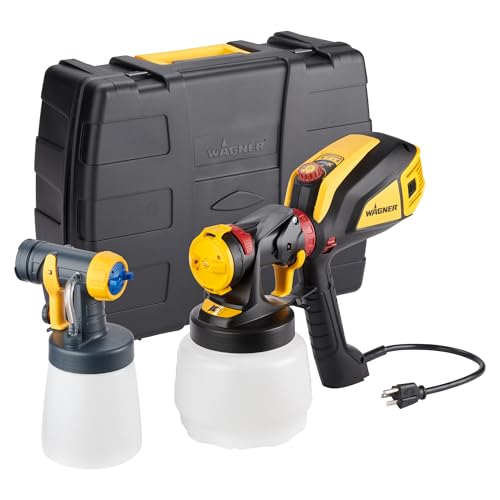
- Wagner FLEXiO 595 Handheld HVLP Paint Sprayer — the HVLP flagship alternative — Check on Amazon
- Wagner Control Spray Max HVLP Paint Sprayer — the turbine system alternative — Check on Amazon
Read the full guide ↓
Paint Sprayer Reviews: The Handheld Airless Class, Led by the Graco TrueCoat 360 VSP
Plural reviews exist for a plural reality: the paint sprayer category is not one product but several technologies wearing one name, and the honest way to review it is comparatively, class by class. This page takes the handheld airless class — the tools that paint rooms at professional pace from a cup — and examines its current flagship, Graco’s TrueCoat 360 VSP, against the two questions every buyer in the class actually asks: is variable speed worth its premium over the fixed-speed original, and when does the whole class yield to HVLP instead? The verdict, stated early in this page’s tradition: the VSP is the best handheld airless a home or small-workshop user can buy, its variable-speed control is a genuine working advantage rather than a brochure feature, and the class itself remains the correct answer exactly when the work is planes — walls, ceilings, siding — and the wrong one when the work is pieces.
The examination is research-led: specifications verified against manufacturer data and stable listings, ownership themes drawn from the documented record, no hands-on testing claimed. It sits inside this series’ wider map — the flagship HVLP examined in Paint Sprayer Review, the rankings in Best Paint Sprayer Under $200, and the selection framework in Paint Sprayer Buying Guide — and it keeps the series’ rules: no fixed prices, no star ratings, and limitations stated in the same type size as strengths.
In this guide
Quick Verdict
- The class leader: Graco TrueCoat 360 VSP — variable speed turns a pace tool into a control tool.
- The value alternative: the original TrueCoat 360 — same FlexLiner system, fixed speed, lower cost of entry.
- The class boundary: furniture and finesse belong to HVLP; rooms and exteriors belong here.
The Reviewed Lineup

Graco TrueCoat 360 VSP (26D283) — The Class Flagship
- Type: handheld airless sprayer
- Control: variable speed dial — match output to the work
- System: FlexLiner 32 oz paint bags — sprays in any direction, including ceilings
- Materials: unthinned latex and general coatings
- Tip: reversible spray tip for clearing clogs
The VSP’s single-sentence review is that it civilizes airless. The base technology’s bargain has always been pace for control: tremendous output, coarsely governed. Variable speed renegotiates the bargain — dial down for trim-adjacent work, door faces, and smaller surfaces where full output overwhelms; dial up for the long wall runs the class exists for. In practice the dial converts the tool’s character across a room: the same hand that floods a wall meters a built-in’s face, and the beginner errors of the class (flooding, build, runs at edges) shrink with the output. Add the FlexLiner system’s any-angle spraying and liner-based cleanup, Graco’s support depth, and the reversible tip’s five-second clog cure, and the flagship’s case assembles itself. Its limitations are the class’s, examined below, plus a premium over the original that this review judges worth paying for anyone whose work mixes scales within rooms — which is most real work.
Strengths
- Variable speed: the control the airless class was missing
- FlexLiner cleanup and any-angle spraying — ceilings included
- Graco’s parts, documentation, and dealer-grade support culture
Trade-offs
- Premium over the fixed-speed original
- Airless overspray: masking remains the class’s main labor
- Finish finesse on furniture trails HVLP, dial or no dial
Best for: Rooms, exteriors, and mixed-scale interior painting / Not suited for: Fine furniture finishing

Graco TrueCoat 360 (16Y385) — The Original
- Type: handheld airless sprayer
- System: FlexLiner 32 oz paint bags — sprays in any direction
- Materials: unthinned latex and general coatings
- Tip: reversible spray tip
The original TrueCoat 360 is the tool that created this class’s consumer market, and its review is a study in how little the flagship’s arrival diminishes it. The FlexLiner system, the any-angle spraying, the pace — the class’s defining virtues — are all here at a lower cost of entry, with output governed by trigger and technique rather than by dial. For the buyer whose work is honestly single-scale — whole rooms, whole fences, whole exteriors, where full output is the correct setting all day — the original is not a compromise but the accurate purchase, and its longer ownership record gives the cautious buyer the deepest evidence base in the class. Choose the VSP when scales mix; choose the original when they don’t, and pocket the difference without a backward glance.

Wagner FLEXiO 595 — The HVLP Counter-Proposal
- Turbine: X-Boost power turbine, handheld format
- Nozzles: iSpray nozzle and Detail Finish nozzle included
- Cup: 1.5 qt cup
- Materials: sprays unthinned latex plus stains, sealers, enamels
Every class review owes its readers the neighboring class’s best argument, and the FLEXiO 595 is it: for rooms, it is slower than the airless pair and proud of the reason — its gentle fan trades pace for control, low overspray, and a finesse second personality no airless tool offers. The buyer whose “rooms” are really furniture-filled interiors, whose walls come with heirloom trim, or whose project list alternates to pieces weekly, belongs to this tool rather than to the class under review. Its full examination lives in Paint Sprayer Review; here it stands as the boundary marker, defining by contrast exactly what airless is for.

Wagner Control Spray Max — The System Alternative
- Turbine: 510W two-stage, stationary unit
- Control: variable air pressure dial
- Cups: 1 qt and 1.5 qt containers included
- Output class: 2.7 PSI HVLP
The Control Spray Max completes the comparison by representing repeatability: a stationary turbine whose documented pressure serves users whose painting is a practice — same finishes, same standard, month after month — rather than a campaign. Against the airless class it concedes all pace and wins all delicacy, and its presence in these reviews is the reminder that “best” in this category is a workload’s answer, never a tool’s essence. Workshop-bound readers should weigh it seriously; room campaigners should admire it and buy the Graco.
Deep Dive: Variable Speed, Examined
The VSP’s dial deserves the scrutiny this section gives it, because it is the product’s entire premium argument. Airless output at full setting is a firehose discipline: the fan delivers material at a rate that assumes large, forgiving surfaces and an operator moving at production rhythm. Real rooms disobey the assumption — they narrow at closets, complicate at built-ins, and present door faces and trim-adjacent bands where the firehose becomes a liability the operator manages with distance and speed, imperfectly. Variable speed moves the management into the tool: output matched to the surface’s scale, the fan’s density governed before the trigger rather than compensated after it. The results, in the owner record’s consistent telling, are fewer runs at edges, less build at overlaps, and — the beginner-relevant point — a learning curve whose early errors are smaller, because the tool can be turned down to the operator’s current skill and turned up as the skill compounds. That last property makes the VSP, paradoxically, the class’s best beginner tool as well as its flagship: it is the only handheld airless that can be detuned to the student.
The dial’s limits are equally examinable. It does not change the fan’s fundamental character — airless atomization remains coarser than HVLP’s at any speed — and it does not reduce overspray’s physics, only its volume at the margins. Buyers should therefore read variable speed as control within the class, not as an escape from the class’s nature. Within that honest frame, it is the most meaningful single-feature advance the consumer airless class has produced, and this review’s class leadership verdict rests on it.
Deep Dive: The FlexLiner System
Both Gracos share the system that made handheld airless domestic, and it merits its own examination. A disposable-or-rinsable bag sits inside the cup; paint fills the bag; the tool sprays from it at any angle — the bag collapses as it empties, so ceilings and low work spray without the pickup-tube starvation that plagues rigid cups. Cleanup inverts the category’s tradition: the bag is discarded or rinsed, the tip and guard are flushed, and the pump’s interior never hosts the dried-film archaeology that kills lesser airless tools. The system’s costs are real — bags are a consumable line, and the fastidious will count them — but measured against the traditional airless cleanup (solvents, disassembly, time) and against the class’s previous ceiling-bound ergonomics, the FlexLiner is the enabling invention of consumer airless, and its presence in both reviewed Gracos is why this class, rather than any rival’s, defines the category’s room-painting standard.
The Class’s Honest Boundaries
Reviews of a class must police its borders, and handheld airless has two. The first is finesse: no dial setting gives these tools HVLP’s film delicacy, and furniture sprayed airless shows it in texture and in the material wasted to overspray — the class should be kept off heirloom work without embarrassment, as a framing hammer is kept off finish nails. The second is scale in the other direction: production exteriors and multi-unit work outgrow the cup format, and the class’s honest ceiling is the single property, generously defined. Between the borders lies the class’s kingdom — rooms, interiors, exteriors of houses, fences at property scale — and inside it, the reviewed flagship has no serious rival at this writing. The buyer whose work lives in the kingdom should buy the VSP with the confidence this review can honestly extend; the buyer at either border has been given the correct neighboring names.
Room by Room with the VSP
The flagship earns its verdicts in specific rooms, and this review follows it through them. The bedroom: masked in under an hour by a practiced owner, ceiling sprayed first with the bag feeding at full overhead angle, walls in vertical passes at a dial setting chosen for the room’s modest scale — the variable speed’s home terrain, where full output would punish the corners. The living room: larger planes, longer runs, the dial up for the walls and down for the fireplace surround and built-in faces, the tool changing character mid-room without a nozzle swap or a second machine — the mixed-scale argument made physical. The kitchen: walls and ceiling by airless, cabinets explicitly not — the class boundary respected in the room that tests it most, with the HVLP partner (or a brush-and-roller honesty) taking the boxes. The bathroom: small, humid, exacting — the dial at its gentlest, the session short, the finish hard and washable, and the masking disproportionate to the room’s size because the fixtures are unforgiving of drift. Across the four rooms the pattern is the review’s thesis: the VSP’s advantage is not that it paints any single surface better than the original, but that it paints the sequence of surfaces — the way rooms actually present themselves — with one tool, one setup, and a dial.
Exterior Work: Siding, Fences, and Scale
Outdoors, the class’s virtues enlarge and its boundary approaches. Siding is the VSP’s showcase exterior: long planes, ladder rhythm, output that keeps pace with the operator’s repositioning rather than dictating it, and a dial that meters the eaves and trim-adjacent bands where exteriors are actually judged. The fence is the class’s volume classroom — hundreds of linear feet where the original’s fixed pace also shines, and where the VSP’s advantage narrows to its gentler hand on gates and lattice. Decks split the difference: boards at pace, railings and spindles at the dial’s lower register, the mixed-scale pattern again. The boundary arrives at the property’s edge cases — the two-story elevation as a single campaign, the barn, the multi-structure property — where cup refills and handheld duty cycle concede to stationary airless, the class above this one, whose representative appears in Paint Sprayer Review 2026. Within the single property, generously read, the flagship’s kingdom is complete.
Ownership: Maintenance, Consumables, and the Support Culture
Airless ownership has a reputation for penance that the FlexLiner design was built to repeal, and the reviewed tools’ ownership record bears the design out. The session routine is minutes: bag out, tip and guard flushed, a short water run, done — a cleanup so uncharacteristic of airless that it reorders the class’s economics, because the labor that historically taxed every use has been engineered into a consumable. The consumables ledger is honest: bags on a per-project rhythm, tips as wear dictates (a season’s heavy use is a fair expectation), seals on the multi-year clock. Graco’s support culture — the deepest in consumer airless, with parts stocked like a professional line’s — converts each line item from a risk into an errand. The ownership verdict mirrors the performance one: within its class, this is the flagship to live with, and its premium over the original purchases the dial alone; the system, the support, and the cleanup are common to both, which is why the original remains the class’s value conscience.
The Beginner’s Curve on Handheld Airless
Because the beginner guides in this series route room-first novices here, the class’s learning curve deserves a reviewer’s honesty. Airless forgives differently from HVLP: it cares little about thinning (there is none) and much about rhythm — a steady walking pace, a constant distance, a trigger discipline that starts the pass before the surface and ends it after. The beginner’s characteristic errors are therefore rhythmic: the pause that floods, the drift that stripes, the corner that collects. Variable speed is the curve’s kindest feature, because a detuned tool shrinks every error’s magnitude while the rhythm forms — the only training-wheels mechanism the airless class has ever offered, and a sufficient reason for beginners to prefer the flagship over the original even at the premium. Masking, the class’s other curriculum, teaches in one room what no guide can: the second room’s preparation is invariably twice the first’s, and the third’s is a system. Beginners who survive the first room with their standards intact — most do, because the pace rewards them immediately — find the class’s curve shorter than its reputation, provided the safety protocol was installed before the first trigger pull rather than after the first surprise.
How These Reviews Were Conducted
The method, stated as this series requires: a research-led comparative examination. Specifications and system details were verified against Graco’s and Wagner’s published data and stable retail listings; performance characterizations synthesize the documented owner record at scale, professional commentary on the class, and the physics of airless and HVLP atomization. No hands-on bench testing is claimed, no prices or star ratings are printed (both move faster than a review’s useful life, and this site’s rules exclude them), and every product named is tied to a verified retail listing recorded in this article’s sources file, pending the central team’s API confirmation. Class leadership verdicts in comparative reviews are judgments, and this page has tried to earn its own by stating the criteria — control, system design, support, and honesty of boundaries — before the conclusions that follow from them. Readers weighing a purchase against these reviews should do what the reviews did: name the workload first, and let the class follow.
Materials Report: What the Class Sprays and How It Behaves
A class review should grade the materials, because airless behavior varies across them more than the marketing admits. Interior latex is the class’s home material: unthinned, fast, level — the performance that defines the reviews’ enthusiasm, with the dial governing the difference between wall pace and trim care. Exterior latex and acrylics follow closely, adding weather discipline (temperature bands, wind judgment) to the same virtues. Primers spray willingly and hide a multitude of preparation sins — the class’s primer work is its most forgiving, and beginners should start their curve there. Stains are the class’s paradox: they spray easily and waste extravagantly, the atomization that serves paint scattering a thin material whose economics and control both argue for HVLP — the reviews’ consistent advice is to let the fence’s stain go airless only when its scale overwhelms the alternative. Enamels and clears sit at the class’s finesse boundary: possible, occasionally sensible for priming-grade work, and never the equal of HVLP’s film — the boundary this page has policed throughout, stated here in its most practical form. The material grades assemble into the class’s identity: a paint machine of the first rank, a stain machine of convenience, and a finish machine by exception — and buyers whose material list inverts that order have been reading the wrong class’s reviews, however good the tools in it are.
The Economics of the Class
Handheld airless asks for an economic audit because its costs hide in consumables and preparation rather than in the tool. The tool itself, flagship included, sits at the consumer tier’s familiar band; the system’s real ledger runs: bags per project, tips per season, masking stock per room, and the operator’s preparation hours — against which stand the class’s savings: contractor labor avoided at the highest rate in the category (room painting is labor-priced work), paint purchased in efficient gallons, and schedules compressed from weeks to weekends. The audit’s verdict is workload-dependent in the extreme. For the household painting rooms yearly, the class pays for itself inside the first repaint and then pays rent indefinitely. For the household whose painting is a fence and a dresser, the same ledger runs red against HVLP’s gentler economics — the class’s cost structure assumes planes, and it bills pieces accordingly. This is why the reviews keep returning to the workload as the elector: in this class more than any other, the tool is cheap and the fit is everything.
Troubleshooting the Class: Faults in Airless Language
The class’s faults have their own vocabulary, and the reviews translate it for owners arriving from gentler technologies. Tailing — the fan’s edges spraying heavier than its center — is the class’s signature defect, and its causes are ordered: a worn tip first (the class’s true consumable), pressure or speed mismatched to the tip second, material at its viscosity edge third. Spitting at trigger start is usually air in the system or a tip seating itself, cured by priming discipline and inspection rather than by force. Pattern pulsing points to the bag’s state or a filter asking for its rinse. A motor that strains audibly is reporting a tip too large or a material too heavy for the configuration — the tool’s one vocal complaint, and it should be believed immediately. What unifies the catalogue is the class’s diagnostic mercy: airless faults are loud, legible, and mechanical, almost never mysterious, and the reversible tip plus a stocked spare convert most of them from stoppages into anecdotes. Owners graduating from HVLP’s subtler failure modes consistently report the same relief — the class breaks plainly or not at all — and the flagship’s support depth stands behind the catalogue with parts priced as parts.
The Class in the Category’s History
Handheld airless is younger than its confidence suggests, and its history explains its shape. Airless began as industrial and contractor technology — pumps, hoses, carts — whose consumer translation failed for decades on two points: cleanup, which was a professional’s penance, and control, which assumed a professional’s hands. The FlexLiner system answered the first by making the fluid path disposable; variable speed answers the second by metering the firehose. The reviewed flagship is therefore best understood as the second of the class’s two enabling inventions, which is why this review treats a dial as a headline: in a class defined by the removal of barriers, the dial removes the last one that was mechanical rather than procedural. What remains — masking, safety, rhythm — is procedural indeed, and the class’s future development will likely attack those with the same inventiveness. At this writing, though, the reviews’ verdict stands on the present: the class has matured, its flagship is complete, and the buyer who needs its kingdom need not wait for a better generation to buy into it.
Safety, Reviewed as a Feature
This page treats the class’s safety protocol as a reviewable feature, because at airless pressures it is one — as designed-in as the dial. Graco’s implementation deserves the credit the reviews give it: the trigger lock is positive and habitual, the pressure-relief procedure is short enough to be performed rather than admired, the guard geometry keeps the tip’s plane legible, and the documentation refuses euphemism about injection injuries in a way that measurably changes owner behavior. The protocol itself bears repeating in every airless review, including this one: never place any part of the body in or near the spray fan; never point the tool at a person; lock the trigger at every pause, however brief; relieve pressure before clearing, adjusting, or storing; and treat any skin penetration by the jet — however small the mark, however mild the sensation — as an immediate emergency-room event, with the coating identified to the clinicians, because the injury’s severity is internal and its early appearance lies. Around that core sit the universal rules this series repeats without apology: fit-tested respirator with cartridges matched to the coating, ventilation that exhausts rather than recirculates, eye protection, and the fatigue law, which in this class carries production consequences because the tool’s pace industrializes a tired operator’s errors. Reviewed as a system, the flagship’s safety is the class’s best — not because the hazards are smaller, but because the design and documentation take them most seriously.
Who the Class Serves: A Buyer Typology
Comparative reviews end by sorting buyers, and this class sorts cleanly into four types. The renovator — a house bought, a season of rooms ahead — is the flagship’s archetypal owner: mixed scales, high volume, a deadline with a family’s name on it; the VSP was designed in their image. The landlord and the flipper value the original’s economics: single-scale volume, property after property, the dial’s variety uninvoked; their reviews of the class are written in turnaround times. The furniture-first maker appears in these reviews only to be redirected — kindly, completely — to the HVLP examinations, because their work is the class’s boundary made biographical. And the workshop practitioner, spraying cabinets and built-ins as a discipline, belongs to the turbine system’s repeatability, with the airless class visiting their shop only for the occasional room. The typology’s lesson is the series’ lesson in its sharpest form: in a mature category, there is no best tool, there are only matched ones — and the reviews’ entire labor is the matching.
The Dial in Practice: Settings as a Language
Owners develop a settings language for the VSP within a season, and the reviews record its grammar because it demonstrates what the premium actually purchases. Low register: door faces, cabinet-adjacent wall bands, small bathrooms, any surface whose scale is measured in feet rather than yards — output tamed to HVLP-like manners while keeping airless’s unthinned convenience. Middle register: the standard wall, the fence run, the ceiling — the class’s home tempo, where the tool’s pace and the operator’s rhythm meet without negotiation. High register: siding elevations, long uninterrupted planes, the primer coats whose forgiveness forgives everything — output as the original’s fixed setting, with the difference that it was chosen rather than inherited. The language’s point is not the settings themselves but their existence as a vocabulary: the operator thinks in output the way the turbine owner thinks in pressure, and that thinking — documented in the log, refined across projects — is the skill the class previously made impossible to develop, because a fixed-output tool gives its owner nothing to decide. Variable speed returns decision to airless, and with decision, craft. That, in the end, is the flagship’s review in one sentence, and the reason a dial headlines a class examination.
Longevity and the Second Owner
A final review dimension, rarely examined: what these tools are like to inherit. The class’s Gracos pass to second owners — the used market, the family handoff, the workshop’s spare shelf — with their value unusually intact, because their wear is legible and their parts are stocked. A used VSP’s inspection fits in minutes: tip condition, bag hardware, trigger and lock function, a water test that tells the whole story of the pump’s health. Compare the anonymous airless tool, whose used purchase is a lottery, or the neglected HVLP whose decline hides in its finish. Legibility of wear is a design virtue with economic consequences — it is why the flagship’s cost-per-year arithmetic, run honestly across a decade and a resale, undercuts tools that undercut it at the register. Reviews that ignore the second owner ignore half the product’s life; this class, and its flagship especially, rewards the longer view, which is the closest thing to a summary these comparative reviews can offer of why Graco’s pair, and the dial above them, lead it.
The Workshop’s View: Built-Ins, Doors, and the Class’s Middle Ground
Between the class’s kingdom (planes) and its boundary (furniture) lies a middle ground of architectural pieces — doors by the half-dozen, built-ins, wainscot, shelving runs — where the reviews’ guidance is most nuanced, because both classes claim the territory honestly. The VSP’s case in the middle ground is its dial at low register plus production habits: doors sprayed flat in a row, at a pace no HVLP matches, with a finish that is smooth, hard, and — at the judging distance of a hallway — entirely professional. The HVLP case is the raking-light standard: on the built-in that anchors a living room, examined at arm’s length for a decade, the turbine’s finer film is a difference that compounds in the owner’s favor every day it is looked at. The reviews’ resolution is a judging-distance rule: middle-ground work judged from across the room belongs to whichever tool is already owned, with the airless holding a pace advantage; middle-ground work judged at arm’s length belongs to HVLP, with the flagship’s dial narrowing but not closing the gap. It is the only territory in this examination where the verdict is a distance rather than a name, and stating it that way is more useful than pretending otherwise.
Seasonal Rhythms: When the Class Earns Its Year
Ownership of a room-painting class follows the calendar’s rhythm, and the reviews close their examination with it because it shapes satisfaction more than any specification. Spring is the class’s high season — exteriors, fences, the winter’s accumulated interior list — when the flagship’s pace converts directly into weekends recovered. Summer sustains it at lower intensity, in the heat-management discipline of early sessions and shaded elevations. Autumn brings the pre-holiday interiors, the class’s second peak, where the dial’s gentleness in occupied, furnished rooms justifies the flagship over the original most clearly. Winter is the class’s quiet season and its maintenance window: tips inspected and renewed, seals checked, the log reviewed, and next year’s campaign planned against the evidence — the season that decides whether the tool’s second year outperforms its first. Owners who keep the rhythm find the class’s economics at their kindest, because a pace tool amortizes by the campaign; owners whose year holds one room should revisit the economics section’s warning with fresh eyes, since the class, like every pace technology, bills its idle seasons to the same account.
The Verdict Restated: What Comparative Reviews Are For
It is worth closing the examination by saying what a page of plural reviews can do that a single-product review cannot. A single review — like this series’ examination of the FLEXiO 595 — can establish a tool’s character in depth: its design intelligence, its failure modes, its second-year sentences. What it cannot do is locate the tool in the buyer’s actual decision, which is never “this tool or nothing” but always “this class or that one, this flagship or its sibling.” Comparative reviews exist to work at the decision’s real altitude, and this page has tried to honor that altitude throughout: the VSP is praised not as an isolated object but as the answer to a workload; the original is honored as the same answer at a different variety profile; the HVLP pair are present not as losers but as the correct answers to the neighboring questions, named so that the reader whose question is neighboring can leave this page with the right name in hand. That is the whole ethics of the format — every tool reviewed as someone’s correct purchase, every boundary drawn where a real buyer’s money would otherwise cross it — and it is why this series writes its reviews in the plural wherever the category itself is plural, which is nearly everywhere that matters.
So the final accounting runs as follows. The handheld airless class, at this writing, is a mature technology with a complete flagship: variable speed for control, a liner system for civilization, a support culture for the decade. Its kingdom is planes; its borders are finesse above and production below; its buyers are renovators, landlords, and room-led households, with the dial sorting the mixed-scale from the single-scale among them. The reader who recognizes their work in that accounting has this page’s confident direction — the flagship for variety, the original for volume, and the neighboring classes, respectfully, for everything else. The reader who does not recognize their work here has been given the map’s other names, which is the second-best outcome a review can deliver and, on the evidence of misdirected purchases everywhere, not a distant second.
Comparison Table
| Tool | Class | Defining strength | Choose when |
|---|---|---|---|
| Graco TrueCoat 360 VSP | Handheld airless | Variable-speed control | Mixed-scale rooms and exteriors |
| Graco TrueCoat 360 | Handheld airless | Class value, deepest record | Single-scale volume work |
| Wagner FLEXiO 595 | Handheld HVLP | Two personalities, gentle fan | Alternating pieces and planes |
| Wagner Control Spray Max | Stationary turbine HVLP | Documented repeatability | Workshop practice and finesse |
Frequently Asked Questions
Is variable speed worth the premium over the original TrueCoat 360?
For mixed-scale work — rooms with trim, built-ins, doors, and varied surfaces — yes: the dial pays for itself in avoided runs, reduced build, and a gentler learning curve, the first time a project mixes a long wall with a careful face. For single-scale volume, where full output is correct all day, the original is the accurate purchase and the premium buys a feature the work never invokes. The deciding question is not budget but variety.
Can handheld airless spray ceilings properly?
Yes — the FlexLiner system exists substantially for this: the collapsing bag feeds the tool at any angle, so ceilings spray without starvation or contortion. Ceiling work remains the class’s most physical labor (overhead pace, masking above, ventilation planning), but the tool itself imposes no compromise, which could not be said of cup-fed designs.
How bad is airless overspray, honestly?
Material and real: a meaningful fraction of the finish becomes airborne, which is why masking is the class’s main labor and why occupied, furnished interiors argue for HVLP. Variable speed trims the volume at lower settings; nothing trims the physics. The honest planning figure is that preparation, not spraying, dominates an airless room project — and that the spraying is so fast the total still wins by days against alternatives.
What safety does handheld airless demand?
The class’s one serious rule set: high-pressure injection is a surgical emergency disguised as a pinprick, so hands never enter the fan’s plane, the trigger locks at every pause, pressure is relieved before service, and any suspected injection goes to an emergency room immediately with the material identified. Graco’s documentation is blunt because the physics is. Beyond that: respirator, ventilation, and the fatigue law, as everywhere in this series — the full protocol is in How To Use A Paint Sprayer.
Airless or HVLP for a whole-house repaint?
Sequenced, usually: airless for the walls and ceilings where planes dominate, HVLP for the doors, trim, and cabinets where finesse dominates — the two-class household this series’ guides keep describing. If one tool must do all of it, the FLEXiO 595 is the compromise with the fewest apologies; if the budget allows the pair, the VSP plus a finesse HVLP is the professional pattern at consumer prices.
Final Recommendation
Within the handheld airless class, buy the Graco TrueCoat 360 VSP: variable speed is a working advantage, the FlexLiner system is the class’s enabling design, and Graco’s support makes the flagship a decade decision rather than a season’s experiment. The original TrueCoat 360 remains the value answer for single-scale work, and the HVLP alternatives stand ready at the class’s borders, correctly named. The wider landscape — every class, every tier, ranked — is mapped in Best Paint Sprayer Under $100 and its sibling guides; this page’s narrower verdict is the one room painters need: the class is Graco’s, and within it, the dial is worth it. Buy it before the season that needs it rather than during — the class’s tools reward the owner who has run the water session, the test wall, and the safety protocol before the campaign’s first real room, and they punish, with production efficiency, the owner who tries to learn all three against a deadline. Set up the masking system, stock the bags and the spare tip, write the first log page before the first wall, and the flagship will do what flagships in this series are bought to do: disappear into the work, room after room, season after season, until the house itself becomes the review that matters — its walls level, its ceilings bright, its trim respected, its rooms renewed at a pace that visitors attribute to professionals and its owner attributes, correctly and a little proudly, to a dial, a bag, a log, and a season of weekends spent learning to use all three in the right order. That is the promise this class, at its flagship, can honestly make — not that the work will be effortless, for masking is effort and rhythm is effort and the safety protocol is vigilance, but that the effort will be the work’s own, unassisted by any deficiency in the tool, which is the most a review can certify and the least a buyer at this level should accept — and the standard against which every future tool in this class, from Graco or from any challenger, will be measured by the reviewers who follow this one, in this series and beyond it, for as long as rooms need painting — which is to say, for as long as people buy houses with walls the color of someone else’s decisions and set about, one weekend at a time, making them unmistakably their own — a project that has never once, in the entire history of the category, been about the sprayer, and has always, in the end, been about the home — its rooms, its light, its people, and the long, ordinary, deeply satisfying project of making all three look their best together, year after year, coat after coat, in the quiet confidence of a finish done properly and a house that knows it, from the front door’s fresh face to the last bedroom’s calm and even walls, painted well and painted once, properly, and for years and years to come after that as well too right now.