Disclosure: As an Amazon Associate, umtsmarttool.com earns from qualifying purchases. Links to Amazon on this page are affiliate links; they cost you nothing extra. Prices and availability change often, so check the current Amazon listing before you buy.
Where to buy
Shopping for the best paint sprayer under $100? Start with the HomeRight Super Finish Max HVLP Paint Sprayer — the most complete sprayer that honestly fits this budget. The full shortlist:
- HomeRight Super Finish Max HVLP Paint Sprayer (C800971) — Best Overall — Check on Amazon
- VONFORN VF803 700W HVLP Paint Sprayer — Best Value — Check on Amazon
- NEU MASTER N3140 600W HVLP Paint Sprayer — Best Turbine Layout — Check on Amazon
- Wagner Control Spray 250 HVLP Stain Sprayer — Best for Stains and Sealers — Check on Amazon
- HomeRight Finish Max HVLP Paint Sprayer (C800766) — Best Compact — Check on Amazon
- Wagner Control Spray Max HVLP Paint Sprayer — Best Step-Up — prose-only: street price usually sits just above this cap
Read the full guide ↓
Best Paint Sprayer Under $100: The Tier Where Brands Begin
The best paint sprayer under $100 competes in the most contested territory in the category, because a hundred dollars is where the serious brands’ real product lines begin. Below this tier, buyers choose among house brands, bare pneumatic guns, and the simplest models of the big names. At a hundred, the calculus changes: multi-tip HomeRight handhelds, Wagner’s tuned stain sprayers, and genuine turbine-layout systems all fit inside the budget, with manuals, spare parts, and companies that answer email. The question stops being “what can I get away with” and becomes “which legitimate tool fits my work” — a much better question, and the one this guide answers.
The picks below are ranked on verified specifications and the ownership realities that matter at this level: material range, atomization quality, cleanup design, and parts support over a five-year horizon. Five of the six picks carry verified links — this tier is rich enough that honesty costs nothing — and the sixth is a prose-only step-up sitting just over the cap, named because it is the answer to a question many readers are silently asking. Readers coming from the Best Paint Sprayer Under $50 tier will find the same names matured: more tips, more power, better support. Readers whose projects demand whole-house volume should keep climbing to Best Paint Sprayer Under $200, where airless begins; everyone else will find that this tier, chosen well, is a destination rather than a waypoint.
One more distinction matters at this shelf: the difference between a sprayer and a system. A sprayer is a motor and a nozzle; a system is the sprayer plus its tips, its parts pipeline, its manual, and the accumulated knowledge of its owner community. Under fifty dollars, buyers mostly purchase sprayers. Under a hundred, the branded picks become systems — and systems are what get maintained, repaired, and handed down. Read the reviews below with that in mind: several rankings here were decided not by how a tool sprays in week one, but by how completely it can be lived with in year four.
Finally, a note on how to read the badges. They are project matches, not a league table: the “Best Value” pick beats the “Best Overall” pick for the buyer whose projects are volume-shaped, and the stain specialist beats both for the deck-and-fence household. The reviews are written so that a reader can re-rank the list for their own project book in about two minutes — which is the correct use of any guide, including this one.
In this guide
Quick Picks
| Pick | Badge | Key spec |
|---|---|---|
| HomeRight Super Finish Max HVLP Paint Sprayer (C800971) | Best Overall | 450W, 3 brass tips, 3 patterns |
| VONFORN VF803 700W HVLP Paint Sprayer | Best Value | 700W, 4 nozzles (1.0–3.0 mm), 1200 ml container |
| NEU MASTER N3140 600W HVLP Paint Sprayer | Best Turbine Layout | 600W floor turbine, 6 ft air hose |
| Wagner Control Spray 250 HVLP Stain Sprayer | Best for Stains and Sealers | Handheld HVLP tuned for thin materials |
| HomeRight Finish Max HVLP Paint Sprayer (C800766) | Best Compact | Electric handheld HVLP, brass tip, 3 patterns |
| Wagner Control Spray Max HVLP Paint Sprayer | Best Step-Up | 510W two-stage turbine, two cup sizes |
How These Picks Were Chosen
This guide is research-led: every specification was checked against manufacturer data or a verified listing, and no hands-on testing is claimed. At this tier the criteria mature. Atomization quality leads, because buyers here are choosing tools they expect to keep, and finish quality is the keeper’s criterion. Tip and nozzle systems follow: interchangeable brass tips outrank fixed plastic nozzles on both range and longevity. Support depth counts heavily — parts diagrams, available seals and tips, a brand that will exist in five years. Cleanup design remains decisive, because it decides usage frequency at every tier. Finally, tier honesty: the one pick whose street price usually exceeds the cap is prose-only and flagged, while the five linked picks genuinely live at or under a hundred dollars in typical selling ranges. The complete selection framework lives in Paint Sprayer Buying Guide; this page is its application to the category’s most competitive shelf. A note on what did not make the list: the pneumatic NEIKO gun that anchors our workshop guides was considered and set aside here, not on merit but on framing — this guide ranks complete systems for the general buyer, and a gun that requires a compressor answers a different question. Compressor owners should absolutely cross-shop it via Best Paint Sprayer For Small Workshops Under $100, where it competes on its home ground.
The 6 Best Paint Sprayers Under $100

HomeRight Super Finish Max HVLP Paint Sprayer (C800971) — Best Overall
The Super Finish Max suits the buyer who wants the under-$100 tier’s most balanced tool: a 450W electric handheld HVLP sprayer with three interchangeable brass tips, three spray patterns, and the strongest fine-finish credentials in its class. It is the sprayer for the project list that defines this tier — cabinets, furniture, doors, trim, and the occasional fence section — handled with an atomization quality that embarrasses tools costing half again as much. HomeRight’s design brief is visible in the details: tips that swap to meet the material instead of demanding the material meet the tip, and a fluid path that cleans in minutes because the company understands that cleaning is where sprayers go to die.
- Motor: 450W electric handheld HVLP
- Tips: 3 brass spray tips included
- Patterns: 3 spray patterns
- Container: generous attached container for furniture-scale work
- Best materials: stains, sealers, enamels, paints with modest thinning
Strengths
- Best finish quality in the tier — brass tips and real atomization headroom
- Tip set spans the material range that defeats single-nozzle rivals
- HomeRight’s support and parts make it a five-year tool, not a season’s
Trade-offs
- Handheld format: container weight rides in your hand on long sessions
- Flow rate suits projects, not structures — big fences are a rhythm of refills
- Thick latex still wants thinning; it is an HVLP, not an airless
The deeper case is about what the tips do to the ownership experience. A single-nozzle sprayer makes every new material a negotiation; a three-tip sprayer makes it a selection. That difference compounds across years of varied projects, and it is why this model anchors so many “which sprayer” answers at this price. The honest limitation is format physics: it remains a handheld, with a handheld’s session length and container rhythm, and buyers whose work is dominated by volume should read the turbine and step-up sections below with real attention.
Best for: Cabinets, furniture, doors, and trim — the tier’s core project list / Not suited for: High-volume exterior work or unthinned latex

VONFORN VF803 700W HVLP Paint Sprayer — Best Value
The VONFORN VF803 suits the value maximalist: the buyer who counts nozzles per dollar and finds this kit — 700W motor, four nozzles from 1.0 to 3.0 mm, a 1200 ml container, cleaning joints, viscosity cup — impossible to argue with on paper, and nearly as hard to argue with in the garage. It sprays the widest material range in the tier, carries the biggest container, and asks the least money of any complete system here. For project lists heavy on fences, sheds, and volume furniture, it is the arithmetic champion.
- Motor: 700W handheld HVLP turbine
- Nozzles: 4 included — 1.0, 1.5, 2.0, and 3.0 mm
- Patterns: horizontal, vertical, and circular
- Container: 1200 ml detachable container
- Extras: cleaning and blowing joints, viscosity cup, cleaning tools
Strengths
- Unmatched kit completeness and nozzle range for the money
- 700W gives the tier’s strongest claim on thinned latex work
- Big container suits the tier’s volume projects
Trade-offs
- Finish finesse trails the Super Finish Max on close-inspection work
- Brand support and long-term parts are the thinnest among the big picks
- Full container makes it the heaviest handheld here
Value analysis deserves one honest paragraph. The VONFORN wins every spreadsheet category and loses the intangibles: the finesse of its fan on fine enamel, the confidence that a replacement tip will be orderable in year four, the manual’s clarity. Buyers should decide which ledger they keep. Project-driven owners who will spray the tool hard for two seasons and judge it on output will love it; heirloom-furniture owners should pay the HomeRight premium and never think about it again. The honest limitation is that intangibles compound too — support is a feature whose value only becomes visible when something breaks.
Best for: Volume projects and maximum capability per dollar / Not suited for: Fine-finish perfectionists or five-year parts planners
Check on Amazon
NEU MASTER N3140 600W HVLP Paint Sprayer — Best Turbine Layout
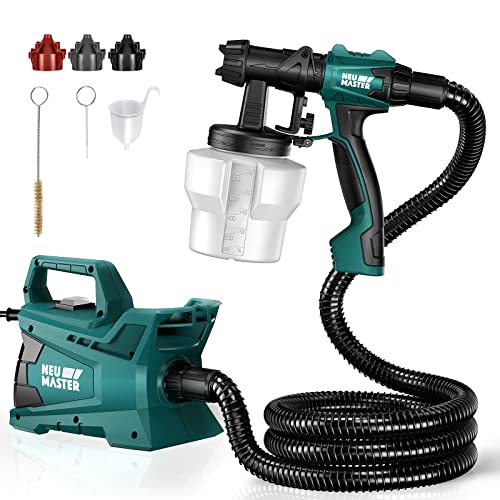
The NEU MASTER N3140 suits the buyer who has held a loaded handheld sprayer at minute forty and sworn never again. Its 600W turbine lives in a floor-standing base and feeds the gun through a 6 ft air hose, delivering the ergonomic layout of professional turbine systems at a fraction of their price. In-hand weight drops to the gun and its cup alone; sessions stretch; finish quality stops decaying with the operator’s forearm. For room days, fence runs, and batch work, that is not a comfort feature — it is a quality feature.
- Motor: 600W turbine in a floor-standing base unit
- Hose: 6 ft air hose between turbine and gun
- Patterns: 3 spray patterns
- Flow: adjustable flow control
- Best for: longer sessions, larger surfaces, fatigue-sensitive users
Strengths
- Lightest gun-in-hand in the tier — the endurance pick
- 600W is strong power for turbine money at this level
- Floor placement moves noise and heat away from the operator
Trade-offs
- Base-and-hose setup is more apparatus for small, quick jobs
- Brand ecosystem and spares trail HomeRight and Wagner
- The hose defines a working radius the handhelds do not impose
The turbine question is really a session-length question. Under twenty minutes, handhelds win on setup speed; over an hour, the turbine’s ergonomics win on finish consistency, because the last panel gets the same steady hand as the first. Buyers should audit their honest session lengths before choosing — most people overestimate them, which is why handhelds outsell turbines, and underestimate their fatigue, which is why turbine owners evangelize. A simple test: if your last big project left your forearm aching from a drill, a sander, or a roller, your spraying sessions will find the same limit, and the turbine’s layout is worth more to you than any specification on this page, and considerably more than the modest price difference separating it from the handhelds nearby on this same shelf of the store right now today. The honest limitation is spontaneity: this is a set-up-for-the-session tool, and the five-minute job belongs to the Finish Max below.
Best for: Long sessions and users who feel handheld weight / Not suited for: Quick small jobs or minimal-setup spraying

Wagner Control Spray 250 HVLP Stain Sprayer — Best for Stains and Sealers
The Control Spray 250 suits the outdoor-materials specialist: the homeowner whose spraying calendar is written in stain — deck in spring, fence in summer, outdoor furniture whenever it fades. Wagner tuned this handheld (model 0529042) for low-viscosity materials, and specialization shows: thin fluids atomize cleanly at its settings without the over-thinning dance generalists demand, and the controls are the simplest in the tier. Behind the tool stands the deepest support network in consumer spraying, which matters for a seasonal tool that must start reliably every spring for a decade.
- Type: electric handheld HVLP, model 0529042
- Tuned for: stains, sealers, and thin finishes
- Patterns: adjustable spray pattern
- Brand: Wagner Spraytech — full parts and support network
Strengths
- Purpose-tuned atomization for the materials outdoor projects actually use
- Simplest controls in the tier — seasonal users relearn it instantly
- Wagner’s parts depth suits a tool stored most of the year
Trade-offs
- Paints are outside its tuning even with thinning
- Small-project sizing means refills across a long fence
- Specialist scope: it will not grow with a paint-heavy project list
Specialists look narrow on paper and wise in practice. A household that sprays ninety percent stain gets more from a tool tuned to stain — its flow range centered where stain lives, its cleanup optimized for thin materials — than from a generalist’s compromise settings. The honest limitation is the boundary of the specialty: the first painted project exposes it completely, and households with mixed lists should take the Super Finish Max or VONFORN and accept their stain work at ninety-five percent of this tool’s ease.
Best for: Decks, fences, and outdoor stain-and-sealer work / Not suited for: Paints, enamels, or indoor furniture

HomeRight Finish Max HVLP Paint Sprayer (C800766) — Best Compact
The original Finish Max suits the buyer who values the smallest complete package in the tier: a handheld HVLP with a brass tip, three patterns, and a cleanup routine measured in minutes, from the same HomeRight line as our top pick but simpler, lighter, and cheaper. It is the apartment dweller’s sprayer, the closet-stored sprayer, the “one chair on a Tuesday evening” sprayer — and for stain-and-enamel furniture work, its single nozzle is not a compromise but a focus.
- Type: electric handheld HVLP
- Tip: brass spray tip
- Patterns: 3 spray patterns
- Flow: adjustable material flow control
- Best materials: stains, sealers, enamels, thinned paints
Strengths
- Most compact complete sprayer in the tier — storage is a shelf
- Fastest cleanup here; the small-job economics champion
- Brass tip and long production history promise years of service
Trade-offs
- Single nozzle narrows the material range versus its Super sibling
- Small container caps project scale
- Not a wall or volume tool
The Finish Max’s presence in an under-$100 guide, when it often sells for less than the under-$50 guide’s ceiling, is a statement about value rather than price: at any price it is the compact pick, and buyers choosing between it and its Super sibling are really choosing simplicity against range. Small-space households and small-project owners should choose simplicity without a second thought. The honest limitation is growth: a project list that expands will eventually want the tips, and the upgrade path is a second purchase rather than an accessory.
Best for: Small spaces, small projects, and cleanup-first owners / Not suited for: Varied materials or growing project lists
Wagner Control Spray Max HVLP Paint Sprayer — Best Step-Up
The Control Spray Max suits the buyer whose research keeps pointing one shelf up: a stationary two-stage turbine system (510W) with variable pressure control and two cup sizes — 1 quart for finish work, 1.5 quarts for volume — that behaves like the entry to professional turbine spraying. It is prose-only here because its street price usually sits just above a hundred dollars; it is included because the distance is small and the capability jump is the largest in this guide, and because many under-$100 shoppers are actually shopping for permission to buy it.
- Turbine: 510W two-stage, stationary unit
- Control: variable air pressure dial
- Cups: 1 qt and 1.5 qt containers included
- Output class: 2.7 PSI HVLP
Strengths
- Variable pressure adapts one system to the whole material book
- Stationary format: light gun, floor turbine, real session endurance
- Wagner support depth for a tool bought as a long-term station
Trade-offs
- Usually priced above this cap — a deliberate stretch, not a loophole
- Stationary system claims storage and setup the handhelds do not
- More parts to clean than any handheld here
Permission granted, with analysis: the Control Spray Max is the right buy for the reader whose projects are weekly, whose materials span stains to paints, and whose frustration with handheld weight or single-pressure tools is already real. It is the wrong buy as a first sprayer for occasional use, where its apparatus will sit idle and its price premium will never be exercised. The honest framing is that this guide’s cap is a budget, not a law — and budgets serve the buyer, not the reverse.
Best for: Frequent sprayers ready for a stationary turbine station / Not suited for: Strict hundred-dollar budgets or occasional use
Prose-only pick — street price usually sits just above this cap.
Comparison Table
| Pick | Type | Power / tips | Container | Needs compressor? |
|---|---|---|---|---|
| HomeRight Super Finish Max | Electric handheld HVLP | 450W; 3 brass tips | Attached container | No |
| VONFORN VF803 | Electric handheld HVLP | 700W; 4 nozzles | 1200 ml | No |
| NEU MASTER N3140 | Electric turbine HVLP | 600W; 6 ft hose | Gun-mounted cup | No |
| Wagner Control Spray 250 | Electric handheld HVLP | Stain-tuned nozzle | Attached container | No |
| HomeRight Finish Max | Electric handheld HVLP | Brass tip, single nozzle | Attached container | No |
| Wagner Control Spray Max | Stationary turbine HVLP | 510W two-stage; variable pressure | 1 qt + 1.5 qt | No |
How to Choose the Best Paint Sprayer Under $100
Choose the format before the model. Handheld, floor turbine, or stationary system is the tier’s real decision, because format decides session length, storage, and cleanup more than any specification. Handhelds own short sessions and small storage; turbines own long sessions; the stationary step-up owns both at a price in money and space. The model choice afterward is refinement. Our full framework in How To Choose A Paint Sprayer starts at the same place.
Interrogate the tip system. At this tier, tips are destiny: brass outlasts plastic, sets outrange singles, and the availability of replacement tips in five years separates tools from toys. Ask of any candidate: what tips exist, what do they cost, and who sells them? The answers are the ownership experience in miniature.
Match power to your thickest regular material. Every pick here sprays stain beautifully; they separate at enamel and part company at latex. Identify the thickest finish you will spray monthly — not once, monthly — and buy the tool whose comfort zone includes it with margin. Occasional extremes can be rented around; regular extremes cannot.
Price the five-year tool, not the first-season tool. A sprayer at this tier should serve five years. That horizon prices in gaskets, tips, and the probability the brand still supports the model — the arithmetic that quietly favors HomeRight and Wagner over anonymous rivals with better launch specs. Cheap tools bought twice are the expensive tools.
Test the cleanup story before the spray story. Every listing shows the sprayer spraying; few show it coming apart. Before buying, find the manual’s cleaning pages — they are public for the branded picks — and count the steps and the tools required. A cleanup you can picture yourself doing on a tired Sunday is a cleanup that will happen; one that reads like a service procedure will happen twice. At keeper tier, this single check predicts satisfaction better than any performance figure, because the tool’s second year is made of cleanings, not purchases.
Respect the stretch when it buys a system.
The Control Spray Max’s premium over this cap buys a format change, not a trim level. Format changes are the stretches worth making; cosmetic upgrades within a format rarely are. Know which kind of stretch you are contemplating before the cart decides for you.
Getting Tier-Quality Results: The Under-$100 Technique Standard
Key Takeaways
- At this tier the tool is no longer the limit — thinning accuracy and spray discipline are
- Log every material’s recipe; a hundred-dollar tool plus a notebook outperforms a costlier tool on memory
- Two thin coats remain the whole secret; this tier’s flow rates make them natural
- Strain every fill, without exception — this tier’s finer tips clog on debris that coarser tools forgive.
- Dial thinning with the viscosity cup and a test board, in small increments, and write the result down.
- Select the tip for the material before the session, not after the first sputter.
- Set the pattern to the workpiece orientation and confirm it on cardboard.
- Spray at a consistent 6–10 inches with half-overlap passes, edges first on paneled work.
- Respect flash times between coats; this tier rewards patience with glass-smooth builds.
- Clean to the standard the tool deserves: full fluid-path flush plus hand-brushed tip, every session.
- Inspect the tip and seals monthly if you spray weekly; replace wear parts before they announce themselves.
Problem: Orange peel on enamel despite correct thinning. → Distance or speed: move closer, slow slightly, and check that the tip size matches the material rather than the material you wish you were spraying.
Problem: The fan tails — heavy edges, light center. → Tip wear or partial obstruction. Clean the tip by hand; if the pattern persists, the tip is worn and replaceable — that is the system working as designed.
Problem: Finish quality varies between projects with the same settings. → Temperature and material batches vary; the logbook plus a test board per session absorbs both.
What This Tier Changes — And What It Does Not
It is worth stating plainly what the jump from fifty to a hundred dollars buys, because the marketing will not. It buys tips: interchangeable, brass, replaceable — the single largest quality-of-life upgrade in spraying. It buys support: brands with parts desks and manuals written by people who have used the tool. It buys format choice: the turbine layout enters, and with it, long-session comfort. And it buys headroom: motors and pumps sized with margin, so the tool works at seventy percent of its capacity on your hardest regular material instead of at its redline.
What it does not buy is equally important. It does not buy airless speed or whole-house volume; that wall stands until the next tier. It does not buy immunity from technique — thinning, straining, distance, and cleaning decide results at a hundred dollars exactly as they did at fifty, a truth Paint Sprayer Pros And Cons explores without sentimentality. And it does not buy the right to skip the test board. Nor does it buy silence about the tier’s real boundary: every tool here is a finishing instrument first and a coating instrument second, happiest laying measured films on prepared surfaces. The moment a project’s essence is coverage — raw square footage against a deadline — the physics of this tier stop being a personality trait and start being a schedule risk, and the wise owner recognizes the moment before the weekend does. The buyers who thrive at this tier are the ones who understand they have purchased capability, not outcomes; outcomes remain, as ever, a practice.
Ownership Costs at This Tier: Tips, Gaskets, and the Real Budget
A hundred-dollar sprayer is the anchor of a small economy, and honest guides should price the economy, not just the anchor. Tips are the recurring cost: they are wear parts, eroding gradually until the fan tails and the finish coarsens, and owners should expect to refresh the most-used size on a rhythm set by their volume — heavy users yearly, occasional users every few years. Gaskets and seals follow a slower clock, aging whether used or not, which is why stored sprayers sometimes greet spring with a drip. Strainers, filters, and cleaning supplies are the petty cash of the system: individually trivial, collectively the difference between a tool that is always ready and one that is always almost ready.
None of this is an argument against the tier — the total cost of five years of spraying here remains a fraction of one professionally painted room — but it is an argument for buying the brands whose parts are priced and stocked like parts, not like relics. When a replacement tip costs little and arrives in days, maintenance is a habit; when it costs a third of the tool and ships from nowhere, maintenance becomes archaeology and the tool’s death spiral begins. This is the concrete form of the “support” criterion repeated throughout this guide, and it is why two of the podium places belong to the brands with the deepest parts shelves.
Session Planning at This Tier: Cabinets, Rooms, and Fences
The under-$100 toolset changes how projects should be planned, because its capabilities redraw the line between a session and a saga. Cabinets become a one-weekend project with a rhythm: doors off and labeled Friday, primed Saturday morning, topcoated Saturday afternoon and Sunday, hung Monday — with the sprayer cleaned between materials and the kitchen masked once for the whole campaign. Rooms become a day: mask in the morning, spray walls with thinned latex through the largest tip in patient sections, and accept the HVLP pace as the price of control and gentle overspray. Fences become a two-session arc divided by gates and refill rhythm, with the turbine pick earning its premium on the second hundred feet.
The planning principle underneath is batching by material and orientation, not by geography. Everything getting primer gets it in one setup; everything spraying flat gets sprayed while the horses are out. This tier’s tools reward that discipline disproportionately, because their setups are fast and their cleanups are faster — the campaign, not the session, becomes the unit of work. Owners who plan campaigns finish the projects that session-by-session owners abandon in the middle, and the difference shows in houses: one has a finished kitchen, the other has four primed doors and a story.
Fine-Finish Work at This Tier: Cabinets and Furniture in Close-Up
This is the tier where close-range work becomes genuinely satisfying, and it is worth describing what changes at the surface. With brass tips and adequate power, enamel atomizes into droplets fine enough to level into a continuous film before they dry — the physical event that separates a sprayed finish from a textured one. On cabinet doors that means no orange peel in raking kitchen light; on furniture it means clear coats that read as depth rather than coating. The technique demands rise in step: dust discipline becomes visible in the result, so tack-clothing and a clean spray zone stop being virtues and become requirements; thinning accuracy shows, so the viscosity cup graduates from accessory to instrument.
The reward for meeting those demands is the tier’s signature satisfaction: work that survives close inspection by people who did not watch you make it. Visitors run a hand across a sprayed cabinet door and assume it was bought that way. For owners whose projects live at arm’s length — and most home projects do — this is the tier where spraying stops being a shortcut and becomes a craft, with tools finally capable of keeping up with the operator’s improving eye. That trajectory, more than any specification, is what the extra fifty dollars over the previous tier actually purchases.
Safety and Storage for a Keeper Tool
A tool bought to keep deserves keeper-grade safety and storage habits. Safety at this tier is unchanged in kind — fit-tested respirator matched to the material, eye protection, ventilation with an exhaust path, ignition discipline with solvents, sealed metal storage for solvent rags — but it gains a system: the gear lives with the sprayer in its bin, cartridges are replaced on a calendar, and the spray zone’s setup includes the safety setup as a single motion. Tools used for years accumulate exactly the familiarity that erodes caution; systems, not intentions, are what survive familiarity.
Storage follows the same logic. The sprayer is stored clean, dry, complete, and indoors, with its tips in a labeled case rather than loose in a drawer where their precision edges knock against wrenches. A keeper tool also earns a record: purchase date, tip changes, gasket changes, and the recipe log, kept together. Five years on, that record is the difference between a tool with a history and a tool with mysteries — and mysteries, in spraying, always resolve expensively. Treat the hundred-dollar tool like the five-year asset it is, and it will behave like one.
Where This Tier Sits in the Wider Lineup
Context sharpens choice, so here is the honest map. Below this tier, the under-$50 shelf offers the same brands’ simpler models and the house-brand kits: capable, narrower, and priced for experimentation. Above it, the under-$200 shelf changes the technology, not just the trim — handheld airless arrives with its speed and its demands, and the stationary turbines grow into systems with pressure control and hose-fed guns. This tier is the last one where HVLP handhelds are the whole story, and for the majority of household and workshop project lists, that story is complete: the work is furniture-scale, the finishes are HVLP-friendly, and the sessions are human-length.
The buyers who should not stop here are identifiable: those whose lists are dominated by rooms and exteriors (airless country), those spraying weekly for paying work (station country), and those whose materials run to the extremes of viscosity. Everyone else is standing at the category’s point of diminishing returns, where additional money buys refinement rather than capability. Recognizing that point — and having the discipline to stop at it — is the mark of the buyer this guide was written for.
Common Buying Mistakes
Buying launch specifications instead of support. The anonymous kit with the bigger motor loses to the branded tool the first time a gasket fails. At keeper-tier prices, support is a specification.
Confusing a stretch with a loophole. The prose-only step-up is named honestly; buying it while pretending the budget survived is how tool budgets quietly double. Stretch deliberately or not at all.
Underbuying tips. Owners who treat the included tip set as complete miss that tips are wear parts and material adapters both. A spare of the most-used size belongs in the first order.
Expecting airless behavior from HVLP money. This tier’s tools are superb within HVLP physics — gentle, controlled, finish-focused. Volume fantasies belong to Best Paint Sprayer Under $200; forcing them here produces only disappointment.
Skipping the recipe log because the tool is “good now.” Better tools forgive more, which makes their owners’ memories lazier. The log matters more, not less, as the material book grows.
Final Recommendation
The HomeRight Super Finish Max is the best paint sprayer under $100: the tier’s best finish quality, a real tip system, fast cleanup, and a brand that will support it for years. The runner-up is the VONFORN VF803 for buyers who price capability per dollar and spray volume — and the honest third path is the deliberate stretch to the Control Spray Max for readers whose sessions and ambitions have already outgrown handhelds. For the single-model deep dive on this tier’s flagship class, see Paint Sprayer Review, and for the beginner-specific cut of this same shelf, Best Paint Sprayer For Beginners Under $100. Buy once at this tier and the category goes quiet in the best way: the sprayer stops being a purchase you evaluate and becomes infrastructure you use — for the cabinets this spring, the fence next summer, and the furniture in between — which is precisely the outcome a hundred dollars is supposed to buy.
Frequently Asked Questions
Is a $100 paint sprayer worth it over a $50 one?
For anyone spraying more than occasionally, yes — the difference buys interchangeable brass tips, stronger support, and format choice, which are precisely the things that decide whether a sprayer is still loved in year three. Occasional users with one project type may never exercise the difference; the under-$50 tier serves them honestly. Frequency and variety are what the extra money feeds. Put in project terms: if your coming year holds one fence, buy the fifty-dollar tier and be happy; if it holds the fence, the cabinets, the doors, and a furniture habit, the hundred-dollar tier will repay its premium before the year is out, in finishes that need no excuses and a tool that never becomes the reason a project waits.
Can an under-$100 sprayer paint a whole room?
Yes, with thinned latex, the largest tip, and patience — the NEU MASTER’s turbine layout makes the longest room days the most comfortable here. What it cannot do is paint rooms at airless pace or spray unthinned latex happily. Occasional rooms: fine. Regular rooms: the next tier’s airless tools are the honest answer.
HVLP or turbine — are they the same thing?
Turbine describes where the air comes from; HVLP describes how the spray behaves. All the turbine systems here are HVLP sprayers whose air is supplied by an electric turbine rather than a compressor or a motor in the gun. The practical differences are ergonomics and session length, not spray physics — the fan, the thinning, and the technique are the same discipline.
How long should an under-$100 sprayer last?
Five years of regular project use is a fair expectation for the branded picks here, with tips and gaskets replaced as wear parts along the way. Many owners stretch well past that — the designs are simple, the wear parts are catalogued, and nothing in these tools is exotic. The sprayers that die young at this tier die of a single cause, dried finish in the fluid path, which is not a lifespan but a decision. Decide for cleaning, and the five-year expectation becomes the floor rather than the ceiling. The failure mode to fear is not wear but neglect: one dried load of paint in the fluid path can end any sprayer at any price. Cleaned same-day, these are half-decade tools.
What is the best under-$100 sprayer for kitchen cabinets?
The Super Finish Max, for its tip set and close-range finish quality; the VONFORN is the value alternative. Spray doors flat and off the boxes, prime and topcoat with the appropriate tips, and respect recoat windows — the process matters more than the badge, but this tier’s flagship makes the process easiest to execute well.
Which of these is best for a first sprayer?
The Super Finish Max, for most first-time buyers at this budget: its tip system forgives the thinning learning curve by letting the tool adapt, its cleanup is fast enough to build the habit that keeps sprayers alive, and its support depth answers beginner questions for years. The VONFORN is the alternative for buyers whose first projects are volume-heavy. First-timers with a purely stain-based list should take the Wagner and enjoy the simplest path. The beginner-specific rankings, including the under-$50 shelf, are in Best Paint Sprayer For Beginners Under $100.
Can these sprayers handle exterior house paint?
On sheds, fences, shutters, and trim — yes, with thinned exterior latex or acrylic through the larger tips, in sections, at HVLP pace. On whole-house siding, they are the wrong tool: the volume, the ladder work, and the duty cycle all belong to airless sprayers. The honest boundary is surface area per session; when a project measures in walls rather than pieces, rent or step up a tier.
Do I still need to thin paint at this price level?
Less, and less precisely — stronger motors and bigger tips forgive more — but yes, paints and enamels generally still want modest thinning for best atomization, and stains want none. The viscosity cup remains the referee. What this tier buys is margin: the difference between “thinned exactly right” and “thinned about right” stops mattering, which is a genuine quality-of-life upgrade.