Disclosure: As an Amazon Associate, umtsmarttool.com earns from qualifying purchases. Links to Amazon on this page are affiliate links; they cost you nothing extra. Prices and availability change often, so check the current Amazon listing before you buy.
Where to buy
This 2026 paint sprayer review examines the Graco Magnum X5 Electric True Airless Paint Sprayer — the stationary airless station that has defined its class for home users for years. The comparison set:
- Graco Magnum Project Painter Plus Electric Airless Sprayer — the entry station — Check on Amazon
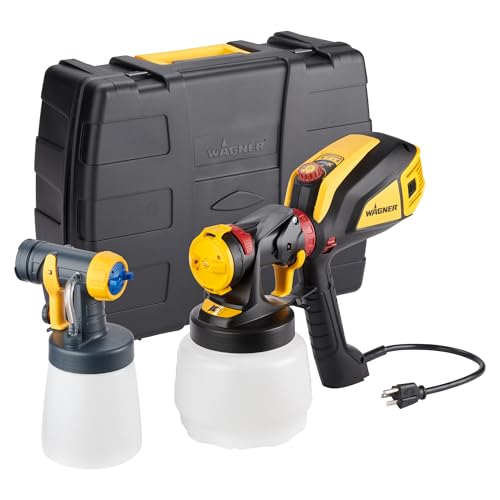
- Wagner Control Pro 130 Airless Paint Sprayer — the HEA rival — Check on Amazon
- Graco Magnum X7 Cart Airless Paint Sprayer — the step-up cart — Check on Amazon
Read the full guide ↓
Paint Sprayer Review 2026: The Graco Magnum X5, Re-Examined
An annual review carries a duty the ordinary review escapes: it must say what changed, what did not, and whether last year’s verdict survives this year’s evidence. The Graco Magnum X5 — a stationary electric airless sprayer on a stand, drawing paint from the can through a suction tube, driving it down up to 75 feet of hose to a metal gun — has been the default recommendation in its class for so long that reviewing it in 2026 risks ceremony. This examination resists the ceremony. The verdict, stated in this page’s tradition and defended below: the X5 remains the best stationary airless value for homeowners and serious DIY users in 2026, not because the class stood still, but because its definition of the class — pump capacity honestly rated, hose reach generously standard, parts supported like a professional line’s — has not been beaten at its price by any arrival since, including the HEA challenger examined alongside it. What has changed is the context: handheld airless has matured beneath it (see Paint Sprayer Reviews), flagship HVLP has converged above the furniture line (see Paint Sprayer Review), and the X5’s kingdom — the whole property, painted by its owner, season after season — is narrower and more clearly drawn than it was. Within that kingdom, it is still the king.
The review is research-led: specifications verified against Graco’s published data and stable listings, ownership themes from the model’s unusually deep documented record, no hands-on testing claimed, and this site’s standing rules observed — no fixed prices, no star ratings, limitations in the same type size as strengths.
In this guide
Quick Verdict
- Buy it if: your painting is property-scale — exteriors, multi-room interiors, fences by the hundred feet — and you want the proven station at the class’s value point.
- Skip it if: your work is a room at a time (handheld airless is easier to live with) or pieces and furniture (HVLP owns that ground entirely).
- The 2026 note: unchanged product, sharpened context — the X5’s case is now about fit, not default.
Specifications, Translated
- Pump: electric stationary airless, stand format, draws from 1 or 5 gallon containers
- Pressure: up to 3000 PSI class
- Flow: 0.27 GPM class
- Tip support: up to .015″ spray tips
- Hose: supports up to 75 ft of airless hose
- Rating class: up to 125 gallons per year recommended use
Each figure carries a practical translation. The 3000 PSI class and .015″ tip support define the material envelope: household latexes, primers, and stains at full consistency, with the heavy-coating territory beyond .015″ honestly ceded to larger pumps. The 0.27 GPM flow is the pace governor — a competent operator paints a house side in the rhythm the figure implies, neither rushed nor waiting on the machine. The 75 ft hose allowance is the specification owners praise most in the record, because it converts the station into a property tool: the pump stays at the can while the gun works a ladder, a fence line, a second story’s lower courses. And the 125-gallons-per-year rating is Graco’s duty honesty — a number that tells the weekend painter they are centered in the design envelope and tells the daily contractor, with equal clarity, to buy the professional line. Few consumer tools state their intended life so plainly, and the plainness is itself a reviewable virtue.
Design and Build
The X5’s design is the stationary format in its classic form: a pump unit on a folding stand, a suction assembly that drops into the paint container, a long hose, and a metal spray gun with a reversible tip. Nothing about it is styled, and everything about it is serviceable — the design language of equipment rather than of appliances. The choices that matter have aged well. The stand keeps the pump at working height and the can beneath it, so refills are a container swap rather than a pouring operation. The gun is metal, rebuildable, and unremarkable in the hand, which in airless is praise: the gun should disappear under the rhythm of the work. The hose management is the format’s known tax — 25-plus feet of charged line is a physical object with opinions — and the X5 neither solves nor worsens it. Build quality, across the model’s long record, is the class’s benchmark: the failures that dominate its complaint literature are wear and neglect items (packings, tips, filters, a prime valve asked to work dry) rather than structural surprises, which is the failure profile of a mature design honestly manufactured.
Performance: Exteriors and Volume
The X5’s home ground is the house itself: siding, trim at ladder scale, fences that measure in hundreds of feet, outbuildings, decks’ worth of railing at primer pace. Here the stationary format’s logic compounds — the pump never tires, the can never empties mid-wall (a five-gallon swap is a pause, not a rhythm), and the hose lets the operator’s body, not the machine, set the work’s geography. Unthinned latex at full consistency is the medium, and the finish it lays — even, fast, level — is the professional standard’s domestic edition. The 2026 context adds one honest comparison the older reviews lacked: a flagship handheld airless now paints a respectable fence, and a crew of one with a single room to do will finish sooner with the cup tool once setup is counted. The X5’s kingdom begins where those tools end — at the second elevation, the third room, the property’s full perimeter — and inside it, its pace advantage is not marginal but categorical.
Performance: Interiors
Indoors, the stationary format’s virtues invert partially, and the review should say so. The hose that liberates exterior work becomes an interior management problem — charged line across finished floors, a pump stationed in a doorway, a gun whose overspray demands the full masking ceremony in furnished spaces. For whole-house interior repaints (the empty rental, the new purchase, the renovation’s paint phase) the X5 remains the correct instrument: rooms in sequence, ceilings at pace, the can swapped in the hall. For the single occupied bedroom, it is overkill with a setup tax, and the handheld class examined in this series’ other reviews is the honest recommendation. A review that cannot route its own subject’s buyers elsewhere when the fit fails is a sales document; the X5 is good enough not to need one.
Setup, Priming, and Cleaning: The Station’s Rituals
Stationary airless has rituals, and the X5’s are the class’s standard liturgy: set the pump, drop the suction tube, prime until the return runs paint, bring the line to pressure, and spray. The priming step is the format’s rite of passage — the record is full of first-day frustration that resolves, permanently, into a two-minute procedure once the sequence is learned — and Graco’s documentation teaches it plainly. Cleaning is the format’s honest tax and the review will not minimize it: a full flush of pump, hose, and gun with water (or solvent, by material), the filters rinsed, the tip and guard scrubbed — a quarter-hour’s ceremony after a day’s painting, with storage fluid for the off-season as the final verse. Owners who run the rituals describe a machine that behaves identically across years; the complaint literature, again, is dominated by the rituals’ neglect. The 2026 note is that nothing in the class has repealed this tax — the HEA rival below pays it too — and buyers choosing stationary airless are choosing the rituals as surely as the pace.
The Comparison Set
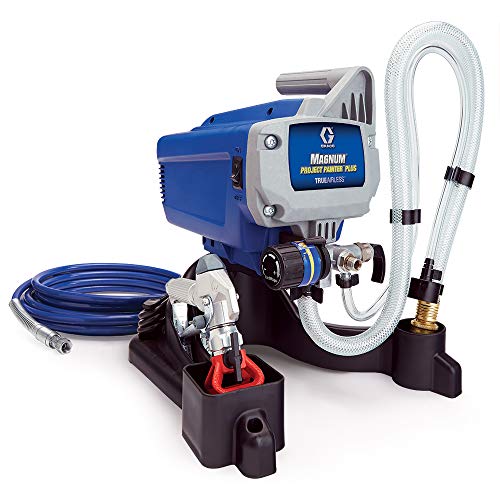
Graco Magnum Project Painter Plus (257025) — The Entry Station
- Pump class: 3/8 HP stationary airless, up to 2800 PSI
- Flow: 0.24 GPM class; tip support up to .015″
- Hose: 25 ft included class; rating up to 50 gallons per year
The Project Painter Plus is the X5’s smaller sibling and the class’s entry ticket: same format, same rituals, a lighter duty rating and a shorter standard reach. Its review in one paragraph: for the owner whose annual volume is honestly small — a room or two a year, a fence in alternate springs — it delivers the stationary experience at the class’s floor price, and its compromises (duty headroom, hose length) will never be invoiced. For anyone painting a whole exterior, the X5’s headroom is the correct purchase, and the price difference is the cheapest insurance in the class. The sibling relationship is the healthiest kind: the choice is a duty calculation, not a quality gamble.

Wagner Control Pro 130 — The HEA Challenger
- Type: stationary HEA airless with 1.5 gal hopper
- Hose: 25 ft; flow 0.24 GPM class; tip support up to .015″
- Claim: high-efficiency tips reduce overspray substantially
- Rating class: up to 50 gallons per year
Wagner’s Control Pro line is the class’s genuine 2026-era challenger, built on HEA (high-efficiency airless) tips that run at reduced pressure and claim substantially less overspray — a real advantage in occupied interiors and close neighborhoods, and this review credits it without reservation. The 130’s hopper format deletes the suction-tube arrangement for smaller work, and its manners are the class’s gentlest. The X5’s defense is depth rather than novelty: a higher duty rating, a longer hose allowance, a larger performance envelope, and a parts-and-knowledge ecosystem an order of magnitude deeper. Buyers whose work is interior-led and overspray-sensitive should weigh the challenger seriously; buyers painting properties should note that the class’s king defends his crown on exactly that ground.

Graco Magnum X7 (262805) — The Step-Up Cart
- Pump class: 5/8 HP stationary airless on a cart, up to 3000 PSI
- Flow: 0.31 GPM class; tip support up to .017″
- Hose: supports up to 100 ft; rating up to 300 gallons per year
The X7 is the answer to the X5’s honest limits: a cart format that rolls the station to the work, a stronger pump that opens the .017″ tip class and its heavier materials, and a duty rating that reaches toward semi-professional volume. Its presence in this review marks the class’s ceiling for homeowners — beyond it lies Graco’s professional line and a different conversation about money. The X5 buyer who reads the X7’s specifications with longing should perform the duty calculation honestly: if the annual gallons and the property’s scale invoice the difference, the cart is the correct purchase and this review blesses it; if not, the X7 is capacity bought for a workload that exists in the imagination, and the X5 remains the king of the real one.
What Changed Around It: The 2026 Context in Detail
An annual review should earn its date stamp, and the honest way is to inventory the context’s motion rather than the product’s. Beneath the X5, handheld airless matured: the FlexLiner generation made a room genuinely hand-portable, with variable speed adding control the class’s founders lacked — the effect on the X5 is a raised floor for its kingdom, since the single-room and small-exterior jobs that once defaulted to the station now have a better-matched home. Above the furniture line, flagship HVLP converged: two-nozzle handhelds now spray latex unthinned and finesse credibly, absorbing the “one tool for everything” buyers who once stretched a station across work it was never shaped for. Beside it, HEA technology pressed the overspray question from a manners footnote into a purchasing criterion, particularly for interior-led and close-neighborhood work. And across the whole category, the parts-and-documentation gap between the majors and the anonymous brands widened into a chasm that any 2026 review must weight more heavily than its predecessors did, because the installed base’s second five years are where that gap is paid. The X5 sits at the intersection of all four motions, diminished by none and clarified by each: its 2026 identity is the property-scale specialist, and the clarification is a service to buyers that the old default never performed.
The Ownership Record: A Decade of Evidence
Few consumer tools offer a reviewer what the X5 offers: an ownership record deep enough to read statistically. Its themes, accumulated across years of documented use, are consistent enough to state as findings. Finding one: the machine’s mechanical core — pump, motor, drive — is not the story; failures there are early-life warranty events, rare and resolved. Finding two: the ownership experience is decided in the fluid path and the rituals — packings, tips, filters, priming and flushing discipline — and owners who systematize those describe a tool of professional reliability. Finding three: the hose allowance is the specification most often praised in retrospect, because properties are larger than the rooms reviewers imagine, and reach converts directly into ladder moves not made. Finding four: the most common regret is not the machine but the match — buyers who purchased property capacity for room-scale lives, and buyers who purchased room tools for property lives and arrived at the X5 second, at the cost of the first purchase. A 2026 review’s highest use is to prevent finding four, which is why this page has policed the kingdom’s borders more carefully than it has praised the king.
The Exterior Campaign: A House, Painted by Its Owner
The X5’s definitive use deserves a narrative examination, because the whole-house exterior is where its specifications stop being figures and become a season. The campaign opens with preparation that dwarfs the spraying — washing, scraping, masking, the ladder plan — and the station’s first virtue appears before the trigger: it waits, set up at the can, for the work to be ready, taxing nothing. The spraying rhythm is the format’s signature: long passes down the siding’s courses, the gun’s distance held by the operator’s walking pace, the pump’s note constant in the background, the hose paying out behind like a supply line. Elevations change; the station does not move — the hose allowance absorbs the house’s height in lower courses and its length everywhere, and the five-gallon container swaps in a pause shorter than a ladder descent. Trim and detail bands slow the campaign to the gun’s manners — shields, patience, the reversible tip clearing the afternoon’s one clog in seconds — and the campaign closes each day with the flushing ritual, performed against the sunset with the house one elevation newer behind it. Owners’ accounts of this campaign share a tone no specification captures: it is the project that converts a homeowner into the house’s maintainer in their own eyes, and the X5 is the instrument of that conversion often enough that reviewing it as mere equipment understates the record.
Interior Campaigns: Rentals, Renovations, and the Empty House
The station’s second kingdom is the unoccupied interior: the rental between tenants, the purchased house before the furniture, the renovation’s paint phase. Here the campaign logic runs room to room with the pump stationed centrally, the hose reaching through doorways, ceilings and walls sprayed in sequence at a pace that turns a fortnight of brushing into a long weekend. The masking ceremony is the campaign’s admission price — floors, fixtures, and glass under film — and it is paid once per room by a crew of one who learns, by the third room, to prepare two rooms ahead of the gun. The finish the station lays in this setting is the landlord’s and the renovator’s standard: uniform, durable, fast — judged not at arm’s length but at the walkthrough, where its evenness reads as professionalism. The 2026 context note applies with full force: the occupied single room has left this kingdom for the handhelds, and a review that pretends otherwise misroutes real buyers. The empty house, though, remains the X5’s by right of pace, and the annual volume of empty houses — every sale, every tenancy change, every renovation — guarantees the kingdom’s population.
Economics of the Station: Cost per Gallon, Cost per Year
The X5’s economics reward the same honesty as its specifications. The tool’s price sits at the serious end of consumer airless; its ledger, though, is written in gallons and years. Against contractor pricing for a single whole-house exterior — labor-dominated, as all painting quotes are — the station’s purchase is recovered inside the first campaign, with the machine retained as capital for every campaign after. Against the handheld class, its per-gallon economics improve with volume (no bags, bulk containers, tips amortized across real distance) and worsen with idleness (rituals taxed on every small job). Against its own siblings, the duty ratings are the actuarial table: the Plus for the 50-gallon life, the X5 for the 125-gallon life, the X7 for the 300-gallon ambition, each priced so that buying one’s true rating is the cheapest strategy and buying above or below it is a donation. The review’s economic verdict mirrors its performance one: the X5 is not the cheapest way to paint anything, and it is the cheapest way to paint a property, repeatedly, at a professional standard — a sentence whose qualifiers are the entire content.
Safety at Station Scale
The annual review renews the class’s safety examination because the station’s scale amplifies every term of it. Injection hazard stands first, as it must in any airless document: at 3000 PSI the jet penetrates skin, the wound’s appearance lies about its severity, and the protocol is absolute — no body part in the fan’s plane, no hand used to feel for leaks (cardboard or wood serves), trigger locked and pressure relieved before any service, and any suspected injection treated as an immediate surgical emergency with the coating identified. The station adds its own verses: a charged hose is a stored-energy device that deserves the respect of one; ladder work with a gun in hand demands the third point of contact be planned rather than improvised; electrical discipline around water-based flushing in a pump’s vicinity is assumed rather than discussed, and should not be. The respirator and ventilation rules scale with output — a station puts more finish into the air per hour than any handheld, and the operator’s protection must be specified to the campaign, not to the tool’s marketing category. Graco’s documentation states these matters with the bluntness this review has praised before; the 2026 edition adds only that the installed base’s accident record, such as it is documented, clusters exactly where the documentation points — familiarity eroding protocol in the machine’s second and third seasons — which is an argument for re-reading the manual annually, as one re-reads any text on which a great deal depends.
Troubleshooting the X5: The Known Catalogue
A mature tool’s faults are a published catalogue, and the X5’s can be recited with the confidence of long acquaintance. Failure to prime, the first-day classic: air in the pump, a suction seal asking to be seated, or a prime valve that wants its procedure followed in order rather than in spirit — cured by the manual’s sequence performed literally, and rarely heard from again. Pressure loss or a motor that cycles at rest: a leak’s signature, sought at the tip, the packings, and the hose connections in that order, with the tip — the class’s true consumable — replaced before deeper surgery is contemplated. Tailing in the fan: tip wear, again, or a tip asked to pass material beyond its orifice class. Spitting at the gun: air in the line or a filter overdue for its rinse. The catalogue’s mercy is its legibility: every fault announces its neighborhood, every neighborhood has a procedure, and every procedure and part is documented by the manufacturer and a decade of owners who have performed it on camera. A reviewer can ask no more of a machine’s middle age than that its failures be this boring, and the X5’s are gloriously so.
Maintenance Across Seasons: The Station’s Calendar
The station’s longevity is a calendar, and the review records it because it is the difference between the model’s two ownership populations — the decade owners and the two-season disappointments. Per job: the full flush, filters rinsed, tip and guard cleaned, the machine left wet or stored by the book. Per season: packings inspected, the prime valve exercised and checked, hoses examined for the abrasion that properties inflict, the suction filter renewed on condition. Per year: the honest audit — gallons logged against the rating, wear parts renewed before they fail mid-campaign, storage fluid for the long rest, and the manual re-read in the specific sections the year’s work stressed. None of this is exotic; all of it is skippable exactly once per part, at the part’s price. The calendar’s total cost is an afternoon a year and a handful of honest parts, against which stands the machine’s alternative biography — the garage-sale X5, sold by an owner who skipped the calendar, bought by an owner who will run it and get the decade the first owner declined. The used market’s respect for this model is the calendar’s reputation, monetized.
Who Buys the X5 in 2026: A Typology Updated
The annual review’s typology has shifted with the context, and recording the shift is the year’s real news. The first-time homeowner with a whole house to rescue remains the archetype — the purchase is still, most often, a house’s fault. The landlord with a small portfolio has grown as a share: the duty rating fits their rhythm precisely, and the rental-interior kingdom keeps their machines in annual service. The serious DIY renovator — flipping, restoring, maintaining a family compound — is the third type, and the one most likely to pair the X5 with a finesse HVLP in the two-tool pattern this series describes. The types that have left the X5’s buyer pool are equally diagnostic: the single-room painter, now served by handheld airless; the furniture maker, now served by converged HVLP flagships; and the purely occasional user, now honestly routed to rentals by every guide including this one. A product whose buyer pool narrows to its true workload while its verdict holds is not declining — it is specializing, and specialization at maturity is what the annual review exists to certify.
The Challenger Question, Answered Fully
Because the HEA challenge is the year’s live question, it deserves a fuller answer than the comparison paragraph could hold. Wagner’s reduced-pressure tips genuinely reduce overspray, and in the settings where overspray is the binding constraint — occupied interiors, tight urban lots, interiors-led landlords — the Control Pro class is not merely competitive but arguably correct, and this review has routed those buyers there without hedging. The X5’s counter is not a counter-feature but a counter-profile: duty rating more than double, hose allowance triple, a professional-depth ecosystem, and a performance envelope (tips, materials, sustained pace) sized for the property rather than the room. The two profiles overlap in the middle — the large interior campaign — where the honest tiebreaker is the buyer’s own overspray sensitivity against their volume forecast. Annual reviews should resist declaring a winner where the workloads genuinely fork, and this one does: the crown metaphor survives only because the X5’s kingdom is the larger and older one, and even there, the challenger now holds the interior provinces by right of manners. Readers should choose by province, not by crown.
How This Annual Review Was Conducted
Method, stated as the series requires and the annual format sharpens. The examination is research-led: specifications and ratings verified against Graco’s published data for the current model year and stable retail listings; the ownership record read across the model’s long documented history, with this year’s themes weighted over the archive’s; challenger characterizations verified against Wagner’s published HEA data and the Control Pro line’s listings. No hands-on testing is claimed; no prices or star ratings appear, per this site’s standing rules — both move faster than an annual review’s useful life, and the verdicts here are constructed to survive their motion. The listings linked are ASIN-verified in this article’s sources file, pending the central team’s API confirmation of exact titles. Where the review renders judgment — class leadership, kingdom borders, the challenger question — it has tried to state the criterion before the conclusion, so that a reader whose weights differ can re-derive a different verdict from the same evidence. That is all an annual review can honestly offer: not a verdict from the mountain, but an accounting, current as of its date, by a method the reader is invited to audit.
Looking Forward: What Would Change This Verdict
An annual review should end by naming its own falsifiers — the developments that would move next year’s examination. Three are visible. First, a handheld generation that closes the duty gap: if cup-format airless reaches sustained property pace with its convenience intact, the station’s kingdom shrinks to the professional border, and the X5 becomes a niche within its own class. Second, an HEA advance that closes the duty gap from the other side: a challenger with the X5’s ratings and hose allowance, at overspray manners the interiors demand, would take the crown on the merits, and this page would enjoy writing it. Third, a shift in the housing stock’s painting economics — coatings that outlast the repaint cycle, or labor markets that reprice the contractor alternative — either of which rewrites every ledger in this series. None of the three has arrived as of this review’s date; the X5’s verdict therefore stands, stated with the confidence the evidence supports and the humility the annual format exists to enforce. The 2027 examination will begin, as this one did, by checking whether the king’s kingdom moved — because in this category, it is always the kingdom, and never the king, that changes first.
The Learning Curve, Revisited for 2026 Buyers
Each year’s buyers meet the station fresh, and the annual review should renew the curve’s description for them. The X5’s first day is its steepest: priming’s sequence, the hose’s physicality, the masking’s scale, and the flushing ritual all arrive together, and the record shows the first-day verdict splitting owners into those who read the manual first (who describe a manageable afternoon) and those who improvised (who describe a story). By the third session the rituals have become rhythm, and by the first campaign’s end the operator’s skills — walking pace, distance constancy, trigger timing, shield work at the trim — are the professional’s basics, acquired at property scale. The 2026 buyer’s advantage over their predecessors is the curriculum’s documentation: a decade of owners has filmed, written, and indexed every step and every fault, so the modern first day can be rehearsed before it is lived. The review’s standing advice holds across the years: rehearse with water, debut on the fence’s back run or the garage’s interior, and let the house’s elevations wait until the rituals are boring — because boring, in station operation, is the sound of competence.
Accessories and the Working Kit
The station’s working kit deserves its annual inventory, because the X5 is bought as a pump and lived as a system. The essentials, in the order owners add them: tip extensions for the ladder work the hose invites; a swivel at the gun for hose manners; spare tips in the working sizes, bought before the campaign rather than during it; a shield set for trim discipline; strainers and a dedicated flush bucket that lives with the machine; storage fluid for the off-season; and the log — in this class a gallon-and-material record that doubles as the duty rating’s odometer. The kit’s total is a modest fraction of the machine’s price and a large fraction of its lived quality, and the annual pattern is consistent: owners buy the kit across the first season, item by item, as each absence invoices itself once. The review’s shortcut is to invoice them here, in advance, at the price of a paragraph.
The Verdict’s Confidence, and Its Limits
It remains to say how confident this verdict is, and where the confidence ends — the annual format’s final duty. The confidence is high on the machine: a design this mature, with an ownership record this deep and a support infrastructure this complete, presents a reviewer with very little genuine uncertainty about what a buyer will receive. The confidence is high, too, on the class map: the borders drawn in this examination — handhelds below, HVLP beside, the cart and the professional line above — are visible in every manufacturer’s own lineup, which is the market agreeing with the review. The confidence ends at the individual workload, where it must: no review can know whether a given reader’s property, calendar, and temperament constitute the X5’s kingdom or merely border it, and the history of this model’s ownership regrets is precisely the history of readers who outsourced that judgment to a verdict — including, in past years, verdicts like this one. So the 2026 examination closes with its confidence properly assigned: total, on the machine; conditional, on the match; and insistent that the reader perform the match’s arithmetic themselves, with the duty ratings, the hose figures, and the campaign descriptions this page has laid out as the working numbers. A king whose kingdom you have honestly measured needs no reviewer’s blessing — but for the record, and for the fourth year in succession in this series’ accounting, he has it.
Strengths and Trade-Offs, Summarized
Strengths
- The class’s proven center: capacity, reach, and duty honestly rated
- Parts, documentation, and owner knowledge at professional depth
- Property-scale pace that handhelds cannot approach
Trade-offs
- Stationary rituals: priming, flushing, hose management on every job
- Overspray and masking at full airless scale
- Overkill — honestly — for room-at-a-time and piece work
Best for: Property-scale owners painting exteriors and multi-room interiors / Not suited for: Single-room, furniture, or occasional users
Frequently Asked Questions
Is the X5 still worth buying in 2026, or is it dated?
The design is mature rather than dated — a distinction the review has tried to earn. Its format’s fundamentals (pump, hose, gun, rituals) have not been superseded; the challengers compete on overspray manners and format details, not on the core proposition. What has genuinely changed is the surrounding map: buyers should confirm their workload is property-scale before defaulting to it, because the classes beneath it have become excellent. Fit first; then the X5, confidently.
X5 or the Project Painter Plus for a first station?
Run the duty calculation. Annual volume near or above a whole exterior, or hose reach beyond a room’s diagonal, argues for the X5’s headroom; a room-or-two annual rhythm argues for the Plus and a saved difference. The formats and rituals are identical, so the decision is purely actuarial — the healthiest kind of choice in the class, and one the log of a single season settles permanently.
How long does the X5 take to clean after a day’s painting?
Budget a quarter-hour for the full ceremony — flush, filters, tip and guard, and storage preparation when the season pauses — with the first performance of the ritual taking twice that while it is learned. It is the stationary format’s standing tax, identical in kind across the class, and the ownership record is unambiguous that the tax, paid, is what the machine’s decade is made of.
Can the X5 spray a car’s worth of fine finish or furniture?
It can spray furniture the way a framing hammer can drive a finish nail — powerfully and wrongly. Airless atomization at this scale is a coating instrument; fine furniture belongs to HVLP, whose examinations fill this series’ other pages, including How To Choose A Paint Sprayer for the full routing logic. The X5’s kingdom is planes, and it is a great king precisely because it does not pretend otherwise.

What wears out on an X5, and is it replaceable?
The wear set is the class’s standard: pump packings across seasons, tips across projects, filters across months, the prime valve eventually. Graco stocks all of it through normal and professional channels, the procedures are documented by the manufacturer and a decade of owners, and the machine’s serviceability is a core part of its value case — this is a tool designed to be maintained rather than replaced, priced and supported accordingly.
Final Recommendation
The 2026 verdict stands where the evidence put it: the Graco Magnum X5 remains the stationary airless recommendation for property-scale owners — proven where novelty is still auditioning, supported where rivals are still building, and honest about its rituals and its kingdom. Buy it when the workload is the property; route elsewhere, with this review’s blessing, when it is not. The full landscape it reigns within is mapped across this series — the handhelds in Paint Sprayer Reviews, the tiers in Best Paint Sprayer Under $200 — and the X5’s place on that map, narrower than its legend and stronger for it, is the real finding of this year’s examination. Buy it the way its best owners did: against a measured workload, with the working kit in the same season’s budget, the rituals learned before the first elevation, and the log opened on the first day — and the machine will repay the method with the only currency this category has ever really traded in, which is a property that looks cared for, painted at a pace that returns your weekends, by a tool that will still be answering, season after season, when the houses around it have changed hands and colors twice over. That is the whole of the 2026 case — not novelty, not nostalgia, but a mature machine, a measured kingdom, and an ownership record that has stopped surprising anyone who reads it carefully, which is the most durable compliment an annual review can pay and the one this examination, having audited the evidence once more from pump to tip, is pleased to renew — with the standing invitation, issued to every reader who has followed the examination this far, to hold next year’s review to the same standard: show the changed context, audit the record again, name the falsifiers, and let the verdict fall where the evidence, and not the anniversary, decides it should. Until then, the station stands where it has stood — at the can, hose coiled, ready for the season — and the properties of its owners will go on being painted, one elevation at a time, by the most thoroughly reviewed machine in its class — a distinction it earned the slow way, gallon by gallon and season by season, and one it shows every intention of keeping for as long as houses are made of paintable things — wood and stucco and brick and board, each waiting for its coat, each indifferent to fashion, each answering to exactly the kind of honest, unglamorous, well-supported machinery this review has spent its length examining, and which the coming season — like every season before it — will put to work again without ceremony, announcement, or doubt — only the steady note of a pump at pressure, the hiss of the fan, and the slow transformation of another house into its best-kept self, elevation by elevation, room by room, and gallon by honest gallon, until the work is done and the machine is flushed, stored, and ready for whatever the next year asks of it, in paint and in patience and in good steady daily care always.