A knife sharpening stone set is a collection of abrasive stones, usually in more than one grit, that you use with water or oil to grind a fresh edge onto a dull blade. Some sets are simple two-sided whetstones with a coarse side and a fine side. Others bundle several stones, a holder and an angle guide so a beginner can follow a repeatable routine.
This guide is for home cooks, hobbyists and anyone who has outgrown a pull-through sharpener and wants better control over the edge. The six picks below include Japanese-style waterstones, a bench-style combination stone, a guided stone system and a rod-based ceramic set. We have not used these products ourselves, so treat every description as a starting point and confirm the details on the current listing before you buy.
As an Amazon Associate we earn from qualifying purchases. Links below are affiliate links, and they do not change the product information we give.
What to Look For
| Feature | Why it matters |
|---|---|
| Grit range | A lower number cuts faster and repairs damage; a higher number refines and polishes the edge |
| Stone type | Waterstones, oil stones and ceramic stones wear and feel different on the blade |
| Base or holder | A stable base keeps the stone from sliding while you work |
| Flattening | Soft stones dish out over time and need a flattening plate or a lapping routine |
| Angle help | A guide or fixed rods take the guesswork out of holding a steady angle |
| Knife fit | Check whether the maker recommends the stone for kitchen knives, pocket knives or both |
No single feature decides the purchase. A beginner often gains more from a stable base and a clear grit pairing than from a premium stone they struggle to hold at the right angle.
In this guide
Specs at a Glance
| Set | Type | Grits | Notes |
|---|---|---|---|
| Sharp Pebble Premium Whetstone | Two-sided waterstone | 1000 and 6000 | Comes with a base; check the listing for extras |
| King KDS Combination Whetstone | Two-sided waterstone | 1000 and 6000 | Long-running Japanese brand |
| Imarku Whetstone Set | Two-sided waterstone | Usually 1000 and 6000 | Often sold with a holder and guide |
| Norton Combination Waterstone | Two-sided waterstone | Coarse and fine pairing | Check the listing for the exact pairing |
| Spyderco Tri-Angle Sharpmaker | Ceramic rod system | Medium and fine | Fixed angle slots; stores in the base |
| Lansky Deluxe 5-Stone System | Clamp-and-guide system | Several grits | Blade clamp with guide rods |
The 6 Best Knife Sharpening Stone Sets
Top pickBest for first-time sharpeners with kitchen knives
1. Sharp Pebble Premium Whetstone Knife Sharpening Stone
This is a two-sided waterstone that pairs a 1000 grit side for general sharpening with a 6000 grit side for refining the edge. It is sold as a beginner-friendly kit, and listings of this style typically include a non-slip base and a few accessories. Check the current listing for exactly what arrives in the box.
The 1000 and 6000 combination is the classic starting point for kitchen knives. The coarse side brings back a dull edge, and the fine side leaves it smoother and sharper to the touch. Waterstones of this kind are soaked or splashed with water before use, then flattened occasionally because they wear in the middle.
The fair trade-off is that a combination stone is a compromise. It will not repair a chipped blade as quickly as a coarse specialty stone, and it will not give the mirror finish of an expensive high-grit stone. For everyday kitchen knives, that is usually fine.
Suits: first-time sharpeners with kitchen knives. Strengths: a sensible grit pair and a base. Weaknesses: wears and dishes with use. Skip it if you need to repair chipped edges often.
View Sharp Pebble Premium Whetstone on Amazon
Best for learners who want a proven, widely taught stone
2. King KDS Combination Whetstone 1000/6000
King is a long-established Japanese maker, and its two-sided combination stone has been a common choice for home sharpening for many years. The pairing is a medium 1000 grit side and a fine 6000 grit side, so one stone covers both sharpening and finishing for most kitchen knives.
Many sharpeners like King stones because they are affordable relative to premium Japanese brands, they are soft enough to give good feedback, and they are widely documented in sharpening tutorials. That last point matters for beginners, because there are plenty of video guides that use this exact stone.
The trade-off is that the stone is soft, so it wears faster than harder stones and needs regular flattening. Some versions are sold with a plastic base and others without, so read the listing carefully and consider a rubber mat or holder if one is not included.
Suits: learners who want a proven, widely taught stone. Strengths: good feedback and a classic grit pair. Weaknesses: soft and needs flattening. Skip it if you want a hard, low-maintenance stone.
View King KDS Combination Whetstone on Amazon
Best for beginners who want everything in one box
3. Imarku Whetstone Knife Sharpening Stone Set
Imarku is better known for kitchen knives, and its sharpening set follows the familiar two-sided pattern with a coarse and a fine side. Listings for this style of kit commonly include a bamboo or rubber holder and an angle guide, which can make a first session less awkward.
An angle guide is a small clip or wedge that helps you keep the blade at a steady angle while you stroke it across the stone. It is not a substitute for practice, but it shortens the learning curve for people who find freehand sharpening intimidating.
The trade-off is that accessories in this category vary between listings and can change over time. Check which grits are included, whether the holder is part of the package, and whether a flattening stone is supplied or sold separately.
Suits: beginners who want everything in one box. Strengths: holder and guide in many listings. Weaknesses: contents can vary. Skip it if you prefer a single premium stone.
View Imarku Whetstone Set on Amazon
Best for sharpeners who want a larger, firmer stone
4. Norton Combination Waterstone
Norton is a long-running abrasives manufacturer, and its waterstones are aimed at woodworkers as well as people who sharpen knives. A combination waterstone pairs a coarser side for shaping with a finer side for refining, in a block that is typically larger and heavier than the budget stones in this roundup.
The larger surface gives you more room for long strokes, which helps with chef knives and longer blades. Because the stone is a firm slab, it also tends to sit steadily on the bench when placed on a damp cloth or a non-slip mat.
The trade-off is that Norton offers several grit pairings, and the exact numbers differ between listings. Read the title carefully to confirm which combination you are buying, and check whether a base or flattening accessory is included.
Suits: sharpeners who want a larger, firmer stone. Strengths: an established abrasives maker and a generous surface. Weaknesses: grit pairings vary by listing. Skip it if you want a compact kit with accessories.

Best for people who want repeatable angles without practice
5. Spyderco Tri-Angle Sharpmaker
The Sharpmaker is not a flat whetstone. It is a base that holds two ceramic rods at fixed angles, so you draw the blade straight down the rod and the slots handle the angle for you. It has been a popular maintenance tool for pocket knives and kitchen knives for a long time.
The appeal is repeatability. Because the angle is set by the base, you do not need to learn how to hold a stable angle by hand. It is best used to touch up an edge that is slightly dull, rather than to rebuild a badly worn one.
The trade-off is that the rods are good for maintenance and weaker for heavy reshaping, and the system works best on knives with a straight edge and a fairly standard angle. Check the listing for the rod grades supplied and any optional extras.
Suits: people who want repeatable angles without practice. Strengths: fixed-angle slots and a stored base. Weaknesses: less suited to heavy repair. Skip it if you want to learn freehand stone work.
View Spyderco Sharpmaker on Amazon
Best for guided sharpening with several grits
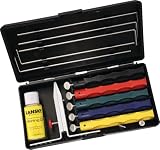
6. Lansky Deluxe 5-Stone Sharpening System
Lansky makes a clamp-based system in which the knife is held in a fixed clamp and the stones are fitted to guide rods that slide through angle-setting holes. The deluxe version includes several stones in different grits, so you can move from coarse to fine without buying anything extra.
This approach suits people who want the stone set and the guide together. Once the knife is clamped, the guide rod does the work of holding the angle, which can produce a consistent edge on a range of blades once you learn the routine.
The trade-off is setup time. Clamping each knife and changing stones takes longer than rubbing a blade on a whetstone, and the clamp works best on blades with a straight spine. Check the listing for the stone grits and whether a honing oil is supplied.
Suits: guided sharpening with several grits. Strengths: clamp, rods and multiple stones in one case. Weaknesses: slower setup per knife. Skip it if you want quick sessions at the counter.
How to Choose a Sharpening Set
Start with your knives. Everyday stainless kitchen knives respond well to a medium stone around 1000 grit, followed by a finer stone for finishing. Harder Japanese steels can take a finer polish, but they can also be less forgiving if you chip them by using the wrong angle.
Next, think about your patience. A whetstone rewards practice and gives you control over the edge, but there is a learning curve. A guided system or a rod-based kit costs you less skill and more setup time. Neither route is wrong; it depends on whether you enjoy the process or only want a sharp knife.
Finally, think about storage and mess. Waterstones need a tray or towel and some water, and they should dry fully before you put them away. A rod system is cleaner and fits in a drawer. If you only sharpen a couple of times a year, convenience may matter more than stone quality.
Stone Types and Materials
Waterstones are soft abrasives that release a fine slurry as you work. The slurry helps cut the steel, and the stone wears down as a result, which is why waterstones need flattening. They give excellent feedback, and they are the traditional choice for Japanese knives.
Oil stones use a different abrasive and are lubricated with oil rather than water. They are hard and long-lasting but can be messy, and once a stone has been used with oil it should not be switched to water. Ceramic stones and rods are very hard and wear slowly, which makes them well suited to maintenance honing.
Diamond plates are another option, though they are not part of the six above. They stay flat for a very long time and cut fast, but the feel is different and some sharpeners find them harsher. When a listing names the abrasive, note how the maker recommends lubricating and cleaning it.
First Use and Technique
Follow the maker’s instructions on whether to soak the stone or only splash it. Place it on a stable surface, using a damp towel or a rubber mat underneath so it cannot slide. Keep the stone wet while you work, since a dry waterstone cuts poorly and wears unevenly.
Hold the blade at a consistent, shallow angle and use light, even pressure. Heavy pressure does not make the edge sharper faster; it tends to make the angle drift. Work one side until you feel a thin burr along the edge, then switch sides and repeat.
Finish on the finer stone with lighter strokes, then rinse and dry the knife. Test the edge carefully on a piece of paper or a tomato rather than with your finger. If the edge catches unevenly, return to the coarser side and take a few more passes.
Care and Maintenance
- Flatten waterstones when the surface develops a visible dip, using a flattening plate or a coarse surface recommended by the maker.
- Rinse the stone after use and let it dry completely in open air before storing it.
- Keep stones away from freezing temperatures if the maker warns against it, since trapped water can crack a stone.
- Clean ceramic rods with a mild abrasive cleaner as the maker recommends if they become glazed with metal.
- Store the stones in a box or sleeve so the working face does not get chipped.
- Wipe your knife dry after sharpening to protect the fresh edge.
Mistakes to Avoid
- Skipping the coarse stone on a very dull blade and wearing out the fine stone.
- Letting the angle wander during each stroke.
- Using a stone that has not been flattened.
- Pressing hard, which can round the edge or damage the stone.
- Leaving a waterstone to soak for far longer than the maker advises.
- Sharpening a serrated blade on a flat stone not meant for it.
Understanding Grit: Coarse, Medium and Fine
A sharpening stone set usually includes stones of different grits. Coarse stones remove metal quickly and repair chips or very dull edges. Medium stones refine the edge, and fine stones polish it. Most home cooks work with a medium stone and a fine stone, using the coarse one only for repairs.
| Grit range | Typical job |
|---|---|
| Coarse | Repair chips, reshape edges |
| Medium | Regular sharpening |
| Fine | Refining and polishing |
Soaking, Lubricating and Stone Types
Some stones need soaking in water, some need a few drops of oil and some work with a splash of water. Check the maker instructions, and do not mix methods. Stones can dish out in the middle with use, so many sets include a flattening plate or recommend a method to keep them flat.
- Water stones are fast but need upkeep.
- Oil stones are durable and slower.
- Diamond plates stay flat and last long.
Holders, Guides and Bases
A non slip base keeps the stone steady while you work. Some sets include an angle guide to help beginners hold a consistent angle. A guide is helpful, but practice builds a feel for the angle. Choose a holder that fits your counter.
Technique, Safety and Common Mistakes
Place the stone on a stable base, wet it as directed and hold the knife at a steady angle, usually somewhere around the angle the maker recommends. Push the edge across the stone with light pressure, working both sides evenly. Feel for a thin burr on the opposite side, then switch. Finish with the fine stone and strop or wipe. Cut-resistant gloves can help beginners, and fingers should stay clear of the edge.
The main mistakes are pressing too hard, changing the angle and skipping the coarse step when the knife is damaged. Practice on an old knife first. Rinse the knife and dry it, clean the stone after use and store it dry. Different steels may need different methods, so read the maker guidance. Patience matters more than speed, and a well sharpened knife is safer and more enjoyable to use. If you are unsure, a professional sharpening service can show you what a properly finished edge looks like.
Grit Guide: Which Stone for Which Job
Stone sets list grit numbers that can seem confusing. A higher number means a finer stone. Use the table below as a general guide.
| Grit range | Typical job |
|---|---|
| Coarse (around 200 to 400) | Repairing chips and reshaping a damaged edge |
| Medium (around 800 to 1500) | Everyday sharpening of dull knives |
| Fine (around 3000 to 6000) | Refining and polishing the edge |
Check the instructions from the maker for each stone, since soaking and flattening needs vary.
Safe Sharpening Checklist
- Place the stone on a non-slip base or damp towel so it cannot move.
- Prepare the stone as the maker describes, by soaking or adding water.
- Hold the angle steady and work with light, even pressure.
- Keep your fingers behind the edge and clear of the blade path.
- Rinse and dry the knife when you finish.
- Flatten the stone from time to time as directed.
Practice on an inexpensive knife first, and take your time. If you are unsure, ask a professional sharpener to show you the basics. Store stones dry and away from freezing temperatures.
Stone Types Compared
| Type | General character |
|---|---|
| Water stone | Soaks in water and cuts quickly, needs flattening |
| Oil stone | Uses oil, durable and slower |
| Diamond plate | Flat and long lasting, cuts hard steel |
| Guided kit | Holds the angle for you |
Pick the type that fits your patience and your knives, and follow the care instructions from the maker.
Keep a small spray bottle or tray near your sharpening spot, along with a towel and a marker for checking the angle, so every session is organized, safe and repeatable.
Knife Sharpening Stone Sets FAQ
What grit should I start with?
For a dull kitchen knife, a stone around 1000 grit is a common starting point. Follow it with a finer stone around 3000 to 6000 for a smoother edge. A very damaged blade may need a coarser stone first.
Do I need to soak the stones?
It depends on the stone. Some waterstones are soaked before use and others only need a splash of water. Follow the maker’s instructions for your specific stone.
How often should I sharpen my knives?
It depends on how often you cook and how you store the knives. Many home cooks sharpen a few times a year and use a honing steel in between. Sharpen when the knife starts to slip on tomato skin or crush rather than slice.
What angle should I use?
Makers publish recommended angles for their knives, and the right value differs between Western and Japanese styles. Check your knife’s documentation and keep the angle steady rather than chasing a precise number.
Can I use a whetstone on serrated knives?
A flat stone is not the right tool for most serrated edges. They usually need a tapered rod or a specialist tool. Check the knife maker’s guidance first.
Why does my stone have a dip in it?
Soft stones wear where you use them most. A dished stone can round the edge of a blade, so flatten it with a flattening plate when the dip becomes noticeable.
Is a guided system better for beginners?
Guided systems and fixed-angle rods remove much of the angle guesswork, so many beginners find them easier. Whetstones offer more control over time but take practice.
How do I keep a stone from sliding?
Use a base that grips the counter, or place a damp towel or non-slip mat beneath the stone. Never sharpen on a surface where the stone can slip toward your hand.
The Short Version
For a beginner kit with a base, the Sharp Pebble. For a classic Japanese combination stone, the King KDS. For a box with a holder and guide, the Imarku. For a larger, firmer slab, the Norton. For fixed-angle touch-ups, the Spyderco Sharpmaker. For a clamp-and-guide system with several grits, the Lansky Deluxe.