Disclosure: As an Amazon Associate, umtsmarttool.com earns from qualifying purchases. Links on this page are affiliate links; they cost you nothing extra. Prices and availability change often, so check the current Amazon listing before you buy.
Parents shopping for air purifiers babys nursery guides all recommend tend to start with the same question — will it clean the air? — and discover, usually at 3 a.m., that the nursery asks harder questions than any other room in the house. Will it stay quiet enough not to surface a lightly sleeping newborn? Will its lights stay dark? Is every part of it safe around a child who will, in the fullness of time, pull up on it, chew near it, and post small objects into any available slot? This guide answers the cleaning question properly — HEPA filtration, correct sizing, honest carbon expectations — and then spends equal weight on the nursery-specific questions, because a purifier that cleans beautifully and glows like a lighthouse is the wrong machine for this room. The five picks below were chosen and verified against current Amazon listings with exactly that double standard in mind.
One framing note before the shortlist. A nursery purifier is a comfort and cleanliness appliance, not a medical device. It reduces airborne dust, pollen, dander, and the general particulate background of a lived-in home, and it can soften the odors of the world’s hardest-working small room. It does not sterilise anything, it does not replace ventilation, hand-washing, or keeping a sick household’s germs sensibly managed, and no claim in this article should be read as a health promise for your child. What it can honestly do — keep the air in the room where your baby sleeps measurably cleaner and fresher, quietly, safely, and without lighting the room up — turns out to be quite enough reason to buy one well, and to buy it before the baby arrives, while the household still has the evenings to set it up properly and the room still has days to be aired, arranged, and made ready.
Key Takeaways
- Quiet is the first nursery specification: look for a sleep mode in the low-to-mid twenty-decibel range on the listing, and a display that dims or switches off entirely.
- Choose filtration-only machines or machines whose extra stages can be switched off; skip ionizer-forward designs for a baby’s room, and never use an ozone generator in a nursery.
- Size for the room with headroom, so the machine cleans at its quiet speeds instead of straining audibly at high speed all night — headroom, in a nursery, is not wasted capacity but the direct purchase of silence, which is the currency this room values above all others.
- Placement is a safety decision: out of reach of the crib, cord managed and inaccessible, stable against a future toddler’s determined pull — and re-audited at every mobility milestone, because the room that was safe for a sleeping newborn is a different room entirely for a crawling, cruising, climbing one-year-old.
- The Coway Airmega 50 and Levoit Core Mini lead this shortlist for most nurseries — one for its night-light-aware design and monitor, the other for sheer small-room simplicity and silence — and every machine on the list was screened first for darkness, quiet, and physical safety, and only afterwards for the filtration numbers that most roundups would have started with.
The Nursery Standard: Five Tests a Purifier Must Pass
Test one — darkness. A nursery at night should be dark, because darkness is doing developmental work for your baby’s sleep cycles and practical work for yours during night feeds. Many purifiers fail here without ever mentioning it: bright status rings, always-on displays, a filter light with the presence of a small moon. The machines below were screened for displays that dim, lights that can be extinguished, or designs with minimal illumination to begin with. If you are comparing beyond this list, treat “display off” as a headline feature, not a footnote.
Test two — quiet at working speed. Every brand quotes its quietest setting; the nursery question is what the machine sounds like at the speed that actually cleans a small room overnight. Small rooms are forgiving — a compact machine’s middle speed is usually both sufficient and soft — but check the sleep-mode decibel figure on the listing and prefer the low twenties. A steady soft sound is, for most babies, neutral-to-soothing; a cycling, surging auto mode that hunts up and down can be more disturbing than a constant hum, which is why several parents end up running nursery machines on a fixed low-medium speed rather than auto.
Test three — clean technology only. A nursery purifier should clean by filtration: pre-filter, HEPA stage, modest carbon. Ionizing stages are the grey area — they are common, they are usually switchable, and the cautious nursery choice is a machine that either lacks them or lets you turn them off, which several picks below allow. Ozone generators are not a grey area at all: do not run one in a baby’s room. Ultraviolet lamps inside sealed consumer machines are a minor feature either way and should never be the reason for a purchase.
Test four — physical safety and stability. Read the machine as your future toddler will meet it: a low, stable base beats a tall tower; a covered or inaccessible fan intake beats an open grille at grabbing height; a cord that can be routed behind furniture and kept out of the room’s play zone beats one trailing across the floor. None of the picks below is a toy substitute for supervision, but they were chosen partly for shapes that forgive a toddler’s curiosity better than most.
Test five — honest cleaning for a small room. Nurseries are usually among the smallest rooms in a home, which is good news: even compact machines deliver many air changes per hour in a small volume, and the dust, pollen, and dander that constitute the nursery’s real particle load are squarely HEPA territory. Beware the reverse error — buying a large machine “for later” and running a big fan’s turbulence and noise in a tiny room now. Size for the nursery; the living room can have its own machine when the time comes.
In this guide
Quick Picks
| Model | Best for | Nursery-relevant trait |
|---|---|---|
| Coway Airmega 50 | Most nurseries, all-in-one | Night light feature, air quality monitor, auto mode, compact |
| Levoit Core Mini | Small nurseries, minimalists | Tiny, simple, very quiet, low cost of ownership |
| Blueair Blue Pure 511i Max | Larger nurseries and shared rooms | Night mode at a listed 19 dB, app control |
| Levoit Core 200S | Smart-home parents | App scheduling and voice control in a compact body |
| Medify MA-14 | Budget-minded, no-frills rooms | Simple controls, compact footprint, honest HEPA |
How These Picks Were Chosen
The screening began with the five tests above, applied before any filtration specification was read — a deliberate inversion of normal roundup method, justified by this room. Machines with non-dimming bright displays, no quiet sleep mode, or tall unstable formats were cut regardless of their cleaning credentials. Survivors were then compared on the ordinary virtues: HEPA-grade filtration from verifiable listings, room ratings comfortably above typical nursery sizes, replacement filters in current production from the brand itself, and controls a sleep-deprived parent can operate one-handed in the dark. Every pick was verified through this site’s own Creators API account, and the listings, ASINs, and images are recorded in this article’s sources file. Two popular categories were excluded on principle: purifier-humidifier hybrids, because a nursery appliance that needs its water tank scrubbed against mould is a maintenance burden this room does not need, and aroma-diffusing models used with scented oils, because fragrancing a baby’s air is the opposite of the goal.
The Five Nursery Picks in Detail

Coway Airmega 50 — Best Overall Nursery Pick
Badge: Best all-round nursery machine
- Filtration: HEPA and deodorization filters
- Coverage: bedrooms up to about 500 sq ft on the listing — generous for a nursery
- Extras: air quality monitor, auto mode, timer, night light
- Warranty: 2 years stated on the listing
The Airmega 50 reads as if Coway designed it from a nursery checklist. It is compact enough for the corner of a small room, its coverage rating gives it quiet headroom in any realistic nursery, and its feature set answers the room’s specific questions: an air quality monitor so you can see the room’s status at a glance during the day, an auto mode that works while you are busy elsewhere, a timer for run-and-stop routines, and a night light whose presence is a choice rather than an accident — soft illumination you control beats a status LED you cannot extinguish. The deodorization filter gives it honest capability against the nursery’s signature odor source, the sealed nappy bin that no parent in history has emptied quite as often as intended.
Day to day, this is the machine for parents who want the purifier handled: set it, let the monitor and auto mode run the room, and glance at the filter indicator when it speaks. Its carbon is a deodorization filter rather than a deep bed, so a nursery doubling as a laundry-drying room or sharing air with a smoking household member’s habits would outrun it — but that household has bigger air questions than this room. Within its brief, the Airmega 50 is the most complete answer in this roundup.
Strengths
- Purpose-suited feature set: monitor, auto mode, timer, controllable night light
- Quiet headroom in small rooms from its 500 sq ft class rating
- Compact footprint that suits nursery corners
Trade-offs
- No app control, if remote checking matters to you
- Deodorization filter is mid-weight, not a deep carbon bed
- Costs more than the simplest compact picks
Best for: most nurseries, especially first-time parents who want automation. Not suited for: app-first households or heavy odor environments.

Levoit Core Mini — Best for Small Nurseries and Simple Needs
Badge: Best compact simplicity
- Filtration: compact filter cartridge for small rooms
- Format: desktop-scale cylinder, fits a dresser or shelf corner
- Controls: simple, minimal — nothing to misconfigure at 3 a.m.
- Extras: fragrance sponge feature (this guide recommends leaving it empty in a nursery)
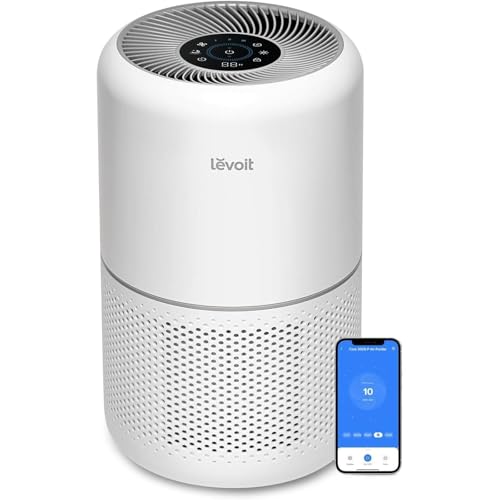
The Core Mini is the case for smallness. A nursery is a small room; the Mini is a small machine; the match is exact. It sits on a dresser rather than occupying floor that a crawling baby will soon claim, runs with the soft steadiness that nursery duty rewards, and asks almost nothing of its owners beyond an occasional cartridge change. Its cleaning capacity is honestly scoped — this is a one-small-room appliance, and within that scope it delivers the many air changes per hour that make small-room purification genuinely effective rather than theoretical.
Two notes of guidance. The Mini includes a fragrance sponge feature; in a nursery, leave it dry and unused, because the goal in this room is less in the air, not more. And if the nursery is actually a large shared bedroom, step up to the Core 200S below or the Blueair — the Mini’s charm is its fit to genuinely small spaces, and asking it to serve a big room wastes it. For the box room, the spare-room conversion, the apartment nursery corner: this is the pick.
Strengths
- Smallest footprint in the roundup; dresser-friendly
- Simple controls that cannot be mis-set in the dark
- Low purchase and running costs
Trade-offs
- Strictly small-room capacity
- No sensor, auto mode, or app
- Minimal odor capacity
Best for: small nurseries, apartment corners, and grandparents’ spare rooms. Not suited for: large shared bedrooms or odor problems.
Blueair Blue Pure 511i Max — Best for Larger Nurseries and Shared Rooms
Badge: Quietest night mode
- Filtration: HEPASilent filtration for particles and light gases
- Noise: night mode listed at 19 dB — the quietest figure in this roundup
- Coverage: rooms up to about 1,138 sq ft on the listing
- Controls: WiFi app, auto mode, 360-degree intake
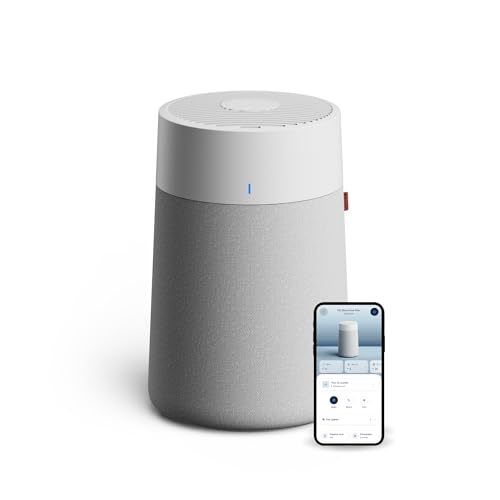
Some nurseries are not small: the primary bedroom shared with the baby, the generous second bedroom in an older house, the room that will become a sibling-shared space. The 511i Max serves those rooms with two nursery-critical virtues — a night mode whose listed 19 dB sits below the threshold most adults can hear across a room, and app control that lets a parent adjust the machine from the feeding chair or from bed without entering the baby’s sleep space and becoming the most interesting event of the night. Its 360-degree intake forgives placement against a wall, and the fabric pre-filter front can be vacuumed during the weekly clean.
Blueair’s HEPASilent approach pairs an electrostatic stage with mechanical filtration; in a nursery context, the practical translation is high airflow at unusually low noise, which is the whole game in this room. The machine is larger than the Mini or the Coway, and priced accordingly — buy it for the room that needs its capacity or the parent who needs its silence and remote control, not as a default.
Strengths
- Exceptionally quiet night mode at a listed 19 dB
- App control suits the feeding-chair reality of nursery life
- Capacity headroom for shared and larger rooms
Trade-offs
- Largest and priciest of the nursery-focused picks
- More capacity than a small nursery can use
- Replacement filters at the premium tier
Best for: shared primary bedrooms, larger nurseries, and noise-sensitive parents. Not suited for: tiny nurseries or tight budgets. The wider range is compared in the best Blueair air purifiers guide.

Levoit Core 200S — Best Smart Pick for App-Happy Parents
Badge: Best scheduling and voice control
- Filtration: 3-in-1 filter with HEPA stage
- Verification: AHAM Verifide on the listing
- Controls: smart app and voice control, sleep mode
- Format: compact cylinder for small to mid rooms
The Core 200S is what happens when the Mini’s compact logic grows a brain. App scheduling fits nursery rhythms precisely — a stronger cleaning run during the evening bath-and-bed routine, a drop to sleep mode at lights-out, a gentle morning cycle — and voice control, which sounds like a gimmick in every other room, is a genuine ergonomic feature when your hands are occupied by a baby and the machine needs adjusting. Its AHAM Verifide rating gives its room claims the independent backing this guide prefers, and its sleep mode keeps it nursery-quiet.
Set it up with the nursery’s darkness test in mind: use the app to manage the display behaviour from day one, and place it where its status light is not in the crib’s sightline. Owners who do that get the smartest small-room machine in this roundup; owners who skip the setup get a fine purifier with an avoidable glow. The cartridge routine is Levoit-standard — simple, widely stocked, replaced as one unit.
Strengths
- Scheduling and voice control genuinely suit nursery routines
- AHAM Verifide room rating
- Compact, quiet, and simple to maintain
Trade-offs
- Display management needs a deliberate setup pass
- Cartridge carbon is light-duty
- Smart features depend on home WiFi behaving
Best for: smart-home parents and shared bedrooms. Not suited for: anyone who wants a machine with no app and no lights at all. Bedroom-focused comparisons continue in the best air purifiers for bedroom guide.

Medify MA-14 — Best No-Frills Budget Pick
Badge: Best simple value
- Filtration: HEPA filter cartridge, removal to 0.3 microns per the listing
- Coverage: up to about 470 sq ft per hour on the listing
- Format: compact unit for small rooms
- Controls: straightforward on-device operation
The MA-14 is the pick for parents who have read the nursery gadget lists, felt the room spinning, and want one honest machine that cleans a small room’s air without apps, accounts, or ceremony. Its listing claims are modest and specific — a real HEPA filter, coverage sized for exactly the rooms this article is about — and its operation is the kind a visiting grandparent can manage without a briefing. In a small nursery it delivers ample air changes, and its simplicity is itself a safety and darkness feature: there is very little on it to glow, beep, or demand attention.
The compromises are the expected ones: no sensor to run an auto mode, no app, and a cartridge whose odor capacity is sized for freshness rather than for battle with a neglected nappy bin. Pair it with the boring disciplines — the bin emptied, the room aired when weather allows — and it serves a nursery perfectly well for years.
Strengths
- Simplest operation in the roundup
- Honest small-room HEPA specification
- Budget-friendly purchase and upkeep
Trade-offs
- No auto mode, sensor, or app
- Light odor capacity
- Manual speed discipline required
Best for: budget-minded parents and small nurseries. Not suited for: larger rooms or automation seekers.
Setting Up the Nursery Purifier: Placement, Cords, and the First Week
Placement. Put the machine where the room’s air actually circulates — a corner with clearance around its intakes, away from the crib rather than beside it, and not directly behind the door where its work is isolated from the room. A few feet of separation from the cot serves two purposes: the cleanest air in the room is the room’s mixed air, not a jet beside the baby’s face, and distance now becomes safety margin when the baby becomes a mobile investigator. Never place a purifier on an unstable surface, inside the crib’s climbing radius, or anywhere its cord must cross a walkway.
Cord discipline. Route the cord behind furniture, flat to the wall, out of the room’s play zone, and check it monthly as mobility milestones arrive — the setup that was safe for a newborn is not automatically safe for a pulling-up nine-month-old. If the only outlet forces a bad route, move the machine, not the standard. This is the least glamorous paragraph in the article and the most important one in it.
The first week. Run the machine on a medium speed for the first days to clear the room’s accumulated background — new-nursery air often carries paint, new-furniture, and gifted-textile emissions at their peak — then settle into the overnight routine: a stronger run during the bedtime hour, sleep mode through the night. Open the window instead whenever weather and outdoor air allow; the purifier is for the closed hours. Note the date the filter enters service, and set the replacement reminder now, while the instruction booklet is still in your hand.
What to expect, honestly. Within days, the room should smell like less — less dusty at changing time, less stale at the morning feed, less like the accumulated evidence of a small person living a full life in a small space. Parents of older babies add a subtler observation: the room recovers faster after the events that define nursery life — the leaked nappy, the upset stomach, the well-meaning visitor’s perfume — because the machine spends the hours after each event steadily processing the room back to neutral instead of leaving the air to clear itself by morning. Dust will still appear on surfaces, because a purifier reduces airborne load rather than abolishing dust, and the baby will still catch the household’s colds, because colds travel by hands and close contact more than by room air. Judge the machine on the room’s freshness and your own sleep, not on miracles, and it will pass its real test every night.
A note on monitors and peace of mind. Two picks in this roundup carry air quality monitors, and new parents sometimes ask whether the numbers should be watched anxiously. They should not. The monitor’s proper use is casual — a glance that confirms the machine is responding when the room’s life stirs the air, and a prompt to open a window on the days the room has been sealed too long. Air quality in a home is a background condition to be kept sensibly good, not a score to be optimised hourly, and the household that treats the display as information rather than judgement will sleep better — which, in a nursery, is the entire point of every appliance in it.
Scenario Guide: Which Pick for Which Nursery?
The apartment nursery corner. Space is the constraint and the Levoit Core Mini is the answer — dresser-top, quiet, and sized to the volume it serves. If the corner is part of the parents’ bedroom rather than a separate room, the Core 200S’s scheduling earns its upgrade.
The prepared second bedroom. The standard case, and the Coway Airmega 50’s home ground: a real room, a monitor to glance at, an auto mode to trust, and a night light under your control rather than the manufacturer’s.
The shared primary bedroom. The Blueair 511i Max, for its night-mode silence across a larger volume and its app control from the bed. Parents’ sleep is a nursery input too; protect it.
The nursery in a pet household. Any pick works harder here — dander is HEPA territory — but pre-filter discipline decides success. Choose the Coway or Blueair for their accessible pre-filters, vacuum them weekly, and keep the door’s gap in mind: the machine cleans the room it is in, so the cat’s favourite hallway nap spot is a separate problem. The best air purifiers for pets guide covers the rest of the house.
The allergy-aware household. Where a parent or an older sibling has significant allergies, weight verified filtration highest: the Core 200S’s AHAM Verifide rating or the Blueair’s capacity headroom, run consistently, with the door kept closed to hold the room’s cleaner air apart from the house’s. The best air purifiers for allergies roundup goes deeper on that household’s whole-home strategy.
Common Nursery Purifier Mistakes
Buying the humidifier combo. A tank of standing water in a warm room is a maintenance obligation with a mould deadline. If the nursery needs humidity, a simple, diligently cleaned separate humidifier — run only when needed — is the safer architecture than a combined appliance doing both jobs casually.
Running scented anything. Fragrance sponges, scented cartridges, and plug-in fresheners add volatile compounds to the one room whose air you bought a machine to simplify. The nursery should smell of nothing; that is the goal state, not a problem to fix.
Sizing for the house, not the room. A large machine at low speed is not automatically gentle — its bulk crowds a small room, its cord is longer, and its cost buys capacity the nursery cannot use. Small rooms reward small, quiet, well-placed machines.
Forgetting the filter in the plastic. The category’s classic setup error applies here with extra force: many machines ship with the filter sealed in a bag inside the unit. A nursery purifier run for a month with its filter bagged has cleaned nothing. Open the machine, free the filter, then start the clock.
Cleaning the nursery’s air with its door wide open. A purifier’s work belongs to the volume it shares, and a nursery door standing open all night merges the room with the whole home’s air — the machine then serves the hallway’s dust as faithfully as the baby’s room, and its careful sizing arithmetic dissolves. For sleeping hours, a closed or nearly closed door is part of the appliance’s installation. The exception is any household guidance about airflow and safe sleep in your own circumstances, which always outranks a filtration preference; where the door must stay open, size the machine for the merged volume instead and accept the compromise knowingly.
Judging by the first night. A purifier’s benefit is cumulative background reduction, not an event. Give it the first week at proper speeds before deciding, and check placement and the filter bag before blaming the machine.
What Is Actually in Nursery Air? A Calm Inventory
New parents are marketed to with fear, so this section trades in proportions instead. A typical nursery’s air carries the same background as the rest of the home — outdoor pollen and dust that entered on clothes and through cracks, skin and textile fibres shed by the household, pet dander where pets live, and the fine residue of cooking and cleaning elsewhere in the house — plus a few nursery-specific additions. New furniture, a new mattress, fresh paint, and new textiles emit volatile compounds most strongly in their first months, which is precisely when the baby arrives to meet them. The nappy bin contributes its honest share. And the room’s small volume means any of these concentrations build faster than they would in a large living room, which is the quiet scientific case for a purifier in this room specifically: small volume, continuous occupancy by the household’s smallest lungs, and a fresh-furnishing emission peak, all at once.
Against that inventory, filtration’s powers and limits map cleanly. The HEPA stage handles the particles — pollen, dander, dust, fibres — comprehensively and measurably. The carbon stage softens the gaseous side — bin odor and part of the new-furnishing emissions — within its capacity, which is why this guide’s picks favour honest deodorization over token sheets without pretending a compact machine scrubs a freshly painted room to laboratory purity. Ventilation handles what neither stage can: the fastest way to cut new-room emissions is to air the nursery thoroughly before the baby sleeps in it, ideally for days, with the purifier then maintaining the result through the closed-window nights. Sequenced that way — air the room, then filter it — the technologies stop competing and start cooperating.
Humidity deserves its own calm paragraph, because it is the nursery variable parents most often reach for a gadget to solve. Very dry air is uncomfortable; very damp air encourages mould and dust mites. A purifier does neither humidifying nor dehumidifying, and this guide’s exclusion of combo machines was deliberate: if the nursery’s humidity needs managing, a simple hygrometer tells you the truth first, and a plainly designed, diligently cleaned single-purpose appliance is the safer tool. The purifier’s job description stays what it was: particles and a share of gases, quietly, in the dark.
Budget Tiers and the Total Cost of a Cleaner Nursery
As category framing — not a quote for any model — nursery-suitable purifiers fall into three tiers. The entry tier, represented here by the Medify MA-14 and Levoit Core Mini, buys honest small-room HEPA filtration with simple controls and the lowest filter costs in the roundup; for a small nursery it is not a compromise, it is a correct specification. The mid tier, the Coway Airmega 50 and Levoit Core 200S, adds the quality-of-life layer — sensors, auto mode, scheduling, monitors — that busy parents genuinely use, at mid-tier filter prices. The premium tier, the Blueair 511i Max here, buys silence and headroom: worth it for shared rooms and light sleepers, unnecessary for a standard nursery. The pattern to notice is that the nursery’s small size compresses the tiers: unlike a living room, where premium capacity earns its money, the nursery rewards fit and quiet at every price, so the cheapest adequate machine is often the best machine.
Total cost over the nursery’s first two years is dominated by one cartridge or filter set per year at most for the compact picks — a modest figure that should never drive the decision toward an unverifiable no-name machine whose filter may vanish from sale before the baby walks. Buy from brands whose replacement filters are stocked under their own name today, as all five picks’ are, and the nursery’s air plan survives contact with the future.
A last word on hand-me-downs and gifts, because nurseries attract both. A relative’s spare purifier, or a gifted unit from a registry, can be a genuinely good start provided three checks pass: the model is filtration-based with no ozone function, a fresh genuine filter is fitted before first use (an old filter is a used consumable, whatever its remaining indicator claims), and its display can be dimmed or it can be positioned so its lights do not face the crib. Fail any check and the kind answer is a new compact pick from this list, which costs less than most of the furniture already in the room.
The First Year With the Machine: A Season-by-Season Walk-Through
Months zero to three — the newborn room. The purifier’s first tour of duty coincides with the nursery’s emission peak and the household’s most broken sleep. Run it as the setup section describes — a stronger early-evening cycle, sleep mode overnight — and expect its most noticeable contribution to be the room’s freshness at the morning feed, when a closed nursery that has held a baby, a bin, and two visiting adults all night would otherwise announce itself. This is also when the darkness discipline pays: any display glow you tolerated in week one will be renegotiated at week six, so set the machine’s lights correctly now. Visitors multiply in these months, and with them the room’s door opens and closes all day; the purifier’s quiet background work is what keeps the room’s air from becoming the sum of its visitors.
Months three to six — the routine room. Sleep consolidates, the routine sets, and the purifier becomes furniture in the best sense — unconsidered. Two maintenance beats belong in this season: the first pre-filter clean, which in a pet household will show you exactly what the machine has been sparing the main filter, and the first fresh-nose check of the room with the machine off for a day, which teaches you the difference it makes more convincingly than any specification. If the household is returning to work and the nursery becomes a daytime nap room only, scheduling features earn their keep here — a cleaning cycle timed to the hour before the evening return keeps the room ready without running hard all day.
Months six to nine — the mobile room. The baby rolls, crawls, and pulls up, and the purifier graduates from appliance to landscape. Re-audit placement and cord routing against the new mobility exactly as the setup section warned; move the machine before the milestone forces the question. This is also the season of weaning, and with it a new odor chapter that the deodorization stage will meet honestly if its filter is still within life — and will not, if the household has been deferring a change the indicator requested in month five. The machine’s demands stay small; the discipline is simply to keep meeting them on time.
Months nine to twelve — the toddler threshold. The room’s air story changes again: more outdoor time tracks more of the outdoors in, first shoes and playground clothes join the laundry cycle, and the purifier’s particle work quietly becomes the headline again after months when odor led. The first annual filter change typically lands in this season for compact machines — do it on the written date’s evidence, and notice how much of the old cartridge’s story is visible in its pleats. By the first birthday, the machine that was bought in a flurry of preparation has become what it was always meant to be: an unremarkable part of a healthy room, noticed only when a parent walks into a friend’s nursery and smells the difference.
Across all four seasons, the pattern is the same one this guide opened with: the nursery rewards the machine that fits its peculiar tests — dark, quiet, safe, simple — far more than the machine with the most impressive general specifications. Choose by those tests, maintain by the calendar you wrote on the filter, and the purifier will be one of the few nursery purchases that is still earning its place, uncomplained about, at the second birthday and beyond.
Registry and Gift-Buying Notes for Family and Friends
A surprising share of nursery purifiers arrive as gifts, so a short briefing for the gift-buyer belongs in this guide. If you are choosing for expectant parents, the rules simplify: buy from this shortlist’s middle — the Coway Airmega 50 for a standard nursery, the Levoit Core Mini for a small flat — buy it new from the brand’s own listing so the warranty and filter are beyond question, and include the first replacement filter as part of the gift if your budget stretches, because it converts a thoughtful present into a two-year solution. Resist the giant machine, however generous it feels: in a nursery, oversized is a burden dressed as a blessing, and the parents will quietly move it to the hallway by month two. Resist, too, the scented, the glowing, and the gadget-combo — the nursery aesthetic that matters is darkness, quiet, and air that smells of nothing at all. And if the parents have already chosen a model for their registry, buy that one and the spare filter for it; in nursery equipment, the researched choice of the household beats the surprise upgrade every time.
Parents building the registry can apply the same logic in reverse: register the machine and its spare filter together, note the model in the household records with its filter’s part name written out in full, and file the warranty before the baby arrives and paperwork becomes archaeology. The families who get the most from these machines are, without exception, the ones whose future selves can reorder the right filter in thirty seconds at midnight — a small administrative grace that is entirely arranged in advance.
Twins, Siblings, and the Second Time Around
Twins change the nursery’s arithmetic without changing its principles. The room’s occupancy doubles, its laundry and bin cycles quicken, and its door opens twice as often — but its volume is the same, so the sizing guidance holds: a machine rated comfortably above the room’s area still delivers its air changes, and the picks above, particularly the Coway and the Blueair with their headroom, serve a twin nursery without upgrading to a living-room machine. What does change is the maintenance tempo: expect the pre-filter and the deodorization stage to live at the fast end of their intervals, and keep the spare filter in the house rather than on a shopping list. For siblings sharing a room, the same logic scales by occupancy rather than by heads — judge by the room and its traffic, and weight the darkness and quiet tests even higher, because two children’s sleep is now riding on the machine’s manners.
Second-time parents, finally, get to skip the research and go straight to the audit: the machine from the first nursery is usually the right machine for the second, after three checks — a fresh genuine filter, a display-and-cord review against everything the household has learned, and an honest fresh-nose test of its odor work. Experience is the one nursery upgrade that cannot be bought, and it applies to air as to everything else.
One more nursery-specific note belongs in the record: the machine you choose will outlast the nursery itself, graduating to a child’s bedroom and then to wherever the family’s air needs it — which is why the wider field in the best air purifiers roundup is worth a glance even when this guide’s shortlist fits.
Final Recommendation
For the typical nursery — a small, dedicated room and parents who want the subject handled — the Coway Airmega 50 is this guide’s answer: monitored, automated, compact, and designed with a night light you control. Choose the Levoit Core Mini when the nursery is genuinely small or the budget is genuinely tight, the Blueair 511i Max when the room is large or shared and silence is precious, the Levoit Core 200S when scheduling and voice control fit your household’s rhythms, and the Medify MA-14 when you want honest filtration with no digital layer at all. Whichever you bring home, place it safely, manage its cord like a toddler is already auditing it, free its filter from its bag, write its start date on that filter in pen, and let it do its quiet work in the dark — tonight, and for the hundreds of nights that follow.
Related guides
Frequently Asked Questions
Is an air purifier safe to run all night in a baby’s room?
A filtration-based purifier from a reputable brand, placed with clearance and a managed cord, is designed for continuous operation and is commonly run all night in nurseries. Choose models without ozone generation, switch off ionizing stages if the machine offers the choice and you prefer filtration only, and keep the machine out of the crib’s reach as the baby grows. The purifier supports a clean, comfortable room; it does not replace safe-sleep practices, which remain the foundation.
What size purifier does a nursery need?
Nurseries are small, so most compact machines suffice — look for a verified or credibly stated rating comfortably above the room’s square footage, which gives the machine headroom to clean at its quiet speeds. A rating around the class of the picks in this guide — a few hundred square feet — covers essentially any nursery and most shared bedrooms. Oversizing far beyond that buys noise, bulk, and cost without cleaner air.
Will a purifier help my baby sleep better?
Indirectly, at most. A purifier’s steady soft sound can mask household noises that startle babies, and cleaner air can mean a less stuffy room — both of which many parents value. But a purifier is not a sleep aid, and no honest guide should promise sleep outcomes. Buy it for air quality and judge it on air quality; treat any sleep benefit as a welcome side effect.
Should I choose a purifier with UV or ionizer features for germs?
No — not for that reason. Consumer UV stages act briefly on air passing close to the lamp and are not a sterilising system for a room; ionizers are a supplement some parents prefer to avoid in a baby’s space altogether. The filtration core — pre-filter, HEPA, modest carbon — is what demonstrably cleans nursery air. Germ management in a nursery is mostly hands, laundry, ventilation, and keeping unwell visitors’ cuddles kindly postponed.
Where exactly should the purifier go in the nursery?
In a corner or against a wall with clear space around its intakes, a few feet from the crib rather than beside it, with the cord routed behind furniture and out of the play zone. Avoid placing it on wardrobes where vibration and height create risk, inside the cot’s climbing radius, or directly in front of a radiator or humidifier, whose output loads the filter and confuses sensors.
Can the purifier share the room with a humidifier?
Yes, with placement sense. Keep the two appliances apart — ideally on opposite sides of the room — so the purifier is not inhaling the humidifier’s output directly, which would load its filter with moisture and mineral dust and confuse any air quality sensor. Run the humidifier only when the room’s humidity genuinely needs raising, keep its tank scrupulously clean, and let the purifier run continuously as usual. The pairing is common in winter nurseries and works well when neither machine is asked to sit in the other’s exhaust.
When should I buy the purifier — before the baby arrives or after?
Before, if you can, and by enough margin to matter. Setting up in advance lets you air the nursery, run the machine through its first days, sort out its light and sound settings, and discover any placement problem while the household still has evenings to solve it in. It also means the machine is quietly working during the very weeks when new-furniture emissions peak. Buying after the birth is not a failure — the machine will still do its whole job — but the parents who buy ahead consistently report the smoother first month, and in nursery economics that is worth more than any sale saving.
How often will I change the filter?
Follow the machine’s indicator and the brand’s stated interval — typically somewhere in the six-to-twelve-month range for compact cartridges in ordinary homes, shorter in pet-heavy or dusty ones. Note the start date on the filter itself with a pen; in the nursery year, nobody remembers when anything was installed, and the written date settles every later argument with yourself.