Disclosure: As an Amazon Associate, umtsmarttool.com earns from qualifying purchases. Links on this page are affiliate links; they cost you nothing extra. Prices and availability change often, so check the current Amazon listing before you buy.
Most air purifier shopping is a conversation about rooms — their sizes, their smells, their occupants, their pets and their seasons; high cadr air purifiers are where the conversation becomes arithmetic, and the arithmetic, unusually for this industry, can actually be checked. CADR — Clean Air Delivery Rate — is quite simply the one number in this category that is measured rather than marketed: the volume of filtered air a machine delivers per minute, tested under a standard protocol in a sealed laboratory chamber, and the figure from which every honest coverage claim in the industry is, or should be, derived. A high-CADR machine is not a better purifier in the sense of cleaner air per pass; it is a faster one, cycling a large room’s air often enough that the room’s continuous pollution — the cooking, the shedding, the litter, the street outside the window — never gets ahead of it, which in a lived-in room is the only kind of clean there is. This guide explains how to read the number and its AHAM verification, sizes it against real rooms with the standard rule, and profiles five verified machines that live at the fast end of the category, from a tall tower built for great rooms to a wide console built for open plans. If your space is a bedroom, most of these are more machine than you need, and the guide will say so in as many words; if your space is a workshop, a wildfire-season living room, an open-plan floor, or a great room with a stove in it, they are the shortlist — and the arithmetic in the next sections will show you which of them is yours.
Key Takeaways
- CADR is measured, comparable, and verifiable through AHAM’s independent program — the rare specification in this category that can be trusted across brands, provided you compare the same pollutant’s figure (dust, pollen, and smoke CADRs differ, sometimes widely).
- The sizing rule: a machine’s smoke CADR should be at least two-thirds of the room’s square footage for the standard protection level; more headroom buys quieter running and longer filter life, because a big machine at medium beats a small one at maximum on every axis that matters across a decade of ownership.
- Manufacturer coverage claims use different air-change assumptions, sometimes a quarter of the standard’s; the AHAM-verified room size is the only coverage number that means the same thing on every box, in every brand, in every model year.
- High CADR is bought with size, fan power, and filter area — the machines below are furniture, not accessories, they are delivered like furniture and they anchor rooms like furniture, and their filters are priced in proportion to all of it.
- Speed is a strategy, not a setting: run high-CADR machines hard during events (cooking, smoke episodes, gatherings, the dog’s post-walk shake) and let auto or medium carry the ordinary hours, so the filters and the quiet are both spent where they matter.
What CADR Actually Measures
CADR answers a question that filter specifications cannot: not how clean the air is when it leaves the machine, but how much clean air the machine delivers into the room per minute — the product of its airflow and its capture efficiency, measured in a test chamber as the rate at which the machine removes dust, pollen, and tobacco smoke respectively, each reported separately because each behaves differently in air. The three figures differ because the particles differ in size and behaviour, and the smoke figure — the finest fraction, the hardest to catch and the closest cousin of wildfire and cooking aerosols — is the conservative one to size by, the one this guide uses throughout. The measurement’s virtue is comparability, and it cannot be overstated in a category this fogged: a verified CADR from one brand means the same thing as another’s, in the same units, under the same protocol — which is more than can be said for coverage claims, wattage boasts, decibel figures quoted at unstated speeds, or the category’s various trademarked filtration names, each of which means exactly what its owner wishes it to mean. AHAM’s verification program is the figure’s custodian — machines in it are tested, listed, and periodically re-checked, with an official room size derived from their CADR by the standard’s own formula — and this guide’s picks were chosen from that verified world, deliberately and without exception. The air purifier comparison tool guide in this series walks the full worksheet for comparing machines on these terms.
The Two-Thirds Rule and the Headroom Principle
The standard sizing rule falls directly out of the measurement, and it is worth deriving once so that it never has to be taken on faith: for the protection level the standard contemplates — roughly four to five air changes an hour in the verified room, at ordinary ceiling height — a machine’s smoke CADR should be at least two-thirds of the room’s square footage. A 300-square-foot room, then, asks for a smoke CADR of 200 or better; a 600-square-foot great room asks for 400; and the reader can extend the line in either direction with confidence, because it is a line — the relationship does not bend at the sizes where brochures begin to improvise. Two refinements separate competent sizing from box-reading, and both are confessions that floor plans make reluctantly. First, ceilings: the rule assumes ordinary ceiling height, and a vaulted space is a bigger room than its floor plan confesses — size by volume when the ceiling climbs, treating every extra foot of height as extra floor you cannot see. Second, headroom: a machine sized exactly to its room must run near maximum to hold its rating, and maximum is where noise lives, where filter life shortens, and where the machine’s welcome in a lived-in room wears thinnest. The high-CADR philosophy — the one this entire guide is written to convert its readers to — is to buy one size up and live at medium: the same delivered air, at a conversational volume, with filter life extended by the gentler pace and the machine’s dignity, in a furnished room, intact. Every machine below was picked with that principle available to its buyer, and with enough genuine capacity above its verified room that the principle is a choice rather than a strain.
Reading a CADR Claim Like an Auditor
Since this category’s entire honesty rests on one number, the number deserves an auditor’s paragraph. A CADR claim is trustworthy in proportion to its paperwork: AHAM Verified, with the machine findable in the program’s directory, is the gold standard; a claim of testing “to the standard” without verification is silver — plausible, unconfirmed; a coverage figure with no CADR anywhere near it is neither, and should be converted by scepticism alone. Check that you are comparing the same pollutant’s figure across machines, since dust CADR flatters and smoke CADR confesses. Check the speed at which the figure was earned — CADR is a maximum-speed measurement, which is precisely why the headroom principle exists. And check the room-size derivation when one is offered: divide the claimed square footage into the CADR and see whether the implied air-change rate resembles the standard’s, or resembles marketing. Five minutes of this arithmetic, performed once, will sort any shelf in the category into the verified, the plausible, and the decorated — a skill worth more than any single recommendation in this guide, including this guide’s.
The auditor’s section closes with the directory habit, which takes ninety seconds and outlasts every recommendation in this article: before money moves, find the machine in AHAM’s directory and read its official room size with your own eyes. Listings change, model suffixes multiply, and a machine verified under one variant is sometimes sold under a near-identical name that was never tested. The directory is the category’s land registry; consult it the way you would any registry — not from distrust of the seller, but because the document exists precisely so that trust does not have to be improvised.
In this guide
Quick Picks
| Machine | Badge | Verified coverage headline | Character |
|---|---|---|---|
| Blueair Blue 211i Max | Best all-round speed | AHAM Verified; large-room headline up to 3,235 sq ft (manufacturer figure) | Fast and unusually quiet |
| Medify MA-112 | Maximum coverage | Manufacturer headline 5,948 sq ft in one hour | The great-room specialist |
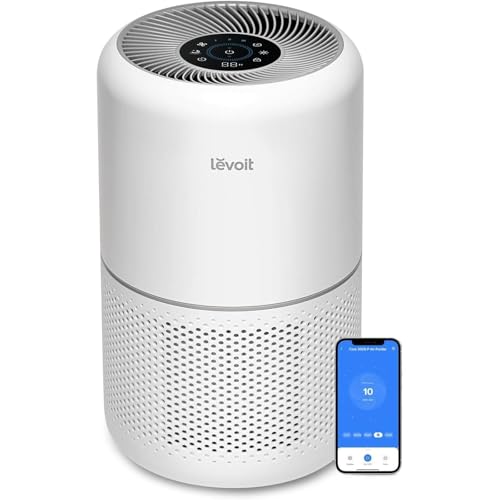
| Levoit Core 600S-P | Smart-home speed | AHAM Verifide; headline up to 2,933 sq ft | Connected and capable |
| Coway Airmega 400 | Open-plan console | Manufacturer headline up to 3,120 sq ft | Wide format, long warranty |
| Winix 5520 | Carbon with its speed | Manufacturer headline 1,882 sq ft in one hour | High deodorization carbon |
How the Picks Were Chosen
Each machine below was verified through the Creators API for this article: listing live, filtration as described, and — the criterion that defines the category — a genuinely high delivered-air figure, anchored where available in AHAM verification rather than in the manufacturer’s largest font. The set spans the format range of fast machines (tower, console, cabinet) and the control range (connected and manual), and every pick carries the running-cost honesty this guide applies throughout, stated once here so it need not be whispered in each profile: high CADR is achieved with big filters, and big filters are the category’s premium consumable, budgeted for or regretted. Machines whose speed claims rested on unverifiable arithmetic were left out of this guide, however large their numbers and however glossy their cabinets; in this corner of the catalogue, the verified figure is the product, and everything else — the finish, the features, the font sizes — is commentary upon it.

Blueair Blue 211i Max — Speed Without the Roar
Badge: Best all-round speed
- Filtration: HEPASilent — electrostatic plus mechanical capture
- Verification: AHAM Verified on the listing
- Headline: large rooms up to 3,235 sq ft (manufacturer figure)
- Extras: Wi-Fi, auto mode, fabric pre-filter; quiet operation from 23 dB on the listing
The 211i Max’s trick is delivering tower-class speed at sound levels the class rarely manages, courtesy of its hybrid capture: particles charged and caught with less resistance for the fan to fight, which is precisely the engineering that converts CADR into quiet. In the headroom philosophy of this guide it is the easiest machine here to live with at full commitment — auto mode minding ordinary hours, its speed arriving without ceremony when the kitchen or the season demands. Its pre-filter is fabric and washable in spirit, catching the coarse load before the main filter’s expensive depth. For a large living room that doubles as the household’s cinema, it is the pick that asks the fewest compromises.
Strengths
- Verified speed with class-leading quiet
- Auto mode and app for event-driven households
- Fabric pre-filter extends main filter life
Trade-offs
- Light carbon — speed, not odor depth, is its brief
- Main filters are a premium consumable
- Hybrid capture is not literal True HEPA (see the technology guide)
Best for: large living rooms wanting speed and quiet together. Not suited for: odor-led briefs or HEPA literalists. Its brand context sits in the best blueair air purifiers roundup.

Medify MA-112 — The Great-Room Specialist
Badge: Maximum coverage
- Filtration: HEPA filter system, capture to 0.3 microns on the listing
- Headline: 5,948 sq ft coverage in one hour (manufacturer figure)
- Positioning: smoke and wildfire duty named on the listing
- Format: full-size cabinet for open spaces
Read the MA-112’s headline the way this guide teaches: 5,948 square feet in one hour is a one-air-change figure, and its honest verified-room interpretation is smaller — but even discounted by the arithmetic, this is one of the fastest cabinets in the consumer category, built for the spaces that defeat ordinary machines: great rooms, open commercial-feeling floors, workshops with a door that opens to the weather. Its listing names wildfire duty explicitly, and that is the right frame: this is the machine a smoke-season household buys when the event lasts six weeks and the room is the whole ground floor. It is furniture-sized and priced like commitment, and for its brief nothing smaller is a substitute.
Strengths
- Among the highest delivered-air figures in the class
- Built and positioned for smoke events
- Filter area proportioned to its speed
Trade-offs
- Large footprint and premium filters
- Overwhelming for ordinary rooms
- Manufacturer coverage figure needs the guide’s discount applied
Best for: great rooms, open plans, wildfire regions. Not suited for: bedrooms and modest spaces. Smoke strategy in depth: the best air purifiers for smoke guide.

Levoit Core 600S-P — Connected Speed
Badge: Smart-home speed
- Filtration: 3-in-1 filter — pre-filter, HEPA stage, carbon
- Verification: AHAM Verifide on the listing
- Headline: large rooms up to 2,933 sq ft (manufacturer figure)
- Extras: app and voice control, HEPA sleep mode, remote
The big Levoit applies the Core family’s formula — honest verified performance, connected controls, filters stocked everywhere — at great-room scale. Its place in this set is the household that runs its home by schedule and voice: the purifier that ramps when the cooking starts because a routine says so, and settles into a genuinely quiet sleep mode when the house does. The 3-in-1 cartridge keeps maintenance to one motion, and the family’s filter ecosystem is the deepest in the business at its prices. It lacks the Blueair’s acoustic sorcery and the Medify’s sheer scale; in exchange it is the easiest fast machine here to own inside a smart home.
Strengths
- Verified speed with full smart-home integration
- Quiet sleep mode at a large machine’s scale
- Ubiquitous, fairly priced cartridge supply
Trade-offs
- Cartridge carbon is modest for heavy odor briefs
- Connected features are only as durable as their app support
- Large footprint for its room class
Best for: smart homes with large main rooms. Not suited for: app-averse households. Family context: the best air purifiers roundup.
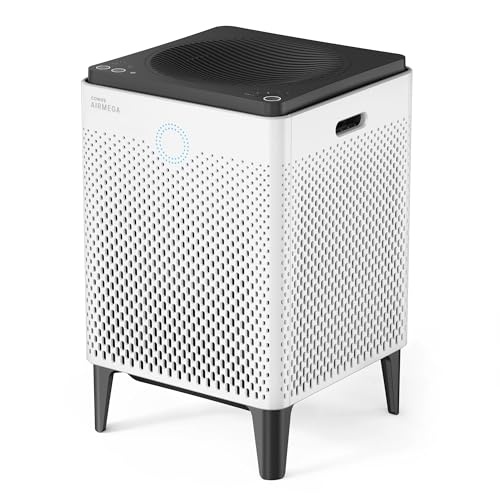
Coway Airmega 400 — The Open-Plan Console
Badge: Open-plan console
- Filtration: washable pre-filter plus HEPA filter system
- Headline: rooms up to 3,120 sq ft (manufacturer figure)
- Extras: air-quality indicator, auto and sleep modes, timer
- Warranty: five years on the listing — the set’s longest
The Airmega 400 draws air through two faces of a wide console, a format that suits the open plan’s geography — a low, broad machine against a wall outperforms a tower marooned in the room’s traffic. Coway’s supporting details are the ownership-minded ones: a washable pre-filter carrying the coarse load for free, an indicator that reports the room rather than the filter’s birthday, and a five-year warranty that reframes the machine’s price as a term of service. For the household furnishing a large, permanent main space — rather than equipping a phase of life — it is the set’s considered, long-horizon pick.
Strengths
- Dual-intake console format suits open plans
- Washable pre-filter lowers running costs
- Five-year warranty anchors the value case
Trade-offs
- Wide footprint needs its wall
- Premium filters at change time
- Less portable between rooms than the towers
Best for: permanent open-plan main spaces. Not suited for: renters who move machines room to room.
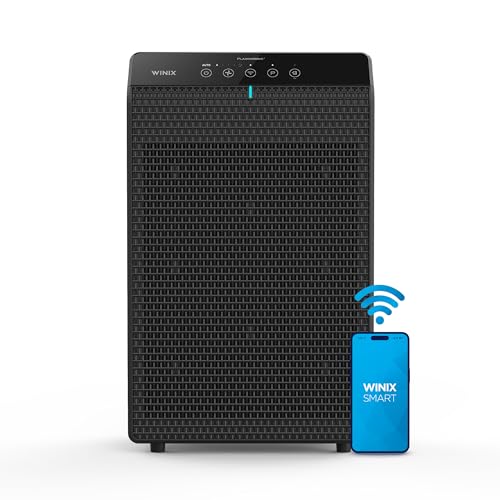
Winix 5520 — Carbon at Speed
Badge: Carbon with its speed
- Filtration: True HEPA plus high-deodorization carbon filter
- Headline: 1,882 sq ft in one hour (manufacturer figure)
- Extras: air-quality monitor, auto mode
- Positioning: pets, smoke, and dust named on the listing
Most high-CADR machines treat carbon as an afterthought; the 5520’s listing leads with a high-deodorization carbon filter alongside its speed, which makes it the set’s pick where the large room’s problem is a smell with scale — the open-plan kitchen-living space, the multi-pet household’s main room, the workshop with solvents in its biography. Its monitor-and-auto pairing lets that carbon be spent intelligently, at speed during events and at rest between them. It is the smallest headline figure here and still, by the two-thirds rule, a machine for rooms most purifiers cannot serve — a reminder that “high CADR” is a range, and matching within it matters more than maximising it.
Strengths
- Serious carbon at genuine speed
- Sensor-driven auto protects filter life
- True HEPA for the literal-minded
Trade-offs
- Smallest coverage headline in this set
- Carbon filter is a real recurring cost
- PlasmaWave-family questions do not apply here — check the specific model configuration on the listing
Best for: large rooms whose problem includes odor. Not suited for: the very largest open plans. Pet-room strategy: best air purifiers for pets.
Two Machines or One Big One? The Zoning Question
Past a certain floor plan, the honest competitor to a high-CADR machine is not a bigger machine but two ordinary ones, and the comparison deserves more respect than it usually gets. Two mid-sized purifiers, placed at opposite ends of an open plan, deliver their combined air where the pollution actually arises — the kitchen end and the living end — without asking air to commute across the room to be cleaned; they also fail one at a time, filter on two smaller bills, and can be re-zoned as the household changes. One large machine counters with simplicity: one filter ecosystem, one corner, one noise source, and a peak capacity no pair of mid machines matches when a single event — a burnt dinner, a smoke incursion — concentrates in one zone. The deciding factors are the room’s shape and the household’s habits. Long, divided, or L-shaped spaces zone naturally and reward the pair; square, open, single-purpose spaces reward the single big cabinet. Smoke-season households, note, zone by closing a door: the refuge-room strategy in the table above is zoning with the walls doing the work, and it outperforms both configurations per dollar when the sky turns orange.
And let the zoning section carry one practical postscript for the pair-buyers: stagger the two machines’ filter calendars by a month or two from the start. A household that changes both machines’ filters in the same week has built itself an annual bill and an annual chore of double size, and — worse — a single week in which both machines are at their oldest together. Staggered, the pair is never simultaneously tired, the costs spread across the year, and one machine is always near its best when an event arrives. Small administration, compounded quietly, is the whole art of owning capacity.
Placement and Running Strategy for Fast Machines
A high-CADR machine mis-sited is a mid-CADR machine with a large filter bill, so placement earns its section. Keep the intake and outlet unobstructed — the manufacturer’s clearances are airflow specifications, not furniture suggestions — and place the machine in the room’s working zone rather than its geometric centre: near the kitchen threshold in an open plan, downwind of the workshop’s bench, in the living room’s occupied half rather than behind its sofa. Run strategy follows the headroom philosophy. Let auto mode or a medium setting carry the baseline hours; spend the machine’s speed deliberately — an hour at full pace when cooking begins, when the gathering arrives, when the outdoor air turns — and then let it settle. A fast machine’s filters are best spent the way its speed is: in events. Households that run this rhythm report the class’s characteristic satisfaction, which is not that the air feels different on ordinary days, but that the bad days — the smoke week, the pollen peak, the party — have stopped being events in the life of the house at all.
The placement section, likewise, earns a postscript about the machine’s social life, because a fast purifier is a piece of furniture with opinions and the household will negotiate with it. Guests will ask what it is; children will test its buttons; the cat, in the long tradition of cats and warm exhausts, will claim its top as a throne — which the guide blesses, provided the outlet’s clearance survives the coronation. Machines that live at this scale succeed socially the way they succeed technically: by being quiet at their working pace, uncomplaining in their corner, and magnificent only when the hour demands it. Choose the one whose company your room can keep, at the size your arithmetic demands, and the two decisions — so often in conflict in this category — will turn out to have been one decision all along.
Matching the Machine to the Space: A Worked Table
| Space | Smoke CADR target (two-thirds rule) | Pick from this set |
|---|---|---|
| Large living room, ~350–450 sq ft | ~235–300 | Winix 5520 or Levoit Core 600S-P at ease |
| Great room, ~500–700 sq ft | ~335–465 | Blueair 211i Max or Coway Airmega 400 |
| Open plan / workshop, 800+ sq ft | 535+ | Medify MA-112, or two mid machines zoned |
| Wildfire-season whole floor | Size the refuge room, not the floor | Any pick, stationed in the closed refuge room |
The last row carries the table’s most important lesson: in a smoke event, the winning strategy is a closed room sized honestly and a machine with headroom in it — not a hero machine asked to purify a draughty floor plan. Zoning beats scale, in smoke as in heating.
Common High-CADR Mistakes
Sizing by the biggest number on the box. Manufacturer coverage assumes fewer air changes than the verified standard; convert via CADR and the two-thirds rule, or be governed by arithmetic written to sell. Buying speed for a bedroom. A fast machine idling in a small room is money spent on a figure the room cannot use; bedrooms want quiet, which the air purifiers for rvs guide’s small-space logic and the wider roundups serve better. Ignoring the filter bill. CADR is achieved through filter area, and the annual filter cost of this class is a real line in the household budget — price it before the machine, not after. Running maximum as a lifestyle. Headroom exists to be spent in events; a machine lived at full speed is a machine whose filters and whose welcome wear out together, and whose owner will eventually solve the noise by switching it off — converting the fastest purifier in the house into its most expensive ornament.
There is a temptation, in this corner of the category, to treat CADR the way a certain kind of driver treats horsepower — as a virtue in itself, to be maximised within budget and displayed. Resist it in the showroom and indulge it only in the arithmetic. The machine that serves a household best is not the fastest it can afford but the fastest its rooms can use, plus one size of grace; everything past that point is a subsidy to the filter department. This guide’s picks were chosen with that discipline, and it is worth noting that even here — in an article whose entire premise is speed — the smallest headline figure belongs to a machine recommended without apology, because its room exists, its carbon is real, and its number is honest. In a category built on one measurement, honesty about the measurement is the premium feature.
Consider, as the guide’s worked example, the household that prompted this category’s existence in the series’ mail: a 620-square-foot open-plan ground floor, a wood stove at one end, two shedding dogs throughout, and a cook who fries without apology. The two-thirds rule prices the room at a smoke CADR of roughly 415 or better. The stove argues for carbon with the speed, the dogs for a washable or cheaply replaced pre-filter, and the frying for auto mode with genuine event response. Walk the set against that brief and the shortlist writes itself: the Coway’s washable pre-filter and console format against the wall between kitchen and living zones; the Winix’s carbon where the stove’s smoke is a weekly fact; the Blueair where the room doubles as a cinema and quiet is a term of the marriage. Three defensible answers, one arithmetic — which is what a buying guide is for. The household that instead bought by the largest font on a box would have spent the same money on a figure measured in a different universe, and would be writing to a guide like this one by winter.
And the guide should end its analysis where the category itself is heading, because the buyer of a machine built for a decade deserves the forecast. Verified CADR is becoming the category’s common language — slowly, against resistance from every marketing department that profits by the fog — and the machines that publish it are, year by year, the machines that also publish their sound levels, their filter prices, and their room sizes in the same arithmetic. Buy into that transparency and the purchase ages well: the figure you sized by will still mean something when the filters are ordered in year five, and the room-size promise will still be checkable against the directory. The fog machines, by contrast, are re-specified with every model year, their claims incomparable even with their own ancestors. Speed dates; verification does not. It is the final reason this guide’s shortlist is drawn entirely from the measured world.
So the recommendation, in its shortest honest form, is a sentence of arithmetic followed by a sentence of temperament. The arithmetic: find your room’s two-thirds figure, and buy the verified machine that clears it with one size to spare. The temperament: choose among the qualifiers by the life the machine will actually lead — the cinema’s quiet, the stove’s carbon, the smart home’s routines, the permanent room’s warranty — because at this level of the category the numbers have done all the sorting they can, and what remains is fit. Fit, in a machine the size of furniture, is not a consolation criterion. It is the difference between a purifier that anchors a room for a decade and one that is demoted to the garage by spring, still fast, still verified, and entirely beside the point.
A closing observation belongs to the readers who arrived here from the smaller end of the catalogue, wondering whether the fast machines are simply the category’s luxury tier. They are not, and the distinction matters for the money. Luxury in a purifier is finish, silence, and design; speed is capacity, and capacity is bought for rooms and events, not for status. A household with a 200-square-foot bedroom and a 700-square-foot open-plan living space needs both kinds of machine and should feel no more extravagant about the big one than about a larger water heater. Size the appliance to the volume it serves, verify the figure it claims, keep one size of grace in reserve — and the fastest machine in the house becomes what it was always meant to be: not the flagship, but the workhorse.
The guide’s picks, re-read against that standard, sort themselves one final time — not by their numbers, which the table already gave, but by the question each answers best. Asked which machine a large, lived-in living room should simply buy, the answer is the Blueair, for delivering the class’s speed at the class’s best manners. Asked which machine a smoke-season household on a big floor should buy, the answer is the Medify, with the refuge-room doctrine attached. Asked which machine a connected household should buy, the Levoit; which a settling household should buy for a decade, the Coway; which a household whose large room smells should buy, the Winix. Five questions, five answers, one arithmetic underneath them all — and a reader whose question is a sixth, unlisted one now owns the arithmetic to answer it without this page, which is the most durable thing a guide can give away.
Print the two-thirds rule, if you print anything from this guide, and keep it with the tape measure: smoke CADR, two-thirds of the room, one size of grace. Behind that napkin arithmetic stands the whole apparatus of this article — the chamber tests, the verification directory, the air-change assumptions, the headroom doctrine — and in front of it stand five machines that honour it. The reader who buys by the napkin will buy well in this category for the rest of their life, through model years and marketing cycles alike, because the rule is not about these machines. It is about air, volume, and time, and those do not go out of production.
One honest caveat closes the analysis, addressed to the reader whose room measured out at the boundary between classes. The two-thirds rule is a standard, not a law of nature: a household that keeps doors open to a hall, runs a kitchen extractor faithfully, and opens windows in the mild months is served by less machine than the rule prescribes, and a household sealing itself against a smoky August with a newborn in the room is served by more. Standards exist to be adjusted by circumstances, intelligently and in the open — which is a different thing from ignoring them because a box promised a bigger number. Adjust, by all means. But adjust from the rule, in the knowledge of what it assumes, rather than from the brochure, in ignorance of what it hides.
And a word, in fairness, for the small machines this guide has spent its length out-sizing. In their rooms — the bedroom, the nursery, the study — they are not the lesser technology; they are the same technology at the scale the arithmetic requests, and several of them are verified with the same rigour as the giants above. The reader who arrived here intending to buy the biggest number for a small room should leave with a smaller machine and a larger remainder, and consider this article a success of exactly the kind its category needs more of: a guide to speed that talked a reader out of buying it. The rooms decide. The numbers merely keep the rooms honest.
Keep the receipt arithmetic, too, as the guide’s parting administrative gift: photograph the machine’s rating label, save the verified figures you sized by, and record the filter part numbers and their first change date in the household notebook. In year three, when the filter is due and the model has been renamed twice, that record is the difference between a ten-minute order and an evening of archaeology. Fast machines are long machines — bought for big rooms and long events — and they reward the household that treats them as infrastructure from the first day: sized on paper, sited with clearances, and documented like the boiler. The air, thereafter, takes care of itself at a rate that can be stated in a number, which was the promise of this category from the beginning.
The guide has one more household to speak for before it closes: the one that has inherited its large room — the farmhouse kitchen, the converted barn, the grandparents’ front room with its twelve-foot ceiling — and suspects, correctly, that no single consumer machine was sized with it in mind. For such rooms the doctrine is zoning with humility: two verified machines at the room’s two lives (the stove’s end and the table’s end), run as a pair in events and singly in the quiet hours, will outperform any single cabinet that pretends to the whole volume — and the pretence, checked against the directory, is always a pretence. Volume is volume. The honest machine for a cathedral is a pair of honest machines for two chapels, and the arithmetic, as ever, is happy to show its work.
That is the whole of it, and the guide is content to be judged by the standard it has spent its length recommending: measured, verifiable, and sized to its room. The reader who measures their space, checks the directory, and buys one size up from the rule will not need this page again for a decade — the highest compliment a buying guide can earn, and the only one this category’s arithmetic makes possible. The machines above will be renamed, restyled, and re-badged in the interval. The number will still mean what it means. Buy the number, keep the grace, and let the room be quiet.
A final practical note concerns delivery day, which for this class is a furniture event rather than a parcel event. Measure the doorway and the corner before ordering; plan the machine’s wall and its outlet; and keep the packaging until the first event has been run at full speed in the actual room — the one test no directory can perform for you, in which the machine’s noise at working pace meets the household’s real tolerance. Returns in this class are freight, not post, and the households that measure twice are the ones that never learn that. The arithmetic got you to the right machine; a tape measure and one honest evening get it installed in the right life.
And if the evening’s test disappoints — if the machine at working speed is louder in your room than its figures promised in the chamber — the guide’s counsel is to adjust the plan before returning the machine: reposition it off the hard floor and out of the corner’s echo, confirm the headroom arithmetic that lets it live at medium, and give the household a week to recalibrate, because rooms and ears both adjust to a new constant sound more kindly than first impressions suggest. What should not be adjusted is the sizing: a machine returned for a smaller one, in a room the rule measured honestly, is a household choosing a quieter inadequacy, and the smoke week will eventually collect the difference. Keep the capacity. Tune the placement. The physics is on your side, and it is patient.
There is, finally, a satisfaction peculiar to this class that no specification sheet records, and the guide will record it as its true last word: the evening the event arrives — the smoke rolling in, the fry-up in full career, the dogs shaking off the rain — and the household watches its big machine stand up to its full height, clear the room, and settle again, the way a good dog settles after the doorbell. That is what the number bought. Not cleanliness, which the small machines also sell, but composure at scale — the room’s worst hour handled inside the hour, by a machine that was sized, verified, and waiting. Buy for that evening, and the ordinary days will take care of themselves.
With the directory checked and the arithmetic done, the purchase itself can finally be the pleasure it ought to be: five machines, each honestly the best answer to a real question, and a household choosing among goods rather than gambling among claims. That is the condition this category’s measurement was invented to create, and it is available to any buyer willing to spend ten minutes with a tape measure and a registry. The guide’s work is done when the choosing feels easy. It should feel easy. The numbers did the arguing in advance.
One sentence of the mistakes list deserves expansion into its own warning, because it is the costliest in the category: the filter bill is not a footnote to a high-CADR purchase but a second purchase, made annually, at a size proportioned to the first. Households should hold the two numbers side by side before ordering — machine, and two years of its filters — and let the combined figure compete against the alternatives, including the two-machine configurations whose filters are smaller and staggered. A fast machine whose filters get stretched in year two is a slow machine with a large cabinet, and the stretching is always, in the end, an economy the air collects back with interest.
Final Recommendation
Choose by room, verified figure, and the headroom principle. The Blueair 211i Max is the set’s easiest recommendation for a large living room — speed with quiet, verified, and automated. The Medify MA-112 serves the genuinely big spaces and the smoke-season households for whom coverage is the whole question. The Levoit 600S-P brings the class into the smart home at the friendliest running costs; the Coway 400 is the long-horizon console for a permanent open plan; and the Winix 5520 is the answer when the large room’s problem smells. What unites them is the discipline of this guide: a number that is measured, a rule that sizes it, and a machine bought one size up so that its speed is a reserve — spent on the bad days, silent on the good ones.
Frequently Asked Questions
Can two smaller purifiers replace one high-CADR machine?
Often, yes — and sometimes preferably. Two verified mid-sized machines at opposite ends of a long or L-shaped space deliver their combined CADR where pollution arises, fail one at a time, and re-zone as the household changes. One large machine wins in square, open, single-purpose rooms and wherever a single concentrated event needs a single large reserve. Compare the pairs’ combined smoke CADR against the single machine’s, price both configurations’ filters, and let the floor plan cast the deciding vote.
What CADR do I need for my room?
Apply the two-thirds rule to the smoke CADR: the figure should be at least two-thirds of the room’s square footage at ordinary ceiling height — 200 for a 300-square-foot room, 400 for 600. Then buy headroom if the budget allows: the machine one size up delivers the same air at a lower, quieter speed. For vaulted ceilings, size by volume rather than floor area, since the machine filters the air, not the carpet.
Is a higher CADR always better?
No — it is better only where the room can use it. Beyond the size your room’s arithmetic calls for, extra CADR buys headroom (valuable: quieter running, event capacity) and then, past that, nothing but filter bills and footprint. A bedroom served by a great-room machine is not cleaner in any way its occupants can detect; it is merely more expensively ventilated. Match the figure to the space, with one size of headroom as the luxury worth paying for.
Why do manufacturer coverage claims differ from AHAM room sizes?
Because they assume different air-change rates. The AHAM room size corresponds to the standard’s roughly four-to-five changes per hour; a manufacturer headline may assume one or two changes, which inflates the square footage severalfold for the same machine. Neither is fabricated, but only the verified figure is comparable across brands. Convert everything to CADR and the two-thirds rule, and the claims reconcile.
Does high CADR mean the air is cleaner?
It means the room’s air is cleaned faster, which in a room with continuous pollution sources amounts to cleaner air in practice — the machine removes particles at a rate that outpaces their arrival. Per pass, a high-CADR machine’s exhaust is not cleaner than a good small machine’s; the difference is throughput. In a sealed, already-clean room, the small machine catches up and the two converge; in a living room with a kitchen attached, they never do.
Are high-CADR purifiers loud?
At maximum, physics collects its fee from every brand. The headroom principle is the answer: a machine bought one size up delivers its room’s requirement at medium speed, where the class’s better members — the Blueair in this set above all — are genuinely quiet. Judge a fast machine by its sound at the speed your room needs, not at the speed its brochure celebrates.
What do high-CADR filters cost to run?
More than small machines’ — the speed is achieved through filter area, and area is the consumable’s price. Expect the annual filter budget of this class to be a real consideration, reduced by washable pre-filters (the Coway’s arrangement) and by auto modes that spend filter life only when the room asks. Any honest comparison in this category prices the machine and its first two years of filters together.
How can I sanity-check a very high CADR claim before buying?
Start by asking whose number it is. A CADR figure from the independent AHAM directory can be compared directly with rival machines, while a coverage or delivery figure published only by the manufacturer should be treated as a manufacturer figure and checked against the room-size method behind it. Then do the simple arithmetic this guide uses elsewhere: match the stated CADR to your room’s floor area and ceiling height, and be suspicious when a modest cabinet claims delivery that far larger machines achieve only at their loudest setting. Finally, check the speed the figure was measured at. A headline number reached only on an unusably loud maximum is worth less than a slightly lower figure available at a speed you will actually live with.