Disclosure: As an Amazon Associate, umtsmarttool.com earns from qualifying purchases. Links on this page are affiliate links; they cost you nothing extra. Prices and availability change often, so check the current Amazon listing before you buy.
This sans air purifier review assesses one of the direct-to-consumer brands that has grown up outside the appliance establishment — a company that sells a clean, minimal design language, a whole-home coverage story and a medical-adjacent marketing vocabulary, at positions that undercut the famous names while claiming their territory. Sans’s range centres on a full-size tower rated by its maker for very large rooms and a Mini for smaller spaces, both built around HEPA filtration with activated carbon and, in the brand’s specification, an ultraviolet stage. The question this review exists to answer is the one every challenger brand must face: how much of the pitch survives translation into the category’s ordinary disciplines — room sizing, consumable economics, verification and the honest limits of what any purifier can claim? The answer, in Sans’s case, is more than the establishment’s fans might expect and less than the brand’s own copy suggests, and the distance between those two figures is exactly what a review is for.
Two ground rules govern what follows. First, the health framing: Sans’s marketing, like much of this category’s challenger wing, leans toward laboratory and pathogen language. This site’s rule is fixed — purifiers are comfort and cleanliness appliances that reduce the particle and gas load of a room’s air; they are not medical devices, they do not sterilise a home, and no claim in this review should be read as a health outcome. Where the brand’s ultraviolet stage is discussed, it is discussed as a feature with a specification, not as a promise. Second, the evidence rule: no hands-on testing is claimed here. The assessment rests on the products’ documented design and listings, the category’s verified benchmarks, and the ownership disciplines this site applies to every machine in the cluster.
Key Takeaways
- Sans sells a minimalist full-size tower (manufacturer-rated for very large rooms) and a Mini, both HEPA-and-carbon machines with a UV-C stage in the brand’s design.
- The design and the value position are the genuine articles: clean looks, simple controls, whole-home ambition at challenger pricing.
- Coverage claims should be read the way this site reads all of them — as full-speed ceilings, with the lived figure set by the speed you can sleep beside.
- The consumable is proprietary to a young brand; filter availability and price across five years is the purchase’s main long-horizon question.
- Buyers who value established verification, staged filters or a decade-deep service record should take the mainstream alternatives named below instead.
In this guide
Where to Buy and What the Range Consists Of

Sans HEPA Air Purifier (Full Size)
The flagship is a tall, spare tower in white or dark finishes, manufacturer-rated for rooms in the region of eighteen hundred square feet at full speed, with a HEPA-and-carbon filtration path and the brand’s UV-C stage. Controls are minimal — the design’s whole aesthetic is the absence of fuss — and the machine is sold through the brand’s own channel and major retail listings. Check price on Amazon
- Filtration: HEPA media with activated carbon; UV-C stage per brand specification
- Coverage: manufacturer-rated for whole-home-scale rooms at full speed
- Design: minimalist tower, quiet-operation emphasis
Strengths
- Genuinely handsome, unobtrusive design for a large machine
- Simple ownership: one filtration path, uncomplicated controls
- Challenger value position against the establishment’s large towers
Trade-offs
- Proprietary consumables from a young brand — the five-year filter question must be asked at purchase
- Coverage is a full-speed figure; plan rooms by working speeds
- The UV stage’s real-world contribution is a specification claim, not a measured household outcome
Best for: design-conscious owners of large rooms who accept a younger brand’s trade-offs. Not suited for: buyers who want AHAM-verified figures and a decade of filter-supply history.
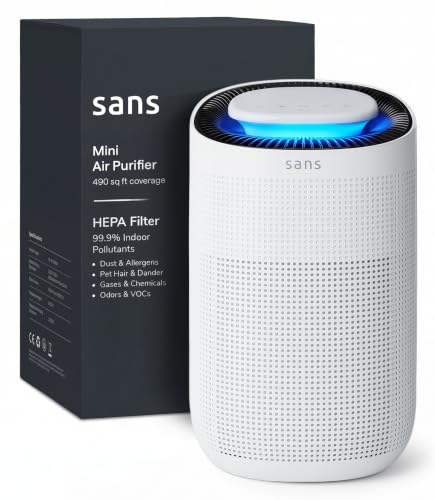
Sans HEPA Air Purifier Mini
The Mini compresses the same proposition into a small-room format, manufacturer-rated for rooms in the region of five hundred square feet — the bedroom, nursery and study member of the pair, sharing the flagship’s design language and its filter philosophy at a gentler position. Check price on Amazon
- Strengths: the brand’s aesthetic at a bedroom scale; simple controls; quiet brief
- Trade-offs: the same proprietary-consumable question, in a class where Levoit’s cartridge ubiquity is the benchmark
Best for: small rooms in design-led households already committed to the brand. Not suited for: buyers optimising purely for consumable price and availability.
Design and Living With It
Sans’s design is its clearest win. Where the establishment’s towers wear their engineering — grilles, badges, control clusters — the Sans tower is a calm monolith that disappears into a modern room, and in the living rooms these machines actually inhabit, disappearance is a specification no laboratory measures and many households will pay for. The control scheme matches: few buttons, no app theatre, a machine that behaves the same on its first night and its five hundredth. Owners who have lived with connected purifiers’ negotiations — the pairings, the accounts, the firmware — will recognise the appeal of an appliance that simply stands there and cleans. The trade is the standing one for simple machines: no sensor-driven automation to exploit the clean hours, no air-quality display to reassure or instruct, and a filter discipline that rests entirely on the owner’s rhythm. This site’s best tower air purifiers survey shows how unusual that restraint has become in the tower class, and how many buyers, given the choice plainly, still choose it.
Noise is the second lived quality, and the brand’s emphasis on quiet operation fits its design story: a large cabinet moving air gently is the classic recipe for a civilised working speed, and the tower should be judged, as this site judges every machine, at the speed the household will actually live with rather than at its silent minimum or its heroic maximum. The full-speed figure exists for events — the renovation evening, the smoke drift, the post-party reset — and a machine whose event speed is loud has not failed; it has stated its terms. Households for whom the bedroom is the destination should audition the Mini in that role rather than assuming the flagship’s scale belongs beside a bed.
Performance, Translated Into the Category’s Terms
Translated out of marketing and into the disciplines this site applies everywhere, the Sans proposition reads as follows. The filtration path — HEPA media for particles, activated carbon for gases and odours — is the category’s proven architecture, the same subtraction every machine in our ozone free air purifiers roundup performs, and there is no reason to doubt its ordinary competence at the ordinary tasks: dust load visibly reduced in a closed room, cooking’s evidence cleared faster, pollen seasons made kinder indoors. The coverage claim should be discounted by the standard method — it is a full-speed ceiling under the maker’s stated assumptions, and the honest planning figure for a lived room is the territory the machine covers at its civilised speeds, which for a tower of this scale remains genuinely large. The UV-C stage should be filed where this review files all such features: a specification with a plausible mechanism and no household-measurable outcome, worth neither a premium nor an objection, and never a substitute for the filtration doing the measurable work.
What the translation cannot supply is independent verification of the establishment kind. The famous names submit to programmes that publish their clean-air delivery; a challenger brand’s figures are its own, and the buyer is asked to extend a trust the incumbents are not. Some buyers extend it gladly, for the design and the value, and the ownership record to date gives them no dramatic reason to regret it. Others prefer their numbers audited. This review’s role is to make the distinction visible, not to make the choice — but it will note that the price difference between the two postures is smaller than it first appears, because the establishment’s verified large towers have been competing with challengers long enough to keep their own positions honest. Readers who want the audited end of the field can start from best air purifiers and compare like with like.
The Consumable Question: Owning a Young Brand’s Filter
Every purifier review on this site ends up at the filter, because the filter is where the money and the risk both live — and with a challenger brand the question sharpens. Sans’s replacement filters are the brand’s own, sold through its channels, and the five-year ledger should be written at purchase with their current position and the household’s realistic rhythm: large-room service, the manufacturer’s stated interval discounted by pets, dust and cooking in the usual proportions. The risk to price is not today’s availability, which is ordinary, but continuity — a young brand’s consumable supply across the machine’s whole life is a promise the establishment’s decade-deep catalogues simply do not have to make. The mitigations are the ones this site recommends for any proprietary system: buy the machine for value you will use in its first years rather than its tenth, keep one spare filter from the second change onward, and re-check availability annually the way our Levoit LV-H134 air purifier review advises for previous-generation machines. Judged by that discipline, the Sans consumable is a reasonable bet knowingly placed — which is the most any honest review can say for any young brand, and more than can be said for several famous ones at the same age.
The mechanics of the change itself follow the family pattern this site’s guides describe: judge by airflow, tone and odour rather than by the calendar alone, vacuum the exterior on the monthly rhythm, and let the machine’s behaviour in its actual room set the interval. A tower working a large, busy room will ask sooner than the stated figure; a tower in a quiet, closed bedroom may honestly serve longer. Either way, the owner’s evidence outranks the brochure, here as everywhere.
The Mainstream Alternative, Named Fairly

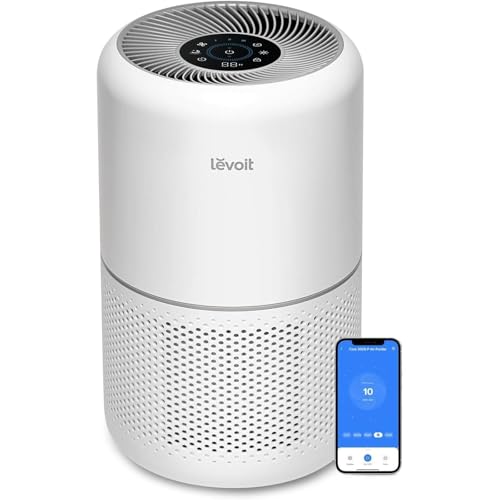
Levoit Core 400S — what the establishment offers instead
The Core 400S is the comparison every Sans buyer should run: sensor-driven automation, an AHAM-programme lineage, a single-cartridge consumable stocked everywhere, and a design that is handsome enough though busier than the Sans monolith. Choose it when verification, automation and filter ubiquity outrank minimalism. Choose the Sans when the room’s look and the machine’s simplicity outrank those — a legitimate ordering, provided it is made with the consumable question priced in. Check price on Amazon
- Strengths: verified programme figures; automation that spares filter and power; the deepest consumable supply in the class
- Trade-offs: a busier design; app ecosystem for those who use it; combined cartridge retires both media together
Best for: buyers who want the audited, automated mainstream. Not suited for: minimalists for whom the Sans silhouette is the point. Large-room traditionalists should also weigh the staged-filter towers in best air purifiers for smoke, where carbon weight is the deciding specification.
How to Choose and How to Own It Well
Choose the Sans if three sentences are true: the room is large and its look matters; the household prefers a machine that obeys to a machine that decides; and the filter’s five-year position has been read and accepted as a young brand’s ordinary risk. Choose against it if any of those fail. Own it by the category’s standard rhythm — placement with clearance, the served room’s door mostly closed, a working speed chosen for the room’s real life, the exterior vacuumed monthly, the filter judged by evidence — and add the young-brand refinement: the annual availability check, performed as calmly as a smoke alarm’s battery test, so that the consumable’s future is a watched fact rather than a discovered one. Owners who run that pattern report the experience the design promises: a calm, quiet tower that cleans a large room and asks for almost nothing but its filter, on schedule, at a known price.
Common Mistakes Sans Buyers Make
Reading the coverage ceiling as a planning figure and stretching the tower across an open plan it cannot serve at living speeds — the sizing error in challenger dress. Believing the laboratory vocabulary in the marketing describes a household outcome; the machine cleans air, it does not sterilise a home, and expectations set by the stronger word curdle into reviews the product did not earn. Ignoring the consumable’s brand risk entirely — not because the risk is large, but because it is the one question this purchase genuinely turns on, and it costs ten minutes to ask. And comparing the Sans only against the establishment’s flagship prices, when its true competition includes the verified mid-towers whose positions have been sharpened by exactly this kind of challenger.
Final Recommendation
Sans earns a recommendation with its conditions printed on the label. As a large-room appliance — handsome, quiet in character, mechanically orthodox in its filtration — it is a legitimate and attractive alternative to the establishment, and households that value design and simplicity will be well served by it. The conditions are the consumable’s young-brand risk, the unverified figures, and a marketing vocabulary the buyer must translate before believing. A reader who accepts those three, eyes open, is buying well. A reader who cannot is equally well served by the mainstream machines named here — and either way, the decision is now an informed one, which is all a review can ever honestly sell.
The Challenger Question in Full: What Young Brands Owe Their Buyers
Sans belongs to a wave — direct-to-consumer appliance brands that design beautifully, market fluently and arrive without the establishment’s decades of infrastructure — and the wave deserves a general assessment this review can offer once, for all of them. What young brands owe their buyers is not perfection; it is legibility. Figures a buyer can check, or an honest silence where figures cannot be checked. A consumable whose price and availability are published as plainly as the machine’s. Marketing that distinguishes a laboratory demonstration from a household outcome. Judged by that standard, Sans is a middling-to-good citizen of its wave: its filtration architecture is orthodox and its design claims are verifiable by looking, while its coverage and pathogen vocabulary ask for the translation this review has supplied. The establishment’s corresponding debt is complacency, and it is the challengers — this one included — who collect it. A category with both pressures is healthier than a category with either, and the buyer who understands both buys well from whichever shelf they choose.
There is also a service dimension to legibility that only time can grade: how a young brand handles its first generation’s ageing — the filters kept in production, the parts honoured, the early buyers remembered. Sans’s record there is still being written, as this review has noted in the consumable section, and the fairest closing judgement on the brand’s maturity is that the question is open rather than answered. Buyers who need it answered in advance know where the answered brands live; they are named throughout this article, at their prices, with their busier designs and their decade-deep catalogues.
The Marketing Vocabulary, Translated
Challenger brands write in a dialect, and a glossary is a public service. “Medical-grade” describes a filter media’s specification class, borrowed from the standards world; it does not make the appliance a medical device or its outcomes clinical. “Removes 99.97%” is the HEPA definition itself — a statement about particles of a stated size under test conditions, true of every genuine HEPA machine in this cluster and therefore a credential of the category, not of the brand. Laboratory pathogen demonstrations — a percentage reduction of a test organism in a sealed chamber — describe the chamber, not your living room, where air changes, sources and people behave nothing like a test rig; file them as evidence the filtration works at all, which was never in doubt, and not as a household promise. “Whole-home” is a coverage ceiling wearing a floor plan. None of this vocabulary is unique to Sans, and little of it is dishonest in the narrow sense — each phrase has a defensible referent — but the accumulation is engineered, and the reader who translates as they go will find the machine underneath the language is a good, ordinary, handsome purifier. Ordinary, in this category, is not an insult; it is what the establishment charges more for. The translation simply restores the comparison to level ground, where the Sans can win or lose on design, value and consumables — the grounds on which it deserves to be judged.
Room by Room: The Tower’s Territory
The large living room is the flagship’s home fixture, and the one its design was drawn for: a calm monolith against a wall, a working speed under the conversation, the room’s dust biography visibly slowed within a fortnight. The open-plan kitchen-diner is its honest second — with the carbon caveat that serious cooking will set the filter’s rhythm, and the standing advice that the extractor remains the kitchen’s first appliance and the purifier its second. The master bedroom suite suits it where the household sleeps with the door closed and wants the machine’s presence to be visual silence; light sleepers should still choose the working speed together in the first week, as with every tower. The nursery belongs to the Mini, with the category’s standard cautions about placement and the parent’s preference — common among this brand’s buyers — for a machine without an app listening in the room, a preference this review records without endorsing or mocking, since it costs the household nothing but automation. And the spare room, the studio flat and the rental all take the tower kindly for the renter’s reasons given elsewhere in this cluster: nothing installed, nothing marked, a machine that moves house in one hand’s ambition and a car’s boot.
Year One With a Challenger: An Ownership Diary in Outline
Month one is the design’s month: the tower disappears into the room, the household sets its two lived speeds, and the machine is admired the way furniture is admired, briefly and then unconsciously. Month three brings the first evidence audit — surfaces, mornings, the room’s smell after a cooking weekend — and the tower, in a correctly sized room, passes it in the category’s ordinary way, which is to say quietly. Month six is the exterior vacuum’s routine becoming habit and, in a busy house, the first odour test: carbon is the mayfly of every filtration path, and a household that cooks seriously will meet the filter question here first, as a smell rather than as a schedule. Month nine is where the young-brand question is first asked with real money behind it — a spare filter ordered, its price and delivery observed — and where, in the ordinary case, it is answered reassuringly and filed. Month twelve closes with the annual check this review prescribes: availability confirmed, the machine’s tone recorded against its first month’s, the room’s evidence weighed. A tower that reaches its first birthday in that condition has done everything its design promised, and the household’s remaining question — the decade question — is one no review can answer for any young brand, which is why this one priced it at purchase instead of pretending to settle it.
Set that diary beside the establishment equivalent and the differences are smaller than the marketing of either side suggests: the same rhythm, the same evidence, the same filter day. What the challenger adds is a room that looks calmer and a small, real uncertainty about year seven. What it subtracts is a sum of money and a quantity of visual noise. Households have made worse trades in this category for less reason, and the diary — mundane, uneventful, satisfactory — is the strongest evidence this review can offer that the Sans trade, made knowingly, is a sound one.
Sans and the Sensitive Household: A Careful Section
Challenger marketing in this category aims squarely at households managing allergies and sensitivities, and those readers deserve the review’s most careful paragraph. A HEPA-and-carbon tower of this scale, run in a closed room on a sensible rhythm, reduces that room’s airborne particle load — dust, pollen, dander — in the ordinary, demonstrable way of its architecture, and many sensitive households find their rooms more comfortable for it, particularly across a pollen season and particularly in the bedroom, where the exposure hours are. That is the whole of the supportable claim. The machine does not treat a condition, does not render a home safe for any particular person, and does not substitute for the clinician-guided management of any respiratory illness; the ultraviolet stage changes none of that arithmetic. Households in this position should also weigh the verification question more heavily than most: where a family’s comfort decisions rest on a machine’s performance, independently verified figures are worth a real premium, and this review’s mainstream alternatives exist in part for exactly that reader. Comfort, honestly framed and competently delivered, is a legitimate purchase. It is also the ceiling of what any purifier — challenger or establishment — should be sold as, and the reader who holds that line will buy well from either shelf.
Troubleshooting and Support: The Young Brand’s Test
The ownership problems a Sans tower can present are the family’s universal ones — the loading filter’s rising tone, the carbon’s quiet expiry, the placement that defeats a good machine — and the responses are the universal responses detailed across this site’s brand problem guides: vacuum the exterior, reseat and judge the filter by evidence, audit the room before the appliance. Where a young brand is genuinely tested is the uncommon case: the panel fault in month fourteen, the part that should not have failed, the warranty conversation with a company whose service operation is years rather than decades deep. This review cannot grade that conversation from evidence it does not have, and it will not pretend to. What it can advise is procedural: keep the purchase record and the filter-change dates, describe symptoms with the tests already performed, and conduct the conversation in writing. Those habits shorten warranty dealings with every brand ever made, and they are the owner’s half of the legibility bargain this review described earlier — the half entirely within the household’s control.
The Price-Position Question, Answered Without Numbers
This site prints no product prices, for the standing reason that they rot — but relative position can be discussed honestly, and the Sans’s position is the heart of its pitch. Against the establishment’s verified large towers, the Sans asks less for a comparable room claim and a calmer design; against the budget coverage-led machines, it asks more for that design and for a quieter character. The buyer is therefore not choosing between cheap and dear but between two allocations of the same money: toward verification and infrastructure, or toward design and simplicity. Allocations are household philosophy, not arithmetic, and the review’s only insistence is that the allocation be seen. A household that knowingly spends on calm — in a room it looks at for a decade — is not being fooled by minimalism; it is buying the thing minimalism actually is, a daily visual experience, at a price it has compared. A household that spends the same sum unknowingly, believing it bought verified performance the brand never claimed in checkable form, has been failed by its research rather than by the brand. This article exists so that its readers land in the first group, on whichever shelf they finally choose.
Gifting and Second-Hand Notes for a Young Brand
Two small markets deserve the young-brand adjustment. As a gift, the Sans tower flatters the giver — it looks like a considered object rather than an appliance — but it commits the recipient to a proprietary filter relationship with a young company, and the etiquette of appliance gifting says that commitment should travel with a first spare filter and an honest sentence about the supply. As a used purchase, the calculus inverts the establishment’s: the machine itself is simple and likely sound, but the buyer’s first act should be the availability check, performed before money moves, because the used tower’s entire value rests on a filter listing the buyer does not control. A used Sans with its filter confirmed in stock, its motor smooth and its cabinet clean is a rational bargain in a way a used connected machine, with accounts and apps to unbind, often is not — one more place where the brand’s simplicity quietly pays its owners. Both notes reduce to the review’s refrain: with a young brand, verify the consumable, and the rest of the ownership takes care of itself in the ordinary, satisfactory way the diary above describes.
What Would Make This Review Change Its Mind
Reviews should state their own falsification conditions, and a challenger-brand review most of all, because its subject is moving. This review’s caution rests on three named unknowns — unverified figures, consumable continuity, ungraded service — and each has an event that would retire it. Independent programme verification of the towers’ clean-air delivery would retire the first, and this page would be updated to say so with pleasure. Five more years of uninterrupted filter supply at stable positions would retire the second. A service record accumulated across the first generation’s ageing would retire the third, in whichever direction the record pointed. Conversely, a discontinued filter line or a pattern of unhonoured warranties would harden every caution here into a warning. Readers returning to this review in future years should check which of those events have occurred and weight the verdict accordingly; a review of a young brand is a dated instrument, and honesty about its expiry is part of its accuracy. The design judgement, notably, has no such expiry — a calm monolith that cleans a large room well will be a good object in any year, which is why the brand’s best asset is the one it shipped first.
The Sans Household, Described: Who Actually Thrives With This Machine
Every review in this cluster has converged on a portrait, and this one should draw it explicitly. The Sans household is design-literate and specification-sceptical in a particular combination: it reads the marketing dialect fluently enough to discount it unaided, it values the room’s calm over the dashboard’s reassurance, and it keeps household systems — including filters — on a written rhythm rather than an app’s prompting. It is often a household that has already owned a connected appliance and been annoyed by it, and that now buys simplicity the way other households buy features, deliberately and at a fair price. It does its five-year arithmetic once, at purchase, and then declines to re-litigate it monthly. For that household the Sans is not a compromise against the establishment; it is the establishment’s values — clean air, honestly delivered — restated in the dialect it prefers.
The counter-portrait is equally clear, and naming it is a service rather than a slight: the household that wants the machine to report, reassure and automate; the household whose comfort decisions need audited numbers behind them; the household that will forget a filter exists until a light insists. Those readers have been directed, throughout this review, to machines that will serve them better, and they should go without a backward glance. A challenger brand does not need every buyer. It needs its buyers, matched well — and a review’s final loyalty is to the match, not to the brand on its cover or to the incumbents in its comparisons.
Energy and Acoustics: The Two Quiet Ledgers
A large tower’s running profile deserves its own short audit, since it will work more hours than any other appliance in its room. On power, the class pattern from this site’s energy guide applies: a working speed in the few-dozen-watts band, a sleep setting that sips, and a maximum reserved for events — with the total across a year landing, for a sensibly run machine, in the modest territory that makes electricity the smallest of the three ownership lines. The household that wants its own figure, rather than the class’s, can measure a week with a plug monitor by the method that guide describes, and a tower with no automation benefits most from the measurement, because its owner is its only scheduler. On acoustics, the same guide’s principle holds in reverse: judge the machine in the room, in the evening, at the chosen speed, against the room’s own sounds — a large cabinet’s low rush disappears into a living room’s life more completely than its laboratory figure suggests, and asserts itself in a silent bedroom more than the figure admits. Both ledgers, in other words, are settled by the household’s evidence within the first fortnight, and a buyer inside a return window should settle them deliberately, in that window, rather than by assumption. The Sans’s design gives it good prospects in both audits; the audits remain the buyer’s to run.
The Short Version, for Readers Who Scrolled
Sans makes a handsome, simple, mechanically orthodox large-room purifier and a matching Mini, sold at challenger positions with a young brand’s two open questions — unverified figures and consumable continuity — attached. Buy the flagship for a large room whose look matters, having priced the filter’s five-year line and accepted the translation of the marketing vocabulary this review supplies. Buy the Mini for the same philosophy at bedroom scale. Buy the Levoit Core 400S instead if you want the numbers audited, the machine automated and the filter sold in every shop in the country. That is the whole review in a paragraph; the preceding pages exist to make its judgements checkable rather than merely quotable, and readers who test them against their own households will find they hold — which is the only compliment a review of a young brand, or of an old one, should ever ask for.
A Note on Finishes, Placement and the Photograph Problem
Small practicalities close the assessment. The tower’s finishes — the white and the dark — behave differently in real rooms: white disappears against pale walls and shows a season’s dust on its intake honestly, which is a maintenance prompt disguised as a cosmetic flaw; the dark finish hides the dust and shows every fingerprint, and households should choose by which reminder they prefer. Placement follows the category’s law with a design corollary: a machine bought for its looks will be placed where it looks best, and the owner should check that the beautiful position also satisfies the airflow one — clear space at the intake, the room’s circulation in its favour, the door’s logic respected — because a purifier in a gorgeous corner behind a sofa is an ornament with a filter inside. And the photograph problem, named for the way these machines are sold: minimalism photographs better than it specifies, and the buyer scrolling a listing should deliberately re-ask the unphotogenic questions — the filter’s price, the coverage’s assumptions, the warranty’s length — before the silhouette closes the sale. The silhouette is good. Let it close the sale only after the questions have had their turn, and it will go on looking good in the room for the right reasons.
What Owners Talk About After a Year: A Composite
Reviewers who follow challenger brands across their first ownership wave hear a characteristic set of refrains, and Sans’s is worth recording in composite — not as testimony, since this review claims no interviews, but as the pattern the design and the category jointly predict, against which a returning reader can check their own experience. The first refrain is surprise at the filter’s size and substance when the first change arrives: the consumable of a large tower is a serious object, and its price, encountered in the flesh rather than on a listing, re-opens the five-year arithmetic for owners who skipped it — the satisfied ones are, almost without exception, the ones who did the arithmetic at purchase and find the object merely confirming it. The second refrain is the design’s staying power: a year in, the monolith has not dated the way busier machines date, and owners mention the room’s calm with the regularity of people still slightly pleased with themselves. The third is the absence of incident — no app sagas, no sensor mysteries, no connectivity winters — reported with the mild astonishment of a category trained to expect them. And the fourth, from the minority, is the wish for a number: a display, a reading, some word from the machine about the room it serves. That wish is the Core 400S’s entire pitch, stated by the people who discovered, a year late, which buyer they were. The composite’s lesson is this review’s refrain one final time: the match is the product, and it is made — or missed — before the box is opened.
The Decision, One Last Time, in the Form of a Door
Imagine the purchase as a door with three rooms behind it, because some readers decide better in pictures. Behind the first door is the Sans room: calm walls, a tower that looks like it was drawn with the furniture, a filter bill that arrives on a rhythm you set, and a small framed certificate on the wall that says the numbers were taken on trust and the trust, so far, has held. Behind the second is the establishment room: busier machines, brighter dashboards, every figure audited and every filter in every shop, and a slightly higher rent. Behind the third is the room too many buyers actually enter — the unexamined purchase, whichever brand it wears, judged nightly against expectations nobody stated. This review has spent its length keeping its readers out of the third room, and it closes by observing that the first two are both good rooms, honestly kept, by sellers whose differences are now, for you, legible. Choose the room whose terms you prefer, move in, and let the machine do the quiet work that — in either room, on either shelf — it was always going to do.
And keep the paperwork. It is the least poetic advice in this long review and, across a young brand’s first decade, potentially the most valuable: the receipt, the filter dates, the annual availability note, filed where the household files its appliance lives. If Sans fulfils its promise, the file will be a curiosity. If it does not, the file is the owner’s evidence, assembled before it was needed, which is the only time evidence can be assembled. Either way, the household that keeps it has done its half of the legibility bargain — and a bargain kept on both sides is, in the end, what every successful appliance purchase in this category has ever been.
The tower, meanwhile, will be standing in its room tonight, asking for none of this reflection. That is rather the point of it. Machines that need their owners to be philosophers are a burden; machines that merely reward a single afternoon of philosophy, at purchase, and then disappear into service are the category’s best citizens, whichever generation or generation of company made them. Sans, on the evidence assembled here, has built such a machine. The afternoon is yours to spend.
Spend it with the room’s measurements in one hand and the filter’s listing open in the other, and whichever tower you choose — this calm challenger or its busier, audited rivals — the choice will be the rare kind that ages well: made on the household’s real priorities, with the costs in view, and with nothing left to discover in month thirteen that a careful hour could not have shown in week one. That hour — unglamorous, unhurried, and entirely within every buyer’s reach — is the true subject of this review, and the Sans, like every machine in this cluster, is finally just the occasion for it.
Occasions, fortunately, are renewable. The next appliance, the next room, the next challenger brand with a beautiful silhouette and an ungraded service record will each present the same hour in a new costume — and the reader who has spent it once, properly, on this tower will recognise the costume at a glance and spend it again without being taught. That recognition is the only loyalty this review asks for, and it is owed not to a brand but to a method.
Frequently Asked Questions
Is Sans a legitimate air purifier brand?
Yes, in the sense that matters mechanically: its machines are genuine HEPA-and-carbon purifiers of orthodox design, sold through major retail channels with a real replacement-filter supply. What the brand lacks, compared with the establishment, is independent verification of its performance figures and a long service history — its numbers are its own, and its consumable continuity is a young company’s promise. Buyers comfortable with that profile, at its value position, are buying a real appliance; buyers who want audited figures should choose the verified mainstream instead.
Does the Sans purifier’s UV light make it better?
It makes it different on a specification sheet. Ultraviolet stages have a plausible germicidal mechanism inside a sealed cabinet, and the brand includes one in its design — but no household can measure the contribution, the filtration does the demonstrable work, and this site’s position is that UV should be treated as a neutral feature: worth neither a premium nor a health claim. Readers should be especially wary of any marketing that converts the feature into a promise about illness; a purifier reduces a room’s particle and gas load, and that is the honest extent of every machine in this category.
What size room does the full-size Sans actually suit?
Plan by working speeds, not by the headline. The manufacturer’s rating describes a very large room at full speed under stated assumptions; the lived figure — the room the tower can hold at speeds a household will tolerate all evening — is smaller, though still genuinely in the large-room class: a generous living room, a large master suite, a modest open plan with the door logic in its favour. Very large open plans and multi-room ambitions exceed it, as they exceed every single portable unit, and should be served by two machines or by the coverage-led designs compared elsewhere on this site.
How often will I replace the Sans filter, and is that a risk?
On the manufacturer’s stated rhythm, adjusted by your household’s evidence — airflow, tone and odour — with dusty, pet-heavy or cooking-heavy service shortening it in the usual proportions. The risk is not the interval but the supply: the filters are the brand’s own, and a young brand’s multi-year continuity is the purchase’s one genuine unknown. Mitigate it the standard way — a spare kept from the second change, an annual availability check — and the risk reduces to the ordinary background level of owning any proprietary-consumable appliance.
Sans or Levoit — which should I choose?
Choose by what you will actually use and what you need verified. The Levoit Core 400S brings sensor automation, programme-verified figures and a filter sold everywhere, in a busier cabinet. The Sans brings minimalism, simplicity and a challenger value position, with figures you take on the brand’s word and a consumable you commit to a young company for. Neither answer is wrong; the wrong answer is choosing the Sans for its looks while needing the Levoit’s verification, or the Levoit for its verification while resenting its presence in the room daily. Match the machine to the household’s real priorities and both brands reward their buyers.
Is the Sans Mini worth it for a bedroom?
For a design-led household already committed to the brand, yes — it carries the same proposition at the right scale, with the quiet brief a bedroom wants. As a pure value calculation for a first bedroom machine, the establishment’s small-room staples — the Core 300 class — offer deeper filter availability and verified figures at competitive positions, and this review’s honest advice to a brand-neutral bedroom buyer is to start there and let the Mini win only if the design genuinely matters to the room’s owner.