Electric knife sharpeners make a fast edge simple. You pull the blade through guided slots or across a moving belt and the machine removes metal evenly, which suits busy cooks who do not want to learn whetstones.
The six sharpeners below range from slot-based machines to belt-driven systems. Each has trade-offs for different knife styles, so confirm the supported knives and angles on the listing. Electric models remove metal quickly, so they are best used when the knife is truly dull rather than for every touch-up. Keep a honing steel for daily maintenance. Read the manual for the knives each machine can handle, since some do not support serrated blades or very thin Japanese knives. A rubber-footed base keeps the unit steady on the counter while you work. Many machines include a small drawer to catch metal filings, which you should empty after each session. If you cook for a family, two or three sharpening sessions a year are usually enough, and each one should take only a couple of minutes per knife. We have not used these products ourselves, so confirm sizes, materials and details on the current listing before buying.
As an Amazon Associate we earn from qualifying purchases. Links below are affiliate links, and they do not change the product information we give.
What to Look For
| Feature | Why it matters |
|---|---|
| Angle guides | Fixed guides give consistent edges with less skill |
| Stages | More stages offer more sharpening and honing steps |
| Abrasive | Diamond abrasives cut hard steels more easily |
| Knife support | Check serrated, thin and Japanese knife limits |
| Stability | Rubber feet and a solid body keep it steady |
In this guide
Specs at a Glance
| Sharpener | Type | Abrasive | Notes |
|---|---|---|---|
| Work Sharp Ken Onion Edition | Belt system | Belts | Adjustable angle |
| Chef’sChoice Trizor XV 15 | Slot machine | Diamond | Three stages |
| Work Sharp Culinary E5 | Slot and belt | Belts | Kitchen knife focus |
| Chef’sChoice 120 | Slot machine | Diamond | Three stages |
| Wusthof Easy Edge | Slot machine | Diamond | Brand-matched |
| Tormek T-1 | Wet system | Water-cooled stone | Slow and controlled |
The 6 Best Electric Knife Sharpeners
Top pickBest for sharpening many types of blades
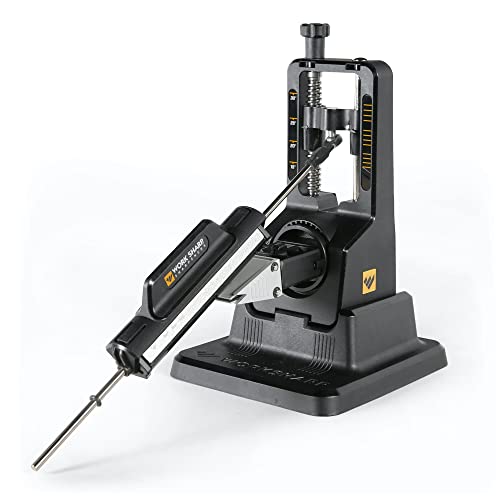
1. Work Sharp Ken Onion Edition Knife and Tool Sharpener
A belt-driven sharpener with an adjustable angle guide. It can handle kitchen knives and tools, and it is a favorite among hobbyists.
Suits: sharpening many types of blades. Strengths: adjustable angles and quick results. Weaknesses: a learning curve for beginners. Skip it if you just want slots.

View Work Sharp Ken Onion Edition Knife and Tool Sharpener on Amazon
Best for home kitchens
2. Chef’sChoice Trizor XV 15 Edge Select
A three-stage electric sharpener with diamond abrasives that converts edges to a sharper angle. It is a well-known staple in many kitchens.
Suits: home kitchens. Strengths: simple slots and fast sharpening. Weaknesses: it reshapes the edge geometry. Skip it if you want to keep your factory angle.
View Chef’sChoice Trizor XV 15 Edge Select on Amazon
Best for busy home cooks
3. Work Sharp Culinary E5 Kitchen Knife Sharpener
A kitchen-focused sharpener that uses guided slots and belts. It is made to simplify sharpening for everyday knives.
Suits: busy home cooks. Strengths: easy guided slots. Weaknesses: belts are a consumable. Skip it if you want a stone-based system.
View Work Sharp Culinary E5 Kitchen Knife Sharpener on Amazon
Best for straight and serrated knives
4. Chef’sChoice 120 Diamond Hone
A three-stage electric sharpener with diamond abrasives for straight and serrated edges. It is a long-selling model with a plain, practical design.
Suits: straight and serrated knives. Strengths: three stages and easy use. Weaknesses: a bulky body. Skip it if you want a compact unit.
View Chef’sChoice 120 Diamond Hone on Amazon
Best for wusthof and similar knives
5. Wusthof Easy Edge Electric Knife Sharpener
An electric sharpener designed to suit the maker’s own knives while working on many western blades. It uses guided slots for simple use.
Suits: Wusthof and similar knives. Strengths: brand-matched angles and simple slots. Weaknesses: less versatile for Japanese knives. Skip it if you own mostly Japanese blades.
Best for careful sharpening
6. Tormek T-1 Kitchen Knife Sharpener
A slow-speed wet sharpening system from a Swedish maker known for water-cooled stones. It is gentle on knives and takes time.
Suits: careful sharpening. Strengths: cool, controlled sharpening. Weaknesses: a higher cost and slower pace. Skip it if you want a quick pull-through.

Care and Setup
- Empty the metal dust tray regularly.
- Wipe the knife after sharpening.
- Follow the machine’s stage order.
- Replace belts or stones as they wear.
- Keep the machine dry and covered.
Mistakes to Avoid
- Sharpening a knife that only needs honing.
- Pulling the blade through too fast.
- Using the machine on unsupported knives.
- Ignoring the manual’s angle notes.
- Sharpening serrated edges in the wrong slot.
How Electric Sharpeners Remove Metal
Understanding what the machine does to your knife helps you use it well. Electric sharpeners remove metal using a rotating abrasive, whether that is a wheel, a disc or a belt. The knife is guided so that each side meets the abrasive at a fixed angle, creating a new edge. Because the process is fast, it takes more steel off per pass than hand sharpening, which is why these machines are best used on genuinely dull knives.
Most slot-style units use stages. A coarse stage reshapes a dull edge, a medium stage refines it and a fine stage polishes. Some machines skip the coarse stage and focus on refining. Belt systems work similarly, using different grits of belt, and often allow adjustable angles. Wet systems turn slowly in water, which keeps the steel cool and reduces the risk of overheating.
Heat is the enemy of an edge. Excess friction can soften thin steel, so a good machine controls speed or pressure, and you should avoid dwelling in one spot. Follow the maker’s instructions about the number of passes and the pace of pull-through. A steady, unhurried motion usually gives better results than pressing hard.
Remember that electric sharpening is a reset, not a daily routine. Use a honing steel to realign the edge between sessions, and sharpen only when slicing a tomato or paper becomes difficult. This approach extends the life of the knife and the machine’s abrasives.
Matching the Machine to Your Knife Collection
Before buying, take stock of the knives you own. Many electric sharpeners are tuned for common Western kitchen knives with edge angles in a certain range. If your knives are thin, very hard or have a narrower angle, the preset guides may not match, and the machine could change the edge geometry. Check the listing for supported angles and knife types.
Serrated knives need special handling. Some machines have a dedicated slot or accessory for them, while others only support straight edges. Do not use a straight-edge slot on a serrated knife unless the manual says it is acceptable. Likewise, ceramic knives, very small blades and very thick cleavers may not be supported at all.
Think about blade length and handle shape. Some slots are narrow, and bolsters or wide heels can prevent the blade from seating properly, leaving an unsharpened section near the handle. Check whether the machine mentions bolster compatibility. If you own a mixed collection, a unit with adjustable angles or multiple stages offers flexibility, though it requires more care to use.
If you own a few valued knives, consider whether you want a machine to touch them at all. Some owners prefer to use stones or professional services for expensive blades and keep an electric unit for everyday knives. There is no wrong choice, as long as the machine suits the knife.
Angle Guides and Edge Geometry
Edge angle is the central idea behind all sharpening. A smaller angle makes a sharper, thinner edge that slices easily but is more delicate. A larger angle is sturdier and better for heavy chopping but feels less keen. Many Western kitchen knives use a mid-range angle, and Japanese styles often use a narrower one.
Some electric machines convert your knife to a specific angle, which means the edge changes over time. If you are happy with that, it is a quick way to get consistent results. If you want to keep the factory angle, look for a machine that matches it or offers an adjustable guide. Read the description carefully, because language about converting edges signals a change in geometry.
Guides matter because hand-held angles drift. A fixed guide holds the blade at a repeatable angle, which is why electric sharpeners suit people who do not want to practice stone technique. Make sure the guide is stable and that the knife sits flat against it. Wobble leads to uneven edges.
After sharpening, inspect the result. Run a thumb carefully across the edge, never along it, to feel for a consistent burr, and slice paper or a tomato to confirm. If the edge is uneven, repeat the finest stage with light pressure. Over time, you will learn how many passes your knives need and avoid removing more steel than necessary.
Safety, Noise and Countertop Practicalities
An electric sharpener is a small power tool, so treat it as one. Place it on a stable, dry surface and make sure the cord is clear of the work area. Keep fingers away from the abrasive and slots. Do not wear loose sleeves. Use the machine as intended and keep it away from children.
Expect some noise and metal dust. Most units collect swarf in a tray or catch area, which you should empty regularly. Wipe the knife after sharpening so abrasive dust does not end up on cutting boards or food. Do not use water on a machine that is not designed for it.
Think about storage and footprint. A bulky unit that lives under the counter may be used less often than one that fits in a drawer. Check dimensions and weight. A rubber-footed base prevents sliding during use, which matters when you pull a knife with force.
Ventilation and eye protection can be sensible if you do a lot of sharpening, since fine particles are released. Follow the maker’s guidance. Finally, unplug the unit when changing belts or cleaning, and never force a blade into a slot that does not seem to fit. Taking a minute to read the manual saves damage to both the knife and the machine.
Consumables, Longevity and When to Switch Methods
Every sharpener eventually needs new abrasives. Belt systems have belts that wear and need replacing, while diamond wheels and discs can lose cutting speed over time. Check whether replacements are available and how they are installed. A machine with expensive or hard-to-find parts may cost more over years than one with simple, accessible replacements.
Signs of worn abrasives include longer sharpening times, glazing, uneven edges and a burnt smell. If a knife takes many more passes than before to reach an edge, the abrasive is probably tired. Clean the machine according to the manual and replace worn parts promptly rather than pressing harder.
Know when to switch methods. If a knife has a chipped edge or a damaged tip, a coarse stone or professional repair may be better than an electric machine. If you want to refine an edge to a very high polish, finish by hand on a fine stone. If your collection changes to include thin, hard or single-bevel knives, a stone-based approach may suit you better.
Finally, maintain the knives themselves. Use a honing steel regularly, avoid cutting on glass or stone and wash and dry knives promptly. A machine is a convenience, and good habits mean you will need it less often, which preserves both the knives and the sharpener.
Electric Knife Sharpeners FAQ
Are electric sharpeners safe for my knives?
They are safe if the machine suits the knife and you follow the instructions.
How often should I sharpen?
Only when the edge stops slicing. Use a honing steel between sessions.
Can they sharpen serrated knives?
Some can. Check each product’s notes.
Do they work on Japanese knives?
Some do, but many are tuned for 15 to 20 degree western edges.
Will an electric sharpener ruin my knives?
Not if it suits the knife and is used as directed. Overuse removes steel unnecessarily, so sharpen only when needed and hone in between.
How many passes should I make?
Follow the manual. Dull knives usually need more passes in the coarse stage, while a touch-up may need only the fine stage. Pull at a steady pace rather than pressing hard.
Can I sharpen scissors or tools?
Only if the manual says the machine supports it. Some belt systems offer accessories for tools, but slot machines generally do not.
Why does my knife still feel dull?
It may have a damaged section, a bolster in the way or worn abrasives. Check the heel and tip, inspect the machine and repeat the finest stage.
Is a wet system better than dry?
A wet system runs cooler and is gentle on steel but works more slowly. Dry systems are faster. Choose based on your patience and knives.
How do I clean the machine?
Unplug it, empty the dust tray, wipe the guides with a dry cloth and follow the maker's guidance. Never wash electrical parts in water.
Do I still need a honing steel?
Yes. Honing realigns the edge between sharpenings and reduces how often you need the machine.
Preparing Knives and Testing Edges Before You Start
A sharpener works best on a clean, inspected blade. Wash and dry the knife first, because grease and food residue can clog abrasives and smear the guides. Look along the edge under good light. Chips, rolled sections and bent tips behave differently from a plain dull edge. A small chip may need several passes to grind out, and a badly damaged edge may be better handled by a professional.
Before sharpening, check how dull the knife really is. A simple test is to slice a sheet of paper held from the top edge. A sharp knife glides through, while a dull one tears or snags. Another test is to slice a ripe tomato with only the weight of the knife. These checks give you a before-and-after comparison so you can see whether the machine helped and avoid grinding more than needed.
- Remove any rust with a gentle abrasive pad first, since it can clog stones.
- Check the knife for loose handles or damaged rivets before sharpening.
- Keep a towel nearby to wipe the blade between stages.
- Count passes, so your results are repeatable.
Knife Steels, Hardness and What the Abrasive Must Handle
Steel type influences how quickly a knife sharpens and how long the edge lasts. Softer stainless steels sharpen quickly but dull sooner. Harder steels hold an edge longer but resist abrasives and can chip if abused. Premium steels with high carbide content can be slow to grind with a mild abrasive, which is where diamond abrasives have an advantage.
Most electric sharpeners aim for a middle range of knives, such as common German and American kitchen knives. Very hard blades, ceramic knives and specialty steels may need a different approach or a machine that explicitly lists support. Read the manual for supported blade types and avoid forcing a knife the machine was not designed for.
Thickness matters too. Thin blades with a fine edge can flex in the guide or heat up quickly if the machine grinds aggressively. A machine with gentle stages and good guides helps. If you own a mix of cheap and expensive knives, start with the less valuable ones to learn how the machine behaves.
Sharpen, Hone and Strop: Building a Routine
Sharpening removes metal to form a new edge, while honing realigns an edge that has bent over without removing much steel. Many people dull their knives by skipping honing, then sharpen more often than necessary. A light honing before each use can extend the time between sharpenings, which preserves the blade and saves time.
An electric sharpener is best used when the knife no longer cuts well after honing. Many include a finishing stage that polishes the edge and removes the burr. Some people finish with a leather strop for a keener edge, though it is optional. Over time, most households settle into a routine of honing weekly, sharpening a few times a year and replacing worn knives rather than grinding them thin.
Troubleshooting Results: Burrs, Uneven Edges and Heel to Tip Problems
A burr is a thin wire of metal that forms on the edge during sharpening. It can feel sharp but folds over quickly, so finishing stages or light polishing passes are intended to remove it. If the knife feels sharp but dulls after a few cuts, a leftover burr may be the cause. Make a few light passes in the finishing slot and wipe the blade clean.
If the edge is sharper near the middle than at the heel or tip, the knife may have been held at an inconsistent angle or pulled at different speeds. Use the guides and keep a steady, even motion from heel to tip. Another cause is a worn belt or wheel that no longer cuts evenly. Replace consumables as the manufacturer advises.
If knives come out uneven, scratched or with excessive metal removed, stop and review the manual. Overheating the blade can soften the steel, and too many passes remove more material than needed. Fewer passes with attention to feel and sound usually produce better results than repeated aggressive grinding.
Cost Compared With Professional Sharpening
A sharpening service charges per knife, and the fee adds up for a full block. An electric sharpener costs more up front but pays for itself after several sessions if you keep a large set. The convenience of sharpening at home when needed also means knives stay in good shape between trips to a shop.
On the other hand, a professional with whetstones can restore damaged blades, reprofile edges and work on expensive or specialty knives with great control. For valuable heirloom or collector knives, the service may be the safer choice. A good approach is to use an electric machine for everyday knives and reserve professionals for repairs and special pieces.
Maintaining the Machine Itself
The sharpener needs care to give consistent results. Metal dust and slurry collect inside the housing and around the guides, so wipe away debris after each session and follow the manual for cleaning. Do not use water on parts that are not designed for it, and unplug the unit before any cleaning. Check abrasive wheels or belts for wear, and replace them on the maker schedule rather than waiting until results suffer. Store the machine in a dry place away from steam and splashes, and keep the cord in good condition. A well-kept machine delivers repeatable edges for years.
Frequently Asked Questions
How do I know if my knife needs sharpening or just honing?
Try a light honing first. If the knife cuts well afterward, it only needed realignment. If it still struggles to slice paper or a tomato, the edge is worn and needs sharpening. Honing regularly delays the need to sharpen and keeps the blade in good condition.
Can an electric sharpener handle ceramic knives?
Only if the manufacturer says so. Ceramic is very hard and brittle, and ordinary abrasives may not cut it. Some machines with diamond abrasives list ceramic support, but many do not. Check the manual before attempting it, because forcing the knife can chip the blade.
What is a burr and why does it matter?
A burr is a thin ridge of metal left on the edge after grinding. If it stays, the knife may feel sharp for a moment and then dull quickly. Finishing stages and light passes help remove it. Wiping the blade and testing it on paper confirms the result.
Is an electric sharpener cheaper than professional sharpening?
Over time, usually, if you have several knives and sharpen them regularly. A professional charges per blade, while a machine has a one-time cost plus occasional replacement parts. Professionals still make sense for damaged, valuable or specialty knives that need careful reprofiling.
The Short Version
For adjustable angles, the Work Sharp Ken Onion. For classic slots, the Chef’sChoice Trizor XV. For kitchen simplicity, the Work Sharp Culinary E5. For serrated edges, the Chef’sChoice 120. For brand match, the Wusthof Easy Edge. For wet sharpening, the Tormek T-1.