A knife lock is the part that keeps a folding knife open while you cut, so the blade cannot close on your fingers. Different lock designs trade off strength, ease of one-handed use and simplicity, and the right one depends on how you use the tool. Check the lock before every use.
Each of the six folding knives below uses a different, well-known lock type. We have not used them ourselves, so confirm the lock, blade length and handle material on the current listing before buying. Strength claims are the makers’ own.
As an Amazon Associate we earn from qualifying purchases. Links below are affiliate links, and they do not change the product information we give.
What to Look For
| Feature | Why it matters |
|---|---|
| Lock type | Lockback, liner, frame, AXIS and compression locks each work differently |
| One-hand use | Some locks can be released with one hand, which helps when your other hand is busy |
| Strength | A lock that is solid in daily use is more important than a flashy design |
| Maintenance | Simple locks are easier to clean and to keep working |
In this guide
Specs at a Glance
| Knife | Lock type | Style | Notes |
|---|---|---|---|
| Buck 110 Folding Hunter | Lockback | Large folder | Classic brass and wood |
| Benchmade Bugout | AXIS lock | Lightweight folder | Ambidextrous release |
| Spyderco Para 3 | Compression lock | Compact folder | Spine release |
| Opinel No.8 | Virobloc ring lock | Traditional folder | Simple twist ring |
| Kershaw Leek | Frame lock | Slim folder | Assisted opening |
| Ontario RAT 1 | Liner lock | Folder | Sturdy handle |
The 6 Best Folding Knives by Lock Type

Top pickBest for traditionalists
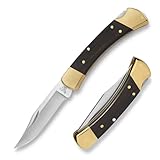
1. Buck 110 Folding Hunter
A classic American folder that has been made for many years, with a lockback mechanism you release by pressing the spine. It is solid and easy to understand, though it is a bit heavy to carry in a pocket.
Suits: traditionalists. Strengths: a proven lock and a classic look. Weaknesses: a bulky, heavy knife. Skip it if you want a light everyday carry.

Best for everyday carry
2. Benchmade Bugout
A lightweight folding knife that uses Benchmade’s AXIS lock, a spring-loaded bar you slide to release. It is ambidextrous and smooth to operate, making it popular for everyday carry.
Suits: everyday carry. Strengths: an ambidextrous lock and a light body. Weaknesses: its premium finish may be more than rough jobs need. Skip it if you want a classic lockback.


Best for pocket carry with a strong lock
3. Spyderco Para 3
A compact folder that uses a compression lock, where the release sits on the spine and the lock presses against the blade tang. It is strong and easy to use with one hand.
Suits: pocket carry with a strong lock. Strengths: an easy-release compression design. Weaknesses: the release takes learning. Skip it if you prefer a simple liner lock.

Best for simple, light everyday use
4. Opinel No.8 Folding Knife
A traditional French folder with a twist-ring Virobloc lock that holds the blade open or closed. It is simple, light and widely used for food and camp tasks.
Suits: simple, light everyday use. Strengths: a distinctive twist lock and a slim blade. Weaknesses: not a one-hand folder. Skip it if you want a one-hand opener.
View Opinel No.8 Folding Knife on Amazon
Best for slim pocket carry
5. Kershaw Leek Folding Knife
A slim folder with a frame lock and assisted opening. It slips easily into a pocket and is known for being light and quick to deploy.
Suits: slim pocket carry. Strengths: a slim profile and a quick opening. Weaknesses: assisted action needs care. Skip it if you want a traditional manual folder.
View Kershaw Leek Folding Knife on Amazon
Best for rough daily tasks
6. Ontario RAT 1 Folding Knife
A sturdy folder with a liner lock and a durable handle. The RAT 1 is known for solid construction and is a practical pick for work and outdoor use.
Suits: rough daily tasks. Strengths: a rugged build and a trusted lock. Weaknesses: a liner lock can wear with heavy use. Skip it if you want a very light folder.
View Ontario RAT 1 Folding Knife on Amazon
Care and Setup
- Check that the lock engages fully before each cut.
- Clean lint from the lock area with compressed air.
- Add a drop of oil at the pivot and lock contact point.
- Test the lock for blade play every so often.
Mistakes to Avoid
- Closing a blade with your finger in its path.
- Spine whacking a knife to test the lock.
- Ignoring blade play or a loose lock.
- Using a folding knife as a pry bar.
How Each Common Lock Type Works
Understanding the mechanism helps you judge a knife beyond its name. A lockback uses a spring-loaded bar along the spine of the handle that drops into a notch at the base of the blade when open. To close it, you press the bar at the rear of the handle to lift it clear. It is simple and long established, but closing requires a firm press and careful hand placement.
A liner lock uses a thin spring metal strip inside one handle scale. When the blade opens, the strip moves across behind the blade tang and holds it in place. You disengage it by pushing the strip sideways with your thumb. It is slim, easy to use one-handed and common on many folders, though its performance depends on the quality of the fit.
A frame lock works like a liner lock, but the handle itself serves as the locking bar, which can make it sturdier. An axis-style lock uses a spring-loaded bar that slides across a pin, engaging a slot in the blade from both sides, and it can be operated from either side of the knife. The twist-ring design on some traditional knives uses a rotating collar that locks the blade by turning.
Each of these works when well built. What matters is how reliably the lock engages, how it resists forces that try to close the blade and how simple it is to release safely. Check the listing for the lock type, and remember that the maker’s description of strength is a claim rather than a test you can verify yourself.
Testing a Lock in Your Hands
When a knife arrives, spend a few minutes checking the lock. Do it with the edge facing away from you and your fingers clear of the cutting path. Open the blade fully and listen for a firm engagement. Look at the lock face and see how much of the engagement surface is in contact. On liner and frame locks, the bar should cover a good portion of the blade tang without sitting at the very edge.
Next, check for play. With the blade open, gently rock it side to side and up and down. A small amount of motion in the pivot may be adjustable, but excessive wobble is a sign of poor fit. Gently press the spine against a solid surface, such as a table, with light pressure to see whether the lock holds. Do not strike or hammer a knife to test it, since that can damage it or cause injury.
Observe the lock’s disengagement. It should release smoothly without sticking. A lock that is too stiff to release is awkward, and one that releases with a slight touch is dangerous. If the knife has a safety feature, check that it works.
Repeat the test after some use and cleaning. Dirt, wear and moisture can change how a lock behaves. If it feels different or the blade shifts, stop using it until you have investigated. A lock is a safety device, and it should earn your trust every time you open the knife.
Matching a Lock to the Job
Different tasks place different demands on a lock. For light daily cutting, almost any properly made lock will do, and ease of use may matter more than raw strength. For rough work such as cutting dense material or pushing hard, a robust lock with a large engagement surface and a sturdy handle design is preferable.
One-handed operation is a key factor. Liner, frame and axis-style locks are all designed to be released with one hand, which is handy if you are carrying something. Lockbacks usually need two hands to close safely. If you often need to work with one hand free, choose accordingly.
Think about the environment. Dirt, sand and water can get into locks and affect them. Locks with fewer small parts and open construction are easier to clean. Cold weather and gloves change how easy it is to release a lock, so test with the gloves you use.
Also consider left- and right-handed use. Some locks are designed to be reached from both sides, while others favor one hand. If you are left-handed, try the release before buying or check the product listing. The best lock for you is the one you can operate confidently every time. When in doubt, choose a simpler design from a maker with a good reputation and keep your use within the knife’s purpose.
Common Lock Failures and Warning Signs
Locks can fail through wear, dirt, misuse or poor design. A common issue on liner and frame locks is lock stick, where the bar sticks to the blade tang and is hard to release. Another is lock rock, where the blade shifts slightly when you push on it, and a related problem is lock slip, where the bar moves too far across the blade. These signs point to wear or poor fit.
Lockbacks can suffer from a weak spring or a worn notch, causing the bar to fail to engage fully. Twist-ring locks can loosen with wear and may rotate unexpectedly if the ring is not tight. Axis-style locks can collect debris that stops them engaging fully. Each type has its own failure modes, and good maintenance can reduce them.
Watch for warning signs. If the blade closes when pressed lightly, the lock engages only a little, or you hear a gritty crunch when opening, stop using the knife. Do not rely on a lock you do not trust. Never put your fingers where a closing blade could trap them, and do not use the knife for prying or twisting, which can stress the lock.
If a lock does fail, contact the manufacturer or retailer about service or replacement. Many makers offer warranty support, and a reputable one will take a safety issue seriously. In the meantime, store the knife safely and keep it out of use.
Keeping a Lock Clean and Reliable
Routine care extends the life of any locking mechanism. Start by wiping the blade and handle after use. Open the knife and clean the area around the lock face and the pivot with a soft brush or compressed air. Pocket lint and grit accumulate quickly and interfere with the lock’s engagement.
Lubricate sparingly. A single drop of a light oil on the pivot is usually enough, and a tiny amount on the lock face can help smooth action. Too much oil attracts dust and can create a sticky paste. Wipe away the excess, and follow the maker’s guidance. If the knife touches food, check that the lubricant is appropriate.
Check fasteners regularly. Loose screws can change how the lock aligns and cause wobble. Tighten them with the right driver, and avoid overtightening, which can bind the pivot. If your knife can be disassembled according to the manual, an occasional deeper clean is helpful, but do not take it apart if the maker advises against it or if you are not confident.
Plan for replacement. Even good locks wear out. Replace the knife or have it serviced if the lock shows persistent play, if the engagement surface is chipped, or if the handle is cracked. Keep a log of any problems and the maker’s response. A lock that is clean, lightly oiled and checked before use is far more likely to stay trustworthy over time.
How the Six Lock Picks Compare in the Hand
Each pick on this list is here because its lock teaches something. The Buck 110 represents the classic lockback: simple, strong in feel, and closed with two hands and full attention, a design that has carried safely for generations. The Benchmade Bugout represents the AXIS-style crossbar lock, ambidextrous and easy to close without putting fingers in the blade path. The Spyderco Para 3 represents the compression lock, which keeps fingers out of the path while offering a secure, mechanical engagement. The Opinel No.8 represents the twist ring, a manual collar that locks the blade open only when you rotate it, and asks you to remember. The Kershaw Leek represents the liner lock in a slim assisted design, quick and pocket-friendly. The Ontario RAT 1 represents the liner lock in a larger, working format that shows how much execution matters at a modest price.
Living with these locks differs more than their strength ratings suggest. Two-handed closing on the Buck is a safety feature in disguise, slowing the moment down. The crossbar and compression designs reward one-handed routines but demand that you learn the safe grip that keeps fingers clear. The Opinel’s ring is wonderfully simple and entirely dependent on the user’s habit of actually twisting it. Choose the lock whose daily routine matches your discipline, not just your preference.
Choose and skip guidance by user
Choose a crossbar or compression lock if you open and close a knife many times a day and want fingers kept out of the blade path by design. Choose the lockback if you value simplicity, glove-friendly operation, and a closing routine that enforces attention. Choose the Opinel if your use is light, deliberate, and food-and-picnic flavoured, and you trust your own habits. Skip assisted opening if your environment is sensitive to quick-opening knives or your local rules treat them differently. Skip any lock you do not fully understand on a knife you plan to carry; spend the learning time at a table first.
Reading Lock Health: What Normal Feels Like
A healthy lock engages the same way every time, with a consistent sound and feel, no new play, and no change in how the blade sits when open. Learn your knife’s normal when it is new and clean, because every later judgement is a comparison against that baseline. A lock that begins to feel gritty usually needs cleaning, not force. A lock that engages later, shallower, or with a different sound is telling you something has changed, and the correct response is to stop, clean, inspect, and, if the change persists, seek service.
Never test a lock by striking the spine or prying with the blade. Those tests can damage a sound knife and prove little about real-world safety. Real cutting keeps force in the direction the lock is designed to hold; your job is to keep your own technique inside that envelope, cutting with the edge, not levering with the flat or twisting a folding knife like a fixed blade.
Cleaning routines that keep locks reliable
Lint is the enemy that arrives daily. Blow out the lock area, wash the knife when it is genuinely dirty, dry it thoroughly, and lubricate sparingly where the maker advises. Pocket carry fills lock mechanisms with fibres faster than most owners expect, so a weekly blow-out and a monthly closer look will prevent most lock complaints. If a lock stays sticky or inconsistent after honest cleaning, that is a service question, not a lubrication problem to drown in oil.
Matching Lock Behaviour to Work and Environment
Cold, gloves, wet hands, and hurry all change which lock serves you. Fine, small lock surfaces are harder to operate with gloves or numb fingers; larger, simpler mechanisms win in winter work. Wet conditions favour designs you can rinse and dry easily. Hurry favours nothing, and the honest advice is to build a closing routine so automatic that hurry cannot skip its steps.
Environment also means people and rules. Workplaces, schools, and public spaces may restrict locking knives, blade lengths, or opening methods, and those rules vary widely by place. The responsible carrier checks the rules that apply where they actually go, chooses a knife that fits them, and carries it discreetly and closed. A lock type is never a legal argument; compliance is its own decision, made before the knife leaves the house.
Teaching a new owner about their lock
If you give or lend a folding knife, spend two minutes on the lock: how it engages, how it releases, where the blade travels, and where fingers must never be. Most folding-knife cuts happen to people using an unfamiliar mechanism confidently. The two-minute briefing is the cheapest safety equipment in this entire article.
When to Retire, Repair or Replace a Locking Knife
Retire a knife from cutting duty when the lock no longer engages fully and consistently after cleaning, when blade play grows, or when parts are visibly worn or damaged. Many makers will service or repair their knives, and that route preserves a good tool. Replacement is the honest answer when repair is not offered, the knife is a copy of uncertain origin, or wear is general rather than specific. A folding knife is a safety device as much as a cutting tool, and its lock is the part you are trusting with your fingers; treat doubt about it as a decision already made.
Keep a simple record for knives you rely on: when bought, any service, any incident. It sounds formal, but when a lock’s feel changes, the record tells you whether you are looking at sudden damage or slow wear, and that distinction decides between repair and replacement.
Worked Examples: Three Carriers, Three Right Locks
Consider a tradesperson who opens and closes a knife dozens of times a day, often with one hand occupied. A crossbar or compression lock, the Bugout or Para 3 pattern, serves this life best, because closing without fingers in the blade path is a daily safety dividend, not a feature. This user should still build the two-minute habit of checking lock engagement each morning, because high use means high lint, and lint is this lock family’s ordinary enemy.
Consider a traditionalist who carries one knife for years, uses it deliberately, and maintains it well. The Buck 110’s lockback fits this temperament exactly: the two-handed close enforces the attention this user naturally gives, the mechanism is simple to understand and clean, and there is nothing to adjust or configure. This user should skip modern one-handed designs without regret; their routine is already the safety system.
Consider a picnicker and light user whose knife cuts food, twine, and packaging on occasional outings. The Opinel’s twist ring is honestly sufficient here, provided the user’s habit of twisting the ring is absolute, and the knife lives in a picnic kit rather than a pocket. The honest skip for this user is any heavy-duty lock marketing; their tasks never approach a lock’s limits, and simplicity serves them better.
The question underneath every lock choice
Ask how you close a knife when you are tired, hurried, cold, or distracted, because that is the moment the lock system must protect. Choose the design whose safe routine survives your worst moment, not the one that delights you at a shop counter on your best one.
Lock Terminology Without the Fog
Terms worth holding clearly: lock-up is how fully and consistently the mechanism engages when the blade opens. Blade play is movement in the open blade that should not be there, side-to-side or up-and-down. Lock stick is a lock surface that resists release with a sticky, grabbing feel. Detent is the feature that keeps a closed blade closed. Centring describes whether the closed blade sits evenly between the handle sides. None of these require expertise to check, only attention and a comparison against how the knife felt when new and clean.
Marketing language, by contrast, should be read loosely. No folding lock makes a knife a fixed blade, no percentage or slogan substitutes for engagement you can see and feel, and the strongest lock on paper is still operated by a human hand that must stay out of the blade’s path. Judge by mechanism, condition, and your own routine, in that order.
A two-minute monthly lock inspection
Open the knife and confirm the lock engages fully with its normal sound. Check for play in both directions with gentle pressure. Close it and confirm the detent holds it shut. Look into the mechanism for lint, and work the action slowly once, feeling for grit or stickiness that was not there last month. Record anything changed. Two minutes, monthly, is the entire cost of knowing your lock’s health rather than hoping for it.
Folding Knife Safety as a Complete System
The lock is one layer of a system whose other layers are grip, technique, maintenance, and environment. Cut with the edge, in directions that keep the blade’s failure path away from your body if anything slips. Keep the handle dry and the blade clean, because a secure lock cannot compensate for a hand sliding onto a blade. Carry closed, store closed, and lend closed. Each layer is ordinary, and together they are why experienced carriers go decades without a serious cut.
Children and guests reset the system to its weakest setting, so adapt when they are present: knives stored out of reach, no knife left open on a table, and no handing over without the lock briefing. A household that treats folding knives this way can enjoy them as tools for generations, which several of these designs have now literally done.
Lock Choice for Different Hands and Abilities
Hands differ, and lock advice that ignores that fails real people. Smaller hands may find large lockbacks and stiff springs genuinely difficult, and a crossbar or compression design with a lighter, clearer action can be the safer knife for that person, because a lock you can operate fully is safer than a stronger lock you operate halfway. Reduced grip strength, arthritis, or an old injury all argue the same way: the best lock is the one this user can engage, verify, and release with complete consistency, every time, including at the end of a tiring day.
Test with the actual hand that will use the knife, in the conditions of use, gloves included if gloves are part of the work. A knife bought for someone else deserves the same care: hand it to them at a table, watch the full open-lock-close cycle, and let their comfort, not your preference, make the final call between two otherwise suitable designs.
Left-handed use, stated honestly
Some locks are genuinely ambidextrous, some are adaptable, and some simply favour the right hand in their release placement or clip position. Left-handed carriers should weight this heavily, because a lifetime of adapting to a right-handed release is a lifetime of slightly awkward closes. Among these six, the crossbar design is the natural starting point for left-handed users, with the others judged model by model rather than assumed.
The Folding Knife as an Heirloom and a Habit
It is worth saying plainly that a well-chosen locking folder is one of the few tools that can serve daily for decades. The Buck 110 pattern has done exactly that for generations of owners, and the modern designs on this list are built to the same ambition. Longevity like that comes from the partnership this article keeps returning to: a sound mechanism, honestly maintained, used within its design, by an owner whose routines are safe enough to be boring.
Choose the lock you will respect, maintain the knife you chose, and let the years do the rest. The best folding knife is never really the one with the strongest lock in a test; it is the one still opening, locking, and closing safely in your hand long after the debate about lock types has been forgotten.
A Short History Worth Knowing, Because It Explains the Designs
Today’s lock variety makes sense once you see it as a series of answers to old complaints. The lockback answered the slip-joint’s habit of closing on fingers under load, with a mechanism simple enough to survive generations of hard use. Liner and frame locks answered the desire for one-handed operation in a slim knife. Crossbar and compression designs answered the liner lock’s one real drawback, fingers in the blade path during closing, by moving the release out of the path entirely. The Opinel’s ring predates them all in spirit: a manual, visible, unmistakable lock for a knife meant to be used slowly and put away.
None of the older answers became wrong when newer ones arrived, which is why this list can honestly recommend designs separated by generations. Locks evolve by adding options, not by expiring, and the carrier’s job is unchanged since the first lockback: understand your mechanism, keep it clean, and close the knife like your fingers matter, because they do.
The buyer’s final filter
After type, size, steel, and rules have all had their say, apply one last filter: could you explain, in one sentence, how this knife locks and how it closes? If not, you are not ready to carry it, whatever its merits. Learn the sentence at the shop counter or the kitchen table, and the knife is yours in every sense that counts.
Pocket Clips, Carry Position and the Lock’s Daily Life
How a knife rides in the pocket affects its lock more than most owners realise. A clip that holds the knife securely against the pocket seam keeps the blade closed and the mechanism out of the lint-rich bottom of the pocket. A knife carried loose travels, tumbles, and fills with debris, and then its owner wonders why the action feels gritty. Carry position also decides which hand reaches the knife and whether the opening and closing routine you practised is the one you can actually perform from that position.
Settle your carry deliberately: one knife, one pocket, one position, practised until retrieval and return are automatic. Consistency is a safety feature here too, because the hand that always finds the knife the same way never fumbles it open, never grips it across the blade’s path, and never has to look down mid-task to solve its own equipment.
Folding Knives by Lock Type FAQ
Which lock is the strongest?
It depends on the design and build, so judge the whole knife rather than the lock name alone.
What is a liner lock?
A liner lock uses a spring metal strip inside the handle that moves behind the blade to hold it open.
What is an AXIS lock?
An AXIS lock uses a spring-loaded bar that slides over the blade tang to hold it open.
Can a lock fail?
Any lock can wear or get dirty. Check it often and clean it, and stop using any knife with a faulty lock.
Is a liner lock safe for daily use?
A well-made liner lock is widely used and works well for everyday tasks. Check it before use and keep it clean. Avoid prying or twisting.
What is lock stick?
It is when the locking bar sticks to the blade and is hard to release. It can come from wear, dirt or poor fit. Clean the lock and contact the maker if it persists.
Can I test a lock by hitting the spine?
Do not strike a knife to test it, as that can damage it or cause injury. Use gentle pressure with your fingers clear of the edge.
Which lock is easiest to close one-handed?
Liner, frame and axis-style locks are designed for one-handed release. Lockbacks usually take two hands. Choose based on how you work.
Do slip-joint knives have locks?
No. They use a spring to hold the blade, which can close if pressure is applied. They suit light tasks.
How often should I clean the lock?
Wipe it after use and clean the lock area whenever it feels gritty. A drop of light oil on the pivot is enough for most knives.
What should I do if my lock feels loose?
Stop using the knife, check the pivot and screws, and consult the manual. If the lock still feels unreliable, contact the maker for service.
Knife Laws, Carry Rules and Why They Affect Your Choice
A lock is a design feature, but in some places it is also a legal one. Rules on folding knives vary by country, state and even city, and some jurisdictions distinguish between knives with a locking blade and those without. Others limit blade length, opening method or the type of place where you may carry. Because these rules change and differ so widely, check your local regulations before choosing a carry knife, and never rely on a product listing to tell you what is lawful where you live.
This is part of why slip-joint designs such as the Opinel No.8 are popular in places with tighter rules, while locking tactical folders are more commonly regulated. If you travel, remember that rules at airports, schools and government buildings are separate from everyday carry rules and are usually stricter.
Consider also workplace policy. Some employers restrict blade length or require a particular type of tool, and some job sites ask for a knife that can be closed with one hand while wearing gloves.
Handle Materials, Pocket Clips and Daily Carry Comfort
Lock type decides how a knife behaves under load, but handle design decides whether you carry it at all. A knife that rides well in the pocket, does not print through trousers and does not dig into your leg is used more often than a technically superior one that stays in a drawer.
- Handle material changes weight and grip. Wood and lightweight polymers feel warm and light, while metal scales add weight and strength but may feel slippery when wet.
- Pocket clip position matters. Tip-up carry keeps the blade point away from fabric folds, while tip-down carry may suit some pockets better. Look for clips that can be moved if you are left-handed.
- Thickness is a larger factor than length for pocket comfort. Thin, slim handles disappear in a pocket, while wide ones are easy to feel.
- Jimping and texture help grip but can irritate your hand in long cutting sessions.
The Buck 110 Folding Hunter is a good example of a design built around a belt sheath instead of a pocket, which is a different carry style that may suit outdoor use better than office wear.
Steel Choice and How It Interacts With the Lock
People often treat blade steel and lock type as separate decisions, but they overlap in practice. A lock only keeps the blade from closing, so a soft or thin tang can still deform at the lock-up surface. Harder liner or frame material resists wear, while softer materials may develop play over time. The steel on the blade itself affects edge retention, corrosion resistance and how easy sharpening is, but it does not make a weak lock stronger.
Choose steel according to the environment. Knives used around water, food or salt air benefit from corrosion-resistant steels, while a dry-use knife can use something that holds an edge longer. Remember that some steels need more care to avoid rust, and that the best everyday option is often a balanced steel that is simple to maintain.
When comparing models, ask whether the maker publishes the steel type, whether the liners or frame are steel or titanium, and whether the pivot uses bushings or washers. These details do not appear on every product page, so a missing detail is a reason to look at the manufacturer site instead of guessing.
Warranty, Repairs and Service Policies
Because a lock is a mechanical part, support matters. Some makers offer service for lock issues, pivot adjustments or cleaning, while others expect you to handle it at home. A knife from a brand with a clear service policy may be worth more over time than a cheaper knife with no support, particularly if you plan to use it hard.
Before buying, look at what the warranty covers. Does it include normal wear, or only manufacturing defects? Is there a cost for shipping? How long does service typically take? Without testing these ourselves, we can only suggest reading the policy and checking buyer reports for how the maker handled a claim.
Consider resale and longevity as well. Knives from established makers with clear model histories tend to keep more of their value, and spare parts such as pocket clips, screws and pivot hardware are easier to find. A common screw type matters because it lets you tighten or clean the knife with tools you already own. If a model requires a proprietary tool or sealed construction, you may be limited to sending it back for service.
A last practical step is to inspect a knife when it arrives. Open and close it several times, check that the blade centers in the handle, that the lock engages fully and cleanly, and that there is no sideways play with the lock closed. Return or exchange it right away if anything feels off, since a flaw found in the first week is much easier to resolve than one found after months of use.
Frequently Asked Questions
Is a locking folding knife legal to carry everywhere?
No. Laws differ by country, state and city, and some places treat locking blades differently from slip-joint ones or limit blade length. Rules also change by location, such as schools or airports. Check your local regulations or an official source before carrying, and do not rely on a product description for legal guidance.
Does a lock make a folding knife better for hard use?
A lock helps prevent accidental closing, which matters for any cutting task where force is applied. It is not a measure of overall toughness, though. Blade thickness, pivot design and handle construction all affect how a knife handles hard use, so judge the whole design instead of the lock type alone.
Is tip-up or tip-down pocket carry better?
Neither is universally better. Tip-up carry usually makes the knife easier to draw and open quickly, while tip-down may keep the point from catching on pocket fabric when you sit. Pick a knife with a clip that can be moved so you can try both and see which suits your pants and routine.
How do I know if a folding knife lock is worn out?
Signs include blade play that was not there before, a lock that engages very close to the edge of its travel, or a knife that closes unexpectedly under light pressure. If you notice any of these, stop using it for cutting and check the maker for service or replacement.
Does a stronger-feeling lock mean a safer knife?
Not by itself. Safety comes from a lock that engages fully and consistently, a user whose technique keeps force in safe directions, and a knife maintained clean and sound. A modest lock in good condition, used correctly, is safer than a heavy-duty lock that is dirty, worn, or trusted to do things folding knives should not do.
Why does my lock feel different in cold weather?
Cold thickens lubricants, stiffens springs slightly, and numbs the fingers judging the feel. Warm the knife in a pocket, work the action a few times, and judge lock health indoors at normal temperature before concluding anything is wrong.
Can I carry a locking knife where I carried a slip-joint before?
Not automatically. Rules and workplace policies often treat locking and non-locking knives differently, and they vary by place. Check the specific rules for where you are going rather than assuming your usual carry is acceptable everywhere.
What should I do if the blade develops side-to-side play?
Stop and inspect: clean the pivot area first, since grit mimics wear. If play persists, the knife needs maker service or professional attention. Continued use with a loose pivot stresses the lock unevenly and makes the knife less predictable in the hand.
Is one-handed closing worth learning?
Only on locks designed for it, and only slowly, at a table, until the safe grip is automatic. For two-handed designs like a classic lockback, the two-handed close is the correct technique, not a limitation to work around.
The Short Version
For a classic lockback, the Buck 110. For an AXIS lock, the Benchmade Bugout. For a compression lock, the Spyderco Para 3. For a twist ring, the Opinel No.8. For a frame lock, the Kershaw Leek. For a liner lock, the Ontario RAT 1.