An everyday carry knife has to be small enough to forget about and useful enough to reach for. A Swiss Army knife fits that brief well, with a blade, scissors and a few small tools folded into a shape that rides easily in a pocket or on a key ring.
The six Victorinox models below cover slim, mid-size and pliers-style carry. We have not used these knives ourselves, and tool lists vary by model, so confirm the exact tools and size on the current listing before buying. Always follow local carry rules, and leave knives behind where they are not allowed.
As an Amazon Associate we earn from qualifying purchases. Links below are affiliate links, and they do not change the product information we give.
What to Look For
| Feature | Why it matters |
|---|---|
| Size | Slim models vanish in a pocket; larger ones carry more tools but feel bulky |
| Tool mix | Scissors, a screwdriver and a bottle opener cover most daily jobs |
| Handle | Plastic handles are light; aluminum handles feel sturdier |
| Carry method | Key ring loops, pocket clips and pouches all change how often you carry it |
In this guide
Specs at a Glance
| Item | Material | Size | Notes |
|---|---|---|---|
| Victorinox Classic SD | Plastic scales, steel tools | Small, key ring size | Blade, scissors, file, tweezers |
| Victorinox Rambler | Plastic scales, steel tools | Small | Slim, with scissors |
| Victorinox Pioneer X | Aluminum Alox scales | Mid-size | Sturdy; larger tool mix |
| Victorinox Compact | Plastic scales, steel tools | Mid-size | Many tools in one body |
| Victorinox Fieldmaster | Plastic scales, steel tools | Larger | Wide tool selection |
| Victorinox SwissTool Spirit X | Stainless steel | Full-size multi-tool | Pliers-based design |
The 6 Best Swiss Army Knives for EDC
Top pickBest for key ring carry
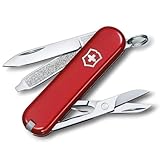
1. Victorinox Classic SD
The classic keychain knife and probably the most carried Swiss Army model. It folds in a small blade, scissors, a nail file with screwdriver, tweezers and a toothpick, which handles daily small jobs.
Suits: key ring carry. Strengths: small size and a trusted design. Weaknesses: a short blade. Skip it if you open heavy packaging often.
Best for slim pockets
2. Victorinox Rambler
A slim pocket knife with a small blade and scissors, plus a few tools. It is easy to forget in a pocket until the moment you need it, which is the point of everyday carry.
Suits: slim pockets. Strengths: very low bulk. Weaknesses: a modest tool count. Skip it if you want a locking blade.

Best for people who want a firm feel
3. Victorinox Pioneer X
A mid-size knife with aluminum Alox scales that feel sturdier than plastic. The mix of blade and utility tools suits people who want more reach than a keychain model gives.
Suits: people who want a firm feel. Strengths: a solid look and feel. Weaknesses: slightly heavier than slim models. Skip it if you want an ultra-light carry.

Best for tool-lovers
4. Victorinox Compact
A multi-layer pocket tool with a generous set of everyday implements in a body that is still manageable. It is a good fit for people who like to solve several small problems with one tool.
Suits: tool-lovers. Strengths: a wide feature set. Weaknesses: extra thickness in the pocket. Skip it if you prefer a simple knife.

Best for camp and workshop days
5. Victorinox Fieldmaster
A larger Swiss Army knife with a bigger tool selection for camping, errands and the workshop. Check the listing for the full tool list, since it changes between versions, and expect a thicker body than the slim models above.
Suits: camp and workshop days. Strengths: plenty of tools. Weaknesses: a larger body. Skip it if you want true pocket-slim carry.

Best for belt-pouch carry
6. Victorinox SwissTool Spirit X
A pliers-based multi-tool from the Swiss Army maker, meant for people who want pliers, a knife and driver bits in one folding body. It carries best in a belt pouch.
Suits: belt-pouch carry. Strengths: real pliers plus tools. Weaknesses: more weight than a pocket knife. Skip it if you only need scissors and a blade.
View Victorinox SwissTool Spirit X on Amazon
Care and Setup
- Rinse sticky residue off the tools with warm water and dry them.
- Put a tiny drop of oil on the joints now and then.
- Close each tool fully before putting the knife in a pocket.
- Keep the blade honed with a small stone or strop.
Mistakes to Avoid
- Prying with the small blade, which can snap the tip.
- Carrying a knife where it is not permitted.
- Leaving a wet knife in a pocket.
- Buying a large model that you will leave at home.
What Everyday Carry Asks of a Knife
Everyday carry, often shortened to EDC, is about what you will actually have with you on an ordinary day. A tool that stays in a drawer does not help, so the best EDC knife is the one you are willing to carry in your pocket or on your keys without thinking about it. This changes how you judge a Swiss Army style knife. Tool count matters less than size, weight and how often you will use each feature.
Start by listing the small jobs you really do. Opening mail and packages, trimming a loose thread, tightening a small screw, removing a splinter, cutting a piece of string, opening a bottle or a can, and slicing an apple are typical. Notice which tools you reach for: blade, scissors, tweezers, screwdriver, bottle opener. A person who mostly opens parcels needs a good small blade, while someone who fixes glasses and electronics may value a small screwdriver and tweezers more.
Think also about where you will carry it. A key ring tool lives with your keys, which means it goes everywhere, including places where knives are restricted. A pocket tool is more comfortable for those who carry a wallet and phone and have room. A pouch or belt tool suits people who work outdoors or in a workshop. The more bulk a knife adds, the more likely it is to be left behind.
Size Tiers and Pocket Feel
Swiss Army style knives come in rough size tiers. The smallest ones, made for key rings, are light and thin, with a short blade, scissors and a few small implements. They hold up well to daily jingling but offer little leverage. Slim pocket models, a step up in size, add a longer blade and a few more tools while staying flat enough for a trouser pocket. Mid-size models have thicker handles and more layers of tools, which gives a firmer grip but adds bulk. Large multi-layer models carry many tools and feel like a small toolbox, and they are best kept in a bag or pouch.
Handle material changes the feel. Plastic scales are light and warm in the hand, while metal scales feel more solid and can be heavier and cooler. Ribbed or textured handles help with grip when wet. A rounded profile is easier on pockets than sharp edges.
Weight can feel more important than you expect. A heavier knife may be fine on a belt but irritating in a pocket, where it pulls on the fabric. If you are unsure, favor the smaller option first. You can always add a bigger tool later for jobs that need it, whereas an oversized knife often ends up in a drawer.
If possible, handle one in a store. The way the tools open, how easy they are to pull out with a fingernail, and how the handle sits in your palm are things a listing cannot tell you.
Blade Geometry and Everyday Cutting
The blade is what you will use most, and small knives have their own limits. A short blade is excellent for packaging, string, fruit and small kitchen tasks, but it is not built for heavy cutting or prying. A well-shaped blade with a fine edge slices easily, while a dull one slips and tends to cause accidents. A sharp knife is safer than a dull one, because it needs less force.
Most small Swiss Army style knives have non-locking blades, as the listing for these models notes. That means the blade can close on your fingers if you press on the spine or twist it sideways. Use the knife for straight cutting, keep your fingers clear of the edge path and avoid using the blade as a screwdriver or lever. If you want a lock, check the listing for lock details and consider a model that has one.
Edge care is simple. A small stone, strop or sharpening tool will keep the edge in working order. Clean off sticky residue after cutting tape or food, and dry the blade. A thin edge can chip if you cut hard materials or twist it in a cut, so avoid cutting wire, bone and frozen items with the small blade.
Scissors deserve mention because many people use them more than the blade. Check that the scissors cut cleanly and that the handle is comfortable enough for a small trimming job.
Tools Beyond the Blade
The extra implements are what give a Swiss Army style knife its character, and each has a practical use. A small flat screwdriver and a Phillips-type driver handle tiny screws, though they are not for tight, stuck fasteners. A can opener and bottle opener serve picnic and camp needs. A file or nail file with a driver tip can smooth rough edges. Tweezers and a toothpick tuck into the handle and are surprisingly handy. A magnifier, a saw or a hook appear on some larger models, and you should confirm what the specific version includes on the listing, as tool lists change between versions.
Think about reach and leverage. Small tools can bend or snap if you use them as pry bars or to turn stubborn screws. Apply steady pressure, work gently, and choose a proper tool if a job needs force. A tool that fits a small screw cleanly is more useful than a longer set of tools that fit poorly.
Open and close each tool carefully, because springs hold them in place and a pinched finger is an easy mistake. Check that each tool locks open when it is meant to, or stays closed when not in use. Some tools have a nail nick that makes them easy to open, while others need a fingernail or a thumbnail slot.
For people who want pliers or a larger set of driver bits, a pliers-based multi-tool is a better answer, and the pouch-carried model in this guide points in that direction.
Carry Rules, Care and When to Replace
Knife rules are local and change from place to place. Rules differ by country, region, city and building, and what is allowed in one place may be prohibited in another. Schools, courthouses, government buildings, airports and many workplaces restrict knives, including small ones. Check the rules for your area and for any place you will visit, and follow the instructions of the airline and airport if you travel. When in doubt, leave the knife at home or pack it where regulations allow.
For care, rinse the knife in warm water if it gets sticky or dirty, open all the tools, and dry them thoroughly. A drop of light oil at the joints keeps things moving smoothly, and a small amount is enough. Keep it out of damp pockets and avoid leaving it in a hot car. If it sits in a bag with other gear, a pouch protects the surfaces.
Signs that it is time to replace the knife include blades or tools that wobble or no longer stay open or closed, springs that have lost their tension, handles with cracks, tips that have snapped off or tools with corrosion that cleaning does not remove. Minor wear is normal, and many people keep the same knife for years, but a knife with broken parts is a safety risk.
When replacing, think about what you wanted from the old one and what you did not use. A change to a smaller or larger size often makes the difference between a tool you carry and a tool you leave at home.
Swiss Army Knives for EDC FAQ
Which Swiss Army knife is best for daily carry?
Many people pick the Classic SD or the Rambler for their light weight, and the Pioneer X for a sturdier feel.
Do these knives lock?
Most small Swiss Army models do not lock the blade. Check the listing for lock details on any model you consider.
Can I take one on a plane?
Rules vary by country and carrier. Check the current guidance for your airline and airport before you travel.
Are they good as a first knife?
Yes. They are simple, proven and made for a wide range of everyday jobs.
What size Swiss Army knife is best for everyday carry?
It depends on where you carry it. Key ring models and slim pocket models are easiest to carry daily, while larger models suit bags, pouches and outdoor use.
Can I use the small blade to pry things open?
It is best not to. Small blades can snap or bend when used as levers, and non-locking blades can close on your fingers. Use a proper pry tool for that job.
How do I keep my Swiss Army knife sharp?
Use a small stone or strop at the original edge angle and keep the blade clean and dry. Wipe off residue after cutting sticky items.
Can I carry a Swiss Army knife to work?
That depends on your employer, building and local rules. Many workplaces and public buildings restrict knives, including small ones, so check the policy first.
Should I get a model with a locking blade?
A locking blade offers more security during harder cuts. Most small models do not lock, so check the listing, and decide whether you need the extra safety.
How often should I oil the joints?
A tiny drop of light oil now and then is enough, especially after cleaning or if the tools feel stiff. Wipe off any extra so that it does not collect lint.
What should I do if a tool will not open easily?
Rinse off dirt, dry the knife, and add a small drop of oil at the joint. If it remains stiff or a spring feels weak, the knife may need replacing.
Scales, Tools and What Each Handle Layer Holds
Victorinox builds its pocket knives from a simple layered structure: a handle shell on each side, with tools mounted on pins between them. Each layer holds a tool or two, and the tools fold in and out of the handle. The number of layers decides the thickness, and the number of tools decides how many layers you need. Slim models stay thin by keeping the tool count low, while larger models stack more layers and feel chunkier in a pocket.
This design has a few practical consequences. Tools on the same layer cannot be open at the same time, and some tools block others when open. The blade, scissors, and nail file on a slim model each have a defined place, and they usually open smoothly one at a time. Larger models include more tools and may need more force to open each one.
- Slim models: fewer layers, lower weight, and a smaller blade.
- Mid-size models: a larger main blade, extra tools, and a thicker handle.
- Pliers-based tools: bulkier and heavier, but able to grip, cut wire, and hold small parts.
Choosing Between Tool Sets
The tool you open most often should drive your pick. If you mostly open mail, trim threads, and tighten the occasional screw, a slim model with a blade, scissors, file, and a small screwdriver is enough. If you work on bikes, electronics, or camping gear, look for a model with a larger screwdriver, a can opener, and a bottle opener. A pliers-based tool is better for repairs that require gripping and bending.
It also helps to think about reach. A tool that is too short can be awkward to use, and tools on the back side can be hard to open one-handed. Try opening each tool and check whether your thumbnail fits the nail nick. If the listing mentions a nail nick on the blade, a one-handed opening may be possible once you get used to it, though many people find two hands easier and safer.
Some features are easy to overlook. A tweezers and toothpick set stored in the handle is handy for splinters and small tasks. A key ring attachment keeps the knife on your keys, and a small lanyard hole helps you carry it on a lanyard. Check that the knife will not get caught or get in your way, especially if you carry it in a pocket full of coins.
Pocket Strategies: Keys, Pouches and Keeping It Quiet
Carrying a pocket knife is mostly about comfort. Loose in a front pocket, a small knife can scratch a phone or wear a hole in fabric. A small pouch, a pocket organizer, or a dedicated pocket separates it from other items. On a key ring, it will add weight and bulk, and it can scratch or dent other objects. Think about whether you want it separate or on your keys.
Smaller knives are easier to carry in dress clothes, and many people keep a second tool at home or in a bag. Consider how often you need the knife and how far you will carry it. Heavier models may feel fine for outdoor work, but at an office, they can feel excessive.
Keep the knife dry and clean in your pocket, since lint and moisture can collect in the joints. Brush out debris with a soft brush and a drop of oil now and then. If the knife has a belt clip or pouch, make sure it holds the knife securely and does not rub the finish.
Counterfeits, Wear and Genuine Parts
Genuine Victorinox knives are widely sold, which also means imitations exist. Buy from the maker or an authorized seller, and compare the logo and markings to the official site. A real knife has crisp stamping, even gaps between layers, and smooth tool action. Poor finishing, sloppy engraving, or very low prices should raise suspicion.
Over years of use, the springs weaken and the pivots loosen, so the tools can feel less crisp. Cleaning and a drop of oil usually restore some smoothness. If a tool fails, check whether the maker sells replacement parts or offers repairs. Many owners keep a knife for decades with simple care.
Finally, remember that you may need to replace a knife if a spring breaks or the blade has been sharpened away. A well-maintained knife is cheap to own, but a damaged one is not worth the risk. When it stops working reliably, retire it and choose a new one.
It also pays to think about how a model will age in your pocket. Handle scales on these knives are often plastic or similar material, and they pick up scratches and a worn look over time. That is cosmetic, and many owners like the patina. Pay more attention to blade centering, spring tension, and whether each tool still snaps firmly into position. If a tool begins to wobble or fails to stay open, stop using it and have it checked, because a closing tool can injure your fingers.
Finally, match the knife to the person. A larger hand may find a very slim model fiddly, while a smaller hand may tire of a thick, heavy one. Handle each model if you can, or compare listed dimensions against a familiar object, such as a standard key or a deck of cards, to get a feel for its size before you decide.
Frequently Asked Questions
What is the thinnest Swiss Army knife for a pocket?
Slim models with only a few tools are the thinnest, because each added tool needs another layer in the handle. Check the thickness and weight listed in the product details and compare. A small knife may feel best if you carry it every day in dress pants.
Can I put a Swiss Army knife on my keychain?
Yes, many models have a key ring attachment. The knife adds weight and bulk to your keys, and it can scratch other items. If you travel, remember that a knife on your keys may need to go into checked luggage or be left at home.
Are Swiss Army knife scissors any good?
They are small, spring-loaded scissors that work well for thread, paper, tape, and light trimming. They are not designed for thick fabric or heavy materials. If you cut often, test the scissors for smooth action and a clean closing edge.
How can I tell if a Swiss Army knife is genuine?
Buy from the maker or an authorized seller, and compare logos, markings, and packaging with the official site. Genuine knives have clean stamping, tight tolerances, and smooth tool action. Low prices and sloppy finishing are warning signs, so avoid listings that seem suspicious.
The Short Version
For key ring carry, the Classic SD. For slim pockets, the Rambler. For a sturdier feel, the Pioneer X. For many tools, the Compact. For camp days, the Fieldmaster. For pliers, the SwissTool Spirit X.
Related Guides
- 6 Best Cheap Swiss Army Knives: Victorinox Picks (2026)
- 6 Best Swiss Army Style Knives: Multi-Tool Alternatives (2026)
- 6 Best Victorinox Swiss Army Knives by Size and Use (2026)
- 6 Best EDC Pocket Knives: Slim, Strong and Simple (2026)
- 6 Best Pocket Knives with Scissors: Swiss Army and Multi-Tool (2026)