Where to buy
Check the latest price, availability and delivery on Amazon. Orders are placed on Amazon. We may earn a commission from qualifying purchases. The honest headline at this budget: there is still no powered miter saw at $50 from any brand — the entry powered compound class costs well over twice this entire budget — so the two linked picks below are the complete hand miter kits that genuinely own this tier, and the remaining picks are prose-only alternatives, including the powered saw this budget is honestly a stepping stone toward.
- Best overall under $50: CRAFTSMAN Mitre Saw, 12-Inch Saw & Clamping Box (CMHT20600) — Check on Amazon
- Best self-storing kit: Stanley Saw Storage Miter Box with Saw (20-600) — Check on Amazon
- CRAFTSMAN Adjustable Angle Mitre Saw (CMHT20800) — the adjustable-angle hand saw step-up; prose-only below
- Japanese pull-saw miter box sets — the fine-finish route; prose-only below
- Excel Blades 6-Inch Metal Mitre Box Set (55666) — the hobby-scale precision set; prose-only below
- The powered destination: an entry 10-inch compound miter saw — prose-only below, at well over twice this budget
Read the full guide ↓
Disclosure: As an Amazon Associate, umtsmarttool.com earns from qualifying purchases. Links to Amazon on this page are affiliate links; they cost you nothing extra. Listing details such as price and availability change often, so check the current Amazon listing before you buy.
The best miter saw under $50 is a search that deserves a straight answer before it gets a shopping list: at fifty dollars, there is still no motor. A powered miter saw needs a 15-amp-class motor, a ground blade, a cast table and a pivot that holds angles under load, and the cheapest honest version of that machine — the entry 10-inch compound class — sells for well over twice this entire budget. Any listing that suggests otherwise at $50 is a toy, a mislabel or a bare accessory wearing a saw’s name. What $50 genuinely buys, and buys noticeably better than $30 does, is the top of the hand miter world: complete clamping kits from the major hand-tool brands, a self-storing Stanley design with decades of production behind it, an adjustable-angle hand saw for work beyond fixed slots, and — for fine and hobby work — pull-saw sets and a metal precision box that no powered saw at any price truly replaces for small stock.
So this guide does the two jobs a $50 buyer actually needs. It ranks the hand miter kits that own this tier — leading with the CRAFTSMAN clamping kit, whose cam pins solve the accuracy problem that defines hand mitering, and the Stanley storage kit, which at this budget steps up from prose mention to a fully linked recommendation — and it maps the boundary honestly: which work belongs to these kits forever, and which work means this $50 is better saved toward the powered class or spent on a rental weekend. If you arrived hoping $50 had quietly become powered-saw money, the kindest service this page can do is tell you it has not, show you exactly what it is instead, and help you decide whether your cutting belongs to the hand tier or the saving tier. The tier below is covered at Best Miter Saw Under $30; this page is about what the step up actually adds.
In this guide
Quick Picks
Each row names a buyer type and the option that suits it. The two linked picks are the complete kits verified as sold within this budget; the rest are described in prose, with the reason stated in each review.
| Buyer type | Pick | Why it stands out | Link |
|---|---|---|---|
| Best overall under $50 | CRAFTSMAN Mitre Saw, 12-Inch Saw & Clamping Box (CMHT20600) | Cam pins clamp the work against a honeycomb base; complete kit | Check on Amazon |
| Best self-storing kit | Stanley Saw Storage Miter Box with Saw (20-600) | 14-inch backsaw stores inside the box; proven for decades | Check on Amazon |
| Best for angles beyond the slots | CRAFTSMAN Adjustable Angle Mitre Saw (CMHT20800) | Adjustable-angle hand miter saw for non-standard angles | Prose-only — check price on Amazon |
| Best for fine finishes | Japanese pull-saw miter box sets | Thin-kerf pull stroke, glue-ready faces on small work | Prose-only — check price on Amazon |
| Best for hobby precision | Excel Blades 6-Inch Metal Mitre Box Set (55666) | Aluminum/steel box and razor saw at desk scale | Prose-only — check price on Amazon |
| Best save-up destination | Entry powered compound miter saw (10-inch, 15-amp class) | Lumber, bevels and volume — at well over twice this budget | Prose-only — plan or rent |
How These Picks Were Chosen
The budget was applied as a ceiling on a complete, ready-to-cut purchase: box, saw and workholding, sold as a real Amazon listing positioned within $50 in the United States — check the current price on Amazon before you buy, because these legacy hand-tool listings drift between sellers. That filter again removed every powered saw, and it removed bare boxes sold without saws. What changed versus the $30 tier is depth: at $50, both of the major clamping/storage kits verify inside the budget, so this guide can link two genuinely different answers instead of one, and the step-up field — adjustable-angle hand saws, finer pull-saw sets — comes into honest view even where individual listings remain prose-only.
We did not use these tools ourselves. We read maker listings, specification pages and reputable roundups, and compared what decides hand-miter accuracy: workholding first (cam pins that lock stock against the base beat any free hand), then box rigidity and slot wear, then the saw itself — spine stiffness, length against your stock widths, tooth style against your finish needs — and finally the angle menu, where 90° and 45° carry most work, 22.5° face angles serve octagons and trim faces, and a genuinely adjustable hand saw covers the odd angles fixed slots cannot. Storage design counted as a real criterion, not a cosmetic one, because a kit that stores as one piece is a kit that survives in a real home or shop.
Prose-only picks carry stated reasons: the adjustable CRAFTSMAN and the pull-saw sets are categories whose individual listings we did not verify to link standard; the Excel set’s specifications are verified but its current in-budget US price is not; and the powered saw is planning advice, not a purchase. Nothing here invents a specification or a price. Buyers deciding between tiers will find the same discipline in the beginners’ version of this guide, written for the first-tool angle, while this page stays with the general $50 buyer.
The 6 Best Miter Saws Under $50
CRAFTSMAN Mitre Saw, 12-Inch Saw & Clamping Box (CMHT20600)
Who it suits: The general buyer at this tier — trim, frames, small furniture and repairs — who wants the most accurate complete hand kit the budget buys, full stop.
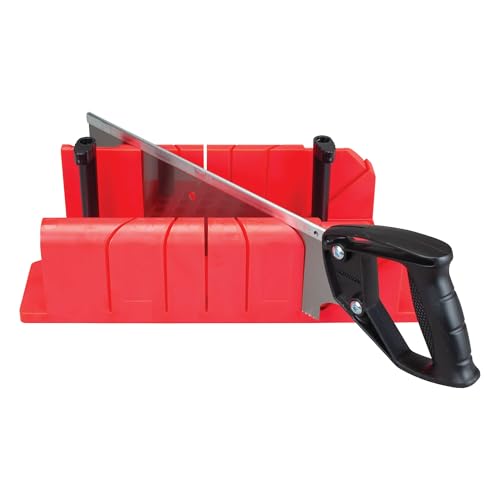
The kit’s completeness is the starting point: miter box, 12-inch backsaw and two cam pins in one box. The cam pins are the reason it leads at $50 just as it did at $30: they twist and lock the workpiece against the box’s honeycomb base, converting the hardest part of hand mitering — holding short, light, odd stock perfectly still — into a solved problem, so the user’s whole attention goes to the stroke. The box cuts 90° and 45° and adds face angles of 45° and 22.5°, covering standard corners, octagonal work and angled trim faces. The backsaw’s stiffened spine keeps the blade tracking flat, which is what lets a cut go straight to glue. At $50 this kit is no longer the scrappy budget answer; it is simply the benchmark hand miter kit in its class, and the budget comfortably contains it with room for the square and practice stock every buyer should own.
Its working profile suits the way this tier is actually used: a room’s casing over a weekend, frames whenever they arise, furniture repairs and small builds at project pace, all in near-silence with a brushable pile of dust. The limits remain the class limits, and $50 does not repeal them: hand pace, small cross-sections, no bevels, no lumber. What the step up from $30 buys here is not a different tool but certainty — the best kit, verified in budget, with the accessories funded. Check the current price on Amazon before ordering, and if your work is trim-scale for the foreseeable future, buy this and consider the miter question closed. The technique that makes it sing is covered in How To Use A Miter Saw Basics.
- Cam pins lock stock against a honeycomb base — the accuracy feature of the class.
- Complete kit: box, 12-inch backsaw, two pins.
- 90°/45° cuts plus 45° and 22.5° face angles.
- Silent, dust-light, stores as one box.
Honest limitation: Hand pace and small-stock capacity, unchanged by the higher budget. Production and lumber work belong to the powered class.
Choose it if you want the benchmark hand kit and your work is trim-scale. Skip it if your list is lumber, flooring or volume — the last pick is your route.
Stanley Saw Storage Miter Box with Saw (20-600)
Who it suits: Buyers who value a kit that stores as one self-contained piece — and who, at $50, can now buy the design that the $30 tier could only point at.
At this budget the Stanley becomes a full recommendation. The design is the classic: a high-impact miter box offering 90°, 45° and 22.5° slots with a clamping facility for the work, and a 14-inch backsaw that stores inside the box itself. That storage is the product’s thesis — the kit is one flat object that lives in a drawer or on a shelf edge, arrives at the bench complete, and leaves no orphaned saw wandering a toolbox. The 14-inch saw gives a longer, smoother stroke than the 12-inch class, which many users feel as easier rhythm on trim-width stock. Decades of continuous production stand behind the pattern; every miter-box technique ever written applies to it without translation.
Choosing between the two linked kits is a genuine judgment call, and this guide will not fake a gap that is not there. The CRAFTSMAN’s cam-pin system is the stronger dedicated workholding; the Stanley’s self-storage is the stronger ownership experience, and its longer saw suits wider trim. Homes and shops with tight storage rationally pick the Stanley; benches that cut often rationally pick the CRAFTSMAN. Either is a complete, verified, in-budget answer — check the current price on Amazon for both on the day, because these listings drift and the day’s gap is a legitimate tiebreaker. What neither does is cut bevels or lumber, and no $50 hand kit pretends otherwise here.
- Saw stores inside the box — the tidiest ownership in the class.
- 90°, 45° and 22.5° slots with a clamping facility.
- 14-inch backsaw: a longer, smoother stroke on trim.
- Decades-proven design; every published technique applies.
Honest limitation: Workholding is a clamping facility rather than the CRAFTSMAN’s dedicated cam-pin system; class limits on pace and capacity apply.
Choose it if storage and completeness-as-one-object matter most. Skip it if maximum workholding is the priority — that is the CRAFTSMAN, by a nose.
CRAFTSMAN Adjustable Angle Mitre Saw (CMHT20800)
Who it suits: Buyers whose work keeps meeting angles that are not 45 or 90 — old houses with settled corners, custom trim geometry, restoration matching — and who need a hand saw that adjusts rather than slots.
Fixed-slot boxes share an assumption: that the world’s corners are standard. Settled houses, hand-built furniture and restoration work disagree, and the adjustable-angle hand miter saw exists for the disagreement. CRAFTSMAN’s entry in this style — the CMHT20800, appearing alongside the clamping box in the brand’s own miter lineup — replaces fixed slots with an adjustable angle mechanism, letting the user set and repeat non-standard angles by hand. For the trim carpenter’s trickiest domestic problem, the corner that measures 44 or 46.5 degrees, that adjustability is not a luxury; it is the difference between a joint that closes and a season of filler.
It is prose-only in this guide because, while the model and its place in the maker’s lineup are verified from roundups of the brand’s range, we did not verify a current US Amazon listing and in-budget price to the standard a link requires — check the live listing if this is your need. The honest positioning: for standard work, the two linked kits are simpler, stiffer and cheaper to run, because fixed slots cannot be mis-set. The adjustable saw earns its place as the specialist second tool for non-standard geometry, bought by buyers who already know their corners are odd — old-house owners will nod at that sentence — rather than as a first kit for standard work.
- Adjustable angle mechanism for non-standard corners.
- Built for restoration, old-house and custom-geometry work.
- Same brand ecosystem as the linked clamping kit.
Honest limitation: Adjustability can be mis-set in a way fixed slots cannot; overkill — and less rigid — for standard 45/90 work.
Choose it if your corners measurably are not standard. Skip it if your work is standard trim and frames — the slotted kits are stiffer and simpler.
Japanese Pull-Saw Miter Box Sets
Who it suits: Finish-first buyers at this tier — frames, fine trim, small furniture with visible joints — who want the best cut faces hand tools produce.
The pull saw remains the finish champion of the hand-miter world: cutting on the draw lets the blade run thin, the thin kerf wastes almost nothing, and the face it leaves frequently needs no sanding before glue. At $50 the sets in this style get more credible — better blades, fuller piece counts in the four-piece configurations roundups describe — even though individual listings still vary enough by seller that this pick stays prose-only, with contents to be verified on the exact listing. For stained hardwood frames, keepsake boxes and any joint that will be looked at closely for years, this route out-finishes every backsaw in the guide, and its gentle, quiet technique suits the unhurried work it serves.
The running truths are unchanged: fine pull-saw teeth are brittle against nails, staples and grit, so reclaimed and painted stock belongs to the backsaw kits; the stroke is a learned rhythm that the first practice board teaches; and replacement blades are the style’s modest running cost. Buyers whose work is painted or rough should save their money for the linked kits. Buyers whose work is visible should consider this the tier’s connoisseur pick — and should read How To Make A Miter Joint for the layout and glue-up craft that fine faces deserve.
- Thin-kerf pull stroke: the finest faces in this guide.
- At $50, sets trend toward better blades and fuller contents.
- Ideal for stained, visible, close-looked-at joinery.
Honest limitation: Brittle fine teeth on dirty stock; contents vary by seller — verify the exact listing.
Choose it if finish quality is the point of your work. Skip it if your stock is painted, rough or reclaimed.
Excel Blades 6-Inch Metal Mitre Box Set (55666)
Who it suits: Hobbyists and modelers at any budget — the buyer whose stock is balsa, basswood and miniature parts, and whose tolerance is measured in fractions.
This set’s presence at $50 makes the same point it made at $30, more strongly: some tools are not budget versions of anything. The six-inch aluminum-and-steel box and razor pull saw, on a K5 handle, cutting 45° and 90°, are the precision instruments of the miter world at desk scale. The metal box’s slots do not flex or wear like small plastic boxes, so miniature miters stay matched across a whole project; the razor teeth leave craft faces nearly cleanup-free; and the set is made in the USA. A modeler with a $50 budget does not need a bigger tool — they need exactly this tool, plus materials.
It is prose-only because we verified the product and specifications from maker listing information but not a current in-budget US Amazon price to the standard a link requires; check the live listing. And the boundary is absolute in both directions: this set cannot cut a room’s trim, and no carpentry kit in this guide can cut a dollhouse staircase properly. Scale is destiny in miter tools, and this pick exists so the hobby scale is served by a specialist rather than by the smallest carpentry compromise.
- Metal box holds miniature tolerances across whole projects.
- Razor pull saw for balsa, basswood and thin stock.
- Made in the USA; desk-scale footprint.
Honest limitation: Miniature capacity only — a specialist, never a household’s only miter tool.
Choose it if your work is models and miniatures. Skip it if your work comes from a lumber rack.
The Powered Destination: An Entry 10-Inch Compound Miter Saw
Who it suits: Buyers whose honest list — lumber, flooring, bevels, volume — has outgrown hand tools, and who are deciding whether $50 is a purchase or a down payment.
The destination class is specific: a 10-inch blade, a 15-amp motor at up to about 5,000 RPM, a single-bevel compound head, roughly 24 pounds, with the Metabo HPT 10-inch compound saw as the class’s usual value benchmark and DEWALT and Makita equivalents above it. It sells for well over twice this guide’s entire budget — no link, no price, by design — and it buys the three capabilities no hand kit offers: crosscut capacity in real lumber, bevel and compound angles, and all-day pace. For a buyer whose projects need those, the correct $50 decision is often not to spend it on a hand kit at all, but to bank it toward the powered saw — or to rent the powered saw for the burst and let the hand question wait.
The counterweight, stated plainly because this guide sells hand kits: most trim-scale buyers never need the destination. A household or small shop cutting frames, casing and small parts a few times a month is fully served by the linked kits, forever, and the powered money is better spent on materials. The decision is a census, not a feeling: count your cuts, measure your widest stock, list your bevels. The census that says “small, standard, occasional” belongs to picks one and two. The census that says “wide, angled, weekly” belongs here — and when it does, How To Choose A Miter Saw is the guide to spend an evening with before spending anything else.
- 10-inch, 15-amp class: lumber capacity, bevels, pace.
- Well over twice this budget — a save-up or a rental, honestly framed.
- The hand kits remain useful beside it for small one-off cuts.
Honest limitation: Not purchasable at this budget in any honest form; also brings storage, noise and dust that hand kits never do.
Choose it if your census says wide, angled and weekly. Skip it if your census says trim-scale — the linked kits are the finished answer.
Comparison Table
| Product | Type | Key verified spec | Best use | Link |
|---|---|---|---|---|
| CRAFTSMAN Mitre Saw & Clamping Box (CMHT20600) | Hand miter kit | 12-in backsaw, cam pins, honeycomb base; 90°/45°, face 45°/22.5° | Benchmark accuracy for trim and frames | Check on Amazon |
| Stanley Saw Storage Miter Box (20-600) | Hand miter kit | 14-in backsaw stores in box; 90°/45°/22.5° slots | Self-storing ownership, wider trim stroke | Check on Amazon |
| CRAFTSMAN Adjustable Angle Mitre Saw (CMHT20800) | Adjustable hand saw | Adjustable angle mechanism (maker lineup) | Non-standard corners, restoration | Prose-only |
| Japanese pull-saw miter sets | Hand miter kit | Thin-kerf pull saw with miter box | Finest finishes on visible work | Prose-only |
| Excel Blades Mitre Box Set (55666) | Hobby miter set | 6-in aluminum/steel box, razor pull saw, 45°/90° | Models, miniatures, craft precision | Prose-only |
| Entry powered compound miter saw | Powered saw | 10-in blade, 15-amp class, up to ~5,000 RPM | Lumber, bevels, volume — save or rent | Prose-only — above budget |
How to Choose a Miter Saw Under $50
- Run the census first. Widest stock, cuts per month, any bevels. Small-standard-occasional means hand kit; wide-angled-weekly means save or rent. The census, not the budget, picks the class.
- Between the linked kits, choose your virtue. Maximum workholding: CRAFTSMAN’s cam pins. Maximum storage elegance and a longer stroke: Stanley. Both are complete, verified and in budget — this is a preference, not a compromise.
- Treat adjustability as a specialist feature. Fixed slots cannot be mis-set and are stiffer; adjustable hand saws earn their place only when your corners measurably are not standard.
- Let finish needs route the rest. Visible, stained, fine work argues for the pull-saw route; painted and general work for the backsaw kits; miniature work for the metal hobby set.
- Fund the accessories. At $50 the kit no longer consumes the whole budget: a combination square, practice stock and a spare blade belong in the same purchase, and they will improve your joints more than any further tool upgrade at this tier.
- Compare live prices on the day. Legacy hand-tool listings drift between sellers; a few dollars of drift between the two linked kits is a fair tiebreaker, and no printed figure — including in older guides — should override the day’s number.
- Refuse the fake powered tier. Motorized “miter saws” advertised near $50 are toys, mislabels or accessories. The honest powered floor is well over twice this budget; plan around the fact rather than learning it by return shipping.
- Remember the kit outlives the decision. Even buyers who later graduate keep the hand kit for small cuts. A $50 hand purchase is rarely wasted money in a way a rushed powered purchase can be.
What the Step Up From $30 Actually Buys
Buyers comparing the two tiers deserve the itemized version. At $30, the verified in-budget field is one complete clamping kit; the Stanley storage design sits just above the line, close enough to mention, too far to link. At $50, both benchmark kits verify inside the budget, which changes the purchase from “the one honest option” to a genuine choice between the class’s two philosophies — dedicated cam-pin clamping versus self-storing completeness. The step up also funds the ecosystem around the kit: the square that verifies your angles, the spare blade that keeps a project un-stalled, the practice stock that makes your first joints tuition instead of tragedy. And it brings the specialist field — adjustable-angle saws, better pull-saw sets — into plausible second-purchase range, even where this guide keeps them prose-only for verification reasons.
What the step up does not buy is equally definite, and a $50 buyer should hear it from this guide rather than from a return label: it does not buy a motor, a bevel, a wider throat or a faster cut. The hand tier’s ceiling is a quality ceiling, not a capability one — the best hand kits in the world cut at hand pace, in small stock, at slotted angles. If your census says that ceiling is your ceiling too, $50 buys you the top of the correct tier and the question is closed. If your census says otherwise, the step up’s real product is information: another tier of evidence that your work belongs to the powered class, purchased cheaply if you rent first and save with the hand kit handling the small work meanwhile.
There is one more step-up dividend that rarely gets printed: confidence calibration. A buyer who has run the $30 tier knows their own pace, their stock sizes and their angle needs from experience; a buyer arriving fresh at $50 is guessing at all three. The two linked kits are forgiving of that guessing — both serve the whole trim-scale range — but the accessories funded at this tier are where calibration happens fastest: the square tells you whether your joints are truly closing, the practice stock tells you your real pace, and together they convert the next tool decision, whatever it is, from a hope into a measurement. Spend the step up on that knowledge and it pays out at every tier above this one.
Hand Versus Powered at $50: The Decision, Worked Through
Work the decision on three projects, because abstractions mislead. Project one: casing and quarter-round for a bedroom, a weekend, perhaps forty cuts in trim stock. Hand kit: entirely in its element, silent, done by Sunday lunch, joints indistinguishable from powered work. Powered saw: faster per cut, slower per project once setup, noise management and cleanup are counted. Verdict: hand, and it is not close. Project two: a hardwood picture-frame commission, four frames, visible joints, stained finish. Hand kit — specifically the pull-saw route or the clamping kit with care: the finish quality is the product. Powered saw: excellent cuts, but its blade and pace buy nothing the hand route lacks at this scale. Verdict: hand, on quality grounds alone. Project three: laminate flooring for two rooms, six hundred cuts, engineered stock, a rented dumpster’s deadline. Hand kit: a punishment and a schedule failure. Powered saw, owned or rented: the only honest answer. Verdict: powered, and it is not close.
The pattern across the three is the whole guide in miniature: the classes do not compete on a scale, they partition the work. Stock size, cut count, bevel need and finish demand assign each project to its class, and a buyer’s real task at $50 is to read their own project list accurately — most lists, read honestly, are projects one and two with an occasional rental-shaped project three. Buy for the list you have, rent for the list you occasionally borrow, and save for the list you are genuinely growing into. That is not a compromise philosophy; it is how well-equipped shops actually allocate money.
Crown, Casing and Baseboards: The Trim Work This Tier Owns
It sharpens the class decision to walk the three trim jobs households actually hire out, and see where a $50 hand kit stands in each. Casing — the trim around doors and windows — is the hand kit’s home turf: stock is narrow, cuts are 45s and 90s, counts per room are in the dozens, and the work is done in an occupied, furnished space where silence and a brushable pile of dust are worth money. A clamping kit cases a room beautifully, at a pace that fills a weekend pleasantly rather than a schedule anxiously. Baseboards are the same profile stretched longer: more cuts, longer stock to support, and one new demand — length accuracy across a wall, which is a measuring discipline, not a tool upgrade. The hand kit owns baseboards in any home whose rooms are counted in ones and twos.
Crown molding is the honest border. Small crown, in one room, cut nested — the molding resting in the box at its installed angle, so a plain 45 slot yields the compound result — is achievable by hand and deeply satisfying. But crown scales badly: the stock is springy, the angles compound, the pieces are long, and a whole house of it is the powered saw’s canonical job. The $50 buyer’s rule writes itself: casing and baseboards, buy the kit and proceed with confidence; crown by the room, rent the powered saw for the weekend and keep the kit for everything else in the house. That division is not a hedge — it is the professional pattern, scaled to a household, and it is why the hand tier at its best is a permanent purchase rather than a starter compromise.
Slot Wear, Blade Care and the Long Life of a $50 Kit
A hand miter kit has exactly two wear surfaces, and a $50 owner who understands them owns the kit for decades. The first is the blade: teeth dull on grit, painted stock and dense hardwood, and a dull blade announces itself by demanding downward pressure — the one input that also ruins accuracy. Replacement is the maintenance: standard backsaw blades are inexpensive, swap in minutes, and restore the kit completely. Keep the old blade for salvage and painted stock, where its remaining life is honestly spent. The second wear surface is the box’s guide slots. Every stroke touches them; gritty stock accelerates the wear; and a slot worn wide is an angle error no technique can correct. Molded boxes wear faster than metal ones, which is the hobby set’s quiet longevity argument, but at household and project pace even a molded box’s slots are measured in years.
The care ritual is correspondingly short. Brush the box out after sessions — packed sawdust against the fence imitates slot wear perfectly and is free to fix. Wipe the blade clean and dry before storage, with a trace of oil in damp shops. Store the saw in its box, both for the edge and for the next hand in the drawer. And once a year, cut a test miter in scrap, close it against its mate, and read the result: a kit that still closes its joints is a kit with years left, whatever its birthday. Owners who run this small ritual discover the tier’s deepest economic fact — a $50 hand kit’s cost per year of service approaches the price of the coffee you drink while using it, which is why the save-up argument only ever wins on capability, never on value.
Common Buying Mistakes
- Hunting for a powered miter saw at $50 and buying the mislabeled toy that the hunt turns up.
- Treating the two linked kits as ranked rather than different — then buying the “winner” against your own storage or workholding reality.
- Buying adjustability for standard work, and trading fixed-slot stiffness for a feature your corners never use.
- Spending the whole $50 on the kit and nothing on the square, spare blade and practice stock that make it perform.
- Judging hand kits by powered standards — pace and capacity — instead of by the trim-scale work they are for.
- Refusing the rental bridge for the one flooring-scale project, and either suffering by hand or panic-buying upward mid-project.
- Ignoring live-price drift between sellers on legacy hand-tool listings; the day’s number is the only number.
- Buying the hobby set as a general tool, or a carpentry kit for miniature work — scale errors at any budget.
Final Recommendation
- Most buyers at $50: CRAFTSMAN Mitre Saw, 12-Inch Saw & Clamping Box (CMHT20600).
- Storage-first buyers: Stanley Saw Storage Miter Box with Saw (20-600).
- Non-standard corners: CRAFTSMAN Adjustable Angle Mitre Saw (CMHT20800) — verify the live listing.
- Finest finishes: a Japanese pull-saw miter box set.
- Miniature work: Excel Blades 6-Inch Metal Mitre Box Set (55666).
- Lumber, bevels, volume: save or rent toward the powered compound class.
Our top two at this budget are the two linked kits, in the order your priorities dictate: the CRAFTSMAN clamping kit for maximum workholding and benchmark accuracy, and the Stanley storage kit for the ownership elegance of a saw that lives in its box. Between them they close the hand-miter question for trim-scale buyers — what remains is only the class decision, and this guide has tried to make that decision a census rather than a guess. Check both live prices on the day, fund the square and the spare blade in the same order, clamp the box to something solid, and cut a practice joint before the good stock. Buyers still torn between tiers should compare the under-$30 guide once more; buyers whose census points upward should put this $50 in the powered fund and read the choosing guide before spending it.
Frequently Asked Questions
Can you buy a powered miter saw for under $50?
No — not a real one, from any brand. The entry powered compound class sells for well over twice this budget. Listings suggesting otherwise are toys, mislabeled hand tools or bare accessories. At $50 the honest category is the hand miter kit, and at the top of that category the kits are genuinely excellent. This is worth internalizing before you shop anywhere else, because the fake powered tier is aimed precisely at the $50 buyer: close enough to real money to feel serious, far enough below the real floor to guarantee disappointment. The hand kits in this guide carry no such asterisk — what they promise, in writing, is what they cut.
What does $50 buy that $30 does not?
Choice and completeness. Both benchmark hand kits — the cam-pin clamping CRAFTSMAN and the self-storing Stanley — verify inside this budget, and the tier leaves room for the square, spare blade and practice stock that make any kit perform. It does not buy a motor, a bevel or more capacity; the hand tier’s ceiling is quality, not capability.
CRAFTSMAN clamping kit or Stanley storage kit?
By virtue, not by rank. Maximum workholding for short and odd stock: the CRAFTSMAN’s cam pins. Tidiness, a longer saw and one-object storage: the Stanley. Frequent bench cutting leans CRAFTSMAN; tight storage leans Stanley; the day’s live price is a fair final tiebreaker. It is also worth knowing that owners of either kit rarely defect: the two designs have coexisted for decades precisely because the choice between them is a genuine fork in ownership style, not a quality gradient — which is why this guide refuses to manufacture a winner and instead keeps asking about your drawer, your bench and your stock.
When is an adjustable-angle hand saw worth it?
When your corners measurably are not 45 or 90 — settled old houses, restoration matching, custom geometry. For standard work, fixed slots are stiffer, simpler and cannot be mis-set, which is why the adjustable saw is a specialist second tool rather than this guide’s lead recommendation.
Should I just save the $50 toward a powered saw?
If your census says lumber, bevels or weekly volume — yes, or rent for the immediate project and save in parallel. If your census says trim, frames and small parts at project pace, no: the hand kits serve that work completely and permanently, and the powered money is better spent on materials.
How accurate are the best hand kits at this tier?
With stock clamped and the box clamped, as accurate as the work requires — joints that close and glue without filler are the normal result on trim-scale stock. Residual errors trace to movement and stroke force, both addressed by the clamping these kits provide and the technique guides linked from this page.
What else should the $50 budget cover?
A combination square for layout and verification, a spare backsaw blade so a dull blade never stalls a project, and practice offcuts for test joints. Bought together with either linked kit, those three complete the tier: tool, measurement, consumable and tuition in one order.
How long does a $50 hand kit stay accurate?
Years, with the small care ritual this guide describes. The blade is a consumable and will be replaced several times across the kit’s life; the box’s guide slots are the true wear item, widening slowly with use and faster on gritty stock. An annual test miter — cut, close, read the joint — tells you the kit’s real condition more honestly than its age does. At household and project pace, most owners will measure slot life in many years, and the kit will usually be retired by a move, a loan or an upgrade long before its angles give out.
Is the $50 tier worth it for a first-time buyer, or should beginners start at $30?
Either is defensible, and the deciding factor is certainty. A beginner sure their work is trim-scale can start at $50 and own the benchmark kit plus its accessories in one purchase. A beginner still discovering their project list is better served at $30, where the same clamping kit teaches the same lessons and the savings fund the materials that reveal what their work actually is. The kits overlap so much that the tier choice matters less than the clamping choice — and both tiers make that choice correctly.