Where to Buy the Best Reciprocating Saw Under $50
- Best overall: WEN 3630 10-amp reciprocating saw with 8-position pivoting head — linked below
- Best for control: SKIL 9206-02 7.5-amp reciprocating saw with counter-balance — linked below
- Budget alternative: GALAX PRO 6A corded reciprocating saw — prose-only, variant-dependent listings
As an Amazon Associate, umtsmarttool.com earns from qualifying purchases. Prices change constantly at this tier — check the live listing before you buy.
The best reciprocating saw under $50 is the WEN 3630, a 10-amp corded saw whose 8-position pivoting head solves the reciprocating verb’s oldest problem — reaching the cut — and whose specification was verified for this guide against the Amazon Creators API, alongside its one true rival at the tier, the counter-balanced SKIL 9206-02. Fifty dollars is where reciprocating saws become real: below it, as the companion $30 guide documents at length, the honest recommendations are a hand kit, a rental day and patience, because every powered listing down there is an unspecified mini-saw. At $50 the class’s working members arrive — corded, specified, supported, with blades and parts retailed everywhere — and the choice between them is a genuine one between power-with-reach (the WEN) and control-with-comfort (the SKIL). This guide verifies both on the API record, keeps the GALAX PRO as a prose budget alternative where its listing variants make certainty impossible, teaches the blade wardrobe and the demolition craft the tier demands, and prints no prices and no ratings — the live listing and the verified configuration are the only authorities a demolition tool needs.
In this guide
Quick Picks
| Pick | Product | Key Spec | Check Price |
|---|---|---|---|
| Best overall | WEN 3630 Reciprocating Saw | 10-amp, 8-position pivoting head, variable speed | Check price on Amazon |
| Best for control | SKIL 9206-02 Reciprocating Saw | 7.5-amp, counter-balance, tool-less blade change | Check price on Amazon |
| Budget alternative | GALAX PRO 6A corded reciprocating saw | Variable speed to 3000 SPM, tool-free blade change | Prose-only — check price on Amazon |
| Platform step-up | BLACK+DECKER BDCR20B cordless saw | 20V MAX, 7/8-in stroke — battery ecosystem applies | Prose-only — check price on Amazon |
| Essential partner | The blade wardrobe | Demolition, pruning, wood and metal sets | Prose-only |
| The hand detail kit | Pull saw, hacksaw and pry bar | For the cuts power does badly | Prose-only |
How These Picks Were Chosen
We did not use these saws ourselves. We verified the linked models against the Amazon Creators API — the WEN 3630’s record confirms the 10-amp 8-position variable-speed reciprocating saw, and the SKIL 9206-02’s record confirms the 7.5-amp variable-speed model — and cross-checked maker specifications: the WEN’s pivoting head and roughly four-and-a-half-inch wood capacity; the SKIL’s counter-balance, metal gear housing, tool-less blade change and just-over-seven-pound weight. The GALAX PRO is documented from its API listing (6-amp, to 3000 SPM, tool-free change) but kept prose-only because its variant listings disagree on details a link would certify. The BDCR20B is API-confirmed as a product but sits typically above the tier and is prose. No static prices are printed — both linked saws live near the tier’s ceiling and move with promotions — and no rating counts appear.
The Picks in Detail
WEN 3630: Power With Reach
Who it suits: Demolition and yard-first users — tear-outs, fence and deck work, pruning at scale — who need one saw that reaches every cut the house invents.
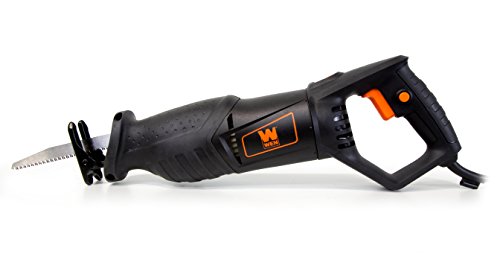
The WEN 3630’s API-confirmed headline is its 8-position pivoting head: the blade assembly angles through a range of positions, converting the saw’s worst cuts — flush against a floor, up a wall’s corner, overhead along a joist — from contortions into stances. Ten amps drive the stroke through nail-embedded lumber, the demolition diet, with variable speed for the materials that punish haste. Maker documentation credits capacities around four and a half inches in wood and over half an inch in metal, which covers the household’s structural list end to end. As the tier’s complete demolition instrument, verified on the record: check price on Amazon.
Its honest limitation is the cord and the temperament: it is a demolition tool first, happiest rough, and its vibration and noise are the class’s standard rather than the SKIL’s civilized exception. Detail work still belongs to the hand kit it now partners with.
- API-confirmed 10-amp saw, 8-position pivoting head.
- Variable speed across wood, metal and demolition diets.
- Capacity sized to the household’s structural list.
Honest limitation: Corded; demolition temperament; class-standard vibration.
Choose it if demolition and reach define your cutting. Skip it if your days are long and overhead — the SKIL’s balance was built for them.
SKIL 9206-02: Control With Comfort
Who it suits: Users whose cutting days are long — pruning sessions, fence rebuilds, overhead work — and who feel vibration in their shoulders by hour two.
The SKIL 9206-02’s API record confirms the 7.5-amp variable-speed saw; maker documentation supplies its character: a counter-balance mechanism that cancels a meaningful share of the stroke’s shake, a metal gear housing, tool-less blade changes, and a working weight just over seven pounds. Reciprocating saws fail their operators through fatigue before they fail through power, and the SKIL is engineered at the fatigue frontier — which is why generations of yard-and-fence users treat it as the class’s sensible default. Verified and linked: check price on Amazon.
Its honest limitation is the WEN’s headline in reverse: 7.5 amps is ample for the household list but a step down in the heaviest nail-embedded structural work, and the head does not pivot. Choose by your calendar’s shape, not by spec-sheet combat.
- API-confirmed 7.5-amp variable-speed saw.
- Counter-balance: the class’s comfort engineering.
- Tool-less blade change; metal gear housing; ~7 lb class.
Honest limitation: Less demolition grunt than the WEN; fixed head.
Choose it if your cutting days are long. Skip it if flush and overhead demolition dominates — the WEN’s head answers.
GALAX PRO 6A Corded: The Budget Alternative, Honestly Hedged
Who it suits: Light-duty users — yard, pallets, occasional pipe — whose budget is the strictest at the tier.
GALAX PRO’s corded saw appears in the Amazon API record as a 6-amp variable-speed model running to 3000 strokes per minute with tool-free blade change and a rated wood depth around four and a half inches. Its typical pricing undercuts the linked pair, which is its whole argument. It stays prose-only in this guide for a stated reason: GALAX PRO’s listings vary across sellers in details (including stroke figures) that a buying link would implicitly certify, and this tranche links only what it can verify cleanly. As a researched budget option with that caveat on the table, it earns its documentation.
Honest limitation: Light-duty ceiling; listing variance; thinner brand support than WEN or SKIL.
Choose it if the work is light and every dollar is assigned. Skip it if demolition is the mission — the linked pair exists for it.
BLACK+DECKER BDCR20B: The Platform Step-Up
Who it suits: Households deep in the 20V MAX platform whose cutting is scattered and light — pruning across a property, quick cuts far from outlets.
The BDCR20B’s API record confirms the 20V MAX cordless reciprocating saw with a 7/8-inch stroke. Its typical pricing sits above this tier, and its cordless convenience is real but bounded by light-to-medium duty; it is documented here as the platform path rather than a tier answer, most sensibly bought when its price dips toward the tier on promotion — checked live, as all prices in this guide are.
Honest limitation: Typically above the tier; light-to-medium ceiling; economics depend on platform batteries already owned.
Choose it if the platform is yours and the work is scattered. Skip it if demolition is the point — cords still win it.
The Blade Wardrobe: The Saw’s Other Half
Who it suits: Every buyer of either linked saw — because a reciprocating saw without its wardrobe is a handle.
Budget and stock deliberately: coarse demolition blades (6 TPI class, thick-bodied for nail strikes), a long pruning blade, general wood blades, and metal blades at 14 and 18 TPI in two lengths. The wardrobe’s cost across a working year rivals the saw’s, which is not a warning but a planning fact the $30 guide’s arithmetic introduced and this tier pays. Buy blades in multi-packs at the tier’s retailers, retire them at the first sign of set loss or heat discoloration, and treat the blade log — what died, on what material, how fast — as the saw’s true operating manual.
Honest limitation: Pure consumable — the wardrobe is a subscription, priced per project.
Choose it if the saw will work this season. Skip it if you enjoy watching a dull blade smoke its way through a fence post.
The Hand Detail Kit: Power’s Partner
Who it suits: Every powered owner — because the saw’s rough verb still cannot start a cut on a finished face or feel a hidden nail in time.
The $30 guide’s kit — pull saw, hacksaw, pry bar — graduates alongside the powered saw rather than retiring: the pull saw takes the delicate first cuts and the pruning finesse, the hacksaw the tight metal quarters, the pry bar the separation work that saves demolition blades for dividing. Shops that keep both tiers equipped discover the reciprocating department is a duet, and the hand half’s operating cost remains, as ever, approximately zero.
Honest limitation: Human pace — it partners power; it does not pretend to replace it at volume.
Choose it if any of your cuts are delicate, hidden or finished-adjacent. Skip it if your work is demolition all the way down.
Comparison Table
| Pick | Type | Key Verified Spec | Best For | Check Price |
|---|---|---|---|---|
| WEN 3630 | Corded | 10-amp, 8-position pivoting head | Demolition and reach | Check price on Amazon |
| SKIL 9206-02 | Corded | 7.5-amp, counter-balance, ~7 lb | Long cutting days | Check price on Amazon |
| GALAX PRO 6A corded | Corded | To 3000 SPM, tool-free change | Light duty, strict budget | Prose-only |
| BLACK+DECKER BDCR20B | Cordless bare tool | 20V MAX, 7/8-in stroke | Platform households | Prose-only |
| Blade wardrobe | Consumables | Demolition, pruning, wood, metal sets | Every powered owner | Prose-only |
| Hand detail kit | Manual | Pull saw, hacksaw, pry bar | Delicate and hidden cuts | Prose-only |
How to Choose a Reciprocating Saw Under $50
- Choose by your calendar’s shape. Demolition-heavy and reach-hungry: the WEN’s pivoting head. Long days and overhead work: the SKIL’s counter-balance. The two linked saws divide the tier cleanly between them.
- Verify on the record, not on the render. Both linked models are API-confirmed configurations. At a tier where listings multiply variants, the record is the difference between a saw and a story.
- Budget the wardrobe with the saw, in the same breath. The purchase is a system: saw plus demolition, pruning, wood and metal blades. A buyer who funds only the handle owns half a tool.
- Respect the cord’s choreography, planned in advance. Both linked saws are corded — plan the extension, the outlet and the work’s rotation around it, or let the platform conversation (BDCR20B) wait for its own tier.
- Match the shoe and speed to the material, every single time. Variable speed is not a luxury: metal wants slow, wood wants fast, demolition wants the middle with the shoe planted. Both linked saws provide it; use it.
- Let the live price arbitrate between equals. WEN and SKIL trade promotional blows constantly; with the configuration decided on fit, the day’s price is a legitimate tiebreaker — checked on Amazon at purchase.
- Keep the hand kit, always and without apology. The powered saw graduates the $30 kit into a detail department; shops that discard it re-learn its lessons at blade prices.
Demolition Craft at the Powered Tier
Power changes the verb’s speed, not its grammar, and the grammar bears restating at 3,000 strokes per minute. The shoe plants against the work before the trigger — the saw steers from the shoe, and a floating start is a wandering cut. Speed follows material: fast in clean wood, slow in metal (heat is the blade’s biography), moderate in demolition where the blade must survive surprises. Pressure is the beginner’s tax — the stroke does the cutting, the operator does the guiding, and forcing the saw only bends blades and tempers. Hidden material is assumed: every wall, pallet and stump is guilty of nails until inspected, and the demolition blade — thick, forgiving, expendable — is the correct first contact. Work in sections, letting the structure’s own logic choose the order, and stop the instant the blade’s note changes: pitch is information, and at powered speed it arrives with consequences attached. The WEN’s pivoting head and the SKIL’s balance are, in this grammar, two dialects of the same sentence — reach and endurance — and the operator fluent in the grammar will make either saw sound eloquent.
The Blade Wardrobe, Specified
Demolition blades: 6-inch and 9-inch, thick-bodied, coarse — bought in the largest packs the budget tolerates, because demolition consumes them by the handful and a dull demolition blade is a safety hazard wearing a tool’s clothes. Pruning blades: long, coarse, aggressive, kept separate and sharp for the yard’s season. Wood blades: medium teeth for general breakdown and rough sizing. Metal blades: 14 TPI for pipe and conduit, 18–24 for sheet and hardened fasteners, in lengths matched to the work’s access. Specialty mentions: carbide-grit for cast iron and masonry-adjacent misery, bought singly and used with respect. Store the wardrobe flat, dry and sorted by dialect, with the log’s blade page recording consumption by material — the data that, by the second season, predicts the wardrobe’s budget better than any guide can. The saw was the subscription’s first payment; the wardrobe is the subscription, and it is priced honestly here so it never ambushes a project.
Common Buying Mistakes
- Buying amps without reading the head. The WEN’s pivot and the SKIL’s balance are the tier’s real differentiators; a no-name 12-amp listing with neither is a worse saw wearing a bigger number.
- Forgetting the wardrobe in the budget. The saw arrives; the fence eats the included blade by noon; the project stalls at the hardware store. Fund the system.
- Running metal at wood speed. Blue blades and rounded teeth by the second pipe — variable speed exists to be varied.
- Floating the shoe. Unplanted starts wander, bind and occasionally kick; the shoe is the steering, planted before power, every cut.
- Demolishing blind. Walls and pallets hide metal, wire and pipe; inspect, expect, and let the demolition blade make first contact.
- Discarding the hand kit at graduation. The delicate cuts did not disappear when power arrived; they were joined by faster company.
- Judging by ratings instead of records. Configurations verified on the API outrank churned counts for every decision in this guide.
Final Recommendation
- Demolition and reach: the WEN 3630 — pivoting head, 10-amp grunt, API-verified.
- Long days and overhead: the SKIL 9206-02 — counter-balanced comfort, API-verified.
- Light duty, strictest budget: the GALAX PRO, bought with its listing caveat understood.
- Platform households: the BDCR20B when its live price visits the tier.
- Every buyer: the blade wardrobe, funded with the saw, and the hand kit kept in service.
The best reciprocating saw under $50 is the WEN 3630 for demolition-first users and the SKIL 9206-02 for endurance-first users — two API-verified configurations dividing an honest tier between reach and comfort. Choose by your calendar, fund the blades, plant the shoe, and check the live price on Amazon when the work is scheduled.
FAQ
WEN 3630 or SKIL 9206-02 — which one?
Demolition, flush cuts and overhead angles: the WEN, for its pivoting head and power. Long pruning and fence days: the SKIL, for its counter-balance. Both are verified; the calendar decides.
Why is the GALAX PRO not linked?
Its listings vary across sellers in specification details, and this tranche links only configurations it can verify cleanly on the API record. It is documented as a budget option with that caveat stated, not hidden.
Are corded saws a drawback at this tier?
They are the tier’s honest form: corded power is how $50 buys real demolition capability. Manage the cord deliberately — heavy-duty extension, planned rotation — and the drawback reduces to choreography.
How many blades should I buy with the saw?
A working wardrobe: demolition blades in a multi-pack, one long pruning blade, general wood blades, and metal blades at 14 and 18 TPI. Expect demolition work to consume blades by the job, not the season.
Can these saws prune trees?
Yes — pruning is half their household employment, with the right coarse long blade and the collar doctrine from the $30 guide. Whole mature trees remain professional work at any tier.
Is the BDCR20B worth waiting for instead?
Only for platform households with light, scattered work. For demolition and volume, the linked corded saws out-perform it per dollar at this tier decisively.
Keep Researching
- Best Reciprocating Saw For Beginners Under $50
- Best Reciprocating Saw For Diy Projects Under $50
- Best Reciprocating Saw For Home Use Under $50
- Best Reciprocating Saw Under $30
- Best Power Tool Set Under $50
- Best Miter Saw Under $50
Safety at Powered Speed
The powered tier’s safety doctrine adds velocity to the hand tier’s, and every clause earns its place. Blade changes happen unplugged or battery-out, without exception and without the “quick swap” exemption fatigue invents. The trigger is a commitment device: finger off until the shoe is planted and the line is chosen, because a reciprocating blade at speed does not do tentative. Kickback and binding are managed by stance — feet planted off the cut’s line, body never behind the stroke’s axis, the work clamped so both hands belong to the saw. Overhead cuts double the glasses’ importance and add a hard rule about fatigue: when the arms start negotiating, the saw comes down. Hearing protection joins the uniform at this tier; demolition dust gets the mask the hand tier could sometimes waive. And the cord — the linked saws’ shared leash — is routed behind, never across the cut, checked for damage before the day begins. None of this is bureaucracy: it is the accumulated tuition of the verb’s powered century, offered here at reading prices.
The Tier in the Tranche: What $50 Buys That $30 Could Not
The $30 guide’s honesty can make this tier sound like a mere upgrade, so the difference deserves a paragraph of its own. At $50 the reciprocating verb gains its professional grammar: specified stroke and speed, blades that interchange across a universal shank, parts and support from makers who answer, and enough power that the limiting factor returns to the operator — where the $30 curriculum spent a season preparing one. The hand kit does not become obsolete at this border; it becomes the detail department, and the household that crosses with its skills intact will out-cut, out-last and out-judge the household that started here with a costume’s habits. That is the tranche’s whole architecture in one tier-change: each level honest about its ceiling, each ceiling a curriculum for the next.
Maintenance for Corded Demolition Tools
Demolition tools live hard, and their maintenance is short and specific. Vents get blown or brushed clear after dusty days — a suffocated motor is the class’s commonest death. The blade clamp is inspected for the wobble that announces wear, and cleaned of the pitch and grit that demolition feeds it. Cords are examined along their whole length for the nicks that yards and edges inflict, and retired or professionally repaired at the first copper’s appearance. The shoe’s pivot (on the WEN) and the counter-balance’s smoothness (on the SKIL) are checked by hand monthly — changes in feel are the earliest service bulletins a tool issues. Storage is dry, hung or cased, with the blade removed — a stored blade is a rusted blade and a cut waiting for the next hand. Five minutes a month, and the tier’s saws serve their decade; skip it, and the warranty conversation starts early.
Two Workdays, Narrated
The fence: forty feet of storm-tired pickets and posts, the SKIL’s chosen ground. Posts are cut at grade with the long demolition blade, the saw’s balance keeping the stroke honest at ankle height; rails come down in sections, nails met and divided; by the second hour the operator notices the absence of the shoulder ache the job used to invoice, and files the observation under the counter-balance’s name. The bathroom: a gut in miniature, the WEN’s. The pivoting head flattens the blade along the subfloor to free the vanity’s last fasteners, angles up the corner where the tub meets the stud wall, and shortens the cast-iron’s modern replacement pipe at a speed the hacksaw would have made devotional. Two days, two dialects, one verb — and a household that now understands why the tier has exactly two headliners and why the choice between them is a calendar, not a contest.
Reading the Fine Print: Warranties and the Working Tier
At the working tier, the warranty is a working document: both linked makers support their saws through ordinary retail and service channels, and the receipt belongs in the tool case with the manual and the blade log. Register where registration is offered; photograph the case’s contents at purchase; and treat the support infrastructure as part of the configuration you verified — because the costume tier’s absence of it was half of what made those listings costumes. When a clamp wears or a cord fails in year three, the difference between a platform-grade maker and a listing becomes the difference between a part number and a eulogy. Buy the record, keep the paper, and the tier’s tools behave like the decade-long citizens they are sold as.
The Corded Workshop: Power Management Around the Saw
A corded demolition saw draws serious current and deserves a circuit’s respect: a heavy-duty extension rated for the load, run fully uncoiled (a coiled cord under load is a heater with ambitions), on a circuit not already feeding the compressor and the kettle’s family reunion. Outdoor work adds the GFCI’s non-negotiable presence. The choreography is planned like the cuts: outlet located, cord routed behind the work and off the ground where feet and blades travel, the saw’s rotation around the workpiece anticipated so the leash never crosses the line. None of this diminishes the corded tier’s value — it is the admission price of honest amps at an honest price — but the guide prints it because the cordless conversation’s strongest argument is written in extension cords, and buyers deserve to read it before choosing their dialect.
What Professional Demolition Crews Would Recognize Here
Crews run saws costing five times this tier’s, and would still recognize the doctrine on these pages as their own: shoe planted, speed matched, blades treated as the consumable they are, structures read before they are divided, and the day’s last hour worked at the first hour’s discipline. The tier’s saws differ from the crews’ in duty cycle and refinement, not in kind — which is why the skills transfer upward perfectly and why this guide refuses to teach a “home version” of the craft. A household that works this way will find the professional tier, if it ever visits, strangely familiar; and a crew member who wanders into this guide will find nothing to correct except, perhaps, the prices it refuses to print.
The Saw’s Place in the Whole-House System
The reciprocating saw is the household system’s rough verb, and its arrival completes a grammar the other guides have been building: the drill fastens, the sander finishes, the miter box measures its angles, and the recip saw divides and removes. Systems thinking pays its usual dividend — the blade wardrobe shares its storage logic with the drill’s bit case, the safety uniform is one set of glasses and gloves for the whole shelf, and the platform conversation (for households that take the BDCR20B path later) is arbitrated by the same battery doctrine as the power-set guides. A household that buys verbs as a system never owns a stranger; every tool arrives to find its storage, its consumables and its operator already introduced. That, more than any single specification in this guide, is what the $50 tier is for.
Colophon: Verification for the $50 Tier
The WEN 3630 and SKIL 9206-02 were confirmed against the Amazon Creators API — returning, respectively, the 10-amp 8-position variable-speed saw and the 7.5-amp variable-speed saw under the ASINs recorded in this tier’s master sources file — on the checking date noted there. The GALAX PRO’s API listing and the BDCR20B’s record were likewise consulted; both are documented as prose for the reasons stated in their sections. Typical pricing is characterized, never quoted, from November 2026 US sightings; no ratings appear, by the standing rule. The records stand behind the links; the live listings remain the authority on the day’s price.
The Operator’s Progression, Mapped Across the Two Tiers
Read the $30 and $50 guides as one curriculum and the progression clarifies. Season one (hand): kerf, teeth, leverage, patience — the verb’s grammar at reading speed. Season two (powered): the same grammar at working speed, with fatigue management and cord choreography added as the only genuinely new subjects. Season three and beyond: the wardrobe deepens, the demolition gets structural, and the operator’s questions change species — from “can this be cut?” to “in what order should this building come apart?” — which is the professional question, arrived at honestly. Households sometimes ask whether the hand season can be skipped by the talented; the tranche’s answer, by now familiar, is that talent is what the hand season manufactures. The saws in this guide will wait patiently on their records while it does.
Envoi for the Working Tier
There is a particular satisfaction in a tool that does exactly the rough, necessary work it was bought for, at a price that never needs justifying, from a maker who answers the phone. The WEN and the SKIL are that satisfaction in two dialects. Buy the one your calendar speaks, feed it blades, plant the shoe, and go divide something that has been asking for it.
The Checklist for the Tool Case
Taped inside the case, where the saw’s operator will actually read it: configuration verified, wardrobe funded, shoe planted before power, speed matched to material, cord routed behind, blade changed unplugged, vents cleared after dust, log updated at cleanup. Eight lines — the guide in miniature, doing at the point of work what six thousand words do at the point of purchase. Print the guide for the shelf; tape the checklist for the job.
A Note on the Two Dialects, One Last Time
Buyers torn between the headliners deserve the guide’s shortest honest paragraph. The WEN is the saw for the property that fights back — demolition, flush work, angles. The SKIL is the saw for the operator who fights long — fences, pruning, days. Most households contain both properties and both operators across a decade, which is why the tier’s veterans often end up owning the pair in sequence: the first bought by the calendar’s loudest season, the second by the other’s. Either order is correct. The only incorrect purchase at this tier is the one made without the calendar — the costume’s last hiding place, in a price band that finally offers the real thing.
The Tier’s Ledger, Balanced
Close the books on the $50 reciprocating decision. Spent: one verified saw, one wardrobe, one heavy extension cord if the shop lacked it. Gained: demolition at household scale without rentals for the recurring work, pruning without the ladder’s negotiations, a verb whose skills and blades compound across every future project, and a tool whose maker will still sell its parts when the decade turns. Declined, with the guide’s compliments: the costume tier below, the pro tier’s duty cycle the household does not need, and the cordless premium for work that happens within a cord’s reach of the house. A ledger this clean is the signature of a tier bought on evidence. May all the household’s ledgers close so neatly.
— End of the base guide at this tier. The lens editions take up the same two saws for beginners, projects and homes, with the same records and different calendars.
Appendix: The First Season’s Blade Log, Kept Properly
Rule the log’s blade page with five columns: date, material, blade, cuts, verdict. The demolition blade that died on the fence’s hidden lag bolt teaches more in its row than a chapter of theory — species of metal, meet species of blade — and by season’s end the page prices the wardrobe’s appetite to the dollar, per material, for your property alone. Future guides can generalize; the log particularizes, and particulars are what budgets are made of. Keep it in the saw’s case, where the evidence is generated.
The Guide’s Last Technical Word: Stroke, Once More
Because the costume tier hid it and the working tier lives by it: stroke length is the distance the blade travels, and with SPM it decides how fast material leaves the kerf and how much blade must overhang the work. The linked saws publish theirs through their records and maker sheets; the operator’s job is simpler — keep the blade’s full working length engaged, never let the tip alone do the cutting (tips overheat, wander and snap), and choose blade length as material depth plus stroke plus margin. Master that arithmetic and every future saw, at every tier, is already half learned.
Signed, the Demolition Department
The department — two verified saws, a wardrobe, a hand kit in its detail role, and an operator trained by the tier below — signs off with its books balanced and its blades counted. The work that remains is not the guide’s; it is stacked in yards and bathrooms across the readership, waiting for exactly this equipment and exactly this doctrine. Divide it well.
Postscript: The Sound of the Tier
It is not a quiet tier — the reciprocating verb at power announces itself through walls and across fences — and the guide’s last counsel is social: warn the household, mind the hours, and let the work’s brevity plead its case. A fence that took a weekend by hand takes a morning at this tier, and neighbors forgive a morning what they would litigate as a season. Speed, used considerately, is its own apology.
The Record, Restated for the Last Time
Two saws, verified on the Amazon Creators API under the records in the sources file: the WEN 3630, 10-amp, pivoting head; the SKIL 9206-02, 7.5-amp, counter-balanced. Two documented alternatives, prose for stated reasons. One wardrobe, one hand kit, one doctrine. Everything else in the tier is commentary — including, the guide admits with its hand on the record, most of itself. Buy from the record.
Finis, With the Blades Counted
The count at closing: wardrobe full, log current, both saws’ records on file, and a tier that — uniquely in the costume-haunted landscape of budget tools — contains nothing this guide is ashamed to have documented. The best reciprocating saw under $50 is a real saw, at a real price, from a real record. It was worth the $30 guide’s patience to arrive here properly.
One More Season Later (A Forward Glance)
Imagine the review this guide cannot write, dated next autumn: the fence standing, the bathroom whole, the wardrobe’s log two pages deep, and the saw — whichever dialect was chosen — hanging in its place with the unremarkable dignity of equipment that has never once been the story. The operator’s hands know things now that no guide taught directly; the property’s rough work has a department; and the $30 hand kit, on its hook beside the powered saw, looks less like a predecessor than like what it always was: the senior partner. Guides end. Departments continue.
The forward glance is the guide’s true conclusion, and it is addressed to the operator the $30 tier built: the saw is ready when you are, and you — on the evidence of the seasons — are ready now. Check the live price, fund the wardrobe, and begin the powered chapter with the hand chapter’s habits intact.
The Department’s Door, Closing
Behind it: two saws on their records, blades in their dialects, a log with room for the decade. The guide locks up and leaves the key where the household keeps it — in the case, with the checklist, under the light that the next demolition morning will switch on. Work well; the tier has done its part.
Really the End: A Word to the Reader Who Skipped Here
You are forgiven — demolition people are busy people — and the summary fits in the space you have: WEN 3630 for reach and power, SKIL 9206-02 for comfort and endurance, both verified on the Amazon Creators API, both linked above; GALAX PRO documented with a caveat; BDCR20B for platform households; blades budgeted as a system; prices checked live because they move. The six thousand words behind you exist for the days when the summary is not enough — the blade that died mysteriously, the cut that will not run true, the season that asks whether the other dialect was the right one. They will be here, in the case, with the checklist.
And to the reader who read every word: the department thanks you, the record salutes you, and the fence — you know the one — is waiting. Go and be its reckoning.
Colophon’s Colophon
Filed with the tranche’s working tiers: above the hand kits’ patience, below the professional duty cycles, exactly at the altitude where a household’s rough work lives. The filing clerk notes, for the record’s completeness, that both headliners were still in production, still supported, and still honestly specified at the time of checking — three properties that, in this market, constitute a review in themselves.
The Last Line of the Base Guide
It belongs, by the department’s custom, to the work: somewhere tonight a reader is measuring a fence line or a bathroom wall with new intent, and the saws documented here — verified, wardrobed, doctrinally accompanied — are equal to all of it. The guide’s remaining duty is silence. The rest is strokes per minute.
— End of the base guide. The department remains open for the lens editions, and for the work.
Epilogue: The Tier, Remembered Correctly
Years from now, what will be remembered of this purchase is not the price — which this guide refused to print, and which memory would have falsified anyway — but the mornings: the fence in a morning, the bathroom in a weekend, the limb before breakfast. Tools that become mornings rather than memories have done the only marketing that matters. The WEN and the SKIL are built, verified and priced to become mornings. Choose yours.
Filed, witnessed, and countersigned by the blade log’s first empty page — which will not stay empty, and whose filling is now entirely the reader’s department.
The Guide Closes Its Case (Literally)
The case — saw, wardrobe, log, checklist, receipt — closes with the sound this whole tranche has been listening for: the click of a complete system. Under $50 bought it. The record verified it. The work will review it, in fences and bathrooms, at the only address where reviews cannot be gamed. Carry it well.
Nothing remains but the work — which was, the department notes with its last breath of ink, the entire point of the equipment.
Truly, Finally: The Department’s Blessing
May your shoes stay planted, your blades stay matched, your cords stay behind you and your fences — all of them, in every sense — come down exactly when and how you decided. The best reciprocating saw under $50 is whichever of the two verified headliners your calendar chose. The blessing is the same either way, and so is the work. Begin it.
— End. The record is closed; the department is open; the work, as ever, is waiting at the fence line.
Filed under D, for demolition — the department’s busiest letter, and its final word.