Disclosure: As an Amazon Associate, umtsmarttool.com earns from qualifying purchases. Links to Amazon on this page are affiliate links; they cost you nothing extra. Prices and availability change often, so check the current Amazon listing before you buy.
Where to buy
Short on time? These are the car emergency kits worth your money under $50. Start with our top pick, then read the full guide below for what this budget can and cannot do.
- Thrive Roadside Emergency Car Kit, 104-Piece — Check on Amazon
- Lifeline AAA Premium Road Kit, 42-Piece (4330AAA) — Check on Amazon
- LIANXIN Roadside Assistance Emergency Kit, 142-Piece — Check on Amazon
- HAIPHAIK Car Emergency Kit, 124-Piece — Check on Amazon
- EVERLIT Survival Car Emergency Kit — prose-only step-up pick; it adds a digital tire inflator and usually sits in the tier above this one
- Swiss Safe 2-in-1 Car Emergency Kit — prose-only step-up pick; the choice when first aid matters more than the budget line
Read the full guide ↓
Searching for the best car emergency kit under $50 means accepting one honest trade up front, and it is better to hear it here than at a roadside: at this budget, the powered tire inflator disappears. The kits that include a digital compressor — the EVERLIT in our Best Car Emergency Kit Under $75 guide is the benchmark — live in the tier above. What $50 still buys, if you choose carefully, is everything else that matters: real jumper cables long enough to use, a warning triangle, an escape tool, a first aid kit that covers more than a grazed knee, and a bag that will still be intact in five winters’ time. Choose carelessly and the same money buys a 200-piece count made of bandages and cable ties wrapped around cables too short to reach between two parked cars.
So the judging standard in this guide is strict. Piece counts are ignored except as a warning sign. What counts is the major-item list: cable length and gauge first, because a jump start is the most likely rescue any kit will ever perform; visibility second, because being hit while broken down is the scenario with the worst outcomes; first aid third; and tools fourth, because most drivers will use the screwdriver twice and the cables for a decade. Every pick below was checked against manufacturer manuals, established retailer contents lists and independent roundups — a research-led process, not a hands-on test — and where sources disagreed about a kit’s contents, we say so in the review rather than picking the most flattering version.
The four linked picks split by personality. The Thrive is the balanced all-rounder and our top pick at this tier. The Lifeline is the compact hard-case option for small cars and second vehicles. The LIANXIN and HAIPHAIK are the tool-heavy pair — one winter-leaning, one rural-leaning — and both ask you to add your own first aid pouch, which we flag plainly rather than hide. The two prose-only step-ups close the guide: if your budget can stretch at all, they are what the extra money buys, and our Car Emergency Kit Buying Guide explains the tier ladder in full.
In this guide
Quick Picks
| Pick | Badge | Key spec |
|---|---|---|
| Thrive Roadside Emergency Car Kit, 104-Piece | Best Overall | 8 ft 8-gauge jumper cables, 66-piece first aid kit, escape hammer |
| Lifeline AAA Premium Road Kit, 42-Piece | Best Compact Kit | 8 ft 8-gauge booster cables, hard-shell EVA case, aluminum flashlight |
| LIANXIN Roadside Assistance Emergency Kit, 142-Piece | Best for Winter | 8.2 ft jumper cables, snow shovel, tool box, reflective triangle |
| HAIPHAIK Car Emergency Kit, 124-Piece | Best Tool Kit | 11.8 ft jumper cables, 16-piece tool box, folding shovel |
| EVERLIT Survival Car Emergency Kit | Best Step-Up | 12 ft 8-gauge cables, digital inflator, 108-piece first aid |
| Swiss Safe 2-in-1 Car Emergency Kit | Best First Aid Step-Up | 12 ft cables, hardcase first aid kit, socket set |
How These Picks Were Chosen
We built this list from contents lists first and marketing second. Every cable length, first aid count and tool list below traces to a source a buyer can check: the manufacturer’s manual where one is published, retailer listings that enumerate contents piece by piece, and roundups that opened the bags and counted. Where a spec could not be confirmed — the jumper cable gauge on the two tool-heavy kits is the recurring example, stated differently by different sellers — we left it out of the spec box and flagged the disagreement in the review. A buying guide that prints a number it cannot stand behind is worse than one that admits the gap.
The filters for this tier were unforgiving because the budget is. A kit needed jumper cables of at least 8 feet from a brand with a traceable product line. It needed a visibility item — triangle, vest or both. It needed either a real first aid kit or an honest absence we could flag, with room in the bag to add one. And it needed a case that would survive trunk life. That last filter quietly removed a tier of very cheap kits sold in cardboard and thin nylon: the emergency is the worst possible moment to discover your kit’s bag disintegrated last summer.
One more note on prices, because this tier moves the most. Kits around the $50 line drift above and below it with sales cycles, so this guide prints no product prices — the budget is your filter, the listing is the truth on the day. The two step-up picks are prose-only for exactly that reason: both are worth knowing about, neither is promised to sit under this guide’s ceiling today.
The 6 Best Car Emergency Kits Under $50

Thrive Roadside Emergency Car Kit, 104-Piece — Best Overall
At this budget the Thrive is the kit with the fewest apologies. Its 104 pieces are arranged around a sensible core — 8-gauge jumper cables, a 66-piece first aid kit, an escape hammer, a reflective triangle and vest, and a tool roll with a bit driver, socket driver and multi-tool pliers — packed in a water-resistant 600D canvas case that keeps its shape in the trunk. Nothing in it is the best in this guide at anything, and the whole is better than any rival under the line at almost everything.
- Jumper cables: 8 feet, 8-gauge
- First aid: 66-piece kit within the 104-piece total
- Tools: 7-bit screwdriver, 9-socket driver, multi-tool pliers, utility cutter, tire pressure gauge
- Safety: escape hammer, reflective vest, reflective triangle, distress sign, whistle, hand-powered flashlight
- Case: 600D nylon canvas, water-resistant
Strengths
- The most balanced contents list under the budget — cables, first aid, visibility and tools all genuinely present.
- The escape hammer and seatbelt-cutting provision cover the one scenario where seconds matter most.
- The structured case makes contents findable under stress, which is when findability counts.
Trade-offs
- Eight feet of cable demands cooperative parking; the HAIPHAIK’s longer set is more forgiving.
- No inflator, so a soft tire means the spare wheel.
- The hand-powered flashlight is adequate, not generous; most owners will add a brighter light.
The Thrive’s real virtue is that it respects a first-time user. The accident form, the first aid guide, the distress sign — these are items for a driver who is shaken, possibly young, possibly dealing with their first breakdown alone. Experienced owners underrate that design brief because they no longer need it; the person you buy this kit for very well might. It is the default recommendation in our How To Choose A Car Emergency Kit checklist for exactly that reason, and the kit we would hand a new driver without a supplementary shopping list — the only addition we insist on is a phone charging cable and a bottle of water, neither of which any manufacturer can include for you.
The honest limitation is reach. Eight-foot cables in a supermarket car park are fine; eight-foot cables on a narrow lane with the rescue car unable to pull fully alongside are a problem you solve by waiting for a better-positioned helper. If your driving is mostly rural, read the HAIPHAIK review below before deciding.
Best for: most drivers, new drivers, and anyone buying one kit to cover the common failures well. / Not suited for: drivers who need long cables or an inflator in the same purchase.
Lifeline AAA Premium Road Kit, 42-Piece — Best Compact Kit
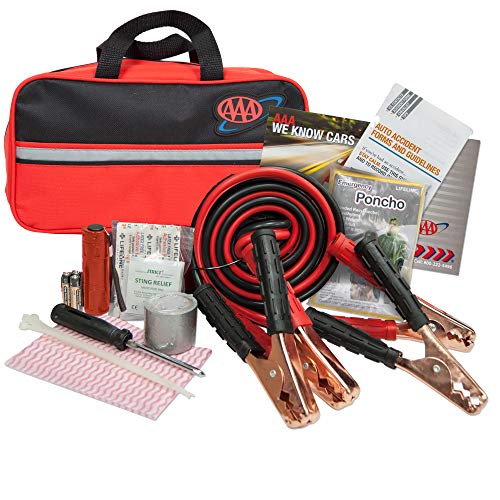
The Lifeline is what the under-$50 tier looks like when a brand chooses durability over abundance. Forty-two pieces, a hard-shell EVA case, 8-gauge booster cables, a metal-bodied flashlight with its batteries included, and a 24-piece first aid kit: a short list, but every item on it is a real one. In a small hatchback or a second car that does short trips, this kit’s footprint is its feature — it tucks into a footwell or side pocket where the Thrive’s fuller bag would crowd.
- Booster cables: 8 feet, 8-gauge
- Flashlight: 9-LED aluminum flashlight, batteries included
- First aid: 24-piece kit with bandages, antiseptic towelettes and sting relief pads
- Case: molded hard-shell EVA foam
- Model: 4330AAA; extras include 2-in-1 screwdriver, duct tape, emergency poncho, shop cloth and cable ties
Strengths
- The hard case shrugs off trunk abuse that crushes soft bags and their contents.
- The flashlight is a genuine tool — aluminum, bright, and ready because the batteries are in the box.
- The smallest serious kit here; it fits where fuller kits cannot.
Trade-offs
- No warning triangle and no tow strap; add a folding triangle yourself.
- First aid stops at scrapes and stings.
- No inflator and no escape hammer.
There is a discipline to this kit that suits a particular kind of owner: the one who knows the car carries a phone, a charging cable and a roadside assistance membership, and wants the physical kit to cover the gap between breaking down and help arriving — light, warmth, a jump if a passer-by stops, a bandage if the bonnet slips. For that owner the Lifeline is not a compromise at all; it is the correct size of insurance, and its association-designed accident guidance is the part they will actually read at the roadside. Our Is A Car Emergency Kit Worth It analysis makes the case that for low-mileage urban drivers, this minimum-plus pattern is the rational buy.
The honest limitation is that the Lifeline leans on that assistance membership existing. Without it, the missing triangle, tow strap and inflator stop being minimalism and start being gaps. Buy it as part of a plan, not as the whole plan.
Best for: small cars, urban drivers with roadside assistance, and second vehicles. / Not suited for: solo rural drivers who must self-recover.

LIANXIN Roadside Assistance Emergency Kit, 142-Piece — Best for Winter
The LIANXIN is the under-$50 kit designed by winter. A folding snow shovel, ice scraper, emergency blanket and raincoat sit alongside the expected triangle, tow rope, safety hammer and tool box, and the combination addresses the breakdown that actually strands northern drivers: not a mechanical failure but a car that cannot move in snow, in the dark, in the cold. The 142-piece headline is inflated, as they all are, but the major items are real.
- Jumper cables: 8.2 feet, maker describes them as UL-certified
- Tool box: hammer, pliers, utility knife, tape measure, PVC tape, digital test pen and three screwdrivers
- Winter gear: folding snow shovel, ice scraper, emergency blanket, raincoat
- Safety: safety hammer and seatbelt cutter, reflective warning triangle, hand-driven LED flashlight
- Tow rope: 9.85 feet
Strengths
- The winter layer — shovel, scraper, blanket — is unmatched at this price.
- The test pen in the tool box helps separate a dead battery from a bad connection before you start swapping clamps.
- Escape hammer and belt cutter included, which several rivals at this tier skip.
Trade-offs
- No first aid kit is specified in the strongest sources; add a compact pouch of your own.
- Cable gauge is stated inconsistently across sources, so we do not print a figure.
- Contents vary slightly between listings and versions; verify against the listing you order.
The shovel deserves its own sentence because it changes what self-recovery means. Most stuck-in-snow events need ten minutes of digging around the driven wheels and something gritty under the tires, not a tow truck — and a kit that anticipates that, plus a blanket for the wait if digging fails, has understood the assignment. Where the LIANXIN asks for your trust instead of earning it is documentation: there is no single authoritative contents list, and the first aid question is answered differently by different sellers. Treat the listing as the contract, check the bag on arrival, and drop in a first aid pouch — the bag has room, and our First Aid Kit Review roundup has compact options sized for exactly this pairing.
The honest limitation is the same as its cousin’s below: you are buying hardware confidence and documentation risk in the same box. For winter drivers, the trade is usually worth it. For everyone else, the Thrive is the safer default.
Best for: northern, mountain and winter-commute drivers. / Not suited for: buyers who want first aid included and contents guaranteed to the last item.

HAIPHAIK Car Emergency Kit, 124-Piece — Best Tool Kit
If the LIANXIN is the winter kit, the HAIPHAIK is the farm-gate kit: the longest cables in this guide at 11.8 feet, a 16-piece tool box with wrenches and pliers, a folding multi-function shovel, tire repair tools and a tow rope. It is built for the driver who expects to fix things at the roadside rather than wait beside them, and at this tier it is the only pick that makes that expectation reasonable.
- Jumper cables: 11.8 feet, maker describes them as UL-certified
- Tool box: 16 essential tools including wrenches, pliers, hammer and voltage tester
- Shovel: folding multi-function shovel, about 18 inches assembled
- Extras: tow rope, tire repair tools, hand-driven LED flashlight, reflective safety vest, gloves, survival whistle
- Model: GJB004
Strengths
- Cable length that forgives bad parking — the rural driver’s most common jump-start problem, solved.
- A tool box that handles battery terminals, clamps and fasteners properly, not decoratively.
- The shovel and tire repair tools extend self-recovery further than any rival here.
Trade-offs
- First aid cover is unclear across sources; plan to add your own pouch.
- Cable gauge claims conflict between sources, so we print length only.
- The tool weight makes it the bag least suited to a small car.
The case for the HAIPHAIK is a scenario: a soft shoulder, a spun wheel, a loose battery terminal, light fading. In that scenario the Thrive’s tidier bag watches from the trunk while the HAIPHAIK works. The case against it is the paperwork: contents lists differ between retailers, and a buyer cannot fully know which version of the kit is in the box until it arrives. That is why this pick carries a weak-pin flag in our notes and a standing instruction — order it when you have time to inspect and, if necessary, return it, not the night before a long trip. Paired with the first aid pouch it lacks, it becomes the most capable under-$50 bag here for the driver who will use it; our Car Emergency Kit Pros And Cons piece weighs that tool-first philosophy against the balanced kits.
The honest limitation is that capability you cannot verify is a promise, not a spec. The shovel, tools and cables are consistently reported across sources, which is why it is listed at all — but the details around them are not, and we have written this review to match that evidence rather than the box art.
Best for: rural drivers, handy owners, and anyone who self-recovers as a first resort. / Not suited for: buyers who want guaranteed contents and included first aid.
EVERLIT Survival Car Emergency Kit — Best Step-Up
The EVERLIT is listed here, without a link at this tier, because it is the answer to the question every under-$50 buyer eventually asks: what does a little more actually buy? It buys the inflator. The EVERLIT pairs 12-foot 8-gauge cables with a digital 12V compressor that presets a pressure and shuts itself off, adds a 108-piece first aid kit, a maker-rated 10,000 lb tow rope, a warning triangle and the full blanket-and-poncho layer, in a 17-inch bag. It is the top pick of our under-$75 guide, and the honest framing for this tier is that it is the kit the under-$50 picks are approximating.
- Jumper cables: 12 feet, 8-gauge, copper-clad aluminum, rated 300 amps
- Tire inflator: 12V digital compressor with auto shutoff, LED light and three extra nozzles
- First aid: 108-piece kit including CPR mask and triangular bandage
- Tow rope: 12 feet, maker-rated at 10,000 lb breaking capacity
- Bag dimensions: 17 x 7 x 7 inches; weight about 8 pounds
Strengths
- The only kit in either guide that solves a soft tire without a wheel change.
- Cable length and gauge both lead the under-$50 field outright.
- Published manual and named first aid contents — documentation the tool kits below it do not match.
Trade-offs
- It usually sits above this guide’s budget line, which is why it is prose-only here.
- The bag is the largest in this comparison; small trunks will feel it.
- The hand-crank flashlight remains a backup-grade light.
Whether the step-up is worth it depends on your spare tire. If your car carries a good spare and you are willing to change a wheel, the EVERLIT’s inflator is a luxury and the Thrive is your kit. If your car has no spare, an old spare, or a driver who cannot change a wheel, the inflator is not a luxury at all — it is the whole plan — and stretching the budget is the correct decision. That is the single most useful question in this entire guide, and it is about your car, not about any kit.
Best for: drivers without a serviceable spare, and anyone who can stretch the budget once. / Not suited for: strict under-$50 budgets — by definition.
Prose-only pick: check the current Amazon listing for the EVERLIT Survival Car Emergency Kit; if it is on promotion into this tier, it becomes the first choice in this guide.
Swiss Safe 2-in-1 Car Emergency Kit — Best First Aid Step-Up
The second step-up inverts the EVERLIT’s priorities. The Swiss Safe pairs a competent roadside bag — 12-foot cables, an 18-piece socket set, tire gauge, vest, poncho, ice scraper — with a hardcase first aid kit that is a standalone product in its own right: trauma shears, a CPR mask, an instant cold pack, an emergency blanket, splints, a trauma pad and a first aid guide, organized in divided sections, plus a detachable mini kit. If the emergency you plan for is a person, this is the upgrade that matters.
- Jumper cables: 12 feet, in the roadside bag
- First aid: hardcase kit with trauma shears, CPR mask, instant cold pack and guide, plus a bonus mini kit
- Roadside tools: 18-piece socket and screwdriver set, tire pressure gauge, work gloves, bungee cord, ice scraper, electrical tape
- Visibility: high-visibility vest, emergency whistle, glow sticks
- Combined size: about 12.3 x 11.6 x 7.5 inches across two cases; weight about 7.3 pounds
Strengths
- First aid coverage nothing under $50 approaches — and nothing under $75 either.
- The mini kit migrates to a glove box, backpack or second car.
- The hardcase organization works under stress, with sections findable by touch.
Trade-offs
- Two cases to keep together, stock and remember.
- No inflator and no flashlight in the roadside half.
- Its street position moves, which is why it is prose-only at this tier.
Families who camp, coach, or drive other people’s children will recognize the logic: the car kit that is also the family first aid kit gets checked, restocked and understood in a way a trunk-only kit never does. The cost of that logic is format discipline, and buyers who know they will scatter the two cases should take the Thrive and a separate first aid purchase instead — a point our Car Emergency Kit Review hub returns to across the category.
Best for: families and anyone whose kit doubles as the household first aid kit. / Not suited for: strict budgets, single-bag loyalists, or drivers who need an inflator.
Prose-only pick: check the current Amazon listing for the Swiss Safe 2-in-1 Car Emergency Kit, and confirm you are viewing the roadside bundle rather than the standalone first aid case.
Comparison Table
| Pick | Jumper cables | Inflator | First aid | Standout extra |
|---|---|---|---|---|
| Thrive 104-Piece | 8 ft, 8-gauge | No | 66-piece | Escape hammer and socket set |
| Lifeline AAA 42-Piece | 8 ft, 8-gauge | No | 24-piece | Hard-shell EVA case |
| LIANXIN 142-Piece | 8.2 ft | No | Not specified | Snow shovel and test pen |
| HAIPHAIK 124-Piece | 11.8 ft | No | Not clearly specified | Folding shovel and 16-piece tool box |
| EVERLIT Survival | 12 ft, 8-gauge | Yes, digital auto-shutoff | 108-piece | 10,000 lb-rated tow rope |
| Swiss Safe 2-in-1 | 12 ft | No | Hardcase kit plus mini kit | Trauma shears and CPR mask |
How to Choose a Car Emergency Kit Under $50
Begin with the cables, because under $50 the cables are where manufacturers save the money you cannot see in a photograph. Length first: 8 feet is the workable minimum, 11 to 12 feet is comfort, and the difference decides whether a jump start needs the rescue car parked in the one position your street allows. Gauge second: 8-gauge is the honest standard for petrol cars at this tier; if a listing will not state a gauge at all, assume the cables are the thinnest part of the kit and price the kit accordingly.
Then audit the first aid claim. A first aid kit’s job at the roadside is cuts, scrapes, stings and splinters — and a 24-piece kit like the Lifeline’s does that job as surely as a 108-piece kit does, just with fewer spares. What piece counts hide is whether the basics are present at all: bandages in two sizes, antiseptic, gauze, tape, tweezers. The two tool-heavy picks in this guide do not clearly promise even that, which is why this guide keeps repeating the same advice: buy the pouch, drop it in the bag, and stop letting a headline number do your thinking.
Visibility is the cheapest safety in the whole category and the most often skipped. A reflective triangle placed behind a broken-down car does more for your survival odds than any tool in any bag here, because the gravest roadside risk is not the breakdown — it is the next driver. Every linked pick in this guide includes a triangle, a vest, or both, except the Lifeline, which is why its review tells you to add a folding triangle: it is the highest-value small purchase in this article.
Last, match the kit to the car’s real life. A kit for a garaged commuter car and a kit for a teenager’s first car doing night shifts are different products wearing the same name. Weight the second toward guidance and visibility — the Thrive’s pattern — and the first toward whatever your own competence lacks. And whatever you buy, spend the first weekend with it: contents checked against the listing, cables uncoiled once, spare tire pressure verified, bag placed where a stranger could find it from a description over the phone.
Making an Under-$50 Kit Complete: The Add-On Layer
No kit at this price is complete, and pretending otherwise is how drivers end up with a bag of tools and no water. The add-on layer is short, cheap and personal, and it matters more than the difference between any two picks above.
- A phone charging cable that lives in the car permanently — not the one you carry in each day and forget.
- Water and a sealed snack, rotated when you check the kit; thirst and low blood sugar make bad roadside decisions.
- A compact first aid pouch, if your pick is one of the two tool-heavy kits without specified medical cover.
- A folding warning triangle, if your pick is the Lifeline.
- A better flashlight or headlamp than any kit here includes — hands-free light is the upgrade every roadside veteran names first; our Emergency Flashlight Review roundup covers the sensible options.
- A written card with your assistance number, insurer and emergency contacts, for the night your phone is the casualty.
- In winter: a real blanket, a hat and gloves that fit you, whatever the kit claims to include.
How to Jump-Start a Car With the Kits in This Guide
All four linked picks jump-start the same way, and the sequence matters more than the kit. Read your car’s manual first — some models specify a remote positive terminal and a designated ground point — then work in this order.
- Park the rescue car so the cables reach both batteries with slack, switch both cars off, and take the keys out.
- Set the warning triangle behind the cars and put the vest on if your kit includes one; then gloves.
- Identify the positive (+) and negative (−) terminals on both batteries and clear heavy corrosion with a cloth.
- Red clamp to the dead battery’s positive terminal, then the other red clamp to the good battery’s positive terminal.
- Black clamp to the good battery’s negative terminal, then the last black clamp to bare metal in the dead car’s engine bay, away from the battery.
- Start the rescue car, idle for a few minutes, then try the dead car. Remove clamps in exact reverse order once it runs, and drive it for a proper run before switching off.
Problem: a single click and nothing more → a clamp is sitting on corrosion or paint; reseat the clamps on clean metal. Problem: slow, tired cranking → give the dead battery more minutes on the rescue car before concluding it has failed. Problem: cables warming up → stop and disconnect in reverse order; heat means resistance, and the safe move is a tow, not persistence. The 8-foot cables in the Thrive and Lifeline make step one the fiddly part — the rescue car must be close — while the HAIPHAIK’s 11.8-foot set relaxes it. Everything after step one is identical, which is why this guide scores cable length so heavily and piece counts so lightly.
What a Real Breakdown Asks of an Under-$50 Kit
It helps to run the three common scenarios against this tier honestly. Scenario one, the dead battery in a car park: every pick here handles it, provided a second car and a willing driver appear; the kit’s contribution is cables that reach and clamps that bite. Scenario two, the soft tire on a Sunday: no pick here inflates, so the kit’s contribution is the triangle, the vest, the light and the tools around a wheel change — which is why the spare’s condition, checked at home, is part of this guide’s advice rather than an afterthought. Scenario three, the minor injury and the long wait: a grazed hand from a slipped wrench, a child stung at a rest stop, rain arriving before the tow truck. Here the Thrive’s 66-piece first aid kit and poncho layer earn their money, the Lifeline covers the basics in miniature, and the two tool kits — absent a pouch you added yourself — have nothing to say. That asymmetry is the real shape of the under-$50 decision: you are not choosing the best kit, you are choosing which scenario your kit will be merely adequate in. Choose the scenario you cannot outsource. Batteries can be jumped by strangers and tires changed by assistance services; the wait, the weather and the small injuries are yours alone, and they are why this guide’s default pick is the balanced one rather than the biggest one.
Key Takeaways
- Under $50, the tire inflator is what you give up; cables, visibility and first aid are what you must not.
- The Thrive is the balanced default; the Lifeline is the compact alternative with a plan behind it.
- The LIANXIN and HAIPHAIK trade documentation certainty for tools and winter or rural hardware.
- The EVERLIT and Swiss Safe step-ups define what stretching the budget buys: inflation, or medical depth.
- The add-on layer — water, cable, card, light — completes any pick on this page.
Under $50 vs Under $75: Where the Extra Money Actually Goes
Buyers hovering between this tier and the next deserve the arithmetic in plain terms. The step up buys, in order of value: a powered tire inflator, which converts the most disruptive common failure from a wheel change into a top-up; longer and sometimes heavier jumper cables, which convert jump starts from a parking negotiation into a routine; and deeper first aid, which converts the kit from car equipment into something closer to household equipment. It does not buy better triangles, better ponchos or better gloves — those are identical across tiers, because they were never the expensive parts. It also does not buy a jump starter at either tier; self-contained starting remains a separate device at every price in this category, which is why both guides keep pointing at the same companion purchase for drivers who travel alone.
That arithmetic produces a simple rule. If your car has a good spare, your routes are covered by assistance, and your household first aid lives in the house, the under-$50 tier is not a compromise — it is the correct spend, and the difference is better kept for the add-on layer and the twice-a-year checks. If any one of those three conditions fails, the tier above stops being a luxury. The inflator substitutes for the spare you do not have; the longer cables substitute for the assistance that will take an hour; the deeper first aid substitutes for the household kit that is two rooms away from the driveway. Read the two guides as one decision and the right tier usually names itself.
Keeping an Under-$50 Kit Alive: The Twice-a-Year Check
A cheap kit does not maintain itself, and the failure mode is silent: nothing looks different from the outside while the inside quietly expires. Twice a year — before winter and before summer road-trip season — give the bag fifteen minutes. Switch the flashlight on; hand-crank and battery lights both die in storage, and a dead light is discovered, by definition, in the dark. Run the jumper cable clamps open and shut and look for cracked insulation and green corrosion at the joints. Check the first aid kit’s dates: antiseptic wipes dry out, adhesive bandages lose their stick, and any medication you added yourself has a printed life. Squeeze the poncho and blanket packets; if the plastic has gone brittle, replace them — they are the cheapest items in the bag and the ones a stranded driver uses longest.
Then check the car around the kit. The spare tire loses pressure sitting still, and an under-$50 kit has no inflator to rescue it, so the spare’s pressure is effectively part of the kit. Confirm the wheel brace and jack are where the manufacturer put them — they migrate during valet cleans and tire rotations more often than owners expect. Restock whatever the year consumed: the bandages used at a picnic, the cable ties used in the garden, the gloves that stayed at a friend’s breakdown. Finally, look at the bag itself. Canvas and EVA cases in this guide survive years; zips are the weak point, and a zip that sticks in a warm driveway will not improve on a cold motorway. Fifteen minutes, twice a year, is the entire maintenance contract — and it is the difference between owning a kit and owning a bag of expired intentions. Drivers who want the full seasonal routine, including the winter additions that matter in cold states, will find it laid out in our Best Car Emergency Kit Under $75 guide’s setup section, which applies to any tier.
Common Buying Mistakes
The classic mistake at this tier is buying the count: sorting by piece total and purchasing a bag of bandages around toy cables. The second is assuming a kit with a shovel must be serious and a kit with 42 pieces must be weak — this guide contains a 42-piece kit we recommend and 140-piece kits we flag, for documented reasons. The third is forgetting the spare tire’s condition while shopping for the kit that assumes it. The fourth is buying for the driver you are rather than the drivers you have: a tool-heavy kit is a poor gift for someone who will never open a tool box, and an organized beginner kit is a poor buy for someone who will. The fifth is leaving the kit sealed. A kit you have never opened is inventory, not insurance.
Final Recommendation
For most buyers, the Thrive Roadside Emergency Car Kit is the under-$50 answer: balanced, organized, honest about its contents, and kind to the inexperienced user who may be the one to open it. If space is your constraint, the Lifeline AAA Premium Road Kit is the runner-up — smaller in every sense, and the right buy when it supports a roadside assistance plan rather than replacing one. Stretch the budget if your car has no serviceable spare; in that one circumstance the EVERLIT’s inflator stops being an upgrade and becomes the point. Otherwise, buy the Thrive, add water and a charging cable, check the spare, walk the car’s other drivers through the bag once, and drive on with the quiet confidence of a driver properly prepared for ordinary trouble.
Frequently Asked Questions
What do you give up by staying under $50?
Mainly the tire inflator. Kits with a powered compressor start in the tier above, so under $50 a soft tire means the spare wheel. You also give up the longest cables and the deepest first aid kits, though 8-gauge cables and mid-size first aid kits are genuinely available at this level, as the Thrive shows.
Is a 42-piece kit really enough?
For the failures it targets — a dead battery, a dark engine bay, a cut finger, a wet wait — yes, provided the pieces are real, as the Lifeline’s are. Piece counts measure bandages more than capability; compare major items instead.
Why do two picks here need a separate first aid pouch?
Because their makers prioritize tools, and their listings do not clearly specify first aid contents. Rather than guess, this guide flags the gap. A compact pouch costs little, fits in either bag, and closes the kits’ only real hole.
How long should jumper cables be for a small car?
Eight feet works when the rescue car can park alongside or nose to nose without a gap. If your parking is tight or your driving rural, the 11.8-foot set in the HAIPHAIK removes the constraint entirely.
Should I buy a kit or build my own at this budget?
A bought kit wins on convenience and case organization; a built kit wins on cable quality, because you can spend most of the budget on cables and a triangle and add the rest gradually. Our Car Emergency Kit Buying Guide compares the two routes honestly — most drivers are better served by a good bought kit plus the add-on layer described above.
Does the case really matter at this price?
More than any single tool in it. A kit is stored, not used, for 99 percent of its life — frozen, baked, buried under shopping and sat on by luggage. The Lifeline’s hard EVA shell and the Thrive’s structured canvas both survive that life; the thin bags on the cheapest kits split at the zip and spill their contents across the trunk floor, where they are effectively lost. When you compare two kits with similar contents, buy the better case every time.
Which pick suits a teenage driver’s first car?
The Thrive. Its layout, guidance materials and complete set of simple tools assume nothing about the user, and its visibility gear — vest, triangle, distress sign — protects the driver who has never stood on a hard shoulder before.