Disclosure: As an Amazon Associate, umtsmarttool.com earns from qualifying purchases. Links to Amazon on this page are affiliate links; they cost you nothing extra. Prices and availability change often, so check the current Amazon listing before you buy.
Where to buy
Short on time? These are the car emergency kits worth your money under $75. Start with our top pick, then read the full guide below for the trade-offs that actually matter.
- EVERLIT Survival Car Emergency Kit — Check on Amazon
- Thrive Roadside Emergency Car Kit, 104-Piece — Check on Amazon
- Lifeline AAA Premium Road Kit, 42-Piece (4330AAA) — Check on Amazon
- HAIPHAIK Car Emergency Kit, 124-Piece — Check on Amazon
- LIANXIN Roadside Assistance Emergency Kit, 142-Piece — Check on Amazon
- Swiss Safe 2-in-1 Car Emergency Kit — prose-only pick in this guide; its first aid case also sells on its own, so check the current bundle listing carefully before you buy
Read the full guide ↓
Searching for the best car emergency kit under $75 puts you at the most useful price point in the whole category. Below this line, kits routinely cut the items that matter most: jumper cables shrink to lengths that barely reach between two cars parked nose to nose, the tire inflator disappears, and the first aid pouch becomes a handful of adhesive bandages in a zip bag. At $75, the real kits show up. You can get full-length jumper cables, a powered tire inflator, a first aid kit that covers more than scraped knuckles, and a bag that survives being dragged out of a trunk in the rain. That combination — not the headline piece count — is what you are actually paying for, and it is the difference between a kit that gets you moving again and one that just makes you feel prepared until the moment it has to work.
Two ground rules before the picks. First, piece counts in this category are marketing arithmetic. A kit that claims 142 pieces is counting every bandage, cable tie and cotton swab individually, while a kit that claims 42 pieces may contain the more useful gear. Judge these kits by their major items: cable length and gauge, whether an inflator is included, what the first aid kit actually covers, and whether there is a warning triangle, a tow strap and a way to cut a seatbelt. Second, no kit at this price includes a standalone battery jump starter. Every pick below uses jumper cables, which means a jump still needs a second vehicle or a separate jump pack. If that matters to you, pair any of these kits with one of the options in our Car Jump Starter Review coverage later — the kits and the jump starter solve different halves of the same bad evening.
The six picks below split into clear camps. The EVERLIT is the only one that pairs proper 12-foot cables with a digital tire inflator, which is why it leads. The Swiss Safe inverts the usual priorities and builds the kit around the strongest first aid case in the group. The Thrive and the Lifeline are the balanced, organized options — one broad and tool-friendly, one compact and hard-cased. The HAIPHAIK and the LIANXIN chase tool counts and winter gear respectively, and each gives something up to get there. If you are still deciding what kind of kit fits your driving, our Car Emergency Kit Buying Guide walks through the category piece by piece, and the How To Choose A Car Emergency Kit guide turns that into a step-by-step checklist.
In this guide
Quick Picks
| Pick | Badge | Key spec |
|---|---|---|
| EVERLIT Survival Car Emergency Kit | Best Overall | 12 ft 8-gauge jumper cables, digital tire inflator, 108-piece first aid kit |
| Swiss Safe 2-in-1 Car Emergency Kit | Best First Aid | 12 ft jumper cables, hardcase first aid kit, 18-piece socket set |
| Thrive Roadside Emergency Car Kit, 104-Piece | Best Organized Kit | 8 ft 8-gauge jumper cables, 66-piece first aid kit, escape hammer |
| Lifeline AAA Premium Road Kit, 42-Piece | Best Compact Kit | 8 ft 8-gauge booster cables, hard-shell EVA case, aluminum flashlight |
| HAIPHAIK Car Emergency Kit, 124-Piece | Best Tool Kit | 11.8 ft jumper cables, 16-piece tool box, folding shovel |
| LIANXIN Roadside Assistance Emergency Kit, 142-Piece | Best for Winter | 8.2 ft jumper cables, snow shovel, tool box, reflective triangle |
How These Picks Were Chosen
This is a research-led guide, not a hands-on test report, and it is worth saying so plainly. Every cable length, cable gauge, piece count and contents list in this article was checked against a primary or near-primary source: the manufacturer’s own manual or listing where one exists, established retailer listings, and independent roundups that publish their own contents breakdowns. Where sources disagreed — and in this category they disagree often — we either used the figure supported by the strongest source or left the number out entirely. You will find those disagreements flagged in the reviews below rather than smoothed over, because a jumper cable gauge that three sources state three different ways is not a spec, it is a warning.
The filters were simple. A kit had to include real jumper cables of at least 8 feet, not a token set. It had to include some form of first aid beyond a token pouch, or be honest about not including it. It had to include a way to be seen — a reflective triangle, a vest, or both — because the most dangerous part of a breakdown is the traffic passing it. And it had to come from a brand with a traceable product line, so that replacement parts, manuals and warranty contact actually exist. Several high-piece-count kits failed on the last point alone: when a brand has no manual, no model number and three different contents lists on three different retailer pages, there is no honest way to recommend it.
A note on the budget itself. Street prices in this category move with sales events, and a kit that sits comfortably under $75 in a quiet month can drift above it during a promotion drought — or well below it during a sale. That is why this guide never prints a product price: use the budget as a filter, then check the current listing. It is also why the Swiss Safe appears as a prose-only pick here. Its first aid case is a substantial product that sells on its own, and the bundled roadside version’s street position moves enough that we would rather describe it honestly than pin a link to a tier it may not currently sit in.
The 6 Best Car Emergency Kits Under $75
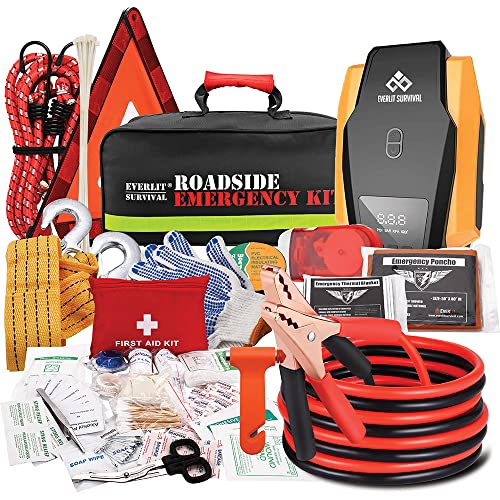
EVERLIT Survival Car Emergency Kit — Best Overall
The EVERLIT is the kit we would put in our own trunk at this budget, and the reason is the combination nobody else in this group matches: proper 12-foot jumper cables and a powered tire inflator in the same bag. Most roadside stops are one of two problems — a battery that will not turn the engine over, or a tire losing air. This is the only pick under $75 that addresses both without asking you to buy anything else, and it still finds room for a genuinely complete first aid kit and the safety gear around the edges.
- Jumper cables: 12 feet, 8-gauge, copper-clad aluminum, rated 300 amps
- Tire inflator: 12V digital compressor with auto shutoff, LED light and three extra nozzles
- First aid: 108-piece kit including CPR mask, triangular bandage and sting relief pads
- Tow rope: 12 feet, maker-rated at 10,000 lb breaking capacity
- Bag dimensions: 17 x 7 x 7 inches; weight about 8 pounds
Strengths
- The inflator presets a target pressure and shuts off when it reaches it, so you are not crouched by a dark roadside watching a gauge needle.
- Twelve feet of cable is the length that actually works when the rescue car cannot park perfectly alongside yours.
- The first aid kit covers the realistic injuries — cuts, scrapes, stings, minor burns — with named contents rather than a vague piece count.
Trade-offs
- At about 8 pounds and 17 inches long, it is the joint-largest bag here; small trunks will notice it.
- The hand-crank flashlight is a backup-grade light, not a work light; most owners will add a better torch.
- Jumper cables still need a second vehicle — there is no battery pack in the bag.
The detail that sells the EVERLIT is how the inflator changes the flat-tire scenario. A slow puncture that would otherwise mean a spare-wheel change on a hard shoulder becomes a ten-minute top-up that gets you to a tire shop, and the auto-shutoff means a nervous first-time user cannot over-inflate the tire by walking away from it. The kit around it is equally thought through: a reflective warning triangle for visibility, a glass breaker and seatbelt cutter for the scenario nobody wants, a mylar blanket and rain poncho for the scenario where the car cannot be fixed and the wait is the emergency. The veteran-owned brand also publishes a proper manual for the kit, which sounds like a small thing until you have tried to find instructions for a no-name rival at midnight.
The honest limitation is size and the flashlight. The bag earns its space, but if your trunk is already full of a stroller or work gear, measure before you buy. And treat the hand-crank light as the third light in the car, not the first — our Emergency Flashlight Review roundup covers the inexpensive dedicated lights worth adding to any of these kits.
Best for: drivers who want one bag that handles the two most common roadside failures. / Not suited for: drivers with very small trunks or anyone who wants a self-contained jump starter included.
Swiss Safe 2-in-1 Car Emergency Kit — Best First Aid
Every other kit in this guide treats first aid as a supporting act. The Swiss Safe reverses that: it pairs a roadside tool bag with a hardcase first aid kit that is a serious product in its own right — the same case the brand sells standalone for car, home and travel use. If the emergency you actually fear is a person getting hurt rather than a car stopping, this is the pick, and it is not close.
- Jumper cables: 12 feet, in the roadside bag
- First aid: hardcase kit with trauma shears, CPR mask, instant cold pack, emergency blanket and first aid guide, plus a bonus mini kit
- Roadside tools: 18-piece socket and screwdriver set, tire pressure gauge, work gloves, bungee cord, ice scraper, electrical tape
- Visibility: high-visibility vest, emergency whistle, glow sticks
- Combined size: about 12.3 x 11.6 x 7.5 inches across two cases; weight about 7.3 pounds
Strengths
- The first aid case is organized in divided sections, so supplies can be found by touch and by stress, not just by daylight and calm.
- Trauma shears, a CPR mask and a cold pack are items almost no rival kit at this price includes.
- The bonus mini kit detaches for the glove box, a second car, or a daypack.
Trade-offs
- Two separate cases are harder to keep together and easier to half-leave behind.
- No tire inflator and no flashlight — the two most-used roadside tools are absent.
- The roadside half is thinner than the EVERLIT’s: no tow-focused extras beyond the basics.
The first aid contents deserve a closer look because they are the reason to buy this kit. Beyond the expected bandages in several shapes — medium, fingertip, knuckle, butterfly closures — the case carries sterile gauze in two sizes, elastic bandages, a triangular bandage, an eye patch, a sterile trauma pad, finger splints, moleskin for blisters, antiseptic wipes, alcohol pads and sting relief. That is a kit that handles a hiking fall or a kitchen-grade cut as readily as a roadside scrape, which is why so many buyers end up moving it between car and house. The roadside bag is competent rather than exceptional: 12-foot cables match the EVERLIT for reach, and the socket set is a thoughtful inclusion for loose battery terminals and trim, but the absence of an inflator means a puncture still means the spare wheel.
The honest limitation is the two-case format. In a real roadside moment you will open the trunk and grab one case; the discipline of keeping both together, both stocked, and both in the car is on you. Drivers who know they are not that person should take the EVERLIT’s single bag instead. Drivers who are that person get the best medical coverage in this guide — and should read our First Aid Kit Review comparison to see how the standalone version of this case stacks up against dedicated first aid kits.
Best for: families, scout and team drivers, and anyone whose emergency planning starts with injuries rather than breakdowns. / Not suited for: drivers who want a single bag, or who need a tire inflator included.
Prose-only pick: check the current Amazon listing for the Swiss Safe 2-in-1 Car Emergency Kit before you buy, and confirm you are looking at the roadside bundle rather than the standalone first aid case.

Thrive Roadside Emergency Car Kit, 104-Piece — Best Organized Kit
The Thrive is the kit for people who open a bag in the dark and want everything to be where the picture on the box said it would be. Its 104 pieces are not the most here, but the mix is unusually sensible — tools, safety gear and a 66-piece first aid kit in a structured canvas case — and it is the only pick that includes both an escape hammer and a proper socket driver set alongside the usual cables and triangle.
- Jumper cables: 8 feet, 8-gauge
- First aid: 66-piece kit within the 104-piece total
- Tools: 7-bit screwdriver, 9-socket driver, multi-tool pliers, utility cutter, tire pressure gauge
- Safety: escape hammer, reflective vest, reflective triangle, distress sign, whistle, hand-powered flashlight
- Case: 600D nylon canvas, water-resistant
Strengths
- The broadest tool selection of the balanced kits — sockets and a multi-tool handle real fasteners, not just cable clamps.
- Visibility is taken seriously: vest, triangle and a distress sign cover day and night scenarios.
- The canvas case is water-resistant and holds its shape, so contents stay findable.
Trade-offs
- Eight feet of jumper cable is the minimum workable length; the rescue car must park close.
- No tire inflator, so punctures mean the spare wheel or a separate inflator.
- The first aid kit, while real, is half the size of the EVERLIT’s and a fraction of the Swiss Safe’s.
What lifts the Thrive above the generic 100-plus-piece crowd is that its count is not padded with absurdities. The bungee cords, ice scraper, electrical tape and zip ties all earn their place in a winter breakdown; the accident form and first aid guide acknowledge that the user of this kit may be a shaken teenager rather than a mechanic. It is the kit we recommend most often as a gift for a new driver, a use case our Car Emergency Kit Pros And Cons analysis looks at in more depth, because everything in it is usable without experience and nothing in it requires confidence to deploy.
The honest limitation is cable length. Eight feet works when a helper can pull alongside on a quiet street; it fails on a narrow road where the only safe position is nose to nose with a gap. If your driving is mostly rural highways, the EVERLIT’s 12-foot cables are worth more than the Thrive’s tidier tools. If your driving is urban and suburban, the Thrive’s organization will serve you better more often.
Best for: new drivers, gift buyers, and anyone who values an organized, everything-visible layout. / Not suited for: drivers who regularly face awkward jump-start parking, or who want an inflator included.
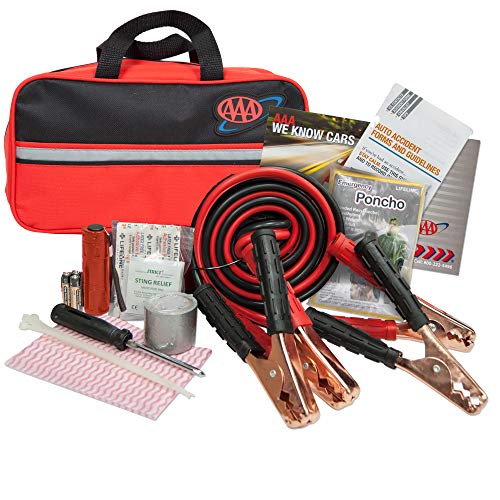
Lifeline AAA Premium Road Kit, 42-Piece — Best Compact Kit
The Lifeline is the smallest serious kit here, and it earns its place by refusing to be a toy. Forty-two pieces sounds modest next to the 142-piece claims elsewhere in this guide, but the pieces are the right ones: 8-gauge booster cables, a metal flashlight with batteries included, a first aid kit that covers the basics properly, and a hard-shell EVA case that protects all of it from the boots, shopping and sports gear that share a trunk. It is also the only kit here designed with an automobile association’s roadside experience behind it, and it shows in the accident guidelines tucked inside.
- Booster cables: 8 feet, 8-gauge
- Flashlight: 9-LED aluminum flashlight, batteries included
- First aid: 24-piece kit with bandages, antiseptic towelettes and sting relief pads
- Case: molded hard-shell EVA foam
- Model: 4330AAA; extras include 2-in-1 screwdriver, duct tape, emergency poncho, shop cloth and cable ties
Strengths
- The hard case survives trunk life better than any soft bag here and keeps the kit grabbable as one object.
- The aluminum flashlight is a real light, brighter and tougher than the hand-crank units in rival kits.
- Compact footprint fits under a seat or in a side well where bigger bags will not go.
Trade-offs
- No warning triangle, no tow strap, no inflator — the recovery side is cables and little else.
- The 24-piece first aid kit is the smallest here; it treats scrapes, not much more.
- Eight-foot cables share the Thrive’s parking limitation.
Think of the Lifeline as the minimum viable emergency kit done properly. It will jump a dead battery, light a dark engine bay, patch a cut finger and keep you dry in a poncho while you wait — and for a large share of real breakdowns, that is the whole job. What it will not do is inflate a tire, tow anything, or warn traffic with a triangle, so owners should add a triangle at minimum; they cost very little and the case has room for a flat-folding one. Commuters in small cars, drivers of second cars that see few miles, and anyone whose trunk space is genuinely contested will get more use from this kit’s discipline than from a bigger bag that ends up left in the garage. Our Is A Car Emergency Kit Worth It verdict piece looks at exactly this minimum-kit question.
The honest limitation is scope. This is a get-you-started kit, not a get-you-home kit, and the price difference against the EVERLIT buys real capability. Buy it for its size and build quality, not as a cheaper substitute for the full kits above it.
Best for: small cars, commuters, second vehicles and tight trunks. / Not suited for: drivers who want towing, inflation or triangle visibility included.

HAIPHAIK Car Emergency Kit, 124-Piece — Best Tool Kit
The HAIPHAIK takes the opposite bet to the Lifeline: maximum hardware. Its 124 pieces include the longest cables in this guide after the two 12-foot sets, a 16-piece tool box with real wrenches and pliers, and a folding multi-function shovel that doubles as a saw, pick and bottle opener. If your breakdowns happen on unpaved shoulders, in snow, or anywhere a shovel and a socket earn their keep, this is the interesting pick — with one significant caveat covered below.
- Jumper cables: 11.8 feet, maker describes them as UL-certified
- Tool box: 16 essential tools including wrenches, pliers, hammer and voltage tester
- Shovel: folding multi-function shovel, about 18 inches assembled
- Extras: tow rope, tire repair tools, hand-driven LED flashlight, reflective safety vest, gloves, survival whistle
- Model: GJB004
Strengths
- The tool box handles real roadside fasteners — battery terminals, hose clamps, loose trim — better than any rival here.
- The folding shovel is genuinely useful for snow, mud and gravel in a way no other pick matches.
- Long cables relax the parking problem that limits the 8-foot kits.
Trade-offs
- First aid is the weak side: sources disagree on whether a meaningful first aid kit is included at all, so treat medical cover as something to add yourself.
- The cable gauge is stated inconsistently across sources, so we do not print a gauge figure for it.
- No tire inflator despite the tool focus.
The HAIPHAIK is a mechanic’s answer to the roadside kit, and for rural drivers that answer has real merit: a car stuck in soft ground needs a shovel and a tow rope before it needs a bandage. The tire repair tools extend that logic — a plug kit plus a passing driver’s compressor can save a wheel change entirely. But the kit’s documentation is the messiest in this guide. Retailer contents lists vary, the first aid question is genuinely unresolved across sources, and the cable gauge appears variously in seller answers and roundups. We have flagged it as a weak pin in our notes: the product is real and widely sold, but check the listing’s contents list line by line before you buy, and budget for a separate first aid pouch — our First Aid Kit Review guide has inexpensive options that pair well with a tool-first bag like this.
The honest limitation is trust. With the EVERLIT or the Lifeline, what the manual says is what arrives. With the HAIPHAIK, verify on delivery that the shovel, tool box and cables are all present, while returns are still easy.
Best for: rural drivers, winter drivers and handy owners who will actually use tools. / Not suited for: buyers who want verified first aid cover in the same bag.

LIANXIN Roadside Assistance Emergency Kit, 142-Piece — Best for Winter
The LIANXIN has the biggest headline number in this guide and, unusually, some of the substance behind it: a snow shovel, a real tool box, a safety hammer and seatbelt cutter, and the usual triangle, tow rope and rain gear. It is the kit most clearly designed by someone who has been stuck in winter — the shovel, scraper and blanket combination is exactly what a January breakdown asks for — even if its documentation shares some of the HAIPHAIK’s looseness.
- Jumper cables: 8.2 feet, maker describes them as UL-certified
- Tool box: hammer, pliers, utility knife, tape measure, PVC tape, digital test pen and three screwdrivers
- Winter gear: folding snow shovel, ice scraper, emergency blanket, raincoat
- Safety: safety hammer and seatbelt cutter, reflective warning triangle, hand-driven LED flashlight
- Tow rope: 9.85 feet
Strengths
- The winter kit is the most complete here: shovel, scraper, blanket and triangle in one bag.
- The tool box is a real one, with a test pen that helps confirm whether a battery or a connection is the problem.
- The escape hammer and belt cutter are mounted-where-you-need-them items many kits omit.
Trade-offs
- No first aid kit is specified in the strongest sources — like the HAIPHAIK, add your own.
- Cable gauge is stated as different figures by different sources, so we do not print one.
- At 8.2 feet, the cables are on the short side for highway jump starts.
The LIANXIN’s appeal is seasonal honesty. Most kits pretend the emergency happens on a mild evening; this one assumes slush, darkness and a dead battery, and packs accordingly. The compass and flashing lights in some listings round out a kit that wants to be found as much as used. Where it loses ground is the same place its HAIPHAIK cousin does: version drift. Different listings describe slightly different contents, so the listing you order from is the only specification that matters — screenshot it, and check the bag against it on arrival. Drivers comparing the two tool-heavy kits will find both appearing again in our under-$50 coverage, where their tool counts buy relatively more of the budget.
The honest limitation is medical cover. A kit with a snow shovel and no bandages has its priorities in a defensible order for winter, but most owners should drop a compact first aid pouch into the bag and call the combination complete.
Best for: northern and mountain drivers, and anyone whose breakdown season is winter. / Not suited for: buyers who need first aid included or long jumper cables.
Comparison Table
| Pick | Jumper cables | Inflator | First aid | Standout extra |
|---|---|---|---|---|
| EVERLIT Survival | 12 ft, 8-gauge | Yes, digital auto-shutoff | 108-piece | 10,000 lb-rated tow rope |
| Swiss Safe 2-in-1 | 12 ft | No | Hardcase kit plus mini kit | Trauma shears and CPR mask |
| Thrive 104-Piece | 8 ft, 8-gauge | No | 66-piece | Escape hammer and socket set |
| Lifeline AAA 42-Piece | 8 ft, 8-gauge | No | 24-piece | Hard-shell EVA case |
| HAIPHAIK 124-Piece | 11.8 ft | No | Not clearly specified | Folding shovel and 16-piece tool box |
| LIANXIN 142-Piece | 8.2 ft | No | Not specified | Snow shovel and test pen |
How to Choose a Car Emergency Kit Under $75
Start with the failure you are actually insuring against. Dead batteries and soft tires account for the overwhelming majority of roadside stops, which is why cable quality and inflation dominate this guide’s scoring. A jumper cable’s job is to move a lot of current through a cold, possibly corroded connection: thicker cable (a lower gauge number) and longer reach both matter, and 12 feet is the length at which parking stops being a puzzle. Eight feet is workable in a driveway or a quiet street. Anything shorter is a decoration. If you drive a larger vehicle or a diesel, weight cable gauge even more heavily, and consider whether a standalone jump starter — covered in our How To Choose A Car Jump Starter guide — belongs in the car alongside the kit.
Next, decide what a flat tire means in your car. If you have a spare wheel you trust and the strength and space to change it, an inflator is a convenience. If your car has no spare — increasingly common — or the spare is a decade old, an inflator plus a plug or sealant option is the difference between driving to a tire shop and waiting for a tow. Only the EVERLIT in this guide includes the inflator, which is the single biggest reason it leads the list; every other pick implicitly assumes your spare is serviceable, so check it this week, not during the emergency.
Then weigh first aid honestly. Most kit first aid is sized for the injuries of a roadside stop: cuts from trim and tools, scrapes, stings, a child’s grazed knee. The Thrive’s 66 pieces and the EVERLIT’s 108 cover that brief well. The Swiss Safe’s hardcase covers a larger brief — the same kit serves camping and home duty — and is the right choice if the car kit doubles as the family kit. What no kit here does is trauma care; if your driving includes remote highways, add a dedicated trauma pouch rather than expecting a bandage-heavy kit to stretch.
Consider, too, who else drives the car. A kit bought for a household’s main vehicle will be used by whoever is driving when something fails, and the best kit for a confident owner — heavy on tools, light on guidance — can be the wrong kit for a partner or a teenage driver who needs the accident form, the printed instructions and the flashlight that simply switches on. The Thrive and the Lifeline both think about that second user; the tool-first kits largely do not. If the car is shared, buy for the least experienced person who will open the bag, and walk them through it once at home, in daylight, before the knowledge is ever needed at a roadside.
Finally, judge the container. A kit lives a hard life: frozen winters, hot trunks, heavy shopping. Hard cases like the Lifeline’s protect contents and stack neatly; soft bags like the EVERLIT’s and Thrive’s flex into odd spaces and swallow additions. Either beats a cardboard box, which is how the cheapest kits arrive and how they die. Whichever you choose, leave room in it for the personal layer no manufacturer can pack for you: a phone charging cable, a paper list of contacts, any daily medication, water, and in winter a real blanket and gloves that fit your hands.
Setting Up Your Kit: The First Weekend
A car emergency kit is not finished when it arrives; it is finished when you have opened it, checked it and placed it. Do this once, at home, in daylight, and every future emergency gets easier.
- Empty the bag completely and check every item against the listing’s contents list. This is the moment missing pieces and version differences are easy to fix.
- Uncoil the jumper cables once and recoil them loosely. Cables that have never been uncoiled fight you; cables you have handled behave.
- Read the jump-start order printed in your car’s manual — some vehicles have a remote positive terminal and a specified ground point, and the time to learn that is now.
- Check your spare tire’s pressure, or confirm your car has a sealant kit and that it is in date. Half the kits in this guide assume a working spare.
- Put the flashlight, triangle and vest in the most reachable layer of the bag, and the bag itself where you can reach it without unloading the trunk.
- Add the personal layer: charging cable, water, medication, and a written contact card in case your phone is the thing that died.
- Set a six-month reminder to recheck batteries, first aid expiry dates and the spare.
How to Jump-Start a Car With Any Kit in This Guide
Every pick here jump-starts the same way, and the order of the clamps is the part that matters. Get it right and the job takes ten minutes; get it wrong and you can damage both cars’ electrics. Work through it in this order, and check your own car’s manual first — some models specify a remote jump terminal and a particular ground point, and the manual always wins over generic instructions.
- Park the rescue car close enough that the cables reach both batteries with slack — this is where the 12-foot sets earn their price — and switch both cars off, keys out.
- Put on the kit’s gloves, set the warning triangle behind the cars if you are on a road, and wear the vest if the kit includes one.
- Find the positive terminal (marked + and usually red-capped) and the negative terminal (marked −) on both batteries, and wipe off any heavy corrosion with a cloth.
- Clamp one red clamp to the positive terminal of the dead battery, then the other red clamp to the positive terminal of the good battery.
- Clamp one black clamp to the negative terminal of the good battery. Clamp the remaining black clamp to a bare metal part of the dead car’s engine bay, away from the battery — not to the dead battery’s negative terminal.
- Start the rescue car and let it idle for a few minutes, then try the dead car. If it starts, let it run; if it only clicks, wait longer and check the clamps are biting metal, not corrosion.
- Remove the clamps in the exact reverse order, keeping them from touching each other or the bodywork, and drive the revived car for a solid run rather than switching it straight off.
Three problems cover most failures. Problem: the starter clicks once and nothing happens → a clamp is usually on corrosion or paint; reseat the clamps on clean metal and try again. Problem: the engine turns slowly but will not catch → the dead battery needs more time on the rescue car, or it has failed internally and no cable will save it; that is a tow, not a technique problem. Problem: the cables get warm and nothing improves → stop, disconnect in reverse order, and call for help; heat means resistance somewhere, and pushing on risks damage. None of this requires strength or experience — it requires the order above and the patience to follow it in the rain, which is exactly what a kit with gloves, a light and a triangle is for.
Key Takeaways
- Cable length and an inflator matter more than headline piece counts.
- The EVERLIT is the only pick here that covers both dead batteries and soft tires by itself.
- First aid ranges from the Lifeline’s 24 basic pieces to the Swiss Safe’s hardcase — match it to your real risk.
- Two picks, the HAIPHAIK and LIANXIN, leave first aid effectively to you; budget for a pouch.
- Every kit here still needs a second vehicle to jump-start yours.
Common Buying Mistakes
The first mistake is buying the biggest number. A 142-piece kit whose count is mostly bandages and cable ties is not better equipped than a 42-piece kit with proper cables; compare major items, not totals. The second mistake is ignoring cable length until the night it matters — measure the gap between two cars parked the way your street forces them to park, and buy for that gap. The third is assuming the kit you bought five years ago is still a kit: batteries leak, adhesive dies, inflator seals perish, and first aid expires. The fourth is leaving the kit in the garage because the bag is bulky; a smaller kit that lives in the car, like the Lifeline, beats a comprehensive one that lives at home. The fifth is forgetting the driver: gloves that fit, a light you can hold in your teeth, and the knowledge of where your car’s jacking points and jump terminals are, are worth more than any single tool in any bag here.
Final Recommendation
For most drivers, the answer at this budget is the EVERLIT Survival Car Emergency Kit: it is the only pick that pairs 12-foot cables with a proper digital inflator and a complete first aid kit, and it does so in one bag at one price. If your priority is medical cover for a family, take the Swiss Safe instead and accept its two-case format. The runner-up for everyone else is the Thrive Roadside Emergency Car Kit — less capable at the roadside’s two big jobs, but the most organized and giftable kit here, and the one a new driver is most likely to actually use correctly. Whichever you choose, open it this weekend, check the spare, and add the personal layer. A kit you know is a safety device; a kit you have never opened is a hope.
Frequently Asked Questions
What should a car emergency kit under $75 include at minimum?
Jumper cables of at least 8 feet — 12 is better — a warning triangle or reflective vest, a flashlight, basic first aid, work gloves, and a rain poncho or blanket. Under $75 you can reasonably add a tire inflator, a tow strap and an escape tool to that list, as the picks in this guide show.
Are longer jumper cables actually better?
Yes, within reason. Length buys parking flexibility: with 12 feet, the rescue car can sit nose to nose or alongside with slack to spare. Very long, thin cables lose voltage, which is why the better kits pair length with an 8-gauge rating rather than stretching thin cable further.
Can these kits jump-start a car on their own?
No. Every kit in this guide uses jumper cables, which need a second vehicle with a healthy battery. A standalone jump starter is a separate device; many drivers carry both, using the kit for everything else and the jump pack for solo starts.
How often should I check my emergency kit?
Twice a year is a workable rhythm — once before winter, once before summer road-trip season. Check flashlight batteries, first aid expiry dates, inflator function, and the spare tire the kit’s plan depends on.
Is a high piece count a sign of a better kit?
No. Piece counts count every bandage and cable tie. Compare the major items instead: cable length and gauge, inflator, first aid scope, triangle, tow gear and tools. Our Car Emergency Kit Review hub explains how we weigh those factors across the whole category.
Which kit here is best for a new driver?
The Thrive, for its organized layout and complete set of simple, confidence-free tools — with the EVERLIT as the step-up if the budget allows, since its inflator removes the hardest roadside task, the wheel change, from a new driver’s first breakdown.