Disclosure: As an Amazon Associate, umtsmarttool.com earns from qualifying purchases. Links on this page are affiliate links; they cost you nothing extra. Prices and availability change often, so check the current Amazon listing before you buy.
Choosing an air purifier for vaping comes down to one uncomfortable fact: vape aerosol is two pollutants wearing one coat. The visible cloud is a suspension of tiny droplets — propylene glycol, vegetable glycerin, nicotine, and flavouring compounds — that behaves like a fine particle pollutant, while the lingering smell and part of the chemical load behave like a gas. A machine that only filters particles will clear the haze and leave the smell; a machine that only absorbs gases will tame the smell while the haze drifts through it. This guide explains what vape aerosol actually contains, which filtration stages remove which part of it, and the five machines — all verified against current Amazon listings — that combine serious particle capture with the one ingredient most purifiers skimp on: enough activated carbon to matter.
A note on honesty before the picks. No air purifier makes indoor vaping harmless, and none removes every trace of nicotine or aerosol residue from a room; surfaces still collect film over time, and ventilation — an open window, an extractor — remains the single most effective tool. What a well-chosen purifier genuinely does is clear visible aerosol far faster than it settles on its own, cut the lingering smell dramatically, and reduce what everyone else in the home breathes second-hand. Buy one with those expectations — faster clearing, far less lingering smell, and cleaner shared air for everyone else in the home — and the machines below will meet them reliably, day after day, for years of daily use. Buy one expecting a licence to vape anywhere without trace, and no machine at any price will satisfy you.
Key Takeaways
- Vape aerosol is part particle, part gas: you need a HEPA stage for the droplets and a substantial activated carbon stage for the odor and volatile compounds. Thin carbon sheets saturate quickly under vape load.
- The Winix 5510 is the top pick for most vaping households because its carbon filter is a deep, separate stage rather than a thin coating — and its pre-filter is fully washable, which matters greatly when aerosol residue coats everything it touches.
- Room fit still rules: a purifier must cycle the room’s air several times an hour to keep up with an active vaping session, so size for the room first, then check carbon depth, then everything else.
- Placement near — but not on top of — the usual vaping spot, with the machine running before and after every session, outperforms any specification upgrade you could buy instead at any price.
- Expect to replace carbon sooner than the manufacturer’s particle-based schedule suggests; odor breakthrough is your signal, not the filter light — and keeping one genuine spare carbon filter or cartridge in the cupboard is the difference between a two-minute fix and a fortnight of stale air while a replacement ships.
What Is Actually in Vape Aerosol, Exactly?
An e-cigarette does not burn anything; it heats a liquid until it becomes an inhalable aerosol. That liquid is mostly propylene glycol and vegetable glycerin, with nicotine in most formulations and flavouring chemicals in nearly all of them. When exhaled, the aerosol is a cloud of sub-micron to few-micron droplets — squarely in the size range that HEPA filtration was designed to capture — carrying those same compounds into the room. Measurements of indoor vaping consistently find elevated fine-particle levels in the room during and after sessions, alongside volatile organic compounds from the flavourings and the carrier liquids themselves.
Two behaviours of this aerosol shape the purifier choice. First, the droplets evaporate and shrink as they drift, and the gaseous fraction — the part your nose detects as lingering sweetness or stale smell an hour later — passes straight through any particle filter, however good. Only adsorption onto activated carbon removes it, and carbon capacity is finite and roughly proportional to carbon mass. Second, the residue is sticky: glycol films settle on surfaces, fabrics, and, relevantly, on purifier pre-filters. A machine with a washable pre-filter can be rinsed back to full airflow in a sink; a machine without one slowly chokes on its own cartridge, and its real-world performance falls away months before the filter indicator notices.
There is also the question of who else is in the room. Second-hand aerosol is not smoke, and this guide will not pretend the evidence makes them equivalent — but it is not clean air either, and households with children, asthmatic family members, or pets generally prefer it cleared quickly, which is a preference a purifier can honour. Readers in that position may also want the broader context in the best air purifiers for smoke guide, since the filtration logic overlaps heavily.
How These Picks Were Chosen
Every candidate had to clear three bars. First, a genuine HEPA-grade particle stage with verified or credibly stated room coverage, because aerosol droplets are a particle problem before they are anything else. Second, a carbon stage with real substance — either a separate deep carbon filter or a combined cartridge with above-average carbon content for its class — because token carbon is the most common failure in this niche. Third, a washable pre-filter or an inexpensive cartridge, because vape households consume filters faster than the schedules printed on boxes. The five survivors span a family room workhorse, a large-room flagship, a smart mid-size machine, an open-plan volume leader, and a proven mid-price all-rounder. Each was checked through this site’s own Creators API account; the listings, ASINs, and images in this article are recorded in its sources file.
In this guide
Quick Picks
| Model | Best for | Why it suits vaping |
|---|---|---|
| Winix 5510 | Most vaping households | Deep separate carbon filter plus washable pre-filter |
| Medify MA-112 | Large rooms and heavy sessions | Huge coverage with a substantial 3-in-1 filter |
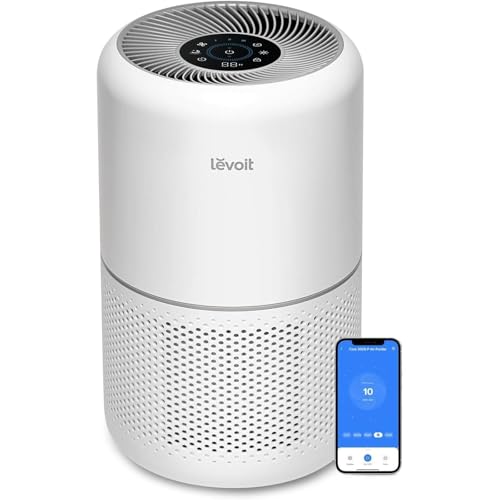
| Levoit Core 600S-P | Smart-home living rooms | Strong airflow, app control, auto mode |
| Blueair Blue 211i Max | Open-plan spaces | Very high clean-air volume at low noise |
| Coway Airmega Mighty | Mid-size rooms, long ownership | Proven design, washable pre-filter, long filter cycle |
Detailed Reviews

Winix 5510 — Best Overall for Vaping Households
Badge: Best carbon stage
- Filtration: True HEPA plus separate high-deodorization carbon filter
- Pre-filter: washable — important under aerosol residue load
- Coverage: large rooms, up to about 1,881 sq ft per hour on the listing
- Extras: auto mode, app support, PlasmaWave stage that can be switched off
The 5510 wins this category on filter architecture. Its activated carbon is not a scented sheet behind the HEPA element; it is a deep, separate filter built for deodorization, which is precisely the workload vaping creates. In practice that means the stale sweetness that survives a session in most rooms is adsorbed rather than merely diluted, and the carbon keeps working for months where a cartridge machine’s thin layer gives up in weeks. The True HEPA stage handles the droplet fraction, and the washable pre-filter — the detail vape households end up valuing most — can be rinsed when glycol residue starts to film it over, restoring airflow without spending money.
Operation suits the use case too. Auto mode reads the air and ramps the fan when a session clouds the room, then settles back; app support on this generation means you can start the machine from another room before a session rather than walking into the cloud to reach the controls. The PlasmaWave ion stage divides opinion; it can be switched off completely, and filtration-only operation loses nothing essential, since the HEPA and carbon stages do the real work. The honest costs are size — this is a substantial cabinet — and the replacement bill for two real filters on a cycle. Under vape load, watch the carbon: when room odor starts surviving overnight again, the carbon is spent regardless of what the indicator says.
Strengths
- Deepest carbon capacity in this roundup, the deciding factor for vape odor
- Washable pre-filter shrugs off aerosol residue that clogs cartridge machines
- Auto mode responds to sessions without manual speed changes
Trade-offs
- Large footprint and a utilitarian look
- Two substantial filters to budget for on a cycle
- More machine than a small bedroom needs
Best for: dedicated vaping rooms, living rooms where sessions happen daily, and households bothered by lingering smell. Not suited for: tiny rooms or buyers wanting the cheapest filter cycle. The wider brand range is covered in the best Winix air purifiers roundup.

Medify MA-112 — Best for Large Rooms and Heavy Use
Badge: Best large-room power
- Filtration: HEPA filter with substantial coverage class
- Coverage: up to about 5,948 sq ft per hour on the listing — the largest figure in this roundup
- Format: full-size floor unit for living spaces
- Positioning: built for smoke, wildfire, and odor duty
Some vaping happens in big rooms — a garage conversion, a basement lounge, an open family space — and big rooms defeat ordinary purifiers by volume alone. The MA-112 is Medify’s answer: a full-size machine whose listing coverage figure dwarfs everything else in this guide, which under the usual air-change arithmetic translates into genuine authority in the large spaces where aerosol otherwise lingers for hours. Its filter set is built for smoke and odor work, the same dual particle-and-gas workload vaping presents, and its sheer airflow means a session’s cloud is processed in minutes rather than gradually diluted.
The trade-offs are the obvious ones of scale: this is furniture-sized, it wants a permanent spot with clearance, and its filters are priced in proportion to its capacity. It is also, deliberately, a single-room solution — a machine this size tempts buyers to imagine whole-home coverage, but closed doors defeat any purifier, and the MA-112’s power should be spent on the room where vaping actually happens. For a smaller Medify footprint in a bedroom, the MA-40 in our other guides covers the middle ground; for the dedicated lounge, nothing in this roundup moves air like the MA-112.
Strengths
- Largest clean-air capacity in the roundup by a wide margin
- Filter design aimed at smoke and odor, matching the vape workload
- Clears visible aerosol from big rooms in minutes at high speed
Trade-offs
- Furniture-sized footprint needs a permanent home
- Filter replacements are priced at its capacity class
- Overkill — in size and cost — for ordinary bedrooms
Best for: large lounges, garage conversions, and heavy daily use in one main room. Not suited for: small rooms or multi-room coverage on one machine.

Levoit Core 600S-P — Best Smart Pick for Living Rooms
Badge: Best app control
- Filtration: HEPA filtration in a large-format cartridge design
- Coverage: large rooms up to about 2,933 sq ft per the listing
- Controls: smart app, remote, auto features, sleep mode
- Verification: AHAM Verifide referenced on the listing family
The Core 600S-P is the machine for the household that wants the purifier to manage itself. Its app control and scheduling solve the specific rhythm of vape use — run a cleaning burst after a session, drop to a quiet overnight speed, wake to fresh air — without anyone touching the unit, and its air quality sensing gives the auto mode something real to react to when aerosol spikes. Levoit’s filter ecosystem is the other practical strength: cartridges are widely stocked, and the brand’s variant filters let owners bias the same machine toward odor duty.
Against the Winix, the honest comparison is carbon architecture: the Levoit’s combined cartridge is competent for everyday odor but carries less carbon mass than the Winix’s separate bed, so in a heavy daily vaping home it will need cartridge changes sooner to keep odor performance. Against the Medify, it concedes raw volume and wins on convenience, footprint, and noise manners. For the common case — a living room, moderate daily vaping, a household that values automation — that balance lands exactly right, which is why it holds the smart pick slot.
Strengths
- Best-in-roundup app, scheduling, and sensor-driven auto operation
- Strong airflow for ordinary living rooms
- Widely stocked cartridges with variant options
Trade-offs
- Combined cartridge carbon saturates sooner than the Winix’s separate bed
- Cartridge replacement replaces all stages at once
- Smart features are wasted if you prefer a dumb, set-speed machine
Best for: living rooms with moderate daily vaping and smart-home households. Not suited for: the heaviest odor loads, where the Winix’s carbon wins.

Blueair Blue 211i Max — Best for Open-Plan Spaces
Badge: Best quiet volume
- Filtration: HEPASilent combined particle and carbon filtration
- Coverage: very large rooms, up to about 3,235 sq ft per hour on the listing
- Noise: listed from 23 dB on low
- Pre-filter: washable fabric — a genuine asset under aerosol residue
Open-plan homes present vaping households with a volume problem: the aerosol does not stay in a corner, it migrates through the whole shared space, and only a machine with real headroom can cycle that volume fast enough to matter. The 211i Max’s HEPASilent design moves that air at noise levels that do not compete with conversation or television, which matters because a purifier that annoys people gets switched off — and an off purifier has a CADR of zero. Its washable fabric pre-filter is the quiet hero here, catching the coarse fraction and the first film of residue, and rinsing clean instead of being replaced.
Carbon is the caveat: the Blueair’s combined filter includes carbon and handles ambient odor well, but a household whose primary complaint is intense, repeated vape smell in a smaller room will extract more odor performance per dollar from the Winix. The Blueair’s case rests on volume and quiet in big shared spaces, where its filtration is more than adequate for the diluted aerosol load of an open plan. Judge it on that ground and it is the strongest machine in this roundup for its scenario.
Strengths
- Highest quiet airflow for open-plan volumes
- Washable fabric pre-filter suits residue-heavy air
- Auto mode and WiFi for set-and-forget operation
Trade-offs
- Carbon capacity trails the Winix for concentrated odor work
- Premium-tier filter pricing
- Large footprint to accommodate
Best for: open-plan living areas and shared family spaces. Not suited for: small dedicated vaping rooms where concentrated odor is the whole problem. See the best Blueair air purifiers guide for the rest of the family.

Coway Airmega Mighty (AP-1512HH) — Best Proven All-Rounder
Badge: Best long-term value design
- Filtration: HEPA and carbon with a washable pre-filter
- Coverage: rooms up to about 1,748 sq ft on the listing
- Extras: air quality monitor, auto and eco modes, timer
- Warranty: 3-year warranty stated on the listing
The Mighty is one of the longest-running designs in this category, and longevity is itself a comparison point for vape households, because a machine that consumes filters quickly needs a manufacturer who will keep supplying them. Coway’s design separates its stages sensibly — washable pre-filter for the coarse and sticky fraction, carbon for odor, HEPA for the fine droplets — and wraps them in an air quality monitor with an auto mode that visibly reacts when the room clouds. Its filter cycle is long by category standards, which under vape load translates into a lower annual consumable bill than cartridge machines of similar coverage.
It concedes the smart-features contest to the Levoit — control is on-device — and its carbon, while a real stage, is not the Winix’s deep bed. What it offers instead is balance: adequate everything, excellent support horizon, and a three-year warranty stated on the listing. For a mid-size room with regular but not industrial vaping, that balance is frequently the correct answer, and the Mighty’s years on the market mean its quirks are known rather than discovered.
Strengths
- Washable pre-filter and long filter cycle suit residue-heavy air
- Air quality monitor with responsive auto mode
- Three-year warranty and a long production history
Trade-offs
- No app control on this model
- Carbon capacity mid-class, below the Winix
- Design is functional rather than decorative
Best for: mid-size rooms and buyers who keep appliances for years. Not suited for: smart-home-first shoppers or the largest open spaces. Readers comparing the wider field should also see the best air purifiers overview.
Comparison Table
| Criterion | Winix 5510 | Medify MA-112 | Levoit Core 600S-P | Blueair 211i Max | Coway Mighty |
|---|---|---|---|---|---|
| Carbon capacity | Deepest — separate bed | Strong for its class | Moderate cartridge | Moderate combined | Real stage, mid-weight |
| Room scale | Large | Very large | Large | Very large | Mid to large |
| Pre-filter | Washable | Standard | Cartridge layer | Washable fabric | Washable |
| Smart features | App + auto | On-device | Best app + auto | App + auto | Auto, no app |
| Choose it when | Odor is the main complaint | The room is huge | You want automation | The space is open-plan | You want proven balance |
How to Use a Purifier in a Vaping Room: Practical Routine
Place it in the drift path, not in a corner. Aerosol rises on warm air and drifts with the room’s circulation. Put the purifier a few feet from the usual vaping seat, with its intakes unobstructed and not pressed against a wall, so the cloud reaches the machine before it reaches the rest of the room. Keep it out of the direct exhale line at arm’s length — a machine blasted point-blank coats its pre-filter unevenly and still lets the room’s far half fill.
Start before, run after. Switch the machine to a higher speed ten minutes before a session and leave it running for at least half an hour afterwards. Aerosol concentration is a race between emission and removal; a purifier already at speed keeps the peak far lower than one started after the room has filled, and the post-session run is what prevents the overnight stale smell, because it clears the gaseous fraction while it is still airborne rather than after it has soaked into fabrics.
Ventilate when you can. A purifier recirculates; a window exchanges. On any day the weather allows, ten minutes of open window plus the purifier outperforms the purifier alone, especially for the gaseous compounds that load the carbon. Think of ventilation as extending your carbon filter’s life, because every compound that leaves through the window is one the carbon never has to hold.
Maintain on a vape schedule, not the box schedule. Rinse washable pre-filters monthly in a vaping home — residue films them faster than household dust alone. Check cartridge machines quarterly by smell: run the machine in a clean room or step outside and return; if the room’s background sweetness persists with the machine running, the carbon is spent even if the HEPA stage and the indicator disagree. Keep one spare carbon or cartridge in reserve, because odor breakthrough never happens on a convenient day.
Mind the soft furnishings. Curtains, upholstery, and bedding absorb the gaseous fraction and re-release it slowly, which is why a room can smell stale even with the purifier running well. Regular laundering of the fabrics nearest the vaping spot does more for background odor than any purifier upgrade. The machine handles the air; the washing machine handles the reservoir.
Common Mistakes Vaping Households Make
Buying a particle-only machine. The most common error in this niche: a well-reviewed HEPA purifier with a token carbon sheet clears the visible cloud and leaves the smell, and the owner concludes purifiers do not work for vaping. The filtration was half right; the carbon was the missing half.
Undersizing for session peaks. A machine sized for background dust duty cannot keep pace with an active session. Size for the room at several air changes per hour, or accept that the machine is a post-session cleaner rather than a during-session one.
Trusting the filter indicator under vape load. Indicators track time or particle-side pressure, not carbon saturation. Your nose is the carbon gauge: odor breakthrough is the replacement signal.
Hiding the machine. A purifier behind a sofa or inside a media cabinet cleans the inside of the furniture arrangement. Intakes need open air on all sides the design draws from.
Expecting the purifier to handle surfaces. Glycol film on windows, screens, and paintwork is a cleaning task, not a filtration task. Wipe hard surfaces near the vaping spot regularly, and do not blame the machine for a job it cannot do. For a deeper look at residue and smoke-adjacent problems, the best air purifiers for smoke guide covers the shared ground.
Why Carbon Quantity Decides This Category: A Closer Look
Activated carbon works by adsorption: gas molecules stick to the enormous internal surface area of treated charcoal — a gram of good activated carbon can present hundreds of square metres of surface. Every carbon filter therefore has a capacity, measured in how much contaminant it can hold before its surface is effectively full. In ordinary household duty — the occasional cooking smell, background city air — even a modest carbon layer lasts months because the load is light. Vaping changes the arithmetic completely. A daily vaping household pushes a concentrated stream of glycol vapour and flavouring compounds through the filter for hours, and the carbon surface fills correspondingly faster. This is why the same cartridge that serves a non-vaping bedroom for a year can stop controlling vape odor in a matter of weeks, and why this guide keeps returning to carbon mass as the deciding specification: it is not a subtle difference, it is the whole ballgame for this use case.
Carbon quality matters as well as quantity. Filters impregnated or blended for specific compound families — the deodorization-focused carbon in the Winix design is the example in this roundup — adsorb target gases faster and hold them more securely than generic carbon of the same weight. Pellet and granular beds generally outperform carbon-coated fibre sheets because air winds through a deeper, more uniform bed with longer contact time; contact time is the unglamorous variable behind most real-world odor performance, since a gas molecule that transits the filter too quickly simply does not stick. Larger machines hold an inherent advantage here too: the same airflow spread across a bigger filter face moves more slowly through the bed, buying contact time for free. When you compare two machines for vaping, then, the questions in order are: how much carbon, in what form, and how fast does air pass through it? A deep bed in a large machine answers all three well, which is why the roundup’s ranking falls out the way it does.
Humidity and temperature nudge the results at the margins — carbon adsorbs less eagerly in very humid air, one reason bathrooms are hard duty for any purifier — but they do not change the ranking. What changes outcomes most, after the machine itself, is the household’s rhythm: several short sessions spread through the day load carbon steadily, while one long evening session creates a peak the machine must clear before bed. Auto modes and post-session run time, covered in the routine section above, exist to handle exactly that rhythm.
Room-by-Room Playbook for Vaping Households
The dedicated vaping or hobby room. This is the easiest scenario to serve and the one where the Winix 5510 earns its keep: one room, a known seat, a machine placed in the drift path, run before and after sessions. Because the load is concentrated, carbon life will be shortest here; budget replacements accordingly and keep the spare on hand. If the room doubles as a gaming or media room, check the noise line in the comparison table — you will run this machine while you are in the room, at speeds you must be able to talk over.
The living room in a shared home. Here the purifier’s job is as much social as technical: other household members did not choose the aerosol, so clearing speed and odor control protect everyone’s comfort. The Levoit Core 600S-P’s automation suits this room — it can react to a session without anyone reaching for controls and settle back before a film starts — while the Blueair 211i Max suits the open-plan version of the same problem. Placement matters more than usual: the machine belongs in the shared space’s circulation, not exiled to the vaper’s corner, because its job is to protect the whole room’s air.
The bedroom. Vaping in a bedroom is where households most often want a hard boundary instead: a purifier can clear the air, but bedding and mattresses are the most absorbent reservoirs in any home, and overnight exposure is the longest exposure anyone gets. If vaping does happen there, run the machine on a timer through the evening, keep the door closed to protect the rest of the home while it works, and launder bedding more often than feels necessary. A quiet machine with a true sleep mode — several picks in the wider best air purifiers for bedroom guide qualify — matters more than raw power in this room.
The home office. Long sedentary hours near the machine make noise the deciding criterion, and video calls add a wrinkle: a purifier ramping up mid-call is audible to everyone on it. Choose a machine whose working speed is calm, place it behind or beside the desk rather than beside the microphone, and prefer manual speed control during work hours with auto mode outside them. The Coway Mighty’s measured manners fit this room well.
The rental or shared house. Where the concern is a landlord’s nose or housemates’ goodwill, the priorities sharpen: odor control first, visible haze second, and discretion throughout. No purifier guarantees a traceless room — glycol film on windows and paint is real — so pair the machine with window ventilation whenever possible, wipe hard surfaces near the usual spot weekly, and be honest with yourself that the purifier reduces evidence and exposure; it does not repeal physics. The Winix’s carbon depth is the best available tool for this scenario, used alongside those habits.
What About Nicotine Staining and Third-Hand Residue?
Long-term vaping in one room leaves a residue story that purifier marketing rarely mentions. The glycol carriers condense on cool surfaces — windows first, then screens, mirrors, and paint — as a faint film that yellows slowly and holds odor. Air filtration reduces the rate of deposition by removing aerosol while it is airborne, which is a genuine benefit: rooms with a properly sized, consistently run purifier accumulate film noticeably more slowly than unfiltered rooms. But the purifier cannot remove film that has already landed, and it cannot extract compounds that have soaked into upholstery foam or carpet backing. Those reservoirs are why a room can smell faintly sweet weeks after vaping stopped in it, and why deep cleaning — washing fabrics, wiping hard surfaces with a degreasing cleaner, airing the room thoroughly — is the reset button. Set expectations accordingly: the purifier is prevention and daily management, not restoration.
Pets deserve a sentence of their own here. Birds are famously sensitive to airborne compounds of many kinds, and small mammals and cats spend their lives closer to the floor where settled residue concentrates. The cautious household keeps vaping — and the purifier’s clean output — in rooms pets do not occupy, and treats any purifier as a supplement to that separation rather than a substitute for it. The best air purifiers for pets guide covers filtration for pet households in depth, though its subject is the animals’ own dander and odor rather than their owners’ habits.
Buying Guide: Sizing, Budget Tiers, and Running Costs for This Niche
Sizing for vaping starts from the standard rule — a purifier should deliver a smoke CADR of at least two-thirds of the room’s square footage — and then adds a margin the standard rule does not contemplate. Background dust arrives slowly and evenly; a vaping session arrives as a burst. To keep the room’s air acceptable during the burst rather than merely recovering afterwards, aim for the machine to cycle the room’s air four to five times per hour at a speed you can tolerate sitting next to. In practice that means choosing one size class above the minimum for your room, or accepting the honest alternative: a minimum-sized machine run on its highest speed during sessions and for half an hour after, which works but is louder and wears its filters harder. The comparison table’s room-scale row is your shortcut — match the room honestly, then step up if sessions are long or frequent.
Budget tiers in this niche behave differently from the general category, because carbon consumption is a real running cost rather than a theoretical one. At the entry tier, expect competent particle cleaning and light odor help suitable for occasional vaping in a small room — but be honest that a daily habit will outrun an entry machine’s carbon within weeks, making it the most expensive tier per month of satisfactory odor control. The mid tier is where this niche’s value lives: separate or substantial carbon stages, washable pre-filters, and auto modes appear here, in the Winix and Coway designs in this roundup, and their filters, while pricier per unit, deliver months of odor performance each. The premium tier buys volume and quiet — the Medify MA-112’s capacity, the Blueair’s calm headroom — which heavy-use and open-plan households genuinely use, and which smaller households genuinely do not. Framing the decision as cost per month of a room that smells clean, rather than cost per machine, reliably sorts buyers into the right tier.
Running costs deserve a line of their own in the budget. Electricity is minor — purifiers sip power, and even daily high-speed hours add little. Filters are the budget: under daily vape load, plan on the shorter end of every manufacturer’s interval, and price the genuine replacement set for any machine before you buy the machine. A useful discipline is to add one full filter set to the purchase price of each candidate and compare those totals; in this niche, that single adjustment reverses more buying decisions than any specification. Finally, buy the spare carbon or cartridge when you buy the machine if a sale makes it sensible — odor breakthrough mid-month with a ten-day shipping wait is the most common frustration in this entire category, and it is entirely preventable.
One last buying consideration is warranty and support horizon. Vaping households run their machines hard and daily, which is exactly the duty cycle that finds weak fan bearings and tired motors. Brands with long production runs and stated multi-year warranties — the Coway in this roundup lists three years — carry less ownership risk than a newer, cheaper design with a one-year term and an uncertain filter future. In a niche where the machine must run every day to do its job, durability is not a luxury feature; it is the difference between a solution and a subscription to replacements.
Checking a Listing Before You Buy: The Five-Minute Vape-Specific Audit
Before any machine joins your shortlist, run this audit on its listing — it takes five minutes and eliminates most disappointments in this niche. First, find the filter architecture: does the listing describe a separate carbon filter, a combined cartridge, or merely “carbon” in a feature list? The wording tells you the weight class; a brand proud of a deep carbon bed says so in dimensions and replacement part numbers. Second, open the replacement filter listing and look at its physical size and stated contents — a substantial carbon filter looks substantial, and its price, while not a quality guarantee, tracks carbon mass more honestly than adjectives do. Third, check whether the pre-filter is washable, and if it is not, price the cartridge and divide by the months of vape duty you honestly expect from it; that monthly figure is the machine’s true odor-control cost. Fourth, confirm the room rating basis — CADR or an AHAM verified size rather than an unqualified coverage claim — and compare it against your room with the session margin described above. Fifth, search the listing’s questions and reviews for the words “smell” and “odor” rather than star summaries; owners of these machines in smoking and vaping households report exactly the breakthrough behaviour you need to predict, in plain language, and patterns across many owners are more trustworthy than any single verdict — including, in fairness, the verdicts in this guide.
Apply that audit to the five machines above and you will reproduce this roundup’s ranking for your own room, which is the point: the picks are a starting set, the audit is the method, and the method transfers to any machine released next year. Vaping hardware and habits change quickly; filtration physics does not, and a buyer who understands carbon capacity, contact time, and air-change rates will choose well from whatever the market offers next.
A Word on Guests, Children, and Shared Air
Most vaping households are mixed households, and the purifier decision is partly a courtesy decision. Guests notice smell before they notice haze, and the background sweetness that a daily vaper’s nose has long stopped registering is plainly obvious to a visitor within seconds of entering. Running the machine on a higher speed for the hour before guests arrive, and keeping the vaping room’s door closed during their visit, does more for that impression than any other single habit. Children raise the stakes from courtesy to care: their exposure is involuntary and their airways are smaller, so the careful household treats bedrooms and play spaces as no-vaping rooms outright and uses the purifier to protect the boundary — clearing drift from hallways and shared spaces — rather than as permission to vape beside a crib or a homework desk. Asthmatic family members deserve the same framing: a purifier reduces airborne load meaningfully, and it complements rather than replaces the separation and ventilation that their condition calls for. None of this requires alarm; it requires only that the machine be bought and run as what it is — a strong tool for managing shared air, inside a household that has decided, deliberately, how its air is shared.
Final Recommendation
For most households the answer is the Winix 5510: it is the only architecture in this roundup that treats the gaseous half of vape aerosol as a first-class problem, and its washable pre-filter is built for the residue this habit produces. Step up to the Medify MA-112 when the room is genuinely large, choose the Levoit Core 600S-P when automation matters more than maximum carbon, the Blueair 211i Max when the space is open-plan and noise-sensitive, and the Coway Mighty when you want a proven, long-supported all-rounder for a mid-size room. Whichever you choose, run it before and after sessions, keep its pre-filter clean, ventilate whenever the weather allows, launder the nearest fabrics more often than you think you should, and replace its carbon when your nose — not the indicator — says so, because in this niche the owner’s habits contribute as much to the result as the machine’s specifications do.
Frequently Asked Questions
Does an air purifier remove vape smell completely?
It removes most of it, and the difference between machines is mostly carbon. A purifier with a substantial activated carbon stage, run during and after sessions, will clear the airborne smell and prevent most of the lingering background odor. It will not strip smell that has already soaked into curtains and upholstery, and during an active session in a small room some odor will always be present while the machine works. Complete elimination requires ventilation and fabric washing alongside filtration.
Will a purifier remove nicotine from the air?
Partially. Nicotine rides on the aerosol droplets, so the HEPA stage captures the fraction still attached to particles, and activated carbon adsorbs some of the gaseous fraction. What no purifier does is make a vaping room equivalent to a non-vaping room: nicotine also deposits on surfaces, where filtration cannot reach it. Households with children or non-vaping family members should treat the purifier as harm reduction for shared air, not as a guarantee.
How long should I run the purifier after vaping?
At least thirty minutes at a working speed, and longer in a large room or after a long session. The visible cloud clears first; the gaseous compounds that cause lingering smell clear more slowly because they depend on carbon adsorption as the air cycles. Auto mode handles this well on machines that have it, since the sensor keeps the fan up until the air actually recovers.
What size purifier do I need for a small vaping den or bedroom?
For a small room, work from air changes rather than the box’s headline coverage. Take the room’s square footage, look for a machine whose verified rating comfortably exceeds it, and then favour carbon depth over extra airflow — in a small room, even a modest machine cycles the air quickly, so odor capacity becomes the limiting factor long before particle capacity does. That is why a mid-size machine with a real carbon stage beats a larger particle-focused machine in a small den: the Winix pattern, scaled to the room, is the template. Keep the machine within a few feet of the usual seat, run it through the session and for half an hour after, and expect its carbon to need replacing sooner than a non-vaping home’s would.
Is an ionizer a good idea for vape aerosol?
Ionizers can make particles settle faster, but settled aerosol is on your furniture rather than in a filter, and ion-only devices do nothing for the gaseous smell. A combination machine whose ion stage can be switched off — like the Winix in this guide — gives you the choice without the compromise. As a primary strategy for vaping, filtration with real carbon is the stronger tool.
Why does my current purifier clear the cloud but not the smell?
Because it almost certainly has a good particle stage and a token carbon stage. The droplets are captured, the room looks clear, and the volatile compounds pass through the thin carbon layer untouched — or the carbon saturated within the first weeks of vape duty and now adsorbs nothing. The fix is a machine whose carbon is a deep, separate stage, and a replacement rhythm based on odor breakthrough rather than the filter light.
How often will I replace filters if I vape every day?
More often than the box suggests. Manufacturer intervals assume average household air; daily vaping loads the carbon stage continuously, so plan on the shorter end of the stated range for cartridges and judge by odor breakthrough rather than the calendar. Washable pre-filters should be rinsed about monthly. The HEPA stage usually outlasts the carbon under this duty, which is why separate-stage machines — where you can replace carbon alone — often work out cheaper for daily vapers despite pricier individual filters.
Does vaping near the purifier damage it?
It will not damage the machine, but exhaling directly into the intakes at close range coats the pre-filter unevenly and wastes the machine’s capacity on a concentrated stream while the rest of the room fills. A few feet of distance lets the aerosol mix with room air so the purifier processes the whole volume evenly. The residue film that does accumulate is exactly what the washable pre-filter is for; rinse it rather than letting airflow quietly decline.
Can one purifier cover a whole home where vaping happens in one room?
Only if doors stay open and the machine is sized for the combined volume, which is rarely practical. Purifiers clean the air volume they share; a closed bedroom door isolates that room’s air almost completely. Put the capable machine in the vaping room, and if other rooms need help — a nursery, an allergy sufferer’s bedroom — give them their own right-sized units rather than asking one machine to be everywhere.
Will a purifier stop vape residue building up on windows and walls?
Only partly, and it helps to understand why. The visible cloud is an aerosol of fine droplets that a HEPA filter captures well while it is airborne, but the vapour that stays suspended longest eventually settles, and that settling is what leaves the slightly tacky film people notice on glass, mirrors and pale paint. A purifier shortens the time droplets spend in the air, so less of them reaches your surfaces, yet it cannot undo residue that has already landed. Wiping glass and hard surfaces regularly, ventilating during longer sessions, and keeping the purifier close to where you sit will together do noticeably more than any one of those habits alone.