Disclosure: As an Amazon Associate, umtsmarttool.com earns from qualifying purchases. Links on this page are affiliate links; they cost you nothing extra. Prices and availability change often, so check the current Amazon listing before you buy.
The question behind searches for air purifiers kill coronavirus claims deserves a straight answer before anything else: no home air purifier has been shown to prevent COVID-19 infection, no purifier “kills coronavirus” in a room in the way the phrase suggests, and any product page implying that buying a machine makes a household safe from the virus is saying more than the evidence allows. What is true — and it is genuinely useful — is narrower and more mechanical. The virus travels through indoor air carried on respiratory particles, and a HEPA purifier demonstrably removes particles of exactly that size range from the air passing through it, reducing the concentration of virus-carrying aerosols in a room over time. Public health bodies, including the US Environmental Protection Agency, describe portable HEPA air cleaners as a potentially helpful part of a layered strategy — alongside ventilation, staying home when ill, and the rest — while being explicit that air cleaning alone does not prevent infection. This guide explains that evidence carefully, separates what filtration does from what marketing says, and shows how to choose and run a machine if reducing airborne particle concentration in your home is your goal.
Nothing in this article is medical advice, and nothing here substitutes for current guidance from health authorities or your own clinician, particularly if someone in your household is ill or at higher risk. The article’s job is humbler: to make you literate in the physics and the evidence, so that a claim on a box — “kills 99.9% of viruses,” “hospital-grade protection” — meets a reader who can ask the only questions that matter: tested how, in what volume, over what time, and shown to change infection outcomes where? Readers who work through the sections below will be able to grade any such claim in about a minute — and, just as usefully, will be able to explain the grade calmly to the family member who sent them the product link, which is where most of these purchases are actually decided.
Key Takeaways
- No home air purifier is proven to prevent COVID-19 or any other infection; treat any “kills coronavirus” claim as marketing until it is backed by room-scale evidence about infection outcomes, which consumer products do not have.
- What HEPA filtration demonstrably does is remove airborne particles — including the respiratory aerosols that carry virus — from air that passes through the filter, lowering a room’s particle concentration over time.
- The virus travels mostly on particles larger than the virus itself, which is why HEPA capture works physically even though the bare virus is smaller than the filter’s rated particle size.
- Ventilation is the first layer — fresh air dilutes what filtration then removes — and health authorities consistently describe purifiers as a supplement to ventilation, not a substitute for it, a ranking this article maintains in every section, including the ones where a purifier is being recommended.
- If you buy for this purpose, buy verified HEPA capacity sized generously for the room, run it continuously at the highest tolerable speed, place it where people actually breathe together, maintain its filter like the strategy depends on it — because it does — and keep every other layer of the household’s hygiene standing exactly where it stood before the machine arrived.
It also helps to know what this article is not claiming about the three machines it presents later. They were not selected because they possess any special anti-viral property — no such property exists in consumer filtration — but because they are well-verified HEPA machines of sensible capacities whose manufacturers describe them in the language of filtration rather than the language of miracles. Any comparably verified HEPA machine, sized and run as this guide describes, serves the strategy equally; the shortlist is a starting point for readers who want one, not a claim that these boxes hold a protection others lack. Holding that distinction clearly is, in the end, the entire skill this article exists to teach.
In this guide
How the Virus Actually Travels Indoors
Understanding the transport is what separates a literate buyer from a frightened one. When a person with COVID-19 breathes, talks, coughs, or sings, they emit a spectrum of respiratory particles — larger droplets that fall within a short distance, and smaller aerosols that can remain suspended and accumulate in a room’s air, especially where ventilation is poor. It is the aerosol fraction that makes indoor air management relevant at all: in a sealed, occupied room, the concentration of virus-carrying particles builds over time, and the other occupants’ exposure is a function of that concentration multiplied by the time they spend breathing it. Every effective intervention works on one of those two variables — reduce the concentration, or reduce the time — and air cleaning works on the first.
Two consequences follow. First, distance and masks act on the near-field plume that no room appliance can intercept; a purifier across the room does nothing about a cough two feet from your face, which is one reason authorities refuse to credit air cleaning with preventing infection. Second, the far-field, accumulated aerosol — the room’s background — is exactly what a purifier does address, steadily, for as long as it runs. Households deciding about a purifier for illness season should hold both facts at once: the machine is neither useless nor a shield. It is a concentration-reduction tool, and it earns its place inside a layered approach whose other layers are ventilation, isolation of the ill person where possible, and ordinary hygiene.
What a HEPA Filter Does to Virus-Carrying Particles
The apparent paradox dissolves with one fact: the virus does not travel naked. A bare coronavirus particle is roughly a tenth of a micron across, smaller than the 0.3-micron size at which HEPA filters are rated — but the virus reaches your room’s air embedded in respiratory fluid particles that are typically far larger, from fractions of a micron upward. HEPA media captures particles across that whole range by several physical mechanisms at once — interception, impaction, and diffusion — and is, counterintuitively, most efficient at sizes both larger and smaller than its rated point, because 0.3 microns is the hardest size to catch, not the smallest it can catch. A true HEPA filter therefore removes the overwhelming majority of virus-carrying aerosols from the air that passes through it. This is not a contested claim; it is the physics on which hospital isolation ventilation and cleanroom practice are built.
The honest limits are about the room, not the filter. A purifier only cleans air that reaches it, at the rate its fan moves air — its CADR — so real-world effect depends on sizing, placement, and runtime, and it reduces concentration gradually rather than sterilising the room at a switch’s flick. Laboratory demonstrations in which a purifier clears a sealed test chamber are true and also incomplete: your living room has people continuously emitting, doors opening, and air arriving from the rest of the home. Expect the machine to lower the background meaningfully over an hour of running in a correctly sized room — a worthwhile reduction in a layered strategy — and expect nothing more dramatic, because nothing more dramatic has been demonstrated.
Grading the Claims: A Field Guide to the Box Copy
| Claim you will see | What it usually means | How to grade it |
|---|---|---|
| “Kills 99.9% of viruses” | A lab test on a surface, a filter sample, or a small chamber — often of a different virus, often with the machine’s UV or ion stage | Ask: which virus, what volume, how long, and was infection measured? Chamber kill rates are not room protection |
| “Removes 99.97% of particles at 0.3 microns” | The HEPA standard itself, properly stated | This is the credible claim — it describes filtration of air passing through the filter, which is the mechanism that matters |
| “Hospital-grade” | An unregulated phrase; hospitals use HEPA plus engineered ventilation rates no appliance replicates | Treat as decoration; check for the HEPA claim underneath it |
| “UV-C sterilises the air” | A lamp inside the machine irradiates air passing close by, briefly | Possible marginal contribution; never a reason to choose a machine over better HEPA capacity and CADR |
| “Ionizer destroys pathogens” | Ions cause particles to deposit on room surfaces; some lab inactivation claims exist | Deposited is not removed, and infection outcomes are unproven; filtration is the defensible mechanism |
| “Proven to prevent infection” | Almost certainly an overclaim for a consumer product | Regulators have acted against such claims; walk away from the brand’s other claims too |
The pattern the table teaches is simple: claims about particles and filtration rates are checkable physics; claims about killing and preventing are outcome claims that require clinical evidence consumer products do not possess. Buy on the first kind. Let the second kind lower your opinion of the seller in proportion to its boldness.
Choosing a Machine for Aerosol Reduction: The Criteria That Matter
If your purpose is lowering the concentration of airborne particles in a shared room, the selection criteria are refreshingly austere. First, genuine HEPA filtration, stated plainly on the listing — the machines below all carry it. Second, capacity: a CADR or verified room rating generous for your room, because the strategy is air changes per hour, and more changes mean faster, deeper concentration reduction; for this purpose, oversizing modestly is rational in a way it is not for dust duty. Third, a noise profile you can live with at high speed, because the machine only works while it runs, and for this job it should run at the highest speed the room’s occupants can tolerate for as many hours as the room is shared. Fourth, a filter in ready supply from the brand, since a machine run hard through an illness season consumes filter life at the fast end of its rating. Carbon, apps, and styling are irrelevant to this brief except as they affect the first four — a liberation, in its way, from the usual feature auction.
One more criterion belongs on this brief’s short list, and it is the one buyers most often skip: the seal between the filter and the machine’s housing. A HEPA element cleans only the air that passes through it, and air prefers gaps; well-made machines gasket their filters into the airstream so the delivered output matches the media’s rating. The practical proxy, once again, is verification — a CADR figure from an independent programme describes the whole machine’s delivered clean air, bypass included, which is why this guide keeps steering readers toward verified figures and away from component claims. A filter’s specification is a promise about a part; a verified CADR is a measurement of the appliance you are actually buying.
Three Verified HEPA Machines, Presented for This Purpose
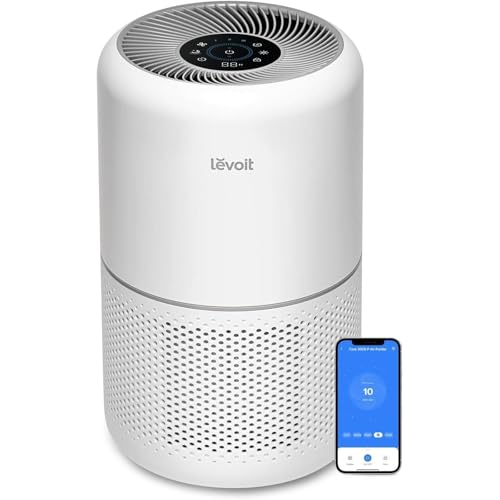
Levoit Core 300S-P — For Bedrooms and Sickrooms
Badge: Best small-room aerosol workhorse
- Filtration: 3-in-1 cartridge with HEPA stage
- Verification: AHAM Verifide room rating on the listing
- Controls: app and voice, auto mode, quiet sleep mode
- Format: compact cylinder for a bedside or desk
The bedroom is where aerosol management matters most in practice — it is where an ill person spends the longest continuous hours, and where a caregiver or partner shares air overnight. The Core 300S-P fits that room: verified ratings, a HEPA cartridge from a brand whose replacements are everywhere, and app control that lets the machine be run hard during the day and checked without entering the room more than necessary. Its sleep mode serves the well person’s side of the bed; its working speeds serve the strategy. Run it continuously, at the highest speed sleep allows, positioned in the room’s circulation rather than in a corner behind furniture.
Strengths
- Verified room rating and widely stocked cartridges
- App control suits sickroom logistics
- Quiet enough for overnight shared rooms
Trade-offs
- Small-room capacity only
- Cartridge replaced as a unit
- No machine at this size changes a large room’s background quickly
Best for: bedrooms, sickrooms, and home offices during illness season. Not suited for: large shared living spaces.

Coway Airmega Mighty — For Shared Living Rooms
Badge: Best family-room capacity with monitoring
- Filtration: HEPA filter with washable pre-filter and carbon stage
- Coverage: rooms up to about 1,748 sq ft on the listing
- Extras: air quality monitor with auto mode
- Warranty: 3 years stated on the listing
The living room is the household’s mixing chamber — the room where the well and the unwell, the children and the grandparents, actually share air for hours. The Mighty’s case is capacity plus feedback: coverage rated for real living spaces, and an air quality monitor that makes the invisible at least partly visible, rising when the room fills and settling as the machine and the ventilation do their work. The monitor measures particles, not virus — a distinction this guide insists on — but as a behavioural tool it is valuable, because it teaches a household what a crowded, sealed evening does to its air and what opening a window achieves.
Strengths
- Living-room capacity with headroom for air changes
- Monitor and auto mode support the layered strategy
- Long filter cycle and warranty for hard seasons
Trade-offs
- No app control
- Monitor reads particles, which must not be mistaken for a virus gauge
- Console size needs a permanent place
Best for: family living rooms and open shared spaces. Not suited for: small bedrooms, where it is more machine than the room needs. The general field is surveyed in the best air purifiers overview.

Medify MA-40 — For Larger Rooms in a Slim Format
Badge: Best tower for big shared rooms
- Filtration: 3-in-1 cartridge with HEPA stage
- Coverage: up to about 1,793 sq ft per hour on the listing
- Format: slim tower
- Options: multi-pack listings for multi-room households
Some households need the strategy in more than one room — a living room and a bedroom, or a classroom-like space where a tutor, carer, or home worker spends the day with others. The MA-40’s tower format and coverage class suit the larger of those rooms, and Medify’s multi-pack listings make the two-room deployment less painful than most. Its operation is manual and honest: set a working speed, leave it there, and let turnover accumulate. In a season when a household member is isolating in one room and the family gathers in another, a machine in each is the configuration the layered strategy actually describes — which is a sentence about rooms and doors, not about any product’s promise.
Strengths
- Large-room coverage in a corner-friendly tower
- Simple, set-and-run operation
- Multi-pack economics for two-room strategies
Trade-offs
- No sensor or app
- Combined cartridge replacement
- Still a supplement to ventilation, never a substitute
Best for: large living rooms and multi-room deployments. Not suited for: anyone seeking a guarantee — no such product exists.
Running the Layered Strategy at Home: A Practical Protocol
Ventilate first. Open windows on opposite sides of the home when weather allows, run extractor fans in kitchens and bathrooms, and treat fresh air as the foundation everything else supplements. During an illness in the house, even a modest, sustained window opening in the sickroom changes the room’s arithmetic more than any appliance setting.
Place the machine where people breathe together. In the shared room, in the circulation, a few feet from seating — not in a hallway hoping to serve two rooms, and not behind the sofa. In the sickroom, place it in the room’s airflow, and remember the caregiver’s exposure is managed by time and distance as much as by any machine.
Run it continuously, at working speed. Aerosol concentration is a balance between emission and removal; a purifier run for an hour in the morning and off by lunch defends a schedule nobody breathes on. During illness in the household, the machine’s job is the whole day, at the highest speed the room tolerates, with sleep mode as the overnight compromise in bedrooms.
Handle used filters sensibly. A filter that has served a sickroom has collected the room’s particle load in concentrated form. Change it outdoors or in a ventilated space, bag it directly into household waste without shaking it out, and wash your hands afterwards — ordinary care, neither alarm nor carelessness. The same applies to vacuuming a pre-filter from a hard-worked machine: do it where the dislodged dust is not returning to the room the machine just cleaned.
Maintain the filter like it matters, because it does. A loaded filter passes less air, and less air is less cleaning. Keep pre-filters clean, respect replacement intervals shortened by hard seasons, and never run the machine with a filter still in its shipping bag — the eternal first check.
Keep the other layers. The ill person resting apart where the home allows, hands washed, surfaces in the sickroom cleaned, visitors postponed kindly — the unglamorous layers carry most of the protective weight, and the purifier’s honest role is to make the air layer of that system as good as a home appliance can make it.
What About UV, Ionizers, and Other “Germ-Killing” Technologies?
Ultraviolet germicidal irradiation is a real technology with a real history in hospitals and water treatment, where engineered systems expose air or surfaces to calculated doses for calculated times. A consumer purifier’s small lamp, past which room air hurries in a fraction of a second, is not that system, and the dose arithmetic is not close. Such lamps may inactivate some fraction of organisms that pass very near them; they do not sterilise a room’s air, and they should never outrank HEPA capacity, CADR, or runtime in a buying decision. If a machine you otherwise want includes UV, treat it as neutral. If a machine’s whole case is UV, keep shopping.
Ionizers occupy a similar position with an added caution: by charging particles so they deposit on surfaces, they move the problem from the air to the furniture, where resuspension and contact continue, and some designs generate ozone as a by-product. For a household whose concern is respiratory health, depositing the room’s particle load onto its surfaces is a strange definition of cleaning. Combination machines whose ion stage can be switched off resolve the dilemma; ion-only devices for this purpose do not survive this guide’s screening.
The technologies that do belong in the conversation are boring: a fan, a sealed HEPA filter, adequate CADR, and a window. Their combined effect on a room’s aerosol concentration is measurable with a particle counter in an afternoon, which is more than can be said for any lamp or ion stage in a consumer cabinet — and measurability, in a subject clouded by fear and marketing, is the quality to buy.
Common Misconceptions, Corrected Plainly
“If the filter catches 0.3 microns and the virus is 0.1, the virus passes through.” The virus travels on larger respiratory particles, and HEPA media is in any case most challenged at 0.3 microns, capturing both larger and smaller particles at equal or better efficiency by diffusion and interception. The premise misunderstands both the transport and the filter.
“A purifier in the hall protects the bedrooms.” Purifiers clean the volume they share. Closed doors isolate rooms almost completely; the machine belongs in the room whose air you are managing.
“The air quality light is green, so the air is safe.” Particle sensors read dust-sized particles, not virus, and a green light certifies only that the room is not dusty. It is a useful behavioural gauge and a meaningless safety certificate.
“Running it for an hour before guests arrive makes the gathering safe.” Pre-running lowers the room’s background, which is worthwhile; the guests then begin emitting and sharing air in real time, and no pre-treatment changes that arithmetic. Gatherings carry the risks they carry; the purifier modestly improves the room’s side of the ledger, and honesty about that is a form of respect for your guests.
“More expensive means more protective.” Protection, insofar as a machine contributes to it, tracks verified HEPA capacity delivered into your room and hours actually run. A modest machine run continuously in the right room outperforms a flagship run occasionally in the wrong one, every time.
Beyond the Home: Classrooms, Offices, Waiting Rooms, and Small Businesses
The same physics scales, and so do the same limits. In classrooms, portable HEPA units became common during the pandemic years precisely because the calculation was favourable: a room full of children breathing together for hours is a far-field aerosol problem, and adding several air changes per hour of filtered air to whatever ventilation the building provides measurably lowers the shared background. School guidance from health authorities treated the units as a supplement to ventilation upgrades, sized by the same CADR arithmetic this guide uses for living rooms — total clean air delivery matched to the room’s volume and occupancy. Offices and waiting rooms follow the identical pattern, with one addition: the machine must be quiet enough at working speed that business tolerates it running, which is a sizing argument again, since headroom buys quiet.
Small businesses — salons, studios, clinics’ waiting areas, cafés — should read the claims table in this article with particular care, because a business that advertises “virus-killing air purification” to customers is making a public claim it cannot support, with regulatory and reputational exposure attached. The defensible statement is the modest one: “we run HEPA air cleaners and ventilate as part of our hygiene practice.” Customers literate in the subject — a growing population — trust the modest statement more, and the immodest one has a way of appearing in screenshots. The layered strategy is not merely better science for a business; it is better communication.
For any shared space, the operating disciplines repeat: machines placed in the occupied volume, run for all occupied hours, filters maintained on a schedule someone owns, and ventilation treated as the foundation. A building manager who wants a single number to manage by can use equivalent air changes — the sum of ventilation and filtration changes per hour — and watch it the way they watch temperature. That framing, borrowed from building science, is the most honest one available: it describes a rate of clean air supply, promises nothing about outcomes, and improves exactly what it says it improves.
Buying During a Scare: Price, Panic, and the Discipline of the Checklist
Demand for purifiers spikes with every respiratory season’s headlines, and the market’s least reputable corner wakes up for exactly those weeks. The defences are the same ones this series teaches for every category, sharpened for urgency. Buy brands whose listings state HEPA filtration and a CADR or verified room size plainly; a crisis is not the moment to discover that a bargain machine’s “HEPA-type” filter is a different, lesser thing. Buy from the brand’s own storefront where possible, because counterfeit and grey-market units circulate most freely when demand surges. Price the replacement filter in the same sitting, and refuse any machine whose filters are already out of stock — in a surge, a purifier without a filter supply is a fan with a deadline. And keep the purchase in proportion: the layered strategy’s other elements — ventilation habits, a thermometer, rest, and time — cost little, and a household that spends its whole budget on a flagship machine while neglecting them has bought the layer out of order.
There is also a timing truth worth stating. A purifier bought calmly in a quiet month — sized properly, filters stocked, placement thought through — protects a household better than a superior machine bought in a panic during the week everyone is already ill, because the strategy’s value compounds over seasons of ordinary use: cleaner background air for the allergy sufferer, less dust for everyone, and a machine already in place, understood, and maintained when it is wanted for the sickroom. The best time to build the air layer of a home’s hygiene is when nobody needs it urgently, which is to say, in the ordinary weeks when guides like this one get read at leisure.
Verify It Yourself: The Particle Counter Test
One reason this subject attracts overclaiming is that air is invisible and trust is cheap. It does not have to stay that way. Inexpensive handheld particle counters, sold for home and hobby use, read the concentration of airborne particles in a room in real time, and a single afternoon with one teaches more than a shelf of marketing. The experiment writes itself: close the room, stir the air with ordinary activity, note the particle count; run the purifier at working speed and watch the count fall over the following hour; open a window and watch ventilation’s contribution join in; cook something in the next room with the door open and watch the count answer. Owners who run this test once stop asking whether their machine “works” in the abstract — they have seen their room’s numbers, know their machine’s rate, and understand viscerally why runtime and door position matter. The counter cannot see virus, and this guide repeats that it measures particles, not safety. But particles are the vehicle, the vehicle is what filtration addresses, and a household that can measure its vehicle traffic is a household that can run the layered strategy with its eyes open.
The test also grades placement claims better than any review. Move the machine to the corner behind the sofa and watch the room’s fall rate slow; return it to the circulation and watch the rate recover. Run it on sleep mode and observe the gentler slope; run it at working speed and see the strategy’s actual pace. Within an hour, the abstract criteria of this article — CADR, placement, runtime — become a set of slopes on a screen that a teenager could interpret. In a category sold on invisible promises, that afternoon of measurement is the closest thing to ground truth a home can buy, and it costs less than a replacement filter for most of the machines in this guide.
Why the “Kill” Claim Persists: A Note on Incentives
It is worth understanding, without cynicism, why the language of killing survives every correction. Filtration is a rate; killing is an event, and events sell. A claim that a machine “reduces aerosol concentration over time as part of a layered strategy” is accurate, and it fits nowhere on a box. Manufacturers also inherit laboratory conventions: a filter medium or a UV stage tested against a virus in a chamber produces a percentage, the percentage is real within its chamber, and the distance between that chamber and your living room is measured in everything this article has discussed — volume, time, continuous emission, human behaviour. Regulators in several countries have pushed back on the boldest consumer claims, and reputable brands have migrated toward the particle language this guide recommends. The reader’s defence is not suspicion of everyone; it is the grading habit from the claims table — ask what was tested, where, and whether infection was ever measured — applied in the thirty seconds before a purchase rather than the thirty days after.
The same literacy protects against the opposite error, which also circulates: the conclusion that because purifiers do not “kill coronavirus,” they do nothing at all. That reading fails the physics in the other direction. The aerosol pathway is real, the capture of aerosol particles by HEPA media is real, and the reduction of a room’s background concentration by continuous filtration is measurable by anyone with a counter and an hour. Between “sterilises your home” and “does nothing” lies the true claim, and it is enough: a well-chosen, well-run purifier makes a shared room’s air measurably cleaner, hour after hour, season after season — for virus-carrying aerosols, for pollen, for dust, for smoke — as one layer in a household’s ordinary care for the people breathing in it.
Households With Higher Stakes: Extra Care, Same Physics
Some readers arrive at this article with more at stake than average — an immunocompromised family member, an elderly parent in the home, a newborn, a household member whose work exposes them daily. The physics does not change for these households, but the diligence should, and this guide addresses them directly because the marketing aimed at them is the least scrupulous in the category. For a higher-stakes home, the layered strategy deserves to be built deliberately and early: ventilation assessed room by room rather than assumed, purifiers sized generously for the rooms where the vulnerable person spends time, filters replaced at the early edge of their intervals, and the whole arrangement discussed with the household’s clinician, who can place air management correctly among the household’s other protective measures. What such households should not do is pay a fear premium for outcome claims — “medical grade,” “virus killing,” “total protection” — because the premium buys adjectives, and the adjectives are not where protection lives. It lives in air changes, in runtime, in maintenance kept when everyone is tired, and in the unglamorous layers this article keeps returning to. A modest machine, correctly sized and faithfully run, inside a deliberate strategy, is the strongest position a home can actually occupy — and it is available at ordinary prices from the brands whose listings state their filtration plainly.
Across the Year: The Strategy’s Seasonal Rhythm
Winter is the strategy’s home season: windows close, heating seals the house, respiratory viruses circulate, and the purifier’s continuous work carries its largest share of the household’s air quality. This is the season to run machines in shared rooms as a default rather than an event, to check filters before the season rather than during it, and to remember that ventilation still matters — a brief, deliberate airing of a room exchanges more air than an hour of closed-window filtration, and the purifier restores the temperature-neutral background afterwards. Spring returns the pollen load, and the same machines pivot to the allergy duty covered in the best air purifiers for allergies guide without changing a single habit — the strategy’s machinery is season-agnostic, which is part of its value. Summer opens the windows and retires the machines to evenings, storms, and smoke days. Autumn is the maintenance hinge: filters inspected, spares ordered, placements reviewed before the sealed months return. A household that adopts this rhythm stops experiencing its purifiers as emergency purchases and starts experiencing them as infrastructure — which, for an appliance whose entire virtue is steady background work, is the correct final form.
Reading a Study Headline Without Being Misled
News coverage of air cleaning research follows a reliable distortion pattern, and a reader armed with three questions can decode any headline in the genre. The first question is what was measured: particle concentration, viral RNA in air samples, viable virus, or actual infections in actual people. These are four different findings of descending frequency and ascending importance, and headlines routinely promote the first into the language of the fourth. The second question is where: a sealed chamber, a test duct, a single classroom, or a community. Chamber results establish possibility; only room-and-people studies establish effect, and they are rarer, messier, and more modest in their conclusions — which is a property of honest research, not a defect in the technology. The third question is compared to what: a purifier against no purifier in a sealed room will shine; a purifier added to good ventilation in a real building shows the smaller, truer increment that households should expect. None of this debunks the underlying strategy — the layered approach in this article is precisely what the careful end of the literature supports — but it calibrates the size of the expectation, and calibrated expectations are what separate a household that maintains its machines for years from one that feels deceived by Christmas and switches them off.
The same three questions, it turns out, grade the product claims in the table earlier in this article, the advice of well-meaning friends, and the copy on the box in your hand. What was measured, where, and against what — a small, portable scepticism that this subject, more than most in the home, richly rewards.
A Note on Words: Clean, Sanitize, Sterilize, Kill
Much of this subject’s confusion is vocabulary wearing a lab coat, so the guide closes its argument with definitions. Cleaning, in air terms, means removing particles and compounds from the air — what filters do, measurably. Sanitizing means reducing microbial levels on a surface or in a defined test to a stated degree — a claim about a procedure, not a room. Sterilizing means the complete elimination of viable microorganisms, a standard achieved by autoclaves and industrial processes, not by anything that sits in a living room corner with a fabric pre-filter. And killing, applied to a virus in a room’s air, promises an event that no consumer appliance performs or measures. When a listing uses the later words for the first process, it is not simplifying for your benefit; it is borrowing authority it has not earned. The brands in this article’s shortlist describe their machines in the first word’s language — filtration, capture, removal — and that restraint, in this of all categories, is a feature to shop for deliberately. A company careful with its verbs is usually careful with its filters.
Finally, a word about the emotional register of this purchase, because it is unlike any other in the home. Nobody buys a toaster frightened. A purifier bought during an illness scare is bought by a household that loves someone and wants to act, and that motive deserves respect rather than exploitation — which is why this guide has been so stubborn about the distance between what these machines demonstrably do and what frightened marketing says they do. The demonstrable part is worth having: measurably cleaner air in the rooms where your people breathe together, maintained hour after hour by a machine that asks little and promises only what physics allows. Buy that, run that, and let the rest of the household’s care — rest, air, cleanliness, time, and professional guidance when it is needed — do what it has always done.
Readers who want the neighbouring questions answered with the same care will find them in this series: the head-to-head of air purifiers vs ionizers for households weighing the two technologies directly, the evidence review behind do ionizer air purifiers work for the claims made about ion stages specifically, and the quiet-first shortlist in the best air purifiers for bedroom guide for the room where most sickroom duty actually happens. Taken together, the four articles share one standard — claims graded by evidence, machines judged by filtration delivered — applied to four different doors into the same subject.
Final Recommendation
Buy the physics, not the promise. If reducing airborne particle concentration in your home is the goal — a reasonable goal, honestly framed — choose a verified HEPA machine sized generously for the room where people share air, run it continuously alongside real ventilation, and hold it to the standard the evidence supports: cleaner air, lower background concentration, one layer among several. The Levoit Core 300S-P serves the bedroom and sickroom, the Coway Mighty the family living room, and the Medify MA-40 the larger shared space; each is presented here for its filtration, its capacity, and its manufacturer’s honesty about what it is. For current health guidance — on isolation, ventilation targets, or anything touching an actual illness in your home — go to your health authorities and your clinician, whose advice this article supplements with appliance literacy and never replaces.
Frequently Asked Questions
Can an air purifier kill the coronavirus?
Not in the sense the phrase implies. A purifier does not sterilise a room or render its air incapable of carrying infection. What a HEPA purifier does is remove virus-carrying respiratory particles from air passing through its filter, reducing the room’s aerosol concentration over time. Some machines add UV or ion stages with laboratory inactivation claims, but no consumer product has demonstrated prevention of infection in real rooms, and health authorities describe air cleaning as one layer in a broader strategy.
Does HEPA filtration capture COVID-19 aerosols?
Yes — the aerosols that carry the virus are mostly larger than the bare virus, and HEPA filters are rated at their most penetrating particle size, capturing both larger and smaller particles at very high efficiency. Air that passes through a true HEPA filter emerges with the overwhelming majority of its virus-carrying particles removed. The limitation is the room: the machine only processes the air that reaches it, at its fan’s rate, which is why sizing, placement, and continuous running decide the real-world effect.
Where should I put a purifier when someone in the house is ill?
Two rooms matter. In the sickroom, place the machine in the room’s circulation to lower the concentration where the ill person rests and where caregivers enter. In the main shared room, place a machine where the rest of the household gathers. Keep doors and ventilation working with the strategy rather than against it, and remember that time and distance remain the caregiver’s primary protections.
How long does a purifier take to clean a room’s air?
It is a rate, not an event. A correctly sized machine delivers several air changes per hour, so the room’s particle concentration falls steadily — substantially within the first hour of continuous running, and maintained for as long as the machine runs. Because occupants continuously emit new particles, the concentration reaches a lower balance point rather than zero. This is why continuous operation at a tolerable speed beats occasional blasts.
Is UV-C in a home purifier worth paying for?
Not as a deciding feature. The doses and exposure times inside consumer cabinets are far below engineered germicidal systems, and any contribution is marginal beside the HEPA stage’s. If a machine you want for its filtration includes UV, it does no harm to the decision; if a machine’s appeal rests mainly on its lamp, the filtration underneath it is usually where the compromise lives.
Should I run a purifier in the room of a child home sick from school?
It is a reasonable part of the household’s response. Place the machine in the child’s room circulation, run it continuously at a comfortable speed, and ventilate the room when you can — the combination lowers the background concentration in the room where the child rests and where parents enter to care for them. Keep the layers in proportion: fluids, rest, and a caregiver’s time and distance do more than any appliance, and a child who wants a parent nearby should get the parent, with the machine as background rather than barrier.
Do purifiers help with other viruses, like flu or colds?
The physics is the same — respiratory viruses generally travel on particles that HEPA filtration captures — and the same limits apply: filtration reduces a room’s aerosol background over time, as one layer among ventilation, hygiene, and rest, and no home purifier is proven to prevent influenza or common colds either. Households that run the strategy for general winter reasons are applying it correctly; households that buy it as a guarantee against any named virus are buying a claim this guide has spent its length correcting.
What else should a household do besides run a purifier?
Ventilate — fresh air is the foundation layer. Keep the ill person resting apart where the home allows, wash hands, clean the sickroom’s high-touch surfaces, and postpone visits kindly. Follow current guidance from your health authorities for anything specific to an illness in progress. The purifier strengthens the air layer of that system; the system, not the appliance, is what protects a household.
Can running a purifier make an indoor gathering completely safe?
No, and any product page suggesting otherwise should be treated with suspicion. A well-sized HEPA purifier can lower the concentration of airborne particles in a single room, which is one layer of risk reduction among several; it does not prevent infection, does not protect someone sitting close to a person who is ill, and does not replace ventilation, staying home when you are unwell, or following current public-health guidance for your area. Think of the gathering question in layers instead: fewer guests, a ventilated room, a shorter visit and a purifier running from before people arrive all help a little, and none of them, alone or combined, turns a risky visit into a guaranteed safe one.

