Disclosure: As an Amazon Associate, umtsmarttool.com earns from qualifying purchases. Links on this page are affiliate links; they cost you nothing extra. Prices and availability change often, so check the current Amazon listing before you buy.
The short answer to do ionizer air purifiers work is: they do something real, measurable, and much less useful than their marketing suggests — and in some designs they do something else as well, something no buyer asked for, which is generate ozone in the very room you breathe in. Ionization genuinely removes particles from the air; that is not in dispute, and this article will show the physics and the evidence fairly. The dispute is about where the particles go (onto your walls, furniture, and lungs’ neighbourhood rather than into a filter), how fast the cleaning happens in a real room (slowly, and slower as the device ages and its needles foul), how the effect compares with a fan and a HEPA filter doing the same job (unfavourably, on speed, completeness, and verifiability), and what rides along with the ions in cheaper or older designs (ozone, a respiratory irritant that air-quality authorities advise against generating in occupied spaces). Work through those four questions and the practical verdict assembles itself: ionization as a sole technology is a poor way to clean air; ionization as a switchable extra inside a real filtration machine is a feature you can safely ignore; and the money an ionizer costs buys, in filtration form, a machine that does the same job better, measurably, and without the footnotes.
A fairness note before the prosecution begins, because this topic attracts absolutists in both directions and both are tiresome. The reputable end of the combination market — machines whose ion stages are engineered to low-emission standards and sit downstream of genuine HEPA and carbon filtration — is not the villain of this article, and nothing here claims that a modern combination unit, run as its maker intends, is dangerous to a healthy adult. The article’s targets are narrower and, it hopes, fairer: the claims made for ionization as a cleaning method in its own right, the standalone ionizers sold as complete air solutions for bedrooms and nurseries, and the unbranded ozone-adjacent devices whose listings use words like “activated oxygen” as though they were virtues rather than warnings. Judge each design by the four questions, and the categories sort themselves.
Judge each design by the four questions — where do the particles go, how fast, compared with what, and what else comes out — and the categories, as promised, sort themselves without any help from this article’s opinions.
Key Takeaways
- Ionizers work by charging particles so they stick to surfaces — the particles leave the air but stay in the room, on walls, furnishings, curtains, and the device itself, rather than being captured in a filter and disposed of with the rubbish.
- Measured cleaning speed for standalone ionizers is slow compared with fan-and-filter machines, and it degrades as emitter points foul with the very particles they attract.
- Some ionizing designs emit ozone; health and air-quality authorities advise against intentionally generating ozone in occupied spaces, which is why this guide’s rule is filtration first and ion stages off or absent.
- Combination machines from reputable brands manage emissions to published standards and let you disable the stage — buy those if you want the feature, and run the stage off in bedrooms and pet rooms.
- For the price of a standalone ionizer, a verified HEPA machine cleans faster, captures rather than relocates, and publishes numbers a third party has tested.
In this guide
How Ionization Actually Works (the Physics, Fairly Stated)
An ionizer, stripped of its cabinet and its adjectives, contains emitter points or wires held at high voltage — in essence, a controlled way of making air itself electrically sticky. Air passing near them acquires ions — molecules carrying an electrical charge — and those ions drift, attach to airborne particles, and charge them in turn, like static gathering on a balloon rubbed against a jumper. A charged particle is attracted to anything at a different electrical potential: the room’s walls, ceiling, furniture, curtains, bookshelves, the device’s own collection surfaces if it has been given any, and, relevantly, the surfaces of your respiratory tract during the time it remains airborne. Over time — the timescale matters, and the next section will weigh it — charged particles deposit out of the air, and the air’s particle count genuinely falls. That is the whole mechanism, and it is real physics, demonstrated in laboratories for the better part of a century.
Notice — because everything in this article follows from it — what the mechanism does not include: a destination the owner controls, empties, or throws away. A filter is a trap with an address — the particles accumulate in a cartridge you remove, bag, and replace on a Saturday morning, and the room is rid of them, permanently and verifiably. Ionization’s destination is the room itself, distributed across every surface it contains, from where ordinary life steadily re-aerosolises a share of it — a curtain shaken, a cushion sat on, a rug vacuumed, a child running a hand along a wall and then rubbing an eye. The cleaning is therefore best described, in the plainest available words, as relocation with losses — and the losses include, with a certain poetic injustice, the surfaces least convenient to wash. None of this makes the technology fraudulent, and this article has been careful not to call it so; it makes it inferior, in a specific and describable way, to capture — inferior in the way a broom is inferior to a vacuum cleaner, honestly and by design. When a listing says an ionizer “removes particles from the air,” it is telling the truth — the narrow, lawyerly, incomplete truth — and omitting the address to which they were removed, which happens to be your home.
The Evidence: Speed, Completeness, and the Fouling Problem
Tested side by side, in furnished rooms rather than in chambers, the practical gap is rate — and it is not a small gap dressed as a large one, but a large one that marketing works hard to dress as small. A fan-and-filter machine processes a room’s entire air volume repeatedly per hour — its CADR is literally a measurement of that throughput, performed by laboratories and published for comparison — and drives particle counts down on a timescale of tens of minutes, audibly, visibly, measurably. A standalone ionizer has no fan worth the name; it depends on room air wandering past its emitters of its own accord and on charged particles finding surfaces by drift and attraction, a process measured in hours for the same reduction — and weaker in large rooms, in still air, behind furniture, and at any honest distance from the device. Independent comparative testing over the years, in publications with no stake in either technology, has repeatedly found the same unglamorous pattern: ionizers reduce particle counts, slowly and partially, while comparably priced HEPA machines reduce them faster, further, and with the evidence left in a filter for anyone to inspect. There is also a maintenance decay unique to the technology, and it is quietly damning: emitter points accumulate a crust of the very particles they charge, insulating the tips the ions come from, so the device’s output — invisible, silent, and unmeasured by any instrument the owner owns — declines steadily between cleanings that many owners never learn they were supposed to perform, on a schedule printed, if anywhere, in a manual nobody kept.
The completeness question cuts deeper than the speed question, and it is the one the demonstrations never stage. The particles an ionizer handles worst are, by the physics of charging and deposition, among those that linger longest airborne; and the ultrafine fraction — the smallest particles, which penetrate deepest into the lung and matter most to health — are the least impressed by a technology whose capture depends on surfaces eventually, perhaps, encountered. A HEPA filter’s indifference is its virtue here: whatever the fan delivers, the maze stops — at the rated efficiency, on the first pass and on every pass, without opinion, without fatigue, and without caring whether the particle arrived charged, neutral, or accompanied by a marketing department. Filtration’s evidence is also simply easier to check, by orders of magnitude: AHAM publishes verified CADR figures for fan machines, tested to a standard anyone can read, while standalone ionizers largely ask — politely, silently, and indefinitely — to be trusted. In a category where trust has been marketed this hard, for this long, verifiability is not a bureaucratic nicety; it is the entire difference between a measurement and a mood — between buying a result and buying a feeling about a result.
There is a coda to the evidence section that deserves its own paragraph, because it explains the confidence gap between the two technologies’ owners. A filtration machine’s work is inspectable: open it at filter-change time and the captured load is there, grey and undeniable, a physical audit of every claim the listing made. An ionizer’s work product is dispersed across the room in a film too thin to audit on any single surface, which means its owner can never actually verify the purchase — they can only believe it, or stop believing it. Technologies that cannot be audited drift toward faith, and faith drifts toward marketing. The deepest argument for capture is not even its superior rate; it is that capture can be checked, by anyone, with a screwdriver and a pair of eyes, and a household technology that invites checking is a technology that expects to survive it.
One more piece of the evidence deserves air, because it is the piece owners can feel: the distance effect. A filtration machine’s influence fills its room because it moves the room’s air through itself; an ionizer’s influence is strongest within a short radius of its emitters and fades across a furnished room, so the air at the device can test cleaner while the air at the bed, the desk, or the crib — the coordinates that matter — is barely treated at all. Demonstrations are invariably staged at the device. Life is lived at the coordinates. When a technology’s benefits concentrate where nobody breathes, the correct response is not outrage but a tape measure, and the tape measure’s verdict is in this article’s first paragraph.
The Ozone Question, Without Hysteria and Without Amnesia
High-voltage discharge in air can split oxygen molecules, and the fragments can recombine as ozone — O3 — a gas that is a respiratory irritant at ground level, in the breathing zone, however protective the same molecule is in the stratosphere, where nobody breathes. How much ozone a given ionizing device emits varies enormously — by orders of magnitude — by design: engineered combination machines from reputable brands are built and certified to keep emissions very low; older designs, dedicated ozone generators marketed for “shock treatments,” and unbranded units of no documented provenance can emit amounts that no one should breathe deliberately, or at all. Air-quality and health authorities’ position, across agencies and across decades, is consistent and worth quoting in substance: ozone is a lung irritant, devices that intentionally generate it should not be used in occupied spaces, and “air cleaning” is not — under any framing, at any concentration claimed to be beneficial — a justification for adding a pollutant to indoor air.
The consumer translation is a three-part rule that this series applies everywhere, without exception for branding, pricing, or the lateness of the hour at which the listing is being read. One: never buy a device whose selling point is ozone, “activated oxygen,” or similar chemistry performed, uninvited, on your room’s air. Two: if a combination machine includes an ion or plasma stage, buy only the kind that can be switched off entirely, and run it off — the filters were doing the measurable work anyway, and will go on doing it in the stage’s absence. Three: treat any unbranded ionizer with no emissions documentation as disqualified from your home, whatever its price, its promises, or the enthusiasm of its review section. The are air purifiers safe for pets guide applies the same rule with animals in the house, where the caution doubles for creatures that cannot report what the air feels like, and the air purifiers vs ionizers comparison scores the two technologies across every criterion, side by side, with the receipts.
Why Ionizers Sell Anyway: The Honest Attractions
A fair article must also explain the technology’s genuine appeal, in its strongest form, because owners are not fools and the attractions — examined one by one below — are real, even where they do not survive as arguments. Ionizers are silent — no fan, no rush of air, no hum worth the name — and for the noise-sensitive buyer that silence is not a gimmick or a garnish but the whole brief, honestly held. They consume very little power, sipping where a fan machine merely sips slightly faster. Many have no filter to replace, which reads — seductively, at midnight, in a listing — as freedom from the consumable treadmill this series spends so much of its time pricing. And the sensation they produce is genuinely seductive: air near an ionizer feels different, crisper, the way air after a thunderstorm is said to feel, and a perceptible difference is easily — almost designedly — mistaken for a measured one. Each attraction survives scrutiny as a fact — the article concedes them all — and fails, one by one, as an argument for cleaning a room. Silence, or near enough, is available from filtration machines at their sleep speeds — with actual cleaning attached. Low power is simply the natural wage of doing less work. The absent filter is the absent destination — the particles are still collected, by your walls. And the thunderstorm feeling is an effect on the perceiver, not a report on the particles. Bought knowingly for silence in a low-stakes room, an ionizer is a defensible eccentricity; bought as a home’s air defence, it is the wrong tool wearing a lab coat.
What to Buy Instead: Filtration That Answers the Same Needs
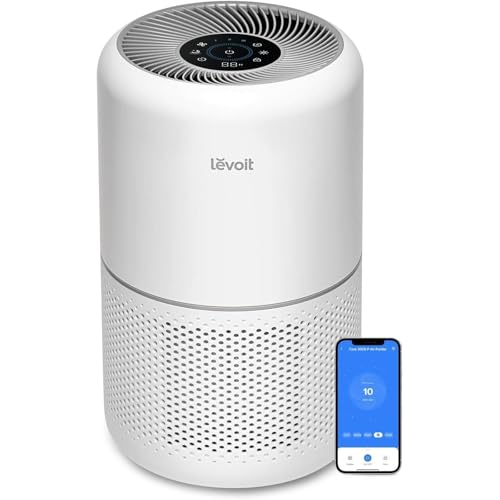
Levoit Core 300S-P — The Filtration Answer at an Ionizer’s Price Class
Badge: Best direct alternative
- Technology: filtration only — 3-in-1 cartridge with HEPA stage
- Verification: AHAM Verifide rating on the listing
- Sleep mode: listed at 24 dB — silence’s honest version
- Controls: app, auto mode, air-quality sensing
Put beside a standalone ionizer, the Core 300S-P is the comparison this article exists to make: verified particle removal at a tested rate, capture into a disposable cartridge instead of relocation onto your walls, a sleep mode quiet enough to answer the silence argument, and a sensor that shows the room’s condition rather than asking you to feel it. It emits nothing, charges nothing, and publishes its numbers. For the bedroom — the room where ionizers are most often bought and where their weaknesses matter most — it is not a close contest.
Strengths
- Verified, rapid, capture-based cleaning
- Quiet enough for the silence brief
- Deep, affordable filter ecosystem
Trade-offs
- Filters are a recurring cost — the price of a destination
- Fan is audible at working speeds above sleep mode
- Light carbon stage
Best for: bedrooms and any room where cleaning must be real. Not suited for: buyers whose absolute requirement is zero moving air at any cleaning rate. See the best air purifiers and the best hepa air purifiers roundup for the wider field.

Winix 5510 — The Combination Machine, Done Responsibly
Badge: Best if you want the ion stage available
- Filtration: True HEPA plus separate high-deodorization carbon filter
- Ion stage: PlasmaWave — fully switchable
- Pre-filter: washable
- Coverage: large rooms on the listing
The 5510 is this article’s exhibit for the defence: a machine whose substance is filtration of the first rank — deep carbon, true HEPA, washable pre-filter — and whose PlasmaWave stage sits where ion stages belong, as an optional garnish under the owner’s control. This guide’s advice stands: run it off, and the machine loses nothing measurable. But the household that wants the option owns it in its most responsibly engineered form, from a brand that publishes its design rather than hiding behind a trademark’s fog.
Strengths
- Filtration strong enough that the ion stage is irrelevant
- Stage can be disabled completely
- Deep carbon for odor — work ionizers cannot do at all
Trade-offs
- Premium filters to maintain
- Large cabinet
- The switch discipline is the owner’s responsibility
Best for: large rooms, odor loads, and buyers who want every option engineered properly. Not suited for: the smallest rooms or budgets. Its odor credentials are graded in the do air purifiers help with bad smells guide.
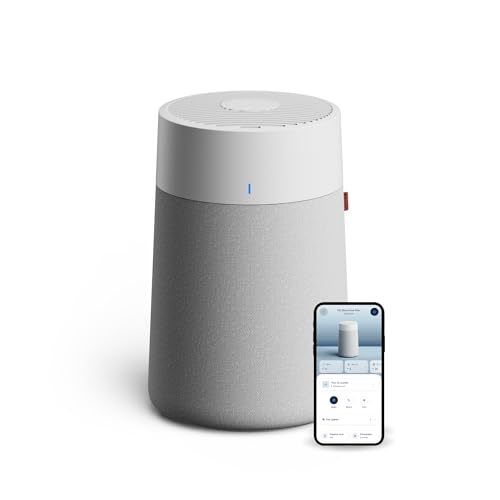
Blueair Blue Pure 511i Max — The Electrostatic Middle Path
Badge: Best quiet filtration with an electrostatic assist
- Filtration: HEPASilent — particles charged and captured inside the machine’s filter
- Noise: night mode listed at 19 dB
- Coverage: rooms up to about 1,138 sq ft on the listing
- Controls: app, auto mode, 360-degree intake
Blueair’s design answers the ionizer debate with an engineer’s compromise: use charge, yes — but use it inside the cabinet, to help a filter capture particles at lower resistance and therefore lower noise, rather than releasing charge into the room and letting the furniture finish the job. The destination problem is solved by construction, and the result is among the quietest real cleaning available. Owners whose attraction to ionizers was always really an attraction to silence should audition this machine before concluding that silence requires surrendering the filter.
Strengths
- Charge used for capture, not relocation
- Exceptional quiet at night settings
- Strong verified-class performance
Trade-offs
- Premium pricing and filters
- Combined filter’s carbon is light-gas class
- Design philosophy needs a paragraph to explain — this one
Best for: light sleepers, bedrooms, and the silence-motivated. Not suited for: heavy odor duty.
The Home Test: Measuring Your Ionizer Without Instruments
Scepticism is cheap in both directions, so here is a test any owner can run with a shelf, a lamp, and a fortnight. Clean a horizontal surface in the ionizer’s room and photograph it in raking light. Run the device as you normally do for a week, living normally. Photograph the same surface in the same light. Now the control, which is what makes it a test rather than an impression: repeat the week with the device unplugged, same room, same life. Compare the two films of dust. Owners of effective cleaning — of any technology — see a difference a camera can catch; owners of standalone ionizers commonly see two photographs that could be swapped without detection, because deposition onto every surface in the room includes the test shelf, which the device has been diligently using as one of its collection plates. The same fortnight with a HEPA machine in the room produces the control week’s opposite: a shelf that stays visibly cleaner, because the particles went into a cartridge instead of onto the furniture. It is not a laboratory protocol. It is better, for a buying decision: it is your room, your dust, and your week, and it has ended more arguments in this category than any specification sheet.
Why the Idea Keeps Coming Back: A Short, Sympathetic History
Ionization’s persistence in the market is not a conspiracy; it is a romance with real roots. The observation that charged air feels fresher descends from genuine phenomena — the air near waterfalls and after storms carries ion populations that people have praised for centuries — and twentieth-century engineering kept rediscovering the deposition effect and announcing it, each time, as filtration without the filter. The pattern of the announcements is instructive: early enthusiasm, impressive demonstrations in small sealed chambers, quieter results in furnished rooms at household scale, regulatory attention when ozone entered the story, and a retreat to combination machines where the stage became a feature rather than the foundation. The technology’s modern, respectable form — a switchable extra inside a real filter machine, or Blueair’s charge-inside-the-cabinet design — is what a century of that cycle converged on. Standalone ionizers persist at the market’s edge because the romance is renewable and the entry cost is low. Readers who understand the cycle can watch the next revival with affection and keep their money in the filter aisle, where the particles are not merely moved but gone.
Reading an Ionizer Listing: The Translation Table
Listings in this corner of the market speak a dialect, and a phrase-by-phrase translation is the cheapest protection a shopper can carry. “Filterless technology” translates as: the room is the filter. “Negative ions freshen the air” translates as: an effect on perception is being sold as an effect on particles. “Covers up to [a very large area]” translates, for a fanless device, as: ions were detected at that distance in a test chamber, which is not the same as air being cleaned there. “Activated oxygen” and “energised air” translate as: ozone is present in this story, and its presence is being marketed rather than minimised — walk away. “No ozone,” by contrast, from a documented brand with a certification to point at, is a claim of the respectable kind; from an anonymous listing with nothing behind it, it is a claim of the other kind. “Whisper quiet” is the one phrase that translates literally — silence is the technology’s true specification — followed by the question the listing hopes you will not ask: quiet, and cleaning at what rate? A shopper armed with the translations will find the shelf sorts itself in minutes, into combination machines whose filters do the work, and standalone devices whose adjectives do.
The Special Cases Where the Answer Softens
Intellectual honesty requires the exceptions to be stated as carefully as the rule. In a large, low-occupancy, low-stakes space — a garage workshop whose dust is an annoyance rather than a health brief, a holiday cabin used six weekends a year — a standalone ionizer’s slow deposition is not nothing, and its silence and indifference to filters are genuine conveniences where no one’s lungs are depending on the outcome. In combination with open windows and low expectations, it can take the edge off a room’s dust between visits. What the exceptions share is the absence of a deadline and a diagnosis: nobody is allergic in the cabin, nobody sleeps nightly in the workshop, and the air’s improvement is a nicety rather than a need. The moment a room acquires a sleeper, a symptom, or a standard, the exception expires and the rule — capture, verified, at a rate — resumes its authority. Technologies, like medicines, are judged by their indications; ionization’s are narrow, and this article’s complaint has never been with the narrowness, only with the marketing that prescribes it for everything.
And a word of genuine sympathy for the reader who bought an ionizer in good faith and has arrived at this article mid-ownership, because the category’s marketing is engineered by professionals and aimed at exactly the hopes — silence, simplicity, no filters to feed — that reasonable people hold. The settlement section below is written for you, without a syllable of reproach: the device can be demoted rather than denounced, its remaining service extracted where its weaknesses cost least, and its replacement, when the day comes, chosen from the capture side of the aisle with the home test as your instrument. Being sold a relocation and calling it removal is the market’s failure. It does not have to be the household’s, twice.
If You Already Own an Ionizer: The Pragmatic Settlement
Ownership is not a verdict on the owner, and a standalone ionizer in the house is not an emergency. The pragmatic settlement runs as follows. Do not run it in a child’s bedroom, a pet’s room, or any room where someone with asthma sleeps — those rooms deserve filtration’s certainty. Clean its emitter points on the manufacturer’s schedule, since a fouled ionizer is an ionizer in name only. Use it, if you use it, where its weaknesses cost least: a low-traffic room, a mild dust problem, an occupant who values its silence with open eyes. And when it is replaced — by age, by doubt, by a dust test that convicts the room it served — replace it with capture. The technology had a fair hearing in your home; the evidence there, as everywhere, is allowed to be final.
The article should also answer the question behind the question, because many readers arrive here not shopping but checking — a device already humming in the corner, a gift already given, a claim already repeated at a dinner party. What they want is a verdict they can repeat, and here it is in one breath, suitable for quotation: ionizers move particles from the air to the room, slowly; filters move them from the air to a bin, quickly; and any device that cleans by adding a gas to your air has the argument backwards. Everything else in these pages is the working shown. Keep the sentence, and the next conversation — with a salesperson, a relative, or a listing at midnight — is already settled.
Finally, let the article close its evidence with the consideration that quietly decides most real purchases: the child’s bedroom test. Every technology in this series is ultimately auditioned for the rooms where the household’s most vulnerable sleepers spend their nights, and a technology is entitled to be judged by whether a careful parent, fully informed, would choose it there over the alternative. Informed parents, in overwhelming practice, choose the machine whose work can be opened and inspected, whose emissions are nothing, whose rate is published, and whose failure mode is a dirty filter rather than a dirty wall. Ionization had a century to win that room. The filter won it. The rest of the house is merely the same argument at lower stakes, and it resolves the same way.
And because this guide’s readers include the practically minded, who will ask what all of this means at the checkout and nothing more, here is the shopping residue of six sections of physics: if the listing’s hero is a filter — named, rated, replaceable, and priced — proceed; if the listing’s hero is a stage, a wave, a plasma, or a trademarked breeze, look for the filter behind it, and price the machine as though the hero did not exist. Combination machines survive that pricing easily, because their filters are genuinely their substance. Standalone ionizers do not survive it at all, because priced without their hero they are a high-voltage needle in a plastic shell, competing against fans and HEPA media at the same money. The market, read this way, is not confusing at all. It is two products sharing a shelf and a vocabulary, and the vocabulary is the only thing they share.
The guide’s last word on method, offered to the reader who will meet this technology again under a new trademark in eighteen months — for it will return, as it has returned for a century, wearing the season’s vocabulary: ask the four questions of the new arrival exactly as they were asked here. Where do the particles go? How fast, in a furnished room, at the bed rather than at the box? Compared with a fan and a filter at the same price, measured by whom? And what else, precisely, comes out of it into the air of the room? A technology that answers those four cleanly deserves its hearing, whatever its name. One that answers them with weather metaphors and thunderstorm poetry has answered them already.
It is also only fair to record where the smart money in the industry has placed its own bet, because manufacturers vote with their product lines more honestly than with their brochures. Across the reputable market, the direction of travel for a decade has been unambiguous: bigger filters, deeper carbon, verified CADR figures printed on the box, and ion stages shrinking to optional extras, disappearing entirely from flagship lines, or retreating inside the cabinet in Blueair’s manner — everywhere, in short, except the marketing headline, where they linger for their romance. An industry does not quietly demote a technology it believes in. The demotion is the review, written by the people who build the machines, and it agrees with this article’s.
So the article’s answer, fully assembled, is a sentence with a semicolon in it — which is the correct punctuation for this technology. Ionizers work, in the narrow sense that charged particles do deposit out of air; they do not work well enough, fast enough, verifiably enough, or cleanly enough to be a household’s air strategy in a world where a fan and a HEPA filter exist at the same price. Readers who remember nothing else should remember the destination test, because it cannot be spun: ask of any air cleaner, in any shop, in any decade, where the dirt goes. If the answer is a cartridge, buy with confidence. If the answer is a poem, keep walking.
One more fairness entry for the ledger, because the prosecution has had the floor for some time: in a sealed test chamber, with hours to work and no furniture to forgive, a good ionizer’s particle graph bends down in a way no honest observer can deny, and the engineers who built the category were not charlatans — they were optimists about scale. The chamber is where the technology’s promises are all true. The furnished, occupied, draughty, lived-in room is where they go to be audited, and the audit’s findings — slow, partial, relocated, unauditable — are this article’s. A technology should be sold for the room it will serve, not the chamber it was demonstrated in, and the distance between those two rooms is the precise width of this article’s disagreement with the ionizer shelf.
And the guide will leave its readers with the home test rather than with its own authority, because that is the settlement this whole series believes in: your shelf, your fortnight, your photographs. Run it on any technology that asks for your money — ionizer today, whatever trademark arrives tomorrow — and let the dust, which has no affiliate programme and no quarterly targets, deliver the verdict. It has been delivering verdicts on air-cleaning claims since long before there were claims, settling on every surface in every home, entirely indifferent to adjectives. Dust is the honest critic. Give it a clean shelf and a week, and read what it writes.
Print the destination test, if anything from this article is printed, and keep it with the household’s other instruments of scepticism — the three-year cost test, the doorway nose test, the shelf test — because together they form a small, complete philosophy of buying air equipment: ask where the dirt goes, what the whole ownership costs, what your own nose reports, and what your own shelf shows. A marketplace that can survive those four questions deserves your money. The ionizer shelf, examined by them, mostly does not — and the filter aisle, examined by the same four, mostly does. That asymmetry, and not any romance about technology, is the entire basis of this article’s recommendation.
One closing observation about language, since this article has spent so much of its length translating it: notice that filtration’s vocabulary is nouns — filter, cartridge, rating, replacement — while ionization’s is weather — waves, breezes, freshness, energy. Nouns can be weighed, priced, warranted, and thrown away; weather can only be experienced and described. A shopper who sorts listings by their grammar will rarely go wrong in this category, because the grammar is the engineering, disclosed in advance by the copywriter’s own hand. Buy the nouns. Let the weather take care of itself, as it always has, outdoors.
And so, at the end of the evidence, the article can afford to be brief about its own conclusion, because the conclusion was never really in the gift of rhetoric: it sits in a filter, grey with a season of captured air, in the homes of everyone who chose capture. Ionization asked to be believed. Filtration asked to be opened. Between a technology that requests faith and a technology that submits to inspection, a household does not need an article to choose — it needs only to be reminded that the choice exists, and that the quiet box with the cartridge in it, humming in the corner of a million bedrooms, is what the reminder looks like when it is plugged in.
Let the last evidentiary word belong to the humblest instrument in this entire series: the white glove, or its domestic equivalent, the damp white cloth drawn along the top of a wardrobe in a room each technology has served for a season. In the filtration room, the cloth comes away with the room’s ordinary, declining dust — the background of a home whose particles are being intercepted. In the ionization room, the cloth tells the relocation story in a single stroke. No laboratory will publish the glove test, and no manufacturer will stage it, which is rather the point: it is the one comparison in this category that cannot be sponsored, and it agrees, as uncontrolled evidence so often does, with everything the controlled kind has been saying for years.
And if a reader finishes this article still fond of their ionizer — still attached to its silence, its simplicity, its weather-like presence in the corner — the article’s parting position is respect, of a specific kind: fondness is a reason to keep a thing, provided the thing is not also being trusted with a job it cannot do. Keep the ionizer as one keeps a houseplant, for the pleasure of its company and the feeling of its air. Feed the bedroom’s actual air to a filter. Households are allowed both pleasures; what they are not allowed, by physics, is to confuse them — and confusing them, in the end, was the only error this long article ever accused anyone of.
The article can rest its case there — on a cloth, a shelf, a cartridge, and a question about destinations — and it does, with one last acknowledgement: technologies are not moral categories, and the fan-and-filter box has no virtue beyond doing the job it is sold for, verifiably, in the open. That, in the end, is all this guide has ever asked of any appliance, and all it asks of its readers: buy the ones that can show their work.
Keep the four questions, then, and the destination test that summarises them, and the next decade’s worth of ionic revivals — for they will come, dressed in new materials and newer trademarks, promising filtration without the filter as their grandfathers did — will find you exactly as this article leaves you: courteous, curious, and entirely unpersuaded, with your money where the particles can be thrown away.
Final Recommendation
Do ionizer air purifiers work? They charge particles, and charged particles deposit — slowly, incompletely, onto the room itself, with an ozone question attached to the cheaper end of the market. Against that record, filtration is not merely the safer recommendation but the more effective one on every axis a buyer can measure: speed, completeness, capture, verification. Choose the Levoit Core 300S-P for the straightforward bedroom answer, the Winix 5510 if you want the ion option engineered responsibly and switched off, and the Blueair 511i Max if silence was the attraction all along. Clean air should end up in a filter you can throw away — not on the walls of the room you cleaned it from.
Frequently Asked Questions
Why do hotels and offices use ionizers if filtration is better?
Some installed systems use ionization inside ductwork, where the context differs entirely: air is moving fast, residence and maintenance are professional, emissions are engineered and monitored, and the goal includes keeping coils and ducts cleaner across a building. That industrial use is not evidence about a fanless box in a bedroom, any more than a hospital’s steriliser is evidence for a kitchen gadget. Scale, supervision, and purpose are the differences, and they are decisive ones.
Can I use an ionizer and a HEPA purifier together?
You can, and the pairing reveals the hierarchy neatly: the HEPA machine will do essentially all of the measurable cleaning, and the ionizer’s marginal contribution will be undetectable beside it. If the ionizer is a stage inside the same reputable machine, the sensible setting is off. If it is a separate device, the electricity is better spent on the filter machine’s next speed. Redundancy is harmless here except to the wallet and, at the ozone-emitting end, to the air.
Are ionizers bad for your health?
The concern is specific rather than general: ozone. Designs that emit meaningful ozone into occupied rooms are a genuine respiratory irritant risk, which is why authorities advise against ozone-generating devices indoors and why unbranded ionizers with no emissions documentation deserve refusal. Engineered combination machines keep emissions very low and let you disable the stage. The particles-relocation issue is a cleaning-quality problem more than a health one — but on both counts, filtration is the cleaner answer.
Do ionizers remove dust as well as HEPA purifiers?
No — measurably slower and less completely in real rooms, and with the dust relocated to the room’s surfaces rather than captured. A HEPA machine’s verified CADR describes a rate of actual removal into a filter; an ionizer’s deposition depends on air movement, distance, and surface availability, and degrades as its emitters foul. For a dust problem with a deadline — allergies, a nursery, a guest arriving — the fan and filter are the instruments that answer.
What is the black staining I see near my ionizer?
It is the technology’s signature, made visible: charged particles deposit preferentially on nearby surfaces, and the accumulated film of dust and soot-dark particles around a long-run ionizer is the relocation mechanism’s own demonstration. Owners sometimes report the same filming on walls and curtains across the room. It is not a malfunction; it is the cleaning, happening to your paintwork instead of to a filter.
Is PlasmaWave / ionic technology in big-brand machines the same thing?
Related physics, different engineering and different context. In a reputable combination machine the stage is one element inside a system whose real work is done by HEPA and carbon filters, its emissions are engineered and documented to low levels, and it can be switched off — which is this guide’s standing advice. That is a different purchase from a standalone ionizer asking the stage to be the whole system, and the two should never be priced or trusted as equivalents.
Can an ionizer help with smells or viruses?
Odor molecules are gases, and ionization is not a meaningful odor technology — carbon is, and no ion stage substitutes for it. On microbes, this guide keeps to its standing discipline: capturing particles — including some of the particles microbes travel on — is a modest physical effect that filtration performs measurably, while claims beyond that belong to regulators and laboratories, not to listings. Buy for particles and odor, with the technologies that provably do those jobs.
Should I throw away my ionizer?
Not necessarily in a panic, and not in a bin if it can be retired responsibly — but do demote it. Move it out of bedrooms and away from children, pets, and anyone with respiratory sensitivities; keep its emitters clean if you run it at all; and plan its replacement as a filtration machine when budget allows. The settlement this article recommends is demotion now, capture at replacement — with no new standalone ionizers joining the household in between.
Why do ionizers look so effective in small demonstration chambers?
Because a small, sealed chamber flatters the technology in ways a lived-in room does not. In a tiny box of still air, charged particles have only a short distance to travel before they meet a wall or settle, so visible smoke clears quickly and dramatically. A real room adds volume, doorways, soft furnishings, people moving and new particles arriving constantly, and the settled dust has not been captured at all; it is resting on surfaces, ready to be stirred back into the air. Demonstrations also rarely measure what else the device produced while it worked. Judge any ionizer by independently tested clean-air delivery for a stated room size, not by how fast a desktop box of smoke appears to empty.

