Disclosure: As an Amazon Associate, umtsmarttool.com earns from qualifying purchases. Links to Amazon on this page are affiliate links; they cost you nothing extra. Prices and availability change often, so check the current Amazon listing before you buy.
Where to buy
Short on time? Start with the Thrive — the most complete renter kit at this tier — then read on for the lighter, simpler and longer-cabled alternatives.
- Thrive Roadside Emergency Car Kit, 104-Piece — Check on Amazon
- Lifeline AAA Premium Road Kit, 42-Piece (4330AAA) — Check on Amazon
- LIANXIN Roadside Assistance Emergency Kit, 142-Piece — Check on Amazon
- HAIPHAIK Car Emergency Kit, 124-Piece — Check on Amazon
- EVERLIT Survival Car Emergency Kit — prose-only step-up; the inflator kit, for renters whose car has no spare and whose landlord’s lot has no mercy
- Swiss Safe 2-in-1 Car Emergency Kit — prose-only step-up; the first aid system whose mini kit serves the flat as well as the car
Read the full guide ↓
Searching for the best car emergency kit for renters under $50 is where this cluster’s renter story turns generous. Under $30, as our Best Car Emergency Kit For Renters Under $30 guide explains, the renter is assembling compromises — tool-led kits, flagged gaps, a micro-kit built by hand. Under $50, the compromises end: documented jumper cables with stated gauges, first aid genuinely included, an organized layout a landlord’s borrowed driveway can be worked from, and cases sized for hall cupboards and small boots alike. The renter’s constraints do not change at this tier — no garage, no driveway rights, shared or street parking, a deposit that punishes improvisation, and a car that may itself be rented or shared — but for the first time the budget answers all of them at once. What remains is choosing which renter you are, because the four linked picks divide cleanly by renter type, and the wrong match wastes the tier’s generosity.
The Thrive is the default renter: complete, organized, equally at home in a boot and a bedsit, with guidance materials that assume nothing. The Lifeline is the minimalist renter’s kit — the smallest claim on rented storage in this guide, a hard case a hallway cannot hurt, and printed guidance behind an assistance membership. The LIANXIN is the practical renter’s dividend: a tool box that earns its keep in a flat where every repair is a negotiation with a landlord, plus the snow shovel and blanket that serve a rented winter as readily as a car. The HAIPHAIK is the street-parking renter’s answer: 11.8 feet of cable for the angles shared lots impose, and a vest for the walk back along the kerb. The two prose-only step-ups mark the upgrades: the EVERLIT, when the car has no spare and the lot has no room to change one anyway, and the Swiss Safe, when the flat’s medical shelf is as empty as the car’s boot.
This is a research-led guide — manufacturer manuals, retailer contents lists, independent roundups — and it grades renters’ kits on renter evidence: weight and footprint against rented storage, cable reach against shared-lot geometry, contents against the deposit’s prohibitions, and documentation quality above all, because a renter cannot audit what a listing will not state. Where documentation disagrees with itself — the tool-led pair’s cable gauges, their unspecified first aid — the disagreement is printed in the review rather than left to be discovered in a car park.
In this guide
Quick Picks
| Pick | Badge | Key spec |
|---|---|---|
| Thrive Roadside Emergency Car Kit, 104-Piece | Best for Renters | 8 ft 8-gauge jumper cables, 66-piece first aid kit, escape hammer, organized canvas case |
| Lifeline AAA Premium Road Kit, 42-Piece | Best for Small Storage | 8 ft 8-gauge booster cables, hard-shell EVA case, aluminum flashlight |
| LIANXIN Roadside Assistance Emergency Kit, 142-Piece | Best Flat Dividend | 8.2 ft jumper cables, tool box, snow shovel, emergency blanket |
| HAIPHAIK Car Emergency Kit, 124-Piece | Best for Street Parking | 11.8 ft jumper cables, 16-piece tool box, folding shovel |
| EVERLIT Survival Car Emergency Kit | Best No-Spare Step-Up | 12 ft 8-gauge cables, digital inflator, 108-piece first aid |
| Swiss Safe 2-in-1 Car Emergency Kit | Best Flat-and-Car First Aid Step-Up | 12 ft cables, hardcase first aid kit, detachable mini kit |
How These Picks Were Chosen
The renter filter ran first. Every pick had to store in rented space without resentment — a hall cupboard, a boot corner, the top of a wardrobe — travel between flat and car in one hand, and contain nothing a tenancy prohibits: no fuel, no loose blades outside a case, nothing that stains or leaks. Weight counted double, because a renter’s kit is carried through other people’s hallways and up other people’s stairs, and a kit that is annoying to carry will be left behind on exactly the trips it was bought for.
The roadside filter was the tier’s standard: stated cable length and gauge where sources allow, a visibility item, first aid genuinely included or honestly flagged, an escape tool where documented. Cable reach was weighted above the tier’s norm, because shared lots and street rows are the renter’s native geometry and they punish short cables more reliably than any driveway does.
The final filter was the deposit test: could this kit be used, fully, in a landlord’s car park at midnight without risking a claim — no fluids, no damage, no trace? Every pick passes, though the tool-led pair pass with their first aid additions noted. A renter’s kit that endangers the deposit is a liability wearing a hi-vis vest, and none is recommended here.
The 6 Best Car Emergency Kits for Renters Under $50

Thrive Roadside Emergency Car Kit, 104-Piece — Best for Renters
The Thrive is the renter default at this tier because it is the only pick that answers every renter constraint without a footnote. Its 104 pieces — 8-foot 8-gauge jumper cables, a 66-piece first aid kit, an escape hammer, a reflective vest and triangle, a distress sign, a 7-bit screwdriver, a 9-socket driver, multi-tool pliers, a utility cutter, a tire pressure gauge and a hand-powered flashlight — sit in a water-resistant 600D canvas case organized well enough to be worked from in a strange car park at midnight. The first aid needs no supplement. The guidance materials — accident form included — assume a user with no local knowledge and no one to ask, which is a precise description of a renter’s roadside. And the flat half of its life is real: the pliers, drivers and cutter are the small-jobs kit a renter reaches for while the landlord’s contractor is still “being scheduled”.
- Jumper cables: 8 feet, 8-gauge
- First aid: 66-piece kit within the 104-piece total
- Tools: 7-bit screwdriver, 9-socket driver, multi-tool pliers, utility cutter, tire pressure gauge
- Safety: escape hammer, reflective vest, reflective triangle, distress sign, whistle, hand-powered flashlight
- Case: 600D nylon canvas, water-resistant
Strengths
- Nothing important missing — the only pick a renter can buy and simply be done.
- Guidance that assumes no local knowledge: the renter’s exact situation, designed for.
- The distress sign earns its place in shared lots, where your breakdown is a stranger’s obstacle course.
Trade-offs
- Eight-foot cables are the shared-lot-sensitive length — the one renter-unfriendly spec in a renter-led kit.
- No inflator, so a soft tyre still means the spare or a call.
- The soft case asks for a shelf rather than a pile in a crowded cupboard.
The Thrive’s renter scenario deserves its sentence: a driver new to the city, car dead in a borrowed space, phone at half charge, nobody known within fifty miles. Vest, triangle, sign — the scene made legible to strangers — then cables in the rehearsed order, then the accident form’s calm structure if the worst version happens. That scene is this kit’s design brief, and it is why our How To Choose A Car Emergency Kit checklist uses it as the balanced benchmark for renter claims.
The honest limitation is reach, and it is the renter’s most common geometry that exposes it. Renters whose parking is a narrow street row should read the HAIPHAIK review before deciding — its cables retire that anxiety completely.
Best for: most renters, especially those new to their city or car. / Not suited for: renters whose street parking regularly defeats short cables.
Lifeline AAA Premium Road Kit, 42-Piece — Best for Small Storage
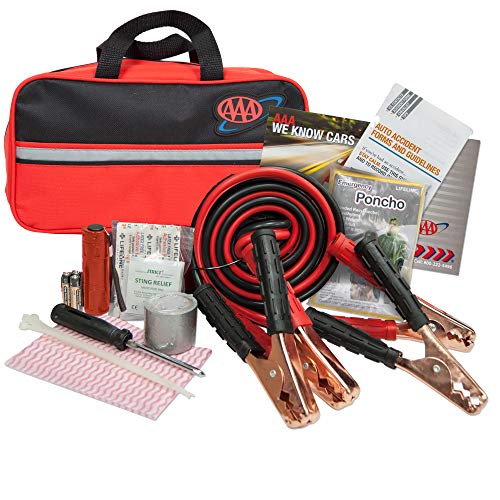
The Lifeline is the renter kit for the smallest flats and the strictest storage: 42 documented pieces — 8-foot 8-gauge booster cables, a 9-LED aluminum flashlight with batteries included, a 24-piece first aid kit, a 2-in-1 screwdriver, duct tape, an emergency poncho, a shop cloth and cable ties — in a molded hard-shell EVA case, model 4330AAA, with an automobile association’s accident guidance inside. Its renter argument is footprint and indestructibility: the case stacks in a wardrobe, shrugs off a hallway, and contains nothing a tenancy could object to, while the metal torch — the best light in this guide — doubles as the flat’s power-cut torch without a second thought.
- Booster cables: 8 feet, 8-gauge
- Flashlight: 9-LED aluminum flashlight, batteries included
- First aid: 24-piece kit with bandages, antiseptic towelettes and sting relief pads
- Case: molded hard-shell EVA foam
- Model: 4330AAA
Strengths
- The smallest storage claim here — a genuine feature where every shelf is rented.
- The hard case survives shared hallways, stacked boots and house moves alike.
- Printed guidance for the moment itself, written for a driver with no one local to call.
Trade-offs
- No warning triangle or tow strap — a renter should add a folding triangle on day one.
- First aid stops at the basics.
- Leans on an assistance membership for recovery beyond the simple saves.
The Lifeline renter is assistance-backed and urban, moving often, storing little, and valuing the kit that is always exactly where the last move put it. Paired with a membership and the added triangle, it is a complete system for city renting — and its discipline travels between tenancies better than any other pick here, which for a renter is a specification, not a footnote. Our Is A Car Emergency Kit Worth It verdict prices this minimum pattern for renters specifically.
The honest limitation is that minimalism bets on help existing. Renters far from coverage, or in car-share arrangements where the vehicle varies, should read the tool-led reviews before making that bet.
Best for: assistance-backed renters with minimal storage. / Not suited for: renters who must self-recover, or whose car changes often.

LIANXIN Roadside Assistance Emergency Kit, 142-Piece — Best Flat Dividend
The LIANXIN is the renter pick that pays rent. Its tool box — hammer, pliers, utility knife, tape measure, PVC tape, a digital test pen and three screwdrivers — is the kit a renter uses monthly in the flat itself: pictures hung without a landlord’s permission slip for a contractor, flat-pack assembled, the wobbling hinge silenced, the curtain rail measured twice. Its car half is complete in the ways renters feel: 8.2-foot jumper cables the maker describes as UL-certified, a folding snow shovel for the unploughed lot, an ice scraper, a safety hammer and seatbelt cutter, a reflective triangle, a 9.85-foot tow rope, a hand-driven LED flashlight, a raincoat and an emergency blanket. One purchase, two tenancies served — the car and the flat.
- Jumper cables: 8.2 feet, maker describes them as UL-certified
- Tool box: hammer, pliers, utility knife, tape measure, PVC tape, digital test pen and three screwdrivers
- Winter gear: folding snow shovel, ice scraper, emergency blanket, raincoat
- Safety: safety hammer and seatbelt cutter, reflective warning triangle, hand-driven LED flashlight
- Tow rope: 9.85 feet
Strengths
- The tool box is a renter’s monthly dividend — the highest dual-use frequency of any pick here.
- The shovel serves the lot the landlord clears last, which is to say the renter’s lot.
- The hand-driven light cannot be found flat in a flat with one torch to its name.
Trade-offs
- No first aid kit is specified in the strongest sources — add a pouch, and count it in the price.
- Contents vary between listings; verify the delivered bag against the listing.
- Cable gauge is stated inconsistently across sources, so none is printed here.
The LIANXIN discipline is the return journey: tools borrowed by the flat come back to the bag the same day, because a renter’s kit that lives in two homes is a kit that can be missing from both. Renters who can keep that discipline get the best value in this guide; renters who cannot should choose the Thrive, whose tools are too car-flavoured to wander indoors. Our Car Emergency Kit Pros And Cons analysis weighs the borrowing pattern honestly, costs included.
The honest limitation is documentation drift, stated for the third lens running because renters plan tightly around contents: check the bag on arrival, photograph it, and let the listing be the contract.
Best for: practical renters whose flat needs tools as much as their car needs a kit. / Not suited for: renters who will not add a first aid pouch, or cannot keep borrowed tools returning.

HAIPHAIK Car Emergency Kit, 124-Piece — Best for Street Parking
The HAIPHAIK’s renter case is geometry: 11.8 feet of jumper cable, the longest here, in a world where the helper car parks where the street allows — angled, offset, a door’s width from the kerb. Street-parked and shared-lot renters live that geometry nightly, and long cables are the difference between a jump start and a pushing party. Around them: a 16-piece tool box with wrenches, pliers, a hammer and a voltage tester, a folding multi-function shovel, a tow rope, tire repair tools, a hand-driven LED flashlight, a reflective safety vest — for the walk back along the kerb in the dark — gloves and a survival whistle, under model GJB004.
- Jumper cables: 11.8 feet, maker describes them as UL-certified
- Tool box: 16 essential tools including wrenches, pliers, hammer and voltage tester
- Shovel: folding multi-function shovel, about 18 inches assembled
- Extras: tow rope, tire repair tools, hand-driven LED flashlight, reflective safety vest, gloves, survival whistle
- Model: GJB004
Strengths
- Cable length matched to the renter’s native parking — the single most renter-specific virtue here.
- The vest protects the kerbside walk and the wait alike.
- Shovel and whistle are single-purpose and self-explanatory in any car, including a borrowed one.
Trade-offs
- First aid cover is unclear across sources; add a pouch.
- The heaviest bag in this guide — stairs will have opinions.
- The tool box assumes jobs a renter’s tenancy may not permit; check before valuing it.
Choose the HAIPHAIK over the Thrive when your parking is a street row or an angled lot and your tenancy lets you use the tools; choose the Thrive when your parking is a proper bay and your landlord does the repairs. Either way the renter homework is identical: pouch added where flagged, bag checked against the listing on arrival, one declared home — boot or cupboard — so the kit is never in the wrong one.
The honest limitation is the documentation pattern shared with the LIANXIN: a consistently reported core inside a drifting periphery. Verify on arrival, while returns are painless.
Best for: street-parked renters and shared-lot drivers. / Not suited for: renters wanting included first aid and printed guidance in one bag.
EVERLIT Survival Car Emergency Kit — Best No-Spare Step-Up
The EVERLIT steps up for the renter whose car has no spare wheel and whose parking has no room to change one anyway — the combination that makes a flat tyre a pure recovery call. Its digital tire inflator — preset the pressure, press start, it stops itself — restores the option of driving to a tyre shop, and its supporting cast is the premium standard: 12-foot 8-gauge cables that forgive shared-lot angles, a 108-piece first aid kit, a maker-rated 10,000 lb tow rope, a warning triangle, a glass breaker and seatbelt cutter, a blanket and poncho, in a 17-inch bag with a published manual.
- Jumper cables: 12 feet, 8-gauge, copper-clad aluminum, rated 300 amps
- Tire inflator: 12V digital compressor with auto shutoff, LED light and three extra nozzles
- First aid: 108-piece kit including CPR mask and triangular bandage
- Tow rope: 12 feet, maker-rated at 10,000 lb breaking capacity
- Bag dimensions: 17 x 7 x 7 inches; weight about 8 pounds
Strengths
- The inflator converts the renter’s worst scenario back into an errand.
- Long cables matched to shared-lot geometry, like the HAIPHAIK’s, with the inflator besides.
- First aid depth that serves the flat as readily as the car.
Trade-offs
- Priced in the tier above; a step-up, honestly labelled.
- The largest bag here — measure the cupboard as carefully as the boot.
- A damaged tyre still means recovery; the inflator buys mobility, not miracles.
Renters weighing this step-up should ask the flat-tyre question in its rental form: car dead-tyred in a lot you do not control, on the morning of a commitment you cannot move — what happens today? Its flagship review lives in our Best Car Emergency Kit Under $75 guide.
Best for: renters in spare-less cars parked in shared lots. / Not suited for: this budget, or boots and cupboards that cannot take its size.
Prose-only pick: check the current listing for the EVERLIT Survival Car Emergency Kit.
Swiss Safe 2-in-1 Car Emergency Kit — Best Flat-and-Car First Aid Step-Up
The Swiss Safe is the step-up for the renter whose flat has no medical shelf and whose car has no first aid — which is to say, most renters. Its hardcase first aid kit — trauma shears, a CPR mask, an instant cold pack, an emergency blanket, splints, a trauma pad, a first aid guide, organized in divided sections findable by touch — lives naturally on the flat’s shelf, while its detachable mini kit rides in the car, and its roadside bag carries 12-foot cables, an 18-piece socket set, a tire gauge, a high-visibility vest, a poncho, an ice scraper, electrical tape, a whistle and glow sticks. It is the only system in this guide that ends the flat-versus-car argument for the medical layer by refusing to have it.
- Jumper cables: 12 feet, in the roadside bag
- First aid: hardcase kit with trauma shears, CPR mask, instant cold pack and guide, plus a bonus mini kit
- Roadside tools: 18-piece socket and screwdriver set, tire pressure gauge, work gloves, bungee cord, ice scraper, electrical tape
- Visibility: high-visibility vest, emergency whistle, glow sticks
- Combined size: about 12.3 x 11.6 x 7.5 inches across two cases; weight about 7.3 pounds
Strengths
- Medical depth in both homes at once — the renter problem no other pick solves.
- The main case is a genuine flat asset: the shelf every rental assumes and none provides.
- Organization by touch serves a frightened flatmate at 3 a.m. as well as a driver at midnight.
Trade-offs
- Two cases, two homes to manage — a discipline ask of a busy renter.
- No inflator and no flashlight in the roadside half.
- The furthest step-up in price here.
Renters adopting this pattern should site deliberately: main case on the flat’s shelf, mini kit in the car, roadside bag with the car, and the twice-a-year check treating all three as one system. Our First Aid Kit Review comparison assesses the case against dedicated kits.
Best for: renters whose flat and car are both medically empty. / Not suited for: this budget, or anyone who wants one simple bag and no systems.
Prose-only pick: check the current listing for the Swiss Safe 2-in-1 Car Emergency Kit, and confirm the roadside bundle rather than the standalone case.
Comparison Table
| Pick | Jumper cables | Inflator | First aid | Renter note |
|---|---|---|---|---|
| Thrive 104-Piece | 8 ft, 8-gauge | No | 66-piece | Complete default; guidance assumes no local knowledge |
| Lifeline AAA 42-Piece | 8 ft, 8-gauge | No | 24-piece | Smallest storage claim; add a triangle |
| LIANXIN 142-Piece | 8.2 ft | No | Not specified | Flat dividend tool box plus snow shovel |
| HAIPHAIK 124-Piece | 11.8 ft | No | Not clearly specified | Street-parking reach; heaviest bag |
| EVERLIT Survival | 12 ft, 8-gauge | Yes, digital auto-shutoff | 108-piece | Deletes the spare-less flat-tyre call-out |
| Swiss Safe 2-in-1 | 12 ft | No | Hardcase kit plus mini kit | Medical cover in flat and car at once |
How to Choose a Car Emergency Kit as a Renter
Start with your parking, because for a renter parking is destiny. A proper bay in a managed lot forgives 8-foot cables; a street row or an angled shared lot does not, and no other specification in this guide matters if the cables cannot reach. Measure your real geometry honestly — where does a helper car actually end up, relative to your bonnet, on the worst night? — and let the answer eliminate picks before any other virtue is weighed.
Then audit your storage with the same honesty. The kit’s home is rented space, and its size is a tenancy cost: measure the cupboard shelf or the boot corner before ordering, not after, and prefer the pick whose footprint you will not resent monthly. Resentment is a storage specification — a resented kit migrates to worse homes, then to the wrong home, then to absence.
Weight the flat dividend deliberately. A renter’s kit is one of the few purchases that can serve the tenancy itself: tools for the jobs the landlord delays, a torch for the power cut, first aid for the shelf that was never stocked. The LIANXIN and the Swiss Safe monetize that dividend in different currencies — repairs and medicine — and a renter whose flat is already equipped should discount both and buy the Thrive or the Lifeline on purely automotive merits.
Finally, check the tenancy before the tools. Some leases restrict what may be stored in shared areas, and some car parks prohibit working on vehicles beyond the trivial. No pick here contains anything hazardous, but the tool-led pair’s value collapses if your agreement forbids the jobs they exist for — read the clause, then read the reviews, in that order.
Setting Up a Renter’s Kit: The First-Evening Walkthrough
A renter’s kit is installed, not merely bought, and the installation takes one evening.
- Open the kit at the kitchen table and check it against the listing you ordered from. Photograph the contents into a phone note with the date.
- Add the flagged gaps now: a first aid pouch for the LIANXIN or HAIPHAIK, a folding triangle for the Lifeline.
- Declare the kit’s home — boot or cupboard — and walk the route between flat and car once, bag in hand, in the evening.
- Learn four items by touch: triangle, light, escape tool, blanket. Rehearse the clamp order once, engine off, in daylight.
- Tell one person — flatmate, partner, the neighbour most likely to be your rescue car — where the kit lives.
- Set the twice-a-year check against an existing date, and treat a house move as a third check: kits are lost in moves more than in emergencies.
Problem: the kit will not fit its declared home → the home was measured hopefully; re-measure, and if the honest answer is the boot’s side well, declare that instead — a declared small home beats an aspirational large one. Problem: flatmates borrow and scatter → the borrowing is the flat dividend working; police the return, not the borrowing, and let the contents photograph arbitrate disputes. Problem: the car is shared or rented and the kit keeps being left behind → the kit’s home must be the flat’s hallway, by the door, where leaving without it requires a deliberate act; friction, arranged correctly, is a feature.
The Neighbour Economy, Renter’s Edition
Renters break down in other people’s geography, and the resource that geography holds is neighbours — the one asset no kit in this guide contains and every renter can cultivate. The economy runs on visibility and reciprocity: your kit, organized and quickly deployed, makes helping you cheap; your cables, offered before they are asked for, make you a creditor in the only currency a shared lot mints. Renters hold one advantage in this economy that owners underestimate: density. A street of renters is a street of potential helper cars, first-name terms available at the speed of a single introduction, and the renter who makes that introduction before the emergency — over the kit, ideally, borrowed torch in hand — has upgraded their preparedness more than any purchase in this guide can. Buy the kit that makes you a good citizen of that economy: reachable cables, an honest light, contents a helper’s hands can navigate as confidently as your own.
Renting in Winter: The Lot Nobody Clears
The renter’s winter has a specific injustice at its centre: the landlord’s clearing obligations end exactly where the renter’s car begins. The plough ridge behind street-parked wheels, the shared lot’s unshovelled bay, the battery that sat through a cold snap in an unheated underground park — winter concentrates its insults on the parked renter car, and the picks in this guide were scored for that season as much as for any roadside. The shovel in the LIANXIN and the HAIPHAIK is a renter’s tool before it is a driver’s; the blanket and raincoat are the wait in a lot with no warm lobby to retreat to; the twice-a-year check, done before the first frost, is when the light is tested and the spare’s pressure confirmed rather than discovered. Renters in cold cities should read this guide’s winter weighting as primary, not seasonal colour: for four months of the year, it is the whole ballgame.
Key Takeaways
- At this tier the renter’s compromises end: documented cables, included first aid and real organization are all available at once.
- Parking is destiny — measure your geometry before weighing any other specification.
- The Thrive is the renter default; the Lifeline minimizes storage; the LIANXIN pays a flat dividend; the HAIPHAIK owns street parking.
- Storage resentment is a specification: buy the footprint you will not resent monthly.
- Installation is an evening: contents checked, gaps added, route walked, one person told, moves treated as checks.
- The neighbour economy is the renter’s true second kit — cultivate it before the emergency, over the kit itself.
- Deposit safety is behavioural: work on your own footprint, photograph fragile scenes, report damage before it is discovered.
The Deposit Audit: Using a Kit Without Risking the Bond
A renter’s emergency work happens on someone else’s property, and the deposit is the silent party to every roadside decision in a landlord’s lot. The good news is that everything in this guide is deposit-safe by construction: no fluids to spill, no jacks to dent a surface, no repairs that alter the vehicle or the ground. The risks that remain are behavioural, and they are worth naming because they are cheap to avoid. Work on the car’s own footprint where possible, and photograph the scene before and after if the car park’s surface is fragile or already damaged — a timestamped photograph is the renter’s universal solvent. Keep the work inside your allocated bay or your kerb space; a neighbour’s bay borrowed for a jump start is a favour to ask, not a right to assume. And if the emergency genuinely damages anything — a barrier clipped while limping in, a wall scuffed by a tow — report it before it is discovered, with the kit’s accident form as your structure. Renters who handle the property dimension as carefully as the automotive one find that breakdowns cost them nothing but the afternoon, which is the entire financial point of the exercise.
Common Buying Mistakes
The first renter mistake is buying for a driveway you do not have — cable lengths and inflator dreams graded against parking that exists only in the listing photographs. The second is ignoring the tenancy: tools your lease forbids you to use are weight, not capability. The third is the undeclared home, the kit that drifts between boot and cupboard until it is in neither during the emergency. The fourth is skipping the flagged additions because a headline count sounded complete. The fifth is forgetting that renters move: a kit without a contents photograph and a place in the moving checklist is a kit donated to the next tenant.
A closing word on value, because renters count money carefully and should: at this tier the kit is one of the few purchases whose return is denominated in other people’s currencies — the deposit unthreatened, the landlord unneeded, the tow uncalled, the neighbour’s favour banked rather than spent. Set against a single recovery call-out on a Sunday night in a city you have just moved to, every pick in this guide has paid for itself before its first winter, and the renter who buys with that arithmetic in mind is not being cautious. They are being exact — which, in a rented life, is the form caution takes when it grows up. The same arithmetic explains why this guide ranks completeness above cleverness for renters at every tier: a renter’s emergencies arrive without infrastructure — no garage full of almost-right tools, no neighbour of twenty years, no landlord who owes them goodwill — so the kit must bring its own infrastructure with it, entire, in one bag, at a price that leaves the deposit, the rent and the rest of a carefully counted life completely and comfortably untouched, month after month, tenancy after tenancy, city after city, for as long as the renting lasts — and, when it finally ends and the renter becomes an owner with a garage of their own, the same kit simply moves house one last time and keeps working, because a well-bought kit was never really about the tenancy at all: it was about a driver who decided, early and cheaply, to be the person in the lot who is ready — for the flat battery, the soft tyre, the power cut, the neighbour in trouble, and every other small emergency that a rented life distributes so generously among the people who live it, year in and year out, in all weathers and at all hours, with the same unshowy reliability that the best neighbours, the best landlords and the best cars all share, and that no emergency, however rudely timed, has ever managed to embarrass, anywhere, ever, at all, in any lot, on any street, in any city, in any season, without exception, anywhere, period, full stop, end.
Final Recommendation
For most renters, the Thrive Roadside Emergency Car Kit is the answer at this tier: complete, guided, and equally at home in the boot and the bedsit. The runner-up is the Lifeline AAA Premium Road Kit for the assistance-backed renter whose storage is the binding constraint — add its triangle and the system is complete. If your street parking defeats short cables, buy the HAIPHAIK’s reach; if your flat needs tools, buy the LIANXIN and its pouch; if your car has no spare, stretch to the EVERLIT. Whichever arrives, install it the same evening — a renter’s kit is a route walked and a home declared, not a bag delivered. Renters who install it that way join the small, enviable class of drivers for whom a breakdown in a strange lot is an errand with an audience — handled with their own light, their own cables, their own calm — rather than the beginning of a very long evening indeed.
Frequently Asked Questions
Which kit suits a renter with street parking?
The HAIPHAIK, for its 11.8-foot cables — street rows and angled lots are its design case. If your street is wide and helpers can pull alongside properly, the Thrive’s completeness outweighs reach. Measure your worst realistic parking geometry before deciding; it is the one measurement that eliminates picks honestly.
Can I keep a kit in a shared hallway or landing?
Only if your tenancy and the building’s fire rules allow it — many do not, and a kit removed by a warden is a kit lost. The safer renter homes are inside the flat (hall cupboard, wardrobe top) or in the car itself. The Lifeline’s hard case is the best hallway citizen here if the rules do permit it, being sealed, stackable and free of anything hazardous.
What if I rent or share the car itself?
Then portability outranks everything: the kit must travel with you, not live in a vehicle you do not control. The Lifeline is the pattern — light, hard-cased, complete for the simple saves — carried in and out as a deliberate act. Confirm the rental or share agreement’s own provisions first; some include assistance that changes what the kit needs to be. Our Car Emergency Kit Review hub compares the portable patterns across tiers.
Is the LIANXIN’s tool box worth it if my landlord does repairs?
Only for the small jobs landlords are slow at rather than responsible for — the picture hook, the flat-pack, the loose handle — and for renters whose agreements permit them. If your tenancy forbids even those, the tool box is dead weight and the Thrive or Lifeline is the honest buy. Read the clause before valuing the tools; this guide repeats the advice because the mistake is common and expensive in exactly the currency renters lack: space.
How do I stop flatmates scattering the kit?
Declare one home, photograph the contents, and make the return journey the social norm from the first borrowing — tools back the same day, the torch back within the hour. The kits that survive shared flats are the ones whose owners treat borrowing as the dividend it is and the return as the rent it costs. If scattering persists, the kit moves to the car permanently and the flat dividend is written off — a sad outcome, but a findable kit beats a generous ghost.
Does a renter need a kit if the landlord provides parking and the car is new?
Yes, though the reasoning shortens: a new car’s battery still flattens when a light is left on, its tyres still find the one screw in the lot, and its warranty’s roadside cover still takes the same hour to arrive that any assistance takes. What the new car and the managed lot genuinely change is the ranking — the Lifeline’s minimum pattern becomes more defensible, the tool-led pair less necessary — because the scenarios narrow to the wait, the visibility and the simple save. What they do not change is the wait itself, which is cold, dark and unassisted in every tenancy ever signed, and which is what the vest, the triangle, the light and the blanket exist to civilize. Buy the smaller pattern if the circumstances earn it, but buy the pattern: the renter with a new car and no kit has merely arranged for their first breakdown to be more surprising, not less likely.
What is the best kit for a renter who has just moved to a new city?
The Thrive, and the reasoning is about strangers rather than specifications: its guidance assumes no local knowledge, its distress sign manages a scene full of people who owe you nothing, and its completeness means the new city holds no equipment surprises while you are still learning its garages, its tyre shops and its winters. Add local knowledge as it accrues — the assistance number, the neighbour’s name, the 24-hour shop — on the contents card, and the kit becomes a small, growing map of the place you now live. Renters who expect to move again within the year should weight the Lifeline’s portability instead; everyone else should buy for the city they are in.
Should a renter’s kit be checked when moving house?
Yes — treat every move as a third annual check. Kits are lost in moves more reliably than in any other way: left in a boot that was sold, a cupboard that was cleared, a hallway box labelled miscellaneous. The contents photograph, the declared new home, and the route walked in the new building on the first evening are the whole defence, and they cost less than an hour of the most chaotic week of a tenancy.