Disclosure: As an Amazon Associate, umtsmarttool.com earns from qualifying purchases. Links to Amazon on this page are affiliate links; they cost you nothing extra. Prices and availability change often, so check the current Amazon listing before you buy.
Where to buy
Shopping for the best paint sprayer for home use under $100? Start with the HomeRight Super Finish Max HVLP Paint Sprayer — the best-balanced household sprayer in the tier. The full home-use shortlist:
- HomeRight Super Finish Max HVLP Paint Sprayer (C800971) — Best Overall for Home Use — Check on Amazon
- HomeRight Finish Max HVLP Paint Sprayer (C800766) — Easiest for Home Use — Check on Amazon
- VONFORN VF803 700W HVLP Paint Sprayer — Best Value for Home Use — Check on Amazon
- NEU MASTER N3140 600W HVLP Paint Sprayer — Best for Big Home Projects — Check on Amazon
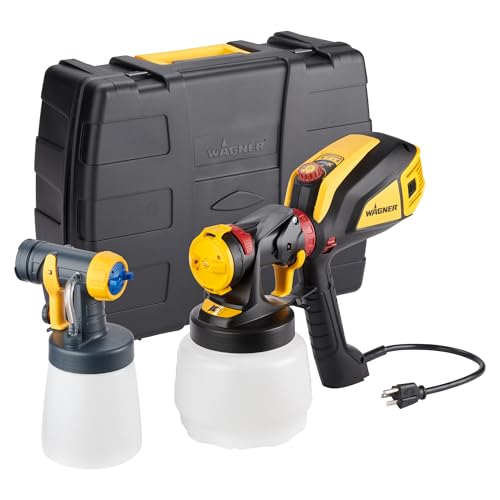
- Wagner Control Spray Double Duty HVLP Sprayer — Best for Home Wood Care — Check on Amazon
- Wagner Control Spray 250 HVLP Stain Sprayer — Best for Seasonal Home Chores — Check on Amazon
Read the full guide ↓
Best Paint Sprayer for Home Use Under $100: The Household Standard
The best paint sprayer for home use under $100 is the tier where spraying becomes a normal household capability rather than a hobbyist’s experiment. At fifty dollars a home buys a promising tool; at a hundred it buys the finished version of the idea — brass tips instead of compromises, power with headroom, brands with parts shelves, and enough refinement that the results stop looking homemade. The home-use lens judges by household standards: Will it serve the furniture and the fence with equal grace? Can it live in a hall closet or a garage corner without complaint? Will a second adult in the household pick it up confidently? Does it ask little — in cleanup, in storage, in learning — relative to what it returns across a decade of ownership?
All six picks here are linked with verified listings, and the spread is deliberate: two HomeRight handhelds for the house’s two tempos (considered and quick), a value generalist, a turbine for big days, and two Wagner specialists for the home’s wood. Readers with smaller budgets should compare Best Paint Sprayer For Home Use Under $50; those planning room-scale work should read Best Paint Sprayer Under $200 before settling. The framework behind the rankings is in Paint Sprayer Buying Guide; this page applies it to the place the sprayer will actually live — your home.
In this guide
Quick Picks
| Pick | Badge | Key spec |
|---|---|---|
| HomeRight Super Finish Max HVLP Paint Sprayer (C800971) | Best Overall for Home Use | 450W, 3 brass tips, 3 patterns |
| HomeRight Finish Max HVLP Paint Sprayer (C800766) | Easiest for Home Use | Electric handheld HVLP, brass tip, 3 patterns |
| VONFORN VF803 700W HVLP Paint Sprayer | Best Value for Home Use | 700W, 4 nozzles (1.0–3.0 mm), 1200 ml container |
| NEU MASTER N3140 600W HVLP Paint Sprayer | Best for Big Home Projects | 600W floor turbine, 6 ft air hose |
| Wagner Control Spray Double Duty HVLP Sprayer | Best for Home Wood Care | Handheld HVLP for stains and finishes |
| Wagner Control Spray 250 HVLP Stain Sprayer | Best for Seasonal Home Chores | Handheld HVLP tuned for thin materials |
How These Picks Were Chosen
This guide is research-led: specifications were verified against manufacturer data and stable listings, and no hands-on testing is claimed. Home-use criteria at this tier, in order: household versatility — the span from nursery furniture to deck boards that a home actually generates. Livability: storage footprint, noise manners, cleanup burden, and the confidence a second household member needs to use it. Finish quality at domestic viewing distances — the arm’s-length standard of furniture and doors. Durability across a decade of intermittent use, which favors brass tips, real seals, and parts support over any single-season specification. And value in the household sense: cost divided by years of service, not by features. All six picks sit within the cap at their typical selling ranges, so every pick is linked — no prose-only flags in this guide.
The 6 Best Paint Sprayers for Home Use Under $100

HomeRight Super Finish Max HVLP Paint Sprayer (C800971) — Best Overall for Home Use
The Super Finish Max suits the household that wants one sprayer, kept for years, that answers the home’s full range of finishing calls: the crib and the cabinets, the doors and the dresser, the shutters and the shelves. Its 450W motor and three brass tips cover that range with the tier’s best finish, and its cleanup — the household tax that decides whether tools get used — is fast enough to keep spraying the default rather than the event. It is the pick that makes the fewest apologies in the widest set of rooms.
- Motor: 450W electric handheld HVLP
- Tips: 3 brass spray tips included
- Patterns: 3 spray patterns
- Container: generous attached container for furniture-scale work
- Best materials: stains, sealers, enamels, paints with modest thinning
Strengths
- The household range champion: furniture to fence without strain
- Best finish quality at domestic viewing distances
- Fast cleanup keeps it the home’s default tool, not its special occasion
Trade-offs
- Handheld weight on the home’s biggest days
- Thick latex still wants thinning
- More tool than a stain-only household needs
The home-use argument is about defaults. Every household has a default way finishes get done — historically the brush, with its marks and its hours — and a sprayer displaces the default only when its total friction (setup, spraying, cleanup, storage) undercuts the brush’s familiarity. The Super Finish Max is the first pick in this series that wins that comparison for the majority of household jobs, which is why it leads: not because it is the most powerful or the cheapest, but because it is the one the home will actually reach for in year three. The honest limitation is scale — whole rooms remain the next technology’s work — but within the home’s piece-and-surface universe, this is the standard.
Best for: Households wanting one long-kept sprayer for everything / Not suited for: Whole-room painting as the main job


HomeRight Finish Max HVLP Paint Sprayer (C800766) — Easiest for Home Use
The Finish Max suits the household whose spraying is frequent, small, and woven into domestic life: the chair between other chores, the frames before guests arrive, the touch-up that cannot wait for a free Saturday. Its single brass-tipped nozzle, short fluid path, and minutes-long cleanup make it the most livable sprayer in the tier — the one that fits a shelf, a routine, and a non-enthusiast’s confidence. In many homes this, not the flagship, will log the most hours, because home life generates small jobs in a steady drizzle and punishes any tool that demands ceremony.
- Type: electric handheld HVLP
- Tip: brass spray tip
- Patterns: 3 spray patterns
- Flow: adjustable material flow control
- Best materials: stains, sealers, enamels, thinned paints
Strengths
- Easiest ownership in the tier: setup, cleanup, storage all minimal
- The second-adult test passed — anyone in the house can run it
- Brass tip durability across years of small jobs
Trade-offs
- Single nozzle: the narrowest material range here
- Small container caps the big days
- Ambitious households will add a bigger sibling eventually
Its household role deserves a name: this is the sprayer as appliance. Like the stick vacuum that gets used daily while the powerful canister waits for weekends, the Finish Max wins by presence — always ready, never a production. Homes are not workshops; their finishing needs arrive unscheduled and modest, and the tool matched to that reality is a genuine category leader rather than a compromise. The honest limitation is the ceiling: when the home’s ambitions grow to cabinets and campaigns, this pick becomes the household’s second sprayer — a demotion it accepts gracefully, still logging the drizzle for years.
Best for: Households with frequent small finishing jobs / Not suited for: Cabinet campaigns or fence-scale days as the only tool
VONFORN VF803 700W HVLP Paint Sprayer — Best Value for Home Use
The VONFORN VF803 suits the household that wants maximum coverage per dollar: four nozzles (1.0–3.0 mm), a 700W motor, a 1200 ml container, and a kit that includes the cleaning and measuring accessories a home would otherwise buy piecemeal. For homes whose projects skew practical — fences, sheds, garage doors, bulk furniture — it delivers the tier’s capability at a friendlier point in it, leaving budget for the finishes themselves, which is where household money often matters more.
- Motor: 700W handheld HVLP turbine
- Nozzles: 4 included — 1.0, 1.5, 2.0, and 3.0 mm
- Patterns: horizontal, vertical, and circular
- Container: 1200 ml detachable container
- Extras: cleaning and blowing joints, viscosity cup, cleaning tools
Strengths
- Widest material range per dollar in the tier
- Complete kit — the home buys nothing else to start
- Container capacity suits the home’s outdoor work
Trade-offs
- Heaviest in hand when full
- Finish polish a step behind the Super Finish Max
- Support depth thinner than the majors’
The value case in a home context is about allocation: the household finishing budget is finite, and every dollar not spent on the tool is a dollar available for better finish, better masking, and the second project. The VONFORN’s completeness amplifies the effect — no accessory dribble — making it the pick for homes that measure value across the whole endeavor rather than the single purchase. The honest limitation is refinement and recourse: on the heirloom piece, its finish trails the leader’s, and when something wears, the majors’ parts shelves answer faster. Homes that prize those should pay for them; homes that prize coverage should take this.
Best for: Value-focused households with practical, varied projects / Not suited for: Heirloom-finish priorities or support-first buyers
Check on Amazon
NEU MASTER N3140 600W HVLP Paint Sprayer — Best for Big Home Projects
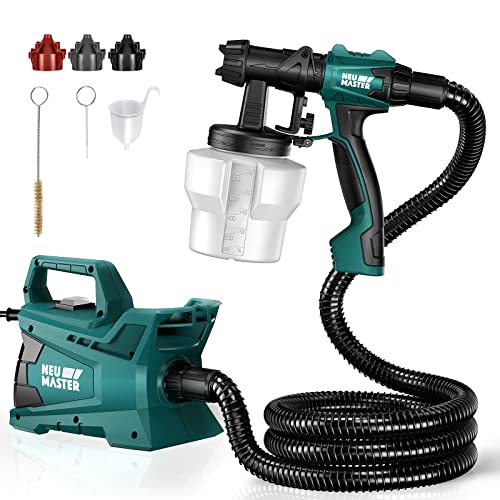
The NEU MASTER N3140 suits the household whose calendar holds event-scale projects: the full fence before summer, the deck-and-furniture overhaul, the room’s worth of doors and trim laid out in the driveway. Its 600W turbine sits on the ground and feeds a light gun via a 6 ft hose, so the operator’s arm — the household member, not an athlete — finishes the day with the same technique they started it. Big home projects fail socially before they fail technically: exhaustion curdles into shortcuts, and shortcuts into a finish the household lives with for a decade. This format is the insurance.
- Motor: 600W turbine in a floor-standing base unit
- Hose: 6 ft air hose between turbine and gun
- Patterns: 3 spray patterns
- Flow: adjustable flow control
Strengths
- Lightest in hand — the big-day consistency pick
- 600W headroom for the home’s thicker coatings
- Turbine placement keeps noise at the driveway’s far end
Trade-offs
- Setup overhead for the home’s small jobs
- Brand support thinner than HomeRight or Wagner
- Storage footprint larger than a handheld’s
Households should audit their calendars honestly: if the year holds two or more event-scale projects, this pick’s endurance outweighs its overhead; if the year is all drizzle, the overhead dominates and the Finish Max pattern wins. The honest limitation is precisely that overhead — the base, the hose, the uncoiling — which is trivial against a fence and absurd against a picture frame. Big-project households will find it the most comfortable hundred dollars in the tier; small-job households should let it pass without regret.
Best for: Households with event-scale seasonal projects / Not suited for: Small-job-dominated homes

Wagner Control Spray Double Duty HVLP Sprayer — Best for Home Wood Care
The Control Spray Double Duty suits the household whose identity is wood: the deck maintained yearly, the fence kept honest, the outdoor furniture refinished in rotation, the interior woodwork touched up as seasons turn. Wagner built this handheld for stains and finishes — the wood-care material class — with settings for both finer interior work and broader exterior application, hence the name. For wood-centric homes it is the specialist that covers the recurring majority of their finishing calendar, with the support network of the category’s most established brand.
- Type: electric handheld HVLP
- Tuned for: stains, sealers, and wood finishes
- Patterns: adjustable spray pattern
- Brand: Wagner Spraytech — full parts and support network
Strengths
- Purpose-built for the home’s recurring wood-care cycle
- Interior/exterior versatility within its material class
- Wagner’s manuals and parts make decade-long ownership realistic
Trade-offs
- Paints sit outside its tuning
- Container size means refills on the largest decks
- Generalist households will pair it with a paint-capable tool
Wood care is the home’s most schedulable finishing work — it returns on a calendar rather than arriving as inspiration — and schedulable work rewards a dedicated, always-ready tool. The Double Duty’s case is that rhythm: every spring it wakes, works, cleans, and sleeps, for years, on the strength of real seals and available parts. The honest limitation is the paint boundary, stated throughout this series: the household’s first painted project needs a stablemate, and wood homes should budget the pair across seasons rather than forcing one tool across the line.
Best for: Wood-centric households with decks, fences, and furniture in rotation / Not suited for: Paint-first households

Wagner Control Spray 250 HVLP Stain Sprayer — Best for Seasonal Home Chores
The Control Spray 250 suits the household that sprays in seasons: the spring fence weekend, the autumn deck rescue, the pre-holiday shutter refresh. Wagner tuned this handheld (model 0529042) for stains and sealers with the simplest control set in the tier, which matters for a tool used in bursts — there is little to re-learn each season, and the manual’s clarity plus the brand’s support close the gaps that storage opens. It is the chore tool: unglamorous, ready, and matched to the way homes actually schedule outdoor finishing.
- Type: electric handheld HVLP, model 0529042
- Tuned for: stains, sealers, and thin finishes
- Patterns: adjustable spray pattern
- Brand: Wagner Spraytech — full parts and support network
Strengths
- Simplest re-learning curve after months in storage
- No thinning judgment for its home materials
- Brand support sized for the seasonal owner
Trade-offs
- Narrowest mission here — stains and sealers only
- Small container on long fence lines
- Year-round, varied households need more range
The seasonal pattern has a hidden requirement: the tool must survive storage gracefully and forgive an operator whose technique has rusted since October. The Control Spray 250’s simplicity serves both — fewer adjustments to forget, a fluid path that cleans fully, and materials that forgive a rusty first pass. The honest limitation is mission width; households spraying monthly across materials should take the generalists above and let this pick serve the homes it was made for.
Best for: Seasonal households with spring/autumn stain chores / Not suited for: Year-round varied spraying
Comparison Table
| Pick | Type | Home-use strength | Container | Needs compressor? |
|---|---|---|---|---|
| HomeRight Super Finish Max | Electric handheld HVLP | Best all-round household range and finish | Attached container | No |
| HomeRight Finish Max | Electric handheld HVLP | Easiest ownership; small-job readiness | Attached container | No |
| VONFORN VF803 | Electric handheld HVLP | Widest range per dollar | 1200 ml | No |
| NEU MASTER N3140 | Electric turbine HVLP | Big-project endurance | Gun-mounted cup | No |
| Wagner Control Spray Double Duty | Electric handheld HVLP | Wood-care cycle specialist | Attached container | No |
| Wagner Control Spray 250 | Electric handheld HVLP | Seasonal chore simplicity | Attached container | No |
How to Choose a Paint Sprayer for Home Use
Match the tool to the household’s rhythm. Drizzle, campaigns, or seasons — the rhythm decides the format before any specification does. The full selection method is in How To Choose A Paint Sprayer; the home-use shortcut is to name your rhythm honestly and let it veto formats.
Apply the second-adult test. A home tool that only one person dares use is a part-time tool. Controls a second household member can learn in one session — and a cleanup they will not resent — double the tool’s effective availability.
Count the storage. Homes store tools in closets, corners, and garage shelves, not in workshops. A sprayer whose bin fits the household’s actual storage gets kept ready; one that demands a dedicated zone gets buried, and buried tools do not spray.
Value the decade, not the season. Home tools amortize slowly and surely. Brass tips, real seals, and parts support — invisible in a feature list — are the difference between a ten-year appliance and a two-season experiment. At this tier the majors offer them; insist on them.
Keep the boundary honest. Rooms at scale belong to the next technology. A household whose list is mostly walls should not ask this tier to pretend otherwise — see the step-up discussion in Best Paint Sprayer For Diy Projects Under $100.
A Year of Home Spraying at This Tier
Key Takeaways
- The household standard is set by defaults: the sprayer wins when its total friction beats the brush’s familiarity
- Rhythm — drizzle, campaigns, seasons — chooses the format before specs do
- Decade durability (brass, seals, parts) outranks any single-season feature
- Spring: fences, decks, and outdoor furniture — stain season; the Wagner specialists and the generalists share the load.
- Late spring: shutters, doors, and trim as the weather settles — the Super Finish Max’s showcase work.
- Summer: furniture projects in free ventilation — thrift flips, nursery pieces, patio sets.
- Late summer: the big campaign, if the year has one — fence completion or deck overhaul on the turbine pick.
- Autumn: interior furniture and cabinets before the holidays, doors sprayed flat in the garage.
- Winter: small indoor jobs with ventilation planning, plus the maintenance hour — deep clean, seal check, tip inventory.
- All year: the drizzle — chairs, frames, touch-ups — served by whichever pick keeps setup near zero.
- Every session: strain, test, spray thin, clean now, log the recipe — the household routine that makes the tier perform.
Problem: The sprayer is “too much trouble” for small jobs, so they get brushed. → The readiness system failed, not the tool: store it complete in one bin, staged with strainers, and the trouble shrinks below the brush’s.
Problem: Results look great outdoors but disappointing indoors. → Viewing distance changed, not the tool: indoor work wants the finer tips, thinner coats, and the raking light check before the final coat.
Problem: Spring’s first session sprays badly. → Storage debt: a seal or tip asking for the maintenance hour that winter skipped. Service it, and put the hour on next winter’s calendar.
Room-by-Room: Where the Home Sprayer Earns Its Keep
The home case is best made room by room, because each space asks the sprayer a different question. The kitchen asks for finesse: cabinet doors and frames in enamel, judged daily at arm’s length under bright light — the Super Finish Max’s home ground, where tip quality converts directly into the absence of orange peel. The bedrooms ask for calm volume: dressers, headboards, doors, and closet systems, where the generalists’ range covers painted furniture in the morning and a stained bench by afternoon. The bathrooms ask for moisture-appropriate coatings on vanities and cabinets, sprayed in the garage and installed dry — small work, perfectly matched to the Finish Max’s readiness. The living spaces ask for the furniture rotation — the thrifted find, the inherited piece, the built-in’s refresh — where finish quality is the whole point and the tier’s brass tips justify themselves in a single raking-light inspection.
Outside, the questions change key. The deck and fence ask for stain at volume and forgive everything except absence — the Wagner specialists’ calendar. The garage itself asks for utility coatings on cabinets, shelves, and doors, where the value picks work without preciousness. And the entry — shutters, the front door, the mailbox — asks for curb-appeal finesse in miniature, the home’s handshake with the street. A sprayer that answers all seven questions is not a luxury in a home; it is the definition of the category, and it is why this guide’s leader is a range tool with finesse rather than a specialist of either pole.
The Home Finishing Workflow: From Garage Setup to Living-Room Result
Homes lack spray booths, so the home workflow adapts: the garage or driveway becomes the spray zone, the piece travels, and the house stays clean. The mature household workflow runs like a small ritual. The piece is prepped where it stands — cleaned, sanded, masked — then moved to the zone on a dolly or by two adults. The zone is set once: drop cloth, horses or stand, raking work light, respirator staged. The sprayer sprays in the campaign order the series teaches — backs, edges, faces — and the piece rests in the zone’s clean corner while the next rotates through. Cleanup happens at the utility sink with the bin system, and the piece re-enters the house only when cured enough for its room — a patience point households learn once, by fingerprint, and never again.
Two household adaptations deserve emphasis. First, ventilation choreography: the garage door and a fan create the exhaust path, and spraying schedules itself around the household’s comings and goings so fumes never tour the living spaces. Second, the cure calendar: pieces return to service on the finish maker’s schedule, not the weekend’s, and households that respect it stop re-doing work. The workflow is unglamorous and entirely learnable in two projects; by the third, the home runs its finishing like it runs its laundry — a system, not an event — and that systematization, more than any specification, is what this tier purchases.
Home Economics: The Sprayer Against the Alternatives
A household tool should survive comparison with its real alternatives, and the home sprayer’s are three: the brush, the aerosol can, and the professional. Against the brush, the sprayer wins on finish (no marks, factory-even films), on time (application compressed by an order of magnitude on piece work), and loses honestly on setup for the very smallest jobs — the crossover sits around a single chair, which is why readiness dominates this guide’s thinking. Against aerosol cans, the sprayer wins on cost per ounce by a wide margin, on material choice (any finish, any color, including the one already in the garage), and on waste; cans keep a legitimate niche in true one-offs and touch-ups, and wise households keep one for that purpose without confusion about the main tool. Against the professional, the sprayer wins on price by the labor margin — which in finishing work is most of the quote — and loses on the master’s ceiling for heirloom work, a ceiling most household projects never approach.
The synthesis is that the home sprayer at this tier is not competing with other sprayers so much as with the household’s default future: a decade of brushed marks, aerosol costs, deferred projects, and occasional professional bills. Priced against that future, a hundred dollars for a decade-standard tool is among the easiest arithmetic in home ownership — provided, as always, the household actually sprays. The forecast question from the beginner guides applies with full force: buy for the home you will actually run, and the economics follow automatically.
Safety in a Lived-In Home
Household spraying happens around children, pets, food, and soft furnishings, and its safety discipline adapts accordingly. The spray zone is a closed system: family and animals out until the air clears, the exhaust path moving fumes away from living spaces and never across them, and the respirator worn by the operator from can-open to cleanup-done. Food-adjacent projects — the kitchen cabinets above all — add their own rules: finishes cured fully before service, work done outside the food space entirely, and utensils and surfaces protected by distance rather than by hope. Solvent rags go to the sealed metal container outdoors; solvents store in their cabinet, latched, away from heat; and the household’s other adults know the system, because safety that depends on one person’s memory fails the first time that person is away.
The subtler household point is modeling. Homes teach by observation, and a sprayer used with visible discipline — respirator on, zone closed, cleanup complete — teaches the household’s younger members the craft’s real culture. The opposite lesson is also taught, faster. At this tier the tools themselves are as safe as their category gets; the culture around them is the household’s own work, and it is part of what a serious home-use guide should say out loud.
Long-Term Ownership: The Decade View
Home tools are bought in weekends and judged in decades, so the decade view deserves a section. Year one is acquisition and learning: the log fills, the bench assembles, the household calibrates its rhythm to a pick. Years two through five are the plateau of value — the tool is known, the recipes are recorded, the projects flow — interrupted only by wear parts: a tip renewed, a seal replaced, each a small errand for the branded picks and a potential orphaning for anonymous ones, which is the concrete content of this guide’s support criterion. Years six through ten test storage and seals more than motors; the winter hour, performed annually, is the difference between a tool that enters its second decade and a story about one that did not.
The decade view also reframes the tier’s prices. A hundred dollars across ten years of service is a rounding error in a household budget — less than the finishes it will spray in a single active year. What the household is really choosing is not a price but a companion standard: the quality of the tool that will mediate a decade of its making and maintaining. Judged that way, the majors’ premiums inside this tier are the cheapest money in the purchase, and the anonymous discount is the most expensive — a sentence this series has approached from several lenses and states here, for the home, without qualification.
Teaching the Household: Shared Tools, Shared Standards
A home sprayer differs from a workshop sprayer in one social respect: it will be borrowed — by the other adult, the grown child, the neighbor with the fence. Each borrowing is a small test of the tool’s design and the owner’s systems. The picks that pass are the legible ones: controls that explain themselves, a manual that lives in the bin, a log that records the household’s recipes so the borrower inherits knowledge rather than folklore. Owners of shared tools should do one deliberate thing in month one: run a teaching session, however informal, in which the second operator sprays a full small project under supervision. The session converts the tool from personal equipment to household infrastructure, doubles its availability, and — not incidentally — creates the second pair of eyes that catches the first operator’s drifting habits in later years.
Shared ownership also disciplines maintenance: a tool that others depend on gets cleaned to standard because the standard is social, not private. Households that spray together keep tools longer, finish more, and argue less about whose turn the fence is — benefits no specification table lists and every experienced household recognizes. When choosing between near-equal picks in this guide, the one your household’s second operator prefers is, more often than not, the right one.
Troubleshooting the Household Tool: Symptoms in Domestic Language
Household troubleshooting begins from domestic observations, and translating them is a service a guide can offer. “It looks bumpy in the kitchen light” is orange peel — thin slightly, close the distance, check the tip against the material. “It ran on the cabinet door” is excess film on a vertical — lighter coats, faster passes, doors sprayed flat henceforth. “It spits at the start” is a tip seating or a strainer skipped — procedure, not defect. “It worked in spring and struggles now” is storage or wear — the seal and tip inspection, in that order. “The finish feels rough though it looks smooth” is dry spray or dust — distance, environment, tack cloth, in that order. Each translation converts a household frustration into a five-minute fix, and the log accumulates them into the home’s private manual.
The deeper pattern is that household tools rarely break; they drift — a tip eroding over seasons, a seal hardening over winters, a filter loading over projects — and drift is cured by the calendar habits this guide repeats: the session routine, the winter hour, the parts test passed at purchase. A home that keeps those habits will find this tier’s tools almost boringly reliable, which is the highest compliment a household appliance category can earn.
When the Home Outgrows the Tier
Even the household standard has a horizon, and naming it protects buyers from both premature and belated upgrades. The tier is outgrown when the home’s project list changes in kind: whole rooms entering the calendar in numbers (the airless conversation), a renovation that turns the household into a job site for a season (rental airless or a step up to the under-$200 class), or a finishing sideline — furniture flipping, craft sales — that converts domestic spraying into production, with duty cycles these tools were never promised for. Each case is identifiable in the log before it is felt in the arm: the same friction, recurring, named. That recurrence is the upgrade signal this series teaches in every lens, and the home lens states it plainly because households are prone to the opposite error — blaming their technique for a technology boundary, season after season.
Until that signal sounds, the correct household posture is contentment with the standard. The picks above are not stepping stones to be apologized for; they are the finished form of home spraying for the overwhelming majority of addresses, and their owners should expect — with the calendar habits kept — a decade of unremarkable, excellent service. Buy the one matched to your rhythm, build its bin, keep its log, and let the house’s projects make the case, year after year, that the standard was set correctly.
Common Buying Mistakes
Buying the workshop’s tool for the home. Homes need livability — storage, noise, second-adult confidence — that workshop rankings ignore. This lens exists because the contexts differ.
Overbuying for one annual project. The fence is one weekend; the drizzle is fifty weeks. Weight the purchase by frequency, and let rentals serve true outliers.
Ignoring the cleanup tax in a busy household. Time-poor homes abandon high-tax tools. The cleanup routine is a household feature; read it before buying, as our other guides insist.
Skipping the parts test. A home tool’s tenth year depends on a five-dollar seal being findable. Verify the manual and one wear part for your finalist — the majors pass; insist anyway.
Expecting the tier to paint the whole house. It will paint the home’s things beautifully and its walls slowly. Match the technology to the surface, per Paint Sprayer Pros And Cons.
Final Recommendation
Most households under $100 should buy the HomeRight Super Finish Max: it is the tier’s best balance of range, finish, and livability, and the one most likely to still be the household’s default in year five. The runner-up is the HomeRight Finish Max for drizzle-dominated homes — and in practice many households end up owning both tempos, the appliance and the flagship, for less than a single premium system. Wood-centric and seasonal homes have their specialists above, each the right answer to its rhythm. For the single-model deep dive, see Paint Sprayer Review. A final household observation to close: the true measure of this purchase will not be any single project’s finish but the quiet change in what the home considers possible — the dresser rescued instead of replaced, the cabinets renewed instead of endured, the fence kept proud instead of apologized for. Homes accumulate their character through exactly these decisions, and a sprayer at this standard is less a tool than a standing invitation to make them well. Choose by rhythm, equip the bin, teach the second operator, and the invitation will be accepted so often, across so many ordinary weekends, that within a year the household will have trouble remembering how its finishes ever got done before — which is the precise definition of a household standard, and the outcome this tier exists to deliver.
Frequently Asked Questions
What is the best sprayer for a typical home’s mix of projects?
The Super Finish Max, because the typical mix — furniture, doors, cabinets, shutters, the occasional fence section — sits exactly in its tip range, and its cleanup keeps it in weekly service. “Typical” is doing work in the question: homes skewed to wood care or to volume should take their specialists instead, which is why this guide ranks by household rhythm rather than declaring one winner for every address.
Can these sprayers be stored in a closet or garage corner?
Yes — all six are household-scale tools. The handhelds fit a modest bin with their accessories; the turbine pick needs a larger footprint. Store them clean, dry, and complete, indoors where possible: garage temperature swings are tolerable for the tool but hard on seals over years, and a climate-stable shelf quietly extends the decade these picks are bought for.
How loud are these sprayers in a residential setting?
They are power tools — expect conversation-stopping noise at the tool, less at the property line, with the turbine format moving its share to the floor unit. Household etiquette is mostly scheduling: weekend mid-mornings rather than dawn, and a word to close neighbors before campaign days. None of the picks is antisocial by category standards, and HVLP’s low overspray keeps the peace in the dimension neighbors notice most — their own cars and siding stay clean.
Is a $100 home sprayer worth it over a $50 one?
For a home that sprays yearly across varied projects, yes: the tier buys brass tips, headroom, parts support, and finish quality that compound across a decade of intermittent use — the arithmetic is in Is A Paint Sprayer Worth It. For a home with one project and no forecast, the fifty-dollar tier remains the honest buy; the difference is the forecast, not the tools. There is also a resale-and-regret asymmetry worth a sentence: the hundred-dollar majors hold their value and their usefulness if the household’s plans change, while the cheapest tools are the ones most often replaced outright — so the cautious buyer, paradoxically, often spends less over five years by buying this tier once than by buying the tier below twice, a pattern familiar from every durable household category from ladders to luggage. Households learn this pattern once per category, usually by paying the tuition the first time; the home-use sprayer is a category where the tuition can be skipped entirely by reading the forecast honestly at the start, which is, in the end, the only real advice this entire guide reduces to, beneath all its tables, criteria, comparisons, and carefully ranked recommendations for households standing in the paint aisle this weekend, weighing a box in each hand and wondering which of them the next decade of their home’s life will quietly be built around, coat by coat, project by project, season by season, in rooms they love and on furniture their grandchildren may one day inherit, refinish in their turn, and pass along with the story of where it all started years ago right now.
Can a home sprayer handle kitchen cabinets?
Yes — cabinets are this tier’s signature interior project. Spray doors flat and removed, prime and topcoat in thin coats with the finer tips, and allow a weekend. The Super Finish Max and, for volume, the turbine pick are the cabinet choices here; the technique sections of this series’ how-to guides cover the full workflow.
What maintenance does a home sprayer need between seasons?
The winter hour: a deep clean beyond the session routine, seals inspected and replaced if tired, tips inventoried and the worn size renewed, and the whole kit stored complete and dry. Seasonal tools fail from storage, not use, and the hour is the specific insurance — cheap, annual, and decisive for the decade-long service this tier promises.