Disclosure: As an Amazon Associate, umtsmarttool.com earns from qualifying purchases. Links on this page are affiliate links; they cost you nothing extra. Prices and availability change often, so check the current Amazon listing before you buy.
This levoit lv h132 air purifier review exists because the little machine refuses to leave. The LV-H132 has been on sale, in essentially its familiar compact form, for longer than most purifier models survive at all — long enough to accumulate an enormous installed base, a deep market in replacement filters, and a reputation that splits owners into two camps: those who call it the perfect small-room appliance and those who call it underpowered. Both camps are describing the same machine honestly, from different rooms. The H132 is a small, simple, single-cartridge purifier for small, enclosed spaces, and nearly everything written about it — praise and complaint alike — follows from whether the room it was bought for respected that description. This review works through the design, the ownership pattern, the consumable economics and the alternatives, so you can tell before buying which camp your household would join.
Context matters with a machine of this age. When the H132 established itself, the small-purifier market was thinner and dumber: no sensors, no apps, few verified performance figures. The current market offers smarter rivals at similar positions, and this review will name them where they genuinely beat the older design. What the H132 retains is the virtue of a long production run — maturity. Its quirks are known, its filters are everywhere, its failure modes are documented across a decade of ownership, and its price position has settled to the honest level of a simple appliance. For the right room, that maturity is worth more than features.
Key Takeaways
- A compact single-cartridge purifier for genuinely small, closable rooms — desks, small bedrooms, nurseries, dorms — and not for living rooms.
- Ownership could not be simpler: one genuine cartridge (LV-H132-RF), one control scheme, no app, no sensor to foul.
- Its night light and quiet low speeds are the features owners actually praise; its modest airflow is the limitation owners actually meet.
- Filter availability is superb and likely to remain so — the strongest argument for buying a design of this age.
- Households wanting automation, displays or larger coverage should step directly to the Core 300 generation instead.
In this guide
Where to Buy and What You Are Buying

Levoit LV-H132 Air Purifier
The H132 is sold through the usual channels under Levoit’s own name; buy the genuine unit and, later, genuine cartridges, because the compatible market for this model is large and uneven. What the box contains is the whole proposition: a compact cylindrical machine, its cartridge fitted (check for the shipping wrapping before first use, as with all Levoit machines), and a manual worth photographing. Check price on Amazon
- Filter type: 3-in-1 cartridge — pre-filter, HEPA media, activated carbon (genuine part LV-H132-RF)
- Coverage position: small rooms; the manufacturer has historically rated it for modest square footage at its higher speeds
- Controls: simple panel with fan speeds and a night light; no app, no sensor, no display
- Extras: the night light is the model’s signature household feature
Strengths
- Footprint small enough for a desk corner or a crowded nightstand
- Low speeds quiet enough for light sleepers in the same small room
- A decade of production behind every part and every answer
Trade-offs
- Airflow is modest in absolute terms — the room ceiling is real and low
- No automatic mode; the owner is the sensor and the scheduler
- The combined cartridge retires carbon and HEPA together, ready or not
Best for: small bedrooms, nurseries, dorm rooms, home-office desks, and anyone who wants a purifier that behaves like a lamp — present, simple, unremarkable. Not suited for: living rooms, open-plan spaces, heavy-odour households, or anyone who will judge it by the standards of a full-size machine.
Design and Living With It
The H132’s design is a cylinder that draws air through its lower body and returns it from the top, a pattern that suits floor, desk and nightstand placement equally and asks only for clear space around its sides. Its scale is the point: it occupies roughly the footprint of a large water bottle’s ambitions, and in small rooms — where every surface is contested — that footprint is a feature no specification sheet captures. The night light, a soft glow that can be switched independently, sounds like a gimmick and behaves like a kindness in nurseries and guest rooms, the two rooms where this machine most often ends up living.
Controls are deliberately minimal: speeds, light, power. There is nothing to configure and nothing to update, and the machine’s behaviour tonight will be its behaviour in five years, which a certain kind of owner values above any feature list. The trade is equally plain. With no sensor, the machine cannot know the room changed; with no timer sophistication worth the name, scheduling is the owner’s habit or a plug timer’s. Households that run purifiers as set-and-forget background appliances will find the H132 asks slightly more of them than a smart model does — and repays them with a total absence of connectivity problems, app accounts and firmware. Our broader Levoit air purifier problems guide covers what little does go wrong across the brand, and the H132’s section of that catalogue is the shortest in it, which is itself a review of sorts.
Noise character deserves a paragraph of its own, because small machines live close to their owners. On its lowest setting the H132 produces the soft, even rush that disappears from attention within minutes — the quality light sleepers actually need, which is not silence but featurelessness. The higher speeds are working sounds, proportionate to the air moved, and in a small room they are present rather than discreet. Plan, as with every purifier, to live at the low speeds and visit the high ones: after cooking, after cleaning, during a pollen spike. Judged by that pattern — the only honest one — the machine is a good neighbour.
Performance, Judged the Way Owners Judge It
No hands-on laboratory claims are made in this review; what can be assessed from the design, the verified programme history of the model line and a decade of ownership patterns is how the machine behaves in the rooms it suits. In a small closed bedroom, run through the evening and night, the H132’s effect accumulates in the ways owners report consistently: surfaces that dust more slowly, a room that smells neutral by morning, and the particular relief of pollen-season sleep that drives most purchases in this category. The machine’s HEPA media addresses particles — dust, pollen, dander — and its carbon layer takes the edge off ordinary household odours without pretending to be a kitchen solution.
The limits arrive exactly where the design says they will. In a large or open room, the machine’s air changes per hour fall below the threshold where occupants notice anything, and the same unit that delighted a dorm room gets reviewed as a placebo by a living room. With heavy odour — a litter tray in the same small room, a smoker — the modest carbon charge saturates quickly and the cartridge’s odour life, not its HEPA life, sets the change interval. And in a dusty, pet-heavy small room, the compact cartridge loads faster than its larger siblings’ do, compressing the maintenance rhythm described in our brand guide. None of these are defects. They are the physics of a small filter in a small fan, and the review’s central advice follows from them: buy the room first, then the machine.
On the health-adjacent questions this category attracts, this review holds the line our site holds everywhere: a purifier like this one is a comfort and cleanliness appliance. It reduces the particle load of a small room’s air, which many owners find makes their rooms feel and sleep better; it does not treat, prevent or cure any condition, and readers with medical concerns about their air should take them to a clinician, with the machine as a household complement rather than a therapy. The evidence picture, stated carefully, is in scientific benefits of air purifiers.
The Consumable: LV-H132-RF and the Economics of Small
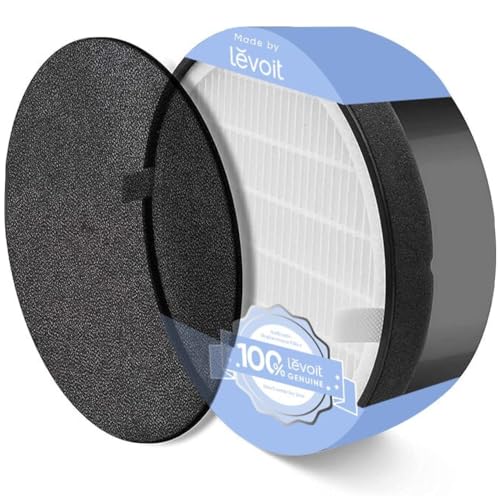
Genuine Levoit LV-H132 Replacement Filter (LV-H132-RF)
The cartridge is the machine’s whole maintenance story: one part, changed when airflow, noise and odour say so — in typical small-room service, on a rhythm measured in months, faster in dusty or pet-heavy rooms. The genuine cartridge’s fit and media are the reference; the compatible market is wide, and the reference-swap logic from our problems guide applies when a cheap cartridge coincides with a decline. Check price on Amazon
- Strengths: sold everywhere; exact fit; the 2-pack and 4-pack formats reward planned ownership
- Trade-offs: combined format retires both media together; small size means a shorter life in hard-working rooms
Best for: every H132 owner, as the default. Not suited for: no one — this is the part the machine was designed around. The five-year economics are the model’s quiet triumph: the cartridge is modestly priced as these things go, the machine’s electricity appetite is small, and the total cost of keeping an H132 honest for years is among the lowest in the category — provided the room stays the size the machine was bought for. The moment the room outgrows it, the economics invert, because a small machine run at maximum against a large room consumes cartridges at a rate its designer never intended. Our how much does an air purifier cost ledger method shows exactly where that crossover sits.
How to Choose: The H132 Against Its Real Alternatives
The H132’s competition is not the flagship towers; it is the other answers to a small room. The first alternative is its own successor generation:

Levoit Core 300 — the step up within the brand
The Core 300 moves more air, serves a larger room, keeps the single-cartridge simplicity, and adds a proper sleep mode and a more grown-up control scheme, at a higher position in the range and with a larger cartridge to feed. Choose it when the room is a master bedroom rather than a small one, when the H132 would live at its maximum, or when you simply want headroom for a future room. Check price on Amazon
- Strengths: more airflow headroom; same ownership simplicity; equally deep filter availability
- Trade-offs: bigger footprint and cartridge; still no sensor automation in the base model
Best for: rooms at the H132’s ceiling. Not suited for: the smallest desks and nurseries, where its size buys nothing.

GermGuardian AC4825 — the tower alternative
The AC4825 answers the same brief with a slim tower format and a different feature bet — including an ultraviolet lamp in its design, which this review notes as a feature with its own consumable and maintenance implications rather than as a benefit to be assumed. Choose it when floor footprint matters more than desk presence, or when its tower shape simply fits the room’s furniture logic better. Check price on Amazon
- Strengths: slim tower footprint; long market history of its own; simple controls
- Trade-offs: the UV element is a consumable with a service life; tower format is less desk-friendly
Best for: floor-standing small-room duty. Not suited for: buyers who want the plainest possible consumable story. Both alternatives, and the wider field, are compared room by room in best air purifiers for bedroom and best tower air purifiers.
How to Get the Best From an H132: A Short Owner’s Manual
Placement first: a clear hand’s width around the cabinet, the machine in the room it serves, the door mostly closed while it works, and — for sleep — the unit a few feet from the bed rather than on the nightstand itself, where even a quiet machine is at ear height. Run it through the evening before bed rather than switching it on at lights-out; a room cleaned for two hours sleeps better than a room whose cleaning starts when you do. Use the high speed as an event tool — after vacuuming, during a pollen spike, when the room has been disturbed — and let the low speeds carry the night.
Maintenance is the rhythm from our brand guide, compressed for a small cartridge: vacuum the exterior monthly, run the odour test quarterly, change the cartridge on evidence rather than on the calendar, and write the date on its frame at every change. Keep one spare genuine cartridge in the house from the second change onward. Store the machine, if it ever rests for a season, clean and dry with the cartridge removed and bagged. That is the entire discipline, and owners who keep it describe the H132 the way its first camp does — as the appliance they forget they own, which for a purifier is the highest praise available.
Common Mistakes H132 Buyers Make
The first is the room mistake, already labouring under this review’s attention: buying it for a space beyond its design and reviewing the room’s physics as the machine’s failure. The second is the cartridge mistake in both directions — compatibles of unknown sealing bought to save a little, or genuine cartridges changed on a rigid short calendar in a gentle room, wasting life that was paid for. The third is judging by the first hour, in an open room, with the cartridge still wearing its shipping plastic — a combination that has generated more one-star verdicts than any defect in the model’s history. The fourth is expecting kitchen-grade odour work from a cartridge whose carbon charge is sized for a bedroom’s ordinary life. And the fifth is retiring the machine when its cartridge tires, mistaking the consumable’s end for the appliance’s — the error our problems guide exists to intercept, across every brand we cover.
Final Recommendation
The LV-H132 earns its recommendation the way mature appliances do: not by winning specification contests against newer rivals, but by doing a defined job — small room, simple ownership, quiet nights — with a decade of evidence that it does it reliably and cheaply to keep. Buy it for a small bedroom, a nursery, a dorm or a desk, feed it genuine cartridges on evidence, and it will repay you with the uneventful service that is this category’s real luxury. Skip it, without regret, if your room is large, your odours are heavy, or your heart is set on automation; the Core generation exists for you, and it is reviewed across this site starting from best air purifiers. The H132’s longevity is not an accident or a marketing artefact. It is what a correctly sized, honestly simple machine looks like after ten years of being correctly sized and honestly simple.
One last consideration for the undecided: the cost of finding out is low and the information is permanent. A household unsure whether a purifier earns its place at all could do worse than learn the answer with the category’s most documented small machine, in its smallest room, over one season. If the experiment fails, the machine hands down gracefully and the lesson was cheap. If it succeeds — as, in the right room, it usually does — the household has acquired not just cleaner air but the calibration to buy every future purifier well: the room measured, the consumable priced, the evidence read. Reviews rarely get to recommend a machine as an education. This one can.
Five Rooms, Five Verdicts: Scenario Judgements
The student’s dorm room is the H132’s ancestral home: one room, one occupant, a desk, a bed, and a door that closes. Verdict — buy with confidence, run it nightly, and let the cartridge rhythm be set by the room’s dust, which in student housing is considerable. The nursery verdict is nearly as warm: quiet lows, the night light, simple controls a grandparent can operate at 3 a.m. — with the placement discipline of a few feet from the cot and the cartridge unwrapped before the due date, not after. The allergy-season bedroom, in a small room, is the third yes: the machine’s whole purpose concentrates there, and owners in this scenario should budget the cartridge rhythm generously, because pollen months load it honestly.
The work-from-home desk is a qualified yes. As a breathing-zone appliance for a small study it performs exactly as owners hope; as a whole-office solution in a converted living room it does not, and the qualification is the room’s size, as always. The guest room is the fifth scenario and the subtlest: the machine’s simplicity flatters it — a guest can operate it without instruction — but its duty is intermittent, and the household should run the pre-visit ritual from our brand guide so the first night’s air is the machine at its best rather than its stored self announcing a season of idleness. Five scenarios, four and a half endorsements — a record no flagship tower could match across its own scenarios, because the H132’s brief is narrow enough to be fully kept.
A Decade on Sale: What a Long Production Run Really Means
Long-running models accumulate small revisions — packaging, minor component sources, the occasional control tweak — while keeping their identity, and the H132’s identity has been stable enough that advice written years ago still lands. That stability has three practical consequences a buyer should price in. First, knowledge: any behaviour your machine shows has been shown before, described before, and answered before, which makes ownership unusually well-documented. Second, supply: a cartridge with this installed base behind it is among the safest consumable bets in the category, because the aftermarket alone would keep it alive for years. Third, honesty of position: a model cannot hide behind launch pricing or novelty after a decade; its shelf position today is what the market, fully informed, thinks a simple small purifier is worth — which makes the value judgement easier, not harder.
Set against that, the design’s age shows in what it lacks rather than in what it does badly. There is no particle display to reassure the anxious, no auto mode to forgive a forgetful owner, no verified-figure culture of the kind the current AHAM-prominent models trade on. Buyers who need feedback from their appliances — and some genuinely do, because the feedback is what keeps the machine running in their household — should treat that absence as decisive and buy the current generation. Buyers who find feedback superfluous are being offered, in the H132, the rare appliance that agrees with them.
Sleep, Specifically: The Night-Time Assessment
Since the H132 will spend most of its working life within earshot of a sleeping person, its night behaviour deserves more than the paragraph it received earlier. The relevant quality is not the decibel figure at any single speed but the sound’s character across the night: no cycling, no surging, no tonal whine that the ear learns to track. Fixed-speed simplicity is an advantage here that smart machines must work to match — the H132 at its chosen speed in January is the H132 at that speed in June, and sleepers habituate to it completely. Partners with different sensitivities solve the problem the old way, by choosing the speed together in the first week and then never discussing the machine again, which is the domestic definition of a successful appliance.
The night light cuts both ways and should be judged by the actual sleeper. In nurseries and guest rooms it is a feature; in a master bedroom of light-sensitive adults it is a reason the machine lives on the floor’s far side or not at all — though on current production the light is switchable, and the household should confirm its behaviour on the first evening rather than discovering it at midnight. These are small things. Small things, at 3 a.m., are the whole review.
The Sibling Question: H132 Versus the LV-H134 Tower
Readers cross-shopping within the older Levoit line meet the H134, the tower sibling assessed in our Levoit LV-H134 air purifier review. The choice between them is a shape-and-room decision. The tower serves a larger room from a floor footprint and suits households that think of a purifier as furniture; the H132 serves a smaller room from any surface and suits households that think of it as an appliance. Their consumable stories rhyme — one combined cartridge each, genuine parts readily available — and their problem lists are the brand’s shared list at different scales. Neither is the other’s upgrade; they are the same idea at two sizes, and the correct selection method is the one this review has applied throughout: measure the room, then pick the machine whose honest territory contains it, with a preference for headroom when the measurement sits near a boundary.
Energy and Running Profile
Small machines draw small power, and the H132’s appetite sits at the modest end of the category’s landscape — a few watts at its gentlest to a figure in the low dozens at full speed, in line with the class norms set out in how much energy does an air purifier use. Nightly running across a year accumulates to a sum no household will find on its bill without a spreadsheet, and there is no standby appetite worth discussing on a machine without a radio. If energy is a household’s deciding concern, this class of simple, right-sized machine is close to the category’s optimum — with the standing caveat that an undersized machine run at maximum in a big room converts even a frugal design into a wasteful pattern.
Troubleshooting the H132 in Five Sentences
If it seems to do nothing, check the cartridge’s shipping wrapping and the room’s door. If it has grown louder, vacuum the cartridge’s exterior and reseat it squarely. If odours pass through while dust control holds, the carbon is spent and the cartridge is due. If it will not start, check the cartridge’s seating and the cabinet’s closure before suspecting the electrics. And if it growls with the cartridge removed, the motor has spoken, and the machine’s long service is complete — replace it with its successor or its sibling, and let the spare cartridges in the cupboard go to a neighbour’s identical machine, of which, given this model’s history, there is very likely one on your street.
What Owners Replace It With — and Why That Matters to a Buyer
The H132’s replacement patterns are a final, oblique review of the machine. Owners whose rooms outgrow it step to the Core 300 and report the move as a sizing correction, not an escape. Owners whose machine dies after long service disproportionately buy the same model again — the strongest signal any appliance can send, since it is sent with full knowledge of the alternatives. And owners who leave the model for smart features rarely cite its cleaning as the reason; they cite their own curiosity or a changed household. A buyer deciding today can read those patterns as the market’s long verdict: the H132 is replaced for reasons of circumstance far more often than for reasons of performance, which is exactly the reputation a simple appliance should aspire to, and exactly the one this review set out to test.
The Cartridge Market in Depth: Genuine, Compatible and the Space Between
No section of this review matters more to a five-year owner than this one, because the H132’s cartridge is both its only consumable and its only real running cost. The genuine LV-H132-RF is the reference: dimensions the cabinet seals around, media of the specified grade, and a supply chain backed by the brand. Around it orbits one of the largest compatible markets in the category — multi-packs at aggressive positions, specialty variants for pets and smoke, and brands that exist for a season and vanish. The honest assessment of that market is mixed rather than dismissive. A compatible cartridge that seals correctly and uses respectable media is a legitimate economy on a machine this simple. A cartridge that sits loose, whistles at speed, or exhausts its carbon in weeks is the expensive kind of cheap, and the tragedy is that the buyer cannot tell which kind arrived until it is fitted and run.
The working method, repeated from our problems guide because it is the method that works: run genuine for the first two changes while the household learns the machine’s baseline — its sound, its rhythm, its room evidence. Experiment with a compatible only from that baseline, one cartridge at a time, judging it against the known standard rather than against hope. Households that follow that sequence capture the compatible market’s real savings without donating their machine’s performance to its failures. Households that begin with the cheapest cartridge they can find own a machine whose true performance they have never met, and review it accordingly — a pattern visible across this model’s entire online reputation, and avoidable for the price of two genuine cartridges.
The H132 in a Multi-Machine Household
Many H132s live as the second or third purifier in a house whose main rooms are served by larger machines, and the role suits it: the child’s room, the study, the spare room — spaces whose doors close and whose volumes are honest. Fleet ownership adds two disciplines. The first is consumable staggering, already recommended in our brand guide: cartridges across the fleet should fall due in different months, so maintenance is a rhythm rather than an event. The second is role honesty: when a larger machine is replaced or upgraded, the temptation is to cascade machines downward and promote the H132 to a room beyond it. Resist the cascade where the H132 is concerned; its promotion is the one that fails, because its ceiling is the lowest in the fleet. Let it keep the small room it serves well, and cascade the larger machines among the larger rooms.
There is also a quiet fleet argument for standardising on simple machines in the secondary rooms: no accounts, no pairings, no firmware, nothing for a house-sitter or a grandparent to defeat. A guest confronted by an H132 understands it in seconds. A guest confronted by a flagship’s app-locked automation understands it never, and opens a window instead — the one outcome every purifier in the house exists to prevent.
Small Print: What This Review Could Not Verify
Honesty about method belongs in every review, and this one is explicit. Production of a long-running model drifts in small ways, and the exact control layout, light behaviour and bundled contents of the unit on today’s shelf may differ in detail from earlier runs; the listing’s own description is the authority for the current unit. Performance figures quoted by the manufacturer for this class are measured under stated test conditions at full speed and should be read as ceilings, as this review has read them throughout. And no claim in these pages rests on laboratory testing by this site: the judgements rest on the design’s documented characteristics, the verified programme history of the model line, and the unusually deep ownership record a decade of sales produces. Readers who weight laboratory measurement above ownership pattern should weight this review accordingly — it is a review of what the H132 is like to own, written for people deciding whether to own one.
A Pollen-Season Playbook for H132 Owners
Because so many of these machines are bought against a season, the season deserves a plan. In the fortnight before your local pollen peak, fit a fresh cartridge or confirm the fitted one’s youth, vacuum the cabinet and the room’s soft furnishings, and agree the household’s window discipline — the machine cannot out-clean an open window in a pollen street, and pretending otherwise wastes its best weeks. Through the season, run the machine from late afternoon, when the day’s pollen has been tracked in and the evening’s settling begins, through the night at the agreed sleep speed, with a high-speed hour after any vacuuming. Shower-and-change before bed does more for a pollen sleeper than any speed setting; the machine’s job is the room, and it does it best when the sleeper stops importing the problem.
After the season, judge the cartridge by its evidence rather than retiring it ceremonially — a cartridge that survived the peak may have honest months left for ordinary duty, and the household that learns to read it saves real money across years. Note the season’s dates on the manual. Next year’s purchase, if there is to be a spare cartridge bought in calm prices before the peak, will be timed by those dates, and the machine will meet its hardest weeks young, sealed and ready — which is all any appliance can be asked to do.
The Buying Checklist, in Order
One: measure the room, including its ceiling’s effect on volume if it is vaulted, and confirm it sits inside the small-room territory this review has described. Two: confirm the door closes and will be closed — the H132’s whole method depends on a room that can be treated as a system. Three: read the current listing for the present production’s control layout and light behaviour, since long-running models drift in detail. Four: price one genuine replacement cartridge at the same moment as the machine, and write both figures down together; the pair is the purchase, not the machine alone. Five: plan the placement — surface, clearance, distance from the bed — before the box arrives, because small machines get placed by momentum and stay where momentum put them. Six: on arrival, unwrap the cartridge, photograph the manual’s key pages, run the machine for a full closed-door night, and only then form the opinion that a decade of owners says will likely be a good one.
Households that run that checklist buy the H132 the way its satisfied camp did — deliberately, for a room that fits, with the consumable already understood. Households that skip it buy the way the dissatisfied camp did. The machine, characteristically, will not care either way; it will simply do, for years, exactly what its design says. That predictability is the product. Everything else in this review has been an elaboration of it, and the elaboration now ends where ownership begins: with a small machine, in a small room, doing its quiet work tonight.
Particle by Particle: What Owners Actually Ask It to Do
Dust is the machine’s home fixture: the slow accumulation on surfaces is what owners watch, and in a small closed room the H132 visibly slows it, which is the mundane miracle the whole category sells. Pet dander in a small room is the same story at a faster cartridge rhythm — the dander is captured, the pleats show it, and the household that brushes the animal and vacuums the pre-filter layer monthly gets the interval the design intends. Cooking in a studio flat is the machine’s hardest ordinary test, because a studio asks one small cartridge to handle a kitchen’s output in the same air as a bed; it will take the edge off, it will age doing it, and the honest advice for studio dwellers is to treat the cartridge as a quarterly consumable during heavy cooking months and to use the window, when the weather allows, as the primary exhaust it has always been.
Mould spores and bathroom-adjacent damp deserve the category’s standard caution: a purifier captures airborne particles, including spores in the air, but it does nothing about the damp source growing them, and a small machine stationed to fight a bathroom’s moisture problem is a machine being asked to lose politely. Fix the moisture; let the purifier keep the bedroom’s air honest. Wildfire smoke, finally, is where small machines meet their absolute limit fastest: in a smoke event the H132 will improve a small sealed room compared with nothing, and its carbon will exhaust in days rather than months. Owners in smoke regions should own the machine for its ordinary virtues and plan the season with the larger, carbon-heavier designs our smoke guidance describes — while keeping the H132, on the season’s worst nights, exactly where it is best: in the small bedroom, door closed, doing its one job at the scale it was built for.
Gifting, Handing Down and the Machine’s Second Life
Few appliances hand down as gracefully. The H132 leaving for a student’s first room, a parent’s spare bedroom, or a neighbour’s nursery takes nothing with it but a cartridge — no account to transfer, no pairing to undo, no subscription to cancel. The etiquette of the handover is one fresh genuine cartridge fitted and the manual’s photographed pages sent along; the recipient then owns the machine completely, at its best, from the first night. Sellers on the used market should note that the same completeness is what buyers are pricing: a used H132 with a fresh cartridge is a known quantity in a way few used appliances are, which is why this model’s second-hand values hold up as well as they do. A machine that can change households without friction has a longer useful life than its motor alone would give it, and the H132’s decade is partly explained by exactly that — it keeps being worth handing to someone.
The Verdict in One Room: A Closing Walk-Through
Picture the room this machine was born for, and walk its week. A child’s bedroom, door closed at seven, the H132 already running since the evening bath. Through the night it holds its low, even note; the night light does its small kindness at the corridor door. In the morning the room smells of nothing, the windowsill’s dust is a day slower than it was before the machine arrived, and the child — who has never thought about the appliance once — has slept through a pollen week with the window shut. On Saturday the cartridge’s exterior gets its monthly vacuum, a two-minute act performed while the room is tidied. Twice a year, on the evidence of airflow and smell, the cartridge changes. That is the entire ownership epic, and its uneventfulness is the point: the H132 does not ask to be reviewed by its owners at all, and most of them oblige.
Set that week against the same machine in the wrong room — the open-plan living space, run at maximum, judged hourly, cartridge ageing by the fortnight — and the two camps of its reputation stop being a mystery. They are the same appliance in two different relationships with physics. This review’s work has been to give you the means to choose your camp before the box arrives: the room measurement, the closed door, the consumable priced in advance, the expectations set to the scale of the design. Choose well, and the LV-H132 will bore you, faithfully, for years — which is to say, it will have been one of the best small purchases in the house.
Spares and Small Accessories Worth Owning
The list is short, in keeping with the machine. One spare genuine cartridge, sealed and stored flat in a dry cupboard, converts every future filter change from a delivery wait into a five-minute task, and guarantees the household never runs the machine on an exhausted bank because the replacement is in the post. A plug-in timer, for households whose model lacks scheduling they trust, disciplines the guest-room and study patterns described earlier at trivial cost. A soft brush kept with the vacuum’s attachments makes the monthly exterior clean a habit rather than a hunt for tools. And that is all: no stands, no covers, no accessories ecosystem — a simplicity that owners consistently cite, years in, as the thing they would not trade. In an era when even a kettle may demand an account, an appliance whose entire digital footprint is a power cord has become a position in itself, and a growing share of this model’s buyers are purchasing that position deliberately: the purifier as the last uncomplicated machine in the house, bought partly for the air and partly for the silence of its demands. The H132’s accessory story is that it does not have one, and in a category drifting toward platforms and subscriptions, a machine that needs nothing but its cartridge and a wall socket is making an argument every time it is plugged in.
Frequently Asked Questions
What size room is the LV-H132 actually good for?
Genuinely small, enclosed rooms: a child’s bedroom, a dorm room, a small study, a nursery — spaces where its airflow can turn the room’s air over several times an hour at working speeds. The manufacturer’s historical ratings describe modest square footage at higher speeds, and owners should read any coverage claim as a full-speed figure. In a master bedroom it is borderline and will live at its upper speeds; in a living room it is out of its depth, and the Core 300 is the correct purchase instead.
How often does the LV-H132 filter need changing?
On evidence, not on a fixed calendar: when airflow falls, the fan’s tone rises, or odours start passing through. In typical small-room service that rhythm runs to a span of months; in dusty or pet-heavy rooms it compresses noticeably, because the cartridge is compact. Vacuum its exterior monthly to stretch the interval honestly, use the genuine LV-H132-RF cartridge, and write the change date on the frame so your household learns its own interval within the first year.
Does the LV-H132 remove odours and smoke?
Its carbon layer takes the edge off ordinary small-room odours — the stale overnight room, mild pet presence — and that is the honest extent of it. Heavy odour loads saturate the small carbon charge quickly, and tobacco smoke in any quantity is beyond what a machine of this class should be asked to handle; households with those needs should look at the carbon-heavier designs in our smoke and odour guidance rather than expecting a compact bedroom machine to scale up by optimism.
LV-H132 or Core 300 — which should I buy?
Measure the room and be honest about the future. The H132 wins on footprint, simplicity and the lowest total ownership cost in the brand, and it is the right answer for a genuinely small room that will stay small. The Core 300 wins on airflow headroom, a better sleep mode and tolerance for larger rooms, and it is the right answer for master bedrooms or any room where the H132 would live at maximum. Both share the same ownership virtues; the decision is a sizing decision, not a quality one.
One tiebreaker, if the room sits exactly on the boundary: consider the household’s trajectory. A nursery becomes a child’s bedroom and then a teenager’s room, all within the H132’s territory; a spare room that may become a home office with two occupants and a dog drifts toward the Core’s. Buy for the room’s next five years rather than its next five months, and the boundary cases resolve themselves — the machine you buy second, to correct the first, is always the most expensive one in the fleet.
Can the LV-H132 handle a home office used all day?
Yes, in a small office or a study corner, and the pattern differs from bedroom duty in one respect: the machine works while you work, so its mid speeds become the lived experience rather than its sleep setting. Run it from an hour before you sit down, let it hold the room through the day, and judge it by the afternoon — the hour when a closed study’s air ordinarily goes stale. For a desk worker, that afternoon difference is the whole product, and the H132 delivers it at the lowest running cost in the brand’s range.
Is a purifier this old in design still worth buying?
Yes, when its maturity is the point: every quirk documented, every consumable stocked everywhere, no connectivity to abandon and no app to be orphaned. What you give up against current designs is automation and display feedback. For a small room and an owner who values simplicity, that is a fair and even attractive trade. For a household that wants the machine to sense and respond on its own, the current generation is the honest recommendation, and this review has pointed at it throughout.

