Disclosure: As an Amazon Associate, umtsmarttool.com earns from qualifying purchases. Links to Amazon on this page are affiliate links; they cost you nothing extra. Prices and availability change often, so check the current Amazon listing before you buy.
Where to buy
Short on time? These are the six keychain tools this guide recommends, led by our top pick, the Leatherman Micra. Every linked pick below says check price on Amazon, because small-tool pricing changes often.
- Leatherman Micra, Stainless Steel — Check on Amazon
- Gerber Dime 12-in-1 Mini Multitool, Black — Check on Amazon
- Victorinox Classic SD, Red — Check on Amazon
- Victorinox Rambler, Red — Check on Amazon
- Gerber Shard Keychain Tool — Check on Amazon
- Nite Ize DoohicKey Keychain Multi Tool — Check on Amazon
Read the full guide ↓
The best keychain multitools solve a problem the full-size tools in best multitools for edc cannot: they are present. A multitool in a glove box helps you at the car; a multitool on your keys helps you at the office door, the trailhead gate, the birthday party with the clamshell packaging, and the hundred other places life actually happens. Keychain tools live or die on one ratio — usefulness divided by annoyance — because a tool that jangles, pokes, or weighs down your ignition will be quietly removed within a month, and a removed tool has zero functions no matter what the box promised.
That ratio is what this guide optimizes for. The six picks below split into three honest families. First, the folding classics: the Leatherman Micra and the two 58 mm Victorinox models, which pack real scissors, blades, and drivers into tools smaller than the keys they ride with. Second, the mini pliers tool: the Gerber Dime, which accepts a little more bulk to give you actual spring-loaded pliers — the one function no flat tool can fake. Third, the one-piece tools: the Gerber Shard and the Nite Ize DoohicKey, flat pieces of steel with no moving parts and no blade at all, which trade cutting for total simplicity and for carry in places where a blade is unwelcome. Every family has a legitimate king; the reviews name which is which and for whom.
Set expectations correctly and these tools delight. No keychain multitool assembles furniture, and none replaces the knife whose edge you maintain with the picks in best knife sharpeners for pocket knives. What they do is collapse the distance between a small problem and its fix from “walk to the toolbox” to “reach in your pocket.” Threads, tags, splinters, loose screws on glasses and battery covers, bottles, boxes, zip ties, hangnails — the daily debris of modern life is overwhelmingly keychain-sized, and so is this guide.
In this guide
Quick Picks
| Pick | Badge | Key spec |
|---|---|---|
| Leatherman Micra | Best Overall | 10 tools, 2.5 inches closed, spring-action scissors |
| Gerber Dime | Best with Pliers | 12-in-1 with spring-loaded needle-nose pliers, 2.2 oz |
| Victorinox Classic SD | Best Ultralight Classic | 7 functions, 58 mm, 0.7 oz |
| Victorinox Rambler | Best for Small Screws | 10 functions, 58 mm, magnetic Phillips screwdriver |
| Gerber Shard | Best Bladeless One-Piece | 7-in-1 one-piece steel: pry, drivers, bottle opener, wire stripper |
| Nite Ize DoohicKey | Best Carabiner Style | Stainless carabiner tool with ruler, wrench, opener, box cutter |
How These Picks Were Chosen
Keychain tools were judged first on carry truth: closed size, weight, and whether the tool’s shape behaves on a key ring — no sharp exposed edges, no tendency to open in a pocket, no bulk that fights the keys themselves. A tool that fails carry gets removed, and a removed tool scores zero, so this criterion outranked raw function counts. Second came the quality of the headline tools: on keychain tools, scissors are the most-used implement for most owners, followed by the small blade and the Phillips driver, so we weighted scissor design and driver usefulness heavily. Third came build: stainless construction, springs that survive, and pivots that do not loosen into rattles within a season.
We also insisted on covering the category’s real diversity rather than picking six near-identical folding tools. Owners searching for the best keychain multitools include people who cannot carry a blade at work, people whose whole need is pliers in miniature, and people who want the lightest possible backup to a main knife. The six below map to those needs deliberately, and each review’s verdict line names who should skip it — on a key ring, the wrong tool is worse than no tool, because it taxes every single day with its presence.
Assessments here are research-led, from manufacturer and retailer specifications for the exact models named, with no invented hands-on claims. Where a model’s reputation includes a known weakness — a spring here, a paint finish there — the review says so in the trade-offs rather than discovering it for you at the checkout.
The 6 Best Keychain Multitools

Leatherman Micra — Best Overall
The Micra suits the widest range of keychain carriers because it is built around the tool people actually use most at this size: scissors. Leatherman’s design makes the spring-action scissors the centerpiece, folding out of a 2.5-inch stainless body alongside a small knife blade, tweezers, a nail file, screwdrivers, and a bottle opener — ten tools in a package that rides on keys without announcing itself. It has been in the Leatherman line for decades for the simplest of reasons: the formula works, and the scissors-first layout keeps proving itself against pliers-first rivals. Buyers comparing across the brand will find its bigger siblings in best leatherman multitools; the Micra is the one that fits a key ring.
- 10 tools in a stainless steel body
- 2.5 inches closed — true keychain size
- Spring-action scissors as the primary tool
- Includes knife blade, tweezers, nail file, screwdrivers, bottle opener, key ring
- Made in the USA, 25-year Leatherman warranty tradition
Strengths
- Best scissors in the keychain class — spring-action and properly sized
- Flat, smooth profile behaves perfectly on a key ring
- Tweezers and nail file cover the grooming tasks that actually arise daily
Trade-offs
- No pliers — gripping tasks beyond tweezer scale are out
- Small blade is for light duty only
- Colored finishes cost the same tool a plainer wardrobe; stainless is the classic
The Micra’s enduring trick is that it feels like a finished product rather than a shrunken compromise. The scissors cut thread, tags, and packaging film cleanly instead of chewing them, because they are real spring scissors, not two blades pinched together as an afterthought. The tweezers are the unsung heroes — splinters, ticks on a dog’s ear, SIM trays, and battery contacts all fall to tweezers, and the Micra’s are stored inside the tool where they cannot be lost, unlike the slide-out pairs on some rivals. Everything folds flat with no protrusions, so it neither pokes a thigh nor scratches a phone screen sharing the pocket.
The honest limitation is force. There are no pliers, and the drivers are small; a Micra will turn glasses screws and battery-cover screws happily and will politely fail at anything involving torque or grip. Owners whose daily surprises involve wire, staples, or stubborn fasteners should look at the Dime next. But as the default recommendation — the tool we would hand to someone who asked for “a keychain multitool” with no further detail — the Micra’s balance of size, scissors, and finish keeps it on top of this category, as it has for years in the wider best edc multitools conversation.
Best for: Most keychain carriers — scissors-led daily fixes with zero carry penalty / Not suited for: Anyone who needs pliers or real torque


Gerber Dime — Best with Pliers
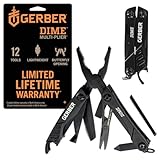
The Dime suits the carrier whose small emergencies involve gripping: pulling staples, bending wire back into place, holding a nut while the other hand drives, extracting the hook that the fish swallowed deep. It is a butterfly-opening mini multitool with spring-loaded needle-nose pliers at its heart and twelve functions around them, including a knife blade, scissors, drivers, a package opener, and a bottle opener, in a black-finished package of about 2.2 ounces. That is the heaviest carry on this list, and the review below treats that honestly — but for pliers people, nothing else here substitutes.
- 12-in-1 mini multitool, model 30-000469
- Spring-loaded needle-nose pliers with wire cutters
- Knife blade, scissors, drivers, package opener, bottle opener
- About 2.2 oz, butterfly-opening design
- Keychain carry with lanyard/key ring attachment
Strengths
- Real pliers — the only pick here that truly grips, pulls, and cuts wire
- Spring-loaded jaws make one-handed small work far easier
- Dedicated package opener saves the knife blade from tape glue
Trade-offs
- Heaviest and bulkiest pick here — you will feel it on light key rings
- Scissors are smaller and less capable than the Micra’s
- Black finish shows wear at edges and pivot over time
The Dime’s design argument is that pliers are the one multitool function with no workaround: you cannot improvise a grip with a knife blade, not safely. In miniature, pliers pull cotter pins, straighten bent key rings, hold small hardware, and turn the wing nuts that fingers cannot. Gerber’s spring loading matters at this scale, because the jaws reopen themselves for the next grip, turning a fiddly two-hand operation into a one-hand rhythm. The rest of the toolset is sensibly chosen, and the retail-package opener — a small hooked blade for clamshells and tape — is the feature owners end up praising most after the pliers, because it keeps the main blade clean.
The honest limitations are size and refinement. On a minimal key ring with two keys, the Dime is a presence; in a suit pocket, it prints. Its scissors do light work adequately and no more, and owners who clip thread and open packaging all day will prefer the Micra. Think of the Dime as the keychain tool for people whose other tools live far away — delivery drivers, field techs, anglers, cyclists — rather than for office carriers. Chosen by the right owner, it is the most capable tool on this list; chosen by the wrong one, it is the first to be left on the dresser.
Best for: Pliers-led small work — wire, staples, hardware, hooks / Not suited for: Minimalist key rings or scissors-heavy daily use
Victorinox Classic SD — Best Ultralight Classic
The Classic SD suits the purist: the smallest, lightest legitimate multitool in the world, and the one that disappears so completely on a key ring that owners forget it until the moment it saves them. In 58 millimeters and 0.7 ounces, Victorinox fits seven functions — a small blade, scissors, a nail file ending in a 2.5 mm screwdriver tip, a key ring, tweezers, and a toothpick. It is Swiss-made, has been produced in staggering numbers for generations, and comes in more colors and designs than any other tool here, which is why it is also the default gift in this category.
- 7 functions in a 58 mm Swiss-made body
- Weighs 0.7 oz (21 g)
- Small blade, scissors, nail file with 2.5 mm screwdriver
- Tweezers and toothpick stored in the scales
- Red Cellidor scales on this classic version
Strengths
- Lightest and smallest full-function pick — zero carry penalty
- Scissors and blade are sharper and better finished than the size suggests
- Tweezers and toothpick onboard cover daily micro-tasks
Trade-offs
- No Phillips driver — flat and small screws only, via the file tip
- Tools are small; large hands find them fiddly
- Plastic scales scuff and can crack if crushed in a back pocket
What the Classic SD understands is that the most common keychain tasks are tiny: a loose thread, a hangnail, a splinter, a package’s tape seam, a fingernail before a meeting. Its scissors snip with a precision that embarrasses bigger tools, the little blade is genuinely sharp from the factory, and the whole thing asks nothing of you — no pocket space worth mentioning, no weight, no jangling bulk. As a backup carried alongside a main knife, in the spirit of best swiss army knife for edc, it is close to perfect, and as a first multitool for a young person, it teaches the carry habit at the lowest possible cost of entry.
The honest limitation is capability ceiling. The Classic SD’s driver is a flat 2.5 mm tip on the file; the Phillips screws that hold the modern world together — battery covers, toys, electronics — mostly refuse it, which is exactly the gap the Rambler below exists to fill. Its scale tools, the tweezers and toothpick, are small separate pieces that can be lost if a scale is damaged, and replacements are a thing owners eventually buy. None of this dims the design; it defines its lane. In that lane — ultralight, ultra-available — nothing else on this list touches it.
Best for: Ultralight everyday backup and the world’s easiest gift / Not suited for: Phillips screws, pliers tasks, or large hands wanting full-size tools
Check on Amazon
Victorinox Rambler — Best for Small Screws
The Rambler suits the gadget-minded carrier whose life is held together by tiny Phillips screws. It takes the Classic SD’s 58 mm chassis and rearranges the toolset into ten functions headlined by a magnetic Phillips screwdriver — paired with a bottle opener and wire stripper on the same implement — alongside the blade, scissors, nail file, tweezers, and toothpick. That one substitution transforms the tool: battery covers, toy compartments, remote controls, glasses, and small electronics all meet their match on your key ring.
- 10 functions in a 58 mm Swiss-made body
- Magnetic Phillips screwdriver (0/1 size class) with bottle opener and wire stripper
- Small blade, scissors, nail file
- Tweezers, toothpick, and key ring
- Red scales, model 54031
Strengths
- The Phillips driver the Classic SD lacks — the keychain gadget-fixer
- Magnetic tip holds tiny screws that fingers cannot
- Same vanishing 58 mm carry as the Classic SD
Trade-offs
- Drops the Classic’s flat screwdriver tip on the file — a real swap, not a pure upgrade
- Same small-tool fiddliness for large hands
- Slightly harder to find than the Classic SD on store pegs
Owners who upgrade from a Classic SD to a Rambler describe the same discovery: the tool they reach for daily changes from the scissors to the driver. The magnetic Phillips is the detail that matters — at this screw size, magnetism is the difference between a fix and a lost screw in the carpet — and Victorinox’s execution, combining driver, cap lifter, and wire stripper in one implement, is a small masterpiece of the 58 mm format. Everything else carries over: the sharp little blade, the precise scissors, the scale tools. It is the connoisseur’s 58 mm, the one recommended across best cheap swiss army knife discussions whenever the budget stretches a little beyond the Classic.
The honest limitation is that the Rambler’s gain is a genuine trade: to fit the Phillips combo tool, the nail file loses the Classic’s screwdriver tip, so flat-head micro screws become a job for the blade tip or another tool — a workaround we mention only to discourage it, since prying and turning with a knife tip is how tips snap. Know your screws: households full of battery toys and electronics belong to the Rambler; households where the Classic’s mix already works gain nothing by switching. Both are correct answers, which is why both are on this list.
Best for: Parents, gadget owners, and anyone beset by tiny Phillips screws / Not suited for: Anyone who needs the Classic SD’s flat driver tip daily
Check on Amazon

Gerber Shard — Best Bladeless One-Piece
The Shard suits the carrier who wants a tool with nothing to break, open, or explain. It is a single piece of steel, about the size of a key, combining seven functions: a pry bar, small and medium flat drivers, a Phillips driver, a bottle opener, a wire stripper, and a lanyard hole for the key ring. There is no blade — which is precisely the point for people who work, study, or travel in places where blades are restricted — and no moving parts, which means the maintenance schedule is “none” and the failure mode is “lost,” full stop.
- 7-in-1 one-piece steel tool, model 22-01769
- Pry bar, flat drivers, Phillips driver
- Bottle opener and wire stripper
- No blade — suitable where blades are restricted
- Lanyard hole for key ring carry
Strengths
- Nothing to break, loosen, rust shut, or snap — one piece of steel
- Pry bar saves knife blades from their most common abuse
- Bladeless design suits restricted workplaces and travel days
Trade-offs
- No blade and no scissors — it cannot cut anything but tape by scoring
- Drivers are short and stubby; recessed screws are out of reach
- Pry tip can poke in a tight pocket if carried carelessly
The Shard’s deepest virtue is behavioral: it gives you something to pry with. Paint cans, battery covers, staples, and stubborn packaging invite knife abuse daily, and a one-piece pry tool absorbs all of it without complaint. Its drivers, while short, are honestly shaped and handle furniture hardware, switch plates, and hose clamps at the keychain scale. Owners who pair a Shard with a small folding knife — the combination many best pocket knives multitools readers land on — find the pair covers nearly everything either tool misses alone.
The honest limitations follow from the concept. It cannot cut, so thread, cord, and clamshells need a partner tool or teeth-and-regret. Its drivers reach only exposed screw heads. And while Gerber markets the design as travel-friendly, airport security anywhere has the final word on any tool — treat “bladeless” as “far more likely to be fine,” not a guarantee, and pack it in checked luggage when a trip matters. Within those lines, the Shard is the toughest, simplest pick here, and the one most likely to be on your keys in ten years, unchanged.
Best for: Bladeless carry, prying tasks, and zero-maintenance simplicity / Not suited for: Anyone whose keychain tool must cut or snip
Nite Ize DoohicKey — Best Carabiner Style
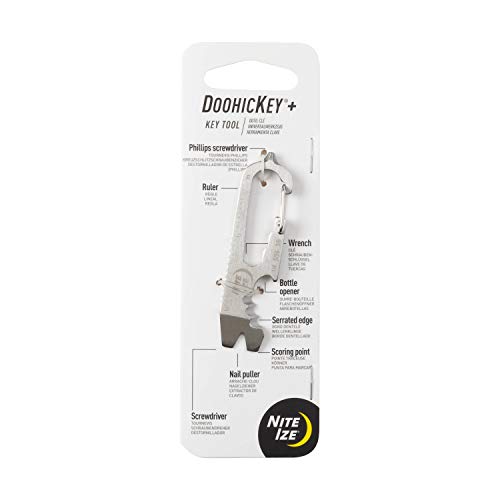
The DoohicKey suits the carrier who does not want another thing on the ring so much as a smarter ring itself. It is a stainless steel carabiner-shaped tool — the KMTSE-11-R3 version listed here — that clips to a belt loop, bag, or keys and packs a ruler, wrench openings, a bottle opener, a box cutter edge, and a screwdriver into the carabiner’s body. The clip is the carry system and the tool in one, which makes it the natural pick for people who hang their keys rather than pocket them: climbers, dog walkers, facilities staff, and anyone whose keys live on a loop.
- Stainless steel carabiner-format multi tool, model KMTSE-11-R3
- Carabiner clip for keys, belt loop, or bag
- Ruler markings along the body
- Wrench openings in common small sizes
- Bottle opener, box cutter, and screwdriver functions
Strengths
- Carabiner carry keeps tools accessible without pocket bulk
- One-piece stainless build — nothing to fold or break
- Box cutter edge opens packages without a blade
Trade-offs
- No blade, scissors, or pliers — opener-and-driver tasks only
- Carabiner gate is for keys and light duty, not climbing loads
- Larger footprint than the folding picks when pocketed
Nite Ize built its name on clever carry hardware, and the DoohicKey shows it: the tool’s best feature is that it changes where your keys live for the better. Clipped to a loop, the whole ring stops burying itself in a pocket, and the tool’s functions sit at the surface — the bottle opener and box cutter, its two most-used implements, need no unfolding at all. The wrench cutouts and ruler are honest occasional-use features, there when a bike fender or a piece of flat-pack furniture needs a quick measurement or a quarter-turn.
The honest limitations are scope and rating. The function set is the narrowest here — no cutting beyond a scoring edge, no gripping, no snipping — so the DoohicKey is a complement to a knife or folding tool, not a replacement for one. And the carabiner is a key carrier, not life-safety hardware: never clip a load, a pet’s lead under strain, or anything whose loss would matter beyond inconvenience to its gate. Judged as what it is — the best-organized key carry on this list with a useful tool folded into it — it earns its place.
Best for: Loop-and-bag carriers who want tools at the surface / Not suited for: Anyone needing a blade, scissors, or pliers from the same tool
Comparison Table
| Tool | Functions | Closed size | Headline tool | Blade? |
|---|---|---|---|---|
| Leatherman Micra | 10 | 2.5 in | Spring-action scissors | Yes |
| Gerber Dime | 12 | Mini pliers format | Spring-loaded pliers | Yes |
| Victorinox Classic SD | 7 | 58 mm | Scissors and blade, 0.7 oz | Yes |
| Victorinox Rambler | 10 | 58 mm | Magnetic Phillips driver | Yes |
| Gerber Shard | 7 | One-piece, key-sized | Pry bar | No |
| Nite Ize DoohicKey | Multi | Carabiner format | Clip carry plus opener | No |
Keychain Tools vs. Pocket Multitools: Where the Line Is
Readers often arrive at this guide from the full-size multitool world and ask a fair question: why accept tools this small at all? The answer is a division of labor that experienced carriers settle into. The full-size tool — a Wave-class multitool or one of the EDC picks in the guide linked at the top of this article — is a capability tool: it lives in a bag, a belt sheath, or a vehicle, and it handles jobs with real torque, real cutting, and real pliers. The keychain tool is an availability tool: it lives on your person at the exact moments the capability tool is in another room, another building, or another vehicle. Judged as capability, keychain tools lose; judged as availability, nothing else competes, because nothing else is guaranteed to be in your pocket at the office, the restaurant, and the school gate.
The line between the classes is roughly two ounces and three inches. Below it, a tool can ride a key ring indefinitely without negotiating for its place every morning. Above it, a tool needs a pocket of its own, a clip, or a sheath — all legitimate, all one step further from always-present. This is why this guide is so strict about bulk: every gram above the line is paid for in carry probability, and carry probability is the entire product. It is also why pairing is the sophisticated answer rather than choosing a side. A Micra on the keys and a full-size tool in the bag is a system with no gaps: micro-tasks are handled where they occur, and real tasks are a bag away. Owners who try to make one tool do both jobs usually end up with a mid-size tool that is too big for keys and too small for work — the worst seat in the house.
One more boundary deserves honesty: safety and legality scale with size in your favor here, but do not vanish. A 58 mm blade is a blade under most workplace and venue policies, and small tools invite casual handling that dulls technique — pinched fingers and slipped drivers are the common keychain injuries, minor but real. Treat the little tools with the same respect as their big brothers: cut away, close before pocketing, and keep them out of small children’s reach exactly as you would a knife, because two of the families on this list are knives, whatever their size suggests.
How to Choose a Keychain Multitool
Start with your most common micro-task. Keep a mental tally for a week: what did you actually need? If the answer is cutting threads, tags, and packaging, scissors lead and the Micra or a Victorinox is your tool. If it is screws, the Rambler’s Phillips rules the list. If it is gripping and pulling, only the Dime qualifies. If it is prying and opening, the one-piece tools win. Keychain tools are too small to be generalists in the way full-size multitools are; the right choice is the one whose headline tool matches your recurring annoyance, with everything else as bonus.
Respect the carry budget. Weigh your current key ring in your hand and be honest about how much presence you tolerate. Under an ounce — the Victorinox pair — is invisible. Around an ounce and a half to two ounces — Micra territory, then the Dime at about 2.2 ounces — is noticeable but livable for most. Beyond that, you are carrying a pocket tool on a ring, and history says it will migrate to a drawer. Also check the tool’s closed manners: exposed sharp corners, tools that can creep open, and aggressive pocket-clip-like protrusions all fail the keychain test no matter how good the spec sheet looks.
Decide your blade policy. Blades on keychain tools are small and light-duty, but they are blades: some workplaces, schools, venues, and travel situations restrict them entirely. If your keys cross those thresholds daily, the bladeless pair here — Shard and DoohicKey — keep you equipped for prying, driving, and opening without the compliance headache. If your keys never cross them, a blade plus scissors covers the two most common cutting needs at this scale, and you should not give them up lightly.
Check the small print of construction. Stainless steel is the right material at this size because keychain tools live against sweat, rain, and pocket lint. Springs are the usual failure point on folding minis — a tool whose scissors or pliers lose their spring has lost its charm — so established makers with warranty support, like the brands heading this list, are worth their modest premium over novelty-store equivalents. Finally, look at how the tool attaches: a sturdy split ring or a real carabiner gate, because the most common way keychain tools die is not breakage but a cheap ring letting go over a drain grate.
One final consideration belongs in every keychain buying decision: redundancy is a feature here, not a waste. A keychain multitool that duplicates a tool already on your larger multitool is not redundant in any way that matters, because the two tools live in different places and fail differently — the big tool is forgotten, left in another bag, or checked in luggage, while the keychain tool simply persists. Experienced carriers therefore choose keychain tools for the gaps in their whole system rather than for novelty: scissors where the big tool lacks them, a driver where the big tool’s is weak, a blade-free option where the big tool cannot travel. Read your own carry as a system, pick the keychain tool that completes it, and the smallest purchase in this guide becomes the one that quietly rescues the most days.
Key Takeaways
- Usefulness divided by annoyance decides keychain tools — carry truth beats function counts.
- Scissors are the most-used keychain implement; the Micra’s are the best here.
- Only the Dime truly grips; only the Rambler truly does Phillips screws.
- Bladeless one-piece tools trade cutting for simplicity and restricted-place carry.
- Stay near or under two ounces, or the tool will leave your keys within a month.
How to Get the Most from a Keychain Multitool
- Set up the ring properly. Put the tool on its own small split ring or clip so it can be removed in seconds — you will use it twice as often if detaching it is effortless.
- Learn each implement once, at home. Open everything, note what locks and what does not, and find the nail nicks with your eyes closed. Keychain tools are used one-handed, in bad light, more often than you expect.
- Keep the blade and scissors clean. Tape glue is the enemy; a wipe with a little oil on a cloth after packaging duty keeps pivots sweet.
- Oil the pivots sparingly. A drop of light oil worked into each joint a few times a year prevents the gritty stiffness that pocket lint causes.
- Sharpen the small blade gently. A few light strokes on a fine ceramic or a strop restores it; small blades need maintenance, not reprofiling — the methods in the sharpening guide linked earlier apply at miniature scale.
- Audit monthly. If a tool has not been touched in a month, swap its slot for a different pick rather than carrying dead weight out of habit.
Troubleshooting, in the usual pattern: Problem: the tool keeps vanishing into the bottom of a bag → move it to a carabiner carry like the DoohicKey’s, clipped where your hand lands. Problem: scissors chew thread instead of cutting → the pivot has loosened or the blades are gummed; clean, oil, and if the pivot is riveted and loose, the maker’s warranty is the fix. Problem: the tool opens in your pocket → its detent has worn or it is riding against keys that lever it; carry it on its own short tether on the ring’s far side. Problem: drivers cam out of small screws → you are using a flat tip in a Phillips head or the wrong size; match the driver to the screw, which is the Rambler’s whole reason to exist. Problem: rust freckles on a stainless tool → dry it after wet days and oil the pivots; stainless resists rust, it does not repeal it.
What Keychain Multitools Cannot Do
Honesty about limits is what keeps small tools loved instead of resented, so let us draw the lines clearly. A keychain tool cannot apply meaningful torque: its drivers are short, its handles give no leverage, and a screw that resists a keychain driver needs a real screwdriver, not more force on a 58 mm handle — that path ends in a snapped tip or a skinned knuckle. It cannot cut like a knife: the little blades are for tape, thread, packaging, and light cord, and asking them to process cardboard boxes daily or whittle tent stakes will dull and eventually damage them. It cannot grip like pliers unless it is the Dime, and even the Dime’s jaws are sized for wire, staples, and small hardware, not plumbing fittings or rusted bolts.
It also cannot substitute for preparation. The keychain tool is the second line — the thing that handles the surprise while you are away from the first line, which is a proper toolkit, a full-size multitool in the bag, and a maintained pocket knife. Carriers who understand this carry both layers without resentment, the way a spare tire does not compete with the four on the car. Carriers who expect the keychain tool to be the whole system end up abusing a two-ounce tool into failure and concluding the category is junk, when the category simply never promised what was demanded of it. Buy the tool for the job it describes — a hundred small saves a year — and it will be the best-value item on your key ring.
Common Buying Mistakes
Counting functions instead of weighing them. A 20-function novelty tool with wobbly implements loses to a 7-function Victorinox on the first real task. Count the tools you will use weekly; the rest is marketing.
Buying pliers when you need scissors. The Dime is excellent — for pliers people. Most owners’ daily tasks are cutting tasks, and they end up carrying the bulkiest tool here to do the Micra’s job worse.
Ignoring blade rules where you actually go. A keychain blade that must be surrendered at your workplace door twice a week is a bad tool for you, however good it is. Bladeless picks exist for your life, not as lesser options.
Trusting a cheap split ring. The tool is only as carried as its weakest ring. Replace flimsy rings immediately; losing a tool down a storm drain is a silly way to end a good purchase.
Expecting keychain tools to do pocket-tool jobs. These are micro-task tools. Asking one to assemble furniture or cut rope under load ends in bent implements and unfair reviews; pair with a full-size tool for real work.
Final Recommendation
For most people, the Leatherman Micra is the keychain multitool to buy: the best scissors in the class, a complete and honest toolset, and a flat profile that disappears onto a key ring. The runner-up is the Victorinox Rambler, which we would choose instead for gadget-heavy households where tiny Phillips screws are the daily enemy, and for anyone who wants the lightest possible carry with real capability. Pliers people should skip both and take the Dime; the blade-restricted should take the Shard. The right keychain tool is the one still on your keys next year.
Frequently Asked Questions
Are keychain multitools allowed on planes?
In most jurisdictions, any tool with a blade must go in checked luggage, and rules for bladeless tools vary by country and by the officer on the day. Bladeless one-piece tools like the Shard are far more likely to travel without issue, but no buying guide can guarantee a security decision. When a trip matters, put any multitool in checked baggage and carry on with confidence instead.
What is the most useful tool on a keychain multitool?
For most owners, scissors — they handle threads, tags, packaging film, tape, and first-aid trimming, none of which a knife blade does as safely at this size. After scissors come the small blade and a Phillips driver. That usage pattern is why the scissors-led Micra tops this list and why the Rambler’s driver earns it the runner-up spot.
Can a keychain multitool damage a car ignition?
Heavy key rings are a long-standing concern for ignition wear in older vehicles with traditional key slots: the weight of the ring swings and loads the cylinder. A sub-ounce tool like a Victorinox adds little; a heavy ring plus the bulkiest tools is worth avoiding. Push-button-start cars make the question moot, but the general principle — keep the driving key’s ring light — is sound.
Keychain multitool or Swiss Army knife — which is better?
They overlap, and two picks here are literally small Swiss Army knives. The distinction is carry: a 58 mm Victorinox is designed for the key ring, while larger Swiss Army knives and pocket multitools are designed for a pocket and offer bigger tools in exchange. Most carriers end up with one of each, keychain for ubiquity and pocket tool for capacity.
How do I stop a keychain tool from scratching my phone?
Carry the phone and the keys in different pockets — the simplest and only fully reliable answer. If they must share, choose smooth-profile tools like the Micra or the Victorinox pair, avoid exposed pry tips facing outward, and consider a small pouch or the carabiner carry that keeps the ring clipped at a pocket’s edge rather than loose at its bottom.
Do keychain multitools rust?
Quality stainless tools resist rust well but are not immune, especially in pivots where water and lint sit. Dry the tool after a soaking, oil the joints occasionally, and do not store it wet in a gym bag. Freckles of surface rust usually clean off with a cloth and oil; deep pitting means the tool lived wet for a long time.
How long does a keychain multitool last?
A quality stainless keychain tool from the makers on this list commonly lasts a decade or more of daily carry; the Victorinox 58 mm models and the Micra are famous for outliving the cars whose keys they rode on. The usual end is not breakage but loss, followed by wear items: springs tire, scale tools like tweezers get misplaced, and blades dull if never maintained. Buy from makers with warranty support, maintain the pivots, and expect the tool to be a long-term companion rather than a consumable — which is also why choosing the right headline tool matters more than saving a little on an unknown brand.
What is a good first keychain multitool for a teenager?
Start with the Classic SD or the Micra, subject to school rules — many schools prohibit any blade, in which case the bladeless Shard is the responsible choice. The folding classics teach real tool habits at a size and price where a loss is a lesson rather than a disaster, and their scissors and drivers handle the actual tasks of teenage life: packaging, threads, screws on gadgets, and the occasional splinter.