Disclosure: As an Amazon Associate, umtsmarttool.com earns from qualifying purchases. Links on this page are affiliate links; they cost you nothing extra. Prices and availability change often, so check the current Amazon listing before you buy.
An air purifier comparison tool sounds like software, but the most useful version is a method: a fixed set of criteria, in a fixed order, applied the same way to every machine you consider. Shoppers get into trouble because listings are not comparable at a glance — one brand shouts about coverage, another about quietness, a third about a filter with a trademarked name — and the brain quietly compares whichever number is biggest. This page gives you the tool in three forms: the criteria that actually decide whether a purifier works in your home, a worked example that runs five well-known models through those criteria side by side, and a simple scoring worksheet you can copy for any two or three machines you are torn between. By the end you will be able to compare any air purifier comparison tool output, spreadsheet, or sales page against your own numbers and spot where the marketing is doing the thinking for you.
Why does a method matter so much in this category? Because an air purifier’s output is invisible. You cannot see clean air, you cannot hear the difference between adequate and inadequate filtration, and a machine that is quietly failing looks exactly like a machine that is quietly succeeding. The only defence is arithmetic done in advance: does this box move enough air for this room, does its filter system match this home’s actual pollutants, and will its running costs stay acceptable for the years you plan to own it? Those three questions, answered with listing data, predict satisfaction better than any single specification — and they are the spine of the comparison method below.
Key Takeaways
- Compare in a fixed order every single time: room fit (CADR versus your square footage) first, filtration type second, filter economics third, noise at working speed fourth, features last.
- Never compare one brand’s headline coverage figure against another brand’s CADR; convert everything to the AHAM two-thirds rule or to air changes per hour in your actual room.
- Filter cost over three years routinely exceeds the price gap between rival machines, so it belongs in the first comparison table, not in a footnote.
- The worked example below shows the same five models producing five different winners depending on which criterion leads — that is normal, and it is why your room and your pollutant decide, not a universal ranking.
- A five-line scoring worksheet, filled in from listing data, settles most two-model dilemmas in about ten minutes — and the same worksheet, kept on file, becomes the fastest way to judge the next sale, the next room, or the next replacement machine years from now without starting the research over.
In this guide
The Five Criteria of the Air Purifier Comparison Tool Method
Criterion 1: Room Fit — CADR Against Your Square Footage
Clean air delivery rate is the closest thing this category has to a universal currency. It states how many cubic feet of filtered air a machine delivers per minute, tested for tobacco smoke, dust, and pollen. Smoke CADR is the number to shop by because smoke particles are the smallest and hardest to capture; a machine that handles smoke handles the easier categories at least as well. The Association of Home Appliance Manufacturers’ two-thirds rule turns CADR into a room size: multiply the smoke CADR by 1.5 to get the largest room, in square feet, where the machine delivers meaningful cleaning at high speed. A purifier with a smoke CADR of 200 therefore suits a room of about 300 square feet.
Air changes per hour refine the picture. For maintenance cleaning in an average home, two air changes per hour at the speed you actually run is a reasonable floor; for allergy bedrooms, wildfire smoke, or a home with heavy pet dander, four to five changes is the target professionals use. This is why headline coverage numbers mislead: a listing that claims a machine covers a large area “in one hour” is describing roughly one air change at full speed — the bare minimum, delivered at the loudest setting. When you build your comparison, write down CADR or the AHAM verified room size, and ignore unverified coverage claims entirely. If a listing offers neither, that absence is itself comparison data: established brands publish these figures because they survive testing.
Criterion 2: Filtration Match — Particles, Gases, or Both
Every purifier in this guide cleans with some combination of a pre-filter, a HEPA-grade particle filter, and activated carbon. The comparison question is not which machine has the longest filter list but which stages carry real weight. Particle problems — pollen, dust, dander, mould spores, smoke particulate — are solved by the HEPA stage and by airflow: a true HEPA element in a well-sealed housing, moved by a fan strong enough for your room. Gas problems — pet odors, litter box smell, cooking smells, paint and furniture off-gassing, the volatile compounds in vape aerosol — are solved only by activated carbon, and only in proportion to how much carbon there is. A carbon-coated sheet weighs ounces; a dedicated carbon filter weighs pounds. When odor matters, compare carbon as a physical quantity: separate deep carbon filters, like the Winix design examined below, sit in a different league from combined cartridges, and no trademark name changes that physics.
Two technologies deserve explicit handling in any comparison. Ionizers and plasma stages can help particles deposit or agglomerate, but they are supplements, not substitutes, for a filter, and some shoppers prefer machines where the ion stage can be switched off entirely. Ultraviolet lamps inside consumer purifiers act on air that passes very close to the bulb for a fraction of a second; treat UV as a minor extra, never as a reason to choose one machine over another with better CADR or carbon. A disciplined comparison writes these features in a “notes” column, not in the score.
Criterion 3: Filter Economics — The Three-Year Number
The purchase price is the down payment; filters are the subscription. For each candidate, find the genuine replacement filter listing, note its price and the manufacturer’s stated interval, and compute three years of ownership: purchase price plus the filters those three years consume. Small cartridges replaced twice a year can make a cheap machine the expensive one by year two, while a premium machine with a long-life filter closes the gap. Also note whether the pre-filter is washable — a rinsable pre-filter, as on the Winix and Coway designs below, protects the expensive stages and quietly extends their working life. Finally, check that the filter is sold by the brand itself and in current production; a comparison that ends with an orphaned machine is a comparison you will repeat in eighteen months.
Criterion 4: Noise at Working Speed
Manufacturers headline the quietest speed, which often moves too little air to matter. The honest comparison is noise at the speed that delivers your room’s target air changes. That figure is harder to find — sometimes it is in the AHAM directory data, sometimes in the manual — but even the sleep-mode and turbo figures bracket it usefully. Decibels are logarithmic: the difference between a low-twenties sleep mode and a low-thirties one is the difference between a machine you forget and a machine you negotiate with. Large machines hold a structural advantage here, because a big fan turning slowly is quieter than a small fan sprinting; when two models tie on everything else, the larger one usually wins the bedroom.
Criterion 5: Features That Survive the First Month
Auto mode with a real air quality sensor is the feature owners still use after a year, because it solves the central dilemma — high speed cleans better but annoys more — by ramping up only when the air worsens. App control matters if the machine lives somewhere inconvenient or if you want schedules, such as a cleaning burst before bedtime. Timers, child locks, filter indicators, and display dimming are small but real. Everything else — aromatherapy pads, mood lighting, novelty modes — should score zero in a disciplined comparison. Features are the last criterion deliberately: they break ties between machines that already fit the room, match the pollutant, and price out fairly over three years. The moment a feature leads your comparison, the tool has stopped working.
A Worked Example: Five Known Models Through the Tool
To show the method in motion, here are five established models — all verified against current Amazon listings through this site’s Creators API account, with details in this article’s sources file — compared on the five criteria. Read the verdicts carefully: each model wins something, which is exactly what a real comparison looks like.
| Model | Room fit (listing basis) | Filtration emphasis | Filter style | Noise note | Standout feature |
|---|---|---|---|---|---|
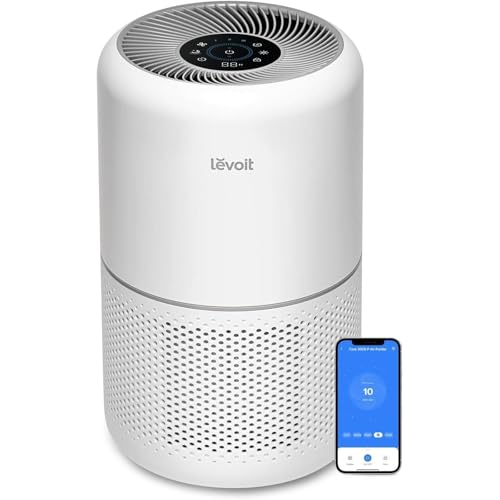
| Levoit Core 300S-P | Small to mid rooms; AHAM Verifide rating | Balanced particles, light carbon | Single 3-in-1 cartridge | Sleep mode listed at 24 dB | App and voice control |
| Winix 5510 | Large rooms, up to about 1,881 sq ft per hour on the listing | Particles plus heavy carbon | Separate True HEPA and carbon filters | Auto mode manages speed | Washable pre-filter, deep carbon stage |
| Coway Airmega 150 | Mid rooms, up to about 1,035 sq ft on the listing | Balanced, with washable pre-filter | Filter set, roughly yearly cycle | Quiet auto operation | Air quality display, 3-year warranty on listing |
| Blueair Blue 211i Max | Very large rooms, up to about 3,235 sq ft per hour on the listing | High-volume particles, moderate carbon | Combined filter plus fabric pre-filter | Listed from 23 dB | HEPASilent high airflow at low noise |
| Medify MA-40 | Mid to large rooms, up to about 1,793 sq ft per hour on the listing | Balanced with above-average carbon for a tower | Single 3-in-1 cartridge | Standard tower range | Slim footprint, multi-pack options |
Levoit Core 300S-P — The Small-Room Benchmark
Badge: Best for bedrooms and offices
- Filtration: 3-in-1 cartridge with HEPA stage
- Verification: AHAM Verifide on the listing
- Sleep mode: listed at 24 dB
- Controls: WiFi app, voice assistants, auto mode
In comparison terms, the Core 300S-P is the machine that sets the small-room baseline: verified ratings, a cartridge the size of a wastebasket, and smart controls that larger rivals sometimes lack. Its comparison weakness is carbon quantity — the combined cartridge handles everyday smells but saturates under sustained odor load — and its comparison strength is the ecosystem: multiple cartridge variants tuned for pets or toxins let owners adjust the same machine to a changing problem. Score it highly for a bedroom or office; do not let a generous coverage claim talk you into deploying it in an open-plan living area.
Strengths
- Verified ratings and a quiet sleep mode make bedroom comparisons easy
- App scheduling few rivals at this size offer
- Cartridge variants extend the machine’s useful range
Trade-offs
- Light carbon stage loses any odor-focused comparison
- Cartridge format means HEPA and carbon are replaced together
- Physically small airflow ceiling
Best for: bedrooms, offices, nurseries. Not suited for: odor-heavy or open-plan spaces.

Winix 5510 — The Odor-Comparison Winner
Badge: Best carbon stage in the comparison
- Filtration: True HEPA plus separate high-deodorization carbon filter
- Pre-filter: washable, protects both main stages
- Controls: auto mode, app support, PlasmaWave stage that can be switched off
- Lineage: current generation of the 5500-2 design
The 5510 is what the filtration-match criterion looks like when a manufacturer takes gases seriously. Because its carbon is a deep, separate filter rather than a coating, it wins any comparison where litter boxes, dogs, cooking, or smoke odors drive the purchase — see the dedicated best Winix air purifiers coverage for the wider range. Its costs show up in criterion three: two substantial filters to replace on a cycle, and a cabinet bigger than the slim towers. In a particle-only comparison against the Blueair it loses on volume per decibel; in an odor comparison it is not close.
Strengths
- Deepest carbon capacity in this comparison set
- Washable pre-filter improves three-year economics
- Ion stage can be disabled for filtration-only operation
Trade-offs
- Largest filter bill of the five over time
- Big, utilitarian cabinet
- More machine than a small bedroom needs
Best for: pet homes, odor problems, family rooms. Not suited for: minimalists wanting the smallest footprint or filter bill.

Coway Airmega 150 — The Ownership-Comparison Winner
Badge: Best warranty and display
- Filtration: HEPA and carbon set with washable pre-filter
- Monitoring: real-time air quality display driving auto mode
- Warranty: 3 years stated on the listing
- Coverage: mid-size rooms, about 1,035 sq ft basis on the listing
The Airmega 150 rarely tops any single specification table, and it wins real comparisons anyway, because ownership criteria — warranty length, filter interval, a display the household actually reads — compound over years. Its air quality ring turns an invisible process into a glanceable fact, which changes behaviour: people run the machine when it matters. In the scoring worksheet below it typically places first or second on economics and features while staying competitive on fit, the profile of a machine few owners regret.
Strengths
- Three-year warranty, above the category norm
- Air quality display encourages correct use
- Design that survives being looked at daily
Trade-offs
- No app control
- Mid-weight carbon stage
- Everyday pricing sits above entry rivals, so comparisons must be three-year ones
Best for: living rooms and long-term owners. Not suited for: app-first shoppers or heavy odor loads.

Blueair Blue 211i Max — The Volume-Per-Decibel Winner
Badge: Best for large rooms
- Filtration: HEPASilent combined filter
- Coverage: very large rooms on the listing’s per-hour basis
- Noise: listed from 23 dB
- Pre-filter: washable fabric, colour options
Run the room-fit criterion for a 600-square-foot open-plan space and the 211i Max is the only machine in this set with true headroom — and headroom converts directly into the noise criterion, because it can deliver target air changes at a low, calm speed. That two-criteria cascade is the most common way real comparisons are won. Its costs are footprint and premium filter pricing; its carbon stage, while respectable, is not the Winix’s equal for dedicated odor work. Shoppers comparing within the brand should also run the smaller 311i Max through the same worksheet; the best Blueair air purifiers roundup maps the family.
Strengths
- Highest clean-air headroom in the set
- Quiet operation at working speeds for its class
- Washable fabric pre-filter lowers consumable costs
Trade-offs
- Large footprint to place and to store packaging for
- Premium-tier filter pricing
- Wasted capacity in small rooms
Best for: open-plan homes, large living areas, noise-sensitive households. Not suited for: small bedrooms or tight budgets.

Medify MA-40 — The Floor-Plan Winner
Badge: Best slim tower
- Filtration: 3-in-1 cartridge with HEPA stage and carbon
- Coverage: mid to large rooms on the listing’s per-hour basis
- Format: slim tower, touch controls, timer, child lock
- Options: multi-pack listings for multi-room homes
The MA-40 demonstrates why format belongs in a comparison even though it is not a filtration spec: a machine that fits the only available corner beats a theoretically better machine that has nowhere to stand. Its cartridge carries more carbon than most slim towers, giving it credible smoke-season performance, and Medify’s multi-pack listings make it the economics winner for two-room deployments. It concedes the smart-features criterion entirely — control is on-device — which matters only if the worksheet says it matters to you.
Strengths
- Fits floor plans the consoles cannot
- Good carbon content for the tower class
- Multi-pack value for whole-home coverage
Trade-offs
- No app or voice control
- Combined cartridge replacement cycle
- Tower stability around toddlers and large pets
Best for: large bedrooms, awkward corners, multi-room buyers. Not suited for: smart-home-first shoppers.
The Ten-Minute Scoring Worksheet
Here is the tool in its portable form. For each candidate machine, open its listing and fill in five lines. Score each line from one to five against your own needs, multiply by the weight in brackets, and add the results. The weights encode the order of the criteria: fit and filtration decide, economics and noise refine, features decorate.
| Line | What to write down | Weight |
|---|---|---|
| Room fit | Smoke CADR or AHAM room size versus your room’s square footage; headroom is good, shortfall is disqualifying | ×3 |
| Filtration match | HEPA stage quality for particles; physical carbon amount for gases; washable pre-filter if hair or coarse dust is present | ×3 |
| Three-year cost | Machine price plus genuine filters consumed in three years | ×2 |
| Noise at working speed | Sleep-mode figure for bedrooms; mid/turbo behaviour for living rooms | ×2 |
| Useful features | Auto mode with sensor, app or scheduling, filter indicator, display dimming — count only ones you will use | ×1 |
Two rules keep the worksheet honest. First, a zero on room fit ends the comparison for that machine regardless of total score; an undersized purifier with wonderful features is still an undersized purifier. Second, score carbon by weight class, not by presence: a machine either has a substantial carbon stage or it has a token one, and odor households should score token carbon as a one no matter what the marketing calls it. Run the worksheet for the worked-example machines and you will find the Levoit winning small bedrooms, the Winix winning pet homes, the Blueair winning open plans, the Coway winning balanced long-term ownership, and the Medify winning tight floor plans — five winners, one tool, zero contradictions. That is the sign the criteria are doing their job.
If you prefer software to worksheets, the same logic powers any reputable comparison site: input room size, pollutant priority, and budget horizon, and check that the output ranks by CADR and carbon rather than by headline coverage or discount size. A comparison tool that cannot tell you its criteria is asking to be trusted; a worksheet shows its working. For category shortlists already organised by need, the best HEPA air purifiers and best air purifiers for allergies guides apply this same method to their niches.
Comparison Mistakes That Distort Results
Comparing coverage claims across brands. One brand’s “per hour” figure and another’s AHAM room size describe different things. Convert or discard; never place them in the same column.
Scoring UV and ion features as filtration. They are extras. A machine with a modest HEPA stage and a UV lamp loses, correctly, to a machine with a strong HEPA stage and no lamp, on every particle that matters.
Ignoring the pre-filter in dusty or pet homes. Hair and coarse dust clog expensive HEPA media early. A washable pre-filter is an economics feature disguised as a convenience, and in pet homes it can be worth a full point on the three-year cost line.
Letting the purchase price stand in for cost. The three-year number is the cost. Comparisons made on sticker price alone systematically favour small-cartridge machines and punish long-filter-life designs that are cheaper to own.
Comparing at the wrong speed. Noise and CADR both change with fan speed. A machine compared at its quietest setting will look serene and weak; at turbo, powerful and loud. Anchor both numbers to the speed that delivers your target air changes.
Forgetting placement and format. A console that cannot fit your only free wall loses to a tower that can, whatever the worksheet says. Add a notes line for footprint and intake clearance.
Reading a Listing Like an Engineer: Where Each Number Hides
Comparison quality is limited by data quality, so it pays to know where each figure lives on a typical Amazon listing and how much to trust it. The title itself carries the first data: reputable brands put coverage basis, filter type, and headline features in the title because retailers require substantiation for title claims — the listings used in this article’s worked example, verified through the Creators API, state their coverage basis and filter architecture right in the product name. The bullet points carry the second layer: CADR figures, decibel figures, and sensor claims usually appear here, written by the brand. The product information and technical details tables carry the third layer, and the AHAM directory — the independent verifier behind the “AHAM Verifide” mark you will see on listings from brands like Levoit and Blueair — is the external check that the first two layers are honest.
Trust should be graded. An AHAM-verified room size outranks a brand-stated CADR, which outranks a brand-stated coverage figure, which outranks an unqualified “large room” claim. When a comparison includes machines with different grades of data, note the grade beside the number; a machine with a slightly lower but verified figure is often the safer buy than one with a higher unverified figure, because the verified number will still be true when the machine is in your room. Filter data needs the same grading: a stated replacement interval from the brand, a genuine filter listing with a stable price, and a pre-filter you can wash are all verifiable today, while “long-life filter technology” without an interval is a slogan. Reviews, finally, are data about ownership — noise complaints, filter availability, app reliability — rather than about filtration, which no reviewer can see. Mine them for the ownership criteria and ignore their air-quality impressions entirely.
One more grading habit separates careful comparisons from lucky ones: record the date and the source of every figure you write down. Listings change — brands revise titles, coverage bases get restated, filter prices move — and a worksheet built over several evenings can quietly mix figures from different versions of the same page. A dated worksheet is also reusable: when a sale event arrives, you re-check only the price lines and keep the engineering lines you already verified. That is the same discipline this article used, with every product figure taken from the current listing data recorded in its sources file on a single stated date, so the worked example can be re-run by any reader against today’s pages in minutes.
A Fully Worked Worksheet: One Bedroom, Three Candidates
Abstract method becomes clear with concrete arithmetic, so consider a common dilemma: a 220-square-foot bedroom, a cat, mild pollen sensitivity, and a shortlist of the Levoit Core 300S-P, the Winix 5510, and the Coway Airmega 150. The room needs, by the two-thirds rule, a smoke CADR around 150 for solid maintenance cleaning and more for allergy-grade air changes; the cat adds hair for the pre-filter and a moderate odor load for the carbon stage.
Room fit, weight three: the Levoit is sized precisely for this class of room and runs its target air changes at a modest speed — score five. The Coway covers the room with comfortable headroom — score five. The Winix covers it with headroom to spare, which is not better than enough — score five, because the worksheet caps credit at “comfortably sufficient” to avoid rewarding wasted capacity. Filtration match, weight three: the Winix’s deep carbon and washable pre-filter fit a cat household best — five. The Coway’s washable pre-filter helps with hair, its carbon is mid-weight — four. The Levoit’s combined cartridge handles the particles well but its carbon is the lightest here and it has no washable pre-filter stage beyond the cartridge’s outer layer — three. Three-year cost, weight two: the Levoit’s cartridge ecosystem is the cheapest to run — five; the Coway’s yearly set sits in the middle — four; the Winix’s two substantial filters cost the most over three years — three. Noise, weight two: the Levoit’s sleep mode is the quietest tool for the night hours — five; the Coway is calm on auto — four; the Winix, sized for bigger rooms, is fine but not class-leading at bedroom speeds — three. Features, weight one: Levoit’s app and scheduling — five; Winix’s app and auto — four; Coway’s display and auto without app — four.
The weighted totals: Levoit (5×3 + 3×3 + 5×2 + 5×2 + 5×1) = 49. Coway (5×3 + 4×3 + 4×2 + 4×2 + 4×1) = 47. Winix (5×3 + 5×3 + 3×2 + 3×2 + 4×1) = 46. Three machines within three points — a genuinely close comparison, which the worksheet resolves by pointing at the deciding criterion: if the cat’s odor is the household’s chief complaint, the filtration line deserves a heavier weight and the Winix wins; if quiet nights and app scheduling dominate, the Levoit wins; if the machine will later move to a living room, the Coway’s headroom and warranty win. Notice what the exercise proves: there was never a “best” machine in the list, only a best match to a stated set of priorities, and the tool’s real output is the priorities made explicit.
Comparing by Scenario: Four Households, Four Winners
The allergy bedroom. Weight room fit and noise highest, carbon lowest. The comparison becomes a search for verified CADR at a quiet speed, and small smart machines like the Levoit Core 300S-P, run on a schedule that pre-cleans the room before bed, beat larger machines whose extra power goes unused. Add the best air purifiers for bedroom shortlist to the candidate pool for this scenario.
The pet household. Weight filtration match and the pre-filter line highest. Hair load punishes machines without washable pre-filters, and odor punishes token carbon, so the Winix pattern — deep carbon, rinsable pre-filter, separate stages — wins comparisons in this scenario more often than any specification headline suggests. The best air purifiers for pets guide applies exactly this weighting.
The smoke-prone home. Wildfire regions and smoking households should weight CADR headroom and carbon together: particles surge during episodes, so the machine needs reserve airflow, and odor lingers after episodes, so carbon must be real. The Medify MA-40’s tower format with above-average carbon and the Blueair 211i Max’s sheer volume both score well here, for different reasons the worksheet makes visible. See the best air purifiers for smoke roundup for the scenario’s full field.
The open-plan family space. Weight room fit almost exclusively at first, because most machines fail it outright; then noise at working speed, because the machine will run where people talk and watch television. This is the Blueair 211i Max’s home ground, and the scenario where buying the larger sibling model — comparing the 211i Max against the 311i Max on the worksheet — most often justifies itself.
Filter Architectures Compared: Cartridge, Separate Stages, and Hybrid Systems
Underneath the brand names, nearly every purifier you will compare uses one of three architectures, and knowing which one you are looking at predicts ownership better than any single specification. The first is the combined cartridge: pre-filter, HEPA media, and a carbon layer bonded into one replaceable cylinder or panel, used by the Levoit Core line and the Medify MA-40 in this article’s example set. Its virtues are simplicity and low replacement cost — one part, changed in minutes, at the lowest price per change in the category. Its structural weakness is coupled ageing: the carbon layer, which exhausts first in odor-heavy homes, forces replacement of HEPA media that may have months of life left, and the carbon quantity is limited by the cartridge’s slim profile. Cartridge machines win comparisons for particle-focused homes with light odor loads and lose them in pet, smoke, and cooking-heavy homes.
The second architecture is separate stages: a washable pre-filter, a discrete HEPA filter, and a discrete carbon filter, each replaced on its own schedule, as in the Winix 5510 and, in set form, the Coway Airmega 150. This is the architecture of homes with mixed or heavy loads, because each stage can be sized and serviced for its job — the carbon bed can be deep because it does not share a cartridge’s thickness, and the HEPA element is protected by a pre-filter the owner rinses monthly. The costs are a higher total filter bill, a bigger cabinet to house the stages, and slightly more involved maintenance. In the worksheet, separate-stage machines should gain filtration-match points in any gas-relevant scenario and lose a point or two on three-year cost; whether that trade wins depends entirely on your pollutant mix.
The third architecture is the hybrid electrostatic-mechanical system, represented here by Blueair’s HEPASilent approach, which charges particles so they can be captured by a less dense mechanical filter, allowing very high airflow at unusually low noise and pressure drop. Its comparison signature is a CADR-to-decibel ratio that pure mechanical machines struggle to match, which is why it dominates large-room and noise-sensitive scenarios. Its filters are proprietary combined units at premium prices, and its carbon capacity, while available in upgraded filter variants, is not its headline strength. When you compare a hybrid against a conventional machine, compare them at equal delivered CADR and equal room outcome, not at equal fan speed — the hybrid’s whole point is delivering the same clean air more quietly.
A fourth design element cuts across all three architectures and belongs in every comparison: housing seal quality. A HEPA filter only cleans the air that passes through it, and air, being lazy, prefers gaps. Well-designed machines seal the filter into the airstream so bypass is negligible; poorly sealed budget machines can pass a meaningful share of air around the media, which silently converts a good filter into a mediocre system. You cannot measure seal quality from a listing, but you can read its proxies: brands that submit to AHAM verification test the whole machine’s delivered output, so a verified CADR already includes whatever bypass the design has. That is one more reason the worksheet treats verified figures as the gold standard — they grade the system, not the component.
When the Comparison Says “Not Yet”: Upgrades, Renewed Units, and Waiting
A honest tool sometimes outputs “keep what you have.” If your current machine passes room fit and filtration match, and its filters are in current production, a newer model rarely cleans measurably better; the rational purchase is a fresh genuine filter, not a new box. Run your existing purifier through the worksheet before shopping — many households discover their real problem is an exhausted filter or a machine exiled to a corner behind furniture, both fixable for nothing.
Renewed and refurbished units complicate comparisons in a specific way: the machine’s criteria scores stay identical, but the three-year cost line improves while the warranty line quietly worsens. Score a renewed unit by adding its condition terms to the worksheet as notes — filter included and new, return window, remaining warranty — and require a clear cost advantage before letting it beat a new unit, because the risks it carries (a tired fan bearing, a missing remote, cosmetic damage in a visible room) are precisely the ones a spreadsheet cannot see. Manufacturer-renewed listings with stated filter replacement, like the renewed Dyson units that appear in this category, are the defensible end of that market.
Waiting is also a comparison outcome. Purifier pricing is cyclical around major sale events, and filter pricing is not; if your worksheet winner is a current, well-supported model, its specification scores will be identical next quarter. Buy when the machine is needed — a new baby, a move, smoke season approaching — or when the price on your verified winner genuinely drops, and let the tool, not the calendar of promotions, make the decision. The best affordable air purifiers guide tracks the value end of the market for households whose worksheet keeps landing on machines above their budget.
The Hidden Comparison Lines: Energy, Attention, and Space
Three costs never appear on listings, yet they decide long-term satisfaction, and a complete comparison accounts for all of them. Energy is the smallest: a purifier draws roughly the power of a bright light bulb, and even a large machine running continuously adds only a modest amount to a household electricity bill over a year. Score it only as a tiebreaker between near-identical machines, and prefer models whose auto mode lets the fan rest when the air is already clean — the saving comes from hours at low speed, not from small differences in rated wattage.
Attention is the underrated cost. Every machine asks for something: a pre-filter rinsed monthly, a cartridge changed twice a year, a sensor lens wiped occasionally, an app updated. Households differ enormously in how much appliance maintenance they actually perform, and a comparison that ignores this produces paper winners that sit neglected. Score attention honestly: if you know you will not rinse a pre-filter monthly, the washable-pre-filter machines lose their economics advantage in your hands, and a simple cartridge machine with a filter indicator you will obey is the better buy. The best purifier, as the saying in this category goes, is the one that is running — and running correctly — which makes your own habits a legitimate worksheet input.
Space is the third hidden line. A purifier occupies a footprint, needs clearance around its intakes, wants a power outlet within cord reach, and in a small home competes for the same corners as everything else you own. Measure the intended spot and compare it against each candidate’s dimensions, which every listing states; check whether the machine intakes from the sides, back, or all around, because a 360-degree intake design tolerates placement that would strangle a rear-intake console pushed against a wall. Towers forgive narrow gaps, cylinders forgive almost anything, and wide consoles demand a deliberate home. A machine returned for fit reasons is the most expensive comparison outcome of all, and the easiest to prevent with a tape measure.
Taken together, these hidden lines explain most of the gap between specification comparisons and lived experience. Two machines can tie on all five weighted criteria and still produce different ownership stories because one fits the household’s space, habits, and tolerance for upkeep while the other fights all three. Add a final notes row to your worksheet — space fit, upkeep fit, and anything the reviews repeatedly mention about daily life with the machine — and let it veto, though never select, a winner.
Final Recommendation
Keep your completed worksheet after you buy. It becomes the baseline for the next decision — a second room, a replacement in five years, a gift for a family member with a similar home — and it records why you chose as you did, which is the first thing owners forget and the first thing they need when a filter question or a warranty claim arises.
Use the tool in order and trust its output over any single ranking, including the ones on this site. Measure your room, decide whether your problem is particles, gases, or both, price three years of ownership, check noise at the speed you will actually run, and let features break only genuine ties. The five models in the worked example are safe starting points for almost any home — Levoit for small smart bedrooms, Winix for odor, Coway for balanced ownership, Blueair for volume, Medify for awkward rooms — and the worksheet will tell you which of them, or which machine beyond this list, deserves your money. Comparison is not about finding the best purifier in the abstract. It is about finding the one purifier whose particular strengths land exactly on your own home’s particular problems, at a cost you have honestly counted over the years you will own it.
Related guides
Frequently Asked Questions
Can I compare purifiers across very different prices fairly?
Yes, if the worksheet’s three-year cost line is doing its job. A premium machine with a long-life filter and a three-year warranty can legitimately beat a budget machine whose cartridges and shorter coverage erase its sticker advantage by year two — and the reverse is equally possible when the budget machine’s filters are cheap and the room is small. Price fairness in a comparison does not mean pretending the machines cost the same; it means costing the same three years of clean air for both, in the same room, at the same air-change target, and letting that honest total compete against the purchase prices.
What is the single most important number when comparing air purifiers?
CADR, interpreted through the AHAM two-thirds rule against your room’s square footage. It is the only figure that predicts whether the machine can actually keep up with the room. Every other specification — noise, features, filter type — only matters once room fit is satisfied, which is why the worksheet weights it first and treats a shortfall as disqualifying.
How do I compare a purifier that only lists coverage in square feet?
Treat the coverage claim as roughly one air change per hour at top speed, then discount it: for allergy or smoke duty you want four to five changes per hour, so divide the claimed coverage by about four to estimate the room the machine serves well at high speed, and expect to run it loudly to do so. Prefer machines whose listings state CADR or an AHAM verified room size, because those figures come from a test standard rather than a marketing decision.
Is a higher CADR always better?
No. CADR beyond your room’s needs buys headroom, and headroom is valuable only because it lets the machine run slower and quieter. In a small bedroom, a very high-CADR machine spends its life idling at its lowest setting, where a smaller, cheaper machine would perform identically. Compare CADR to your room, not to other machines in the abstract.
How much does activated carbon really matter in a comparison?
It matters exactly as much as gases matter in your home. For pollen, dust, and dander — pure particle problems — carbon quantity is nearly irrelevant and should score low in your weighting. For pet odor, litter boxes, cooking smells, smoke odor, or new-furniture off-gassing, carbon is the only stage that works, and its physical quantity is the comparison: deep separate filters outperform thin combined cartridges by a wide margin.
Should I trust comparison websites or build my own worksheet?
Use comparison sites for discovery and the worksheet for the decision. A good comparison site applies consistent criteria across hundreds of models, which is genuinely useful for building a shortlist. But only your worksheet knows your room’s size, your pollutant mix, and your noise tolerance. Ten minutes with listing data, using the five weighted lines above, converts a generic ranking into your ranking.
How many purifiers should I compare at once?
Three is the practical maximum for a worksheet comparison, and two is often better. Beyond three candidates, the criteria blur, listings get confused with each other, and shoppers start comparing machines against the average of the group instead of against their room. Build a long list freely from guides and comparison sites, cut it to three using room fit alone, then run the full worksheet on the survivors.
What if two machines tie on the worksheet?
Break the tie with the hidden lines: space fit in the actual corner the machine will occupy, upkeep fit with your real habits, warranty length, and filter availability from the brand’s own store. If they still tie, choose the larger machine for a living space — its headroom buys quieter running — and the smaller, simpler machine for a bedroom, where sleep-mode behaviour and a dimmable display matter nightly. A tie means both machines will serve you; the worksheet has done its job by proving it.
Do smart features change which purifier I should buy?
Only at the margin. Auto mode with a real sensor changes real-world performance because it keeps the machine at the right speed without your attention, so it earns its place in the worksheet. App control and voice assistants are conveniences that break ties between otherwise equal machines. Neither should rescue a machine that fails on room fit, filtration match, or three-year cost.
How should I compare filter replacement schedules fairly?
Add two columns to the worksheet that most shoppers leave out: the replacement interval stated for each machine, and the date a household like yours would realistically reach it. A purifier running around the clock in a pet home works its filter far harder than the occasional evening use behind many stated intervals, so the honest comparison is cost and effort per year of your use, not per cartridge. Note also whether a genuine cartridge is sold by several retailers or only through one channel, and whether compatible alternatives exist at all. A machine that wins narrowly on clean-air delivery but depends on a single, frequently unavailable filter is the weaker long-term choice.