Disclosure: As an Amazon Associate, umtsmarttool.com earns from qualifying purchases. Links on this page are affiliate links; they cost you nothing extra. Prices and availability change often, so check the current Amazon listing before you buy.
Of all the air purifier technologies activated carbon air filter design is the one most often advertised and least often understood. Every purifier box mentions carbon somewhere — a carbon sheet, a carbon coating, a carbon stage — yet the difference between a token layer of carbon-dusted fibre and a deep bed of granular activated carbon is the difference between a purifier that freshens a room for a fortnight and one that controls odors for a year. This guide explains the technology properly: what activated carbon is, how adsorption works, why carbon quantity and contact time decide real-world performance, how the main carbon formats compare, and how to read any purifier listing’s carbon claims with a sceptical, informed eye. It closes with four verified machines that show the technology at its best in different formats, and a maintenance routine that keeps carbon working for its full life.
The reason this technology deserves its own guide is that gases are the blind spot of air purification. Particle filtration is essentially a solved problem — a HEPA stage either meets its standard or it does not, and independent verification exists. Gases are different. Cooking smells, pet odor, litter boxes, paint and furniture emissions, tobacco and vape residue, the volatile organic compounds that pour out of new carpets and cleaning products: none of these are stopped by a particle filter of any quality, because their molecules are thousands of times smaller than the filter’s finest pore. They pass through HEPA media like weather through a chain-link fence. Activated carbon is the only widely available technology that captures them, and it does so by a completely different mechanism — which is why understanding it changes what you buy.
Key Takeaways
- Activated carbon removes gases and odors by adsorption — molecules stick to its vast internal surface — not by sieving, so it complements rather than duplicates a HEPA filter.
- Capacity scales with carbon mass: deep granular beds hold vastly more than carbon-coated sheets, and they control odor for months on end where thin sheets fade in mere weeks under real household loads.
- Contact time matters just as much as quantity: slower air passing through a deeper bed adsorbs far more completely than fast air through a thin one.
- Carbon does not remove particles, carbon monoxide, or humidity, and saturated carbon can release odors back — replacement on odor breakthrough, not on the calendar alone, is the rule, and it applies in every home, at every budget, with every brand, without exception.
- The honest way to compare carbon claims is physical: find the replacement filter, look at its size and construction, and judge the bed, not the adjectives — a discipline that takes two minutes per listing and will save most buyers more money than any other single habit in this entire category of appliances.
In this guide
What Activated Carbon Actually Is
Activated carbon starts life as a carbon-rich material — coconut shell, coal, and wood are the common feedstocks in consumer filters — that is heated and treated with steam or gas at high temperature. That activation process etches the material with an astronomical number of microscopic pores. The result is a substance whose useful surface is almost entirely internal: a single gram of good activated carbon presents hundreds of square metres of surface area, folded into tunnels and chambers at molecular scale. It is less a material than a landscape — a gram-sized labyrinth that a gas molecule, wandering in, is very likely to stick to.
The sticking is called adsorption, with a “d,” and the distinction from absorption is worth one sentence: absorption soaks a substance into a volume, like water into a sponge, while adsorption collects molecules onto a surface, like dust onto a shelf — except the shelf, in this case, has the surface area of several tennis courts packed into a filter the size of a shoebox. The forces involved are weak physical attractions, which is why adsorption is reversible in principle and why a saturated filter, warmed or left in heavily contaminated air, can give some of its load back. In practice, in a home purifier, the practical meaning is simpler: carbon has a finite capacity, it fills up, and when it is full it does nothing at all — silently, with no change in the machine’s sound or airflow. Everything about owning carbon filtration follows from that paragraph.
Keep one sentence from this section in mind while shopping, because it predicts more real-world odor performance than any feature list ever printed: the gas you cannot smell tomorrow is the gas that met enough carbon, slowly enough, today.
How Carbon Filtration Works in a Purifier
Inside the machine, the fan pushes room air through the carbon stage — positioned, in most designs, after a pre-filter that strips out hair and coarse dust, and alongside or before the HEPA stage that handles fine particles. As air percolates through the bed, volatile molecules collide with pore surfaces and stick. The cleaned air exits; the compounds stay. Three variables govern how completely this works in a real room.
The first is carbon mass, which sets total capacity. The second is contact time, sometimes called dwell: air moving slowly through a deep bed gives each molecule many chances to stick, while air blasted through a thin sheet gives each molecule one brief chance. This is why a large, slow machine can outperform its specifications on odor, and why running a purifier at a moderate speed continuously often controls smell better than blasting it at turbo intermittently — the turbo pass cleans particles fast but rushes the carbon stage. The third variable is the compound mix itself: carbon adsorbs most organic vapours eagerly, small and highly volatile molecules less completely, and a few gases — carbon monoxide is the important one — essentially not at all in consumer quantities. No carbon purifier is a carbon monoxide safety device, and any listing implying otherwise should be read as a warning about the seller, not a feature of the product.
Manufacturers sometimes enhance carbon for particular targets: impregnating it with compounds that react chemically with specific gases, or blending it with minerals like zeolite that have their own adsorption preferences. These tuned carbons are real engineering, and in dedicated odor machines — the Winix design examined below markets its carbon stage explicitly for deodorization — they are part of why one bed outperforms another of similar size. The general-purpose lesson stands: judge carbon by bed depth, mass, and the manufacturer’s willingness to publish the replacement filter’s construction, and treat trademarked names as pointers to check, not conclusions to accept.
The Four Carbon Formats You Will Meet on Listings
Carbon-coated fibre sheets. The entry format: a thin non-woven sheet dusted or bonded with carbon, often wrapped around a HEPA cartridge. It provides genuine but small capacity — adequate for the faint background odors of an ordinary bedroom, inadequate for a litter box corner, a smoker’s room, or daily cooking smells in a small flat. Its virtue is cost and compactness; its vice is silence about its own exhaustion. Most combined cartridges, including capable ones like the Levoit format discussed below, use a version of this approach with more carbon than the cheapest sheets but the same basic geometry.
Combined cartridges with a real carbon layer. A step up: the cartridge’s carbon section is a distinct, visible layer with meaningful depth, engineered as a compromise between size, cost, and capacity. Machines in this class handle everyday household odor honestly and are the right answer for most homes whose odor load is “a dog, a kitchen, and life” rather than a concentrated source. Their replacement rhythm — the whole cartridge at once — is their main economic quirk.
Separate granular or pellet carbon beds. The serious format: a dedicated filter, often an inch or more deep, filled with loose granular or pelletized carbon, serviced independently of the HEPA filter. Capacity is in a different league, contact time is longer, and the owner replaces carbon when carbon is spent rather than when the HEPA stage dictates. The Winix 5510’s deodorization filter is this guide’s reference example. The costs are cabinet size and a higher per-filter price that buys proportionally more life.
Hybrid and specialty systems. Some designs pair carbon with other media — zeolite blends, impregnated carbons for formaldehyde or acidic gases, or, in Blueair’s HEPASilent line, a combined filter where an electrostatic stage handles particles and a carbon component handles gases within one housing. These systems can be excellent; the comparison discipline is unchanged. Find the carbon, estimate its mass and depth from the replacement part, and let that physical evidence outrank the system’s name.
Four Machines That Show Carbon Done at Different Scales
The clearest way to understand the formats is to look at real machines, each verified against its current Amazon listing through this site’s Creators API account, with the verification recorded in this article’s sources file. None of these is “the carbon purifier” in the abstract — each embodies a different point on the capacity-versus-convenience curve, and the right point depends on the odor load in your home.

Winix 5510 — The Separate Deep Bed
Badge: Reference design for odor-first filtration
- Carbon format: separate high-deodorization carbon filter
- Particle stage: True HEPA, independently replaceable
- Pre-filter: washable
- Coverage: large rooms, up to about 1,881 sq ft per hour on the listing
Winix built this machine’s reputation on a single decision: give carbon its own deep filter and say so in the listing title. The 5510 — the current, app-connected generation of the long-running 5500-2 line — treats deodorization as a headline function rather than a bullet point, and the physical filter backs the claim: a substantial bed that an owner can hold, weigh in the hand, and replace on its own schedule when odor control fades. Around it, the design is equally deliberate — a washable pre-filter keeps hair and dust from crusting the expensive stages, and the True HEPA filter lives its own life, uncoupled from the carbon’s.
For the reader of this guide, the 5510 is the benchmark against which other carbon claims can be measured. When a rival listing says “activated carbon filter,” picture this bed and ask whether the rival’s replacement part looks anything like it. Usually it does not — and that visual gap is the honest summary of the performance gap for litter boxes, pet odor, cooking smells, and smoke residue. The machine’s PlasmaWave stage, switchable and supplementary, is best understood as an extra; the carbon and HEPA stages are the substance.
Strengths
- Deepest, independently replaceable carbon stage in this guide
- Washable pre-filter protects both main stages
- Auto mode and app support on this generation
Trade-offs
- Two substantial filters to budget for
- Large cabinet for a bedroom
- Carbon still saturates — on odor duty, sooner than the HEPA stage wears out
Best for: pet homes, litter box rooms, kitchens’ adjoining spaces, and anyone whose primary complaint is smell. Not suited for: buyers who want the smallest, cheapest cartridge routine.

Coway Airmega Mighty — The Balanced Staged Design
Badge: Best long-cycle balance
- Carbon format: dedicated carbon filter within a staged set
- Particle stage: HEPA filter with washable pre-filter ahead of it
- Coverage: rooms up to about 1,748 sq ft on the listing
- Warranty: 3 years stated on the listing
The Mighty demonstrates the middle path executed well: carbon as a genuine, separate stage — not a coating — sized for real household odor rather than industrial loads, inside a machine whose filter set is rated for a long cycle and whose manufacturer has supported the design for years. Its air quality monitor and auto mode matter to carbon life more than they appear to: a machine that runs at the speed the air requires, rather than flat out or off, spreads its carbon load evenly and avoids the wasteful high-velocity passes that shorten contact time.
Owners of this design learn the staged rhythm: rinse the pre-filter, watch the indicator, and replace the set when odor control and airflow together say it is time. For homes whose odor problem is “a dog and a kitchen” rather than a concentrated source, this is frequently the sweet spot of the whole technology — enough carbon to matter, in a machine sized and priced for ordinary rooms.
Strengths
- Real carbon stage with a long rated filter cycle
- Washable pre-filter and air quality monitoring
- Three-year warranty stated on the listing
Trade-offs
- Carbon capacity sits below the Winix’s dedicated bed
- No app control
- Filter set is replaced as a set rather than stage by stage
Best for: ordinary family odor loads in mid-size rooms. Not suited for: concentrated odor sources or app-first buyers. The best air purifiers overview places it in the wider field.

Medify MA-40 — The Generous Cartridge
Badge: Best cartridge-format carbon
- Carbon format: combined 3-in-1 cartridge with an above-average carbon component
- Coverage: up to about 1,793 sq ft per hour on the listing
- Format: slim tower
- Positioning: marketed for smoke and odor duty
The MA-40 is the cartridge format’s strongest argument. Medify loads its 3-in-1 filter with more carbon than the slim-tower class usually carries, which is why the model keeps appearing in smoke and odor discussions despite its combined design. It will not match a separate deep bed under a concentrated load — physics again — but for the large population of homes whose odor problem is real yet diffuse, it delivers honest carbon performance in a footprint that fits where consoles cannot.
Its lesson for this guide’s readers is about judging cartridges individually rather than by category prejudice. A cartridge’s carbon layer can be a dusting or a genuine stratum; the MA-40 is the latter, and the way to tell, on any listing, is the replacement filter’s own description and dimensions. Medify publishes them plainly, which is itself a signal worth rewarding.
Strengths
- Carbon content above the slim-tower norm
- Space-saving tower shape
- Multi-pack listings suit multi-room homes
Trade-offs
- Cartridge coupling: carbon and HEPA are replaced together
- No app control
- Deep-bed machines still beat it on concentrated odor
Best for: large bedrooms and living rooms with moderate odor in tight floor plans. Not suited for: the heaviest odor sources.
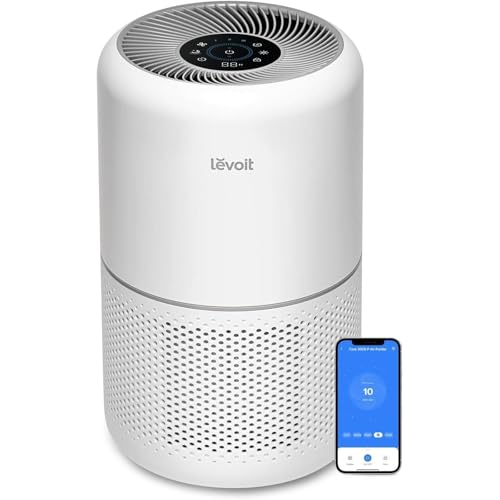
Levoit Core 300S-P — The Smart Cartridge, Honestly Scoped
Badge: Best small-room cartridge system
- Carbon format: combined 3-in-1 cartridge with variant options
- Verification: AHAM Verifide rating on the listing
- Sleep mode: listed at 24 dB
- Controls: app, voice, auto mode
The Core 300S-P represents the format most buyers actually live with, and it deserves a fair statement of its carbon position: the cartridge’s carbon layer handles the everyday odor background of a bedroom — stale air, light cooking drift, a small pet — competently, and Levoit’s variant cartridges let owners bias the blend toward pet or toxin duty. What it cannot do is absorb a concentrated, continuous gas load for months; no cartridge of its dimensions can, and Levoit’s own range acknowledges the boundary by offering larger machines for larger problems.
Included here deliberately, it anchors the guide’s central skill: matching carbon capacity to load. A bedroom with a window and one cat does not need the Winix’s bed; a basement litter room is insulted by a cartridge. The technology is the same — the dose makes the purifier.
Strengths
- Quiet, smart, verified small-room performance
- Variant cartridges tune the carbon blend to the problem
- Cheapest filter routine of the four machines here
Trade-offs
- Lightest carbon capacity of the four
- Cartridge replaced as one unit
- Not a solution for concentrated odor sources
Best for: bedrooms and offices with light odor backgrounds. Not suited for: litter rooms, smoking rooms, or heavy cooking odor. For particle-side depth, see the best HEPA air purifiers guide.
Myth vs Fact: Six Carbon Claims, Graded
Claim: “A carbon filter cleans the air.” Verdict: half true. A carbon filter cleans the air of gases and odors. It does essentially nothing for dust, pollen, dander, or any particle — those pass through the bed’s open structure untouched. A complete purifier needs both stages, which is why every machine in this guide pairs carbon with HEPA-grade media.
Claim: “Carbon filters last the life of the machine.” Verdict: false. Carbon saturates. Under light duty the process takes a year or more; under a concentrated odor source it can take weeks. A seller who does not state a replacement interval or sell a replacement filter is telling you, indirectly, that the carbon is decorative.
Claim: “You can wash or vacuum a carbon filter back to life.” Verdict: mostly false. Vacuuming removes surface dust from a bed, which is harmless and occasionally useful, but it does not empty the pores — adsorption sites stay occupied. Genuine regeneration requires heat and conditions no home appliance provides. The washable element in real designs is the pre-filter, never the carbon.
Claim: “More fan speed means better odor removal.” Verdict: usually backwards. Higher speed moves more air but shortens each molecule’s contact with the bed. For odor duty, a moderate speed run continuously generally outperforms intermittent turbo bursts. Particles obey the opposite logic — volume wins — which is why mixed problems reward auto modes that balance both.
Claim: “Carbon removes carbon monoxide and makes a room safe.” Verdict: false and dangerous. Consumer carbon beds do not meaningfully adsorb carbon monoxide. Combustion appliances need ventilation, maintenance, and a dedicated carbon monoxide alarm; no air purifier substitutes for any of those.
Claim: “If the room smells fine, the carbon is fine.” Verdict: unreliable. Noses adapt to constant background odor within minutes, so the household is the worst judge of its own baseline. The trustworthy test is comparative: leave for a day, return, and smell the room with a fresh nose — or ask whether a guest would notice. Odor that greets you at the door is breakthrough, and breakthrough means the bed is spent.
Keeping Carbon Working: A Maintenance Routine
Protect the bed from the start. Carbon spent adsorbing coarse household grime is carbon wasted, so keep the pre-filter clean — rinse or vacuum it monthly, more often in pet homes — and never run the machine with the pre-filter removed. Dust that reaches the bed coats pore entrances and shortens useful life in a way no later cleaning reverses.
Run for contact, not for drama. Default to a moderate continuous speed or a well-implemented auto mode. Save turbo for particle events — a dust storm, a vacuuming session, wildfire smoke arriving — and remember that during those events the carbon is mostly a bystander; its shift is the quiet hours afterwards, when the room’s gaseous load is processed slowly and completely.
Track odor, not the calendar. Note the date each carbon filter enters service, then judge it by the fresh-nose test monthly once it passes half its rated life. In odor-heavy homes — litter boxes, indoor smoking, daily frying — expect the shorter end of every interval; the best air purifiers for pets guide’s households should treat carbon as a consumable on a rhythm, not an annual event.
Store spares correctly. A spare carbon filter left unsealed in a kitchen or garage is adsorbing its environment right now and will arrive at your machine partly spent. Keep spares in their sealed packaging, in a dry cupboard away from cleaning chemicals, and rotate stock so the oldest sealed filter is used first.
Dispose without drama. A saturated household carbon filter is ordinary waste in most jurisdictions — it holds what your room’s air held, in concentrated form — and goes out with household refuse, not recycling. If the machine served a genuinely contaminated environment, check local guidance; for normal homes, the bin is the answer.
How to Choose: Matching Carbon to Your Home’s Load
Work through three questions. First, is your problem particles, gases, or both? Allergy and dust households can weight HEPA and airflow and treat carbon as a minor line; odor households must invert that priority entirely. Second, how concentrated is the gas load? A diffuse background — a dog, ordinary cooking, city air — is cartridge territory, honestly served by the Coway, Medify, or Levoit formats above. A point source — a litter box in a small room, a smoking chair, a workshop’s solvents — demands a separate bed, and the Winix pattern is the template. Third, how large is the room, and how fast must the air turn over? Carbon capacity cannot rescue an undersized machine, and airflow cannot rescue token carbon; the two specifications must both clear your bar. The best air purifiers for litter box smell shortlist, written for this cluster’s sister topic, applies exactly this logic to the hardest common point source.
Budget framing helps at the end: in this technology, you are buying carbon by the month of service. A deep bed costs more per filter and less per month of odor control under load; a cartridge costs less per filter and more per month under the same load. Light-load homes should buy the cartridge’s convenience; heavy-load homes should buy the bed’s endurance. Either way, price the replacement before the machine — it is the only number in this category that never lies about what the technology will cost you.
A Problem-by-Problem Dossier: What Carbon Does to Specific Gases
New furniture, paint, and flooring (formaldehyde and VOCs). Fresh pressed-wood furniture, new flooring, and recent paint release formaldehyde and a cocktail of volatile organic compounds, strongest in the first months and worse in warm, sealed rooms. Carbon adsorbs many of these compounds well, and specially impregnated carbons target formaldehyde specifically. Practical expectations: a purifier meaningfully reduces background levels in the room where it runs, but the sources keep emitting for months, so the winning combination is ventilation first — new rooms aired aggressively — with carbon handling the residual. Buyers renovating a nursery should weight this dossier entry heavily and size the machine generously, because the load is continuous rather than episodic.
Tobacco smoke odor. The particles in smoke are a HEPA problem; the smell that soaks into a room is a carbon problem of the hardest kind, because smoke carries hundreds of compounds, some of which adsorb reluctantly and all of which arrive in high concentration. Deep beds cope; cartridges cope briefly. Households should also know that smoke odor already absorbed into fabrics and paint is beyond any purifier’s reach — carbon defends the air, and through the air, slows further absorption, but it cannot launder a curtain by proximity.
Cooking odors and grease vapour. Frying and searing produce both fine particles and a heavy vapour load. Carbon handles the smell well when the machine is close enough to matter — a purifier in the kitchen’s adjoining space, running during and for an hour after cooking, outperforms a larger machine two rooms away. Range extraction vented outside beats every purifier for this job and should be the first fix; carbon is for open-plan homes where the kitchen’s air is the living room’s air.
Pet urine and litter ammonia. The honest entry in this dossier: plain activated carbon is only moderately effective against ammonia, the sharp compound in urine odor. Impregnated carbons — treated to react with alkaline gases — do better, and some pet-focused filters use them. For litter rooms, the hierarchy is source hygiene first (the box itself, cleaned on a rhythm), ventilation second, and a deep or pet-tuned carbon bed third. This is the scenario where the Winix’s deodorization emphasis earns its reputation, and where cartridge owners most often report disappointment that this guide exists to prevent.
Workshop and hobby solvents. Paints, adhesives, resins, and finishes emit strong VOC loads in bursts. Carbon is genuinely useful here — a mid-size machine with a real bed, running during work and for an hour after, cuts both exposure and the smell that migrates into the house — but it does not make an unventilated solvent workspace safe, and respirators and extraction remain the primary controls for anyone working with these materials regularly. Treat the purifier as the third layer, never the only one.
Wildfire smoke gases. During smoke episodes, public attention fixes on particles, and HEPA capacity rightly leads. But smoke events also carry acrid gases that irritate eyes and throats indoors, and homes running purifiers through multi-day episodes consistently report that carbon-equipped machines leave indoor air noticeably less harsh. The catch is consumption: episode weeks can spend a noticeable fraction of a bed’s life, so smoke-region households should check carbon after each major event rather than on the calendar.
Spec-Reading Guide: Decoding the Carbon Line on Any Listing
Listings describe carbon in a small vocabulary, and each phrase has a reliable translation. “Carbon filter” with no further detail, on a slim machine, almost always means a coated sheet — assume minimal capacity until the replacement part proves otherwise. “Activated carbon filter” as a named, separately sold component signals a real stage; open the replacement listing and look for depth and weight cues in its description and dimensions. “High-deodorization” or “odor removal” carbon, as in the Winix listing used in this guide, indicates a bed designed and marketed for gas duty — the strongest claim a listing can make, and one the physical filter can be checked against. “Carbon pre-filter” means the carbon lives in the washable-looking first stage — the lightest duty of all, intended for ambient freshness rather than source control. And any phrase promising that carbon “never needs replacing” contradicts the physics in this article’s second section; a bed that never fills is a bed that never adsorbed.
It is also worth understanding what a carbon stage does to the rest of the machine’s behaviour, because the interaction surprises new owners. A deep bed adds airflow resistance, so a machine’s quietest, most economical running happens with a fresh bed and degrades almost imperceptibly as the bed loads with both gases and the fine dust that slips the pre-filter. Owners sometimes report that a purifier “got louder over the year” or that its auto mode “runs faster than it used to” — frequently that is not a failing motor but a filter system asking, in the only language it has, for service. Reading those signals as filter information rather than machine failure is part of owning this technology well, and it is one more reason the maintenance routine above pairs every performance complaint with a filter check before any other diagnosis.
Two further checks separate careful buyers from the rest. First, look at the replacement filter’s price relative to the machine: a genuinely substantial carbon bed is a significant fraction of the machine’s cost to manufacture, and its replacement price shows it. A machine whose full filter set costs very little is telling you how much carbon is inside, whatever the feature list says. Second, look for the filter’s rated life stated in months under normal use, and mentally halve it if your home carries a point-source load. Brands that publish intervals, sell the part under their own name, and describe its construction — as the four manufacturers in this guide do — are offering verifiable claims. In a category built on an invisible process, verifiability is the product.
Carbon in Context: The Other Ways Homes Control Gases
Activated carbon earns its place in a purifier, but it is one tool among several for gas control, and an honest guide ranks them. Source control is first and always cheapest: the litter box scooped daily, the solvent tin sealed and stored outside living space, the smoking moved outdoors, the new furniture aired in a garage before it enters a bedroom. No filter outperforms not emitting. Ventilation is second: an open window or a vented extractor physically removes gases from the building rather than storing them in a bed, and during cooking or renovation it outperforms any recirculating machine. Carbon’s role is third and specific — it is the tool for the hours when windows are closed, sources cannot be moved, and life continues in the room anyway. That is most of winter, every night, and every home with a litter box in a flat. Bought for that role, it excels; bought as a substitute for the first two, it disappoints.
Two popular alternatives deserve explicit grading. Houseplants are lovely and their effect on room VOC levels, at any realistic plant count, is negligible — the famous studies used sealed chambers and densities no living room approaches; keep plants for joy, not filtration. Ozone generators sit at the opposite pole: they do attack odors chemically, but ozone is itself a respiratory irritant, and health authorities advise against running them in occupied spaces. A technology that cleans the air by adding a regulated pollutant to it fails this guide’s basic test. Between those poles, the scented products — sprays, gels, plug-ins — do not remove gases at all; they add a stronger smell on top, and their own emissions load your carbon bed if you run one. The disciplined household removes sources, ventilates when it can, filters carbon when it cannot, and perfumes never.
| Approach | Removes gases? | Best role | Watch out for |
|---|---|---|---|
| Source control | Prevents them | First fix for any point source | Requires habits, not hardware |
| Ventilation | Yes, by exchange | Cooking, renovation, mild weather | Weather, security, outdoor air quality |
| Deep carbon bed | Yes, by adsorption | Continuous odor duty, closed-window hours | Saturation — replace on breakthrough |
| Carbon cartridge | Yes, modest capacity | Diffuse background odor | Fades fast under point sources |
| Ozone generator | Reacts with some | Unoccupied industrial use only | Adds a respiratory irritant |
| Scented products | No — masks only | None for air quality | Adds VOC load |
There is a final, quieter benefit to understanding this technology that has nothing to do with any single purchase: it makes you immune to a whole dialect of marketing. Once you know that capacity is mass, that contact time is depth divided by speed, and that saturation is silent, phrases like “advanced carbon technology” stop sounding like information and start sounding like what they are — a request to trust. Sometimes trust is warranted, and this guide has pointed at the listings that earn it with published parts and honest intervals. But the trust now follows your inspection rather than replacing it, and that ordering — evidence first, brand second — is the most durable thing a buyer in this category can own.
Read the table as a hierarchy rather than a menu. The households with the cleanest-smelling air in this guide’s experience are not the ones with the largest purifiers; they are the ones that stack the rows in order — disciplined sources, ventilation used whenever weather and security allow, and a carbon stage sized for everything that remains. The purifier purchase is the last step of that system, and this article’s four example machines are sized to play their part in it at four different scales of home and load.
The Economics of Carbon: Pricing Odor Control by the Month
Because carbon is a consumable with a capacity, its honest unit of comparison is not the filter’s price but the cost per month of working odor control — and that figure flips depending on load, which is why universal “best value” claims in this category are usually wrong. Work the arithmetic in principle. A light-load bedroom asks little of its carbon: a modest cartridge serves a year, and its low price makes it the cheapest odor control per month available anywhere in this guide. Move the same cartridge to a litter-box room and its useful life collapses to a small fraction of that year; its monthly cost multiplies several-fold, and it becomes the most expensive option on the page — while the deep bed, pricey as a single purchase, spreads its cost across months of sustained performance and wins the same comparison it lost in the bedroom.
This is why the four machines in this guide are presented as a matched set rather than a ranking. The Levoit cartridge is the rational buy where loads are light and rooms are small. The Medify cartridge stretches that logic to bigger rooms and moderate loads. The Coway’s staged set prices its longer cycle against a mid-weight load. The Winix bed is the heavy-duty instrument whose economics only make sense — and then make excellent sense — where odor is a daily, concentrated fact. A buyer who states their load honestly can compute their winner from the replacement listings in minutes; a buyer who shops by machine price alone is gambling that their load matches the assumption buried in the cheapest box.
One environmental note belongs in an honest economics section. Carbon filters are consumables that go to landfill, and a household that chooses the right capacity discards less, not more: one deep bed retired after a year of full service represents less material — and far less packaging and shipping — than the procession of cartridges a heavy load would consume in the same period. Right-sizing is the green choice in this category, as in most others. When a bed is spent, some owners ask about reactivating it in an oven; home ovens cannot reach or safely sustain regeneration conditions, and the attempt risks releasing the bed’s accumulated load into the kitchen. Replace, dispose, and move on.
A Sixty-Second Decision Checklist
Before buying any machine on carbon grounds, answer these in order. One: name your gas load in a single sentence — “a litter box in a small laundry room” or “general family cooking and a dog” — because every later answer depends on it. Two: does the candidate’s replacement filter, viewed on its own listing, show a bed or a sheet? Three: can the carbon be replaced on its own schedule, or is it coupled to a cartridge whose other stages still have life? Four: is the machine’s room rating — CADR or an AHAM verified size — sufficient for your room at the moderate speeds where carbon works best? Five: have you priced twelve months of filters for your load, honestly derated, and compared that figure rather than the machine’s sticker? Six: is there a source-control or ventilation fix that should happen first, shrinking the load before you size the machine? A candidate that survives all six questions is a sound purchase; a candidate that fails question two or five is a disappointment scheduled in advance. The four machines profiled in this guide each pass the checklist for their stated loads — which is, in the end, the only claim this technology ever allows anyone to make honestly.
Final Recommendation
Activated carbon is the difference between a purifier that makes air measurably cleaner and one that makes a home smell cleaner too — but only when there is enough of it, in a bed deep enough for real contact time, replaced when your fresh nose says it is done. Choose the format by your load: the Winix 5510’s separate bed for concentrated odor, the Coway Mighty’s staged balance for ordinary family life, the Medify MA-40’s generous cartridge for tight floor plans, and the Levoit Core 300S-P’s smart cartridge for light bedroom duty — and then run whichever machine you choose the way carbon asks to be run, at moderate speeds, for long hours, behind a clean pre-filter, with a sealed spare waiting in a dry cupboard for the day your fresh nose tells you the working bed has finally given everything it has. Read every future carbon claim the way this guide taught you — by the replacement filter’s physical evidence — and the technology will do for your home what its inventors intended.
Frequently Asked Questions
What is the difference between adsorption and absorption in carbon filters?
Adsorption collects molecules onto a surface; absorption soaks them into a volume. Activated carbon adsorbs: its internal pore surfaces gather gas molecules and hold them there. The distinction matters practically because a surface fills up — once the accessible pore surface is occupied, the filter stops working, even though the carbon itself looks unchanged. That is why saturation is invisible and why odor breakthrough, not appearance, is the replacement signal.
How long does an activated carbon filter actually last?
It depends on load more than on time. In a light-duty bedroom, a cartridge’s carbon can remain useful for the cartridge’s full rated life. In a room with a litter box, indoor smoking, or daily heavy cooking, a thin carbon layer can saturate in weeks, while a deep separate bed lasts months. Manufacturers’ intervals assume average homes; odor households should expect the short end and judge by the fresh-nose test.
Can activated carbon remove cooking smells and pet odor?
Yes — that is precisely its job, and it is the only common purifier technology that does it. The variable is capacity. Everyday cooking drift and a dog’s background presence are within a good cartridge’s ability; a litter box in a small room or a frying-heavy kitchen routine calls for a separate deep bed. Ventilation while cooking remains the cheapest odor control of all, and carbon handles what ventilation misses.
Does activated carbon help with allergies?
Indirectly at most. Allergens themselves — pollen, dander, dust mite debris — are particles, removed by the HEPA stage, not the carbon. Carbon can reduce irritant gases and odors that make an allergic household more comfortable, and some people react to volatile compounds as well as to particles. But a buyer whose problem is allergies should choose on HEPA quality and CADR first, which is the ordering used in the best air purifiers for allergies guide.
Why does my purifier smell worse than before on some days?
Usually because the carbon is saturated and conditions have shifted — a warm, humid day can coax weakly held compounds back off a full bed, a phenomenon owners describe as the filter “giving the smell back.” It is the clearest possible replacement signal. Less commonly, a musty note means moisture has reached the filter media itself, which calls for the same response: replace the filter and check the machine’s placement away from humidifiers and steam sources.
Can I add extra carbon to a purifier that came with a thin filter?
Not safely or effectively. A purifier’s fan is matched to its filter’s resistance; packing additional media into the housing raises that resistance, cuts airflow, and can strain the motor, while loose carbon placed outside the airstream does almost nothing because air takes the path of least resistance around it. If your machine’s carbon is inadequate for your load, the honest fixes are a machine designed with a deeper bed or, where the brand offers one, a heavier-duty filter variant made for your model. Improvised media is a false economy that trades away the particle performance you already had.
Do carbon filters help with wildfire smoke smell indoors?
Yes, and during multi-day smoke events this is one of carbon’s most appreciated jobs. The particle side belongs to the HEPA stage, but the acrid, eye-watering quality of smoke that seeps indoors is substantially gaseous, and a real carbon bed takes the edge off it in a way residents notice within hours. Expect the event to consume a meaningful share of the bed’s life; check for odor breakthrough after the episode ends, and keep a sealed spare if your region has a regular smoke season.
Is coconut-shell carbon better than coal-based carbon?
Coconut-shell carbon tends to have a pore structure favouring small organic molecules and is widely used in quality consumer filters; coal-based carbons offer a broader pore distribution. In practice, bed depth, total mass, and honest construction outweigh feedstock in a home purifier. Buy the filter whose physical substance you can verify, from a brand that publishes its replacement part openly, and the feedstock question becomes a footnote.

