Disclosure: As an Amazon Associate, umtsmarttool.com earns from qualifying purchases. Links on this page are affiliate links; they cost you nothing extra. Prices and availability change often, so check the current Amazon listing before you buy.
The market for air purifiers for litter box smell is crowded with machines that were never designed for the job, because litter box odor is not a generic smell problem — it is a concentrated, continuous, chemically specific one, produced a few feet from the floor in a room that is often small, warm, and short on ventilation. The compounds involved include ammonia from urine, which plain carbon handles only moderately, alongside the broader organic load of a working litter tray. This guide treats the problem as a system: source habits first, because no purifier outruns a neglected box; placement geometry second, because a good machine in the wrong corner is a decoration; and only then the machines themselves, five of them, verified against current Amazon listings and ranked by the one specification that decides this niche — how much real activated carbon stands between your cat’s habits and your guests’ noses.
Set the expectation honestly at the start. A well-chosen, well-placed purifier makes a litter room smell like a room again — visitors stop performing the polite pause at the doorway — and it keeps the rest of the home from inheriting the smell. It does not make a litter box smell like nothing at six inches, it does not scoop, and it does not forgive a box that is cleaned weekly whether it needs it or not. Bought as the third layer of a system whose first two layers are hygiene and placement, the machines below perform — measurably, durably, and to the standard of a guest who does not know a cat lives here until the cat chooses to be known. Bought as a substitute for the first two layers, every one of them will be returned as faulty by a disappointed owner whose real problem was never filtration at all.
Key Takeaways
- Carbon quantity is the whole game in this niche: a deep, separate carbon bed outperforms any thin carbon sheet by months of working life, because litter odor is a continuous, around-the-clock load, not an occasional whiff that a token filter can wave at.
- Ammonia is carbon’s hardest common target — impregnated and deodorization-tuned carbons do better than plain ones, which is one reason the Winix 5510 leads this list.
- Place the purifier in the same room, a few feet from the box, drawing air across it — never in the next room, never behind a closed door, never across the house, and never with its intake blocked by the laundry basket that every litter room in the world seems to generate spontaneously beside the machine.
- Scoop daily, wash the box on a rhythm, and let the purifier handle the airborne remainder; the machine is layer three of a system, not layer one.
- Judge carbon by odor breakthrough on a fresh-nose return home, and keep a sealed spare in a dry cupboard — litter rooms consume carbon faster than any manufacturer’s average-home schedule, and the week the filter fades is always, by some law of the household, the week guests are coming.
Layer One and Two: The System Before the Machine
Layer one — the box itself. Odor output is roughly proportional to what is sitting in the tray. Daily scooping is the single highest-value act in this entire article, worth more than any specification on any listing. The box itself absorbs odor into its plastic over months; a tray that has served for years can smell when it is empty, and replacing the box is occasionally the whole solution. Litter choice matters at the margins — clumping litters that seal waste quickly reduce the airborne load the purifier must carry — and a covered box concentrates odor inside itself, which helps the room and concentrates the cat’s experience, a trade each household judges for itself. Enzyme cleaners on accidents outside the box address the reservoir problem that no air machine can reach: compounds soaked into flooring or fabric, re-emitting for weeks.
Layer two — the room. A litter room with any ventilation — a window opened daily, a bathroom extractor, a door left ajar to a hall with moving air — starts the purifier’s shift halfway done. Heat accelerates odor release, so a box beside a radiator works against you; a cool corner works with you. The room’s size cuts both ways: small rooms concentrate odor, which makes the problem more noticeable, but they also let a modest purifier cycle the entire volume many times an hour, which makes the solution more effective. Most litter rooms are small, and that is quietly good news for every machine on this list.
One more layer-one refinement separates the homes that win this fight from the homes that merely fund it: box count and box size. The durable rule of feline practice — one box per cat, plus one extra, in separate locations where the home allows — is an odor rule as much as a welfare rule, because a box that is never overwhelmed never becomes the concentrated source that defeats a room. An undersized box concentrates traffic and mess alike. Households that fix the box arithmetic first routinely discover that the purifier they then need is a class smaller and a full tier cheaper than the one they were about to buy in despair, which is the most satisfying sentence in this entire subject.
Layer three — the machine. Only now does filtration enter, with two jobs: capture the dust and dander the cat and its litter generate — a particle job, handled by the HEPA stage and a pre-filter you must keep clean, because litter dust coats filters faster than household dust — and adsorb the gaseous load continuously, which is the carbon stage’s shift, worked at moderate speed around the clock rather than in heroic bursts.
In this guide
Quick Picks
| Model | Best for | Why it works at the litter box |
|---|---|---|
| Winix 5510 | Most litter rooms | Deep separate deodorization carbon bed, washable pre-filter |
| GermGuardian AC4825 Tower | Budget litter corners | Tall tower format, HEPA plus carbon, UV-C stage, low cost |
| Coway Airmega Mighty | Laundry and utility rooms | Staged filters, washable pre-filter, air quality monitor |
| Medify MA-40 | Larger multi-cat rooms | Generous cartridge carbon in a slim tower |
| Levoit Core 300S-P | Studio flats and small spaces | Compact, smart, pet-variant cartridges available |
How These Picks Were Chosen
The screening weighted carbon architecture above every other specification, then pre-filter practicality — litter dust is relentless — then room fit for the small spaces litter boxes usually occupy. Machines whose listings offered only an undescribed “carbon filter” were cut; every survivor’s carbon story can be inspected on its replacement filter listing, which is the discipline this niche demands. Each pick was verified through this site’s own Creators API account, with listings, ASINs, and images recorded in this article’s sources file. One design family was excluded deliberately: tiny desktop units marketed for pet odor, whose carbon content is measured in grams and whose honest role is a desk, not a litter room. In this niche, undersized is not a budget choice; it is a delayed return.
The Five Machines, Judged at the Litter Box

Winix 5510 — Best Overall for Litter Box Smell
Badge: Best carbon bed for the job
- Carbon: separate high-deodorization carbon filter
- Particle stage: True HEPA, independently replaceable
- Pre-filter: washable — essential under litter dust
- Coverage: large rooms on the listing, so a litter room is easy duty
Everything this niche demands, the 5510 happens to be built around. Its carbon is a deep bed sold as a deodorization filter — the listing’s own words — rather than an accessory layer, and deodorization-tuned carbon is exactly the chemistry that copes best with the litter room’s mixed load, ammonia included. Because the bed is separate, you replace it when the room tells you to, without discarding a HEPA stage that still has life. And because the machine is rated for large rooms, in a small litter room it works at its calm low speeds, cycling the whole volume constantly — the operating pattern carbon performs best at, with long contact time on every pass.
The washable pre-filter is the second half of the case. Litter dust is fine, abundant, and relentless; a pre-filter you can rinse under a tap monthly keeps the expensive stages breathing, where a sealed cartridge in the same room slowly suffocates. The PlasmaWave stage can be left off entirely if you prefer filtration only; the carbon and HEPA stages are the substance. Budget honestly for the bed’s replacement rhythm in this duty — it will be the shorter end of the stated range — and keep the spare sealed in a cupboard.
Strengths
- Deepest, deodorization-tuned carbon in the roundup
- Washable pre-filter built for litter dust reality
- Oversized for the room, so it runs quietly and constantly
Trade-offs
- Physically large for the smallest litter corners
- Carbon replacements are a real, recurring cost in this duty
- More machine than a single-cat, well-kept box strictly needs
Best for: dedicated litter rooms, multi-cat homes, and anyone whose guests currently know where the box is. Not suited for: the tiniest corners or the tightest budgets. The brand’s wider range is covered in the best Winix air purifiers roundup.

GermGuardian AC4825 Tower — Best Budget Litter Corner Pick
Badge: Best value tower
- Filtration: HEPA filter with carbon and a UV-C stage
- Coverage: up to about 743 sq ft on the listing
- Format: slim 22-inch tower for corners
- Verification: AHAM Verifide on the listing
The GermGuardian tower has been the budget answer in pet corners for years, and its formula is legible: a real HEPA filter for the dust and dander, a carbon layer for the smell, a UV-C stage that this guide counts as a minor extra rather than a reason to buy, and a tall slim cabinet that stands in the corner a litter room actually has free. Its three quiet speeds suit the small-room pattern — set it at a steady middle speed near the box and let it work around the clock.
Its honesty requirement is about carbon scale: the carbon here is a layer within a combined filter, not a bed, and under a heavy multi-cat load it will fade sooner than the Winix’s. For a single cat in a ventilated room with a scooped box — the majority case — it is genuinely sufficient, and its low purchase and filter costs make it the rational first machine. Owners stepping up from it later usually keep it as the second room’s unit, which tells you something about its value.
Strengths
- Lowest cost of entry and upkeep in the roundup
- Slim tower fits litter-room corners
- AHAM Verifide rating backs its room claims
Trade-offs
- Carbon layer saturates faster than a deep bed under heavy load
- UV-C stage is a minor feature, not core filtration
- Combined filter replaced as one unit
Best for: single-cat homes, first purifier purchases, and ventilated litter rooms. Not suited for: heavy multi-cat odor loads. Pet households comparing the wider field should see the best air purifiers for pets guide.

Coway Airmega Mighty — Best for Laundry and Utility Rooms
Badge: Best monitored workhorse
- Filtration: staged set — washable pre-filter, carbon, HEPA
- Coverage: rooms up to about 1,748 sq ft on the listing
- Extras: air quality monitor, auto and eco modes
- Warranty: 3 years stated on the listing
Many litter boxes live in the home’s working rooms — the laundry, the utility space, the downstairs bathroom — and the Mighty is the workhorse for those rooms. Its staged filter set puts a washable pre-filter in front of real carbon and HEPA stages, its air quality monitor shows the room’s status at a glance when you walk in with a laundry basket, and its auto mode surges when the air worsens and settles when it clears. In a room you pass through rather than live in, that self-management is the feature that matters: nobody is there to adjust speeds, so the machine must.
The carbon stage is a genuine filter, mid-weight in this company — better than any cartridge layer, short of the Winix bed — and the filter set’s long rated cycle suits a room whose load is steady rather than extreme. The three-year warranty on the listing matters in utility duty, where machines run for years in warm, humid-adjacent air.
Strengths
- Monitor and auto mode suit pass-through rooms
- Washable pre-filter and staged filters
- Long filter cycle and three-year warranty
Trade-offs
- Carbon is mid-weight versus the Winix bed
- No app control
- Console footprint needs a deliberate spot
Best for: laundry rooms, utility spaces, and larger litter areas. Not suited for: the smallest corners or maximum-odor multi-cat rooms.

Medify MA-40 — Best for Larger Multi-Cat Rooms
Badge: Best tower for bigger rooms
- Filtration: 3-in-1 cartridge with above-average carbon for its class
- Coverage: up to about 1,793 sq ft per hour on the listing
- Format: slim tower
- Options: multi-pack listings for multi-room cat homes
Multi-cat households graduate to a different problem class: more boxes, more dust, more load, often in a bigger room — a basement cat space, a catio-adjacent room, a large utility area. The MA-40’s case is capacity in a tower’s footprint: coverage rated well beyond any single litter room, a cartridge carrying more carbon than its slim format suggests, and a price structure — including multi-packs — that suits homes solving this problem in two rooms at once.
Its cartridge coupling is the standing caveat: when the carbon fades under feline load, the whole cartridge is replaced, HEPA life notwithstanding. Multi-cat owners should price that rhythm honestly against the Winix’s staged economy. Where the room is large and the load is spread rather than concentrated at one box, the MA-40’s airflow advantage is real and its carbon is adequate — the profile of most actual multi-cat rooms.
Strengths
- Large-room airflow in a slim footprint
- Carbon content above the tower class norm
- Multi-pack value for two-room solutions
Trade-offs
- Cartridge coupling raises running costs under heavy odor load
- No app or sensor-driven auto mode
- Tower stability around boisterous animals needs a thought
Best for: multi-cat rooms and basement cat spaces. Not suited for: one concentrated box in a tiny room, where the Winix’s bed wins.
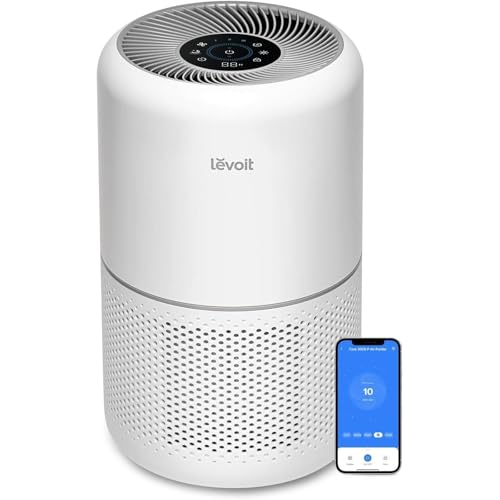
Levoit Core 300S-P — Best for Studio Flats and Shared Spaces
Badge: Best compact smart pick
- Filtration: 3-in-1 cartridge, with pet-focused variant cartridges in the range
- Verification: AHAM Verifide on the listing
- Controls: app, voice, auto mode, quiet sleep mode
- Format: compact cylinder for small footprints
The studio flat is the hardest litter scenario of all: the box, the bed, and the sofa share one air volume, and there is no door to close on the problem. The Core 300S-P is the compact answer — small enough for the only available surface, smart enough to run a stronger cycle while you are out and a whisper at night, and backed by Levoit’s cartridge ecosystem, which includes pet-tuned variants that bias the blend toward exactly this duty. Its app scheduling is not a luxury here; in a one-room home, timing the machine’s loud hours to your absent hours is the whole strategy.
Scope it honestly: its carbon is a cartridge layer, and in a studio the load is continuous and close, so cartridges will cycle faster than in any other scenario in this article. The machine earns its place on size, silence, and smarts — and on the fact that the alternative in a studio is not a bigger machine, it is no machine at all.
Strengths
- Compact footprint and quiet sleep mode suit one-room living
- Scheduling matches cleaning bursts to your absences
- Pet-variant cartridges available for the same machine
Trade-offs
- Lightest carbon capacity in the roundup
- Fast cartridge cycling under continuous studio load
- Cannot create the separation a door provides
Best for: studio flats, small apartments, and spare-room litter corners. Not suited for: multi-cat homes or dedicated large litter rooms. For the general field, see the best air purifiers overview.
Placement Geometry: Where the Machine Stands Decides Half the Result
Draw the room’s air as a slow river. Odor leaves the box, rises gently on the room’s warmth, and drifts toward wherever the air exits — a door gap, a vent, a window crack. The purifier belongs in that river, a few feet from the box, positioned so its intake faces the drift and its clean output pushes across the room rather than into a wall. Three placements fail predictably. The machine across the room lets odor tour the entire space before collection. The machine in the next room, however powerful, is filtering a different volume of air — closed or even ajar doors reduce exchange to a trickle. And the machine directly on top of or touching the box chokes on the concentrated dust plume at source and coats its pre-filter in days. A few feet of standoff, intake toward the box, output toward the room: that is the geometry, and it costs nothing.
Height matters less than folklore suggests, because room air mixes continuously; floor-standing machines near the box are the standard for a reason. What does matter is clearance — every intake unobstructed, no laundry basket parked against the grille, no curtain draped over the top. In litter rooms, which double as storage in most homes, the purifier’s breathing space is the first casualty of tidiness. Defend it.
Troubleshooting Tree: “I Bought One and the Room Still Smells”
Start here: is the filter still in its shipping bag? A remarkable share of “faulty” purifiers are running with the filter sealed in plastic inside the cabinet. Open the machine and check before any other diagnosis.
Next: how old is the carbon, really? If the machine helped for weeks and then faded, the carbon is saturated — the classic litter-room timeline for thin carbon layers. Fresh-nose test on returning home confirms it. The fix is a fresh filter and, if the fade was fast, a machine with a deeper bed next time.
Next: where is the machine standing? Wrong room, wrong corner, or intake blocked — reposition per the geometry section and give it two days before judging.
Next: what is the box’s own state? Scooping rhythm, box age, litter type, and accidents outside the box soaking into flooring. Purifiers cannot fix reservoirs; enzyme cleaner and, occasionally, a new box can.
Next: is the machine big enough and actually running? A desktop unit in a real room, or a capable unit on its lowest speed behind a closed door all day, will both read as failure. Match the machine to the room and run it continuously at a working speed.
Finally: is the smell the box at all? Drains, a forgotten accident behind furniture, and a cat whose health has changed all present as “litter smell.” A sudden change in a cat’s urine odor or habits is a veterinary conversation, not a filtration one — the purifier’s job is the room, and some messages from the box are addressed to the vet.
Readers whose litter room is one front in a wider campaign will find the neighbouring guides useful in sequence. The technology underneath this niche is carbon, and the how activated carbon air filters work explainer in this same series covers beds, cartridges, saturation, and contact time in the depth this article could only summarise. The particle side — dander through the whole home rather than at the box — is the territory of the best HEPA air purifiers roundup, while smoke, the other great household odor-and-particle problem, is handled by the best air purifiers for smoke guide with the same carbon-first logic. And when the litter room is also the room somebody sleeps in — the studio and spare-room cases — the best air purifiers for bedroom shortlist’s quiet-first screening becomes the deciding layer on top of everything said here. Read together, the four guides amount to a complete doctrine: particles by HEPA, gases by carbon mass, rooms by fit, and systems by habit.
Comparison Table
| Criterion | Winix 5510 | GermGuardian AC4825 | Coway Mighty | Medify MA-40 | Levoit Core 300S-P |
|---|---|---|---|---|---|
| Carbon class | Deep separate bed | Combined layer | Staged filter | Generous cartridge | Compact cartridge |
| Pre-filter | Washable | Standard | Washable | Cartridge layer | Cartridge layer |
| Room scale | Small room easy, large capable | Small to mid | Mid to large | Large | Small |
| Running pattern | Continuous low | Steady middle | Auto | Steady working speed | Scheduled |
| Choose when | Odor is severe | Budget leads | Room is a utility space | Room is large, cats are many | Space is one room total |
The Chemistry of Litter Odor, and Why It Defeats Ordinary Purifiers
To choose well in this niche it helps to know what is actually in the air. Cat urine’s notorious staying power comes from its composition: urea that bacteria convert to ammonia after deposition, and a family of sulfur-bearing and protein-derived compounds — including the felinine pathway unique to cats — that break down into exceptionally potent odorants over hours and days. This is why a fresh accident and a day-old one smell different, why old boxes smell even when empty as residues work into plastic, and why the odor seems to intensify in warm rooms: warmth accelerates both the chemistry and the evaporation. Faecal odor adds its own volatile load, strongest in the minutes after use and mercifully shorter-lived in the air than the urine side.
Each compound class meets filtration differently. The airborne fraction near the box — fine litter dust carrying absorbed compounds — is partly a particle problem, and a good pre-filter and HEPA stage genuinely reduce it, which is why rooms feel fresher within hours of a capable machine arriving. The gaseous fraction is carbon’s work, and here the chemistry explains the roundup’s ranking. Ammonia is a small, polar molecule that plain activated carbon adsorbs reluctantly; carbons impregnated to react with alkaline gases, and deep beds that give every molecule a long, slow passage with many chances to stick, perform measurably better. The sulfur compounds adsorb more willingly but are detectable by the human nose at extraordinarily low concentrations, so a filter can be performing respectably in percentage terms while the room still registers “cat” to a visitor. That last fact sets the niche’s practical standard: success is not a percentage, it is the doorway test — a fresh nose entering the home notices nothing. Machines and systems should be judged against that standard and no other.
Humidity plays a supporting role worth knowing. Carbon adsorbs less eagerly in very humid air, and litter rooms are often laundry rooms and bathrooms — the home’s humid rooms. This is one more reason the Coway’s self-managing design suits utility spaces and one more argument for ventilation as layer two: every point of humidity and every compound the extractor removes is load the bed never carries. It also explains a pattern owners report, of odor control feeling weaker in summer; the chemistry of release and the physics of adsorption both tilt with the season, and the correct response is maintenance tempo, not a bigger machine bought in July.
Special Situations: Kittens, Seniors, Illness, and the Foster Home
Kittens multiply everything briefly — more boxes, more accidents outside them, more dust from energetic digging. The purifier guidance is unchanged except for placement safety: a kitten room’s machine must be stable and its cord untouchable, and the troubleshooting tree’s reservoir step matters most, because kitten accidents soak into corners adults cannot smell their way to. Enzyme cleaner, used patiently and repeatedly, is the co-star of this season.
Senior cats and medical conditions change the load’s character. Kidney disease and other common conditions of age alter urine volume and concentration, and a litter room’s odor can shift noticeably over months. The purifier response is to step maintenance up a rhythm — pre-filter rinsed more often, carbon judged monthly by the doorway test — and to hear the box’s other message: a sustained change in a cat’s output or habits belongs in a vet visit. Filtration manages rooms; it does not manage diagnoses, and this guide’s households are better served by hearing that plainly.
Foster and rescue homes run litter infrastructure at a scale ordinary advice does not imagine — multiple rooms, rotating residents, quarantine spaces. The foster pattern that works is the utility pattern repeated: a monitored, auto-managing machine per closed room, staged filters with washable pre-filters, spare carbon bought ahead in sealed stock, and the discipline of judging each room by its own doorway rather than by the house’s average. The Coway and Winix designs in this roundup are the two that scale to that duty without complaint.
The cat who misses deserves a final word, because a meaningful share of “purifier failures” in this niche are aim failures. A cat urinating beside the box — from preference, stress, arthritis that makes high sides a barrier, or a box kept dirtier than the cat’s standards — creates a floor reservoir that no air machine will ever fix. Lower the box’s entry, add a box, clean the reservoir enzymatically, and ask the vet about pain if the behaviour is new. The purifier will handle the air beautifully once the floor stops competing with it.
Filter Economics in Litter Duty: The Honest Ledger
Litter rooms are where purifier running costs stop being theoretical, so this niche deserves its own ledger. The variables are carbon class, load, and replacement rhythm, and the arithmetic punishes wishful thinking. A combined cartridge in a busy litter room may deliver a small number of weeks of full odor control; priced per month of doorway-test success, it can cost several times what a deep bed costs over the same period, despite the bed’s higher price per unit. Conversely, in a single-cat home with a scooped box and a window, the same cartridge lasts toward its rated life and becomes the cheapest satisfactory option in the article. The ledger’s lesson is identical to the carbon guide’s — cost per month of working control, computed against your load — but litter duty stretches the spread between best and worst choices wider than any other common use, which is why this niche, more than any other, rewards buying the carbon class first and the machine second.
Practical budgeting follows. Price the replacement filter for any candidate before the machine, multiply by the changes your load will honestly require in a year, and compare totals across two years rather than sticker prices today. Buy the spare with the machine when a multipack or sale makes it sensible, store it sealed and dry, and write the in-service date on every filter you install. The households that find purifiers “expensive to run” in this niche are almost always running the wrong carbon class for their load and paying the cartridge tax monthly; the households that find them cheap are running a bed in a big room and replacing it on evidence. Same technology, opposite ledgers — the difference is the match.
Decision Table: Matching the Machine to the Home
| Your situation | Load profile | Start with | Step up to |
|---|---|---|---|
| One cat, box in a ventilated bathroom, scooped daily | Light, episodic | GermGuardian AC4825 | Coway Mighty if the room is large |
| One cat, box in a spare room, door mostly closed | Moderate, continuous | Winix 5510 | — |
| Two or more cats, boxes in a utility or basement room | Heavy, continuous | Winix 5510 or Medify MA-40 | One machine per closed room |
| Studio flat, box in the living space | Moderate, inescapable | Levoit Core 300S-P on a schedule | Winix 5510 if floor space allows |
| Laundry room box, nobody present most of the day | Moderate, unmanaged | Coway Mighty on auto | Winix 5510 if odor greets you at the door |
| Foster or rescue rotation | Heavy, variable | Coway Mighty per room | Winix 5510 in the quarantine room |
The table encodes the article’s whole argument in six rows: load first, room second, machine third. Notice how rarely the answer is the largest machine and how often it is the machine whose carbon class matches the load’s continuity. Continuous loads — the closed spare room, the multi-cat basement — are what separate beds exist for. Episodic loads in ventilated rooms forgive lighter carbon and reward the budget picks. And the studio row exists to say plainly that some situations are managed, not solved: scheduling, scooping, and ventilation carry a one-room home, with the purifier as a tireless assistant rather than a magician.
An Operating Week in a Litter Room That Works
Monday morning, the machine is already running — it never stopped — at the low continuous speed that is its working life. The weekend’s visitors have gone; the doorway test, performed without thinking while bringing in the post, registers nothing, which is the system’s whole report card. The box is scooped with the morning routine, a thirty-second act that remains the highest-value filtration event of the day. Wednesday, the litter is topped up and the area around the box vacuumed, including the tracked scatter that every cat distributes with an artist’s commitment; the purifier’s pre-filter will meet the airborne share of that dust across the week. Friday, the pre-filter gets its monthly rinse a few days early because the calendar said so and the sink is right there — two minutes, dried on the draining board, back in service before lunch. The box itself is emptied and washed on its fortnightly rhythm over the weekend, dried fully before refilling, because a damp box restarts the odor chemistry at full speed.
Nothing in that week is heroic, and that is the point the sales pages miss. Litter odor is not defeated in a purchase; it is managed in a rhythm, in which the purifier’s contribution is to be always on, correctly placed, and honestly filtered, while the humans contribute the scooping and washing that no machine can do. The households whose litter rooms smell like rooms are not the ones with the most expensive purifiers. They are the ones whose week looks like the one above — and whose purifier, chosen by carbon class for their load, makes the rhythm easy to keep.
The Cat’s Side of the Arrangement
Every other section of this guide treats the litter room as a human problem, but the room’s primary resident has standing too, and a purifier arrangement the cat rejects is a failed arrangement however clean the air. Cats experience the box area through smell a hundred times richer than ours, and through a strong preference for predictability. Introduce the machine gradually — run it in the room before placing it in its final position near the box, let the cat investigate it switched off, and never let its first operation coincide with the cat’s first use of a new box or a new litter, because cats file simultaneous changes under “the box is wrong now” and act accordingly. A steady low speed suits feline nerves better than an auto mode that surges unpredictably beside the tray; several owners in this niche run their machines on a fixed setting for exactly this reason, accepting a little less responsiveness for a lot more feline confidence.
Noise and airflow direction deserve a cat’s-eye check. A gentle exhaust drifting across the box area is unremarkable; a strong stream aimed at the box itself can scatter lightweight litter and startle a cat mid-business, teaching avoidance of the exact place you need used faithfully. Position output across the room, as the geometry section advised for human reasons, and the cat’s reasons agree. Scented anything — fragrance cartridges, sprays deployed to “help” the purifier — works against the cat as much as against the chemistry: a cat’s world is read through scent, and flooding its bathroom with perfume is the feline equivalent of a flashing light in a library. The goal state, a room that smells of nothing, is the one occupant and owner share. Finally, if a cat begins avoiding a previously accepted box after any change — machine, litter, location — believe the cat and revert the change; litter behaviour is communication, and the purifier is never the priority it is purchased to protect.
Before Guests Arrive: The Two-Hour Protocol
Because the doorway test is administered by visitors, this guide closes its practical sections with the protocol experienced cat owners run before company comes — not as a deception, but as the system’s surge capacity, used honestly. Two hours out, scoop the box and take the waste out of the house entirely; a sealed bag in a kitchen bin is a reservoir with a postcode inside your home. Run the purifier a speed higher than its everyday setting for those two hours — the one occasion this guide endorses a burst, because the goal is to process the room’s accumulated background down to its floor before the door opens. Air the room for ten minutes if weather and the cat’s indoor status allow, letting exchange do what recirculation cannot. Then return the machine to its steady working speed, close the litter room’s door if the gathering is elsewhere in the home, and let the system hold the line it has already won. Guests who meet a cat for the first time at the sofa, rather than at the front door, will assume the house simply smells clean — which, on the evidence of the preceding weeks of rhythm, it does. The protocol works because the everyday system works; it is a garnish on a meal already cooked, and owners whose rooms need the two hours to include emergency carpet treatment should read that as the troubleshooting tree clearing its throat.
A closing observation from the homes that get this right: the purifier’s presence changes the humans’ behaviour as much as the air. A machine humming in the corner is a standing reminder of the room’s system — scooping happens because the room now has a standard to keep, the box gets washed because its state is suddenly visible against a clean-smelling background, and guests’ compliments reinforce the rhythm that produced them. This feedback loop, unglamorous as it sounds, is responsible for as much odor control as any carbon bed. Buy the machine partly for that effect if you like; it is real, it compounds, and it is the reason this guide insists the purifier is layer three of a system rather than a gadget — systems change behaviour, and behaviour, in a litter room, is destiny.
And a final word for the household keeping score at home: the litter room is the one room where a purifier’s effect can be verified by a guest’s face at the doorway, which makes it the most honest room in the house to own one in — and the room whose verdict, good or bad, no specification sheet can argue with.
Final Recommendation
Build the system in order — scoop daily, ventilate when you can, place the machine in the drift a few feet from the box — and then let carbon depth make your choice. The Winix 5510 is the default answer for a litter room that matters, because its deodorization bed is the only design here built specifically for continuous odor duty. The GermGuardian tower is the honest budget start, the Coway Mighty the self-managing utility-room workhorse, the Medify MA-40 the large multi-cat room’s tower, and the Levoit Core 300S-P the studio flat’s compact strategist. Keep a sealed spare filter in the cupboard, judge the carbon with a fresh nose, give the system a fortnight of rhythm before you judge it at all, and the room will stop announcing itself — to guests, to buyers viewing the home one day, and to you, every single morning, at the door.
Related guides
Frequently Asked Questions
Will an air purifier completely eliminate litter box smell?
No, and any product promising that should be distrusted. A well-matched purifier reduces the room’s airborne odor to the point where visitors do not notice it and the smell does not migrate through the home. At the box itself, immediately after use, there will always be an interval where odor is present while the machine processes the room’s air. Complete elimination is a hygiene outcome — scooping, washing, ventilation — with the purifier as the finishing layer.
How close to the litter box should the purifier be?
A few feet away, in the same room, with its intake facing the box’s drift and its output aimed across the room. Not touching the box, where the dust plume coats the pre-filter, and not across the room, where odor tours the whole space before collection. If the room has an extractor or a usual door draft, place the machine so the air’s path runs from the box, past the purifier, toward the exit.
Why did my purifier work for a month and then stop helping?
Carbon saturation, almost certainly. Litter duty is a continuous gas load, and thin carbon layers exhaust in weeks under it while the machine sounds and blows exactly as before. Confirm with the fresh-nose test — return home after hours away and judge the doorway smell — then replace the filter. If the cycle repeats quickly, the machine’s carbon class is too light for your household’s load and a deeper-bed design is the durable fix.
Is UV-C or an ionizer useful for litter box odor?
Neither addresses the core problem. Odor here is gaseous compounds in room air, removed by adsorption onto carbon; UV stages act on air passing a lamp inside the machine and ionizers mainly affect particles. A machine can include them harmlessly — the GermGuardian in this guide has a UV-C stage — but the purchase decision should rest on carbon quantity, pre-filter practicality, and room fit.
How many cats can one purifier handle?
It is the wrong unit — purifiers handle rooms and loads, not cat counts. Two cats sharing one well-kept box in a ventilated room can be an easier load than one cat whose box is neglected in a sealed closet of a room. Count boxes, room size, and your scooping rhythm instead; then choose the carbon class to match, stepping up a class when boxes multiply or rooms grow.
Does litter type change which purifier I should buy?
At the margins. Fine, dusty litters load pre-filters faster and reward washable designs — the Winix and Coway in this guide — while low-dust litters relax that requirement. Scented litters add their own volatile load for the carbon to carry and mask the doorway test you rely on to judge the filter, which is a practical argument for unscented litter in any home running a purifier: you cannot manage what your nose cannot measure. The purifier choice itself still turns on carbon class and room fit; litter choice tunes the maintenance rhythm around it.
Can I put the purifier in a cupboard or closet with the box?
Only if air can genuinely circulate — a closet with its door ajar and clearance around the machine’s intakes is a small room and works as one, while a sealed cupboard starves the machine and concentrates heat and humidity around it. Many cats also dislike fully enclosed box arrangements, and a humming appliance in a tiny enclosed space can be the detail that tips a cat into avoiding the box. If the box lives in a closet, treat the closet as the room: door ajar, machine a few feet from the tray with breathing space, and the doorway test applied at the closet door.
Should the purifier run all the time?
Yes — litter odor is emitted continuously, and carbon works best in the pattern this guide recommends throughout: a moderate speed, run constantly, processing the room’s air slowly and completely. Intermittent turbo bursts clear events but leave the background load untouched between them, and the background is what guests smell. Continuous running costs little in electricity; the filters are the budget, and they are spent by load, not by the clock.

