Disclosure: As an Amazon Associate, umtsmarttool.com earns from qualifying purchases. Links to Amazon on this page are affiliate links; they cost you nothing extra. Prices and availability change often, so check the current Amazon listing before you buy.
Where to buy
Short on time? These are the six sheaths this guide recommends, led by our top pick, the American Bench Craft Riveted Leather Sheath. Every linked pick below says check price on Amazon, because leather goods pricing shifts with hide costs and small-batch availability.
- American Bench Craft Riveted Leather Sheath for Buck 110 — Check on Amazon
- Carl Thomas Water Buffalo Leather Sheath for Buck 110/112 — Check on Amazon
- Retrospec Creations Buck 110 Quick-Draw Leather Sheath — Check on Amazon
- GUN & FLOWER Leather Sheath for Buck 110/112, Black — Check on Amazon
- ChapLithe Premium Leather Sheath for Leatherman Multitools, Medium — Check on Amazon
- KA-BAR Leather Sheath for 7-Inch Fighting Knives — Check on Amazon
Read the full guide ↓
A good knife carried badly is a knife you stop carrying, and that is why the search for the best leather knife sheaths matters more than it first appears. The sheath decides how the knife rides on your belt, how fast it comes to hand, how safely it stays put when you bend, climb, or sit, and how the blade is protected from the world — and the world from the blade. Leather remains the classic material for the job because it molds to a specific knife, quiets down in the woods in a way hard plastic never will, protects an edge without dulling it, and ages into something that looks better in year five than it did on day one. Whether your carry is a folding hunter like the knives in best pocket knives under $50 or a fixed blade from best fixed blade knives for hiking, there is a leather pattern built for it.
The honest landscape first: leather sheaths divide sharply by fit. The best ones are molded or cut for a specific knife — most famously the Buck 110 Folding Hunter, whose enormous installed base supports a whole aftermarket of dedicated sheaths, four of which appear below. Generic one-size sheaths exist in every marketplace, and some are decent, but sloppy fit is the original sin of sheaths: a loose knife rattles, works its way out, or saws at stitching with its edge. This guide therefore leans toward model-specific sheaths with verified fit, plus one multitool sheath and one large fixed-blade sheath for the two other carry styles readers ask about most. Every pick names the exact knife or tool it fits, because with sheaths, fit is not a detail — it is the product.
Leather also asks something of its owner. It needs to stay reasonably dry, it benefits from occasional conditioning, and it should never be treated as a waterproof safe for a carbon-steel blade stored long-term. In exchange it gives you quiet, comfort against the body, and a carry that feels crafted rather than manufactured. The sections below explain the six picks, how to choose leather weight and carry style, how to break in and care for a sheath, and the mistakes — above all, buying by blade length alone — that leave buyers with a beautiful sheath their knife does not actually fit.
In this guide
Quick Picks
| Pick | Badge | Key spec |
|---|---|---|
| American Bench Craft Riveted Leather Sheath | Best Overall | Full-grain leather, riveted construction, custom fit for Buck 110 |
| Carl Thomas Water Buffalo Leather Sheath | Best Traditional Soft Leather | 10 oz water buffalo leather, right-hand draw, fits Buck 110/112 |
| Retrospec Creations Quick-Draw Sheath | Best Quick-Draw | Latigo leather open design for Buck 110 and similar 5-inch folders |
| GUN & FLOWER Leather Sheath, Black | Best Secure Retention | Custom-molded genuine leather, adjustable retention, 1.5 and 1.75 inch belts |
| ChapLithe Premium Leather Sheath, Medium | Best for Multitools | Leather sheath sized for Leatherman Wave, FREE P2/P4, and Skeletool |
| KA-BAR Leather Sheath | Best for Large Fixed Blades | Leather belt sheath for KA-BAR 7-inch fighting/utility knives |
How These Picks Were Chosen
Sheath selection starts and ends with fit verification. Each pick below is tied by its maker or listing to a named knife or tool — a specific folding hunter, a named multitool family, a specific fixed blade — rather than a vague promise to fit “most knives.” Where a listing claims a size range, we treated that claim skeptically and weighted dedicated-fit sheaths above universal ones. That is why the Buck 110 appears so often: it is the folding knife with the deepest verified aftermarket, and a sheath molded for it is a known quantity in a category full of guesses.
Beyond fit, we weighed leather quality and construction. Full-grain and heavier vegetable-tanned or latigo leathers outlast thin split leather; rivets at stress points and saddle stitching outlast glue and hope. Carry style mattered too: this list includes a classic closed pouch with snap retention, an open quick-draw pattern, a molded retention design, a soft traditional sheath, a multitool pouch, and a big fixed-blade belt sheath, so the six cover the real ways people carry. Finally, we favored makers who state their leather type and weight honestly — a sheath listing that will not say what the leather is has told you something important already.
This guide makes no invented hands-on claims. Fit statements come from manufacturer and retailer listings for the exact models named; care and break-in guidance follows standard leatherworking practice; and the one pick whose sourcing is thinner than the rest is flagged in its review and in the sources file rather than quietly passed over.
A word about why one knife dominates this list, because readers deserve the reasoning rather than the appearance of favoritism. The Buck 110 has been in continuous production since the 1960s, is dimensionally consistent across decades, and is owned in enormous numbers — which means sheath makers can invest in dedicated patterns for it with confidence, and buyers can choose among those patterns on merit. Most other knives, even excellent ones, are served by their factory sheath and a handful of universal options. If your knife is not a 110, read this guide for its decision framework — fit, grade, weight, retention, belt interface — and apply that framework to the dedicated or sized options for your model; the framework travels even where the specific picks do not. And if your knife is a 110, you are simply the best-served sheath buyer in the knife world, and this list is your shortlist.
The 6 Best Leather Knife Sheaths

American Bench Craft Riveted Leather Sheath — Best Overall
The American Bench Craft riveted sheath suits the Buck 110 owner who wants the last sheath that knife will ever need. It is handcrafted in the USA from thick, premium full-grain leather, cut and riveted specifically for the 110 Folding Hunter, with the kind of overbuilt construction — rivets at the stress points instead of stitching alone — that shrugs off years of belt carry. This is the sheath equivalent of the knife it carries: traditional, substantial, and bought once.
- Thick premium full-grain leather
- Riveted construction for strength at stress points
- Custom fit exclusively for the Buck 110 Folding Hunter
- Handmade in the USA
- Brown finish
Strengths
- Full-grain leather is the most durable grade and ages beautifully
- Dedicated 110 fit means no rattle and no guesswork
- Rivets reinforce the areas where sheaths usually fail first
Trade-offs
- Fits the Buck 110 only — other folders need a different sheath
- Thick leather needs a break-in period before the draw smooths out
- Premium small-maker pricing tier compared with imported sheaths
What sets this sheath apart is the combination of material and intent. Full-grain leather keeps the hide’s tight surface fibers, so it resists scuffs, holds its molded shape, and develops the deep patina that makes old sheaths look better than new ones. The riveted build suits a working knife: where a purely stitched sheath can begin to separate at the mouth after years of draws, rivets keep the structure honest. Owners of classic folders — the same audience browsing best folding knife sheath options — consistently find that a dedicated sheath like this one transforms the 110 from a knife that lives in a drawer to a knife that lives on a belt.
The honest limitation is exclusivity and patience. Exclusivity, because a sheath molded for one knife is a commitment: your other folders will not fit, and that is by design. Patience, because thick full-grain leather arrives stiff, and the first weeks of carry are a break-in during which the draw is snug and the belt loop is unforgiving. Work the knife in and out, carry it daily, and the leather relaxes into a fit that feels machined. Buyers who understand that trade are buying a decade of service; buyers who want instant softness should look at the next pick instead.
Best for: Buck 110 owners wanting a buy-once, handmade full-grain sheath / Not suited for: Anyone needing one sheath to serve several different knives

Carl Thomas Water Buffalo Leather Sheath — Best Traditional Soft Leather
This handmade sheath suits the traditionalist who finds stiff molded sheaths overbuilt and wants leather that is soft and pliable from the first week. It is made by sheath maker Carl Thomas from genuine 10 oz water buffalo leather — a heavy weight in a naturally supple hide — in a light brown, right-hand-draw pattern sized for the Buck 110 or 112. Water buffalo leather has a distinctive relaxed grain and a reputation for shrugging off scratches that would mark smoother cowhide, which suits a working sheath that will ride against brush, truck seats, and fence wire.
- Genuine 10 oz water buffalo leather
- Soft and pliable feel with a light brown finish
- Right-hand draw pattern
- Sized for Buck 110 or 112 and similar knives
- Handmade by Carl Thomas
Strengths
- Heavy-weight leather that is comfortable and quiet from early on
- Fits both the 110 and the slightly smaller 112 Ranger
- Buffalo hide hides scuffs and ages with character
Trade-offs
- Soft leather offers less rigid retention than a molded sheath
- Right-hand draw only
- Small-maker listing — check current availability before planning around it
The appeal here is the hand feel and the honesty of the make. A named individual maker, a stated leather and weight, and a defined fit — that is the information a sheath buyer actually needs, and this listing provides all three. The 10 oz weight is substantial on paper, roughly the heavy end of sheath leather, yet buffalo’s character keeps it supple, so the sheath carries softly against the hip and draws quietly, a real virtue for hunters who dislike the clicks and snaps of hard sheaths in the woods — the same quiet-carry logic that runs through best hunting knives kit choices.
The honest limitation is retention philosophy. A soft pouch-style sheath holds a knife by fit and friction, not by molded lock or strap engineering, and while that is entirely adequate for a heavy folding hunter riding upright on a belt, it is not the choice for inverted carry, horseback work, or anyone who wants a mechanical guarantee. Treat it as what it is — a beautifully simple traditional sheath for a classic knife — and it is one of the most satisfying picks on this list.
Best for: Traditional carry of a Buck 110/112 with soft, quiet leather / Not suited for: High-activity carry demanding locked-in retention

Retrospec Creations Buck 110 Quick-Draw Sheath — Best Quick-Draw
The Retrospec Creations quick-draw sheath suits the working carrier — ranch hand, tradesperson, anyone who opens their folder a dozen times a day — who finds a flapped pouch too slow. Its open design is handmade from genuine 7/8 oz pre-dyed Latigo leather and tailored for the Buck 110 and similar 5-inch folding knives, exposing the knife’s end so it can be drawn in one motion without unsnapping anything. Latigo is the classic belt-and-harness leather: strong, weather-tolerant, and finished to take outdoor use without babying.
- Genuine Latigo leather, 7/8 oz weight, pre-dyed
- Open quick-draw pattern — no flap or snap to open
- Designed for the Buck 110 and similar 5-inch folding knives
- Handmade, brown finish
- Maker: Retrospec Creations (S. Jarrod James)
Strengths
- Fastest draw of any pattern on this list
- Latigo leather is tough and weather-tolerant
- Fits the 110 plus similar-sized 5-inch folders
Trade-offs
- Open design retains by fit alone — not for inverted or rough carry
- Exposed knife end can pick up dings and weather
- Similar-size fit is less precise than a dedicated mold
Quick-draw sheaths are a working person’s pattern with a long history in ranch and rodeo country, and this one executes the idea in honest materials. The draw is genuinely one-handed and fast: thumb pressure, and the folder is in your hand. For the user who cuts baling twine, opens feed sacks, and trims leather all day, that speed compounds into the sheath’s whole argument. The Latigo choice is apt, too — it is the leather of reins and cinches, made to flex outdoors for years.
The honest limitation is the mirror image of its strength: nothing closes. Retention is the sheath’s molded grip on the knife, full stop. Riding, climbing, crawling under equipment, or any carry where the knife could be levered upward is outside this pattern’s envelope, and the exposed end of the knife takes the weather the leather would otherwise block. Choose it for upright belt carry in working days where draw speed rules, and it is the best tool for that job here; choose anything else for the trail roles covered by best bushcraft knives.
Best for: Working carriers who draw a Buck 110-style folder constantly / Not suited for: Trail, riding, or any carry where the knife might be knocked upward
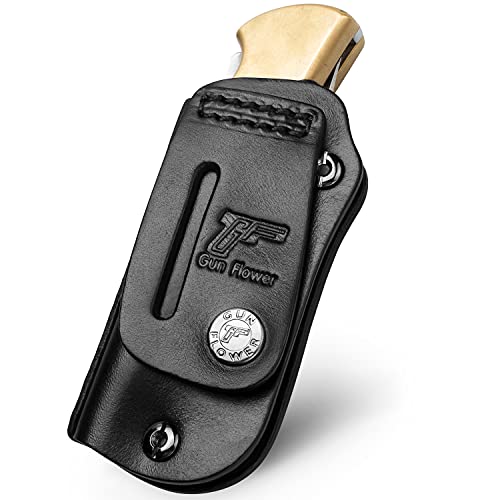
GUN & FLOWER Leather Sheath for Buck 110/112 — Best Secure Retention
This GUN & FLOWER sheath suits the 110 owner whose worry runs the other way from the quick-draw crowd: not speed, but the knife staying exactly where it was put. It is custom-molded in genuine leather specifically for the Buck 110 and 112, with adjustable retention you tune with the included hardware, and a belt fit that covers both 1.5-inch and 1.75-inch belts. The black finish and molded profile give it a more modern, technical look than the traditional pouches above — leather outside, engineered fit inside.
- Genuine leather, custom-molded for Buck 110 and 112
- Adjustable retention, tuned with included Allen key
- Fits 1.5-inch and 1.75-inch wide belts
- Black finish
- Maker: GUN & FLOWER
Strengths
- Molded fit plus adjustable retention is the securest carry here
- Two common belt widths covered without adapters
- Molded leather protects the knife’s bolsters and scales
Trade-offs
- Retention hardware needs occasional checking and re-tightening
- Molded fit is strictly for the 110/112 pattern
- Made in China, per the maker’s own listing answers
Molding is leather’s answer to the retention question: wet-formed and dried around the knife’s shape, the sheath grips the bolsters and handle contours so the knife seats with a positive hold that soft pouches cannot match. Making that grip adjustable is the thoughtful part — leather changes with seasons and wear, and a retention screw lets you restore the factory feel in seconds instead of re-wetting and re-molding. For motorcycle, ATV, and active outdoor carry of a heavy folder, this is the pattern that sleeps best.
The honest limitations are maintenance and scope. Hardware loosens; check the retention screw whenever you condition the leather, and keep the Allen key with your sharpening kit rather than in a junk drawer. Scope is the other limit: the mold is the 110/112’s shape and no other’s, so this is a single-knife commitment just like our top pick. Within that commitment, it is the most security-minded leather option in this guide, and a useful counterpoint for readers comparing against the hard-shell approach in best kydex knife sheath.
Best for: Active carry of a Buck 110/112 where retention is the priority / Not suited for: Anyone wanting one sheath for several different folders

ChapLithe Premium Leather Sheath, Medium — Best for Multitools
Not every blade that needs leather is a knife. The ChapLithe premium leather sheath suits the multitool carrier whose nylon pouch has frayed, stretched, or started dumping its contents — a common story — and who wants the tool carried in leather instead. The medium size is built for the Leatherman Wave and Wave Plus, FREE P2 and P4, and Skeletool family, which covers the most-carried full-size multitools in the world, including the lineups detailed in best leatherman multitools.
- Premium leather multitool sheath, medium size
- Sized for Leatherman Wave / Wave Plus
- Also fits Leatherman FREE P2 and P4
- Also fits Leatherman Skeletool models
- Belt-carry pouch format
Strengths
- Leather durability and quiet carry replace fraying nylon
- One size covers the most popular full-size Leatherman tools
- Belt pouch keeps a heavy tool riding close and stable
Trade-offs
- Sized for the listed tools — larger tools like the Surge need the next size up
- Leather needs break-in before the tool seats fully
- Single-source listing details; verify size against your tool before ordering
A multitool is the worst-shaped object most of us carry: dense, angular, and heavy for its size, which is precisely why cheap pouches fail under it and why leather suits it so well. A leather pouch molds around those angles over the first weeks, quieting the tool against the belt and spreading its weight over a stiffer backing than nylon provides. For the tradesperson or farmer whose Wave Plus is effectively a third hand, the upgrade in carry quality is felt every single day, and it pairs naturally with the care guidance in the how-to section below.
The honest limitation is sizing discipline. “Medium” is a family, not a guarantee: the listed fits are Wave-class tools, and owners of larger or smaller Leathermans must match their tool to the maker’s size chart rather than assuming. We also flag this pick transparently as the guide’s thinner-sourced listing — its fit list comes from the product’s own listing title — so measure your tool’s closed length and compare before you order, and keep the return window in mind. Sized right, it is the leather answer for the tool most readers actually carry.
Best for: Leatherman Wave, FREE, and Skeletool owners replacing a worn nylon pouch / Not suited for: Oversize multitools or buyers unwilling to check the size chart
KA-BAR Leather Sheath — Best for Large Fixed Blades
The KA-BAR leather sheath suits owners of the classic 7-inch KA-BAR fighting/utility knife — including the USMC pattern — whose original sheath has worn out, been lost, or never matched the knife’s working life. It is the traditional brown leather belt sheath pattern the knife has been carried in for generations: a deep pouch that swallows the blade, with the handle held by the sheath’s upper section, in the style that has ridden on packs and belts since the pattern’s wartime origins. For the fixed blades in best survival knives, this is the carry tradition they descend from.
- Leather belt sheath for KA-BAR 7-inch fighting/utility knives
- Fits the classic USMC-pattern KA-BAR
- Traditional deep-pouch leather pattern
- Brown leather
Strengths
- Correct traditional pattern for an iconic fixed blade
- Leather protects a carbon-steel edge quietly in the field
- Deep pouch carry keeps a large blade secure and covered
Trade-offs
- Weakest sourcing on this list — see the note below and the sources file
- Pattern-specific: fits the 7-inch KA-BAR profile, not generic fixed blades
- Leather and carbon steel demand dry storage habits
There is a transparency note this pick requires, and we would rather print it than bury it: this sheath’s Amazon identity rests on thinner third-party sourcing than the other five picks, which is why it sits last on the list despite the strength of the pattern itself. The sheath pattern is real and long-established — the KA-BAR’s leather sheath is one of the most recognized in the knife world — but buyers should confirm on the listing that the item is the sheath for the 7-inch KA-BAR pattern and check the seller’s details carefully before ordering, and the central verification pass on this guide will confirm or strip the link.
On the pattern’s merits, the case is simple. A 7-inch carbon-steel blade needs its edge covered, its point contained, and its carry quiet; a deep leather pouch does all three while protecting the blade from the dings that hard sheaths can inflict on an edge during a fall. Paired with dry storage — never leave a carbon blade sealed in leather in a damp truck box — it is the historically correct and practically sound home for the knife. Buyers who want a modern alternative for the same knife should cross-check the hard-sheath options, but traditionalists are served here.
Best for: Replacing the sheath on a classic 7-inch KA-BAR / Not suited for: Other fixed blades, or buyers who cannot verify listing details before ordering
Check on Amazon
Comparison Table
| Sheath | Fits | Leather | Retention style | Carry |
|---|---|---|---|---|
| American Bench Craft Riveted | Buck 110 | Full-grain, riveted | Fitted pouch | Belt |
| Carl Thomas Water Buffalo | Buck 110/112 | 10 oz water buffalo | Soft pouch, right-hand draw | Belt |
| Retrospec Quick-Draw | Buck 110 and similar 5-inch folders | Latigo, 7/8 oz | Open quick-draw | Belt |
| GUN & FLOWER Molded, Black | Buck 110/112 | Genuine leather, molded | Adjustable retention | Belt, 1.5–1.75 inch |
| ChapLithe Multitool Sheath | Leatherman Wave, FREE P2/P4, Skeletool | Premium leather | Pouch | Belt |
| KA-BAR Leather Sheath | KA-BAR 7-inch pattern | Leather, traditional | Deep pouch | Belt |
Leather Sheath Styles, Explained
The pouch sheath is the pattern most people picture: a folded piece of leather, stitched or riveted up one side, with a belt loop at the back and the knife sliding in from the top. For folders it is a closed pocket that swallows the whole knife; for fixed blades it covers the blade and grips the handle’s base. Pouches are simple, protective, and quiet, and their retention comes from fit. Two of this guide’s picks — the American Bench Craft and the Carl Thomas — are pouches, differing in leather character rather than concept, which is typical: within a pattern, material and execution are where quality lives.
The molded sheath starts as a pouch and then gets wet-formed around the actual knife, so the leather dries holding the knife’s contours — bolster curves, handle swells, guard lines. The result is a sheath that clicks the knife home and resists shaking loose, the leather equivalent of a fitted holster. The GUN & FLOWER pick represents the style, with the modern addition of adjustable hardware. Molded sheaths are the right answer when a maker’s generic pouch feels too vague for an active life, and the wrong answer for a knife the maker has never molded — the shape is the whole point, so a mold for another model is not “close enough.”
The open and quick-draw styles sacrifice coverage for access. A quick-draw sheath grips the folder low and leaves its end exposed, so the draw is a grab rather than a procedure. Pancake sheaths, which sandwich the knife between two flat panels with belt slots at both edges, spread the knife flat against the hip and suit fixed blades carried cross-draw. These styles belong to working carry, where the knife comes out constantly and the carrier is upright and in control of their environment. They are poor choices anywhere gravity or brush can argue with the knife’s seating.
The multitool pouch deserves its own mention because its engineering problem is different: not an edge to protect, but a dense, angular tool to silence and stabilize. Leather’s stiffness is an asset here — a leather pouch holds its mouth open for re-holstering one-handed, where tired nylon collapses — and its moldability turns a rattling tool into a quiet one over the first month. Anyone whose workday includes a full-size multitool should read the ChapLithe review above with that in mind, and should think of the pouch as part of the tool, in the same way a knife’s sheath is part of the knife system rather than an accessory to it.
How to Choose a Leather Knife Sheath
Fit first, everything else second. Measure your knife closed (for folders) or by blade length, width, and thickness (for fixed blades), then buy the sheath made for that knife, not the one whose size range includes it. A folder sheath must grip the handle without the blade’s edge touching stitching; a fixed-blade sheath must swallow the guard fully and hold the handle’s base snugly. If a listing cannot name your knife, it is a guess wearing a product photo. The dedicated-fit bias of this whole guide exists because returns data and owner forums tell the same story: universal sheaths are the ones that disappoint.
Learn leather grades and weights. Full-grain is the top of the hide with its tight surface intact — the strongest, most water-resistant, best-aging option, and what our top pick uses. Top-grain is lightly corrected and still good. Split and “genuine leather” labels can hide thin, weak material; “genuine leather” on the GUN & FLOWER pick is backed by a molded construction, but as a label alone it guarantees little. Weight is given in ounces per square foot: 7–8 oz is a working sheath weight, 9–10 oz is heavy-duty, and anything much lighter belongs on a wallet. Match weight to knife: a heavy folder like the 110 deserves 8 oz and up.
Choose retention for your activity, honestly. A fitted pouch is enough for walking, working, and camp life. Molded or strapped retention earns its keep on horseback, on machines, in vehicles, and anywhere you bend, crawl, or hang upside down professionally. Open quick-draw patterns trade retention for speed and suit controlled working environments. The mistake is buying the romantic option for the wrong life: the quick-draw on a trail horse, the flapped pouch for a roofer. Your Tuesdays should choose your sheath, not your fantasies.
Plan for your climate and your draw side. Leather in a perpetually wet climate needs more conditioning discipline and benefits from a rotation — two sheaths alternating rest days outlast one sheath worn sodden daily. Hunters in swamp country and deckhands may honestly be better served by a hard sheath for the wet season and leather for the rest of the year. Draw side matters too: most production sheaths are right-hand, strong-side patterns, and left-handed carriers and cross-draw fans should confirm the pattern before ordering rather than discovering it at the mailbox — the Carl Thomas pick on this list, for example, is explicitly a right-hand draw, and its maker says so, which is exactly the clarity to look for.
Check the belt interface. Loop size must match your belt width — the molded pick here covers 1.5 and 1.75 inches, the two common work-belt widths — and the loop should be stitched or riveted as a structural part of the sheath, not an afterthought tab. Dangler and drop-loop styles suit packs with hip belts; high-ride loops suit drivers who sit all day. If you wear a pack with a padded hip belt, test whether the sheath can move to the pack itself before blaming the sheath for a sore hip.
Plan for the edge inside. A sheath’s welt — the leather spacer between front and back panels — is what the edge should meet, never the stitching. Quality sheaths have a welt thick enough to keep the edge centered; cheap ones let the blade saw through their own seams over a season of draws. When a sheath arrives, draw the knife slowly and watch whether the edge tracks the welt. It is a ten-second test that predicts the sheath’s lifespan, and it applies equally to the kitchen storage covered in best knife sheaths for kitchen knives.
Key Takeaways
- Fit is the product: buy the sheath made for your exact knife.
- Full-grain leather in the 8–10 oz range is the durable sweet spot.
- Retention should match your activity, not your imagination.
- Leather needs dry storage and occasional conditioning — a fair trade for decades of service.
- Check that the edge tracks the welt, not the stitching, on first draw.
One last framing note before the detail sections: a sheath is not an accessory you buy after the knife decision — it is half of the carry system, and experienced carriers budget for it the way they budget for the knife itself. A great knife in a poor sheath gets left at home; a good knife in a great sheath gets carried for years. Everything below is written to help you land in the second group.
How to Break In and Care for a Leather Sheath
- Test the fit dry. Insert the clean, dry knife slowly. A new molded or full-grain sheath should grip firmly; the draw should need intent, not force.
- Carry it daily for two weeks. Body heat, belt flex, and repeated draws relax the leather into its working fit faster than any shortcut.
- Never soak a sheath to “shrink” it. Uncontrolled wetting warps leather and invites mold. If a sheath is genuinely loose, a maker can re-mold it properly; a bucket cannot.
- Condition sparingly. A light coat of leather conditioner, worked in and buffed off, a few times a year keeps fibers fed. Over-conditioning softens a molded sheath’s grip — the one place stiffness is a feature.
- Dry slowly after a soaking. Room temperature, away from heaters and direct sun, stuffed loosely with paper. Heat-dried leather cracks.
- Store the knife out of the sheath. For long-term storage, leather traps moisture against steel — especially carbon steel. Oil the blade lightly and store knife and sheath side by side, not together.
Troubleshooting, in the usual pattern: Problem: the knife rattles in a pouch sheath → the fit has relaxed past its design; a maker can add a stitch line or re-mold, and a temporary folded leather shim inside the mouth restores grip. Problem: the draw suddenly gets much harder in summer → humidity has swollen the leather; dry the sheath slowly and carry on. Problem: dark stains where the blade sits → moisture and steel salts are migrating; clean the blade, dry the sheath fully, and store them apart. Problem: the belt loop stretches → the loop was the thinnest leather on the sheath; a cobbler can reinforce it, and it is the detail to inspect first on your next purchase. Problem: mold spots after a wet trip → brush off outdoors, wipe with a cloth barely dampened with diluted vinegar, dry slowly, then condition.
Common Buying Mistakes
Buying by blade length alone. Two knives with the same blade length differ in width, thickness, guard shape, and handle bulk. Length-only sizing is how a sheath ends up too tight to draw or loose enough to lose the knife. Buy by model name whenever a maker offers it.
Chasing the cheapest “genuine leather.” The label can legally describe thin split leather that cracks at the fold within a season. Grade and weight — full-grain, stated ounces — are the numbers that predict a sheath’s life.
Storing a carbon blade in leather long-term. Leather holds moisture; carbon steel rusts. The pairing is perfect for carry and wrong for storage, and confusing the two has pitted more good blades than any river crossing.
Ignoring belt width. A sheath loop cut for a dress belt wanders on a work belt, and a wide loop forced onto a narrow belt chews both. Measure your belt before the sheath, not after.
Expecting one sheath to serve a collection. Molded and fitted sheaths are single-knife tools. A universal sheath for the drawer of beaters is fine; a universal sheath for the knife you carry daily is a compromise you will feel daily.
Final Recommendation
For the classic case — a Buck 110 that deserves a real home — the American Bench Craft Riveted Leather Sheath is our top pick: full-grain leather, riveted construction, handmade in the USA, and molded for exactly that knife. The runner-up is the Carl Thomas Water Buffalo Leather Sheath, which we would choose for its softer traditional carry and its fit across both the 110 and 112. Multitool carriers and KA-BAR owners are served by their dedicated picks above; everyone else should start from the fit rule and buy the sheath that names their knife.
Frequently Asked Questions
How do I know what size leather sheath my knife needs?
Start with the knife’s identity, not its dimensions: search for a sheath that names your exact model, as most picks in this guide name theirs. If none exists, measure a folder by its closed length and handle thickness, and a fixed blade by blade length, blade width, and guard width, then match those to a maker’s size chart. When between sizes for a pouch sheath, choose the snugger fit — leather relaxes with carry.
Is leather or Kydex better for a knife sheath?
Leather is quieter, kinder to blades and finishes, more comfortable against the body, and molds to the knife; Kydex is waterproof, needs no conditioning, and offers a mechanical click of retention. Outdoors in constant wet, Kydex has the edge; for everyday belt carry, hunting tradition, and classic folders, leather remains the better-feeling and better-looking choice. Many serious carriers own both for different seasons.
How long does a leather knife sheath last?
A full-grain sheath in the 8–10 oz range, kept dry and conditioned a few times a year, commonly lasts decades — often longer than the stitching on the boots carrying it. Thin split-leather sheaths may crack within a season or two. Lifespan is decided mostly at purchase, by grade and weight, and secondarily by whether the knife is stored in it long-term, which it should not be.
Can I carry a fixed blade in a leather sheath on a pack?
Yes, with attention to retention and access. A deep pouch sheath with a snug handle fit rides well lashed to a pack or on a hip belt, but test the draw with the pack on, and avoid positions where a fall could drive the knife upward out of a loose sheath. For very active scrambling, a molded or strapped retention style is the safer leather choice.
Why does my new leather sheath feel too tight?
Because it is new. Quality sheath leather is cut and molded to grip, and it relaxes measurably over the first weeks of carry as the fibers take the knife’s shape. Draw and re-sheath the knife a few dozen times over the first days and carry it daily; if the draw still requires two hands after two weeks, contact the maker — that is a sizing issue, not a break-in issue.
Does a leather sheath dull a knife?
A correctly made sheath does not: the blade’s edge rides against the smooth welt, not across abrasive surfaces, and leather is far softer than steel. Dulling happens in sheaths where the edge saws against stitching or a missing welt — a construction flaw — or when grit gets inside the sheath and is dragged along the edge on every draw. Keep the inside of the sheath clean and the edge stays honest.
Are leather sheaths legal and practical for everyday carry?
Practicality is covered throughout this guide; legality depends entirely on your jurisdiction’s knife laws, which govern the knife and its carry style — blade length, concealed versus open carry, and fixed-blade rules vary widely by state and country. A belt sheath is generally considered open carry, but that is a legal characterization you should verify locally rather than take from a buying guide. Check your local rules before carrying any fixed blade in public.
How do I stop a leather sheath from squeaking on my belt?
Squeak is leather rubbing leather or hardware, and it usually fades as the loop breaks in. A tiny amount of conditioner worked into the belt loop’s contact surfaces speeds the process. Persistent squeak after break-in often means the loop is slightly loose and shifting; a closer-fitting belt or a loop sized to your belt solves it mechanically.